
South Korea Entertainment Content and Goods Market (2025-2030)

The South Korea Entertainment Content and Goods Market was valued at $5100.1 Million in 2025 and projected to reach to $6650.2 Million by 2030, representing a compound annual growth rate of 5.5%. South Korea's Entertainment Content and Goods Market is poised for sustained growth through 2030, driven by the global expansion of Korean cultural content and increasing consumer demand for merchandise tied to popular franchises.


| Market Size in | USD 26.32 MN |
| Market Forecast in | |
| CAGR | |
| Forecast Period | |
| Units Considered | Value (USD MN) |
South Korea Entertainment Content and Goods Market Trends and Insights
- South Korea's strong digital infrastructure, high internet penetration, and thriving content creation ecosystem position the country as a regional leader in entertainment goods and digital content distribution.
- The market in South Korea benefits from robust consumer demand for K-pop merchandise, gaming peripherals, streaming services, and collectibles, driven by the nation's influential entertainment industry and tech-savvy population. During the forecast period from 2025 to 2030, South Korea is expected to maintain steady growth momentum as digital transformation accelerates across entertainment platforms.
- South Korea's competitive advantage lies in its ability to produce globally recognized content and hardware that resonates with both domestic and international audiences.
- The expansion of e-commerce channels, rising disposable incomes, and increasing investment in entertainment technology infrastructure will further support market expansion in South Korea throughout this period..
Key Market Statistics
- CAGR (2025-2030) 5.5% CAGR
- Market Size, 2025 ~USD 5100.1 Million
- Forecast, 2030 ~USD 6650.2 Million
- Country South Korea
South Korea Entertainment Content and Goods Market Overview
Market Valuation :
South Korea's Entertainment Content and Goods Market is valued at USD 5,100.1 million in 2025, with strong growth trajectory driven by digital transformation and content consumption trends.
Digital Infrastructure Leadership :
South Korea boasts world-class digital infrastructure and the highest internet penetration rates globally, creating an ideal ecosystem for entertainment content distribution and e-commerce of entertainment goods.
Content Creation Hub :
The country has established itself as a regional powerhouse in content creation, with K-pop, K-dramas, and webtoons gaining massive international audiences, driving merchandise and goods demand.
Growth Momentum :
With a CAGR of 5.5% through 2030, reaching USD 6,650.2 million, South Korea's market is outpacing many developed nations, reflecting strong consumer spending on digital and physical entertainment products.
South Korea Entertainment Content and Goods Market Dynamics
- The country's advanced digital payment infrastructure and high smartphone penetration enable seamless e-commerce transactions, while the thriving creator economy continues to generate new revenue streams.
- Investment in virtual entertainment experiences and metaverse-based goods is expected to accelerate market expansion. The market will benefit from South Korea's strategic positioning as a content exporter, with K-pop idols, streaming platforms, and gaming companies driving international merchandise sales.
- Domestic consumption remains robust due to high disposable incomes and strong fan culture.
- However, competition from global entertainment giants and market saturation in certain segments may moderate growth rates.
- Strategic partnerships between content creators and goods manufacturers will be critical for capturing emerging opportunities in the 5.5% CAGR growth period..
Market Ecosystem
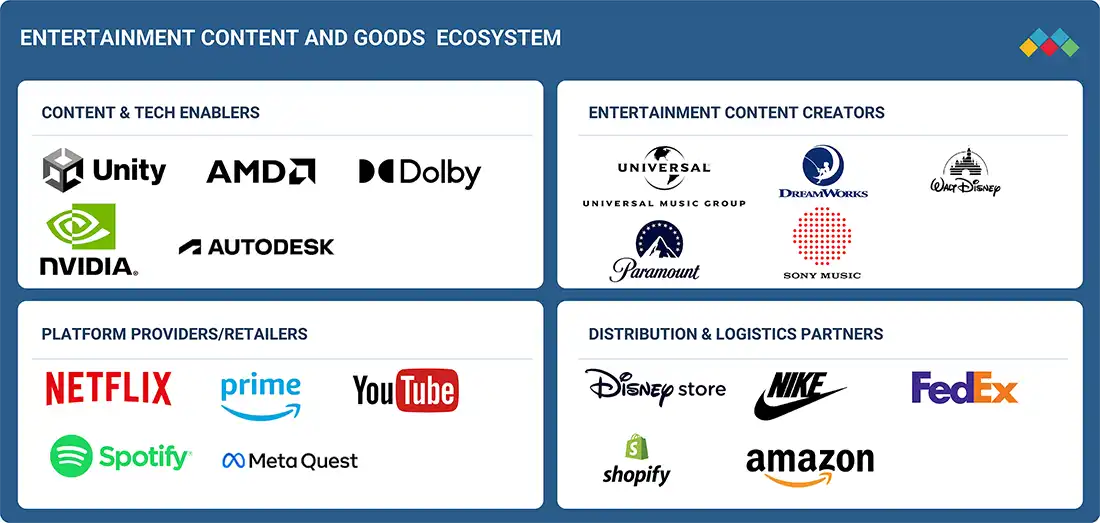
Entertainment Content and Goods Market: COMMERCIAL USE CASES ACROSS INDUSTRIES
| COMPANY | USE CASE DESCRIPTION | BENEFITS |
|---|---|---|
 |
Immersive AR/VR experiences for animated content with synchronized merchandise launches across theme parks, streaming platforms, and retail channels | Cross-platform brand loyalty, seamless content-to-commerce conversion, and enhanced fan lifetime value with 40-50% increase in merchandise sales |
 |
AI-powered artist merchandise personalization with blockchain-based NFT collectibles and direct fan-to-artist monetization through streaming integration | 25-35% revenue increase for artists, reduced intermediary costs, and authentic fan engagement through digital ownership and exclusive content access |
 |
Smart licensing platforms integrating music content with gaming studios, sporting events, and lifestyle brands for cross-industry merchandise collaboration | Enhanced licensing revenue streams, global brand partnerships, and optimized royalty distribution with 30-40% operational cost savings |
 |
D2C monetization platforms with generative content tools for personalized fan experiences and automated merchandise recommendations | Improved artist-fan relationships, streamlined revenue collection, and data-driven product development leading to 20-30% increase in direct sales |
 |
AI-driven animated content production with automated licensing for show-based merchandise and personalized memorabilia through viewer data analytics | Accelerated content-to-market delivery, optimized licensing revenue, and enhanced consumer personalization driving 35-45% merchandise conversion rates |
Logos and trademarks shown above are the property of their respective owners. Their use here is for informational and illustrative purposes only.
Related Ecosystem
Information System And Analytics
- Machine Learning
- Natural Language Processing (NLP)
- Sensors
- Software as A Service (SaaS)
- Data Loss Prevention (DLP)
- International Business Machines Corporation
- MICROSOFT CORPORATION
- Amazon.com, Inc.
- Oracle Corporation
Key Takeaways
- South Korea's entertainment content and goods market will grow from USD 5.1B in 2025 to USD 6.7B in 2030 at a 5.5% CAGR.
- South Korea's digital-first consumer base and K-pop/gaming dominance drive sustained demand for entertainment merchandise and digital content.
- South Korea's advanced e-commerce infrastructure and streaming platform ecosystem create competitive advantages in content distribution and goods sales.
- South Korea's market growth is supported by rising disposable incomes, youth demographics, and expanding international content exports.
Entertainment Content and Goods Market Report Scope
| Report Metric | Details |
|---|---|
| Base Year | 2025 |
| Fastest Growing Segment | LIFESTYLE, FAN GEAR, AND MEMORABILIA (Product Type) |
| Forecast Period | 2025-2030 |
| Growth Rate | CAGR of 6.2% from 2025 to 2030 |
| Largest Segment | LICENSED SPORTSWEAR (Product Type) |
| Market Size Base Year (Billions) | ~USD 177.3 (2025) |
| Revenue Forecast (Billions) | ~USD 239.52 (2030) |
| Segments Covered | Product Type, Content Type, Type |
South Korea Entertainment Content and Goods Market Report Segmentation
3 segment dimensions are covered across the global market.
By Product Type
- Accessories
- Apparel
- Athletic And Fan Accessories
- Licensed Sportswear
- Lifestyle And Home Goods
- Lifestyle, Fan Gear, And Memorabilia
- Music Equipment And Memorabilia
- Sporting Equipment
By Content Type
- Films
- Tv/Ott
By Type
- Animated Content Creation
- Licensed Goods
- Music Artist Goods
Target Audience
- Entertainment & Media Companies : Content creators, streaming platforms, and production studios need South Korea market data to understand licensing opportunities, merchandise potential, and consumer demand for Korean entertainment exports.
- E-commerce & Retail Operators : Online retailers and physical store operators require insights into South Korea's entertainment goods market to optimize inventory, identify trending merchandise categories, and capitalize on K-content merchandise demand.
- Investment & Private Equity Firms : Investors evaluating opportunities in South Korea's entertainment sector need market sizing, growth projections, and competitive analysis to assess portfolio companies and identify acquisition targets.
- Brand & Merchandise Manufacturers : Companies producing entertainment-related goods and licensed merchandise need South Korea market intelligence to understand consumer preferences, pricing strategies, and distribution channels in this affluent market.
- Market Research & Consulting Professionals : Analysts and consultants require detailed South Korea market data to support client recommendations, competitive benchmarking, and strategic planning in the entertainment content and goods sector.
Reasons to Buy this Report
- Market Size & Growth Data : Access precise valuation figures for South Korea's market (USD 5,100.1M in 2025) with detailed CAGR projections through 2030, enabling accurate financial forecasting and investment planning specific to this high-growth region.
- Competitive Landscape Intelligence : Understand South Korea's unique position as a regional content leader with insights into K-pop, K-drama, and webtoon merchandise ecosystems, helping identify competitive advantages and market entry strategies.
- Consumer Behavior Insights : Gain deep understanding of South Korean consumer preferences for entertainment goods, digital content consumption patterns, and fan culture dynamics that drive purchasing decisions in this affluent market.
- Strategic Investment Guidance : Make informed decisions about market entry, expansion, or partnership opportunities in South Korea with comprehensive data on growth drivers, digital infrastructure advantages, and emerging entertainment segments.
- Regional Expansion Blueprint : Leverage South Korea's market insights as a model for understanding broader Asian entertainment trends, with actionable intelligence for scaling operations across the region's fastest-growing digital markets.
Frequently asked questions
What is the current market size of entertainment content and goods in South Korea?
South Korea's entertainment content and goods market is valued at USD 5,100.1 million in 2025.
What is the projected market size for South Korea by 2030?
South Korea's entertainment content and goods market is projected to reach USD 6,650.2 million by 2030.
What is the CAGR for South Korea's entertainment market?
South Korea's entertainment content and goods market is expected to grow at a CAGR of 5.5% from 2025 to 2030.
What drives growth in South Korea's entertainment market?
Growth in South Korea is driven by K-pop merchandise demand, gaming peripherals, streaming services, e-commerce expansion, and rising disposable incomes among tech-savvy consumers.
How does South Korea compare to other Asia Pacific markets?
South Korea maintains a strong position in the Asia Pacific region due to its advanced digital infrastructure, influential content creation industry, and high consumer spending on entertainment goods and digital content.
RESEARCH METHODOLOGY
The research study involved four major activities in estimating the size of the entertainment content and goods market. Exhaustive secondary research has been done to collect key information about the market and peer markets. The next step has been to validate these findings and assumptions and size them with the help of primary research with industry experts across the value chain. Both top-down and bottom-up approaches have been used to estimate the market size. The market breakdown and data triangulation have been adopted to estimate the market sizes of segments and sub-segments.
Secondary Research
In the secondary research process, various secondary sources were referred to identify and collect the information required for this study. The secondary sources include annual reports, press releases, investor presentations of companies, white papers, and articles from recognized authors. Secondary research has been mainly done to obtain key information about the market’s value chain, the pool of key market players, market segmentation according to industry trends, regional outlook, and developments from market and technology-oriented perspectives.
The entertainment content and goods market report estimates the global market size using top-down and bottom-up approaches and several other dependent submarkets. The major players in the market were identified using extensive secondary research, and their presence in the market was determined using secondary and primary research. All the percentage shares, splits, and breakdowns have been determined using secondary sources and verified through primary sources.
Primary Research
Extensive primary research has been conducted after understanding the entertainment content and goods market scenario through secondary research. Several primary interviews have been conducted with key opinion leaders from demand- and supply-side vendors across four major regions—North America, Europe, Asia Pacific, and the Rest of the World (RoW). Approximately 25% of the primary interviews have been conducted with the demand-side vendors and 75% with the supply-side vendors. Primary data was collected mainly through telephonic interviews, which comprised 80% of the total primary interviews. Questionnaires and emails have also been used to collect data.
After successful interaction with industry experts, brief sessions were conducted with highly experienced independent consultants to reinforce the findings of our primary research. This, along with the in-house subject matter experts’ opinions, has led us to the findings as described in the report.
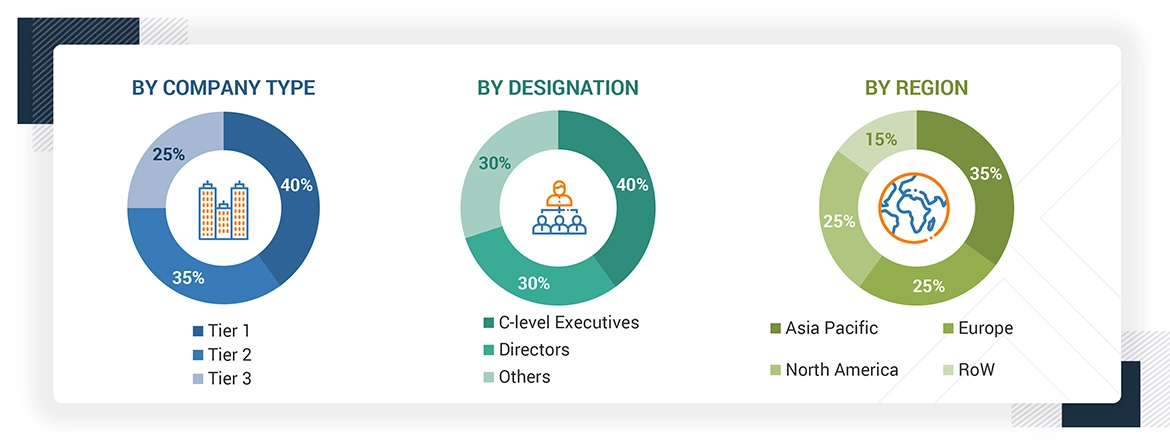
Note: Others include sales, marketing, and product managers.
To know about the assumptions considered for the study, download the pdf brochure
Market Size Estimation
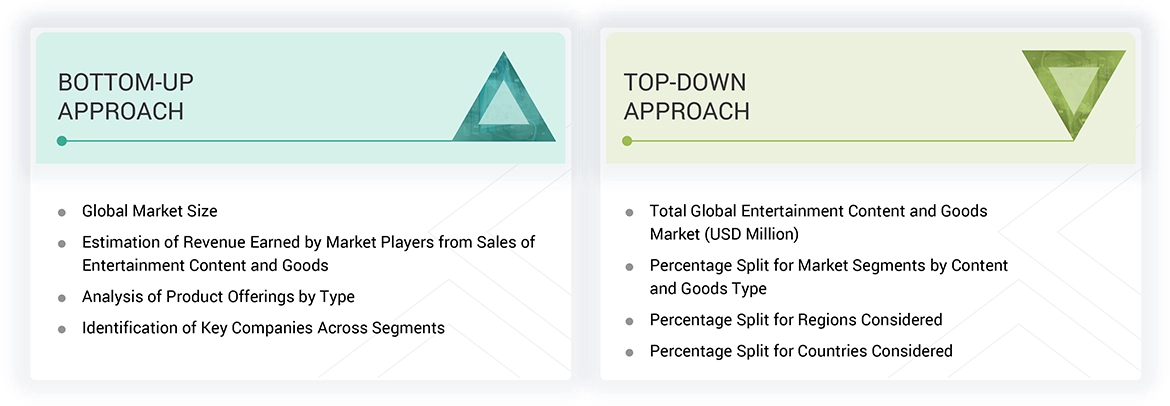
In the market engineering process, top-down and bottom-up approaches and data triangulation methods have been used to estimate and validate the size of the entertainment content and goods market and other dependent submarkets. The research methodology used to estimate the market sizes includes the following:
- Estimating the market size of each key segment within the entertainment content and goods market, namely:
- Music artist goods (merchandise, collectibles, concert-linked items)
- Licensed goods (sporting equipment – licensed) (officially branded merchandise linked to major sports leagues and athletes)
- Animated content creation (film/OTT) (production and distribution of animated content via streaming platforms, cinema releases, and merchandise)
- Breaking down each segment by region—North America, Europe, Asia Pacific, and RoW—followed by detailed country-level estimation based on demand trends, consumption patterns, content popularity, and merchandise penetration rates
- Analyzing region- and country-level consumer behavior, fanbase size, IP monetization strategies, and cultural consumption preferences to derive segment-specific country revenues
- Aggregating the revenues of all segments at the country level to derive total market size by country, followed by aggregation of country-level data to estimate regional market sizes, and finally summing regional values to determine the global market size
- Validating segment-wise assumptions by triangulating with content consumption metrics, digital platform usage, IP franchise growth, and merchandising expansions from public sources, annual reports, streaming trends, and media publications, and finally aligning insights with the domain experts at MarketsandMarkets to ensure robustness and precision in market projections
Entertainment Content and Goods Market : Top-Down and Bottom-Up Approach
Data Triangulation
After arriving at the overall market size by the market size estimation process explained in the earlier section, the entertainment content and goods market has been divided into several segments and subsegments. The data triangulation and market breakdown procedures have been used to complete the overall market engineering process and arrive at the exact statistics for all segments, wherever applicable. The data has been triangulated by studying various factors and trends from both the demand and supply perspectives. Along with data triangulation and market breakdown, the market has been validated through the top-down and bottom-up approaches.
Market Definition
The Entertainment Content and Goods encompasses creating, commercializing, and consuming digital media content and associated branded merchandise derived from intellectual property (IP), artist influence, or licensed franchises. This market captures the intersection of cultural expression, consumer fandom, and monetization strategies across music, sports, animation, and other entertainment domains.
At its core, the market comprises two primary pillars: content creation and goods commercialization. Content creation includes digital formats such as films, TV/OTT series, and animated productions in 2D, 3D, stop-motion, and mixed media styles. These are increasingly delivered through global streaming platforms, forming the narrative foundation for merchandise, fandom, and brand engagement.
Complementing the content layer is a vast and diverse merchandise segment that includes music artist goods, such as printed apparel, accessories, lifestyle items, signed memorabilia, and branded instruments. Similarly, licensed goods related to sports teams, celebrities, esports, and entertainment franchises drive global demand for apparel, collectibles, sporting equipment, and lifestyle accessories. These goods are distributed through online artist stores, tour/event merchandising, e-commerce platforms, and retail partnerships.
The market is driven by rising consumer affinity for pop culture, the growing influence of artist-led branding, and the expanding global reach of content IPs. Fan-based consumption behavior and digital platforms enabling global access to content and merchandise continue to reshape how entertainment is monetized. As such, the market represents a dynamic convergence of media, commerce, and consumer identity.
Key Stakeholders
- IP Creators and Rights Holders
- Branded Merchandise Manufacturers and OEMs
- Licensing and Brand Collaboration Agencies
- Direct-to-Fan and E-commerce Platforms
- Retail Chains, Fashion Collaborators, and Pop-up Stores
- Streaming Platforms and Digital Content Distributors
- Digital Rights Management (DRM) and IP Protection Firms
- Fan Engagement, Loyalty, and Community Management Platforms
- Influencer Marketing and Talent Management Agencies
- Advertising, Branding, and Promotional Service Providers
- Regulatory Authorities and IP Protection Agencies
- Industry Associations and Entertainment Trade Forums
- Research Institutes and Academic Bodies
- Content Consumers, Fans, and Patronage Communities
Report Objectives
- To describe, segment, and forecast the size of the entertainment content and goods market, by music artist goods type, licensed goods type, and animated content creation, in terms of value
- To forecast the size of various segments for four regions: North America, Asia Pacific, Europe, and the Rest of the World (RoW), in terms of value
- To offer detailed information on drivers, restraints, opportunities, and challenges influencing market growth
- To provide a detailed overview of the entertainment content and goods market value chain analysis, pricing analysis, ecosystem analysis, technology analysis, case study analysis, trends/disruptions impacting customer business, and key conferences and events
- To strategically analyze the micromarkets concerning individual growth trends, prospects, and contributions to the overall market
- To analyze opportunities for various stakeholders by identifying the high-growth segments of the market
- To benchmark the key players and analyze their market position in terms of revenue, market share, and core competencies, and a detailed competitive landscape for the market leaders
- To analyze competitive developments, such as product/services launches, expansions, acquisitions, partnerships, collaborations, and agreements, carried out by players in the entertainment content and goods market
Customization Options:
With the given market data, MarketsandMarkets offers customizations according to the specific requirements of companies. The following customization options are available for the report:
Country-wise Information:
- Country-wise breakdown for North America, Europe, Asia Pacific, and Rest of the World
Get the Full Entertainment Content and Goods Market Report
Full forecast, segment splits, and company analysis for all Entertainment Content and Goods Market.
- US Entertainment Content and Goods Market
- Canada Entertainment Content and Goods Market
- Mexico Entertainment Content and Goods Market
- Germany Entertainment Content and Goods Market
- UK Entertainment Content and Goods Market
- France Entertainment Content and Goods Market
- Italy Entertainment Content and Goods Market
- China Entertainment Content and Goods Market
- Japan Entertainment Content and Goods Market
- India Entertainment Content and Goods Market
- Rest Of Europe Entertainment Content and Goods Market
- Rest Of Asia Pacific Entertainment Content and Goods Market
Need a Tailored Report?
Customize this report to your needs
Get 10% FREE Customization
Customize This Report
