
South Korea Environment, Health, and Safety Market (2024-2029)

The South Korea Environment, Health, and Safety Market was valued at $140.7 Million in 2024 and projected to reach to $221.4 Million by 2029, representing a compound annual growth rate of 9.5%. South Korea's Environment, Health, and Safety market is positioned for sustained growth through 2029, driven by the nation's commitment to industrial safety excellence and environmental stewardship.


| Market Size in | USD 26.32 MN |
| Market Forecast in | |
| CAGR | |
| Forecast Period | |
| Units Considered | Value (USD MN) |
South Korea Environment, Health, and Safety Market Trends and Insights
- This 9.5% compound annual growth rate reflects South Korea's increasing regulatory compliance requirements and corporate emphasis on workplace safety standards.
- South Korea's advanced manufacturing sector and stringent government environmental policies are driving demand for integrated EHS solutions across industrial and service sectors. The South Korea EHS market is benefiting from digital transformation initiatives and heightened awareness of occupational health risks.
- South Korea's investment in smart factory technologies and Industry 4.0 adoption is creating opportunities for cloud-based EHS management platforms.
- South Korea's competitive business environment and export-oriented economy necessitate robust safety and environmental management systems to meet international standards and customer expectations..
Key Market Statistics
- CAGR (2024-2029) 9.5% CAGR
- Market Size, 2024 ~USD 140.7 Million
- Forecast, 2029 ~USD 221.4 Million
- Country South Korea
South Korea Environment, Health, and Safety Market Overview
Strong CAGR Outpacing Global Average :
South Korea's EHS market is growing at 9.5% CAGR (2024-2029), significantly exceeding the global rate of 7.6%, driven by stricter regulatory frameworks and corporate accountability measures.
Manufacturing Sector Compliance Pressure :
South Korea's advanced manufacturing industry faces increasing pressure to adopt comprehensive EHS solutions, with government mandates requiring enhanced workplace safety protocols and environmental monitoring systems.
Rapid Market Expansion :
The market is projected to grow from $140.7 million in 2024 to $221.4 million by 2029, representing a 57.4% increase in total market value over five years.
Regulatory Compliance Drivers :
South Korea's stringent government environmental regulations and labor safety standards are primary catalysts for EHS software and service adoption across industrial and corporate sectors.
South Korea Environment, Health, and Safety Market Dynamics
- The country's advanced manufacturing base, including semiconductor and automotive sectors, necessitates sophisticated EHS management solutions to meet both domestic regulatory requirements and international standards.
- Corporate investment in digital transformation is accelerating adoption of cloud-based EHS platforms and real-time monitoring systems. Government initiatives promoting workplace safety culture and environmental compliance will continue to fuel market expansion.
- South Korea's emphasis on sustainable business practices and worker protection creates a favorable environment for EHS solution providers.
- The convergence of regulatory pressure, technological advancement, and corporate responsibility initiatives positions the market for consistent double-digit growth through 2029..
Market Ecosystem
Related Ecosystem
Software And Services
- Natural Language Processing (NLP)
- Machine Learning
- Supply Chain Management
- Predictive Analytics
- Image Sensors
- International Business Machines Corporation
- MICROSOFT CORPORATION
- Oracle Corporation
- SAP SE
- Amazon.com, Inc.
Key Takeaways
- South Korea's EHS market will grow from $140.7M (2024) to $221.4M (2029), representing a 9.5% CAGR.
- South Korea's manufacturing-heavy economy and regulatory environment are primary drivers of EHS solution adoption.
- Digital transformation and Industry 4.0 initiatives in South Korea are accelerating demand for integrated EHS platforms.
- South Korea's export-focused industries require compliance with international safety and environmental standards, boosting market expansion.
Environment, Health, and Safety Market Report Scope
| Report Metric | Details |
|---|---|
| Base Year | 2024 |
| Fastest Growing Segment | MANAGED SERVICES (Service) |
| Forecast Period | 2024-2029 |
| Growth Rate | CAGR of 7.6% from 2024 to 2029 |
| Largest Segment | SOLUTIONS (Component) |
| Market Size Base Year (Billions) | ~USD 7.97 (2024) |
| Revenue Forecast (Billions) | ~USD 11.5 (2029) |
| Segments Covered | Offering, Type, Vertical, Service, Technology, Component, Deployment Mode, Organization Size |
South Korea Environment, Health, and Safety Market Report Segmentation
8 segment dimensions are covered across the global market.
By Offering
- Services
- Software
- Solutions
By Type
- Analytics Services
- Audit, Assessment, And Regulatory Compliance Services
- Business Consulting & Advisory Services
- Certification Services
- Project Deployment & Implementation Services
- Training & Support Services
By Vertical
- Agriculture
- Automotive & Transportation
- Bfsi
- Chemicals & Materials
- Construction & Engineering
- Energy & Utilities
- Financial Services
- Food & Beverage
- Government
- Government & Defense
- Healthcare
- Healthcare & Life Sciences
- It & Telecom
- Manufacturing
- Other Vertical
- Other Verticals
- Residential & Commercial Buildings
- Retail & Consumer Goods
- Transportation & Logistics
By Service
- Analytics Services
- Audit, Assessment & Regulatory Compliance Services
- Audit, Assessment, & Regulatory Compliance Services
- Audit, Assessment, And Regulatory Compliance Services
- Business Consulting & Advisory Services
- Certification Services
- Consulting
- Integration And Deployment
- Managed Services
- Professional Services
- Project Deployment & Implementation Services
- Support And Maintenance
- Training & Support Services
By Technology
- AI & ML
- Blockchain
- Cloud Computing
- Cybersecurity
- Digital Twin
- Edge Computing
- IoT
By Component
- Services
- Solutions
By Deployment Mode
- Cloud
- On-Premises
By Organization Size
- Corporates/Enterprises
- Mid-Tier Enterprises
- Small Businesses
Target Audience
- EHS Software & Service Providers : Solution vendors need South Korea-specific market data to develop localized offerings, understand competitive landscape, and identify growth opportunities in this high-CAGR market.
- Manufacturing & Industrial Companies : South Korean manufacturers require market intelligence to benchmark EHS spending, evaluate solution providers, and align compliance investments with industry standards and regulatory expectations.
- Corporate Strategy & Investment Teams : C-suite executives and investors need validated market forecasts to assess South Korea's EHS sector attractiveness, guide M&A decisions, and allocate capital to high-growth opportunities.
- Regulatory & Compliance Officers : Compliance professionals in South Korea need market insights to understand emerging regulatory trends, benchmark organizational EHS maturity, and justify budget allocations for safety initiatives.
- Consulting & Systems Integration Firms : Consultants require South Korea market data to advise clients on EHS technology adoption, identify implementation trends, and develop service offerings aligned with regional market demands.
Reasons to Buy this Report
- Market Size & Growth Validation : Quantified market data for South Korea with precise valuations ($140.7M in 2024) and 5-year forecasts enables accurate investment planning and revenue projections specific to this high-growth market.
- Competitive Positioning Intelligence : Understand South Korea's 9.5% CAGR advantage over global 7.6% growth to identify market opportunities and competitive advantages in this outperforming regional market.
- Regulatory & Compliance Insights : Detailed analysis of South Korea's stringent government requirements and manufacturing sector compliance pressures informs product development and market entry strategies tailored to local demands.
- Sector-Specific Opportunity Mapping : Targeted intelligence on South Korea's advanced manufacturing, semiconductor, and automotive industries reveals high-value customer segments and vertical-specific EHS solution requirements.
- Strategic Market Timing : Forecast data through 2029 enables long-term strategic planning, partnership development, and resource allocation decisions aligned with South Korea's accelerating market expansion trajectory.
Frequently asked questions
What is the current size of South Korea's EHS market?
South Korea's Environment, Health, and Safety market was valued at $140.7 million in 2024.
What is the projected market size for South Korea's EHS sector by 2029?
South Korea's EHS market is forecast to reach $221.4 million by 2029, growing at a 9.5% CAGR.
What factors are driving growth in South Korea's EHS market?
South Korea's EHS market growth is driven by stringent regulatory requirements, digital transformation, Industry 4.0 adoption, and international compliance standards for export-oriented industries.
How does South Korea's EHS market growth compare to global trends?
South Korea's 9.5% CAGR outpaces the global EHS market CAGR of 7.6%, indicating stronger regional demand and adoption rates.
Which industries in South Korea are primary EHS solution adopters?
South Korea's manufacturing, semiconductor, chemical, and export-oriented industrial sectors are leading adopters of comprehensive EHS management solutions.
RESEARCH METHODOLOGY
The research study involved four major activities in estimating the environment, health, and safety market size. Exhaustive secondary research has been done to collect important information about the market and peer markets. The next step has been to validate these findings and assumptions and size them with the help of primary research with industry experts across the value chain. Both top-down and bottom-up approaches have been used to estimate the market size. Post which the market breakdown and data triangulation have been adopted to estimate the market sizes of segments and sub-segments.
Secondary Research
The market size of the companies offering environment, health, and safety to various end users was arrived at based on the secondary data available through paid and unpaid sources and by analyzing the product portfolios of major companies in the ecosystem and rating the companies based on their performance and quality. In the secondary research process, various sources were referred to identify and collect information for the study. The secondary sources included annual reports, best practices, international organization websites and resources (UN-Habitat, Zero Waste Europe, Global Carbon Project, Emissions Database for Global Atmospheric Research (EDGAR), International Energy Agency (IEA), United Nations Framework Convention on Climate Change (UNFCC), Union of Concerned Scientists, U.S. Green Building Council, and Environmental Protection Agency), press releases and investor presentations of companies, white papers, journals, and certified publications and articles from recognized authors, directories, and databases.
Secondary research was used to obtain critical information about the industry’s supply chain, the total pool of key players, market classification and segmentation according to the industry trends to the bottom-most level, regional markets, and key developments from market- and technology-oriented perspectives, all of which were further validated by primary sources.
Primary Research
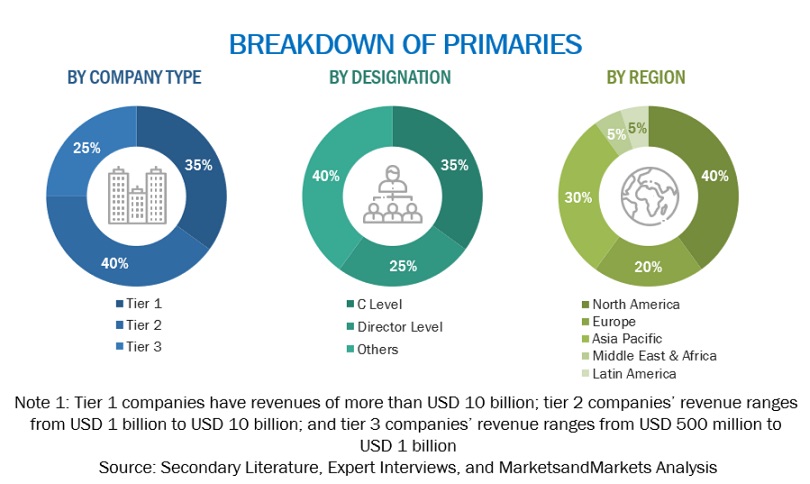
In the primary research process, various sources from the supply and demand sides were interviewed to obtain qualitative and quantitative information for the report. The primary sources from the supply side included Chief Executive Officers (CEOs), Chief Technology Officers (CTOs), Chief Operating Officers (COOs), Vice Presidents (VPs), Managing Directors (MDs), technology and innovation directors, and related key executives from various key companies and organizations operating in the environment, health, and safety market.
Primary interviews were conducted to gather insights, such as market statistics, data on revenue collected from software and services, market breakups, market size estimations, market forecasts, and data triangulation. Stakeholders from the demand side, such as Chief Information Officers (CIOs), Chief Finance Officers (CFOs), Chief Strategy Officers (CSOs), and the installation team of end users who use environment, health, and safety, were interviewed to understand buyers’ perspectives on suppliers, products, service providers, and their current usage of environment, health, and safety solution and services, which is expected to affect the overall environment, health, and safety market growth.
To know about the assumptions considered for the study, download the pdf brochure
Market Size Estimation
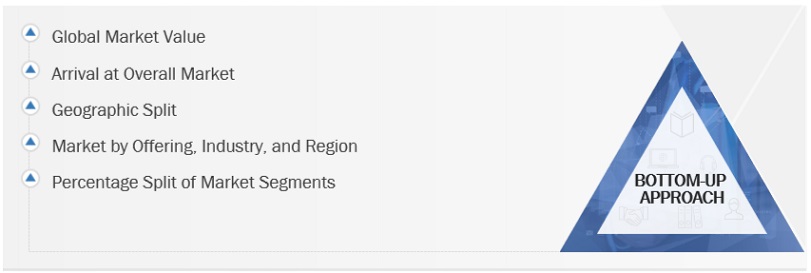
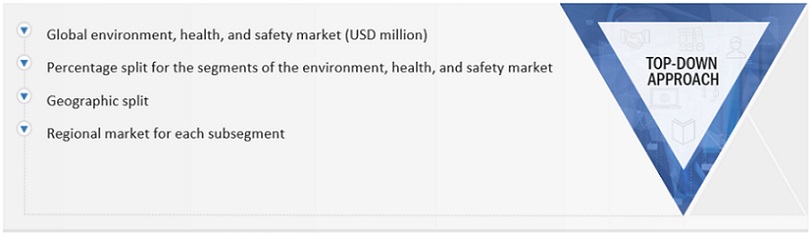
In the market engineering process, the top-down and bottom-up approaches were used along with multiple data triangulation methods to estimate and validate the size of the environment, health, and safety market, as well as other dependent submarkets. The research methodology used to estimate the market sizes includes the following:
- Initially, MarketsandMarkets focuses on top-line investments and spending in the ecosystems. Further, significant developments in the critical market area have been considered.
- Tracking the recent and upcoming developments in the environment, health, and safety market that include investments, R&D activities, product launches, collaborations, mergers and acquisitions, and partnerships, as well as forecasting the market size based on these developments and other critical parameters.
- Conduct multiple discussions with key opinion leaders to learn about the diverse types of authentications and brand protection offerings used and the applications for which they are used to analyze the breakdown of the scope of work carried out by major companies.
- Segmenting the market based on technology types concerning applications wherein the types are to be used and deriving the size of the global application market.
- Segmenting the overall market into various market segments
- Validating the estimates at every level through discussions with key opinion leaders, such as chief executives (CXOs), directors, and operation managers, and finally with the domain experts at MarketsandMarkets
Market Size Estimation Methodology-Bottom-up approach
To know about the assumptions considered for the study, Request for Free Sample Report
Market Size Estimation Methodology-top-down approach
Data Triangulation
After arriving at the overall market size from the above estimation process, the environment, health, and safety market has been split into several segments and sub-segments. To complete the overall market engineering process and arrive at the exact statistics for all segments and sub-segments, data triangulation and market breakdown procedures have been used, wherever applicable. The data has been triangulated by studying various factors and trends from both the demand and supply sides.
The environment, health, and safety market size has been validated using top-down and bottom-up approaches.
Market Definition
An EHS system streamlines EHS management by automating safety program management and simplifying government regulatory compliance. It prioritizes greater user engagement and collaboration to reduce operational risks and improve health and safety performance while achieving corporate sustainability goals. The EHS market includes software and services that aim to reduce environmental pollution (including air, water, and soil) and protect workers' health, thereby improving ergonomics and confirming a risk-free workplace. This EHS software has various features, such as environment and sustainability management, waste management, health and safety management, industrial hygiene management, energy and water management, incident and risk management, and air quality and compliance management.
Stakeholders
- EHS Software Providers
- EHS Service Providers
- System Integrators
- Consultancy and Advisory Firms
- Certification and Training Firms
- Regulatory Agencies
- Governments
- Chief Technology And Data Officers
- Workplace Safety Service Professionals
- Business Analysts
- Information Technology (IT) Professionals
- Investors and Venture Capitalists
- Third-party Providers
- Managed And Professional Service Providers
Report Objectives
- To determine and forecast the global environment, health, and safety market by offering (software and services), application, vertical, and region from 2024 to 2029, and analyze the various macroeconomic and microeconomic factors affecting market growth.
- To forecast the size of the market segments concerning five central regions: North America, Europe, Asia Pacific (APAC), Middle East & Africa (MEA), and Latin America.
- To provide detailed information about the major factors (drivers, restraints, opportunities, and challenges) influencing the growth of the market.
- Analyze each submarket concerning individual growth trends, prospects, and contributions to the overall market.
- To analyze the opportunities in the market for stakeholders by identifying the high-growth segments of the environment, health, and safety market.
- To profile the key market players; provide a comparative analysis based on business overviews, regional presence, product offerings, business strategies, and key financials; and illustrate the market’s competitive landscape.
- Track and analyze competitive developments in the market, such as mergers and acquisitions, product developments, partnerships and collaborations, and Research and Development (R&D) activities.
Available Customizations
With the given market data, MarketsandMarkets offers customizations per the company’s specific needs. The following customization options are available for the report:
Geographic Analysis
- Further break-up of the Asia Pacific market into countries contributing 75% to the regional market size
- Further break-up of the North American market into countries contributing 75% to the regional market size
- Further break-up of the Latin American market into countries contributing 75% to the regional market size
- Further break-up of the Middle East African market into countries contributing 75% to the regional market size
- Further break-up of the European market into countries contributing 75% to the regional market size
Company Information
- Detailed analysis and profiling of additional market players (up to 5)
Get the Full Environment, Health, and Safety Market Report
Full forecast, segment splits, and company analysis for all Environment, Health, and Safety Market.
- Canada Environment, Health, and Safety Market
- US Environment, Health, and Safety Market
- UK Environment, Health, and Safety Market
- Germany Environment, Health, and Safety Market
- China Environment, Health, and Safety Market
- India Environment, Health, and Safety Market
- Brazil Environment, Health, and Safety Market
- France Environment, Health, and Safety Market
- Italy Environment, Health, and Safety Market
- Nordic Countries Environment, Health, and Safety Market
- Rest Of Europe Environment, Health, and Safety Market
- Spain Environment, Health, and Safety Market
- Japan Environment, Health, and Safety Market
- Rest Of Asia Pacific Environment, Health, and Safety Market
- Southeast Asia Environment, Health, and Safety Market
- Mexico Environment, Health, and Safety Market
- Rest Of Latin America Environment, Health, and Safety Market
- GCC Countries Environment, Health, and Safety Market
- South Africa Environment, Health, and Safety Market
Need a Tailored Report?
Customize this report to your needs
Get 10% FREE Customization
Customize This Report
