
Japan EV Connector Market (2025-2030)

The Japan EV Connector Market was valued at $16596 Million in 2025 and projected to reach to $51784 Million by 2030, representing a compound annual growth rate of 17.7%. Japan's EV connector market is poised for exceptional growth as the nation accelerates its transition toward electrified transportation.


| Market Size in | USD 26.32 MN |
| Market Forecast in | |
| CAGR | |
| Forecast Period | |
| Units Considered | Value (USD MN) |
Japan EV Connector Market Trends and Insights
- This represents a compound annual growth rate of 17.7%, driven by Japan's aggressive electrification strategy and government incentives supporting EV adoption.
- Japan's automotive sector, led by major manufacturers, is investing heavily in standardized connector infrastructure to support the nation's transition to electric mobility. The Japanese market benefits from strong domestic demand for EVs, technological innovation in connector design, and the country's commitment to carbon neutrality by 2050.
- Japan's established automotive supply chain and manufacturing expertise position it as a critical hub for EV connector development and production.
- Between 2025 and 2030, Japan is expected to see significant expansion in charging infrastructure, particularly in urban centers and along major highways, further accelerating connector market growth..
Key Market Statistics
- CAGR (2025-2030) 17.7% CAGR
- Market Size, 2025 ~USD 16596 Million
- Forecast, 2030 ~USD 51784 Million
- Country Japan
Japan EV Connector Market Overview
Rapid Market Expansion :
Japan's EV connector market is projected to grow from USD 16,596 million in 2025 to USD 51,784 million by 2030, representing a 17.7% CAGR driven by aggressive government electrification policies and manufacturer investments.
Government Support & Incentives :
Japan's government is actively promoting EV adoption through subsidies, tax incentives, and infrastructure development programs, creating favorable conditions for connector manufacturers and suppliers.
Leading Automotive Manufacturers :
Major Japanese automakers including Toyota, Honda, Nissan, and Mitsubishi are investing heavily in EV production and standardized connector technologies, positioning Japan as a global innovation hub.
Standardization & Infrastructure :
Japan is prioritizing connector standardization and charging infrastructure development, with focus on CHAdeMO and emerging fast-charging technologies to support mass EV adoption.
Japan EV Connector Market Dynamics
- With government incentives, substantial investments from leading automotive manufacturers, and a commitment to standardized connector technologies, the market will experience significant expansion through 2030.
- The development of comprehensive charging infrastructure and adoption of advanced fast-charging solutions will further drive demand. Japan's position as a global automotive leader ensures that innovations in connector technology will have worldwide implications.
- The market's growth trajectory reflects both domestic EV adoption targets and Japan's strategic role in supplying connectors to international manufacturers, solidifying its importance in the global EV ecosystem..
Market Ecosystem
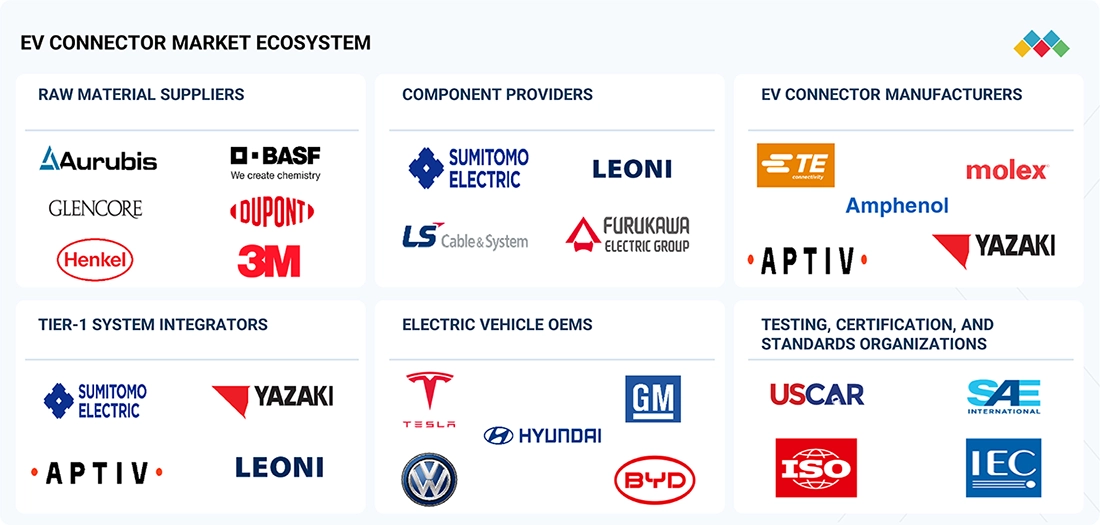
EV CONNECTOR MARKET: COMMERCIAL USE CASES ACROSS INDUSTRIES
| COMPANY | USE CASE DESCRIPTION | BENEFITS |
|---|---|---|
 |
Provides high voltage and signal connectors for battery packs, charging systems, inverters, e motors, onboard chargers, ADAS, zonal architectures, and vehicle Ethernet networks in electric vehicles | Supports high power and high speed data transmission, improves electrical safety, reduces wiring complexity, and enhances connector reliability |
 |
Supplies high voltage connection systems and power distribution solutions for battery packs, charging systems, power electronics, and electric drive systems in battery electric vehicles | Enables efficient power distribution, improves system safety, supports lightweight vehicle architectures, and enhances packaging efficiency |
 |
Manufactures connectors integrated with automotive wiring harnesses for battery systems, charging systems, power distribution, and electronic control units in electric vehicles | Ensures reliable electrical connectivity, supports stable power distribution, and improves durability under automotive operating conditions |
 |
Provides automotive connectors for ADAS, infotainment, vehicle networking, cameras, radar, battery management systems, and high speed in vehicle communication | Enables reliable high speed data transmission, supports connected vehicle functions, and improves signal integrity |
 |
Develops automotive connectors for ADAS cameras, infotainment systems, electronic control units, displays, and in vehicle communication modules | Supports compact electronic designs, reliable signal transmission, and improved assembly efficiency |
Logos and trademarks shown above are the property of their respective owners. Their use here is for informational and illustrative purposes only.
Related Ecosystem
Automotive Electronics And Electrical Equipment
- Battery Electric Vehicle (BEV)
- Light Commercial Vehicles (LCVs)
- Fuel Cell Electric Vehicle (FCEV)
- Sensors
- Hybrid Electric Vehicle (HEV)
- BOSCH LIMITED
- Continental ag
- DENSO Corporation
- Panasonic Holdings Corporation
- Texas Instruments Incorporated
Decarbonization
- Battery Electric Vehicle (BEV)
- Energy Management Systems
- Fuel Cell
- Fuel Cell Electric Vehicle (FCEV)
- Geographical Information System (GIS)
- TotalEnergies SE
- Siemens ag
- Mitsui & Co., Ltd.
- General Electric Company
- Thyssenkrupp ag
Key Takeaways
- Japan's EV connector market will grow from USD 16.6B in 2025 to USD 51.8B by 2030, reflecting a 17.7% CAGR.
- Japan's commitment to carbon neutrality and government EV incentives are primary drivers of connector market expansion.
- Japan's automotive manufacturers are standardizing connector technologies to support nationwide charging infrastructure development.
- Japan's established supply chain and manufacturing capabilities position it as a regional leader in EV connector innovation and production.
EV Connector Market Report Scope
| Report Metric | Details |
|---|---|
| Base Year | 2025 |
| Fastest Growing Segment | FCEV (Propulsion) |
| Forecast Period | 2025–2030 |
| Growth Rate | CAGR of 18.2% from 2025 to 2030 |
| Largest Segment | MEDIUM VOLTAGE (Voltage) |
| Market Size Base Year (Billions) | ~USD 2.73 (2025) |
| Revenue Forecast (Billions) | ~USD 6.3 (2030) |
| Segments Covered | Application, System, Voltage, Propulsion |
Japan EV Connector Market Report Segmentation
4 segment dimensions are covered across the global market.
By Application
- ADAS & Safety Systems
- Battery Management Systems
- Body Control & Interiors
- Engine Management & Powertrain
- Infotainment Systems
- Other Applications
- Vehicle Lighting
By System
- Sealed
- Unsealed
By Voltage
- High Voltage
- Low Voltage
- Medium Voltage
By Propulsion
- Bev
- Fcev
- Phev
JAPAN: EV CONNECTOR MARKET, BY APPLICATION, 2025–2032
| Segment | 2025 | 2026 | 2027 | 2028 | 2029 | 2030 | 2031 | 2032 | CAGR (%) |
|---|---|---|---|---|---|---|---|---|---|
| ADAS & SAFETY SYSTEMS | 6.2 | 7.8 | 9.7 | 11.9 | 14.4 | 16.9 | 19.7 | 22.5 | 20.2 |
| BATTERY MANAGEMENT SYSTEMS | 4.9 | 6.2 | 8 | 9.8 | 11.9 | 14.2 | 16.6 | 19.1 | 21.6 |
| BODY CONTROL & INTERIORS | 2.9 | 3.6 | 4.5 | 5.4 | 6.4 | 7.4 | 8.4 | 9.5 | 18.4 |
| ENGINE MANAGEMENT & POWERTRAIN | 3.2 | 3.9 | 4.7 | 5.6 | 6.5 | 7.4 | 8.4 | 9.4 | 16.8 |
| INFOTAINMENT SYSTEMS | 1.1 | 1.4 | 1.7 | 2.1 | 2.5 | 2.9 | 3.4 | 3.8 | 19.2 |
| OTHER APPLICATIONS | 0.5 | 0.6 | 0.8 | 0.9 | 1 | 1.2 | 1.3 | 1.4 | 14.5 |
| VEHICLE LIGHTING | 1.3 | 1.6 | 2 | 2.3 | 2.7 | 3 | 3.3 | 3.6 | 15.6 |
| TOTAL | 20.1 | 25.2 | 31.3 | 37.9 | 45.4 | 53 | 61 | 69.3 | 19.3 |
Target Audience
- EV Connector Manufacturers : Manufacturers need Japan-specific market data to assess growth opportunities, benchmark against competitors, and develop products aligned with Japanese standardization requirements and OEM specifications.
- Automotive OEMs & Suppliers : Japanese and international automakers require detailed market insights to plan EV production capacity, connector sourcing strategies, and infrastructure partnerships within Japan.
- Charging Infrastructure Developers : Companies building charging networks need market forecasts and connector adoption trends to optimize infrastructure investments and ensure compatibility with emerging technologies.
- Investment & Private Equity Firms : Investors evaluating opportunities in Japan's EV ecosystem require validated market sizing, growth projections, and competitive analysis to support funding and M&A decisions.
- Government & Policy Organizations : Japanese government agencies and regulatory bodies need market intelligence to inform electrification policies, infrastructure planning, and standardization initiatives.
Key Companies in the Japan EV Connector Market
| Company | HQ | Ownership | Strongest segments |
|---|---|---|---|
| TE CONNECTIVITY | Switzerland | Public Company | Sealed high-voltage connectors (battery, inverter, e-axle),Sealed low-voltage connectors (ADAS & safety, BMS signal),Unsealed body control & interiors connectors, |
| APTIV | Ireland | Public Company | Sealed EV connectors,Unsealed EV connectors,ADAS & safety connector solutions, |
| HIROSE ELECTRIC CO., LTD. | Japan | Public Company | Sealed connectors (signal and low-power for ADAS, BMS, body),Unsealed board-to-board / FPC/FFC for interiors and ECUs,ADAS & safety application connectors, |
| SUMITOMO ELECTRIC INDUSTRIES, LTD. | Japan | Public Company | Sealed high-voltage connectors (battery, inverter, e-axle),Unsealed low-voltage connectors (body control & interiors),ADAS & safety connectors and radar interfaces, |
| JAPAN AVIATION ELECTRONICS INDUSTRY, LTD. | Japan | Public Company | Battery Management High-Current & Charging/Discharging Plugs,Body Control & Interiors (Board-to-Board, Board-to-FPC/FFC, Board-to-Cable),ADAS & Safety (Coaxial, Fiber Optic, High-Speed I/O), |
| AMPHENOL CORPORATION | United States | Public Company | Sealed high-voltage power connectors and busbars,Unsealed low-voltage signal connectors (ADAS & safety, body, interiors),Cable assemblies, harnesses, and value-add systems, |
| KYOCERA CORPORATION | Japan | Public Company | Sealed connectors for ADAS & Safety,Sealed connectors for Battery Management (BEV/PHEV/FCEV),Connectors for Body Control & Interiors, |
| FURUKAWA ELECTRIC CO., LTD. | Japan | Public Company | Sealed high-voltage connectors and harness interfaces,Unsealed low-voltage connectors for body control and interiors,Integrated wire harness systems with embedded connectors, |
| LUXSHARE PRECISION INDUSTRY CO., LTD. | China | Public Company | High-voltage battery and powertrain connectors (BEV/PHEV/FCEV),Low-voltage signal connectors for ADAS & safety,Body control & interior connectors, |
| LITTELFUSE, INC. | United States | Public Company | Sealed high-voltage connector and fuse modules,Unsealed low-voltage connectors and interconnects,ADAS and safety sensing and protection interconnects, |
| SHENGLAN TECHNOLOGY CO., LTD. | China | Public Company | Sealed high-voltage EV connectors,Unsealed low-voltage body & interior connectors,Battery management & sensing connectors, |
TE CONNECTIVITY
TE Connectivity is a Swiss public company founded in 1941 that employs 80,000 people globally. The company specializes in connectivity and sensor solutions for various industries.
APTIV
Aptiv is an Irish public company founded in 2011 with 140,000 employees worldwide. The company focuses on automotive and mobility technology solutions.
HIROSE ELECTRIC CO., LTD.
Hirose Electric Co., Ltd. is a Japanese public company founded in 1937 with 5,110 employees. The company manufactures connectors and electronic components for industrial and telecommunications applications.
SUMITOMO ELECTRIC INDUSTRIES, LTD.
Sumitomo Electric Industries, Ltd. is a Japanese public company founded in 1897 with 302,972 employees. The company produces electrical wires, cables, and related products for automotive, energy, and telecommunications sectors.
JAPAN AVIATION ELECTRONICS INDUSTRY, LTD.
Japan Aviation Electronics Industry, Ltd. is a Japanese public company founded in 1950 with 11,908 employees. The company manufactures connectors and electronic components for aerospace and industrial applications.
AMPHENOL CORPORATION
Amphenol Corporation is a United States public company founded in 1932 with 170,000 employees. The company is a leading manufacturer of interconnect products and assemblies for various industries including automotive, aerospace, and telecommunications.
KYOCERA CORPORATION
Kyocera Corporation is a Japanese public company founded in 1946 with 73,856 employees. The company manufactures ceramics, electronic components, and telecommunications equipment.
FURUKAWA ELECTRIC CO., LTD.
Furukawa Electric Co., Ltd. is a Japanese public company founded in 1884 with 49,112 employees. The company produces electrical wires, cables, and related products for power transmission and telecommunications.
LUXSHARE PRECISION INDUSTRY CO., LTD.
Luxshare Precision Industry Co., Ltd. is a Chinese public company founded in 2004 with 416,197 employees. The company manufactures connectors, cables, and precision components for consumer electronics and telecommunications.
LITTELFUSE, INC.
Littelfuse, Inc. is a United States public company founded in 1927 with 17,000 employees. The company designs and manufactures circuit protection devices and components for automotive and industrial markets.
SHENGLAN TECHNOLOGY CO., LTD.
Shenglan Technology Co., Ltd. is a Chinese public company founded in 2007 with 3,647 employees. The company manufactures connectors and electronic components for telecommunications and industrial applications.
Reasons to Buy this Report
- Market Size & Growth Validation : Obtain precise market valuation data for Japan's EV connector sector with verified 17.7% CAGR projections, enabling accurate business planning and investment decisions for the 2025-2030 period.
- Competitive Landscape Intelligence : Understand Japan's leading connector manufacturers, their market positioning, and strategic initiatives to identify partnership opportunities and competitive threats specific to the Japanese market.
- Government Policy & Regulatory Insights : Access detailed analysis of Japan's electrification policies, subsidies, and infrastructure mandates that directly impact connector demand and market dynamics.
- Technology Standardization Trends : Gain insights into Japan's connector standardization efforts, including CHAdeMO adoption and emerging fast-charging technologies, to align product development strategies.
- Strategic Market Entry Planning : Leverage Japan-specific market data to develop targeted go-to-market strategies, identify key stakeholders, and optimize resource allocation for market penetration.
Frequently asked questions
What is the current size of Japan's EV connector market?
Japan's EV connector market is valued at USD 16,596 million in 2025 and is expected to grow significantly through 2030.
What is the projected growth rate for Japan's EV connector market?
Japan's EV connector market is projected to grow at a compound annual growth rate of 17.7% from 2025 to 2030.
What will Japan's EV connector market size be in 2030?
Japan's EV connector market is forecasted to reach USD 51,784 million by 2030, representing significant expansion from 2025 levels.
What factors are driving growth in Japan's EV connector market?
Japan's EV connector market growth is driven by government electrification policies, carbon neutrality commitments, increased EV adoption, and expanding charging infrastructure.
Why is Japan important in the global EV connector market?
Japan's advanced automotive manufacturing capabilities, technological innovation, and major EV manufacturers make it a critical player in the global EV connector market.
RESEARCH METHODOLOGY
The research study relied extensively on secondary sources, including company annual reports and presentations, industry association publications, automotive magazine articles, directories, technical handbooks, the World Economic Outlook, trade websites, technical articles, and databases, to identify and collect information on the EV connector market. Primary interviews were conducted to obtain and verify critical qualitative and quantitative information and to assess the prospects of the industry. Primary sources included experts from core and related industries, suppliers, manufacturers, distributors, service providers, technology developers, and organizations across various segments of the EV connector market value chain. Detailed interviews were conducted with primary respondents, including key industry participants, Subject Matter Experts (SMEs), C-level executives of key market players, and industry consultants.
Secondary Research
Secondary sources for this research study include automotive industry organizations such as the International Energy Agency (IEA), International Organization of Motor Vehicle Manufacturers (OICA), European Automobile Manufacturers' Association (ACEA), International Electrotechnical Commission (IEC), Institute of Electrical and Electronics Engineers (IEEE), Wiring Harness Manufacturers Association (WHMA), Society of Manufacturers of Electric Vehicles (SMEV), and World Electric Vehicle Association (WEVA), among others; corporate filings such as annual reports, investor presentations, and financial statements; and trade, business, and automotive associations. Secondary data has been collected and analyzed to determine the overall market size, which is further validated by primary research.
Primary Research
Extensive primary research was conducted after gaining an understanding of the EV connector market through secondary research. Several primary interviews were conducted with market experts from EV connectors, OEMs, EV connector manufacturers, and wiring harness manufacturers across three major regions, namely North America, Europe, and the Asia Pacific. Approximately 20%, 45%, and 35% of the primary interviews were conducted, respectively. Primary data was collected through questionnaires, emails, and telephone interviews. Various departments within organizations, including sales, operations, and administration, were contacted to provide a holistic viewpoint in the reports while canvassing the primaries. After interacting with industry participants, brief sessions were held with experienced independent consultants to reinforce the findings from the primaries. This, along with the opinions of in-house subject matter experts, led to the findings delineated in the rest of this report.
Primary interviews have been conducted to gather insights, including EV connector market sizing and forecast, future trends, and upcoming technologies in the EV connector market. Data triangulation of these points was performed using information from secondary research and model mapping. Stakeholders from the demand and supply sides have been interviewed to understand their views on these points.
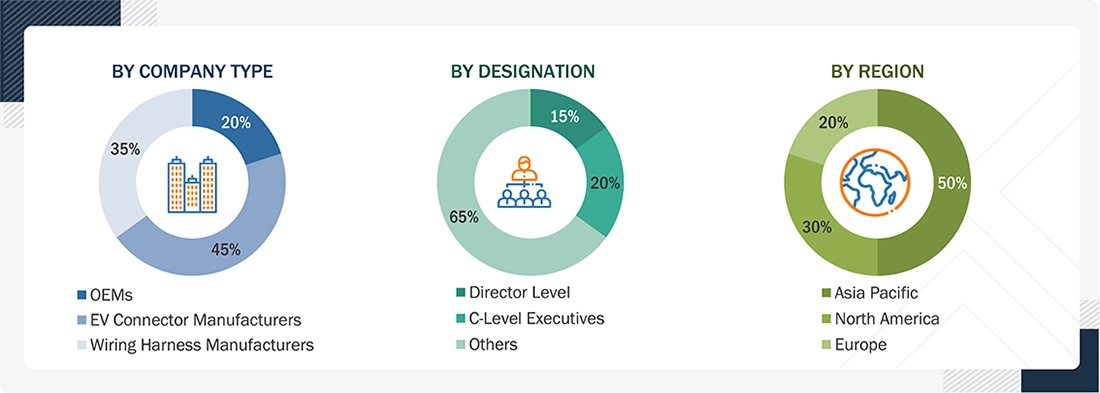
Note: Others include sales, marketing, and product managers.
Company tiers are based on the value chain; revenue of the company is not considered.
To know about the assumptions considered for the study, download the pdf brochure
Market Size Estimation
A detailed market estimation approach was followed to estimate and validate the value and volume of the EV connector market and other dependent submarkets, as mentioned below:
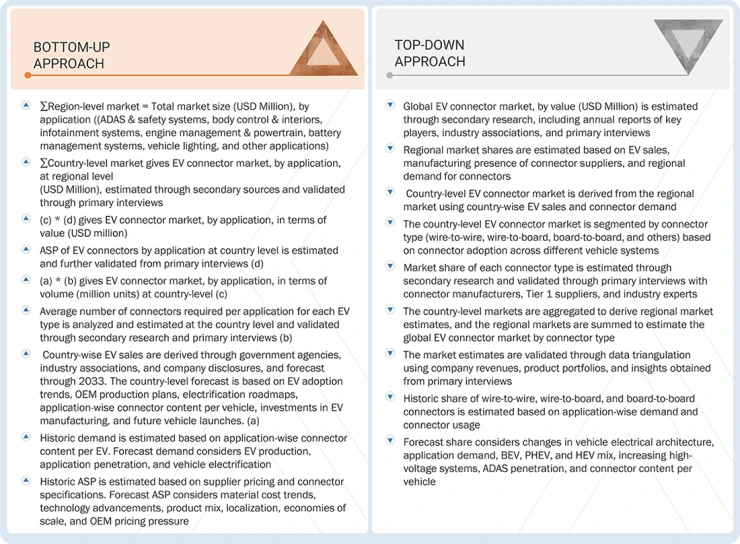
- The bottom-up and top-down approaches were used to estimate and validate the size of the EV connector market. The EV connector market, by application, in terms of value and volume, is derived by identifying the volume of connectors required in each application for all EV types at the country level.
- The market size was derived using parameters such as sales of EVs (BEVs, PHEVs, HEVs) and corresponding penetration of the applications considered under the scope.
- Key players in the EV connector market were identified through secondary research, and their global market rankings were determined through primary and secondary research.
- The research methodology included the study of annual and quarterly financial reports, regulatory filings of major market players, and interviews with industry experts to gain detailed market insights.
- All major penetration rates, percentage shares, splits, and breakdowns for the EV connector market were determined through secondary sources and verified through primary sources.
- All key macroindicators affecting the revenue growth of the market segments and subsegments have been accounted for, viewed in extensive detail, verified through primary research, and analyzed to obtain validated quantitative & qualitative data.
The market data gathered was consolidated, supplemented with detailed inputs, analyzed, and presented in this report.
EV Connector Market : Top-Down and Bottom-Up Approach
Data Triangulation
All percentage shares, splits, and breakdowns were determined using secondary sources and verified by primary sources. All parameters that are said to affect the markets covered in this research study were accounted for, examined in detail, and analyzed to obtain the final quantitative and qualitative data.
Market Definition
|
APPLICATION |
MARKET DEFINITION |
|
ADAS & Safety Systems |
ADAS and safety systems benefit consumers and protect them from potential hazards. They contribute to improving the overall safety of drivers and passengers. They include the application of communication technology in ADAS features such as adaptive cruise control, blind-spot detection, lane departure warning, automatic emergency braking, and park assist. This also includes basic safety systems such as adaptive cruise control (ACC), anti-lock braking system (ABS), tire pressure monitoring system (TPMS), vehicular communication system, and electronic stability control. In an ADAS system, a series of sensors, processors, and actuators work together to perceive the environment and assist drivers. EV connectors are vital electrical connections that carry data, power, and signals between these components. The connector prevents features such as automatic emergency braking, lane departure warning, and adaptive cruise control from malfunctioning, thereby assisting safety. |
|
Body Control & Interiors |
Body control and interior systems require the most electronics in a vehicle. Body electronics cover various applications inside the passenger compartment, including automatic HVAC control, seat position, automatic wipers, automatic headlamps, dimming mirrors, and antifogging windshield systems. Premium cars are equipped with a range of comfort and convenience sensors. OEMs are introducing enhanced body control and comfort applications with advanced electronic features. |
|
Engine Management & Powertrain |
Engine management and powertrain in an automobile refer to the main components that generate and transmit power to the road surface. This includes the engine, transmission, drive shafts, differentials, and the final drive. The engine management and powertrain control module is a control unit used in motor vehicles. The main priority of OEMs is a powertrain with low emissions to meet market expectations and stringent government regulations. Vehicles require high-performance connectors for engine management, drivability, appropriate performance levels, and high-accuracy data transfer. |
|
Infotainment Systems |
The infotainment system manages multiple audio, video, navigation, voice recognition, and other data streams. Connectors enable high-speed, reliable data transfer between components such as the head unit, speakers, displays, microphones, and external devices. These connections ensure smooth video playback, responsive touchscreens, and clear audio without skipping or lag. Different parts of the infotainment system require varying power levels. Connectors manage this distribution efficiently, supplying sufficient power to screens, amplifiers, processors, and other components. |
|
Battery Management Systems |
A battery management system monitors key operational parameters such as current, voltage, and the battery's internal temperature. It reduces stress on the battery by delivering the right amount of power to the electric vehicle's motor. A BMS needs a reliable network of connectors to gather data and control the battery's functions. |
|
Vehicle Lighting |
Vehicle lighting comprises the various lighting components and systems integrated into a vehicle for both interior and exterior purposes. These lighting elements are essential for visibility, safety, and functionality. Exterior vehicle lighting includes headlights, taillights, turn signals, brake lights, and fog lights. Interior vehicle lighting includes instrument panel lighting, dome lighting, and ambient lighting. EV connectors ensure a secure, reliable connection between the wiring harness and the lighting components, preventing flickering, dimming, or complete failure. Loose connections or exposed wires could cause electrical shorts, fires, and accidents. |
|
Other Applications |
Other connector applications, such as EV connectors in auxiliary systems, are considered. An auxiliary system in an automobile is a collection of electrical components that support the car's main systems and components. |
|
CONNECTION |
MARKET DEFINITION |
|
Wire-to-Wire |
Wire-to-wire connections are a specific type of electrical connection that enables the joining of two separate wires or cables. This is achieved through a connector with two halves, each designed to accommodate and secure the end of a wire. When the two halves of the connector are mated together, the wires within them are brought into contact, establishing an electrical pathway for the flow of current or signals. |
|
Wire-to-Board |
Wire-to-board connectors are a type of connector that joins a group of individual wires to a printed circuit board (PCB). They play a crucial role in establishing electrical connections between external wiring and the components on the PCB, enabling the flow of power, signals, and data. |
|
Board-to-Board |
Board-to-board connectors are specialized electrical connectors that directly link multiple printed circuit boards (PCBs), establishing reliable electrical connections without wires or cables. They enable the transfer of power, signals, and data between boards in a compact, efficient, and organized manner. |
|
Other Connection Types |
Other connector systems, such as busbar-to-busbar, busbar-to-wire, and busbar-to-board connector systems, are considered in this study. A busbar-to-busbar connector system connects two busbars, a busbar-to-wire connector system connects a busbar to a wire, and a busbar-to-board connector system connects a busbar to a board in an electrical system. |
Key Stakeholders
- Automotive Electronics Council (AEC)
- Department of Transportation (DoT)
- Electric Vehicle Association of Asia Pacific (EVAAP)
- Energy Efficiency and Renewable Energy (EERE)
- Environmental Protection Agency (EPA)
- European Automobile Manufacturers' Association (ACEA)
- EV Connector Manufacturers
- International Energy Agency (IEA)
- Institute of Electrical and Electronics Engineers (IEEE)
- International Council on Clean Transportation (ICCT)
- International Electrotechnical Commission (IEC)
- International Organization of Motor Vehicle Manufacturers (OICA)
- Investor Presentations and Annual Reports of Key Players
- National Highway Traffic Safety Administration (NHTSA)
- Other Component Manufacturer Associations
- Society of Manufacturers of Electric Vehicles (SMEV)
- Wiring Harness Manufacturers' Association (WHMA)
- World Electric Vehicle Association (WEVA)
- Other EV connector manufacturers & associations
Report Objectives
-
To define, describe, and forecast the size of the EV connector market in terms of value (USD million) and volume (million units) between 2026 and 2033 based on the following segments:
- By connector type (wire-to-wire, wire-to-board, board-to-board, and other connection types)
- By application (ADAS & safety systems, body control & interiors, infotainment systems, engine management & powertrain, battery management systems, vehicle lighting, and other applications)
- By propulsion (BEV, PHEV, and HEV)
- By system (sealed and unsealed)
- By voltage (low voltage, medium voltage, and high voltage)
- By region (Asia Pacific, Europe, and North America)
- To identify and analyze key drivers, restraints, opportunities, and challenges influencing the market
- To strategically profile key players and analyze their market share and core competencies
- To analyze recent developments, including product launches, deals, and expansions, by key market players
-
To study the following with respect to the market
- Supply Chain Analysis
- Ecosystem Analysis
- Technology Analysis
- Trade Analysis
- Case Study Analysis
- Patent Analysis
- Regulatory Landscape
- Conferences and Events
- Pricing Analysis
- Impact of AI
- Investment and Funding Scenario
- Key Stakeholders and Buying Criteria
- Key Conferences and Events
- Benchmarking of Global EV Charging Standards
- Regional Adoption and OEM Migration Strategies
- High Voltage Architecture Evolution
- Connector Content per Vehicle Analysis
- Connector Adoption Strategies of Leading Automotive OEMs
- Total Cost of Ownership
- Impact of EU FTA Trade Deal Analysis on Automotive & Transportation Industry
- Impact of Israel-Iran War Analysis on Automotive & Transportation Industry
Available customizations:
MarketsandMarkets offers the following customizations for this market report:
-
EV connector market, By connector type, at the country-level
- Wire-to-Wire
- Wire-to-Board
- Board-to-Board
- Other Connector Types
Note: The EV connector market can be offered for connector type at the country level.
- EV connector market, By application, at the country-level
- ADAS & Safety Systems
- Body Control & Interiors
- Infotainment Systems
- Engine Management & Powertrain
- Battery Management Systems
- Vehicle Lighting
- Other Applications
Get the Full EV Connector Market Report
Full forecast, segment splits, and company analysis for all EV Connector Market.
- Switzerland EV Connector Market
- Austria EV Connector Market
- Denmark EV Connector Market
- Canada EV Connector Market
- US EV Connector Market
- China EV Connector Market
- India EV Connector Market
- South Korea EV Connector Market
- Germany EV Connector Market
- France EV Connector Market
- UK EV Connector Market
- Netherlands EV Connector Market
- Spain EV Connector Market
- Sweden EV Connector Market
- Norway EV Connector Market
Need a Tailored Report?
Customize this report to your needs
Get 10% FREE Customization
Customize This Report
