EV Semiconductors Market

EV Semiconductors Market by Technology (Silicon-based, Wide-Bandgap), Propulsion, Application (Battery Management System, Powertrain, ADAS, and more), Component (Power ICs & Modules, MCUs & Processors, Sensors, and more), and Region - Global Forecast to 2032




OVERVIEW
Source: Secondary Research, Interviews with Experts, MarketsandMarkets Analysis
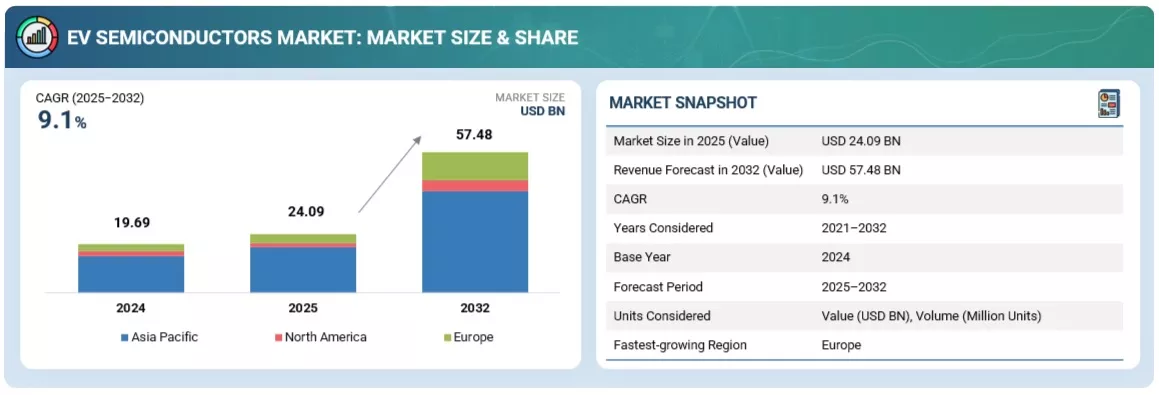
The global EV semiconductors market size projected to grow from USD 24.09 billion in 2025 to USD 57.48 billion by 2032, at a CAGR of 9.1%, during the forecast period 2025-2032. EV semiconductors market growth is driven by the shift toward software-defined vehicles, high levels of driving autonomy, adoption of 800V architectures, and the transition to wide bandgap semiconductor technologies, such as SiC and GaN. Trade tensions, including US tariffs and China’s export controls on key materials, are accelerating efforts toward semiconductor localization and supply chain diversification, supporting sustained market expansion.
EV Semiconductors Market Size and Forecast:
- Market Size Value in 2024: USD 19.69 Billion
- Market Size Value in 2025: USD 24.09 Billion
- Revenue Forecast in 2032: USD 57.48 Billion
- Growth Rate: CAGR of 9.1% from 2025 to 2032
- Data available from 2021 to 2032
- Base year: 2024
- Forecast period: 2025–2032
Key Market Trends and Insights
- Market Growth: Growth is driven by software-defined vehicles, EV electrification, 800V architectures, and adoption of SiC and GaN semiconductors.
-
IoT Impact: IoT increases demand for EV semiconductors by enabling connected vehicles, real-time diagnostics, and intelligent energy management.
- Growing Trends: The market is witnessing increased adoption of SiC/GaN semiconductors, EV-specific SoCs, and advanced ADAS technologies.
- Growth Opportunities: Opportunities are driven by growing adoption of SiC and GaN semiconductors for efficient EV powertrain and fast-charging systems.
KEY TAKEAWAYS
-
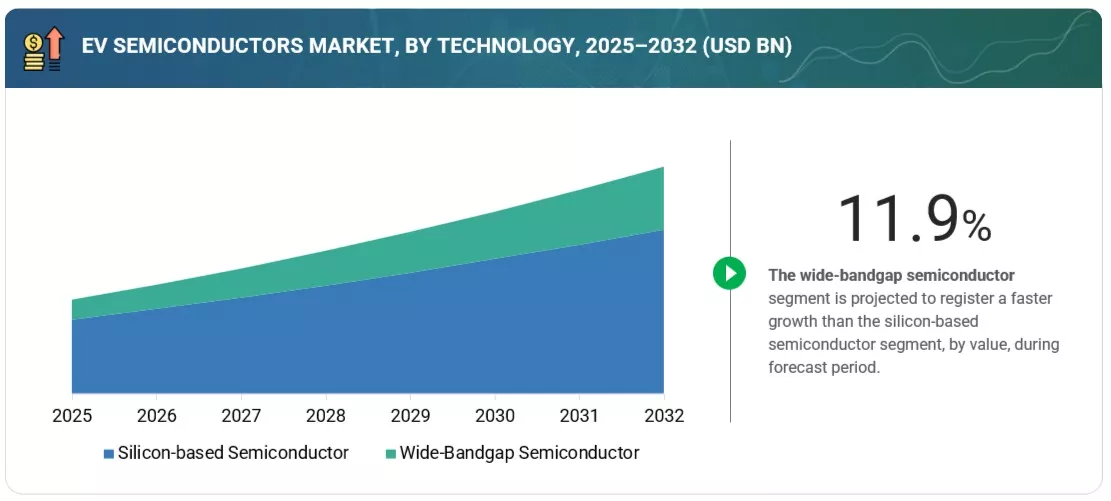
BY TECHNOLOGYThe silicon-based semiconductor segment is dominating the market in this category due to cost efficiency and proven reliability, while wide-bandgap semiconductors (SiC, GaN) are increasingly adopted in high-voltage EV platforms and fast-charging applications for efficiency and thermal performance.
-
BY PROPULSIONThe battery electric vehicle segment drives the demand for semiconductors, witnessing shift to 800V architecture, high integration of power modules, MCUs, and sensors. On the other hand, PHEVs require hybrid solutions combining EV and ICE components, which are also increasing the demand for versatile power semiconductors.
-
BY APPLICATIONThe battery management system segment is driving major demand for semiconductors in this market segmentation because accurate monitoring, better thermal control, and quick charging require high precision power and sensing components. Powertrain systems are also being adopted since traction inverters and onboard chargers use SiC and GaN devices to improve driving range and energy efficiency.
-
BY COMPONENT TYPEPower semiconductors and microcontrollers are key growth drivers in this market category, supported by rising adoption of logic, memory, sensors, and discrete semiconductors for ADAS, BMS, infotainment, and high-voltage power electronics. Suppliers of these components focus on automotive-grade reliability and hybrid SiC-GaN modules.
-
BY REGIONAsia Pacific leads the EV semiconductors market due to large-scale EV production in China and local semiconductor supply. Europe focuses on high-end BEVs and ADAS-driven chip demand, while North America sees growth from Tesla, Rivian, and domestic manufacturing expansions to counter trade restrictions and ensure supply resilience.
-
COMPETITIVE LANDSCAPEInfineon Technologies AG leads the global EV semiconductors market, followed by STMicroelectronics. NXP, Texas Instruments, and Renesas are also key promising players. These companies are expanding production, developing next-generation microcontrollers and power semiconductors, and partnering with EV OEMs and Tier-1 suppliers. Investments in SiC/GaN technologies, advanced packaging, and software-defined vehicle architectures are enhancing efficiency and integration. Moreover, firms are localizing production and diversifying supply chains to mitigate trade and supply risks.
The EV semiconductors market is being shaped by advancements in packaging, thermal management, and hybrid SiC-GaN modules enabling high efficiency and compact designs for inverters and chargers. Growing use of sensors, AI processors, and connectivity chips for autonomous driving and V2X applications is increasing the semiconductor content per vehicle at a high rate. High-voltage architectures and rising battery energy density require robust power electronics, while safety and emissions regulations demand reliable components. Supply chain constraints for materials and skilled talent remain challenges, prompting firms to invest in R&D, advanced manufacturing, and partnerships to support next-generation EV platforms.
TRENDS & DISRUPTIONS IMPACTING CUSTOMERS' CUSTOMERS
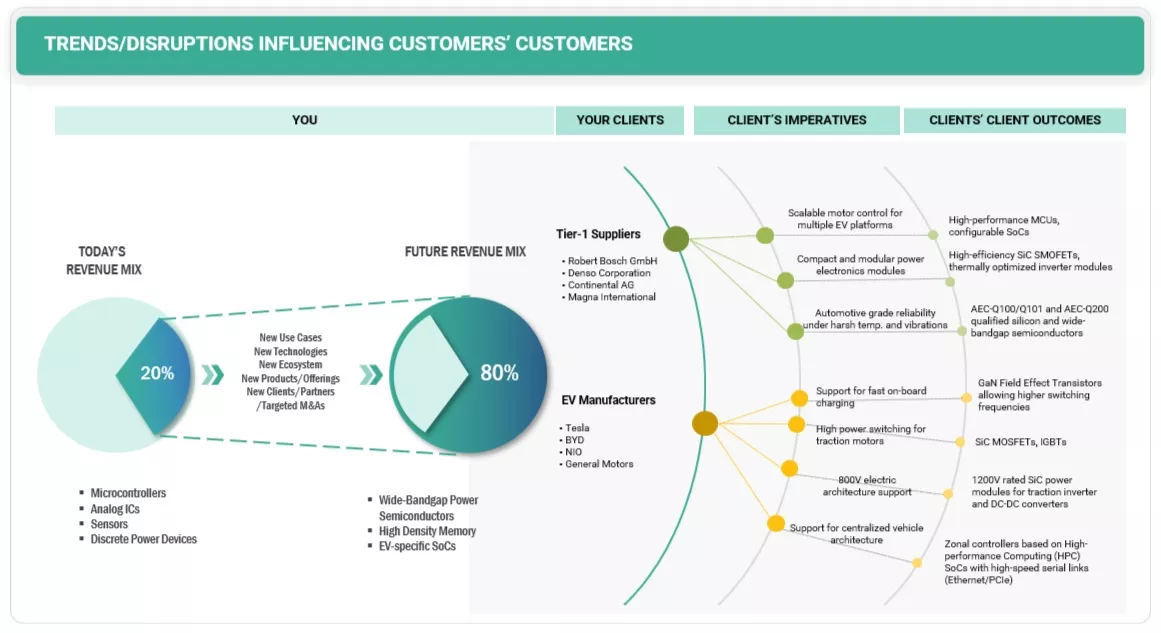
The past EV semiconductors revenue mix was dominated by analog ICs, microcontrollers, discrete, and sensors, reflecting growing EV adoption. The future mix is shifting toward wide-bandgap power semiconductors, high-density memory, and EV-specific SoCs, driven by higher-voltage architectures and higher levels of ADAS. Innovations in SiC/GaN, battery management ICs, and integrated power modules enable more efficient and compact EV systems. Additionally, growing adoption of autonomous driving, connected services, and fast-charging infrastructure is further expanding semiconductor demand.
Source: Secondary Research, Interviews with Experts, MarketsandMarkets Analysis
MARKET DYNAMICS

Level
-
High-voltage EV architectures and 48V systems

-
High semiconductor content per EV


Level
-
Long qualification cycles and strict automotive reliability standards

-
High cost of advanced materials


Level
-
Growth in wide-bandgap materials

-
Expansion in emerging markets


Level
-
Intense competition and margin pressure

-
Cybersecurity, safety, liability concerns

Source: Secondary Research, Interviews with Experts, MarketsandMarkets Analysis
Driver: High semiconductor content per EV
The EV semiconductors market is growing rapidly because EVs use two to three times more semiconductor devices than ICE vehicles across power electronics, sensors, and computing. Automakers are securing supply through collaborations like the Volkswagen and Rivian partnership to jointly manage semiconductor sourcing. Additionally, software-defined vehicle architectures and advanced battery control continue to increase chip content per EV.
Restraint: Long qualification cycles and strict automotive reliability standards
Long qualification cycles and strict automotive reliability standards restrict the EV semiconductors market by increasing time to revenue, costs, and supply lead times. Components must meet AEC-Q100/Q200 and ISO 26262 standards, undergoing HTOL, HAST, temperature cycling, and vibration tests. Qualification typically takes 12–18 months, with zero field failures, -40°C to +150°C operation, 10–15 year lifetime, and ongoing post-qualification monitoring.
Opportunity: Growth in wide-bandgap materials
Silicon carbide (SiC) and gallium nitride (GaN) present opportunity for EV semiconductors by improving efficiency, reducing size, and enabling faster charging. SiC powers traction inverters in vehicles like Tesla Model 3, while GaN boosts onboard and fast chargers with 30–50% efficiency gains. Investments, such as US grants to Wolfspeed for SiC wafer scaling, support supply expansion.
Challenge: Intense competition and margin pressure
The EV semiconductors sector is facing a profitability squeeze from weaker OEM demand and a price war in key materials, compressing margins. Infineon, STMicroelectronics, and NXP reported revenue declines and cost-cutting measures in 2024. SiC oversupply has pressured pricing, impacting players like Wolfspeed. Additionally, suppliers must reduce costs, adjust pricing, and pursue higher-value system content to sustain margins and revenue growth.
EV semiconductor market: COMMERCIAL USE CASES ACROSS INDUSTRIES
| COMPANY | USE CASE DESCRIPTION | BENEFITS |
|---|---|---|
 |
SiC MOSFETs in Model 3/Y for traction inverters and onboard chargers | Enhanced acceleration, faster charging, extended range, improved inverter efficiency |
 |
Advanced BMS ICs in Prius and bZ4X models | Precise cell monitoring, improved battery life, safer fast charging |
 |
Domain controllers and zonal ECUs in MEB platform EVs | Centralized processing for infotainment and safety, efficient over-the-air updates |
Logos and trademarks shown above are the property of their respective owners. Their use here is for informational and illustrative purposes only.
MARKET ECOSYSTEM
The EV semiconductors market ecosystem includes raw material and semiconductor manufacturing equipment suppliers; semiconductor designers and manufacturers; tier-1 suppliers; and OEMs. Companies like SUMCO, Wolfspeed, TSMC, and Infineon provide essential materials and chips. Tier-1 suppliers, such as Bosch and Continental, integrate these into automotive modules. OEMs like Tesla, BYD, and Volkswagen incorporate them into EVs. This network drives innovation, efficiency, and scalability to meet growing EV demand.
Logos and trademarks shown above are the property of their respective owners. Their use here is for informational and illustrative purposes only.
MARKET SEGMENTS
Source: Secondary Research, Interviews with Experts, MarketsandMarkets Analysis
EV Semiconductors Market, By Technology
The silicon-based semiconductor segment is projected to account for a larger market share than the wide-bandgap semiconductor segment during the forecast period. This dominance is driven by widespread adoption, mature manufacturing processes, cost advantages, and reliability in automotive applications. Their proven performance across EV powertrains and battery systems ensures steady demand.
EV Semiconductors Market, By Propulsion
The battery electric vehicle segment is projected to account for a larger share than the plug-in electric vehicle segment during the forecast period. This growth is supported by rapid global BEV adoption, government incentives, lower operating costs, and expanding charging infrastructure. Additionally, increasing electrification of fleets and consumer preference for zero-emission vehicles further boost growth.
EV Semiconductors Market, By Application
The powertrain system segment is expected to show notable growth during the forecast period, fueled by rising demand for efficient inverters, motor controllers, and integrated drive modules. Expansion of high-performance EV models and advanced power electronics drives semiconductor adoption in this segment.
EV Semiconductors Market, By Component Type
The microcontrollers & processors segment is projected to record strong growth, as these components are critical for battery management, powertrain control, ADAS, and vehicle connectivity. Increasing EV complexity and the need for precise system control are driving higher integration f these components across EV platforms.
REGION
Asia Pacific to be the largest market for EV semiconductors during forecast period
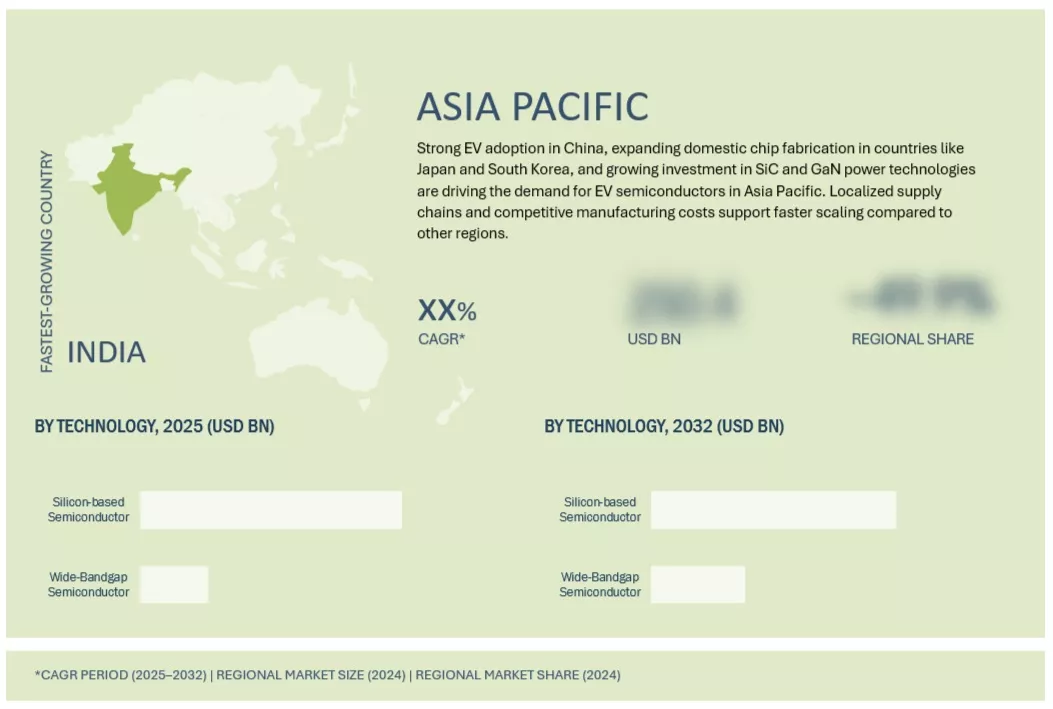
Asia Pacific is projected to lead the EV semiconductors market due to large EV production volumes and a strong regional semiconductor supply base. In 2024, China recorded production of more than 12 million EVs, which directly boosted semiconductor requirements. In April 2024, Japan’s Renesas increased automotive chip capacity by starting its 300 mm Kofu fab. South Korean suppliers are expanding SiC and GaN output to support high voltage EV platforms. Fast charging network growth in China and South Korea is boosting the demand for SiC-based power components. Moreover, government backing for domestic manufacturing is expected to support continued regional dominance during the forecast period.
EV semiconductor market: COMPANY EVALUATION MATRIX
In the EV semiconductors market matrix, Infineon Technologies AG (Star) leads with a broad product portfolio across power electronics, battery management, and automotive microcontrollers, driving large-scale adoption in traction inverters, onboard chargers, and ADAS solutions. NVIDIA Corporation (Emerging Leader) is gaining momentum with its AI and edge processing chips for autonomous driving and advanced infotainment, showing strong growth potential to move toward the leaders' quadrant.
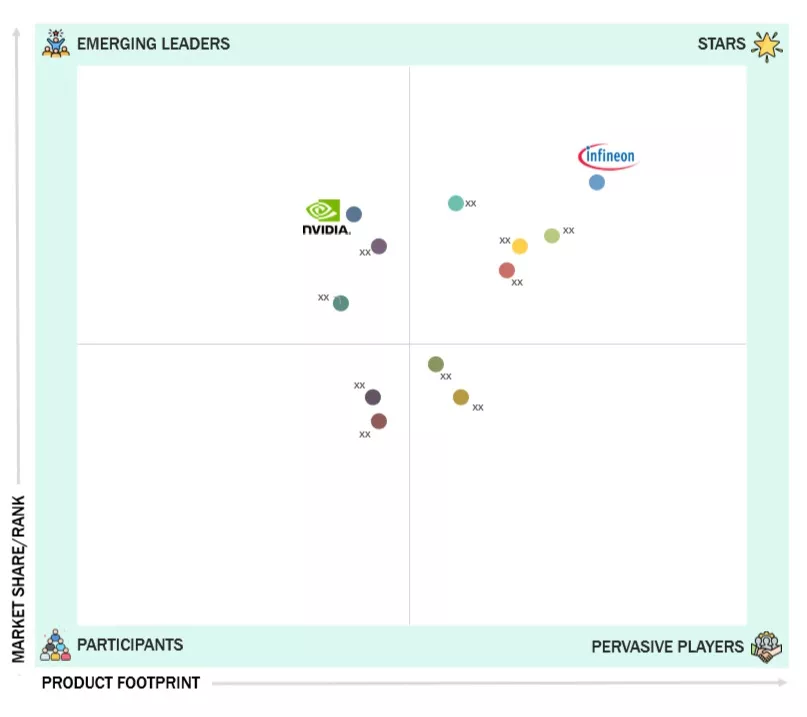
Source: Secondary Research, Interviews with Experts, MarketsandMarkets Analysis
KEY MARKET PLAYERS
MARKET SCOPE
| REPORT METRIC | DETAILS |
|---|---|
| Market Size in 2024 (Value) | USD 19.69 BN |
| Market Forecast in 2032 (Value) | USD 57.48 BN |
| Growth Rate | CAGR of 9.1% from 2025–2032 |
| Years Considered | 2021–2032 |
| Base Year | 2024 |
| Forecast Period | 2025–2032 |
| Units Considered | Value (USD Billion), Volume (Million Units) |
| Report Coverage | Revenue forecast, company ranking, competitive landscape, growth factors, and trends |
| Segments Covered |
|
| Regions Covered | Asia Pacific, Europe, North America |
WHAT IS IN IT FOR YOU: EV semiconductor market REPORT CONTENT GUIDE
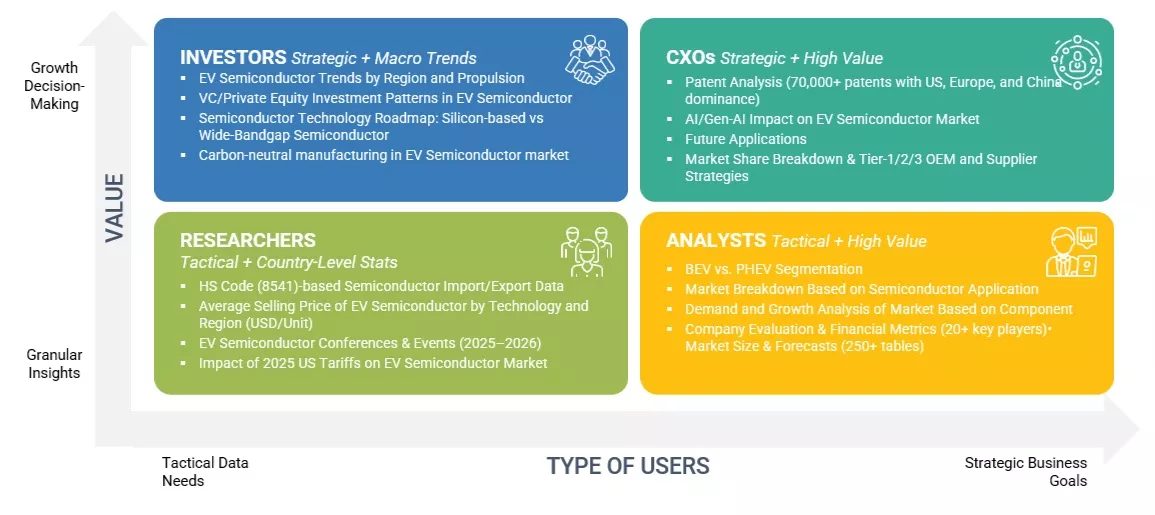
DELIVERED CUSTOMIZATIONS
We have successfully delivered the following deep-dive customizations:
| CLIENT REQUEST | CUSTOMIZATION DELIVERED | VALUE ADDS |
|---|---|---|
| EV Semiconductor SME |
|
|
| EV Manufacturer | Semiconductor BOM and cost structure optimization for latest passenger EV platform |
|
| Tier-1/Tier-2 Integrator | Advanced packaging trends (2.5D/3D/FOCoS) and foundry capability evaluation |
|
| Leading BMS Supplier |
|
|
| Asian Auto Conglomerate | Make-vs-buy advisory for in-house automotive chip design and IP portfolio scan |
|
RECENT DEVELOPMENTS
- September 2025 : Infineon and ROHM signed a Memorandum of Understanding to enable each other as second sources for selected SiC power semiconductor packages. The development increased design and procurement flexibility for automotive, renewable energy, and AI data center applications.
- September 2025 : STMicroelectronics invested USD 60 million to establish a new Panel-Level Packaging (PLP) pilot line at its Tours site. The expansion aimed to boost chip packaging efficiency and flexibility for next-gen automotive and power products.
- August 2025 : Qualcomm started localizing module and chipset production for automotive customers, specifically supporting Indian OEMs and rapidly growing local EV demand.
- July 2025 : Onsemi expanded its collaboration with Schaeffler through a new design win for a major global automaker’s PHEV platform. The solution uses Onsemi’s next-generation EliteSiC MOSFETs to improve inverter efficiency, reduce size, and enhance reliability, making onsemi the exclusive SiC supplier for this program.
- May 2025 : NXP launched the S32R47 family of imaging radar processors in 16 nm FinFET that delivered up to twice the processing power of the prior generation. The devices met ISO 26262 ASIL B/D safety requirements and supported advanced autonomous driving features.
Table of Contents
 Exclusive indicates content/data unique to MarketsandMarkets and not available with any competitors.
Methodology
The research study uses extensive secondary sources, such as company annual reports/presentations, industry association publications, magazine articles, directories, technical handbooks, World Economic Outlook, trade websites, technical articles, and databases, to identify and collect information on the EV semiconductors market. In-depth interviews were conducted with various primary sources, experts from related industries, auto component providers, and service providers, to obtain and verify critical information and assess the growth prospects and market estimations.
Secondary Research
Secondary sources for this research study included corporate filings, such as annual reports, investor presentations, and financial statements; trade, business, and professional associations; whitepapers and automotive semiconductor-related journals; certified publications; articles by recognized authors; directories; and databases. Secondary data was collected and analyzed to determine the overall market size, further validated by primary research.
Primary Research
Extensive primary research was completed after a clear understanding of the EV semiconductors market through secondary research. Multiple primary interviews were conducted with experts from the demand and supply sides. Demand-side participants included EV OEM powertrain, electronics teams, and Tier-1 suppliers focused on integrating the inverter and power module. Supply-side participants included semiconductor device manufacturers, wafer suppliers, packaging technology companies, and national industry associations. The study covered respondents across North America, Europe, and Asia Pacific. Around 34 percent of interviews came from the demand side and 66 percent from the supply side. Primary information was gathered through structured questionnaires, email exchanges, and telephonic discussions. Experts from product development, procurement, and technology strategy functions were included in this report to ensure a clear view of market needs, product roadmaps, and design priorities.
After interacting with industry experts, brief sessions were conducted with experienced independent consultants to reinforce the findings from the primaries. This and the in-house subject matter experts’ opinions led to the findings described in this report.
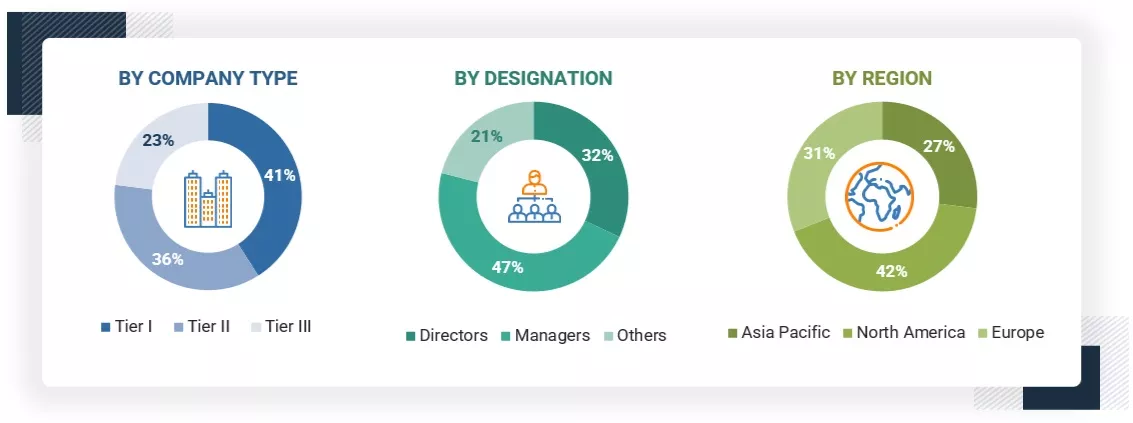
Notes:
- Others included Sales Managers and Product Managers.
- Company tiers are based on the value chain and do not consider revenue.
To know about the assumptions considered for the study, download the pdf brochure
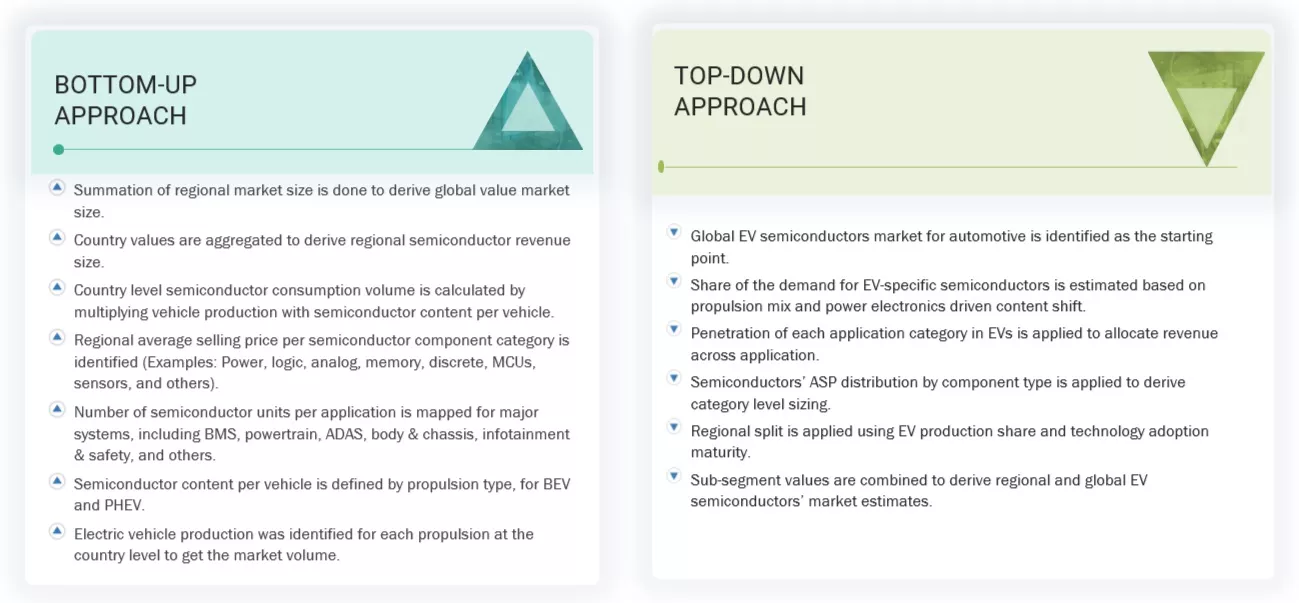
Market Size Estimation
A detailed market estimation approach has been followed to estimate and validate the volume and value of the EV semiconductors market and other submarkets. Given below are the steps followed in this approach:
- The market size has been derived using parameters such as the production of EVs.
- Segment split has been identified through primary and secondary research.
- Key players in the global EV semiconductors market have been identified through secondary research, and their global market ranking has been determined through primary and secondary research.
- The research methodology included the study of the annual and quarterly financial reports & regulatory filings of major market players, as well as interviews with industry experts for detailed market insights.
- All major penetration rates, percentage shares, splits, and breakdowns for the global EV semiconductors market have been determined using secondary sources and verified through primary sources.
- All key macro indicators affecting the revenue growth of the market segments and subsegments have been accounted for, viewed in extensive detail, verified through primary research, and analyzed to get the validated and verified quantitative & qualitative data.
- The gathered market data has been consolidated and added with detailed inputs, analyzed, and presented in this report.
EV Semiconductors Market : Top-Down and Bottom-Up Approach
Data Triangulation
After arriving at the overall market size through the aforementioned methodology, the EV semiconductors market has been split into several segments and subsegments. Where applicable, the data triangulation procedure has been employed to complete the overall market engineering process and arrive at the exact market value for key segments and subsegments. The extrapolated market data has been triangulated by studying various macro indicators and regional trends from both the demand and supply-side participants.
Market Definition
The EV semiconductors market encompasses the sale of integrated circuits (ICs) and discrete power devices explicitly designed to manage, control, and convert electrical energy within electric and electrified vehicles. These semiconductor components are essential for EV core functional blocks, including the traction inverter, Battery Management System (BMS), on-board charger (OBC), and more. Key component types include power semiconductors (such as SiC MOSFETs, GaN FETs, and IGBTs), microcontrollers (MCUs), analog ICs, and sensors, which enable the two EV types, namely, BEVs and PHEVs.
Stakeholders
- Advanced Packaging and Module Integrators
- Automotive Electronics Providers
- Automotive Tier-1 Suppliers
- Automotive Trade Associations
- Government Agencies and Policymakers
- OEMs
- Semiconductor Designing Companies
- Semiconductor Industry Associations and Alliances
- Semiconductor Manufacturers
- Wafer and Raw Material Suppliers
- Sensor and Microcontroller Suppliers
Report Objectives
- To analyze and forecast the EV semiconductors market in terms of volume (thousand units) and value (USD billion) from 2025 to 2032
-
To define, describe, and forecast the market by technology, propulsion, application, component type, and region
- To segment and forecast the market based on Technology (Silicon-based Semiconductor and Wide-Bandgap Semiconductor)
- To segment and forecast the market based on Propulsion [Battery Electric Vehicle (BEV) and Plug-In Hybrid Electric Vehicle (PHEV)]
- To segment and forecast the market based on Application (Battery Management System, Powertrain System, ADAS, Body & Chassis, and Infotainment & Connectivity)
- To segment and forecast the market based on Component Type (Power ICs and Modules, Microcontrollers & Processors, Discretes, Communication and Interface ICs, Sensor ICs, Gate Driver ICs, Memory & Storage ICs, and Other semiconductors)
- To segment and forecast the market based on region (Asia Pacific, Europe, and North America)
- To identify and analyze key drivers, challenges, restraints, and opportunities influencing the market growth
- To strategically analyze the market, considering individual growth trends, prospects, and contributions to the total market
-
To study the following with respect to the market
- Supply Chain Analysis
- Ecosystem Analysis
- Technology Analysis
- Trade Analysis
- Case Study Analysis
- Patent Analysis
- Sustainability & Regulatory Landscape
- Average Selling Price Analysis
- Trends/Disruptions Impacting Customer Business
- Impact of AI/Gen AI
- Impact of 2025 US Tariffs
- Key Stakeholders and Buying Criteria
- Key Conferences and Events
- MNM insights on the EV semiconductors market trends, policy drives, semiconductor sourcing models, supply chain risks, and regional semiconductor hotspots & localization dynamics
- To strategically profile the key players and comprehensively analyze their market share and core competencies
- To track and analyze competitive developments, such as deals (joint ventures, mergers & acquisitions, partnerships, collaborations), product developments and launches, and other activities undertaken by the key industry participants
Available Customizations
With the given market data, MarketsandMarkets offers customizations in accordance with the company's specific needs. The following options are available:
- EV Semiconductors Market, By Commercial Vehicle Type at the Regional Level (for regions covered in the report)
- EV Semiconductors Market, By Technology, for additional countries (for countries not covered in the report)
- Additional Company Profiles (Up to 5)


Personalize This Research
- Triangulate with your Own Data
- Get Data as per your Format and Definition
- Gain a Deeper Dive on a Specific Application, Geography, Customer or Competitor
- Any level of Personalization
Let Us Help You
- What are the Known and Unknown Adjacencies Impacting the EV Semiconductors Market
- What will your New Revenue Sources be?
- Who will be your Top Customer; what will make them switch?
- Defend your Market Share or Win Competitors
- Get a Scorecard for Target Partners

Custom Market Research Services
We Will Customise The Research For You, In Case The Report Listed Above Does Not Meet With Your Requirements
Get 10% Free CustomisationTESTIMONIALS

JIM NAAS
PRODUCT DIRECTOR, WEASLER
Weasler Engineering, a CentroMotion organization
Global Provider of Industrial Actuation & Control Solutionswww.weasler.com
Our organization was interested in learning more about the attractiveness of a particular market space. We contacted MarketsandMarkets to help us based on previous positive experiences we had with them. The results did not disappoint! We discussed our objectives with them, and the team at MarketsandMarkets developed and executed a proposal that met our needs precisely. We were very impressed by their level of expertise, the quality of the analysis and their insightful recommendations. We would not hesitate in working with them again in the future.

Matt Kardel,
Vice President
Aptiv,
A global technology company that develops safer, greener and more connected solutions.www.aptiv.com
We contracted with
MarketsandMarkets to evaluate the value chain and potential go-to-market partners related to our
interest in the Fleet Management space. The team successfully completed the work on time and at the
pricing agreed. MarketsandMarkets listened and understood our objectives and collaborated well with
us to help us get the visibility we needed to make an investment.
We have subsequently used
MarketsandMarkets again related to Smart Cities to good results.
- China EV Semiconductors Market
- India EV Semiconductors Market
- Japan EV Semiconductors Market
- South Korea EV Semiconductors Market
- Germany EV Semiconductors Market
- France EV Semiconductors Market
- Italy EV Semiconductors Market
- Spain EV Semiconductors Market
- UK EV Semiconductors Market
- Canada EV Semiconductors Market
- Mexico EV Semiconductors Market
- US EV Semiconductors Market






Growth opportunities and latent adjacency in EV Semiconductors Market