
Canada EV Semiconductors Market (2025-2030)

The Canada EV Semiconductors Market was valued at $30 Million in 2025 and projected to reach to $70 Million by 2030, representing a compound annual growth rate of 16.1%. Canada's EV semiconductors market is poised for accelerated expansion, driven by increasing electric vehicle adoption rates and the country's commitment to carbon neutrality by 2050.


| Market Size in | USD 26.32 MN |
| Market Forecast in | |
| CAGR | |
| Forecast Period | |
| Units Considered | Value (USD MN) |
Canada EV Semiconductors Market Trends and Insights
- This acceleration significantly outpaces the global average of 9.1%, reflecting Canada's strategic position in North American electric vehicle manufacturing and semiconductor supply chains.
- Canada's growth trajectory is driven by increasing EV adoption, government incentives for clean transportation, and investments in domestic semiconductor capabilities to support the automotive transition. The Canadian market benefits from proximity to major U.S.
- automotive hubs and established relationships with global semiconductor suppliers.
- Between 2025 and 2030, Canada is expected to capture growing demand from both domestic EV manufacturers and cross-border supply agreements.
- The country's commitment to carbon neutrality and supportive regulatory frameworks are accelerating semiconductor innovation in power management, battery control systems, and autonomous driving technologies.
- Canada's EV semiconductors market represents a critical component of the broader North American automotive electrification ecosystem..
Key Market Statistics
- CAGR (2025-2030) 16.1% CAGR
- Market Size, 2025 ~USD 30 Million
- Forecast, 2030 ~USD 70 Million
- Country Canada
Canada EV Semiconductors Market Overview
Exceptional Growth Trajectory :
Canada's EV semiconductors market is projected to grow from $30.0 million in 2025 to $70.0 million by 2030, with a CAGR of 16.1%, significantly outpacing the global average of 9.1%.
North American Supply Chain Hub :
Canada's strategic position in North American EV manufacturing and semiconductor supply chains positions it as a critical node for regional semiconductor distribution and innovation.
Government Support & Incentives :
Federal and provincial initiatives promoting EV adoption and domestic semiconductor manufacturing create favorable conditions for market expansion and investment opportunities.
OEM Integration Opportunities :
Growing partnerships between Canadian automotive manufacturers and semiconductor suppliers strengthen the domestic ecosystem and drive demand for specialized EV semiconductor solutions.
Canada EV Semiconductors Market Dynamics
- The market's 16.1% CAGR reflects strong demand from domestic automakers and the establishment of advanced manufacturing facilities.
- Government policies supporting EV infrastructure and semiconductor localization further bolster growth prospects. The forecast period through 2030 will witness intensified competition among semiconductor suppliers seeking to capture market share in Canada's growing EV sector.
- Strategic partnerships between Canadian tech companies and international semiconductor manufacturers will enhance innovation capabilities.
- Investment in R&D for battery management systems, power electronics, and autonomous driving chips will create substantial opportunities for stakeholders aligned with Canada's clean technology objectives..
Market Ecosystem
EV semiconductor market: COMMERCIAL USE CASES ACROSS INDUSTRIES
| COMPANY | USE CASE DESCRIPTION | BENEFITS |
|---|---|---|
 |
SiC MOSFETs in Model 3/Y for traction inverters and onboard chargers | Enhanced acceleration, faster charging, extended range, improved inverter efficiency |
 |
Advanced BMS ICs in Prius and bZ4X models | Precise cell monitoring, improved battery life, safer fast charging |
 |
Domain controllers and zonal ECUs in MEB platform EVs | Centralized processing for infotainment and safety, efficient over-the-air updates |
Logos and trademarks shown above are the property of their respective owners. Their use here is for informational and illustrative purposes only.
Related Ecosystem
Automotive Advance Technologies
- Battery Electric Vehicle (BEV)
- Light Commercial Vehicles (LCVs)
- Fuel Cell Electric Vehicle (FCEV)
- Hybrid Electric Vehicle (HEV)
- Internal Combustion Engine (ICE)
- BOSCH LIMITED
- Continental ag
- Visteon Corporation
- DENSO Corporation
- ZF FRIEDRICHSHAFEN AG
Automotive Electronics And Electrical Equipment
- Battery Electric Vehicle (BEV)
- Light Commercial Vehicles (LCVs)
- Fuel Cell Electric Vehicle (FCEV)
- Sensors
- Hybrid Electric Vehicle (HEV)
- BOSCH LIMITED
- DENSO Corporation
- Continental ag
- Panasonic Holdings Corporation
- Texas Instruments Incorporated
Electric Hybrid Vehicles
- Battery Electric Vehicle (BEV)
- Fuel Cell Electric Vehicle (FCEV)
- Light Commercial Vehicles (LCVs)
- Hybrid Electric Vehicle (HEV)
- Agricultural Tractors
- Visteon Corporation
- BOSCH LIMITED
- Byd company ltd.
- Tesla, Inc.
- FORD MOTOR COMPANY
Key Takeaways
- Canada's EV semiconductors market will more than double from $30.0M (2025) to $70.0M (2030), driven by 16.1% CAGR growth.
- Canada's growth rate of 16.1% significantly exceeds the global CAGR of 9.1%, positioning the country as a high-growth market in the sector.
- Government incentives, EV adoption acceleration, and North American supply chain integration are primary growth catalysts for Canada's market expansion.
- Canada's strategic location and semiconductor investments position it as a key supplier hub for North American EV manufacturers through 2030.
EV Semiconductors Market Report Scope
| Report Metric | Details |
|---|---|
| Base Year | 2025 |
| Fastest Growing Segment | WIDE-BANDGAP SEMICONDUCTOR (Technology) |
| Forecast Period | 2025–2030 |
| Growth Rate | CAGR of 9.1% from 2025 to 2030 |
| Largest Segment | SILICON-BASED SEMICONDUCTOR (Technology) |
| Market Size Base Year (Billions) | ~USD 31.24 (2025) |
| Revenue Forecast (Billions) | ~USD 48.29 (2030) |
| Segments Covered | Technology, Propulsion, Component, Application |
Canada EV Semiconductors Market Report Segmentation
4 segment dimensions are covered across the global market.
By Technology
- Silicon-Based Semiconductor
- Wide-Bandgap Semiconductor
By Propulsion
- Bev
- Phev
By Component
- Communication & Interface Ic
- Discrete
- Gate Driver Ic
- Memory & Storage Ic
- Microcontroller & Processor
- Other Semiconductors
- Power Ic & Module
- Sensor Ic
By Application
- ADAS
- Bms
- Body & Chassis
- Infotainment & Connectivity
- Powertrain System
Target Audience
- Semiconductor Manufacturers : Evaluate Canada's market potential, identify expansion opportunities, and understand local demand drivers for EV-specific chip products and manufacturing capabilities.
- Automotive OEMs & Suppliers : Assess semiconductor supply chain reliability, sourcing strategies, and partnership opportunities with Canadian suppliers to support EV production scaling.
- Investment & Private Equity Firms : Analyze market growth potential, identify acquisition targets, and evaluate investment returns in Canada's high-growth EV semiconductor sector.
- Government & Policy Makers : Understand market dynamics to inform industrial policy, incentive programs, and strategic initiatives supporting Canada's semiconductor and EV ecosystem development.
- Technology & Innovation Consultants : Leverage market insights to advise clients on R&D priorities, technology trends, and competitive positioning within Canada's emerging EV semiconductor landscape.
Key Companies in the Canada EV Semiconductors Market
| Company | HQ | Ownership | Strongest segments |
|---|---|---|---|
| INFINEON TECHNOLOGIES AG | Germany | ||
| STMICROELECTRONICS | Switzerland | Public Company | Power ICs & Modules (Silicon-based),Wide-Bandgap Power (SiC MOSFETs & Modules),Automotive MCUs & Processors, |
| NXP SEMICONDUCTORS | Netherlands | Public Company | MCUs & Application/Domain Processors for EV (powertrain, ADAS, body, gateways),Battery Management System ICs and Analog/Interface,Sensors (pressure, inertial, magnetic, environmental) for EV, |
| TEXAS INSTRUMENTS INCORPORATED | United States | Public Company | Power ICs & Modules (incl. battery management, DC/DC, AC/DC, motor drives),MCUs & Processors (embedded processing for powertrain, BMS, ADAS control),Sensors & Signal Chain (radar, current/voltage sensing, data converters, amplifiers), |
| RENESAS ELECTRONICS CORPORATION | Japan | Public Company | MCUs & Processors,Power ICs & Modules,Sensors, |
| NVIDIA CORPORATION | United States | Public Company | MCUs & Processors (ADAS / central compute),MCUs & Processors (Infotainment / cockpit),Sensors & perception-enabling components, |
| SEMICONDUCTOR COMPONENTS INDUSTRIES, LLC | United States | Private Company | Power ICs & Modules,MCUs & Processors,Sensors, |
| ANALOG DEVICES, INC. | United States | Public Company | Battery Management System (incl. power management & isolation),Powertrain (inverter, OBC, DC-DC signal chain & drivers),ADAS & Autonomous (sensing, data conversion, processing support), |
| ROBERT BOSCH GMBH | India | Private Company | Power ICs & Modules (Silicon-based),Wide-Bandgap Power (SiC/GaN),MCUs & Processors, |
| MICRON TECHNOLOGY, INC. | United States | Public Company | DRAM / LPDDR for ADAS, infotainment, and domain controllers,NAND, managed NAND, and auto SSD for data logging and storage,NOR and legacy memory for BMS, powertrain, and body ECUs, |
| MICROCHIP TECHNOLOGY INC. | United States | ||
| TOSHIBA CORPORATION | Japan | Private Company | Power ICs & Modules (silicon-based),MCUs & Processors (in-vehicle digital and logic microcomputers),Analog & Mixed-Signal ICs (incl. BMS, power management), |
| ROHM CO., LTD. | Japan |
INFINEON TECHNOLOGIES AG
Infineon Technologies AG is a German semiconductor manufacturer specializing in automotive, industrial, and power management solutions.
STMICROELECTRONICS
STMicroelectronics is a Swiss-based semiconductor company founded in 1987 with 48,000 employees, operating as a public company and serving diverse markets including automotive, industrial, and consumer electronics.
NXP SEMICONDUCTORS
NXP Semiconductors is a Dutch public company founded in 2006 with 32,169 employees, specializing in semiconductors for automotive, industrial, mobile, and IoT applications.
TEXAS INSTRUMENTS INCORPORATED
Texas Instruments Incorporated is a United States-based semiconductor company founded in 1930 with 33,000 employees, operating as a public company and providing analog and embedded processing solutions.
RENESAS ELECTRONICS CORPORATION
Renesas Electronics Corporation is a Japanese public company founded in 2002 with 21,907 employees, specializing in microcontrollers, analog semiconductors, and power management solutions.
NVIDIA CORPORATION
NVIDIA Corporation is a United States-based public company founded in 1993 with 42,000 employees, specializing in graphics processing units and AI computing platforms.
SEMICONDUCTOR COMPONENTS INDUSTRIES, LLC
Semiconductor Components Industries, LLC is a United States-based private company founded in 1999 with 9,570 employees, manufacturing semiconductors and analog components.
ANALOG DEVICES, INC.
Analog Devices, Inc. is a United States-based public company founded in 1965 with 24,500 employees, specializing in analog, mixed-signal, and digital signal processing semiconductors.
ROBERT BOSCH GMBH
Robert Bosch GmbH is a German multinational private company founded in 1886 with 412,774 employees, operating globally with significant operations in India and serving automotive, industrial, and consumer markets.
MICRON TECHNOLOGY, INC.
Micron Technology, Inc. is a United States-based public company founded in 1978 with 53,000 employees, specializing in memory and storage solutions including DRAM and NAND flash.
MICROCHIP TECHNOLOGY INC.
Microchip Technology Inc. is a United States-based semiconductor company providing microcontrollers, analog semiconductors, and embedded systems solutions.
TOSHIBA CORPORATION
Toshiba Corporation is a Japanese private company founded in 1875 with 106,648 employees, operating as a diversified conglomerate with significant semiconductor and electronics divisions.
ROHM CO., LTD.
Rohm Co., Ltd. is a Japanese semiconductor manufacturer specializing in analog semiconductors, power management, and discrete components for industrial and consumer applications.
Reasons to Buy this Report
- Market-Specific Growth Data : Access detailed Canadian market sizing, forecasts, and CAGR analysis that outpaces global trends, enabling precise investment and expansion planning for the region.
- Competitive Landscape Intelligence : Understand key players, market consolidation trends, and competitive positioning specific to Canada's EV semiconductor ecosystem and supply chain dynamics.
- Regulatory & Policy Insights : Gain comprehensive analysis of Canadian government incentives, EV adoption policies, and semiconductor localization initiatives impacting market opportunities.
- Strategic Partnership Opportunities : Identify potential collaboration points with Canadian OEMs, semiconductor manufacturers, and technology providers within the North American EV supply chain.
- Investment Decision Support : Make informed capital allocation decisions with country-specific market trends, risk assessments, and growth projections through 2030 for Canadian operations.
Frequently asked questions
What is the current size of Canada's EV semiconductors market in 2025?
Canada's EV semiconductors market is valued at $30.0 million in 2025, with strong growth momentum expected through the forecast period.
What is the projected market size for Canada's EV semiconductors by 2030?
Canada's EV semiconductors market is projected to reach $70.0 million by 2030, representing more than a doubling of market value over five years.
How does Canada's EV semiconductors growth compare to global trends?
Canada's 16.1% CAGR significantly outpaces the global average of 9.1%, making it one of the fastest-growing markets in the EV semiconductors sector.
What factors are driving growth in Canada's EV semiconductors market?
Key drivers include increasing EV adoption, government clean transportation incentives, North American supply chain integration, and domestic semiconductor capability investments.
Why is Canada strategically important for EV semiconductor supply chains?
Canada's proximity to major U.S. automotive manufacturing hubs, established supplier relationships, and commitment to carbon neutrality make it a critical node in North American EV semiconductor networks.
RESEARCH METHODOLOGY
The research study uses extensive secondary sources, such as company annual reports/presentations, industry association publications, magazine articles, directories, technical handbooks, World Economic Outlook, trade websites, technical articles, and databases, to identify and collect information on the EV semiconductors market. In-depth interviews were conducted with various primary sources, experts from related industries, auto component providers, and service providers, to obtain and verify critical information and assess the growth prospects and market estimations.
Secondary Research
Secondary sources for this research study included corporate filings, such as annual reports, investor presentations, and financial statements; trade, business, and professional associations; whitepapers and automotive semiconductor-related journals; certified publications; articles by recognized authors; directories; and databases. Secondary data was collected and analyzed to determine the overall market size, further validated by primary research.
Primary Research
Extensive primary research was completed after a clear understanding of the EV semiconductors market through secondary research. Multiple primary interviews were conducted with experts from the demand and supply sides. Demand-side participants included EV OEM powertrain, electronics teams, and Tier-1 suppliers focused on integrating the inverter and power module. Supply-side participants included semiconductor device manufacturers, wafer suppliers, packaging technology companies, and national industry associations. The study covered respondents across North America, Europe, and Asia Pacific. Around 34 percent of interviews came from the demand side and 66 percent from the supply side. Primary information was gathered through structured questionnaires, email exchanges, and telephonic discussions. Experts from product development, procurement, and technology strategy functions were included in this report to ensure a clear view of market needs, product roadmaps, and design priorities.
After interacting with industry experts, brief sessions were conducted with experienced independent consultants to reinforce the findings from the primaries. This and the in-house subject matter experts’ opinions led to the findings described in this report.
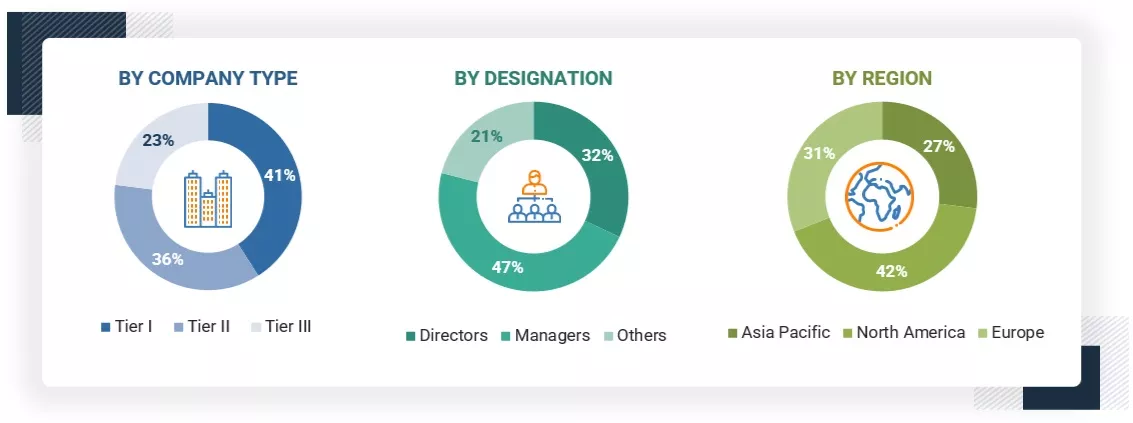
Notes:
- Others included Sales Managers and Product Managers.
- Company tiers are based on the value chain and do not consider revenue.
To know about the assumptions considered for the study, download the pdf brochure
Market Size Estimation
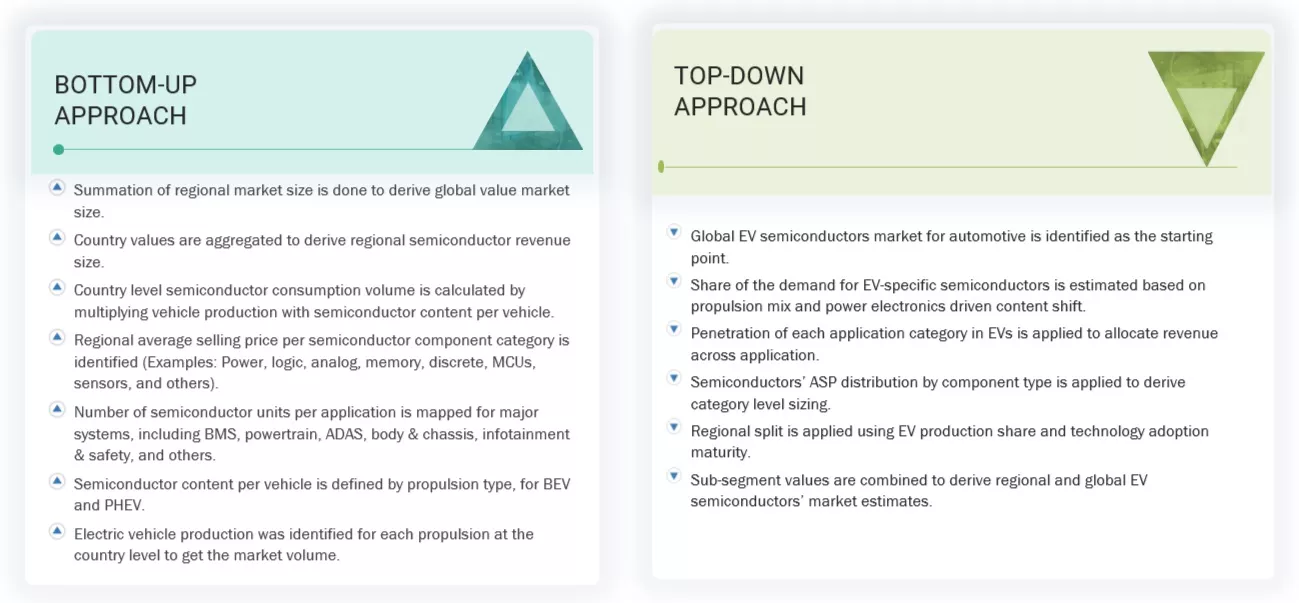
A detailed market estimation approach has been followed to estimate and validate the volume and value of the EV semiconductors market and other submarkets. Given below are the steps followed in this approach:
- The market size has been derived using parameters such as the production of EVs.
- Segment split has been identified through primary and secondary research.
- Key players in the global EV semiconductors market have been identified through secondary research, and their global market ranking has been determined through primary and secondary research.
- The research methodology included the study of the annual and quarterly financial reports & regulatory filings of major market players, as well as interviews with industry experts for detailed market insights.
- All major penetration rates, percentage shares, splits, and breakdowns for the global EV semiconductors market have been determined using secondary sources and verified through primary sources.
- All key macro indicators affecting the revenue growth of the market segments and subsegments have been accounted for, viewed in extensive detail, verified through primary research, and analyzed to get the validated and verified quantitative & qualitative data.
- The gathered market data has been consolidated and added with detailed inputs, analyzed, and presented in this report.
EV Semiconductors Market : Top-Down and Bottom-Up Approach
Data Triangulation
After arriving at the overall market size through the aforementioned methodology, the EV semiconductors market has been split into several segments and subsegments. Where applicable, the data triangulation procedure has been employed to complete the overall market engineering process and arrive at the exact market value for key segments and subsegments. The extrapolated market data has been triangulated by studying various macro indicators and regional trends from both the demand and supply-side participants.
Market Definition
The EV semiconductors market encompasses the sale of integrated circuits (ICs) and discrete power devices explicitly designed to manage, control, and convert electrical energy within electric and electrified vehicles. These semiconductor components are essential for EV core functional blocks, including the traction inverter, Battery Management System (BMS), on-board charger (OBC), and more. Key component types include power semiconductors (such as SiC MOSFETs, GaN FETs, and IGBTs), microcontrollers (MCUs), analog ICs, and sensors, which enable the two EV types, namely, BEVs and PHEVs.
Stakeholders
- Advanced Packaging and Module Integrators
- Automotive Electronics Providers
- Automotive Tier-1 Suppliers
- Automotive Trade Associations
- Government Agencies and Policymakers
- OEMs
- Semiconductor Designing Companies
- Semiconductor Industry Associations and Alliances
- Semiconductor Manufacturers
- Wafer and Raw Material Suppliers
- Sensor and Microcontroller Suppliers
Report Objectives
- To analyze and forecast the EV semiconductors market in terms of volume (thousand units) and value (USD billion) from 2025 to 2032
-
To define, describe, and forecast the market by technology, propulsion, application, component type, and region
- To segment and forecast the market based on Technology (Silicon-based Semiconductor and Wide-Bandgap Semiconductor)
- To segment and forecast the market based on Propulsion [Battery Electric Vehicle (BEV) and Plug-In Hybrid Electric Vehicle (PHEV)]
- To segment and forecast the market based on Application (Battery Management System, Powertrain System, ADAS, Body & Chassis, and Infotainment & Connectivity)
- To segment and forecast the market based on Component Type (Power ICs and Modules, Microcontrollers & Processors, Discretes, Communication and Interface ICs, Sensor ICs, Gate Driver ICs, Memory & Storage ICs, and Other semiconductors)
- To segment and forecast the market based on region (Asia Pacific, Europe, and North America)
- To identify and analyze key drivers, challenges, restraints, and opportunities influencing the market growth
- To strategically analyze the market, considering individual growth trends, prospects, and contributions to the total market
-
To study the following with respect to the market
- Supply Chain Analysis
- Ecosystem Analysis
- Technology Analysis
- Trade Analysis
- Case Study Analysis
- Patent Analysis
- Sustainability & Regulatory Landscape
- Average Selling Price Analysis
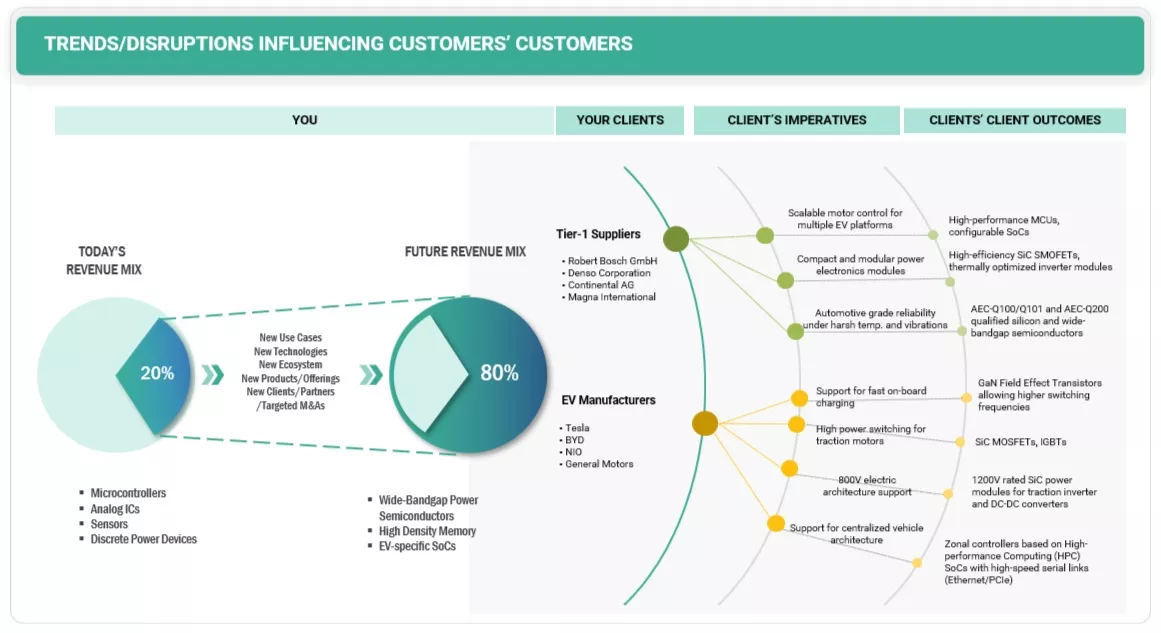
- Trends/Disruptions Impacting Customer Business
- Impact of AI/Gen AI
- Impact of 2025 US Tariffs
- Key Stakeholders and Buying Criteria
- Key Conferences and Events
- MNM insights on the EV semiconductors market trends, policy drives, semiconductor sourcing models, supply chain risks, and regional semiconductor hotspots & localization dynamics
- To strategically profile the key players and comprehensively analyze their market share and core competencies
- To track and analyze competitive developments, such as deals (joint ventures, mergers & acquisitions, partnerships, collaborations), product developments and launches, and other activities undertaken by the key industry participants
Available Customizations
With the given market data, MarketsandMarkets offers customizations in accordance with the company's specific needs. The following options are available:
- EV Semiconductors Market, By Commercial Vehicle Type at the Regional Level (for regions covered in the report)
- EV Semiconductors Market, By Technology, for additional countries (for countries not covered in the report)
- Additional Company Profiles (Up to 5)
Get the Full EV Semiconductors Market Report
Full forecast, segment splits, and company analysis for all EV Semiconductors Market.
- China EV Semiconductors Market
- India EV Semiconductors Market
- Japan EV Semiconductors Market
- South Korea EV Semiconductors Market
- Germany EV Semiconductors Market
- France EV Semiconductors Market
- Italy EV Semiconductors Market
- Spain EV Semiconductors Market
- UK EV Semiconductors Market
- Mexico EV Semiconductors Market
- US EV Semiconductors Market
Need a Tailored Report?
Customize this report to your needs
Get 10% FREE Customization
Customize This Report
