
Canada eVTOL Aircraft Market (2031-2036)

The Canada eVTOL Aircraft Market was valued at $108.1 Million in 2031 and projected to reach to $164.5 Million by 2036, representing a compound annual growth rate of 11.1%. Canada's eVTOL aircraft market is poised for steady expansion driven by urbanization pressures in major metropolitan areas including Toronto, Vancouver, and Montreal, where congestion mitigation solutions are increasingly critical.


| Market Size in | USD 26.32 MN |
| Market Forecast in | |
| CAGR | |
| Forecast Period | |
| Units Considered | Value (USD MN) |
Canada eVTOL Aircraft Market Trends and Insights
- Canada's geographic expanse, urban congestion in major metropolitan areas, and supportive regulatory environment are driving adoption of electric vertical takeoff and landing technologies across the country.
- The Canadian market benefits from strong aerospace heritage, government investment in clean aviation, and partnerships between domestic operators and international eVTOL manufacturers. Canada's eVTOL sector is accelerating as urban air mobility solutions address transportation challenges in cities like Toronto, Vancouver, and Montreal.
- Canada's commitment to net-zero emissions and sustainable aviation fuels creates favorable conditions for eVTOL commercialization through 2036.
- Infrastructure development, including vertiport construction and air traffic management systems, is underway across Canada to support operational deployment. The forecast period through 2036 will see Canada emerge as a key North American hub for eVTOL innovation and deployment.
- Canada's regulatory frameworks, developed in collaboration with Transport Canada, are establishing certification pathways that position the nation competitively within the global eVTOL ecosystem..
Key Market Statistics
- CAGR (2031-2036) 11.1% CAGR
- Market Size, 2031 ~USD 108.1 Million
- Forecast, 2036 ~USD 164.5 Million
- Country Canada
Canada eVTOL Aircraft Market Overview
Market Valuation Growth :
Canada's eVTOL aircraft market is valued at USD 108.1 million in 2031 and is projected to reach USD 164.5 million by 2036, demonstrating robust expansion opportunities across the country.
Strong CAGR Performance :
The Canadian market is experiencing an 11.1% compound annual growth rate, slightly below the global average of 12.3%, indicating steady but measured adoption of electric vertical takeoff and landing technologies.
Geographic Advantages :
Canada's vast geographic expanse and dispersed population centers create unique opportunities for eVTOL deployment in remote areas, reducing reliance on traditional infrastructure while improving connectivity.
Regulatory Support :
Canada's supportive regulatory environment and progressive aviation policies position the country as a favorable market for eVTOL innovation, attracting manufacturers and operators seeking stable governance frameworks.
Canada eVTOL Aircraft Market Dynamics
- The country's advanced aerospace infrastructure, skilled workforce, and commitment to sustainable transportation technologies create a conducive environment for market growth.
- Government initiatives supporting clean aviation and urban air mobility development further accelerate adoption prospects. The 11.1% CAGR through 2036 reflects growing investment in eVTOL infrastructure, pilot programs, and commercial operations across Canadian cities.
- Strategic partnerships between domestic operators and international manufacturers, combined with improving battery technology and regulatory clarity, will drive market penetration.
- Canada's geographic diversity presents opportunities for both urban air mobility and regional connectivity applications, positioning the nation as a significant growth market within North America's eVTOL ecosystem..
Market Ecosystem
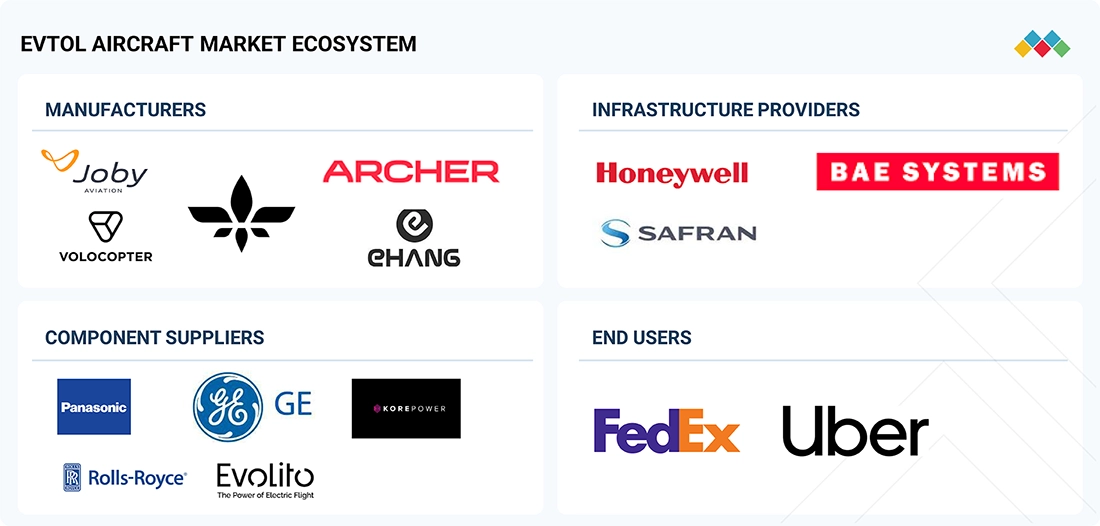
EVTOL AIRCRAFT MARKET: COMMERCIAL USE CASES ACROSS INDUSTRIES
| COMPANY | USE CASE DESCRIPTION | BENEFITS |
|---|---|---|
 |
Integrated urban air traffic management and vertiport network planning for scalable urban air mobility operations. | Improves airspace coordination, boosts operational safety, minimizes congestion risk, and facilitates efficient fleet deployment. |
 |
All-electric air taxi operations with vertical takeoff capability for short-range urban and airport connectivity. | Reduces travel time, cuts operating emissions, minimizes noise, and promotes sustainable urban transport. |
 |
High-frequency urban shuttle services using electric vertical lift aircraft for city-to-city mobility. | Increases route flexibility, supports quick passenger turnaround, lowers per-trip operating costs, and improves urban connectivity. |
 |
Autonomous passenger eVTOL deployment for pilotless urban air mobility and smart city integration. | Removes pilot dependency, boosts fleet scalability, improves safety with automated control systems, and supports smart transportation ecosystems. |
Logos and trademarks shown above are the property of their respective owners. Their use here is for informational and illustrative purposes only.
Related Ecosystem
Key Takeaways
- Canada's eVTOL market is valued at USD 108.1 million in 2031 and will grow to USD 164.5 million by 2036 at an 11.1% CAGR.
- Canada's vast geography and urban congestion in major cities drive demand for electric vertical takeoff and landing solutions.
- Transport Canada's regulatory framework and government sustainability commitments accelerate eVTOL commercialization across Canada.
- Canada's aerospace expertise and infrastructure investments position the nation as a North American eVTOL innovation leader through 2036.
eVTOL Aircraft Market Report Scope
| Report Metric | Details |
|---|---|
| Base Year | 2031 |
| Fastest Growing Segment | HYBRID ELECTRIC (Propulsion) |
| Forecast Period | 2031–2036 |
| Growth Rate | CAGR of 12.3% from 2031 to 2036 |
| Largest Segment | FULLY ELECTRIC (Propulsion) |
| Market Size Base Year (Billions) | ~USD 3.19 (2031) |
| Revenue Forecast (Billions) | ~USD 5.7 (2036) |
| Segments Covered | Lift Technology, Mtow, Propulsion, Operating Range, System, Mode Of Operation, Application |
Canada eVTOL Aircraft Market Report Segmentation
7 segment dimensions are covered across the global market.
By Lift Technology
- Lift Plus Cruise
- Multirotor
- Vectored Thrust
By Mtow
- 1,001–2,000 Kg
- 100–1,000 Kg
- >2,000 Kg
By Propulsion
- Fully Electric
- Hybrid Electric
By Operating Range
- >200 Km
- =200 Km
By System
- Aerostructures & Cabin Interiors
- Avionics
- Batteries & Cells
- Electric Motors & Engines
- Other Systems
- Software
By Mode Of Operation
- Fully Autonomous
- Piloted
By Application
- Air Taxis/Air Metros/Air Shuttles
- Cargo Transport/Last-Mile Delivery
- Special Mission & Other Applications
CANADA: EVTOL AIRCRAFT MARKET, BY APPLICATION, 2031–2035
| Segment | 2031 | 2032 | 2033 | 2034 | 2035 | CAGR (%) |
|---|---|---|---|---|---|---|
| AIR TAXIS/AIR METROS/AIR SHUTTLES | 79.9 | 89.3 | 103.4 | 112.8 | 126.9 | 12.3 |
| CARGO TRANSPORT/LAST-MILE DELIVERY | 4.7 | 4.7 | 4.7 | 9.4 | 9.4 | 18.9 |
| SPECIAL MISSION & OTHER APPLICATIONS | 23.5 | 23.5 | 23.5 | 23.5 | 28.2 | 4.7 |
| TOTAL | 108.1 | 117.5 | 131.6 | 145.7 | 164.5 | 11.1 |
Target Audience
- eVTOL Manufacturers & OEMs : Manufacturers seeking to establish or expand Canadian operations need detailed market sizing, growth projections, and regional demand drivers to inform production capacity and market entry strategies.
- Urban Air Mobility Operators : Commercial operators planning service launches in Canadian cities require market valuation data, growth forecasts, and regulatory insights to develop business cases and operational roadmaps.
- Investment & Private Equity Firms : Investors evaluating opportunities in Canada's aerospace and clean technology sectors need precise market data, CAGR analysis, and growth projections to assess portfolio potential and returns.
- Government & Policy Makers : Canadian federal and provincial authorities developing aviation policy and infrastructure investments require market intelligence to align regulatory frameworks and funding with industry growth trajectories.
- Technology & Infrastructure Providers : Suppliers of batteries, charging infrastructure, and supporting technologies need Canadian market-specific data to identify demand patterns and develop localized solutions for the eVTOL ecosystem.
Key Companies in the Canada eVTOL Aircraft Market
| Company | HQ | Ownership | Strongest segments |
|---|---|---|---|
| SAFRAN GROUP | France | Public Company | Aerospace Propulsion,Aircraft Equipment, Defense and Aerosystems,Aircraft Interiors, |
| LMI AEROSPACE, INC. | United States | Private Company | Aerostructures components and assemblies,Engineering services,Non-aerospace and ancillary components, |
| ARCHER AVIATION INC. | United States | Public Company | Civil eVTOL air taxi aircraft sales,Defense and government programs,Support services and operations (MRO, fleet management, UAM services), |
| EHANG | China | Public Company | EH216 series (autonomous passenger eVTOL),VT series, Falcon B, GD series (non-passenger UAVs),Digital UAM platform and command-and-control systems, |
| JOBY AVIATION | United States | Public Company | Government flight and engineering services,Customer demonstrations and exhibitions,Passenger transportation facilitation, |
| AIRBUS | Netherlands | Public Company | Commercial aircraft and services,Helicopters and related services,Defence and Space systems and services, |
| TEXTRON INC. | United States | Public Company | Textron Aviation (business and military trainer aircraft plus services),Bell (military and commercial helicopters, tiltrotor, services),Textron Systems (unmanned, marine, weapons, armored vehicles), |
| BETA TECHNOLOGIES | United States | Public Company | Electric aircraft (ALIA fixed-wing and eVTOL),Electric propulsion systems and components,Charging systems and infrastructure network, |
| XTI AEROSPACE INC. | United States | Public Company | Enterprise and public-safety UAS services (training, compliance, program ops, lifecycle support),UAS hardware distribution (platforms, payloads, sensors, batteries, accessories),Software integration, fleet management tools, and workflow support, |
SAFRAN GROUP
Safran Group is a French multinational aerospace and defense company founded in 1896, employing over 103,000 people worldwide. As a publicly traded company, it specializes in propulsion, equipment, and systems for commercial and military aircraft.
LMI AEROSPACE, INC.
LMI Aerospace, Inc. is a private aerospace manufacturing company based in the United States, founded in 1948 with 1,651 employees. The company provides engineering and manufacturing services to the aerospace and defense industries.
ARCHER AVIATION INC.
Archer Aviation Inc. is a publicly traded U.S. aerospace company with 1,160 employees focused on advanced air mobility solutions. The company develops technology for next-generation aircraft and transportation systems.
EHANG
EHang is a Chinese public company founded in 2014 with 829 employees, specializing in autonomous aerial vehicle technology and urban air mobility solutions. The company develops electric vertical takeoff and landing aircraft for passenger and cargo transport.
JOBY AVIATION
Joby Aviation is a U.S. public company founded in 2009 with 2,559 employees, developing electric vertical takeoff and landing aircraft for urban air mobility. The company is advancing sustainable aviation technology for passenger transportation.
AIRBUS
Airbus is a multinational aerospace corporation headquartered in the Netherlands, founded in 1998 with 166,876 employees worldwide. As a publicly traded company, it is a leading manufacturer of commercial aircraft, helicopters, and defense systems.
TEXTRON INC.
Textron Inc. is a U.S. public company founded in 1923 with 34,000 employees, operating across aerospace, defense, and industrial segments. The company manufactures aircraft, helicopters, and specialized vehicles for commercial and military markets.
BETA TECHNOLOGIES
Beta Technologies is a U.S. public company founded in 2017 with 1,008 employees, developing electric aircraft and sustainable aviation technology. The company focuses on creating zero-emission aircraft for cargo and passenger transport.
XTI AEROSPACE INC.
XTI Aerospace Inc. is a publicly traded U.S. aerospace company with 101 employees developing innovative aircraft designs and advanced aviation technology. The company focuses on next-generation aircraft development and engineering solutions.
Reasons to Buy this Report
- Market-Specific Sizing Data : Access precise valuation figures for Canada's eVTOL market with detailed projections through 2036, enabling accurate financial planning and investment decisions tailored to the Canadian market landscape.
- Regional Growth Drivers Analysis : Understand Canada-specific factors including geographic advantages, urban congestion patterns, and regulatory frameworks that differentiate the Canadian market from global trends and competitors.
- Investment Opportunity Identification : Identify high-potential segments within Canada's eVTOL ecosystem, from urban air mobility in major cities to regional connectivity solutions, with data-driven insights for capital allocation.
- Competitive Positioning Strategy : Benchmark your organization against Canadian market dynamics and understand local adoption rates, enabling strategic positioning for market entry or expansion within Canada's aerospace sector.
- Regulatory and Policy Insights : Gain comprehensive understanding of Canada's supportive regulatory environment and government initiatives driving eVTOL adoption, critical for compliance and strategic planning in the Canadian market.
Frequently asked questions
What is the current size of Canada's eVTOL aircraft market?
Canada's eVTOL aircraft market is valued at USD 108.1 million in 2031, with strong growth projected through the forecast period.
What is the forecast market size for Canada's eVTOL sector by 2036?
Canada's eVTOL market is forecast to reach USD 164.5 million by 2036, representing 52% growth from 2031 levels.
What is the CAGR for Canada's eVTOL aircraft market?
Canada's eVTOL market is expected to grow at an 11.1% compound annual growth rate between 2031 and 2036.
Which Canadian cities are leading eVTOL adoption?
Toronto, Vancouver, and Montreal are primary markets for eVTOL deployment in Canada, driven by urban congestion and infrastructure readiness.
What regulatory body oversees eVTOL certification in Canada?
Transport Canada is the primary regulatory authority establishing certification pathways and operational standards for eVTOL aircraft in Canada.
RESEARCH METHODOLOGY
The study used four main steps to estimate the size of the eVTOL aircraft market. Secondary research was carried out to collect data on eVTOL aircraft systems. These findings were checked through primary talks with defence firms, system suppliers, and procurement teams. The research team reviewed defense budgets, order plans, and active field use to estimate demand. Market figures were then broken into segments by lift technology, MTOW, propulsion, operating range, system, mode of operation, application, and region. Data triangulation was applied to confirm the final numbers for each segment and sub-segment.
Secondary Research
Secondary research was used to build the base for this study. Information was collected from civil aviation authorities, transport regulators, and urban air mobility programs. Company data was reviewed from annual reports, certification updates, press releases, and investor disclosures of eVTOL aircraft developers. The study also reviewed white papers, aviation journals, and published research on electric aviation and advanced air mobility. Additional inputs were taken from aerospace industry platforms and mobility associations to understand market trends and regional adoption.
Primary Research
Primary research was carried out after key findings from secondary analysis were defined. The study team engaged with executives, engineers, operators, and suppliers active in the eVTOL aircraft ecosystem. Discussions included manufacturers, mobility service providers, infrastructure partners, and regulatory experts across major regions. Interviews were conducted through calls and written exchanges to validate market size estimates and user requirements. These inputs helped refine views on competition, deployment plans, and technology progress. Feedback was also used to adjust assumptions and improve data accuracy
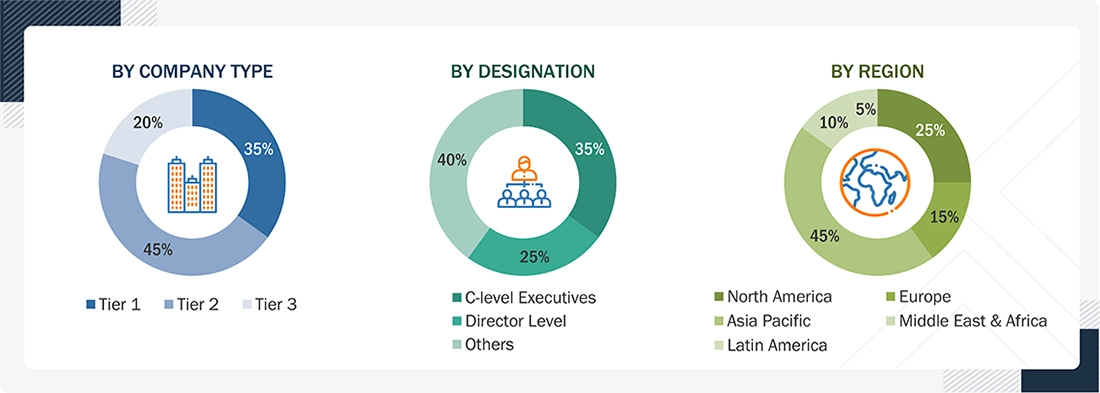
To know about the assumptions considered for the study, download the pdf brochure
Market Size Estimation
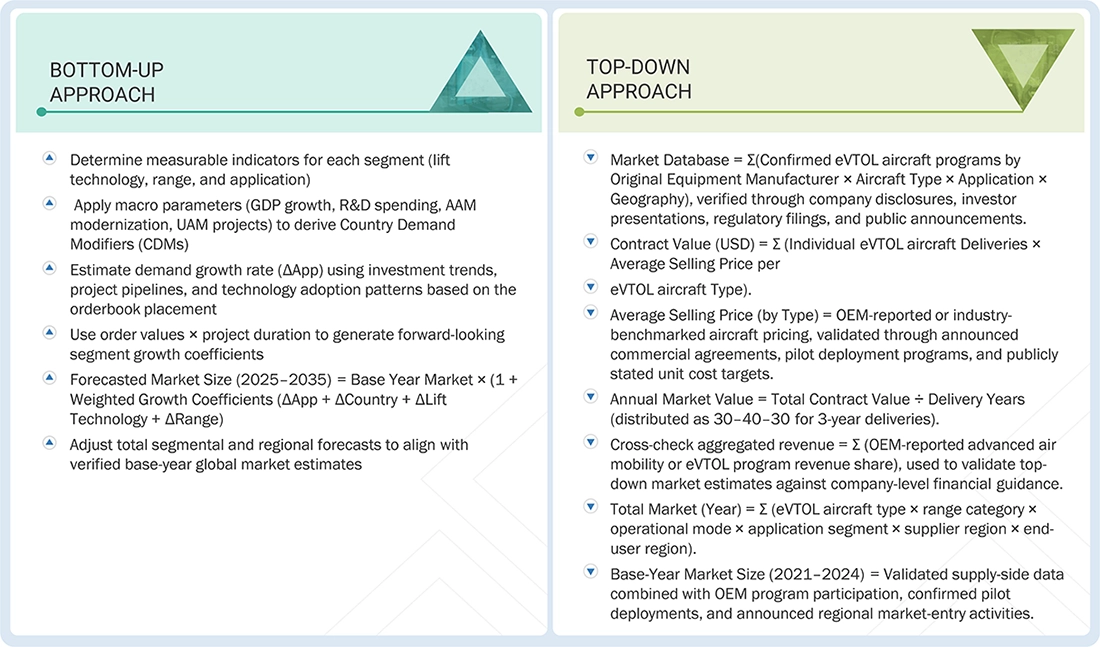
Top-down and bottom-up approaches were used to estimate and validate the size of the eVTOL aircraft market. The research methodology included several steps to ensure accuracy:
- Key companies active in the eVTOL aircraft market were identified through secondary research. Their market shares were assessed using a mix of primary inputs and published data. This included reviewing annual reports, financial disclosures, certification updates, and public filings from leading eVTOL developers. Interviews were also conducted with industry participants such as company executives, program managers, operators, infrastructure providers, and aviation experts. These inputs were used to validate assumptions and refine market size estimates across regions.
- All percentage shares, segment splits, and market breakdowns were first developed using secondary information. These values were then verified through primary discussions with industry participants.
- Key factors affecting the eVTOL aircraft market were assessed in the analysis. These included regulatory frameworks, certification timelines, technology progress, infrastructure readiness, and investment activity. Each factor was reviewed through primary research and used to finalize both quantitative and qualitative market estimates for this report.
eVTOL Aircraft Market : Top-Down and Bottom-Up Approach
Data Triangulation
After determining the overall market size, the total market was divided into several segments and subsegments. The data triangulation and market breakdown procedures explained below were implemented, wherever applicable, to complete the overall market engineering process and arrive at the estimated market numbers for the market segments and subsegments. The data was triangulated by studying various factors and trends from the demand and supply sides. Additionally, the market size was validated using top-down and bottom-up approaches.
Market Definition
The eVTOL aircraft market focuses on technologies that streamline and optimize airport operations, integrating software, hardware, and real-time data for efficient passenger processing, flight management, resource allocation, and security. Key components like departure control systems (DCS), airport operational databases (AODB), and flight information display systems (FIDS) enhance decision-making, operational efficiency, and passenger experiences. Meanwhile, airport information systems (AIS) support applications in baggage handling, airside management, and dynamic revenue optimization while fostering collaboration among airlines, air traffic control, airport authorities, and ground handlers. They are vital for smarter, more connected airport ecosystems by addressing congestion, improving security, and enabling sustainable practices.
Key Stakeholders
- Raw material suppliers (aluminum alloys, composites, battery materials, electronic components)
- Propulsion system suppliers (electric motors, power electronics, energy storage systems)
- Airframe and structural component manufacturers (fuselage, wings, rotors)
- eVTOL aircraft manufacturers and original equipment manufacturers
- Avionics and flight control system providers (navigation, communication, fly-by-wire systems)
- Battery technology and energy management system providers
- Software and autonomy solution providers (flight management, vehicle control, autonomy systems)
- System integrators and Tier-1 aerospace suppliers
- Vertiport infrastructure developers and charging solution providers
- MRO service providers
- Urban air mobility operators and air taxi service providers
- Civil aviation authorities and regulatory bodies
Report Objectives
- To define, describe, and forecast the size of the eVTOL aircraft market, in terms of value, based on lift technology, MTOW, propulsion, operating range, system, mode of operation, application, and region
- To forecast the size of market segments with respect to five regions, namely North America, Europe, Asia Pacific, Middle East & Africa, and Latin America, along with key countries in each region
- To identify and analyze drivers, restraints, opportunities, and challenges influencing the growth of the market
- To identify industry trends, market trends, and technology trends currently prevailing in the market
- To provide an overview of the tariff and regulatory landscape with respect to drone regulations worldwide
- To analyze micro markets with respect to individual growth trends, prospects, and their contribution to the overall market
- To analyze opportunities in the market for stakeholders by identifying key market trends
- To profile prominent market players and comprehensively analyze their market shares and core competencies
- To analyze the degree of competition by identifying key growth strategies, such as contracts, partnerships, and collaborations, adopted by leading market players
- To identify detailed financial positions, key products, and unique selling points of leading companies in the market
- To analyze the degree of competition in the market by identifying growth strategies, such as agreements, acquisitions, partnerships, collaborations, and product launches, adopted by leading market players
Available customizations:
MarketsandMarkets offers the following customizations for this report:
- Additional country-level analysis of the eVTOL aircraft market
- Profiling of other market players (up to five)
Product Analysis
- Product matrix, which provides a detailed comparison of the product portfolio of each company in the eVTOL aircraft market
Get the Full eVTOL Aircraft Market Report
Full forecast, segment splits, and company analysis for all eVTOL Aircraft Market.
- US eVTOL Aircraft Market
- UK eVTOL Aircraft Market
- Germany eVTOL Aircraft Market
- France eVTOL Aircraft Market
- Spain eVTOL Aircraft Market
- Ireland eVTOL Aircraft Market
- China eVTOL Aircraft Market
- India eVTOL Aircraft Market
- Japan eVTOL Aircraft Market
- Australia eVTOL Aircraft Market
- South Korea eVTOL Aircraft Market
- UAE eVTOL Aircraft Market
- Saudi Arabia eVTOL Aircraft Market
- South Africa eVTOL Aircraft Market
- Brazil eVTOL Aircraft Market
- Mexico eVTOL Aircraft Market
- Argentina eVTOL Aircraft Market
- Rest Of Europe eVTOL Aircraft Market
- Rest Of Asia Pacific eVTOL Aircraft Market
Need a Tailored Report?
Customize this report to your needs
Get 10% FREE Customization
Customize This Report
