
Europe Feed Additives Market (2026-2031)

The Europe Feed Additives Market was valued at $1130.5 Million in 2026 and projected to reach to $1629.7 Million by 2031, representing a compound annual growth rate of CAGR 7.6%. Europe's phytogenics feed additives market is positioned for sustained growth driven by regulatory pressures favoring natural ingredients, rising consumer awareness of sustainable animal farming, and livestock producers' shift toward plant-based nutritional solutions.


| Market Size in | USD 26.32 MN |
| Market Forecast in | |
| CAGR | |
| Forecast Period | |
| Units Considered | Value (USD MN) |
Europe Feed Additives Market Trends and Insights
- Phytogenics, derived from plant-based sources, are gaining traction as natural alternatives to synthetic additives in animal nutrition.
- The segment's 7.6% compound annual growth rate outpaces the broader feed additives market, reflecting rising demand for clean-label and sustainable feed solutions across livestock and poultry sectors. Phytogenics encompass essential oils, herbs, spices, and botanical extracts that enhance animal performance, immunity, and feed palatability.
- Between 2026 and 2031, Phytogenics adoption is accelerating due to regulatory pressures against antibiotic growth promoters, consumer preference for naturally-raised animal products, and documented efficacy in improving gut health and feed conversion ratios.
- Phytogenics are particularly valued in premium and organic feed formulations, where producers command price premiums and differentiate products in competitive markets..
Key Market Statistics
- CAGR (2026-2031) CAGR 7.6%
- Market Size, 2026 ~USD 1130.5 Million
- Forecast, 2031 ~USD 1629.7 Million
- Geography Europe
Europe Feed Additives Market Overview
Strong Regional Growth Trajectory :
Europe's phytogenics feed additives market is expanding at 7.6% CAGR, significantly outpacing the global feed additives market growth of 6%, demonstrating robust regional demand for plant-based animal nutrition solutions.
Market Leadership by Key Nations :
Germany (USD 2,494.2M), Spain (USD 2,417.6M), and Russia (USD 2,733.4M) lead Europe's market, collectively representing substantial market share and driving innovation in natural feed additive formulations across the continent.
Regulatory Support for Natural Additives :
European stringent regulations favoring natural and organic feed additives create a competitive advantage for phytogenic products, aligning with EU sustainability standards and consumer demand for cleaner animal protein production.
Projected Market Expansion :
Europe's phytogenics segment is forecast to grow from USD 1,130.5 million in 2026 to USD 1,629.7 million by 2031, reflecting increasing adoption of plant-derived alternatives in livestock and poultry nutrition across the region.
Europe Feed Additives Market Dynamics
- The region's mature agricultural infrastructure and stringent food safety standards create favorable conditions for premium phytogenic product adoption. Key European markets including Germany, Spain, and Russia are investing heavily in R&D for innovative plant-derived formulations.
- The 7.6% CAGR reflects growing demand from dairy, poultry, and swine sectors seeking to improve animal health outcomes while meeting EU environmental compliance requirements.
- Market expansion will be supported by increasing feed production volumes and premiumization trends across Western and Eastern European markets..
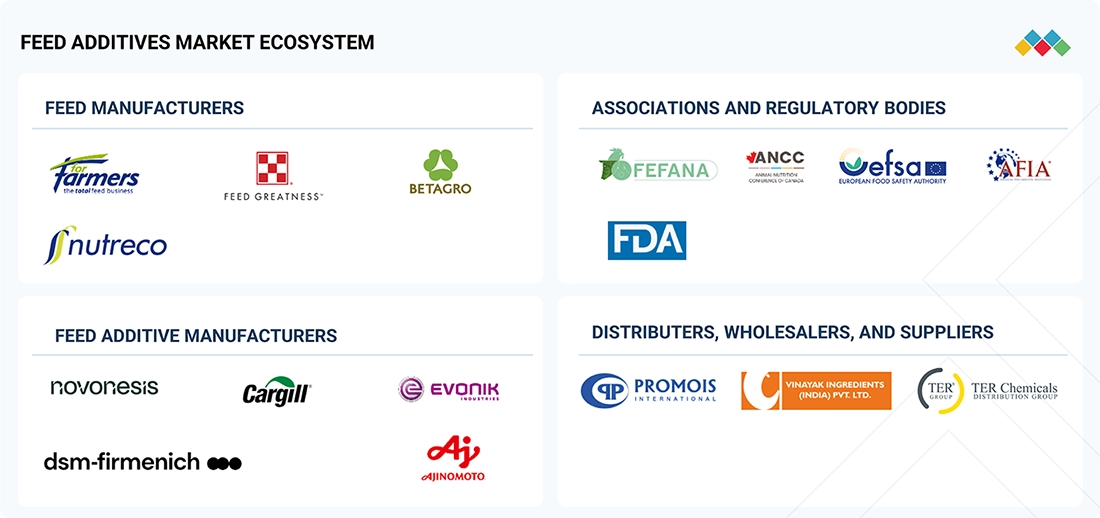
Market Ecosystem
FEED ADDITIVES MARKET: COMMERCIAL USE CASES ACROSS INDUSTRIES
| COMPANY | USE CASE DESCRIPTION | BENEFITS |
|---|---|---|
 |
Application of amino acid feed additives to optimize protein utilization and support growth performance in poultry, swine, and aquaculture | Improves feed efficiency, reduces nitrogen excretion, and enables cost-effective and sustainable animal production |
 |
Integration of specialty feed additives and nutritional solutions through its animal nutrition brands to support health, performance, and sustainability across livestock systems | Enhances animal productivity, supports responsible feed practices, and improves long-term production efficiency for producers |
 |
Application of enzymes, vitamins, and performance-enhancing nutritional solutions to support gut health, immunity, and nutrient digestibility | Improves animal health and feed conversion while enabling antibiotic-free and science-based nutrition programs |
Logos and trademarks shown above are the property of their respective owners. Their use here is for informational and illustrative purposes only.
Related Ecosystem
Feed And Animal Nutrition
- Animal-Based Sealants
- Camera Systems
- Lactic Acid
- Tricalcium Phosphate
- Citric Acid
- AZELIS HOLDINGS SA
- NOVUS INTERNATIONAL, INC.
- Feedone Co., Ltd.
- Mitsui & Co., Ltd.
- NOSAN CORPORATION
Key Takeaways
- Phytogenics market valued at USD 1,130.5M in 2026, expanding to USD 1,629.7M by 2031 at 7.6% CAGR
- Phytogenics outpace global feed additives growth (7.6% vs. 6% CAGR), driven by antibiotic phase-out regulations and clean-label demand
- Phytogenics applications span essential oils, botanical extracts, and herbal blends targeting gut health and feed efficiency
- Phytogenics command premium pricing in organic and specialty feed segments, supporting margin expansion for feed manufacturers
Feed Additives Market Report Scope
| Report Metric | Details |
|---|---|
| Base Year | 2026 |
| Fastest Growing Segment | BIFIDOBACTERIUM (Bacteria Type) |
| Forecast Period | 2026–2031 |
| Growth Rate | CAGR of 6% from 2026 to 2031 |
| Largest Segment | DRY (Form) |
| Market Size Base Year (Billions) | ~USD 50.74 (2026) |
| Revenue Forecast (Billions) | ~USD 67.9 (2031) |
| Segments Covered | Type, Bacteria Type, Livestock, Source, Form |
Europe Feed Additives Market Report Segmentation
5 segment dimensions are covered across the global market.
By Type
- Acidifiers
- Amino Acids
- Ammonia
- Antibiotics
- Anticaking Agents
- Antioxidants
- Astaxanthin
- Bacteria
- Beef
- Benzoic Acid
- Beta Carotene
- Binders
- Breeders
- Broilers
- Calcium
- Calf
- Canthaxanthin
- Carbohydrase
- Carotenoids
- Citric Acid
- Copper
- Crustacean
- Dairy
- Defluorinated Phosphate
- Dicalcium Phosphate
- Enzymes
- Essential Oils
- Fat-Soluble Vitamins
- Feed Flavors
- Feed Sweeteners
- Fish
- Flavonoids
- Flavors & Sweeteners
- Formic Acid
- Growers
- Iron
- Lactic Acid
- Layers
- Lutein
- Lysine
- Magnesium
- Malic Acid
- Manganese
- Methionine
- Minerals
- Modifiers
- Mold Inhibitors
- Mollusk
- Mono-Dicalcium Phosphate
- Monocalcium Phosphate
- Mycotoxin Detoxifiers
- Natural
- Non-Protein Nitrogen
- Oleoresins
- Other Acidifiers
- Other Amino Acids
- Other Antibiotics
- Other Aquatic Animals
- Other Carotenoids
- Other Enzymes
- Other Minerals
- Other Non-Protein Nitrogen
- Other Phosphates
- Other Phytogenics
- Other Ruminants
- Penicillin
- Phosphates
- Phosphorus
- Phytase
- Phytogenics
- Potassium
- Preservatives
- Probiotics
- Propionic Acid
- Protease
- Saponins
- Sodium
- Sorbic Acid
- Sows
- Starters
- Synthetic
- Tetracycline
- Threonine
- Tricalcium Phosphate
- Tryptophan
- Urea
- Vitamins
- Water-Soluble Vitamins
- Yeast & Fungi
- Zinc
By Bacteria Type
- Bacillus
- Bifidobacterium
- Lactobacillus
- Other Bacteria Types
- Streptococcus
By Livestock
- Aquatic Animals
- Other Livestock
- Poultry
- Ruminants
- Swine
By Source
- Animal-Based
- Natural
- Plant-Based
- Synthetic
By Form
- Dry
- Liquid
- Moist
- Wet
Target Audience
- Feed Manufacturers & Producers : European feed producers need detailed market intelligence to develop competitive phytogenic formulations, optimize product portfolios, and capture growing demand from livestock farmers seeking natural additive alternatives.
- Agricultural & Livestock Companies : Livestock producers and dairy operations require market insights to evaluate phytogenic adoption ROI, understand regional pricing trends, and make informed sourcing decisions for premium animal nutrition products.
- Investment & Private Equity Firms : Investors targeting Europe's agricultural sector need comprehensive market data to identify acquisition targets, assess growth potential in phytogenics, and evaluate regional market valuations and expansion opportunities.
- Regulatory & Compliance Consultants : Consultants advising European feed companies require detailed market analysis to guide product development strategies, ensure regulatory compliance, and navigate country-specific requirements across diverse European markets.
- Ingredient Suppliers & Distributors : Plant-based ingredient suppliers and distributors need regional market forecasts to optimize supply chain strategies, identify growth markets, and develop targeted sales approaches for European feed manufacturers.
Key Companies in the Europe Feed Additives Market
| Company | HQ | Ownership | Strongest segments |
|---|---|---|---|
| TESSENDERLO GROUP | Belgium | Public Company | Proteins and fats (Bio-Valorization-derived feed ingredients),Gelatins and collagen peptides for pet and specialty feed,Agro-linked animal nutrition and crop-adjacent inputs, |
| ZOETIS INC | United States | Public Company | Antibiotics and anti-infective feed additives,Probiotics, phytogenics, and gut-health functionals,Vitamins, nutritionals, and metabolic support, |
| ROYAL COSUN | Netherlands | Private Company | Prebiotic fibers / inulin-type functional additives,Carbohydrate-rich feed ingredients from residual streams,Starch-based functional components, |
| MITSUI & CO., LTD. | Japan | Public Company | Amino Acids,Vitamins,Phytogenics, |
| FEED ONE CO., LTD. | Japan | Public Company | Amino acids,Vitamins,Enzymes, |
| NOSAN CORPORATION | Japan | Private Company | Amino Acids,Vitamins,Probiotics, |
| CERMAQ GROUP AS | Norway | Private Company | Amino Acids,Vitamins,Antioxidants, |
| AZELIS HOLDINGS SA | Belgium | Private Company | Amino Acids,Vitamins,Enzymes, |
| ADM | United States | ||
| INTERNATIONAL FLAVORS & FRAGRANCES INC. | United States | Public Company | |
| EVONIK INDUSTRIES AG | Germany | Public Company | |
| BASF SE | Germany | Public Company | Amino Acids,Vitamins,Carotenoids, |
| DSM-FIRMENICH | Switzerland | Public Company | |
| AJINOMOTO CO., INC. | Japan | Public Company | Amino Acids,Other Feed Additives (vitamins, acidifiers, etc.), |
| ADISSEO | China | Public Company | Amino Acids (Rhodimet methionine, AdiSodium and related sulfur-based products),Vitamins (Microvit A Supra 1000, Microvit E Promix 50 and related),Mycotoxin Management & Palatability (Unike, Toxy-Nil, Krave AP, Optisweet, Gusti Plus, Maxarome, Delistart, Nutri-Bind Aqua), |
| JUBILANT INGREVIA LIMITED | India | Public Company | Vitamins & Mineral Premixes,Amino Acids,Acidifiers & Toxin Binders, |
| NUTRECO | Netherlands | Private Company | Amino Acids,Phosphates,Vitamins, |
TESSENDERLO GROUP
Tessenderlo Group is a Belgian public company founded in 1919 with 6,945 employees. The company operates across multiple industrial sectors and maintains a significant international presence.
ZOETIS INC
Zoetis Inc is a United States-based public company founded in 2012 with 14,500 employees. The company operates in the animal health sector.
ROYAL COSUN
Royal Cosun is a Dutch private company with 4,528 employees. The company operates in the agricultural and food production industry.
MITSUI & CO., LTD.
Mitsui & Co., Ltd. is a Japanese public company founded in 1947 with 55,463 employees. The company operates as a major trading and investment corporation with diverse business interests.
FEED ONE CO., LTD.
Feed One Co., Ltd. is a Japanese public company founded in 2014 with 935 employees. The company operates in the animal feed and nutrition sector.
NOSAN CORPORATION
Nosan Corporation is a Japanese private company founded in 1931 with 1,079 employees. The company operates in the agricultural and food production industry.
CERMAQ GROUP AS
Cermaq Group AS is a Norwegian private company founded in 1994 with 4,361 employees. The company operates in the aquaculture and seafood production sector.
AZELIS HOLDINGS SA
Azelis Holdings SA is a Belgian private company founded in 2001 with 1,325 employees. The company specializes in specialty chemicals and ingredients.
ADM
Insufficient data available for ADM.
INTERNATIONAL FLAVORS & FRAGRANCES INC.
International Flavors & Fragrances Inc. is a United States-based public company founded in 1909 with 21,500 employees. The company manufactures and supplies flavors, fragrances, and specialty ingredients.
EVONIK INDUSTRIES AG
Evonik Industries AG is a German public company founded in 1847 with 30,643 employees. The company operates as a specialty chemicals manufacturer serving diverse industrial sectors.
BASF SE
BASF SE is a German public company founded in 1865 with 106,428 employees. The company is one of the world's largest chemical manufacturers with operations across multiple industries.
DSM-FIRMENICH
DSM-Firmenich is a Swiss public company founded in 1902 with 26,873 employees. The company specializes in nutrition, health, and beauty solutions.
AJINOMOTO CO., INC.
Ajinomoto Co., Inc. is a Japanese public company founded in 1909 with 34,787 employees. The company manufactures and supplies food seasonings, amino acids, and nutritional products.
ADISSEO
Adisseo is a Chinese public company founded in 1939 with 3,295 employees. The company specializes in animal nutrition and feed additives.
JUBILANT INGREVIA LIMITED
Jubilant Ingrevia Limited is an Indian public company founded in 2019 with 2,139 employees. The company operates in the specialty chemicals and ingredients sector.
NUTRECO
Nutreco is a Dutch private company with 9,217 employees. The company operates in animal nutrition and aquafeed production.
Countries within Europe - compare and drill down
| Country | 2025 size (native) |
|---|---|
| France | USD 2208.6 Million |
| Germany | USD 2494.2 Million |
| Italy | USD 1719 Million |
| Spain | USD 2417.6 Million |
| Russia | USD 2733.4 Million |
| UK | USD 1340.4 Million |
| Rest Of Europe | USD 2329.5 Million |
Country market size visualization
Reasons to Buy this Report
- Regional Market Sizing & Forecasts : Access precise market valuations for Europe's phytogenics segment with country-level breakdowns for Germany, Spain, Russia, France, Italy, and UK, enabling accurate investment and expansion planning decisions.
- Competitive Landscape Intelligence : Understand market dynamics across Europe's leading agricultural economies, identify growth hotspots, and benchmark performance against regional competitors in the rapidly expanding plant-based feed additives sector.
- Regulatory & Compliance Insights : Navigate Europe's complex regulatory environment for natural feed additives with region-specific compliance requirements, EU standards alignment, and market entry strategies tailored to individual European markets.
- Growth Opportunity Identification : Leverage 7.6% CAGR data to identify high-potential segments within European livestock production, from dairy to poultry, and capitalize on the shift toward sustainable, plant-derived nutritional solutions.
- Strategic Partnership & Investment Guidance : Make informed decisions on market entry, acquisitions, and partnerships by understanding regional market maturity, key player positioning, and emerging opportunities across Europe's phytogenics value chain.
Frequently asked questions
What is the market size of Phytogenics in 2026?
Phytogenics market is estimated at USD 1,130.5 million in 2026.
What is the projected market size of Phytogenics by 2031?
Phytogenics market is forecast to reach USD 1,629.7 million by 2031.
What is the CAGR for Phytogenics from 2026 to 2031?
Phytogenics are projected to grow at a compound annual growth rate of 7.6% during the forecast period.
Why is Phytogenics growth outpacing the broader feed additives market?
Phytogenics growth (7.6% CAGR) exceeds global feed additives growth (6% CAGR) due to regulatory bans on antibiotic growth promoters, rising consumer demand for natural products, and proven efficacy in animal health and performance.
What are the main applications of Phytogenics in animal feed?
Phytogenics applications include essential oils, botanical extracts, and herbal blends used to enhance gut health, improve feed conversion efficiency, boost immunity, and increase feed palatability in livestock and poultry.
RESEARCH METHODOLOGY
This study employed two primary approaches to estimate the current size of the feed additives market. Exhaustive secondary research was done to collect information on the type, livestock, source, form, function (qualitative), and end user (qualitative) segments of the market. The next step involved validating these findings, assumptions, and sizing with industry experts across the value chain through primary research. The top-down and bottom-up approaches were employed to estimate the complete market size. Thereafter, data triangulation was used to estimate the market size of segments and subsegments.
Secondary Research
This research study used extensive secondary sources—directories and databases such as Bloomberg Businessweek and Factiva—to identify and collect information for a technical, market-oriented, and commercial market study. In the secondary research process, sources such as annual reports, press releases & investor presentations of companies, white papers, feed-related journals, certified publications, articles from recognized authors, directories, and databases were referred to identify and collect information. Secondary research was mainly used to obtain key information about the industry’s supply chain, the pool of key players, and market classification and segmentation based on the industry trends to the bottom-most level, regional markets, and key developments from market- and technology-oriented perspectives.
Primary Research
Extensive primary research was conducted after obtaining information regarding the feed additives market scenario through secondary research. Several primary interviews were conducted with market experts from the demand and supply sides across major countries of North America, Europe, Asia Pacific, South America, and the Rest of the World. Primary data was collected through questionnaires, emails, and telephonic interviews. The primary sources from the supply side included various industry experts, such as Chief Experience Officers (CXOs), vice presidents (VPs), directors from business development, marketing, research, and development teams, and related key executives from distributors and key opinion leaders.
Primary interviews were conducted to gather insights, including market statistics, revenue data from products and services, market breakdowns, market size estimations, market forecasting, and data triangulation. Primary research also helped to understand the various trends related to type, livestock, source, form, function (qualitative), end user (qualitative), and region. Stakeholders from the demand side, such as livestock growers who are using feed additives, complete feed manufacturers, and others, were interviewed to understand the buyer’s perspective on the suppliers, products, and their current usage of feed additives and the outlook of their business, which will affect the overall market.
Breakdown of Primary Interviews
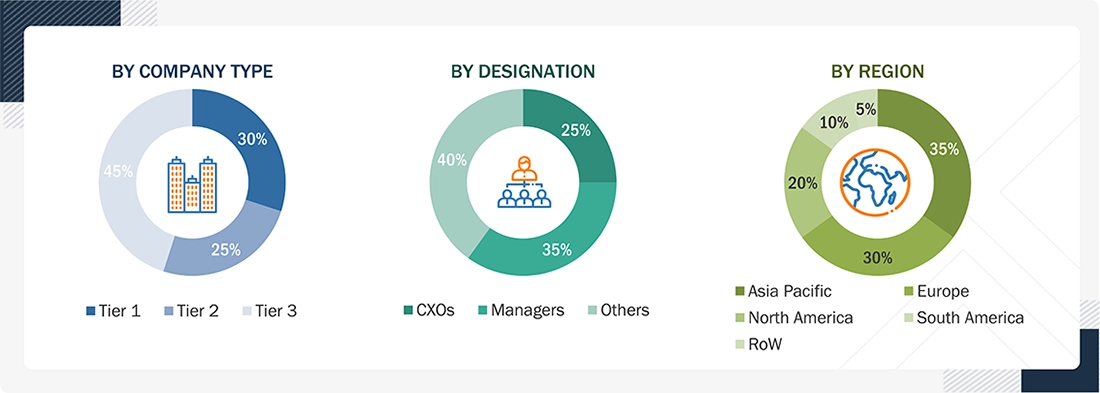
Note: The three tiers of the companies are defined based on their total revenues in 2023 or 2024, based on the availability of financial data: Tier 1: Revenue > USD 1 billion; Tier 2: USD 100 million ≤ revenue ≤ USD 1 billion; Tier 3: Revenue < USD 100 million. RoW includes Africa and the Middle East.
|
COMPANY NAME |
DESIGNATION |
|
Cargill, Incorporated (US) |
Product Development Manager |
|
ADM (US) |
Sales Manager |
|
DSM-Firmenich (Switzerland) |
Manager |
|
International Flavors & Fragrances Inc. (US) |
Head of Processing Department |
|
BASF SE (Germany) |
Marketing Manager |
|
Ajinomoto Co. Inc (Japan) |
Sales Executive |
Market Size Estimation
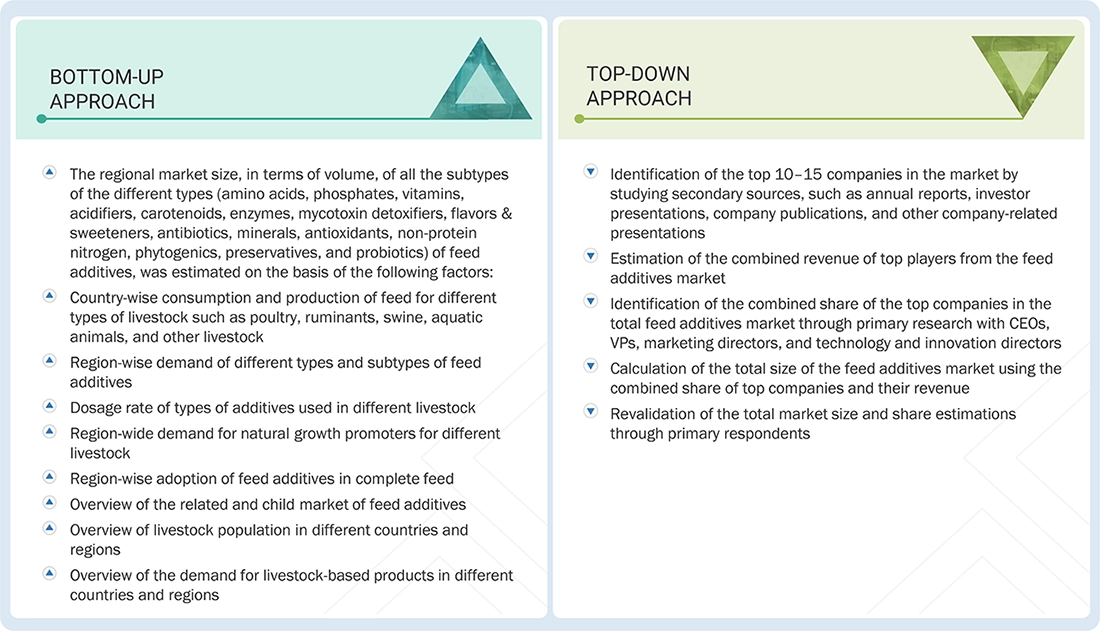
The top-down and bottom-up approaches were used to estimate and validate the total size of the feed additives market. These approaches were also used extensively to determine the size of various subsegments in the market. The research methodology used to estimate the market size includes the following details:
- The key players in the industry and the overall markets were identified through extensive secondary research.
- All shares, splits, and breakdowns were determined using secondary sources and verified through primary sources.
- All possible parameters that affect the market covered in this research study were accounted for, viewed in extensive detail, verified through primary research, and analyzed to obtain final quantitative and qualitative data.
Feed Additives Market : Top-Down and Bottom-Up Approach
Data Triangulation
After determining the overall market size from the estimation process explained above, the total market was split into several segments and subsegments. The data triangulation procedure was employed, wherever applicable, to estimate the overall feed additives market and obtain precise statistics for all segments and subsegments. The data was triangulated by studying various factors and trends from the demand and supply sides. The market size was also validated using the top-down and bottom-up approaches.
Market Definition
According to the European Food Safety Authority, “Feed additives are products used in animal nutrition to achieve an effect on the feed itself, on the animals, on food products obtained from the animals consuming the feed additive, or on the environment. For instance, feed additives are used to enhance the flavor of feed, to meet the need for certain nutrients, or to increase the performance of animals in good health. They are used in feed for food-producing animals and in pet food.”
According to the European Commission, “Feed additives are defined as products used in animal nutrition for the purpose of improving the quality of feed and the quality of food from animal origin, or to improve the animals’ performance and health, e.g., providing enhanced digestibility of the feed materials. Feed additives may not be put on the market unless authorization has been given, following a scientific evaluation demonstrating that the additive has no harmful effects on human and animal health and the environment.”
Key Stakeholders
- Feed manufacturers
- Dairy, poultry farms, and livestock farms
- Feed importers and exporters
- Intermediary suppliers such as traders and distributors of feed additives such as amino acids, phosphates, enzymes, vitamins, acidifiers, carotenoids, mycotoxin detoxifiers, flavors & sweeteners, antibiotics, minerals, antioxidants, nonprotein nitrogen, phytogenics, preservatives, and probiotics
- Government and research organizations
-
Associations and industry bodies:
- Food and Agriculture Organization (FAO)
- United States Department of Agriculture (USDA)
- European Food Safety Authority (EFSA)
- European Association of Specialty Feed Ingredients and their Mixtures (FEFANA)
- International Feed Industry Federation (IFIF)
- Organization for Economic Co-operation and Development (OECD)
- Animal Feed Manufacturers Association (AFMA)
- The Irish Grain and Feed Association (IGFA)
- National Grain and Feed Association (NGFA)
- The Compound Feed Manufacturers Association (CLFMA)
- Brazilian Poultry Association and the Brazilian Chicken Producers and Exporters Association (UBABEF)
- Japan Feed Manufacturers Association (JAFMA)
- Animal Nutrition Association of Canada (ANAC)
Report Objectives
- To determine and project the size of the feed additives market based on type, livestock, source, form, function (qualitative), end user (qualitative), and region, over five years, ranging from 2026 to 2031
- To identify the attractive opportunities in the market by determining the largest and fastest-growing segments across regions
- To provide detailed information about the key factors influencing market growth (drivers, restraints, opportunities, and challenges)
- To analyze the opportunities in the market for stakeholders and provide details of the competitive landscape for market leaders
- To analyze the micromarkets with respect to individual growth trends, prospects, and their contribution to the total market
- To identify and profile the key players in the market
- To understand the competitive landscape and identify the major growth strategies adopted by players across the key regions.
Available customizations:
With the given market data, MarketsandMarkets offers customizations according to company-specific scientific needs. The following customization options are available for the report:
PRODUCT ANALYSIS
Product matrix, which gives a detailed comparison of the product portfolio of each company
GEOGRAPHIC ANALYSIS
With the given market data, MarketsandMarkets offers customizations according to company-specific scientific needs
- Further breakdown of the Rest of Europe feed additives market into key countries
- Further breakdown of the Rest of Asia Pacific feed additives market into key countries
- Further breakdown of the Rest of South America feed additives market into key countries
COMPANY INFORMATION
- Detailed analyses and profiling of additional market players (up to five)
Get the Full Feed Additives Market Report
Full forecast, segment splits, and company analysis for all Feed Additives Market.
- Rest Of Europe Feed Additives Market
- Rest Of Asia Pacific Feed Additives Market
- US Feed Additives Market
- Canada Feed Additives Market
- Mexico Feed Additives Market
- France Feed Additives Market
- Germany Feed Additives Market
- Italy Feed Additives Market
- Spain Feed Additives Market
- Russia Feed Additives Market
- UK Feed Additives Market
- China Feed Additives Market
- India Feed Additives Market
- Japan Feed Additives Market
- Thailand Feed Additives Market
- Indonesia Feed Additives Market
- Brazil Feed Additives Market
- Argentina Feed Additives Market
Need a Tailored Report?
Customize this report to your needs
Get 10% FREE Customization
Customize This Report
