
Netherlands Feed Robotics Market (2024-2029)

The Netherlands Feed Robotics Market was valued at $125.8 Million in 2024 and projected to reach to $166.2 Million by 2029, representing a compound annual growth rate of 5.7%. The Netherlands feed robotics market is positioned for steady growth as dairy and livestock producers increasingly invest in automation to address labor shortages and enhance operational efficiency.


| Market Size in | USD 26.32 MN |
| Market Forecast in | |
| CAGR | |
| Forecast Period | |
| Units Considered | Value (USD MN) |
Netherlands Feed Robotics Market Trends and Insights
- In the Netherlands, the adoption of automated feeding systems is driven by the country's advanced dairy and livestock farming infrastructure, where precision agriculture and labor efficiency are critical competitive factors.
- The Netherlands' strong agricultural technology sector and high farm mechanization rates position the country as a key market for feed robotics innovation in Europe. During the 2024-2029 forecast period, the Netherlands is expected to see increased investment in robotic feeding solutions as farms seek to optimize operational costs and improve animal welfare standards.
- The Netherlands' regulatory environment and sustainability focus further accelerate the integration of smart feeding technologies.
- With a mature agricultural base and growing demand for automation, the Netherlands represents a stable and expanding opportunity for feed robotics vendors targeting the European market..
Key Market Statistics
- CAGR (2024-2029) 5.7% CAGR
- Market Size, 2024 ~USD 125.8 Million
- Forecast, 2029 ~USD 166.2 Million
- Country Netherlands
Netherlands Feed Robotics Market Overview
Market Valuation :
The Netherlands feed robotics market reached $125.8 million in 2024, with projected growth to $166.2 million by 2029, representing a 5.7% CAGR driven by advanced dairy farming practices.
Dairy Sector Leadership :
Netherlands' world-renowned dairy industry is a primary driver of feed robotics adoption, with automated systems enhancing milk production efficiency and animal welfare standards across premium farms.
Labor Efficiency Focus :
High labor costs and workforce scarcity in Dutch agriculture make automated feeding systems economically attractive, reducing operational expenses while maintaining precision nutrition for livestock.
Precision Agriculture Integration :
Dutch farms leverage advanced robotics for real-time feed optimization, integrating IoT and data analytics to maximize yield, reduce waste, and meet strict EU sustainability and animal welfare regulations.
Netherlands Feed Robotics Market Dynamics
- The country's commitment to sustainable farming practices and EU compliance standards creates strong demand for intelligent feeding solutions that optimize resource utilization and animal health outcomes. Future expansion will be supported by technological advancements in AI-driven feeding systems, integration with farm management software, and growing consumer demand for ethically-produced dairy products.
- Dutch agricultural innovators and equipment manufacturers will continue driving market development through R&D investments and strategic partnerships with global robotics providers..
Market Ecosystem
Related Ecosystem
Precision Agriculture
- Sensors
- Global Positioning System (GPS)
- Camera Systems
- Data Services
- Platform as A Service (PaaS)
- MITSUBISHI AGRICULTURAL MACHINERY
- MSK FARM MACHINERY CORPORATION
- MITSUBISHI CHEMICAL AGRI DREAM
- Trimble Inc.
- Deere & Company
Key Takeaways
- The Netherlands feed robotics market is valued at $125.8 million in 2024 and will reach $166.2 million by 2029, growing at 5.7% CAGR.
- The Netherlands' advanced dairy sector and high farm mechanization drive strong adoption of automated feeding systems.
- Sustainability regulations and labor cost pressures in the Netherlands accelerate investment in robotic feeding technologies.
- The Netherlands serves as a key innovation hub for feed robotics in Europe, attracting technology vendors and early adopters.
Feed Robotics Market Report Scope
| Report Metric | Details |
|---|---|
| Base Year | 2024 |
| Fastest Growing Segment | OUTDOOR (Farming Environment) |
| Forecast Period | 2024-2029 |
| Growth Rate | CAGR of 11.5% from 2024 to 2029 |
| Largest Segment | HARDWARE (Offering) |
| Market Size Base Year (Billions) | ~USD 1.45 (2024) |
| Revenue Forecast (Billions) | ~USD 2.5 (2029) |
| Segments Covered | Product Type, Application, Farming Environment, Functionality, Farm Size, Applications, Offering |
Netherlands Feed Robotics Market Report Segmentation
7 segment dimensions are covered across the global market.
By Product Type
- Feed Mixers
- Feed Pushers
- Feeding Systems
- Other Product Types
By Application
- Dairy Farms
- Other Farm Types
- Other Farms
- Poultry Farms
- Swine Farms
By Farming Environment
- Indoor
- Outdoor
By Functionality
- Autonomous
- Semi-Autonomous
By Farm Size
- Large-Size Farms (>200 Ha)
- Large-Sized Farms (>200 Ha)
- Medium-Sized Farms (50-200 Ha)
- Medium-Sized Farms (50-200 Ha)
- Medium-Sized Farms (<50-200 Ha)
- Small-Sized Farms (<50 Ha)
By Applications
- Dairy Farms
- Other Farms
- Poultry Farms
- Swine Farms
By Offering
- Hardware
- Services
- Software
Target Audience
- Dairy Farm Operators : Dutch dairy producers need market intelligence to evaluate feed robotics investments, understand ROI timelines, and benchmark automation adoption against peer operations in the competitive Netherlands market.
- Agricultural Equipment Manufacturers : Equipment suppliers require Netherlands-specific market data to develop localized product strategies, identify customer segments, and optimize distribution channels for the Dutch agricultural sector.
- Technology Integrators & Service Providers : System integrators and farm management consultants need detailed market insights to advise Dutch clients on technology selection, implementation best practices, and performance optimization strategies.
- Investment & Private Equity Firms : Investors evaluating agricultural technology opportunities in Netherlands require market sizing, growth projections, and competitive analysis to assess portfolio companies and identify acquisition targets.
- Government & Policy Organizations : Dutch agricultural ministries and policy bodies need market research to inform subsidy programs, sustainability initiatives, and technology adoption incentives supporting the modernization of Netherlands farming.
Reasons to Buy this Report
- Market-Specific Insights : Gain detailed understanding of Netherlands-specific adoption drivers, regulatory environment, and competitive landscape that directly impact feed robotics investment decisions in Dutch agriculture.
- Dairy Industry Focus : Access targeted analysis of the Netherlands' premium dairy sector, including farm size trends, technology integration patterns, and ROI benchmarks for automated feeding solutions.
- Growth Opportunity Assessment : Identify expansion opportunities within the 5.7% CAGR growth trajectory, including underserved farm segments, emerging technologies, and regional market gaps specific to Dutch operations.
- Competitive Positioning : Understand the competitive dynamics among equipment suppliers, integrators, and service providers operating in the Netherlands market to inform strategic partnerships and market entry strategies.
- Regulatory & Sustainability Alignment : Navigate EU compliance requirements and Dutch sustainability standards that influence technology adoption, helping businesses develop solutions aligned with local regulatory expectations and consumer preferences.
Frequently asked questions
What is the current size of the feed robotics market in the Netherlands?
The Netherlands feed robotics market was valued at $125.8 million in 2024 and is expected to grow to $166.2 million by 2029.
What is the growth rate of the feed robotics market in the Netherlands?
The Netherlands feed robotics market is projected to grow at a compound annual growth rate (CAGR) of 5.7% from 2024 to 2029.
What factors drive feed robotics adoption in the Netherlands?
Key drivers in the Netherlands include advanced dairy farming infrastructure, high labor costs, sustainability regulations, and the country's strong agricultural technology sector.
How does the Netherlands market compare to other European markets?
The Netherlands represents a mature, high-adoption market for feed robotics due to its advanced farming practices, regulatory environment, and mechanization levels, positioning it as a leader in European agricultural automation.
What is the forecast market size for feed robotics in the Netherlands by 2029?
The Netherlands feed robotics market is forecasted to reach $166.2 million by 2029, up from $125.8 million in 2024.
RESEARCH METHODOLOGY
The study involved two major approaches in estimating the current size of the feed robot market. Exhaustive secondary research was done to collect information on the market, peer, and parent markets. The next step was to validate these findings, assumptions, and sizing with industry experts across the value chain through primary research. Both top-down and bottom-up approaches were employed to estimate the complete market size. After that, market breakdown and data triangulation were used to estimate the market size of segments and subsegments.
Secondary Research
This research study involved the extensive use of secondary sources—directories and databases such as Bloomberg Businessweek and Factiva—to identify and collect information useful for a technical, market-oriented, and commercial study of the market.
In the secondary research process, various sources such as annual reports, press releases & investor presentations of companies, white papers, food journals, certified publications, articles from recognized authors, directories, and databases were referred to identify and collect information.
Secondary research was mainly used to obtain key information about the industry’s supply chain, the total pool of key players, and market classification and segmentation as per the industry trends to the bottom-most level, regional markets, and key developments from both market- and technology-oriented perspectives.
Primary Research
Extensive primary research was conducted after obtaining information regarding the feed robotics market scenario through secondary research. Several primary interviews were conducted with market experts from both the demand and supply sides across major countries of North America, Europe, Asia Pacific, South America, and the Rest of the World. Primary data was collected through questionnaires, emails, and telephonic interviews. The primary sources from the supply side included various industry experts, such as Chief X Officers (CXOs), Vice Presidents (VPs), Directors from business development, marketing, research, and development teams, and related key executives from distributors and key opinion leaders. Primary interviews were conducted to gather insights such as market statistics, data on revenue collected from the products and services, market breakdowns, market size estimations, market forecasting, and data triangulation. Primary research also helped in understanding the various trends related to feed robotics product types, farm size, functionality, end user application, and region. Stakeholders from the demand side, such as farmers, dairy farm, poultry farm, swine farms, & aquaculture owners were interviewed to understand the buyer’s perspective on the suppliers, products, and their current usage of feed robotics and the outlook of their business, which will affect the overall feed robotics market.
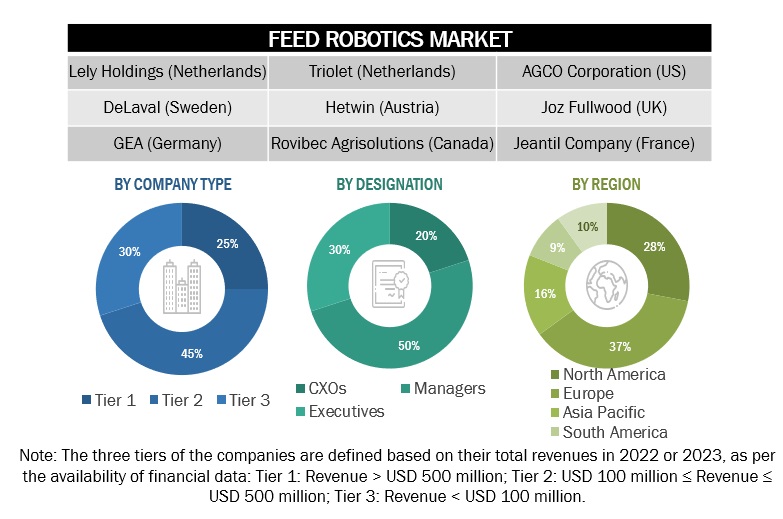
To know about the assumptions considered for the study, download the pdf brochure
|
COMPANY NAME |
designation |
|
Lely ( Netherlands) |
Research |
|
DeLaval (Europe) |
Sales Manager |
|
GEA Group AG (Germany) |
Product Sales Manager |
|
Triolet BV (Netherlands) |
Product Developer |
|
Hetwin (Austria) |
Managing Director |
|
Rovibec Agrisolutions (Quebec) |
Senior Software Engineer |
Market Size Estimation
Both the top-down and bottom-up approaches were used to estimate and validate the total size of the feed robotics market. These approaches were also used extensively to determine the size of various subsegments in the market. The research methodology used to estimate the market size includes the following details:
- The key players in the industry and the overall markets were identified through extensive secondary research.
- All shares, splits, and breakdowns were determined using secondary sources and verified through primary sources.
- All possible parameters that affect the market covered in this research study were accounted for, viewed in extensive detail, verified through primary research, and analyzed to obtain final quantitative and qualitative data.
- The research included the study of reports, reviews, and newsletters of top market players, along with extensive interviews for opinions from leaders, such as CEOs, directors, and marketing executives.
Global feed robotics market: Supply-side analysis.
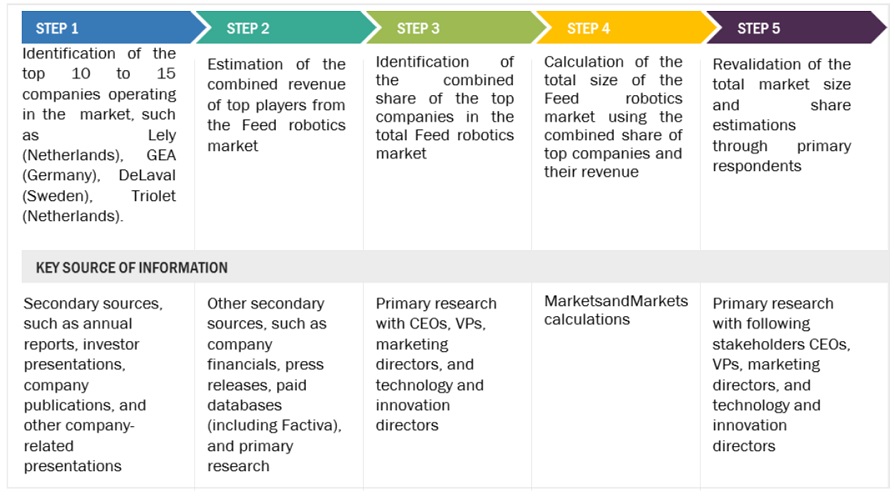
To know about the assumptions considered for the study, Request for Free Sample Report
Global feed robotics market: Top-Down Approach.
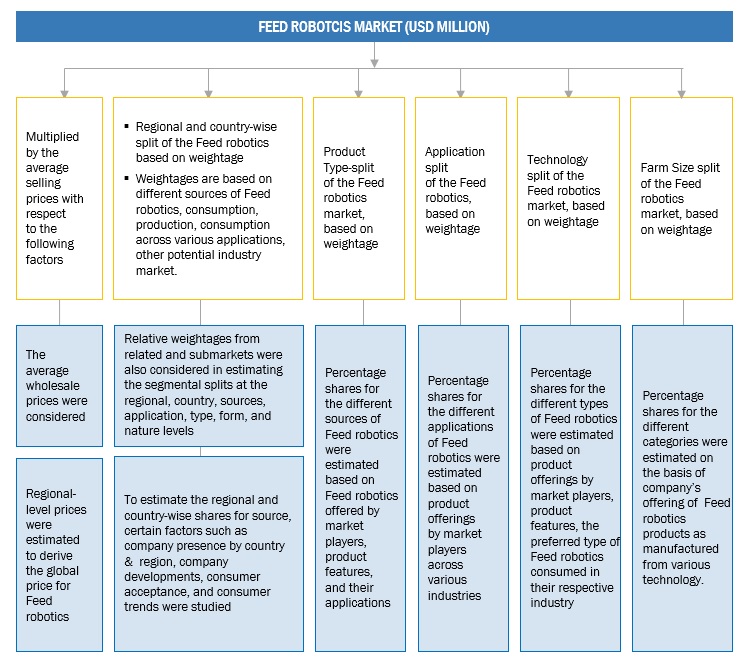
Data Triangulation
After arriving at the overall market size from the estimation process explained above, the total market was split into several segments and subsegments. The data triangulation and market breakdown procedures were employed, wherever applicable, to estimate the overall feed robotics market and arrive at the exact statistics for all segments and subsegments. The data was triangulated by studying various factors and trends from the demand and supply sides. The market size was also validated using both the top-down and bottom-up approaches.
Market Definition
The feed robotics refers to the specialized application of robotic technology designed to automate the process of feeding in various context such as enhance efficiency, precision, and consistency in the feed management, therefore optimizing productivity and reducing labor costs. The feed robotics market offers a range of robotic feeders, feed pushers, and feed mixers that are designed to increase feeding operations' accuracy and management. These technologies contribute to improved animal health and productivity by ensuring that animals receive the proper amount of feed at the right time. The market is expanding as a result of developments in automation and robotics, the demand for more productive agricultural methods, and the desire to lower labor costs without sacrificing animal welfare.
Key Stakeholders
- Feed Robotics manufacturers, suppliers, and processors
- Research & development institutions
- Traders & retailers
- Distributors, importers, and exporters
-
Regulatory bodies
- Organizations such as the Food and Drug Administration (FDA), United States Department of Agriculture (USDA), European Food Safety Agency (EFSA), European Union (EU) Directorate-General for Agriculture and Rural Development, World Organisation for Animal Health (OIE), Animal Feed Industry Association (AFIA), Animal Feed Manufacturers Association (AFMA)
- Government agencies
- Intermediary suppliers
- Universities and industry bodies
- End users
Report Objectives
MARKET INTELLIGENCE
- To determine and project the size of the feed robotics market with respect to the product type, end use application, farm size, functionality, and regions in terms of value over five years, ranging from 2024 to 2029.
- To identify the attractive opportunities in the market by determining the largest and fastest-growing segments across regions
- To provide detailed information about the key factors influencing market growth (drivers, restraints, opportunities, and challenges)
- To analyze the opportunities in the market for stakeholders and provide details of the competitive landscape for market leaders.
- To analyze the micro-markets with respect to individual growth trends, prospects, and their contribution to the total market.
- To identify and profile the key players in the feed robotics market.
- To understand the competitive landscape and identify the major growth strategies adopted by players across the key regions.
Available Customizations:
With the given market data, MarketsandMarkets offers customizations according to company-specific scientific needs.
The following customization options are available for the report:
Product Analysis
- Product Matrix, which gives a detailed comparison of the product portfolio of each company.
Geographic Analysis
With the given market data, MarketsandMarkets offers customizations according to company-specific scientific needs.
- Further breakdown of the European feed robotics market into key countries.
- Further breakdown of the Rest of Asia Pacific feed robotics market into key countries.
Company Information
- Detailed analyses and profiling of additional market players (up to five)
Get the Full Feed Robotics Market Report
Full forecast, segment splits, and company analysis for all Feed Robotics Market.
- US Feed Robotics Market
- Canada Feed Robotics Market
- Mexico Feed Robotics Market
- Germany Feed Robotics Market
- UK Feed Robotics Market
- France Feed Robotics Market
- Poland Feed Robotics Market
- Denmark Feed Robotics Market
- China Feed Robotics Market
- India Feed Robotics Market
- Japan Feed Robotics Market
- Brazil Feed Robotics Market
- Argentina Feed Robotics Market
- Rest Of Europe Feed Robotics Market
- Rest Of Asia Pacific Feed Robotics Market
- Rest Of South America Feed Robotics Market
Need a Tailored Report?
Customize this report to your needs
Get 10% FREE Customization
Customize This Report
