
North America Fiber Laser Market (2024-2029)

The North America Fiber Laser Market was valued at $1645 Million in 2024 and projected to reach to $2655.5 Million by 2029, representing a compound annual growth rate of 10.1%. North America's fiber laser market is positioned for sustained expansion through 2029, driven by increasing automation in manufacturing and the region's commitment to precision engineering.


| Market Size in | USD 26.32 MN |
| Market Forecast in | |
| CAGR | |
| Forecast Period | |
| Units Considered | Value (USD MN) |
North America Fiber Laser Market Trends and Insights
- North America's advanced manufacturing infrastructure and strong semiconductor sector are driving adoption of fiber laser technologies across industrial and precision cutting applications.
- The region's emphasis on automation and high-precision manufacturing positions North America as a key growth hub for fiber laser solutions. During the 2024-2029 forecast period, North America is expected to maintain a compound annual growth rate (CAGR) of 10.1%, reflecting steady demand from automotive, aerospace, and electronics industries.
- North America's investment in R&D and technological innovation continues to accelerate fiber laser penetration in emerging applications.
- The region's mature industrial base and focus on operational efficiency support sustained market expansion through 2029..
Key Market Statistics
- CAGR (2024-2029) 10.1% CAGR
- Market Size, 2024 ~USD 1645 Million
- Forecast, 2029 ~USD 2655.5 Million
- Geography North America
North America Fiber Laser Market Overview
Market Valuation & Growth :
North America's fiber laser market reached $1,645.0 million in 2024 with a projected CAGR of 10.1%, expanding to $2,655.5 million by 2029, demonstrating strong regional demand and investment momentum.
Advanced Manufacturing Leadership :
The region's sophisticated manufacturing infrastructure and automation-focused industries are driving widespread adoption of fiber laser technologies for precision cutting, welding, and material processing applications.
Semiconductor Sector Strength :
North America's robust semiconductor industry is a primary growth catalyst, leveraging fiber lasers for high-precision micromachining, circuit board processing, and advanced component fabrication.
US Market Dominance :
The United States commands the largest share of North America's fiber laser market at $1,565.2 million, supported by leading technology companies, R&D investments, and industrial automation initiatives.
North America Fiber Laser Market Dynamics
- The semiconductor and electronics sectors continue to invest heavily in fiber laser technologies for advanced production capabilities.
- Industrial applications spanning automotive, aerospace, and medical device manufacturing are accelerating adoption rates across the region. Canada and Mexico are emerging as secondary growth markets, contributing $594.2 million and $496.2 million respectively to the regional total.
- The convergence of Industry 4.0 initiatives, rising labor costs favoring automation, and technological advancements in fiber laser systems will sustain the 10.1% CAGR through 2029, positioning North America as a critical market for fiber laser manufacturers and solution providers..
Market Ecosystem
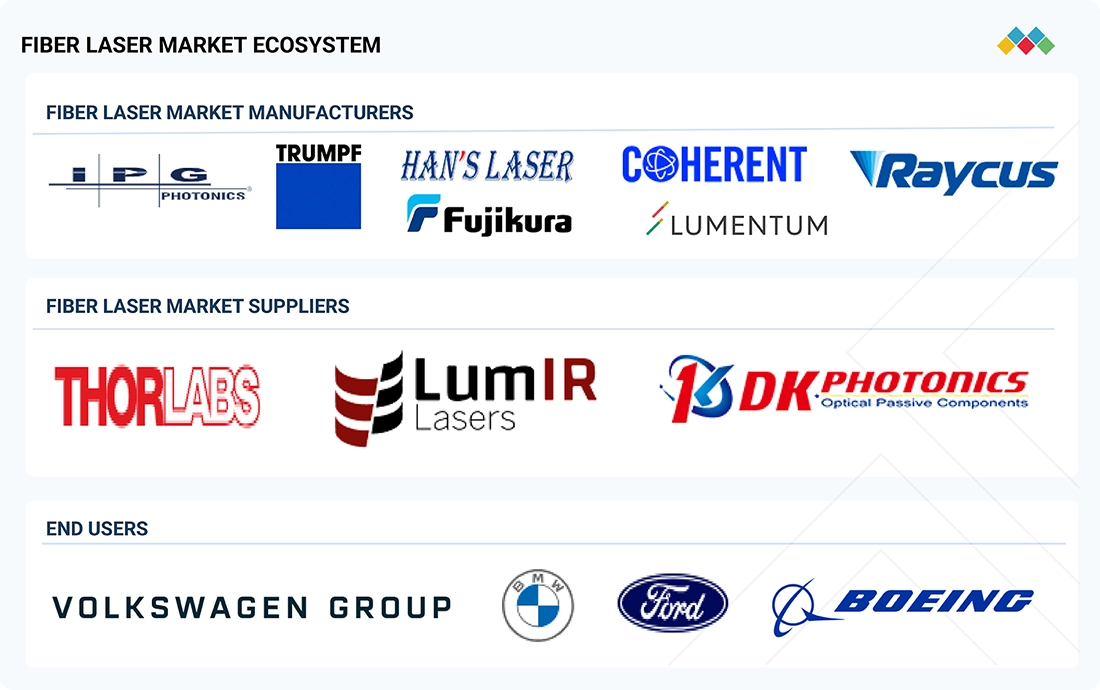
FIBER LASER MARKET SIZE, SHARE, TRENDS: COMMERCIAL USE CASES ACROSS INDUSTRIES
| COMPANY | USE CASE DESCRIPTION | BENEFITS |
|---|---|---|
 |
Supplies high power fiber laser sources for metal cutting, welding, and additive manufacturing in automotive and industrial facilities. | Higher processing speed and cut quality, lower energy use, automation ready production, reduced ownership cost. |
 |
Provides fiber laser-based machine tools for cutting, welding, and marking in automotive, aerospace, and industrial plants. | High accuracy, improved uptime, connected manufacturing support, stable process control. |
 |
Delivers fiber laser systems for electronics, battery, and automotive component manufacturing. | Higher throughput, support for miniaturization, consistent output in high volume production. |
 |
Uses fiber lasers in optical fiber processing, cable manufacturing, and precision component fabrication. | High precision processing, improved yields, reliable telecom grade performance. |
 |
Offers fiber laser solutions for semiconductors, medical devices, and industrial micromachining. | High precision and repeatability, compliance with strict quality needs, efficient processing of advanced materials. |
Logos and trademarks shown above are the property of their respective owners. Their use here is for informational and illustrative purposes only.
Related Ecosystem
Industrial Automation
- Sensors
- Image Sensors
- Manufacturing Execution System (MES)
- Actuators
- Flow Sensors
- Siemens ag
- ABB India Limited
- Emerson Electric Co.
- HONEYWELL INTERNATIONAL INC.
- SCHNEIDER ELECTRIC SE
Logistics And Transportation
- Internal Combustion Engine (ICE)
- Crawler Excavator
- Fuel Cell
- Light Commercial Vehicles (LCVs)
- Sensors
- Siemens ag
- Alstom s.a.
- Hitachi, Ltd.
- Godrej Industries Limited
- Toshiba Corporation
Key Takeaways
- North America's fiber laser market will grow from $1,645.0M (2024) to $2,655.5M (2029) at a 10.1% CAGR.
- North America's advanced manufacturing and semiconductor sectors are primary drivers of fiber laser adoption.
- North America's focus on automation and precision engineering supports sustained market momentum through 2029.
- North America's R&D investments and technological innovation accelerate fiber laser deployment in emerging applications.
Fiber Laser Market Report Scope
| Report Metric | Details |
|---|---|
| Base Year | 2024 |
| Fastest Growing Segment | MEDICAL (End-Use Industry) |
| Forecast Period | 2024-2029 |
| Growth Rate | CAGR of 10.8% from 2024 to 2029 |
| Largest Segment | SOLID LASERS (Laser Type) |
| Market Size Base Year (Billions) | ~USD 7.66 (2024) |
| Revenue Forecast (Billions) | ~USD 12.8 (2029) |
| Segments Covered | Type, Operation Mode, Output Power, End-Use Industry, Laser Type |
North America Fiber Laser Market Report Segmentation
5 segment dimensions are covered across the global market.
By Type
- Argon Lasers
- Chemical Lasers
- Co2 Lasers
- Excimer Lasers
- Helium-Neon Lasers
- Infrared
- Ultrafast
- Ultraviolet
- Visible
By Operation Mode
- Continuous Wave
- Pulsed
By Output Power
- High
- Low
- Medium
By End-Use Industry
- Aerospace
- Automotive
- Commercial
- Industrial
- Medical
- Other End-Use Industries
- Research
- Semiconductor & Electronics
- Telecommunications
By Laser Type
- Gas Lasers
- Liquid Lasers
- Other Laser Types
- Solid Lasers
Target Audience
- Fiber Laser Manufacturers : Manufacturers need North America-specific market data to optimize product portfolios, identify high-growth segments, and develop targeted go-to-market strategies for the region's advanced manufacturing base.
- Industrial Equipment Integrators : System integrators require detailed market insights to understand North American customer needs, competitive positioning, and application-specific demand drivers for fiber laser-based solutions.
- Semiconductor & Electronics Companies : Electronics manufacturers need regional market intelligence to evaluate fiber laser adoption trends, assess supplier capabilities, and plan precision manufacturing investments across North America.
- Investment & Private Equity Firms : Investors require comprehensive North America market analysis to evaluate acquisition targets, assess growth potential, and identify emerging opportunities in the fiber laser technology sector.
- Consulting & Strategy Firms : Consultants need region-specific market data to advise clients on market entry strategies, competitive positioning, and growth opportunities within North America's fiber laser ecosystem.
Countries within North America - compare and drill down
| Country | 2025 size (native) |
|---|---|
| US | USD 1565.2 Million |
| Canada | USD 594.2 Million |
| Mexico | USD 496.2 Million |
Country market size visualization
Reasons to Buy this Report
- Regional Market Sizing & Forecasts : Access precise market valuations for North America ($1,645M in 2024) and country-level breakdowns including the US, Canada, and Mexico with detailed 5-year projections through 2029.
- Competitive Landscape Intelligence : Understand market dynamics specific to North America's advanced manufacturing ecosystem, semiconductor sector adoption patterns, and regional competitive positioning of fiber laser providers.
- Application & End-User Insights : Identify high-growth application segments within North America including precision cutting, welding, micromachining, and semiconductor processing with adoption trends and growth drivers.
- Strategic Investment Guidance : Make informed decisions on market entry, expansion, and product development strategies tailored to North America's 10.1% CAGR growth trajectory and regional industry priorities.
- Country-Level Market Analysis : Leverage detailed breakdowns of US ($1,565.2M), Canadian ($594.2M), and Mexican ($496.2M) markets to identify regional opportunities and prioritize resource allocation.
Frequently asked questions
What is the current size of the North America fiber laser market?
The North America fiber laser market was valued at $1,645.0 million in 2024.
What is the projected size of the North America fiber laser market by 2029?
The North America fiber laser market is forecast to reach $2,655.5 million by 2029.
What is the CAGR for the North America fiber laser market?
The North America fiber laser market is expected to grow at a compound annual growth rate (CAGR) of 10.1% from 2024 to 2029.
Which industries drive fiber laser demand in North America?
North America's automotive, aerospace, electronics, and semiconductor industries are primary drivers of fiber laser adoption and demand.
Why is North America a key market for fiber laser technology?
North America's advanced manufacturing infrastructure, strong R&D ecosystem, and emphasis on automation and precision engineering make it a strategic hub for fiber laser growth.
RESEARCH METHODOLOGY
The study involved four major activities in estimating the size of the Fiber laser market . Exhaustive secondary research has been done to collect information on the market, peer market, and parent market. Validation of these findings, assumptions, and sizing with industry experts across the value chain through primary research has been the next step. Both top-down and bottom-up approaches have been employed to estimate the global market size. After that, market breakdown and data triangulation have been used to estimate the market sizes of segments and subsegments.
Secondary Research
Various secondary sources were referred to in the secondary research process to identify and collect information pertinent to this study. The secondary sources include annual reports, press releases, and investor presentations of companies; white papers, certified publications, and articles by recognized authors; directories; and databases. Secondary research has been mainly carried out to obtain key information about the supply chain of the fiber laser industry, the value chain of the market, the total pool of the key players, market classification, and segmentation according to the industry trends to the bottom-most level, geographic markets, and key developments from both market- and technology oriented perspectives.
Primary Research
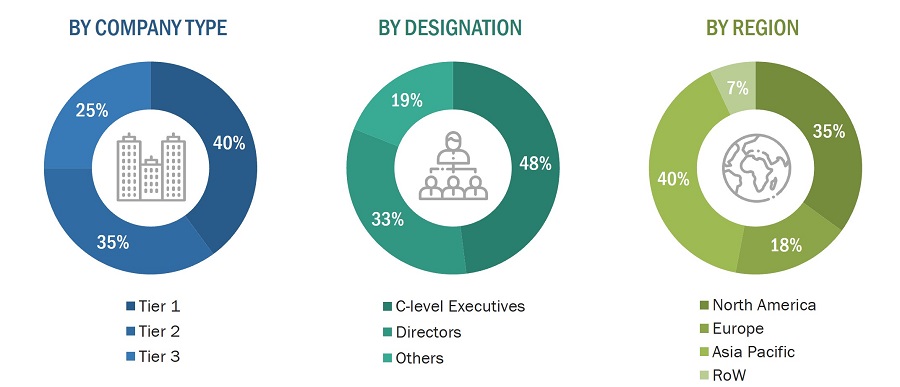
In the primary research process, various primary sources, from both supply and demand sides, were interviewed to obtain qualitative and quantitative information for this report. Primary sources from the supply side included experts such as chief executive officers (CEOs), vice presidents, marketing directors, technology and innovation directors, SMEs, consultants, and related key executives from the major companies and organizations operating in the fiber laser market share .
After the complete market engineering process (which includes market statistics calculations, market breakdown, market size estimations, market forecasting, and data triangulation), extensive primary research was conducted to gather information and verify and validate the critical market numbers.
Several primary interviews were conducted with experts from both the demand and supply sides across four major regions—North America, Europe, Asia Pacific, and RoW. This primary data was collected through questionnaires, emails, and telephonic interviews.
To know about the assumptions considered for the study, download the pdf brochure
Market Size Estimation
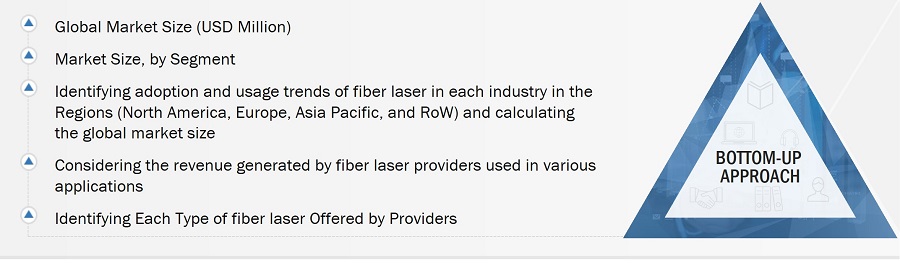
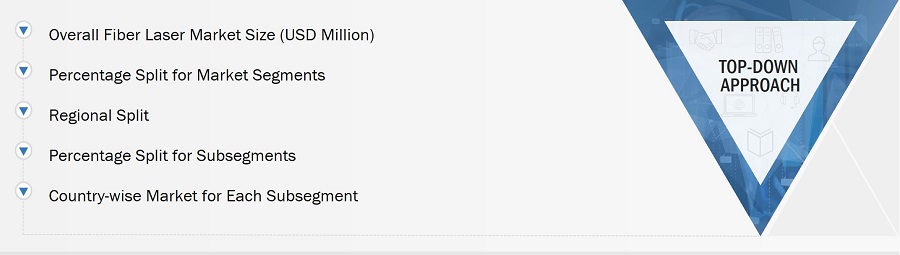
Both top-down and bottom-up approaches have been used to estimate and validate the total size of the fiber laser market. These methods have also been extensively used to estimate the sizes of various market subsegments. The research methodology used to estimate the market sizes includes the following:
- Information related to the revenue of key manufacturers and providers of fiber laser type was studied and analyzed to estimate the global size of the fiber laser market
- Multiple discussions were conducted with key opinion leaders to understand the demand for fiber laser products and analyze the break-up of the scope of work carried out by each major company
- Revenue, geographic presence, key industries served, and the diverse offerings of all identified players in the fiber laser market size were studied to estimate and arrive at the percentage split of different market segments
- All major players in the fiber laser market size were identified through secondary research and verified through brief discussions with industry experts
- Multiple discussions were conducted with key opinion leaders of all major companies involved in developing fiber laser solutions to validate the market split based on operation mode, type, output power, industry, and region
- Geographic splits were estimated using secondary sources on the basis of factors such as the number of players offering fiber laser in a specific country or region and the industries for which these players offer the solutions.
Market Size Estimation Methodology-Bottom-up Approach
Market Size Estimation Methodology-Top-Down Approach
Data Triangulation
The total market was split into several segments after arriving at the overall market size from the market size estimation process explained in the sections above. Market breakdown and data triangulation procedures were employed to complete the overall market engineering process and arrive at the exact statistics for all segments, wherever applicable. The data was triangulated by studying several factors and trends from both the demand and supply sides. The market size was also validated using both the top-down and bottom-up approaches.
Market Definition
Fiber lasers are a type of solid-state laser which uses optical fiber, doped with rare earth elements which acts as the active gain medium. Optical fiber converts light from pump laser diodes into a laser beam with specific wavelengths. Neodymium, ytterbium, praseodymium, erbium, thulium, holmium, and dysprosium are used as doping elements. Due to this wide range of produced wavelengths, fiber lasers are ideal for a variety of applications such as laser cutting, texturing, cleaning, engraving, drilling, marking, and welding. The industries that use fiber laser technology include commercial, telecommunications, research, aerospace, healthcare, automotive, semiconductor & electronics, industrial, and others (oil & gas, iron & steel, tobacco, glass, wood, retail, and plastics).
Stakeholders
- End users
- Government bodies, venture capitalists, and private equity firms
- Fiber laser manufacturers
- Fiber laser distributors
- Fiber laser industry associations
- Professional service/solution providers
- Research institutions and organizations
- Standards organizations and regulatory authorities related to the fiber Laser market
- System integrators
- Technology consultants
Research Objectives
- To define, describe, and project the size of the global fiber laser market, in terms of value, segmented based on type, industry, operation mode, output power and region
- To project the market size of fiber lasers in terms of volume
- To forecast the market size for various segments with respect to four main regions—North America, Europe, Asia Pacific, and RoW
- To provide detailed information regarding the major factors (drivers, restraints, opportunities, and industry-specific challenges) influencing the growth of the market
- To analyze the micro markets with respect to individual growth trends, prospects, and contributions to the total market
- To profile the key market players and comprehensively analyze their market ranking and core competencies.
- To analyze competitive developments, such as joint ventures, mergers & acquisitions, product launches, and research & development (R&D) activities, in the fiber laser market
- To provide leadership mapping based on company profiles and key player strategies such as product launches and development, collaborations, expansions, and acquisitions
- To analyze the opportunities in the market for stakeholders and provide a detailed competitive landscape of the market
- To provide ecosystem analysis, case study analysis, patent analysis, pricing analysis, Porter’s five forces analysis, key stakeholders & buying criteria, key conferences and events, and regulatory bodies, government agencies, and regulations pertaining to the market under study
Available Customizations:
MarketsandMarkets offers the following customizations for this market report:
- Further breakdown of the market in different regions to the country level
- Detailed analysis and profiling of additional market players (up to 5)
Get the Full Fiber Laser Market Report
Full forecast, segment splits, and company analysis for all Fiber Laser Market.
- US Fiber Laser Market
- Canada Fiber Laser Market
- Mexico Fiber Laser Market
- Germany Fiber Laser Market
- UK Fiber Laser Market
- France Fiber Laser Market
- Rest Of Europe Fiber Laser Market
- China Fiber Laser Market
- Japan Fiber Laser Market
- South Korea Fiber Laser Market
- India Fiber Laser Market
- Rest Of Asia Pacific Fiber Laser Market
Need a Tailored Report?
Customize this report to your needs
Get 10% FREE Customization
Customize This Report
