
Philippines Floating Offshore Wind Market (2026-2031)

The Philippines Floating Offshore Wind Market was valued at $242.7 Million in 2026 and projected to reach to $1504.6 Million by 2031, representing a compound annual growth rate of 44.0%. The Philippines floating offshore wind market is entering a transformative phase, driven by the nation's abundant maritime resources and escalating energy demand.


| Market Size in | USD 26.32 MN |
| Market Forecast in | |
| CAGR | |
| Forecast Period | |
| Units Considered | Value (USD MN) |
Philippines Floating Offshore Wind Market Trends and Insights
- This represents a compound annual growth rate of 44.0%, significantly outpacing many regional peers.
- The Philippines' strategic location in the Asia Pacific region, combined with its abundant offshore wind resources and increasing energy demand, creates a compelling investment landscape for floating offshore wind technologies. Driven by the Philippines' commitment to renewable energy targets and the need to diversify its power generation portfolio, the floating offshore wind sector is attracting both domestic and international stakeholders.
- The Philippines' archipelagic geography and consistent wind patterns make floating offshore wind an ideal solution for meeting the nation's growing electricity requirements.
- Between 2026 and 2031, the Philippines is expected to emerge as a key market for floating offshore wind deployment in Asia Pacific, supported by favorable policy frameworks and technological advancements in offshore wind infrastructure..
Key Market Statistics
- CAGR (2026-2031) 44.0% CAGR
- Market Size, 2026 ~USD 242.7 Million
- Forecast, 2031 ~USD 1504.6 Million
- Country Philippines
Philippines Floating Offshore Wind Market Overview
Explosive Growth Trajectory :
The Philippines floating offshore wind market is projected to grow from $242.7 million in 2026 to $1,504.6 million by 2031, representing a robust 44% CAGR that demonstrates strong investor confidence and market expansion potential.
Strategic Geographic Advantage :
Located in the Asia Pacific's typhoon belt with consistent trade winds, the Philippines possesses exceptional offshore wind resources that make it an ideal location for floating offshore wind development and energy generation.
Government Support & Policy Framework :
The Philippine government's renewable energy targets and commitment to decarbonization are driving regulatory support for offshore wind projects, creating favorable conditions for market participants and reducing investment barriers.
Outpacing Regional Growth :
With a 44% CAGR, the Philippines market is growing faster than many regional competitors, positioning it as a key growth engine within Southeast Asia's renewable energy transition and attracting significant capital allocation.
Philippines Floating Offshore Wind Market Dynamics
- Government initiatives promoting renewable energy adoption, combined with technological advancements in floating platforms, are creating unprecedented opportunities for market expansion.
- The country's strategic position in a high-wind region positions it as a critical hub for offshore wind development in Southeast Asia. Investment in floating offshore wind infrastructure is expected to accelerate as major energy companies and developers recognize the Philippines' potential.
- The market's 44% CAGR reflects growing confidence in project viability and returns.
- With supportive policies, declining technology costs, and increasing grid capacity investments, the Philippines is poised to become a regional leader in floating offshore wind energy by 2031..
Market Ecosystem
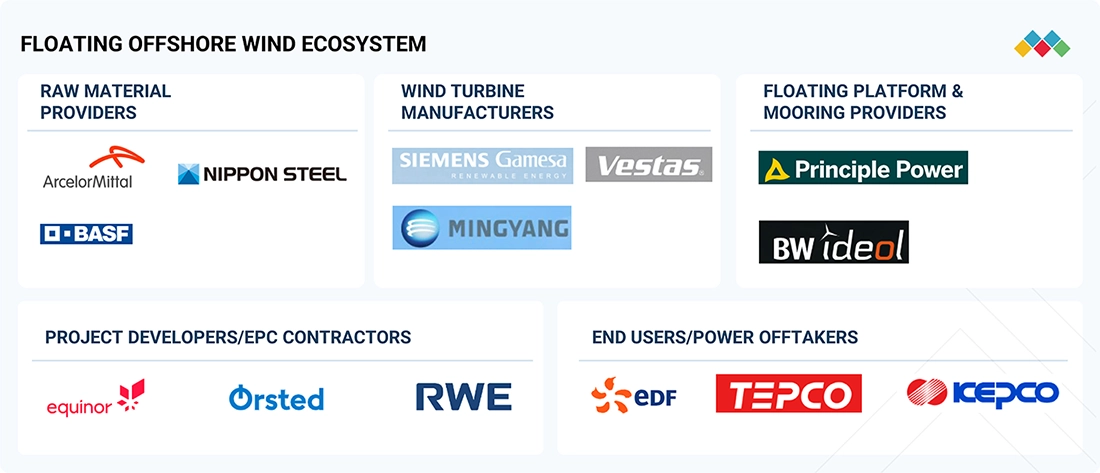
FLOATING OFFSHORE WIND MARKET: COMMERCIAL USE CASES ACROSS INDUSTRIES
| COMPANY | USE CASE DESCRIPTION | BENEFITS |
|---|---|---|
 |
Equinor developed the Hywind Scotland project, the world’s first commercial-scale floating offshore wind farm, located off the coast of Scotland. The project utilizes spar-type floating foundations to support multi-megawatt wind turbines in deep-water conditions exceeding 100 meters, with electricity transmitted to the UK grid via subsea cables. The project was implemented to overcome the limitations of fixed-bottom offshore wind technologies in deep-water environments, where seabed conditions, water depth, and installation complexity pose significant challenges. Advanced mooring systems and real-time monitoring technologies were integrated to ensure structural stability and optimize operational performance. | The project demonstrated the technical and commercial viability of floating offshore wind technology, achieving high capacity factors and stable energy generation in deep-water conditions. It validated spar-buoy floating foundations as a scalable solution, strengthened investor confidence, and supported policy development for future leasing rounds. Additionally, it enabled cost reduction pathways and de-risked floating wind deployment, accelerating the transition toward large-scale commercial projects globally. |
 |
Principle Power deployed the WindFloat Atlantic project off the coast of Portugal, utilizing its proprietary semi-submersible floating platform technology. The project features large offshore wind turbines mounted on triangular semi-submersible structures designed to provide stability in deep-water conditions. These platforms are assembled onshore and towed to the installation site, eliminating the need for heavy-lift vessels and enabling more efficient deployment. The design incorporates three-column structures connected by bracing systems to withstand harsh marine environments, including strong wave action, wind loads, and dynamic cable stresses, while maintaining optimal turbine performance. | The project significantly improved the technical and economic feasibility of floating offshore wind by enhancing platform stability and scalability. It reduced offshore construction risks through port-based assembly and simplified installation logistics, while increasing flexibility in deployment. Additionally, it demonstrated compatibility with existing port infrastructure and supported cost reduction through industrialized manufacturing approaches, thereby accelerating the pathway toward commercial-scale floating wind development. |
Logos and trademarks shown above are the property of their respective owners. Their use here is for informational and illustrative purposes only.
Related Ecosystem
Decarbonization
- Battery Electric Vehicle (BEV)
- Energy Management Systems
- Fuel Cell
- Fuel Cell Electric Vehicle (FCEV)
- Geographical Information System (GIS)
- TotalEnergies SE
- Siemens ag
- Mitsui & Co., Ltd.
- General Electric Company
- Thyssenkrupp ag
Key Takeaways
- The Philippines floating offshore wind market is projected to grow at a 44.0% CAGR from 2026 to 2031, reaching $1,504.6 million.
- The Philippines' archipelagic geography and consistent offshore wind resources position it as a strategic hub for floating offshore wind development in Asia Pacific.
- The Philippines' renewable energy targets and energy security needs are driving significant investment in floating offshore wind infrastructure.
- The Philippines market is expected to attract both international technology providers and domestic developers seeking to capitalize on the sector's rapid expansion.
Floating Offshore Wind Market Report Scope
| Report Metric | Details |
|---|---|
| Base Year | 2026 |
| Fastest Growing Segment | 11–15 MW (Turbine Rating) |
| Forecast Period | 2026–2031 |
| Growth Rate | CAGR of 51.7% from 2026 to 2031 |
| Largest Segment | SEMI-SUBMERSIBLE (Floating Platform) |
| Market Size Base Year (Billions) | ~USD 3.16 (2026) |
| Revenue Forecast (Billions) | ~USD 25.4 (2031) |
| Segments Covered | Turbine Rating, Floating Platform, Component, Depth |
Philippines Floating Offshore Wind Market Report Segmentation
4 segment dimensions are covered across the global market.
By Turbine Rating
- 11–15 Mw
- 5–10 Mw
- Above 15 Mw
- Up To 5 Mw
By Floating Platform
- Barge & Hybrid
- Semi-Submersible
- Spar-Buoy
- Tension-Leg
- Tension–Leg
By Component
- Electrical Systems
- Floating Platforms
- Moorings & Anchors
- Turbines
By Depth
- 30–60 M
- Above 60 M
- Up To 30 M
Target Audience
- Energy Project Developers : Developers need Philippines-specific market data to identify viable project sites, assess financial viability, understand regulatory requirements, and plan capital allocation for floating offshore wind installations.
- Investment & Financial Institutions : Investors require detailed market forecasts and growth metrics for the Philippines to evaluate investment returns, portfolio diversification opportunities, and risk-adjusted returns in the renewable energy sector.
- Government & Policy Makers : Philippine government agencies need market intelligence to design supportive policies, set renewable energy targets, allocate infrastructure budgets, and attract foreign direct investment in offshore wind development.
- Technology & Equipment Suppliers : Manufacturers of floating platforms, turbines, and subsea equipment need Philippines market insights to forecast demand, plan production capacity, and develop localized supply chain strategies for the region.
- Strategic Consultants & Analysts : Consulting firms and research organizations require comprehensive Philippines market data to advise clients on market opportunities, competitive positioning, and long-term strategic planning in offshore wind energy.
Reasons to Buy this Report
- Market Size & Growth Validation : Obtain precise market valuation data for the Philippines floating offshore wind sector with verified CAGR of 44%, enabling accurate financial forecasting and investment decision-making for the 2026-2031 period.
- Competitive Intelligence : Understand the competitive landscape specific to the Philippines market, including key players, market share distribution, and strategic positioning to identify partnership and investment opportunities in this high-growth segment.
- Risk Assessment & Mitigation : Access detailed analysis of Philippines-specific market risks including regulatory changes, typhoon impacts, supply chain vulnerabilities, and mitigation strategies to protect investment portfolios and project timelines.
- Entry Strategy Development : Leverage country-specific insights to develop tailored market entry strategies, including optimal timing, technology selection, and partnership models suited to the Philippines' unique geographic, regulatory, and economic conditions.
- Stakeholder Alignment : Present data-backed market projections to investors, government agencies, and partners to build consensus on the Philippines' offshore wind potential and secure funding, permits, and policy support for project development.
Frequently asked questions
What is the current market size of floating offshore wind in the Philippines?
The Philippines floating offshore wind market was estimated at $242.7 million in 2026 and is projected to reach $1,504.6 million by 2031.
What is the expected growth rate for floating offshore wind in the Philippines?
The Philippines floating offshore wind market is expected to grow at a compound annual growth rate (CAGR) of 44.0% between 2026 and 2031.
Why is the Philippines a strategic market for floating offshore wind?
The Philippines' archipelagic geography, abundant offshore wind resources, growing energy demand, and renewable energy commitments make it an ideal market for floating offshore wind development.
What factors are driving growth in the Philippines floating offshore wind market?
Key drivers include the Philippines' renewable energy targets, energy security needs, technological advancements in floating offshore wind systems, and supportive policy frameworks.
How does the Philippines market compare to the global floating offshore wind market?
The Philippines' 44.0% CAGR exceeds the global average of 51.7%, demonstrating strong regional growth potential within the Asia Pacific floating offshore wind sector.
RESEARCH METHODOLOGY
This study encompassed significant efforts in determining the present size of the floating offshore wind market. It commenced with a thorough secondary research process to gather data on the market, comparable markets, and the broader industry. Subsequently, these findings, assumptions, and market size calculations were rigorously validated through primary research by consulting industry experts across the entire supply chain. The total market size was assessed by conducting an analysis specific to each country. Following that, the market was further dissected, and the data was cross-referenced to estimate the size of various segments and subsegments within the market.
Secondary Research
In this research study, a wide range of secondary sources was utilized, including directories, databases, and reputable references such as the Global Wind Energy Council, WindEurope, Factiva, World Bank, International Monetary Fund (IMF), the US Department of Energy (DOE), and the International Energy Agency (IEA). These sources played a crucial role in gathering valuable data for a comprehensive analysis of the global market, covering technical, market-oriented, and commercial aspects. Additional secondary sources included annual reports, press releases, investor presentations, whitepapers, authoritative publications, articles authored by well-respected experts, information from industry associations, trade directories, and various database resources.
Primary Research
The floating offshore wind market involves a range of stakeholders, including raw material providers, wind turbine manufacturers, floating platform & mooring providers, project developers/contractors, and end users/power offtakers. To gather qualitative and quantitative insights, various primary sources from both the supply and demand sides of the market were interviewed. The following breakdown presents the primary respondents involved in the research study.
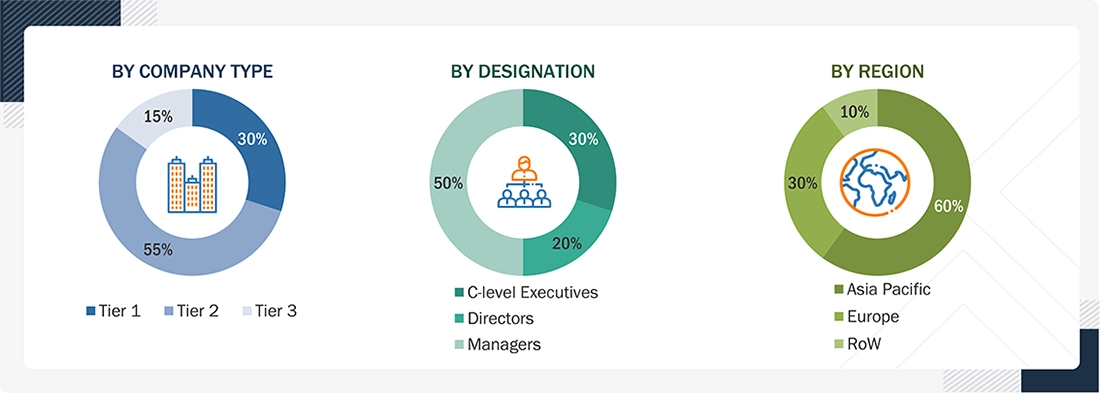
Note: “Others” include sales managers, engineers, and regional managers.
The tiers of the companies are defined based on their total revenue as of 2024: Tier 1: >USD 1 billion, Tier 2: USD 500 million–1 billion, and Tier 3: <USD 500 million.
To know about the assumptions considered for the study, download the pdf brochure
Market Size Estimation
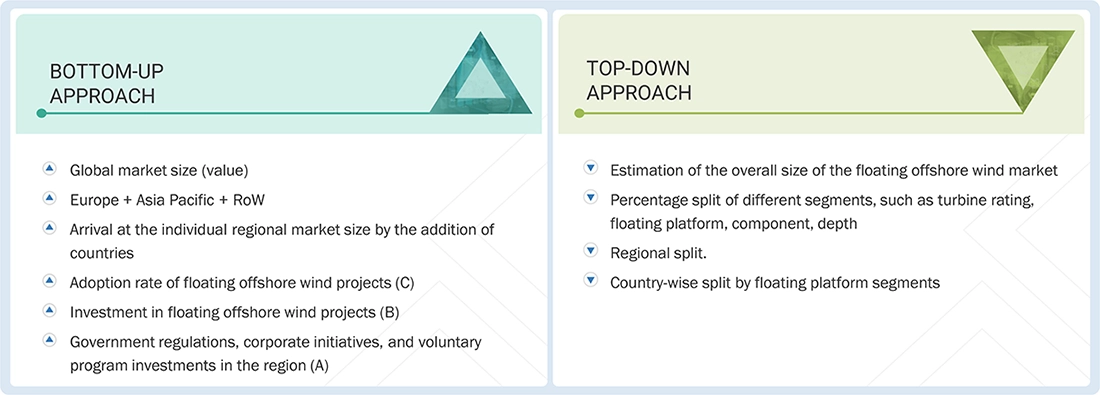
The estimation and validation of the floating offshore wind market size have been conducted using both bottom-up and top-down approaches. This approach was rigorously employed to ascertain the dimensions of multiple subsegments within the market. The research process comprises the following key stages.
- Thorough secondary and primary research has been conducted to gain a comprehensive understanding of the global market landscape for various segments of the market.
- When calculating and forecasting the market size, qualitative factors such as market drivers, restraints, opportunities, and challenges have been taken into account.
Data Triangulation
The process of determining the overall market size involved the methodologies described earlier, followed by segmenting the market into multiple segments and subsegments. To finalize the comprehensive market analysis and obtain precise statistics for each market segment and subsegment, data triangulation and market segmentation techniques were applied, as appropriate. Data triangulation was accomplished by examining various factors and trends from both the demand and supply perspectives within the ecosystem of the floating offshore wind market.
Market Definition
The global floating offshore wind market comprises the development, deployment, and commercialization of wind energy systems installed on buoyant substructures in deep-water environments where conventional fixed-bottom foundations are technically or economically unviable. This market encompasses a range of turbine ratings, from small-scale units to next-generation high-capacity turbines exceeding 15 MW, integrated with advanced floating platform designs such as semi-submersible, spar-buoy, and tension-leg platforms. It further includes critical components such as wind turbines, floating substructures, mooring and anchoring systems, and subsea electrical infrastructure required for power transmission and grid integration. The market operates across varying water depths, particularly beyond 60 meters, unlocking access to superior wind resources located in deeper offshore zones. Floating offshore wind plays a pivotal role in expanding the geographical scope of offshore wind deployment, enabling countries with limited shallow-water sites to harness renewable energy potential, while contributing significantly to global decarbonization objectives and the transition toward low-carbon energy systems.
Key Stakeholders
- Project Developers & Owners
- Turbine Manufacturers
- Floating Platform Developers & Technology Providers
- EPC Contractors & Marine Engineering Firms
- Mooring, Anchoring & Subsea System Providers
- Electrical Infrastructure & Grid Connection Providers
- Ports, Shipyards & Installation Vessel Operators
- Governments & Regulatory Authorities
- Investors & Financial Institutions
- Research Institutions & Certification Bodies
- Energy Associations
- Environmental Associations
- Energy Efficiency Consultants
Report Objectives
- To describe, analyze, and forecast the floating offshore wind market, by turbine rating, floating platform, component, and depth, in terms of value
- To describe and forecast the market for five key regions: Europe, Asia Pacific, and the Rest of World (RoW), along with their country-level market sizes, in terms of value
- To give comprehensive details regarding drivers, restraints, opportunities, and challenges impacting the expansion of the market
- To systematically examine the market for floating offshore wind in terms of each segment’s contributions to the market, growth trends, and prospects
- To provide the supply chain analysis, trends/disruptions impacting customer business, market maps, ecosystem analysis, sustainability and regulatory landscape, pricing analysis, patent analysis, case study analysis, technology analysis, key conferences and events, Porter’s five forces analysis, macroeconomic outlook, customer landscape & buyer behavior, regulatory analysis, and AI/Gen AI impact on the market
- To conduct a strategic analysis of micromarkets concerning their respective growth trends, planned expansions, and market share contributions
- To sketch into a competitive environment for market participants and assess the potential for stakeholders in the floating offshore wind business
- To benchmark players within the market using the company evaluation matrix, which analyzes market players on various parameters within the broad categories of business and product strategies
- To compare key market players for the product specifications and rankings
- To strategically profile key players and comprehensively analyze their market ranking and core competencies
- To analyze competitive developments in the floating offshore wind industry, such as agreements, investments, joint ventures, expansions, product launches, contracts, partnerships, collaborations, and acquisitions.
Available customizations:
With the given market data, MarketsandMarkets offers customizations based on the company’s specific needs. The following customization options are available for the report:
PRODUCT ANALYSIS
- Product Matrix, which provides a detailed comparison of the product portfolio of each company
COMPANY INFORMATION
Detailed analyses and profiling of additional market players (up to 5)
Get the Full Floating Offshore Wind Market Report
Full forecast, segment splits, and company analysis for all Floating Offshore Wind Market.
- China Floating Offshore Wind Market
- South Korea Floating Offshore Wind Market
- Taiwan Floating Offshore Wind Market
- Norway Floating Offshore Wind Market
- UK Floating Offshore Wind Market
- France Floating Offshore Wind Market
- Sweden Floating Offshore Wind Market
- Italy Floating Offshore Wind Market
- Rest Of Europe Floating Offshore Wind Market
- Rest Of Asia Pacific Floating Offshore Wind Market
Need a Tailored Report?
Customize this report to your needs
Get 10% FREE Customization
Customize This Report
