
Philippines Fluid Transfer System Market (2025-2030)

The Philippines Fluid Transfer System Market was valued at $8335 Million in 2025 and projected to reach to $13385 Million by 2030, representing a compound annual growth rate of 7.0%. The Philippines fluid transfer system market is positioned for sustained expansion through 2030, supported by rising vehicle ownership, growing automotive manufacturing, and increased logistics activity.


| Market Size in | USD 26.32 MN |
| Market Forecast in | |
| CAGR | |
| Forecast Period | |
| Units Considered | Value (USD MN) |
Philippines Fluid Transfer System Market Trends and Insights
- This 7.0% compound annual growth rate significantly outpaces the global average of 3.3%, reflecting the Philippines' accelerating automotive and transportation sector development.
- The market's expansion is driven by rising vehicle production, increased adoption of advanced fluid management technologies, and growing infrastructure investments across the archipelago. In the Philippines, fluid transfer systems are critical components in automotive applications, including fuel delivery, cooling, and hydraulic systems.
- The market's strong performance through 2030 is underpinned by the Philippines' emerging middle class, rising vehicle ownership rates, and government initiatives supporting local automotive manufacturing.
- As the Philippines continues to modernize its transportation infrastructure and expand its automotive assembly capabilities, demand for reliable and efficient fluid transfer solutions will intensify, positioning the country as a key growth market within the Asia Pacific region..
Key Market Statistics
- CAGR (2025-2030) 7.0% CAGR
- Market Size, 2025 ~USD 8335 Million
- Forecast, 2030 ~USD 13385 Million
- Country Philippines
Philippines Fluid Transfer System Market Overview
Exceptional Growth Trajectory :
The Philippines fluid transfer system market is growing at 7.0% CAGR, more than double the global rate of 3.3%, driven by rapid motorization and expanding transportation infrastructure across the archipelago.
Significant Market Expansion :
Market valuation is projected to surge from USD 8,335 million in 2025 to USD 13,385 million by 2030, representing a USD 5,050 million increase over five years as vehicle production and aftermarket demand accelerate.
Rising Vehicle Production :
Increasing automotive manufacturing capacity and vehicle ownership rates in the Philippines are creating sustained demand for advanced fluid transfer systems across passenger cars, commercial vehicles, and industrial applications.
Infrastructure Development Impact :
Government investments in transportation networks and logistics infrastructure are boosting commercial vehicle sales, directly fueling demand for reliable fluid transfer solutions in the Philippine market.
Philippines Fluid Transfer System Market Dynamics
- The 7.0% CAGR reflects the country's developing economy and expanding middle class driving vehicle purchases.
- Key growth catalysts include government infrastructure projects, foreign automotive investments, and the rising adoption of modern vehicle technologies requiring advanced fluid management systems.
- The market's outperformance versus global averages indicates strong localized demand dynamics and emerging opportunities for suppliers and manufacturers targeting the Philippine automotive sector..
Market Ecosystem
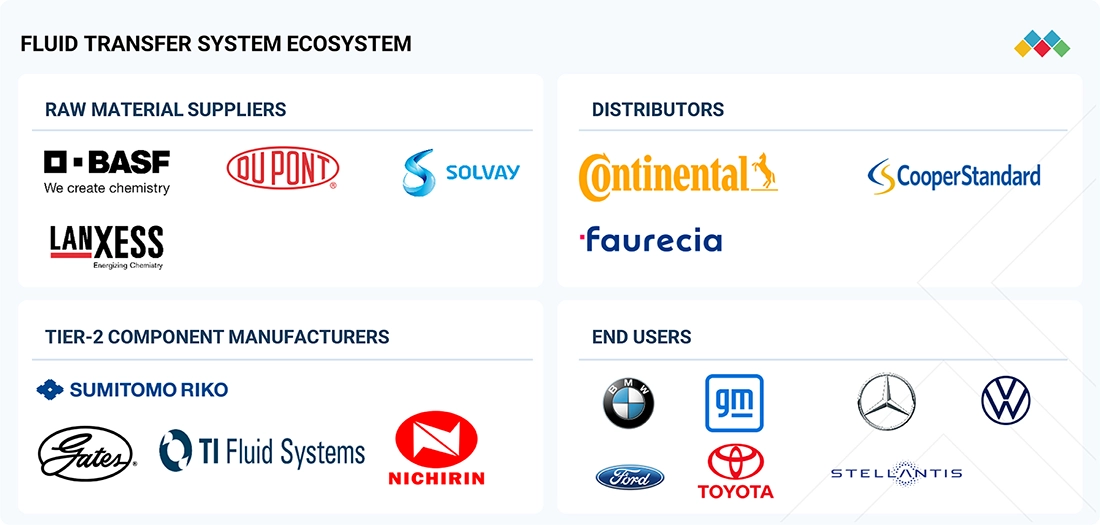
Fluid Transfer System Market: COMMERCIAL USE CASES ACROSS INDUSTRIES
| COMPANY | USE CASE DESCRIPTION | BENEFITS |
|---|---|---|
 |
High-pressure fuel injection lines, throttle valve cables, and fuel rail systems for passenger cars and commercial vehicles | Improved fuel atomization, better combustion efficiency, lower emissions, enhanced engine performance |
 |
Radiator hoses, battery coolant hoses, and DC-DC converter cooling hoses for electric buses and trucks | Efficient thermal management, reduced overheating risk, longer battery life, optimized cooling system performance |
 |
Brake and clutch hose assemblies, vacuum booster hoses, and EVAP lines in electric and hybrid commercial vehicles | Enhanced braking response, improved safety, minimized vapor leaks, and reliable hydraulic operation under extreme conditions |
Logos and trademarks shown above are the property of their respective owners. Their use here is for informational and illustrative purposes only.
Related Ecosystem
Automotive Materials
- Light Commercial Vehicles (LCVs)
- Battery Electric Vehicle (BEV)
- Hybrid Electric Vehicle (HEV)
- Fuel Cell Electric Vehicle (FCEV)
- Agricultural Tractors
- GORKOVSKY AVTOMOBILNY ZAVOD
- AISIN CORPORATION
- Continental ag
- Basf se
- BOSCH LIMITED
Automotive Systems
- Light Commercial Vehicles (LCVs)
- Battery Electric Vehicle (BEV)
- Hybrid Electric Vehicle (HEV)
- Agricultural Tractors
- Fuel Cell Electric Vehicle (FCEV)
- BOSCH LIMITED
- DENSO Corporation
- ZF FRIEDRICHSHAFEN AG
- Continental ag
- GORKOVSKY AVTOMOBILNY ZAVOD
Key Takeaways
- The Philippines fluid transfer system market will grow from USD 8,335M (2025) to USD 13,385M (2030), representing a 7.0% CAGR that outpaces global growth.
- Rising vehicle production and automotive assembly in the Philippines is driving increased demand for fluid transfer components and systems.
- Government infrastructure investments and a growing middle class in the Philippines are accelerating adoption of advanced automotive technologies.
- The Philippines represents a high-growth opportunity within Asia Pacific, with expansion potential in both OEM and aftermarket segments.
Fluid Transfer System Market Report Scope
| Report Metric | Details |
|---|---|
| Base Year | 2025 |
| Fastest Growing Segment | BATTERY ELECTRIC (Propulsion) |
| Forecast Period | 2025-2030 |
| Growth Rate | CAGR of 3.3% from 2025 to 2030 |
| Largest Segment | DIESEL (Propulsion) |
| Market Size Base Year (Billions) | ~USD 23.86 (2025) |
| Revenue Forecast (Billions) | ~USD 28.07 (2030) |
| Segments Covered | Propulsion, Component, Vehicle Type, System Type |
Philippines Fluid Transfer System Market Report Segmentation
4 segment dimensions are covered across the global market.
By Propulsion
- Battery Electric
- Cng
- Diesel
- Petrol/Gasoline
- Plug-In Hybrid Electric
By Component
- A/C Cabin Climate Control (Incl. Ventilation)
- A/C Drain Line
- Air Intake Hose
- Air Suspension Line
- Anti-Roll Bar
- Anti-Roll Hose
- Battery Coolant Hose
- Brake And Clutch Hose & Line Assembly
- Brake Bundle Assembly
- Bypass Hose
- Cng Hose
- Cng Tube
- Dc-Dc Converter Cooling Hose
- Differential Pressure Hose
- Dipstick Tube
- Egr Tube & Assembly
- Evap Line
- Expansion Valve Tube
- Feed Return Line
- Fluid Return Hose
- Fuel Delivery Line
- Fuel Feed Line
- Fuel Filler Line
- Fuel Filler Neck
- Fuel Injector Line
- Fuel Leak-Off Assembly
- Fuel Rail
- Fuel Vapor Vent Line
- Hp Fuel Injection Line/Direct Injection Line
- Hydraulic Power Steering Hose
- Hydraulic Suspension Line
- Motor Cooling Hose
- Oil Line
- Positive Crankcase Ventilation (Pcv) Hose
- Power Door Lock Hose
- Pressure Control Solenoid Hose
- Radiator Hose
- Reservoir Overflow Hose
- Scr Tube & Assembly
- Shock Absorber Hose
- Sunroof Drain Hose
- Tailpipe
- Thermal Line (For Heating And Cooling)
- Transmission Oil Cooler Line
- Turbocharger Coolant Line
- Turbocharger Coolant Return Line
- Turbocharger Oil Drain Line
- Turbocharger Oil Feed Line
- Vacuum Booster Hose
- Vacuum Hose
- Vacuum Modulator Hose
- Windshield Washer Hose
By Vehicle Type
- Buses
- Light Commercial Vehicles
- Passenger Cars
- Trucks
By System Type
- Body & Exterior
- Brake & Clutch
- Engine
- Exhaust
- Fuel Delivery
- Lubrication
- Power Steering
- Suspension
- Thermal Management
- Transmission
Target Audience
- Automotive Manufacturers : Philippine-based and international OEMs need market data to plan production capacity, source fluid transfer components locally, and align manufacturing strategies with the region's 7% growth trajectory.
- Component Suppliers & Distributors : Fluid system suppliers require detailed market forecasts to identify distribution opportunities, negotiate supplier contracts, and expand their presence in the fast-growing Philippine automotive supply chain.
- Investment & Private Equity Firms : Investors evaluating opportunities in Philippine automotive and transportation sectors need market sizing and growth projections to assess portfolio companies and identify acquisition targets in fluid transfer systems.
- Business Development Executives : Corporate strategists in automotive and logistics need Philippines-specific market intelligence to evaluate partnerships, joint ventures, and expansion opportunities in this high-growth regional market.
- Market Research & Consulting Teams : Research professionals and consultants require granular Philippines data to support client advisory work, competitive analysis, and strategic recommendations for automotive and transportation sector clients.
Reasons to Buy this Report
- Market-Specific Growth Intelligence : Gain detailed insights into the Philippines' 7.0% CAGR performance, understanding localized drivers and competitive dynamics that differ significantly from global market trends.
- Investment Decision Support : Access comprehensive valuation data (USD 8,335M to USD 13,385M) to evaluate market entry opportunities, expansion strategies, and capital allocation decisions in the Philippine automotive sector.
- Competitive Positioning Analysis : Understand the Philippine market landscape, identify key competitors, and benchmark your fluid transfer system offerings against regional and local players capturing this high-growth market.
- Demand Forecasting Accuracy : Leverage five-year projections specific to the Philippines to optimize supply chain planning, inventory management, and production capacity decisions aligned with regional demand trajectories.
- Strategic Market Entry Planning : Develop targeted go-to-market strategies for the Philippines with data-driven insights on vehicle production trends, infrastructure development, and emerging customer segments driving fluid system adoption.
Frequently asked questions
What is the current size of the Philippines fluid transfer system market?
The Philippines fluid transfer system market is valued at USD 8,335 million in 2025 and is expected to grow to USD 13,385 million by 2030.
What is the projected growth rate for the Philippines market?
The Philippines fluid transfer system market is projected to grow at a compound annual growth rate (CAGR) of 7.0% from 2025 to 2030.
What are the main drivers of growth in the Philippines fluid transfer system market?
Key growth drivers in the Philippines include rising vehicle production, increased automotive assembly, government infrastructure investments, growing middle-class vehicle ownership, and adoption of advanced fluid management technologies.
How does the Philippines market compare to global growth rates?
The Philippines fluid transfer system market is growing at 7.0% CAGR, significantly outpacing the global average of 3.3%, making it one of the fastest-growing markets in the sector.
What applications drive demand for fluid transfer systems in the Philippines?
In the Philippines, fluid transfer systems are essential for automotive fuel delivery, cooling systems, hydraulic applications, and other critical vehicle functions across both OEM and aftermarket segments.
RESEARCH METHODOLOGY
The research study involves extensive secondary sources, such as company annual reports/presentations, industry association publications, magazine articles, directories, technical handbooks, World Economic Outlook, trade websites, technical articles, and databases, to identify and collect information on the fluid transfer system market. Primary sources, such as experts from related industries, automobile OEMs, and suppliers, have been interviewed to obtain and verify critical information and assess the growth prospects and market estimations.
Secondary Research
Secondary sources for this research study include corporate filings, such as annual reports, investor presentations, and financial statements; trade, business, and professional associations; whitepapers and automotive fluid and flow transfer-related journals; certified publications; articles by recognized authors; directories; and databases. Secondary data has been collected and analyzed to determine the overall market size, further validated by primary research.
Primary Research
Extensive primary research has been conducted after understanding the fluid transfer system market scenario through secondary research. Several primary interviews have been conducted with market experts from the demand side (vehicle manufacturers, country-level government associations, and trade associations) and the supply side (fluid transfer system providers and integrators). The regions considered for the research include Asia Pacific, Southeast Asia, Europe, North America, and the Rest of the World. Approximately 32% and 68% of primary interviews have been conducted from the demand and supply sides. Primary data has been collected through questionnaires, emails, and telephonic interviews. In the canvassing of primaries, various departments within organizations, such as sales, operations, and marketing, have been covered to provide a holistic viewpoint in this report.
After interacting with industry experts, brief sessions have been conducted with highly experienced independent consultants to reinforce the findings from the primaries. This, along with the in-house subject matter experts’ opinions, has led to the findings described in this report.
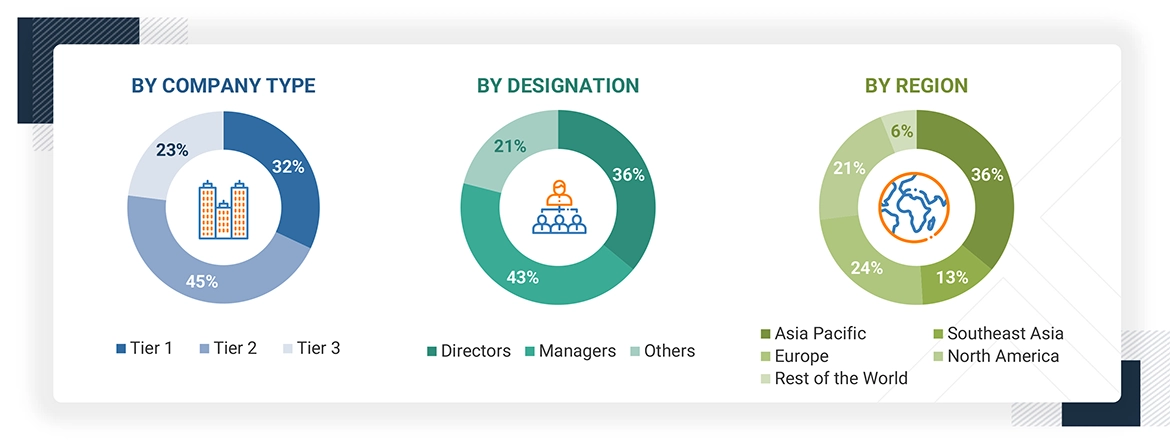
Note: Tiers are based on the value chain; the company’s revenue is not considered. Others include sales and product managers.
To know about the assumptions considered for the study, download the pdf brochure
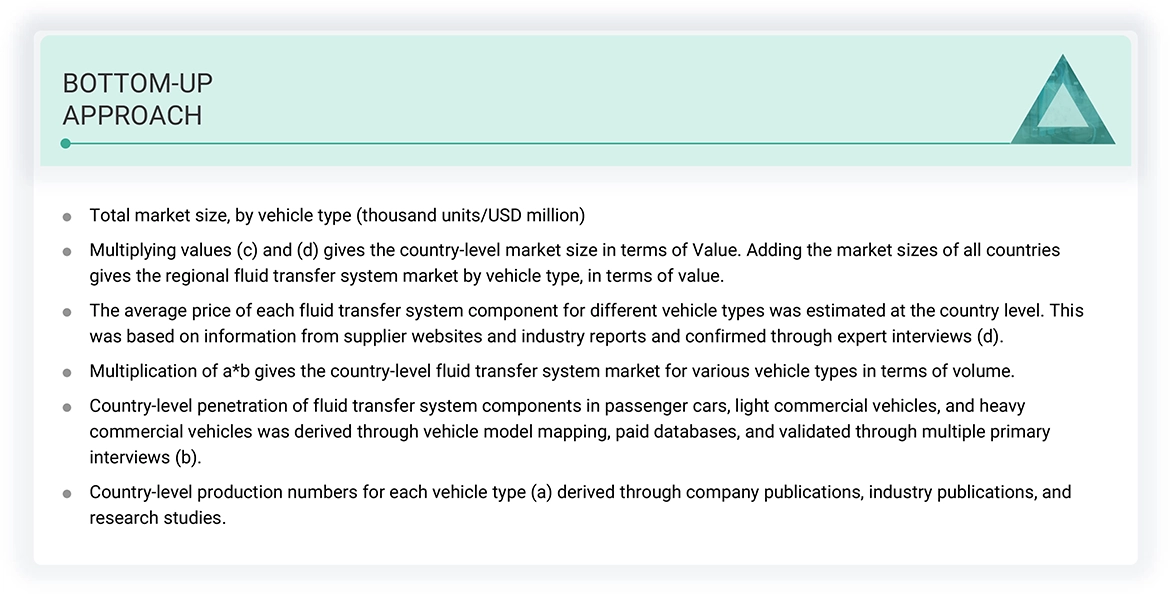
Market Size Estimation
The bottom-up approach has been used to estimate and validate the total size of the fluid transfer system market. This method was also used extensively to estimate the size of various subsegments in the market. The research methodology used to estimate the market size includes the following:
Fluid Transfer System Market : Top-Down and Bottom-Up Approach
Data Triangulation
After arriving at the overall market size through the methodology above, the fluid transfer system market has been split into several segments and subsegments. Where applicable, the data triangulation procedure has been employed to complete the overall market engineering process and arrive at the exact market value for key segments and subsegments. The extrapolated market data has been triangulated by studying various macro indicators and regional trends from both the demand- and supply-side participants.
Market Definition
The fluid transfer system in the automotive sector includes hoses, pipes, tubes, and fluid transfer lines designed to transport fluids such as fuel, oil, coolant, brake fluid, and air across vehicle subsystems. These components are critical for thermal management, powertrain, brake, and transmission across passenger and commercial vehicles.
Stakeholders
- Authorized Service Centers and Independent Aftermarket Service Providers
- Automobile Organizations/Associations and Government Bodies
- Automobile OEMs
- Automotive Component Manufacturers
- Automotive Raw Material Suppliers
- Automotive Research Organizations
- EV and EV Component Manufacturers
- Fluid Transfer System Integrators
- Fluid Transfer System Manufacturers
- Tooling and Machinery Suppliers
- Vehicle Safety and Emission Regulatory Bodies
Report Objectives
- To analyze and forecast the size of the fluid transfer system market in terms of volume (thousand units) and value (USD million) from 2025 to 2032
-
To segment the market by propulsion & component, vehicle type, system type, and region
- To segment and forecast the market size by propulsion & component [petrol/gasoline (air intake hose, vacuum hose, fuel feed line, feed return line, fuel leak-off assembly, turbocharger oil feed line, turbocharger oil drain line, turbocharger coolant line, turbocharger coolant return line, positive crankcase ventilation (PVC) hose, vacuum modulator hose, dipstick tube, fluid return hose, pressure control solenoid hose, transmission oil cooler line, hydraulic power steering hose, fuel delivery line, fuel rail, direct fuel injection line, CNG tube, CNG hose, fuel vapor vent line, fuel injector line, fuel to tank filler line, fuel filler neck, thermal lines, expansion valve tube, A/C cabin climate control hose, radiator hose, reservoir overflow hose, bypass hose, DC-DC converter cooling hose, motor coolant hose, battery coolant hose, A/C drain line, hydraulic suspension line, air suspension line, shock absorber hose, anti roll bar, brake & clutch hose and line assembly, vacuum booster hose, brake bundle assembly, EGR tube & assembly, SCR tube & assembly, EVAP line, differential pressure hose, tail pipe, sunroof drain, windshield hose, power door lock hose, oil line), diesel, CNG, battery electric, and plug-in hybrid electric]
-
(*Note: A similar component-level breakdown is provided for other propulsion types.)
- To segment and forecast the market by vehicle type (passenger cars, light commercial vehicles, trucks, and buses)
- To segment and forecast the market by system type (engine, transmission, power steering, fuel delivery, thermal management, suspension, brake & clutch, exhaust, and body & exterior)
- To forecast the market by region (Asia Pacific, Southeast Asia, Europe, North America, and Rest of the World)
- To identify and analyze key drivers, restraints, challenges, and opportunities influencing market growth
- To strategically analyze the market, considering individual growth trends, prospects, and contributions to the total market
-
To study the following with respect to the market
- Value Chain Analysis
- Ecosystem Analysis
- Technology Analysis
- Trade Analysis
- Case Study Analysis
- Patent Analysis
- Regulatory Landscape
- Pricing Analysis
- Trends and Disruptions Impacting Customer Business
- Impact of AI/Gen AI
- Key Stakeholders and Buying Criteria
- Key Conferences and Events
- MnM Insights on Fluid Transfer Market Trends
- To strategically profile the key players and comprehensively analyze their market share and core competencies
- To track and analyze competitive developments such as deals (joint ventures, mergers & acquisitions, partnerships, collaborations), product launches/developments, and other activities undertaken by the industry participants
Available Customizations
With the given market data, MarketsandMarkets offers customizations in accordance with the company’s specific needs.
- Fluid transfer system market for two- & three-wheelers and off-highway vehicles at the regional level (those covered in the report)
- Fluid transfer system market by vehicle type for additional countries (those not covered in the report)
- Additional company profiles (up to five)
Get the Full Fluid Transfer System Market Report
Full forecast, segment splits, and company analysis for all Fluid Transfer System Market.
- China Fluid Transfer System Market
- India Fluid Transfer System Market
- Japan Fluid Transfer System Market
- South Korea Fluid Transfer System Market
- Thailand Fluid Transfer System Market
- Indonesia Fluid Transfer System Market
- Vietnam Fluid Transfer System Market
- Canada Fluid Transfer System Market
- Mexico Fluid Transfer System Market
- Germany Fluid Transfer System Market
- France Fluid Transfer System Market
- Italy Fluid Transfer System Market
- Spain Fluid Transfer System Market
- UK Fluid Transfer System Market
- South Africa Fluid Transfer System Market
- Kenya Fluid Transfer System Market
- Egypt Fluid Transfer System Market
- US Fluid Transfer System Market
- Rest Of Europe Fluid Transfer System Market
Need a Tailored Report?
Customize this report to your needs
Get 10% FREE Customization
Customize This Report
