
Brazil Fumed Silica Market (2025-2030)

The Brazil Fumed Silica Market was valued at $56.7 Million in 2025 and projected to reach to $66.9 Million by 2030, representing a compound annual growth rate of CAGR 3.35%. Brazil's fumed silica market is poised for steady growth through 2030, supported by expanding industrial applications and the country's manufacturing sector recovery.


| Market Size in | USD 26.32 MN |
| Market Forecast in | |
| CAGR | |
| Forecast Period | |
| Units Considered | Value (USD MN) |
Brazil Fumed Silica Market Trends and Insights
- Brazil's fumed silica demand is driven by expanding applications in rubber, coatings, adhesives, and pharmaceutical sectors, supported by the country's robust manufacturing base and industrial recovery.
- The market in Brazil reflects steady growth momentum as regional industries increasingly adopt high-performance silica products for product enhancement and operational efficiency. During the forecast period from 2025 to 2030, Brazil is expected to maintain moderate but consistent expansion, underpinned by rising demand from automotive, construction, and consumer goods sectors.
- Brazil's strategic position in South America and its established chemical supply chains position the country as a key market for fumed silica producers.
- Investment in local production capacity and R&D initiatives will further support market penetration across Brazil's diverse industrial base..
Key Market Statistics
- CAGR (2025-2030) CAGR 3.35%
- Market Size, 2025 ~USD 56.7 Million
- Forecast, 2030 ~USD 66.9 Million
- Country Brazil
Brazil Fumed Silica Market Overview
Market Size & Growth :
Brazil's fumed silica market is valued at USD 56.7 million in 2025, with projected growth to USD 66.9 million by 2030, reflecting a steady CAGR of 3.35% driven by industrial expansion and manufacturing recovery.
Key Application Sectors :
Fumed silica demand in Brazil is primarily driven by rubber manufacturing, coatings production, adhesives formulation, and pharmaceutical applications, leveraging the country's strong industrial base and diverse manufacturing ecosystem.
Industrial Recovery Momentum :
Brazil's fumed silica market benefits from the country's ongoing industrial recovery and manufacturing sector expansion, creating sustained demand across automotive, construction, and consumer goods industries.
Regional Manufacturing Advantage :
Brazil's robust manufacturing infrastructure and established supply chains position it as a key market for fumed silica consumption in Latin America, supporting both domestic and regional industrial applications.
Brazil Fumed Silica Market Dynamics
- The market benefits from increasing demand in rubber compounding, high-performance coatings, and adhesive formulations across automotive and construction sectors.
- Growing pharmaceutical and cosmetic industries further contribute to market expansion.
- However, growth remains moderate at 3.35% CAGR, reflecting competitive pricing pressures and economic cyclicality in Brazil's industrial sector.
- Strategic investments in manufacturing capacity and product innovation will be critical for market participants to capture emerging opportunities in this developing market..
Market Ecosystem
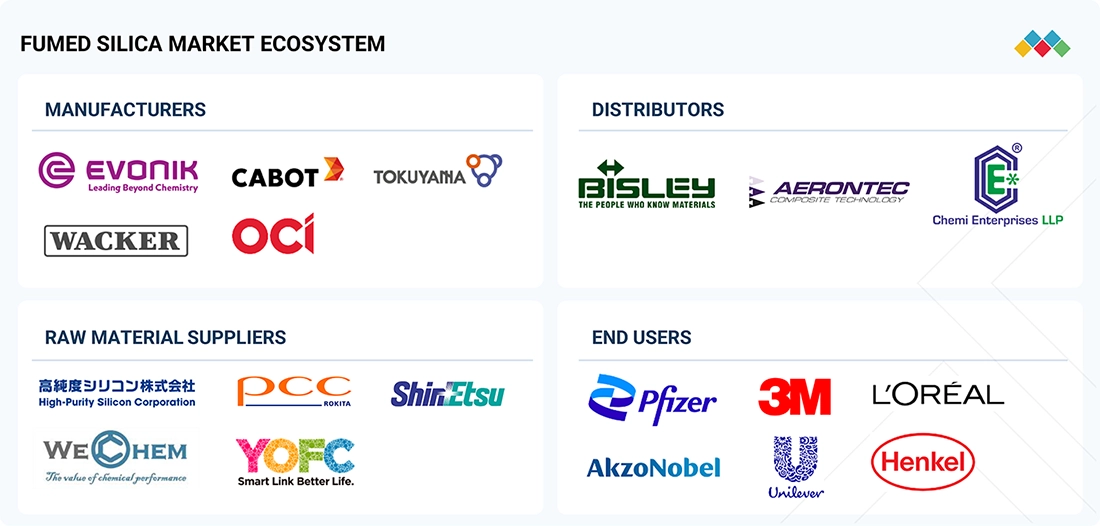
FUMED SILICA MARKET: COMMERCIAL USE CASES ACROSS INDUSTRIES
| COMPANY | USE CASE DESCRIPTION | BENEFITS |
|---|---|---|
 |
Tested AEROSIL 200 Pharma in partnership with Gericke AG and L.B. Bohle for continuous direct compression, including feeding, mixing, and tablet production. The precise application of the glidant at minimal rates provided optimum dispersion, improved powder flow, and consistent die filling during short residence times. | Enhanced flowability and reduced variability, facilitating continuous treatment and precise low-dose administration. Continuous production processes achieved elevated average tablet weights, less weight variability, enhanced crushing strength, and superior mechanical integrity. |
 |
A coatings producer in Hubei Province used HL-200, a hydrophilic fumed silica with a surface area of ~200 m²/g, to counter sedimentation and delamination in 40% powder water-based coatings. The additive was efficiently dispersed at high-speed mixing, creating a hydrogen-bonded three-dimensional structure that stabilized pigments and fillers without influencing gloss or film properties. | Prevented sedimentation and phase separation under prolonged storage conditions while improving viscosity and rheology. Retained consistent gloss, smooth film appearance, and long-term stability, proving optimal suspension performance in water-based coating applications. |
|
|
AEROSIL® fumed silica is used in VRLA gel lead-acid batteries to immobilize sulfuric acid and prevent stratification during cycling. The silica generated by flame creates a thixotropic three-dimensional SiO2 network, facilitating regulated gel formation, structural recovery post-shear, and prolonged electrolyte stabilization. | Eradicates acid stratification, diminishes sulfation and moisture loss, and improves deep-cycle stability and safety. Provides an extended service life, enhanced oxygen recombination efficiency, reduced leakage risk, and greater electrochemical performance relative to traditional systems. |
Logos and trademarks shown above are the property of their respective owners. Their use here is for informational and illustrative purposes only.
Related Ecosystem
Speciality Chemicals
- Basf se
- DOW CHEMICAL COMPANY
- Evonik industries ag
- Clariant ag.
- Solvay sa
Key Takeaways
- Brazil's fumed silica market is valued at USD 56.7 million in 2025 and will reach USD 66.9 million by 2030.
- Brazil exhibits a steady CAGR of 3.35% over the forecast period, reflecting moderate but consistent market growth.
- Brazil's demand is primarily driven by rubber, coatings, adhesives, and pharmaceutical applications across diverse industrial sectors.
- Brazil's strategic location and established supply chains position it as a critical hub for fumed silica distribution in South America.
Fumed Silica Market Report Scope
| Report Metric | Details |
|---|---|
| Base Year | 2025 |
| Forecast Period | 2025–2030 |
| Growth Rate | CAGR of 3.46% from 2025 to 2030 |
| Market Size Base Year (Billions) | ~USD 1.81 (2025) |
| Revenue Forecast (Billions) | ~USD 2.14 (2030) |
| Segments Covered | Type, Application, End-Use Industry |
Brazil Fumed Silica Market Report Segmentation
3 segment dimensions are covered across the global market.
By Type
- Hydrophilic Fumed Silica
- Hydrophobic Fumed Silica
By Application
- Adhesives & Sealants
- Other Applications
- Paints, Coatings & Inks
- Silicone Elastomers
- Upr & Composites
By End-Use Industry
- Automotive & Transportation
- Building & Construction
- Electrical & Electronics
- Food & Beverages
- Other End-Use Industries
- Personal Care & Beauty
- Pharmaceuticals
BRAZIL: FUMED SILICA MARKET, BY END-USE INDUSTRY, 2024–2030
| Segment | 2024 | 2025 | 2026 | 2027 | 2028 | 2029 | 2030 | CAGR (%) |
|---|---|---|---|---|---|---|---|---|
| AUTOMOTIVE & TRANSPORTATION | 13.1 | 13.6 | 14 | 14.5 | 14.9 | 15.4 | 15.9 | 3.29 |
| BUILDING & CONSTRUCTION | 13.3 | 13.7 | 14 | 14.4 | 14.8 | 15.2 | 15.6 | 2.66 |
| ELECTRICAL & ELECTRONICS | 9.2 | 9.6 | 9.9 | 10.3 | 10.8 | 11.2 | 11.6 | 4 |
| FOOD & BEVERAGES | 3.6 | 3.8 | 3.9 | 4 | 4.1 | 4.2 | 4.4 | 3.05 |
| OTHER END-USE INDUSTRIES | 7.9 | 8.2 | 8.4 | 8.7 | 9 | 9.3 | 9.6 | 3.39 |
| PERSONAL CARE & BEAUTY | 3.8 | 3.9 | 4.1 | 4.2 | 4.4 | 4.5 | 4.7 | 3.64 |
| PHARMACEUTICALS | 3.9 | 4.1 | 4.3 | 4.4 | 4.6 | 4.8 | 5 | 4.19 |
| TOTAL | 54.9 | 56.7 | 58.6 | 60.6 | 62.6 | 64.7 | 66.9 | 3.35 |
Target Audience
- Fumed Silica Manufacturers : Manufacturers need Brazil-specific market data to assess production capacity requirements, identify growth opportunities in key application sectors, and develop localized go-to-market strategies for this expanding market.
- Raw Material Suppliers : Suppliers require detailed insights into Brazil's fumed silica demand by end-use industry to optimize inventory management, forecast procurement needs, and establish strategic partnerships with local distributors and manufacturers.
- End-Use Industry Players : Rubber, coatings, adhesives, and pharmaceutical companies in Brazil need market intelligence to secure reliable fumed silica supply, negotiate pricing, and plan product development aligned with regional demand trends.
- Investment & Private Equity Firms : Investors evaluating opportunities in Brazil's chemical sector require market sizing, growth forecasts, and competitive landscape analysis to make informed decisions on acquisitions, partnerships, or new facility investments.
- Market Consultants & Analysts : Consultants advising clients on Brazil market entry, expansion, or strategic positioning need comprehensive, country-specific data on market size, CAGR, application trends, and industrial drivers to support client recommendations.
Reasons to Buy this Report
- Localized Market Intelligence : Gain Brazil-specific insights on fumed silica demand patterns, application trends, and market dynamics that differ from global averages, enabling targeted business strategies for the Brazilian market.
- Sector-Specific Growth Drivers : Understand which Brazilian industries—rubber, coatings, adhesives, and pharmaceuticals—are driving fumed silica consumption and identify high-growth application segments for investment prioritization.
- Competitive Positioning : Benchmark your market position against competitors in Brazil's fumed silica sector, identify market gaps, and develop differentiated strategies to capture market share in this emerging economy.
- Forecast-Driven Planning : Leverage Brazil's specific 2025-2030 forecast data (USD 56.7M to USD 66.9M) to plan production capacity, supply chain investments, and market entry strategies with confidence in regional growth trajectories.
- Supply Chain Optimization : Identify opportunities to optimize distribution networks, establish local partnerships, and streamline operations by understanding Brazil's manufacturing base, logistics infrastructure, and industrial recovery momentum.
Frequently asked questions
What is the current size of Brazil's fumed silica market?
Brazil's fumed silica market is estimated at USD 56.7 million in 2025, with verified data confirming steady market fundamentals across the country's industrial sectors.
What is the projected market size for Brazil by 2030?
Brazil's fumed silica market is forecast to reach USD 66.9 million by 2030, representing growth of approximately USD 10.2 million over the five-year period.
What is the CAGR for Brazil's fumed silica market?
Brazil's fumed silica market is expected to grow at a CAGR of 3.35% from 2025 to 2030, reflecting moderate and sustainable expansion.
Which industries drive fumed silica demand in Brazil?
Brazil's fumed silica demand is primarily driven by rubber manufacturing, coatings, adhesives, pharmaceuticals, automotive, and construction industries.
Why is Brazil an important market for fumed silica?
Brazil's established manufacturing base, strategic South American location, and developed chemical supply chains make it a key market for fumed silica producers and distributors.
RESEARCH METHODOLOGY
The study involved four major activities to estimate the current size of the global fumed silica market. Exhaustive secondary research was carried out to collect information on the market, the peer product market, and the parent product group market. The next step was to validate these findings, assumptions, and sizes with the industry experts across the value chain of fumed silica through primary research. The top-down and bottom-up approaches were employed to estimate the overall size of the fumed silica market. After that, market breakdown and data triangulation procedures were used to determine the size of different segments and sub-segments of the market.
Secondary Research
The market for companies offering fumed silica is arrived at by secondary data available through paid and unpaid sources, analyzing the product portfolios of the major companies in the ecosystem, and rating the companies by their performance and quality. Various secondary sources, such as Business Standard, Bloomberg, World Bank, and Factiva, were referred to identify and collect information for this study on the fumed silica market. In the secondary research process, various secondary sources were referred to identify and collect information related to the study. Secondary sources included annual reports, press releases, and investor presentations of door vendors, forums, certified publications, and white papers. The secondary research was used to obtain critical information on the industry’s value chain, the total pool of key players, market classification, and segmentation from the market and technology-oriented perspectives.
Primary Research
In the primary research process, various primary sources from both the supply and demand sides were interviewed to obtain qualitative and quantitative information for this report. The primary sources from the supply side included industry experts, such as Chief Executive Officers (CEOs), Vice Presidents (VPs), marketing directors, technology and innovation directors, and related key executives from several key companies and organizations operating in the fumed silica market. After the complete market engineering (calculations for market statistics, market breakdown, market size estimations, market forecasting, and data triangulation), extensive primary research was conducted to gather information and verify and validate the critical numbers arrived at. Primary research was also conducted to identify the segmentation types, industry trends, competitive landscape of fumed silica offered by various market players, and key market dynamics, such as drivers, restraints, opportunities, challenges, industry trends, and key player strategies. In the complete market engineering process, the top-down and bottom-up approaches and several data triangulation methods were extensively used to perform the market estimation and market forecasting for the overall market segments and subsegments listed in this report. Extensive qualitative and quantitative analysis was performed on the complete market engineering process to list the key information/insights throughout the report.
Following is the breakdown of primary respondents:
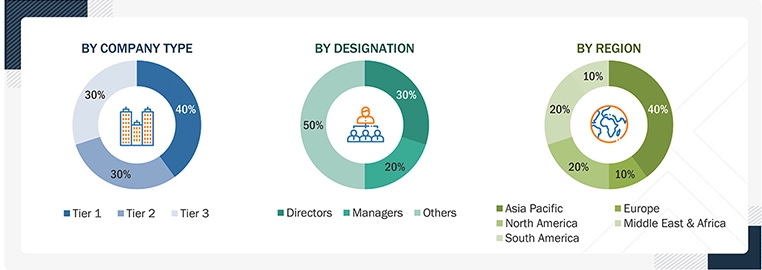
Notes: Other designations include sales, marketing, and product managers.
Tier 1: >USD 1 Billion; Tier 2: USD 500 million–1 Billion; and Tier 3: <USD 500 million.
To know about the assumptions considered for the study, download the pdf brochure
Market Size Estimation
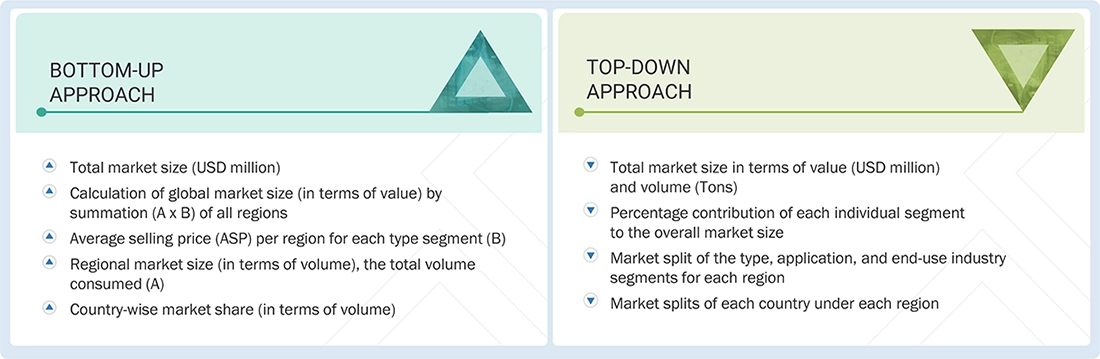
The top-down and bottom-up approaches were used to estimate and validate the size of the global fumed silica market. These approaches were also used extensively to estimate the size of various dependent market segments. The research methodology used to estimate the market size included the following:
Fumed Silica Market : Top-Down and Bottom-Up Approach
Data Triangulation
After arriving at the overall market size using the market size estimation processes, the market was split into several segments and subsegments. The data triangulation and market breakup procedures were employed, wherever applicable, to complete the overall market engineering process and arrive at the exact statistics of each market segment and subsegment. The data was triangulated by studying various factors and trends from both the demand and supply sides.
Market Definition
Fumed silica, or pyrogenic silica, is a synthetic, amorphous variant of silicon dioxide (SiO2) generated via high-temperature flame hydrolysis of silicon tetrachloride in a hydrogen-oxygen flame. This process forms microscopic, non-porous particles fused into branched chain-like structures, resulting in a white powder with high purity (>99.8%), very high specific surface area (50–400 m²/g, BET), and low bulk density. It is classified into hydrophilic and hydrophobic grades. Hydrophilic fumed silica contains surface hydroxyl groups, enabling strong water affinity and good dispersion in polar systems. Hydrophobic grades undergo surface treatment with silanes or siloxanes, which diminishes moisture absorption and enhances compatibility with non-polar systems. Due to its unique structure, fumed silica functions as a rheology modifier and performance additive, providing thickening, thixotropy, reinforcement, anti-settling, and flow control in silicones, coatings, adhesives, sealants, composites, pharmaceuticals, cosmetics, food, and electronics. It is crystalline-free and chemically distinct from hazardous crystalline silica forms.
Key Stakeholders
- Fumed silica manufacturers
- Raw material suppliers
- Converters & processors
- Distributors and traders
- Industry associations and regulatory bodies
- End users
Report Objectives
- To define, describe, and forecast the size of the global fumed silica market, based on type, application, end-use industry, and region in terms of value and volume
- To provide detailed information on the significant drivers, restraints, opportunities, and challenges influencing the market
- To strategically analyze micromarkets1 concerning individual growth trends, prospects, and their contribution to the market
- To assess the growth opportunities in the market for stakeholders and provide details on the competitive landscape for market leaders
- To forecast the market size of segments and subsegments for North America, Europe, Asia Pacific, South America, and the Middle East & Africa
- To strategically profile key players and comprehensively analyze their market shares and core competencies
- To analyze competitive developments such as product launches, acquisitions, expansions, partnerships, and agreements in the fumed silica market
- To provide the impact of AI/Gen AI on the market
Available customizations:
With the given market data, MarketsandMarkets offers customizations according to client-specific needs.
The following customization options are available for the fumed silica market report:
Product Analysis.
- A product matrix that gives a detailed comparison of the product portfolio of each company.
Regional Analysis
- A further breakdown of the fumed silica market for additional countries
Company Information
- Detailed analysis and profiling of additional market players (up to five)
Get the Full Fumed Silica Market Report
Full forecast, segment splits, and company analysis for all Fumed Silica Market.
- China Fumed Silica Market
- India Fumed Silica Market
- Japan Fumed Silica Market
- South Korea Fumed Silica Market
- Germany Fumed Silica Market
- UK Fumed Silica Market
- France Fumed Silica Market
- Russia Fumed Silica Market
- Spain Fumed Silica Market
- Belgium Fumed Silica Market
- Italy Fumed Silica Market
- South Africa Fumed Silica Market
- Argentina Fumed Silica Market
- Rest Of Asia Pacific Fumed Silica Market
Need a Tailored Report?
Customize this report to your needs
Get 10% FREE Customization
Customize This Report
