
Rest Of Europe Furniture Plastic Market (2025-2030)

The Rest Of Europe Furniture Plastic Market was valued at $767.7 Million in 2025 and projected to reach to $984.4 Million by 2030, representing a compound annual growth rate of 5.1%. Rest Of Europe's furniture plastic market demonstrates resilient growth potential, supported by ongoing residential and commercial construction projects across the region's diverse economies.


| Market Size in | USD 26.32 MN |
| Market Forecast in | |
| CAGR | |
| Forecast Period | |
| Units Considered | Value (USD MN) |
Rest Of Europe Furniture Plastic Market Trends and Insights
- Rest Of Europe encompasses a diverse set of economies with varying demand patterns for plastic-based furniture components, driven by residential and commercial construction activity.
- The region's market growth is supported by increasing adoption of lightweight, durable plastic materials in furniture manufacturing, cost-efficiency advantages, and rising consumer preference for sustainable and recyclable plastic solutions. Rest Of Europe's furniture plastic sector benefits from established manufacturing infrastructure and supply chain networks across multiple countries.
- Between 2025 and 2030, Rest Of Europe is expected to experience steady market expansion as furniture producers increasingly integrate advanced plastic materials to meet evolving design and performance standards.
- The region's growth trajectory reflects broader European trends toward circular economy practices and innovation in material science, positioning Rest Of Europe as a significant contributor to the continental furniture plastic market..
Key Market Statistics
- CAGR (2025-2030) 5.1% CAGR
- Market Size, 2025 ~USD 767.7 Million
- Forecast, 2030 ~USD 984.4 Million
- Country Rest Of Europe
Rest Of Europe Furniture Plastic Market Overview
Market Valuation :
Rest Of Europe's furniture plastic market is valued at USD 767.7 million in 2025, with steady growth trajectory driven by regional construction and furniture manufacturing sectors.
Growth Projection :
The market is forecasted to reach USD 984.4 million by 2030, representing a CAGR of 5.1%, outpacing broader economic growth in the region.
Diverse Economic Landscape :
Rest Of Europe encompasses varied economies with distinct demand patterns for plastic furniture components, influenced by residential and commercial construction activity across multiple countries.
Regional Drivers :
Growth is propelled by increasing urbanization, rising disposable incomes, and expanding furniture retail sectors across Central and Eastern European markets.
Rest Of Europe Furniture Plastic Market Dynamics
- The 5.1% CAGR reflects steady demand for plastic-based furniture components, driven by cost-effectiveness and material versatility.
- Key growth catalysts include urbanization trends, rising consumer spending on home furnishings, and the expansion of modern retail furniture chains throughout Central and Eastern European countries. The market outlook remains positive as manufacturers increasingly adopt lightweight plastic materials for furniture production, reducing transportation costs and environmental impact.
- Regional supply chain development and local manufacturing capabilities are strengthening market competitiveness.
- However, growth may be moderated by fluctuating raw material prices and competition from alternative materials, requiring strategic innovation and sustainability initiatives from market participants..
Market Ecosystem
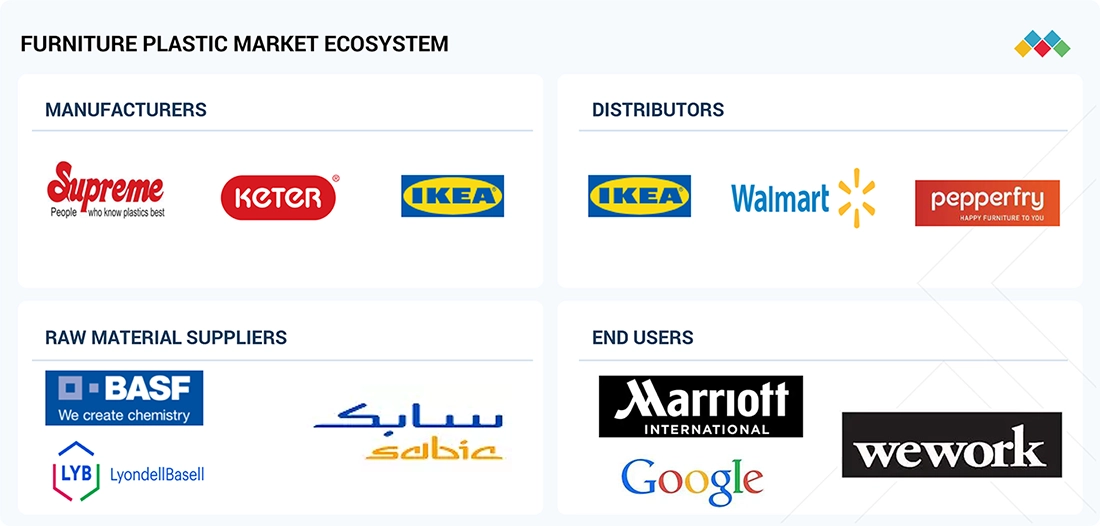
FURNITURE PLASTIC MARKET: COMMERCIAL USE CASES ACROSS INDUSTRIES
| COMPANY | USE CASE DESCRIPTION | BENEFITS |
|---|---|---|
 |
IKEA globally integrated polypropylene (PP) and recycled PP compounds in its mass-market chairs, stools, and storage furniture lines, replacing wood-only and metal-intensive designs to enable flat-pack logistics and high-volume injection molding. | The company was able to reduce the product weight by 20–30%, enhance transport efficiency, increase the possibility of high design repeatability, and increase the usage of recycled content while maintaining the product's cost level. |
 |
Nilkamal switched to the use of HDPE and PP injection-molded plastics for residential and institutional chairs, tables, and cabinets across Asia, with a primary focus on the product's features, including durability, stackability, and moisture resistance. | The company managed to raise the load-bearing capacity, prolong the product life in the presence of moisture in the air, reduce maintenance costs, and also initiate large-scale mass production for price-sensitive markets. |
 |
Herman Miller opted for the use of glass fiber-reinforced polypropylene in office chair shells and seating components to achieve a balance of ergonomics, strength, and lightweight design for corporate environments. | Along with the feat of weight reduction of 15–20%, the company has also achieved structural integrity improvement, increased design flexibility, and supported the objectives of a long lifecycle and recyclability. |
 |
Keter employed UV-stabilized polypropylene resins in the manufacturing of plastic storage boxes that were made for the outdoors, garden furniture, and patio seating, which were sold all over Europe and North America. | The product became highly resistant to weather, minimizing color fading, improving impact resistance, and extending the outdoor product lifespan with minimal maintenance required. |
 |
Grosfillex turned to injection-molded polypropylene and composite plastics for the production of hospitality furniture intended for use in hotels, restaurants, and poolside areas. | The company delivered furniture with high UV resistance, stackability, corrosion resistance, and compliance with the commercial fire and safety standards. |
Logos and trademarks shown above are the property of their respective owners. Their use here is for informational and illustrative purposes only.
Related Ecosystem
Fibers And Composites
- Polyetheretherketone (PEEK)
- Polyphenylene Sulfide (PPS)
- Epoxy Resin
- Polycarbonate
- Polyester Resin
- Toray Industries, Inc.
- Teijin Limited
- Hexcel Corporation
- Sgl carbon se
- Solvay sa
Green Bio Chemicals
- Animal-Based Sealants
- Bacterial Fermentation
- Corrosion Inhibitors
- Hydrogen Peroxide
- Nitrile Butadiene Rubber (NBR)
- Basf se
- Evonik industries ag
- Solvay sa
- AZELIS HOLDINGS SA
- CARGILL, INCORPORATED
Paints And Coatings
- Polyurethane Resin
- Alkyd Resins
- Epoxy Resin
- Polyester Resin
- Acrylics
- Basf se
- JOTUN
- PPG Industries, Inc.
- DOW CHEMICAL COMPANY
- Akzonobel n.v.
Key Takeaways
- Rest Of Europe's furniture plastic market is valued at USD 767.7 million in 2025 and will grow to USD 984.4 million by 2030 at a 5.1% CAGR.
- Rest Of Europe demonstrates steady market expansion driven by lightweight material adoption and cost-efficiency in furniture manufacturing.
- Rest Of Europe's growth is supported by established supply chains and increasing demand for sustainable, recyclable plastic solutions.
- Rest Of Europe is positioned as a significant regional contributor to Europe's furniture plastic market through 2030.
Furniture Plastic Market Report Scope
| Report Metric | Details |
|---|---|
| Base Year | 2025 |
| Fastest Growing Segment | –PP (Plastic Type) |
| Forecast Period | 2025–2030 |
| Growth Rate | CAGR of 6.2% from 2025 to 2030 |
| Largest Segment | VIRGIN GRADE (Plastic Type) |
| Market Size Base Year (Billions) | ~USD 15.95 (2025) |
| Revenue Forecast (Billions) | ~USD 21.55 (2030) |
| Segments Covered | Plastic Type, Composition, Furniture Type, Application, End-Use Industry |
Rest Of Europe Furniture Plastic Market Report Segmentation
5 segment dimensions are covered across the global market.
By Plastic Type
- Compounded Grade
- Virgin Grade
- – Compounded Abs
- – Compounded Pc
- – Virgin Abs
- – Virgin Pc
- –Hdpe
- –Other Compounded-Grade Plastics
- –Other Virgin-Grade Plastics
- –Pa
- –Pmma
- –Pp
- –Ps
By Composition
- Glass Fiber Reinforced
- Mineral Filled
- Other Compositions
- Unfilled
By Furniture Type
- Garden Furniture
- Household Furniture
- Institutional Furniture
- Residential Furniture
- –Cleaning & Service Tools
- –Design Accessories & Hooks
- –Indoor Chairs & Tables
- –Kitchen Tools
- –Office Chairs & Tables
- –Other Residential Furniture
- –Outdoor Chairs & Tables
- –Outdoor Pots & Jars
- –Pots & Jars
- –School, Institutional, And Stadia Seating
By Application
- Indoor
- Outdoor
By End-Use Industry
- Commercial
- Institutional
- Residential
Target Audience
- Furniture Manufacturers : Manufacturers need Rest Of Europe market data to optimize production capacity, source plastic materials efficiently, and identify growth opportunities in residential and commercial segments.
- Plastic Material Suppliers : Suppliers require regional demand forecasts and market sizing to plan inventory, develop customer relationships, and expand distribution networks across Rest Of Europe.
- Investment & Private Equity Firms : Investors need comprehensive market analysis to evaluate acquisition targets, assess growth potential, and make informed capital allocation decisions in Rest Of Europe's furniture sector.
- Retail & Distribution Companies : Retailers and distributors require market insights to forecast demand, optimize product portfolios, and identify expansion opportunities across Rest Of Europe's furniture retail landscape.
- Strategic Business Consultants : Consultants need detailed regional data to advise clients on market positioning, competitive strategies, and growth initiatives specific to Rest Of Europe's furniture plastic market.
Key Companies in the Rest Of Europe Furniture Plastic Market
| Company | HQ | Ownership | Strongest segments |
|---|---|---|---|
| NILKAMAL | India | Public Company | Virgin Grade Plastics – Unfilled & Basic Compositions,Compounded Grade – Mineral Filled,Compounded Grade – Glass Fiber Reinforced, |
| THE SUPREME INDUSTRIES LIMITED | India | Public Company | Virgin Grade – Unfilled,Virgin Grade – Mineral Filled,Virgin Grade – Glass Fiber Reinforced, |
| TRAMONTINA | Brazil | Private Company | Virgin Grade – Unfilled,Virgin Grade – Mineral Filled,Virgin Grade – Glass Fiber Reinforced, |
| CELLO | India | Public Company | Virgin grade plastics – moulded furniture,Compounded / mineral-filled plastics – premium furniture,Unfilled plastics – houseware-linked furniture items, |
| MILLERKNOLL, INC. | United States | Public Company | Virgin Grade Plastics in Premium Seating and Systems,Compounded Grade and Mineral Filled Plastics,Glass Fiber Reinforced Plastics in Structural Components, |
| HARWAL GROUP OF COMPANIES | United Arab Emirates | Virgin grade plastics for furniture,Compounded grade plastics for furniture,Unfilled compositions, | |
| PRIMA PLASTICS | India | Public Company | Virgin grade plastic furniture (chairs, stools, tables, home accessories),Compounded grade and reinforced furniture (storage, heavy-duty seating, specialty items),Pallets, crates, and shippers for furniture-relevant logistics and storage, |
NILKAMAL
Nilkamal is a public company founded in India in 1934 and employs 3,524 people, operating in the furniture and home products industry.
THE SUPREME INDUSTRIES LIMITED
The Supreme Industries Limited is an Indian public company established in 1942 with 6,081 employees, specializing in plastic products and packaging solutions.
TRAMONTINA
Tramontina is a Brazilian private company founded in 1911 with 2,200 employees, known for manufacturing kitchenware, cookware, and home products.
CELLO
Cello is an Indian public company founded in 1958 with 469 employees, operating in the consumer products and home goods sector.
MILLERKNOLL, INC.
MillerKnoll, Inc. is a publicly traded American company founded in 1905 with 10,544 employees, specializing in office furniture and workplace solutions.
HARWAL GROUP OF COMPANIES
Harwal Group of Companies is a private enterprise based in the United Arab Emirates, founded in 1936.
PRIMA PLASTICS
Prima Plastics is an Indian public company founded in 1993 with 342 employees, specializing in plastic products and manufacturing.
Reasons to Buy this Report
- Regional Market Sizing : Obtain precise valuation data for Rest Of Europe's furniture plastic market with detailed 2025-2030 projections, enabling accurate business planning and investment decisions specific to the region.
- Growth Opportunity Identification : Identify high-potential segments and country-level opportunities within Rest Of Europe's diverse economies, with insights into varying demand patterns and construction activity drivers.
- Competitive Landscape Analysis : Understand regional competitive dynamics, market consolidation trends, and key player strategies tailored to Rest Of Europe's unique economic and regulatory environment.
- Strategic Market Entry : Develop informed market entry strategies for Rest Of Europe with localized insights on supply chain infrastructure, manufacturing capabilities, and distribution channels.
- Risk Assessment & Mitigation : Evaluate region-specific risks including raw material volatility, regulatory changes, and competitive pressures affecting furniture plastic demand across Rest Of Europe.
Frequently asked questions
What is the market size of furniture plastic in Rest Of Europe in 2025?
The Rest Of Europe furniture plastic market is valued at USD 767.7 million in 2025.
What is the projected market size for Rest Of Europe furniture plastic by 2030?
Rest Of Europe's furniture plastic market is projected to reach USD 984.4 million by 2030.
What is the CAGR for Rest Of Europe's furniture plastic market?
Rest Of Europe's furniture plastic market is expected to grow at a compound annual growth rate (CAGR) of 5.1% from 2025 to 2030.
What factors are driving growth in Rest Of Europe's furniture plastic market?
Rest Of Europe's market growth is driven by increasing adoption of lightweight and durable plastic materials, cost-efficiency advantages, rising consumer preference for sustainable solutions, and established manufacturing infrastructure.
How does Rest Of Europe compare to the global furniture plastic market?
Rest Of Europe represents a significant regional segment within Europe, with a 5.1% CAGR compared to the global market CAGR of 6.2%, reflecting steady but slightly more conservative growth patterns in the region.
RESEARCH METHODOLOGY
The study involved four main activities to estimate the current size of the furniture plastic market. Extensive secondary research was conducted to gather information on the market, peer product markets, and the parent product group market. The next step was to validate these findings, assumptions, and sizes with industry experts across the value chain of tools plastic through primary research. Both top-down and bottom-up approaches were used to estimate the market’s overall size. Then, market segmentation and data triangulation procedures were applied to determine the size of various segments and sub-segments of the market.
Secondary Research
In the secondary research process, various secondary sources such as Hoovers, Factiva, Bloomberg BusinessWeek, and Dun & Bradstreet were used to identify and collect information for this study on the tools plastic market. These secondary sources included annual reports, press releases & investor presentations of companies; white papers; certified publications; articles by recognized authors; regulatory bodies, trade directories, and databases.
Primary Research
The tools plastic market includes several stakeholders in the supply chain, such as raw material suppliers, distributors, end-product manufacturers, buyers, and regulatory organizations. Various key sources from both the supply and demand sides of the market have been interviewed to gather qualitative and quantitative data. On the demand side, primary participants include key opinion leaders, executives, vice presidents, and CEOs of companies in the tools plastic market. On the supply side, primary sources consist of associations and institutions involved in the tools plastic market, key opinion leaders, and processing companies.
Market Size Estimation
The bottom-up and top-down approaches have been used to estimate the tools plastic market by type, application, end-use industry, and region. The research methodology used to calculate the market size includes the following steps:
- The key players in the industry and markets were identified through extensive secondary research.
- In terms of value, the industry’s value chain and market size were determined through both primary and secondary research processes.
- All percentage shares, splits, and breakdowns were established using secondary sources and verified via primary sources.
- All relevant parameters influencing the markets covered in this study were thoroughly considered, verified through primary research, and analyzed to obtain the final quantitative and qualitative data.
- The research involved reviewing reports, reviews, and newsletters of top market players and conducting extensive interviews with leaders such as directors and marketing executives to gather opinions.
Data Triangulation
After estimating the overall size of the tools plastics market, the data was divided into several segments and subsegments. Data triangulation and market breakdown methods were used, where appropriate, to complete the market analysis and determine precise statistics for all segments and subsegments. The data was triangulated by examining various factors and trends from both the demand and supply sides. Additionally, the market size was validated using both top-down and bottom-up approaches.
Market Definition
The tools plastic market is defined as the segment involved in manufacturing plastics used in tools, including hand tools, power tools, garden tools, medical tools and devices, manual tools, and industrial equipment. The plastics used, often ABS, polycarbonate, nylon, and polypropylene, are selected for their qualities such as strength and durability, lightweight nature, chemical and heat resistance, and impact resistance. The tools plastic market has many end-use sectors, including construction, automotive, healthcare, and manufacturing. With advances in material technology and consumer demand for ergonomic, affordable, high-performance tools, the tools plastic market, with various consumer and professional applications, is diverse and expanding globally.
Stakeholders
- Tools plastic manufacturers
- Raw material suppliers
- Regulatory bodies and government agencies
- Distributors and suppliers
- End-use industries
- Associations and industrial bodies
- Market research and consulting firms
Report Objectives
- To define, describe, and forecast the size of the tools plastic market in terms of value and volume
- To provide detailed information regarding the key factors influencing the growth of the market (drivers, restraints, opportunities, and challenges)
- To forecast the market size based on type, application, end-use industry, and region
- To forecast the market size for the five main regions—North America, Europe, Asia Pacific, South America, and the Middle East & Africa, along with their key countries
- To strategically analyze micromarkets with respect to individual growth trends, prospects, and contributions to the total market
- To analyze the opportunities in the market for stakeholders and provide details of the competitive landscape for the market leaders
- To strategically profile leading players and comprehensively analyze their key developments, such as product launches, expansions, and deals in the tools plastic market
- To strategically profile key players and comprehensively analyze their market shares and core competencies
- To study the impact of AI/Gen AI on the market under study, along with the macroeconomic outlook
Get the Full Furniture Plastic Market Report
Full forecast, segment splits, and company analysis for all Furniture Plastic Market.
- US Furniture Plastic Market
- Canada Furniture Plastic Market
- Mexico Furniture Plastic Market
- Germany Furniture Plastic Market
- France Furniture Plastic Market
- UK Furniture Plastic Market
- Italy Furniture Plastic Market
- Spain Furniture Plastic Market
- Poland Furniture Plastic Market
- Brazil Furniture Plastic Market
- Argentina Furniture Plastic Market
- China Furniture Plastic Market
- Japan Furniture Plastic Market
- India Furniture Plastic Market
- South Korea Furniture Plastic Market
- South Africa Furniture Plastic Market
- Rest Of Asia Pacific Furniture Plastic Market
- Rest Of South America Furniture Plastic Market
Need a Tailored Report?
Customize this report to your needs
Get 10% FREE Customization
Customize This Report
