
Europe Generative AI Cybersecurity Market (2025-2030)

The Europe Generative AI Cybersecurity Market was valued at $2164.6 Million in 2025 and projected to reach to $8646.6 Million by 2030, representing a compound annual growth rate of 26.0%. Europe's Generative AI Cybersecurity Market is positioned for substantial growth through 2030, fueled by mandatory compliance with evolving data protection and critical infrastructure security regulations.


| Market Size in | USD 26.32 MN |
| Market Forecast in | |
| CAGR | |
| Forecast Period | |
| Units Considered | Value (USD MN) |
Europe Generative AI Cybersecurity Market Trends and Insights
- Europe is witnessing accelerated adoption of generative AI-powered security solutions driven by stringent regulatory frameworks, including GDPR and NIS2 Directive compliance requirements.
- Organizations across Europe are increasingly deploying AI-driven threat detection, incident response automation, and vulnerability management tools to combat evolving cyber threats and meet regulatory mandates. The European market's 26.0% compound annual growth rate reflects strong investment momentum across financial services, healthcare, and critical infrastructure sectors.
- Europe's commitment to digital sovereignty and cybersecurity resilience is propelling demand for indigenous and trusted generative AI security platforms.
- By 2030, Europe is expected to solidify its position as a leading regional market, with enterprises prioritizing AI-enhanced security architectures to protect sensitive data and maintain operational continuity against sophisticated threat landscapes..
Key Market Statistics
- CAGR (2025-2030) 26.0% CAGR
- Market Size, 2025 ~USD 2164.6 Million
- Forecast, 2030 ~USD 8646.6 Million
- Geography Europe
Europe Generative AI Cybersecurity Market Overview
Regulatory Compliance Driving Adoption :
Europe's stringent regulatory frameworks, including GDPR and the NIS2 Directive, are compelling organizations to adopt generative AI-powered cybersecurity solutions to meet compliance requirements and enhance threat detection capabilities.
Rapid Market Expansion :
The European market is projected to grow from $2,164.6 million in 2025 to $8,646.6 million by 2030, representing a robust 26% CAGR, reflecting strong enterprise investment in AI-driven security infrastructure.
Enterprise Security Modernization :
European organizations are increasingly deploying generative AI solutions to automate threat response, reduce security operations costs, and improve incident detection accuracy across complex IT environments.
Regional Market Leadership :
The UK and Germany lead European adoption with market sizes of $1,997.5 million and $1,766.1 million respectively, driven by advanced cybersecurity infrastructure and high regulatory compliance standards.
Europe Generative AI Cybersecurity Market Dynamics
- Organizations across the region are prioritizing AI-powered security solutions to address sophisticated cyber threats while meeting stringent regulatory obligations.
- The market benefits from Europe's mature technology infrastructure, high cybersecurity awareness, and significant enterprise investment in digital transformation initiatives. Key growth drivers include increasing ransomware attacks targeting European enterprises, the need for real-time threat intelligence, and the shortage of skilled cybersecurity professionals.
- Financial services, healthcare, and government sectors are leading adoption rates.
- As European regulators continue strengthening cybersecurity mandates, demand for generative AI solutions that enable automated threat detection, response automation, and compliance monitoring will accelerate significantly through the forecast period..
Market Ecosystem
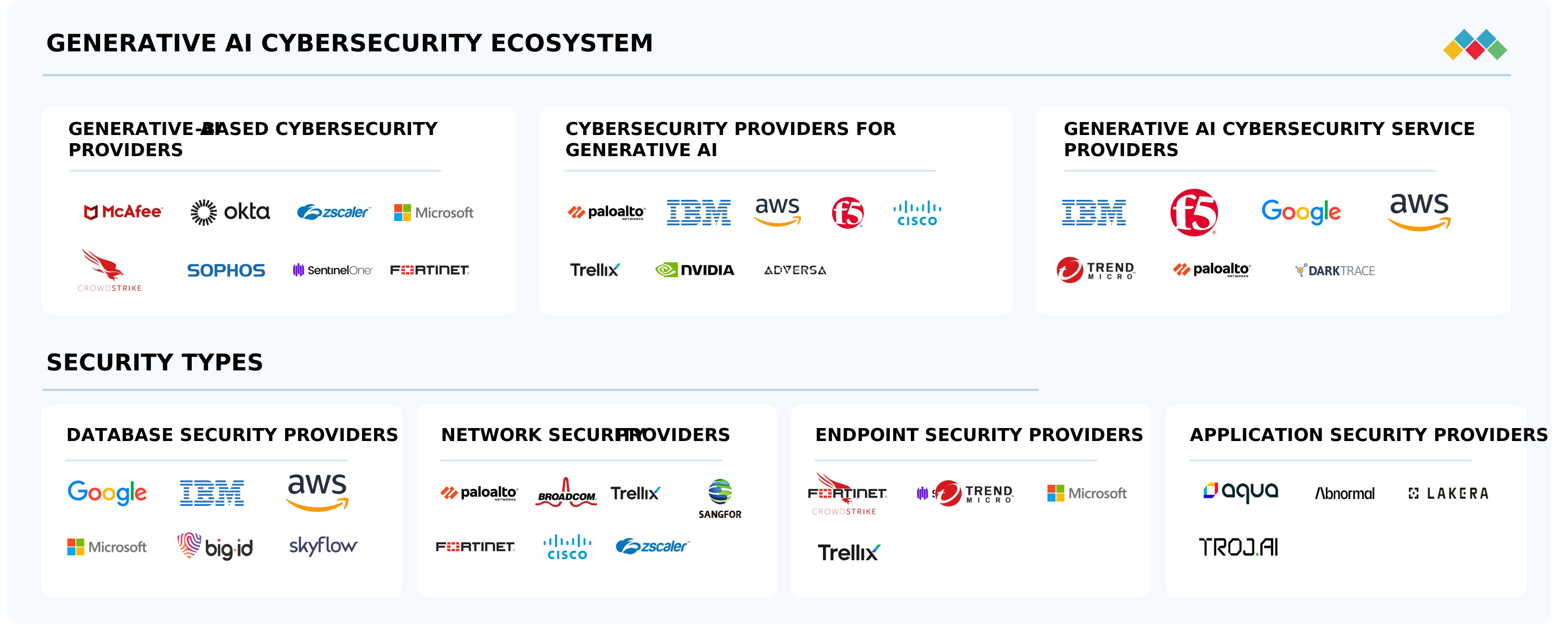
Generative AI Cybersecurity Market: COMMERCIAL USE CASES ACROSS INDUSTRIES
| COMPANY | USE CASE DESCRIPTION | BENEFITS |
|---|---|---|
 |
Zerofox provides actionable intelligence to shore up simply business’s information security. | ZeroFox protected 15 Simply Business executives from impersonation, account takeover, physical threats, and doxing ZeroFox escalated more than 150 high-value alerts during our partnership. |
 |
Pomelo stays secure amid rapid growth with Snyk. | The team has fixed 9,500 issues since adopting Snyk. This total includes 2,150 highs and 200 criticals, with 100 containing mature exploits. |
 |
OpenAI uses Okta to safeguard itself. | By safeguarding OpenAI’s operations, Okta provided valuable insights that strengthened security protocols, benefiting all clients. This collaborative learning approach greatly improved the overall cybersecurity. |
 |
Carnival Corporation charts a safer course with Cyberark. | With CyberArk's solutions, Carnival Corporation achieved stronger protection for onboard digital systems, enhanced guest and business trust, and improved resilience against emerging cyber threats. |
 |
IBM uses Palo Alto to protects its AI systems. | IBM Consulting's expanded cybersecurity services portfolio allowed it to offer more comprehensive solutions to its clients. Over 1,000 security consultants were trained to deploy and manage Palo Alto Networks' products, which enhanced the skill set of IBM's workforce. |
Logos and trademarks shown above are the property of their respective owners. Their use here is for informational and illustrative purposes only.
Related Ecosystem
Analytics
- Natural Language Processing (NLP)
- Machine Learning
- Supply Chain Management
- Predictive Analytics
- Image Sensors
- International Business Machines Corporation
- MICROSOFT CORPORATION
- Oracle Corporation
- SAP SE
Cloud Computing
- Software as A Service (SaaS)
- Natural Language Processing (NLP)
- Platform as A Service (PaaS)
- Machine Learning
- Supply Chain Management
- International Business Machines Corporation
- MICROSOFT CORPORATION
- Oracle Corporation
- Amazon.com, Inc.
Software And Services
- Natural Language Processing (NLP)
- Machine Learning
- Supply Chain Management
- Predictive Analytics
- Image Sensors
- International Business Machines Corporation
- MICROSOFT CORPORATION
- Oracle Corporation
- SAP SE
- Amazon.com, Inc.
Key Takeaways
- Europe's Generative AI Cybersecurity Market is valued at $2,164.6 million in 2025 and is forecast to grow to $8,646.6 million by 2030, representing a 26.0% CAGR.
- Regulatory compliance drivers including GDPR and NIS2 Directive are accelerating Europe's adoption of generative AI security solutions across enterprise sectors.
- Europe's emphasis on digital sovereignty and trusted AI platforms is creating differentiated demand for indigenous and European-developed cybersecurity technologies.
- Financial services, healthcare, and critical infrastructure sectors in Europe are leading investment in AI-powered threat detection and incident response automation capabilities.
Generative AI Cybersecurity Market Report Scope
| Report Metric | Details |
|---|---|
| Base Year | 2025 |
| Fastest Growing Segment | DATA MASKING & TOKENIZATION (Database Security) |
| Forecast Period | 2025–2030 |
| Growth Rate | CAGR of 26.5% from 2025 to 2030 |
| Largest Segment | SOFTWARE (Offering) |
| Market Size Base Year (Billions) | ~USD 8.66 (2025) |
| Revenue Forecast (Billions) | ~USD 28.06 (2030) |
| Segments Covered | Offering, Software Type, Deployment Mode, Service, Professional Service, Type, Security Type, Database Security, Network Security, Endpoint Security, Application Security, End User, Generative Ai-Based Cybersecurity Vertical, Cybersecurity For Generative Ai Vertical, Software Deployment Mode, Vertical |
Europe Generative AI Cybersecurity Market Report Segmentation
16 segment dimensions are covered across the global market.
By Offering
- Services
- Software
By Software Type
- Cybersecurity Software For Generative AI
- Generative AI-Based Cybersecurity Software
By Deployment Mode
- Cloud
- On-Premises
By Service
- Managed
- Professional
By Professional Service
- Support & Maintenance
- System Integration & Implementation
- Training & Consulting
By Type
- Code Analysis Software
- Exposure Management Software
- Generative AI Application
- Generative AI Application Security Software
- Generative AI Application Software
- Generative AI Infrastructure
- Generative AI Infrastructure Security Software
- Generative AI Model
- Generative AI Model Security Software
- Generative AI Training Data
- Generative AI Training Data Security Software
- Phishing Simulation & Prevention Software
- Remediation Guidance Software
- Risk Assessment Software
- Threat Detection & Intelligence Software
- Threat Hunting Platforms
By Security Type
- Application
- Database
- Endpoint
- Network
By Database Security
- Access Control
- Data Compliance & Governance
- Data Encryption
- Data Loss Prevention
- Data Masking & Tokenization
- Data Usage Monitoring
By Network Security
- Firewalls
- Intrusion Detection/Prevention Systems
- Network Traffic Analysis
- Secure Access Service Edge
- Vpns & Secure Tunneling
- Zero Trust Network Access
By Endpoint Security
- Endpoint Detection & Response
- Endpoint Protection Platforms
By Application Security
- Dynamic Application Security Testing
- Governance, Risk, And Compliance
- Incident Response & Recovery
- Llm Security
- Runtime Protection
- Static Application Security Testing
By End User
- Cybersecurity For Generative AI End Users
- Generative AI-Based Cybersecurity End Users
- Generative AI-Based Cybersecurityend Users
By Generative Ai-Based Cybersecurity Vertical
- Bfsi
- Energy & Utilities
- Government & Defense
- Healthcare & Life Sciences
- Manufacturing
- Media & Entertainment
- Other Verticals
- Retail & Ecommerce
- Software & Technology
- Telecommunications
- Transportation & Logistics
By Cybersecurity For Generative Ai Vertical
- Bfsi
- Energy And Utilities
- Government & Defense
- Healthcare & Lifescience
- Manufacturing
- Media & Entertainment
- Other Verticals
- Retail & Ecommerce
- Software & Technology
- Telecommunications
- Transportation & Logistics
By Software Deployment Mode
- Cloud
- On-Premises
By Vertical
- Bfsi
- Energy & Utilities
- Government & Defense
- Healthcare & Life Sciences
- Manufacturing
- Media & Entertainment
- Other End Users
- Other Verticals
- Retail & Ecommerce
- Software & Technology
- Telecommunications
- Transportation & Logistics
REST OF EUROPE: GENERATIVE AI CYBERSECURITY MARKET, BY END USER, 2025–2031
| Segment | 2025 | 2026 | 2027 | 2028 | 2029 | 2030 | 2031 | CAGR (%) |
|---|---|---|---|---|---|---|---|---|
| CYBERSECURITY FOR GENERATIVE AI END USERS | 276.1 | 353.5 | 449.6 | 562.2 | 698.4 | 861.5 | 1043.9 | 24.8 |
| GENERATIVE AI-BASED CYBERSECURITY END USERS | 513.6 | 668 | 863.1 | 1096.9 | 1384.8 | 1736.2 | 2138.2 | 26.8 |
| TOTAL | 789.7 | 1021.5 | 1312.7 | 1659.2 | 2083.2 | 2597.8 | 3182.1 | 26.1 |
EUROPE: GENERATIVE AI CYBERSECURITY MARKET, BY END USER, 2025–2031
| Segment | 2025 | 2026 | 2027 | 2028 | 2029 | 2030 | 2031 | CAGR (%) |
|---|---|---|---|---|---|---|---|---|
| CYBERSECURITY FOR GENERATIVE AI END USERS | 720 | 920.1 | 1167.9 | 1457.9 | 1807.7 | 2225.9 | 2692.1 | 24.6 |
| GENERATIVE AI-BASED CYBERSECURITY END USERS | 1444.6 | 1875.9 | 2419.8 | 3070.1 | 3869.2 | 4843.1 | 5954.6 | 26.6 |
| TOTAL | 2164.6 | 2796 | 3587.7 | 4528 | 5677 | 7069 | 8646.6 | 26 |
Target Audience
- Cybersecurity Solution Vendors : Vendors need European market intelligence to develop localized generative AI security products, navigate regulatory requirements, and identify partnership opportunities across key markets.
- Enterprise Security Leaders : CISOs and security directors require market insights to benchmark their AI cybersecurity investments, evaluate emerging solutions, and align spending with European compliance mandates.
- Investment & Private Equity Firms : Investors need comprehensive market data to identify high-growth cybersecurity AI companies in Europe, assess market potential, and make informed acquisition or funding decisions.
- Technology Consultants & Integrators : Consulting firms require regional market analysis to advise clients on generative AI cybersecurity adoption, recommend solutions, and develop implementation roadmaps aligned with European standards.
- Government & Regulatory Bodies : Policy makers and regulatory agencies need market insights to understand cybersecurity AI adoption trends, assess compliance effectiveness, and inform future regulatory frameworks.
Key Companies in the Europe Generative AI Cybersecurity Market
| Company | HQ | Ownership | Strongest segments |
|---|---|---|---|
| ELASTIC NV | Netherlands | Public Company | Elastic Cloud (Hosted + Serverless),Self-Managed Elasticsearch Platform & Kibana,Elastic Observability, |
ELASTIC NV
Elastic NV is a Dutch public company founded in 2012 with 4,019 employees that develops search, observability, and security solutions powered by the Elastic Stack.
Countries within Europe - compare and drill down
| Country | 2025 size (native) |
|---|---|
| UK | USD 1997.5 Million |
| Germany | USD 1766.1 Million |
| France | USD 1700.9 Million |
Country market size visualization
Reasons to Buy this Report
- Regulatory Compliance Intelligence : Gain detailed insights into how GDPR, NIS2 Directive, and other European regulations are shaping generative AI cybersecurity adoption, enabling informed compliance strategy development.
- Market Sizing by Country : Access granular market data for UK, Germany, and France—Europe's largest markets—to identify high-opportunity regions and tailor market entry or expansion strategies accordingly.
- Competitive Landscape Analysis : Understand regional competitive dynamics, key players, and market positioning specific to Europe's generative AI cybersecurity ecosystem to benchmark against competitors.
- Investment & Growth Opportunities : Identify emerging segments and high-growth verticals within Europe's $8.6 billion forecasted market to prioritize product development and go-to-market initiatives.
- Enterprise Buyer Insights : Understand European enterprise priorities, procurement patterns, and security challenges to develop targeted sales strategies and value propositions for regional customers.
Frequently asked questions
What is the current market size of Generative AI Cybersecurity in Europe?
Europe's Generative AI Cybersecurity Market is valued at $2,164.6 million in 2025, with expectations to reach $8,646.6 million by 2030.
What is the projected growth rate for Europe's Generative AI Cybersecurity Market?
Europe's market is projected to grow at a compound annual growth rate (CAGR) of 26.0% from 2025 to 2030.
Which regulatory frameworks are driving Europe's Generative AI Cybersecurity adoption?
Europe's adoption is primarily driven by GDPR compliance requirements and the NIS2 Directive, which mandate enhanced cybersecurity measures and AI-powered threat detection capabilities.
Which sectors in Europe are leading investment in Generative AI Cybersecurity solutions?
Financial services, healthcare, and critical infrastructure sectors in Europe are the primary drivers of investment in generative AI-powered security solutions.
How does Europe's market compare to global Generative AI Cybersecurity trends?
Europe's 26.0% CAGR aligns closely with the global 26.5% CAGR, reflecting strong regional alignment with worldwide generative AI cybersecurity adoption patterns and investment priorities.
RESEARCH METHODOLOGY
This research study on the generative AI cybersecurity market involved extensive secondary sources, directories, journals, and paid databases. Primary sources were mainly industry experts from the core and related industries, preferred generative AI cybersecurity providers, third-party service providers, consulting service providers, end users, and other commercial enterprises. In-depth interviews with primary respondents, including key industry participants and subject matter experts, were conducted to obtain and verify critical qualitative and quantitative information and assess the market’s prospects.
Secondary Research
In the secondary research process, various sources were referred to to identify and collect information for the study. The secondary sources included annual reports, press releases, investor presentations of companies, white papers, journals, certified publications, and articles from recognized authors, directories, and databases. The data was also collected from other secondary sources, such as AI conferences and related magazines. Additionally, the generative AI cybersecurity spending of various countries was extracted from respective sources. Secondary research was used to obtain key information about the industry’s supply chain to identify key players by solution, service, market classification, and segmentation according to the offerings of major players and industry trends related to offerings, generative AI-based cybersecurity software, cybersecurity software for generative AI, security types, end users, and regions, and key developments from both market and technology-oriented perspectives.
Primary Research
In the primary research process, various primary sources from both the supply and demand sides were interviewed to obtain qualitative and quantitative information on the market. The primary sources from the supply side included various industry experts, including Chief Experience Officers (CXOs); Vice Presidents (VPs); directors specializing in business development, marketing, and generative AI cybersecurity; related key executives from generative AI cybersecurity offering vendors, SIs, managed service providers, and industry associations; and key opinion leaders.
Primary interviews were conducted to gather insights, such as market statistics, revenue data collected from solutions and services, market breakups, market size estimations, market forecasts, and data triangulation. Primary research also helped understand various trends related to technologies, offerings, security types, end users, and regions. Stakeholders from the demand side, such as Chief Information Officers (CIOs), Chief Technology Officers (CTOs), Chief Strategy Officers (CSOs), and end users using generative AI cybersecurity solutions, were interviewed to understand the buyer’s perspective on suppliers, products, and their current usage of generative AI cybersecurity solutions, which would impact the overall generative AI cybersecurity market.
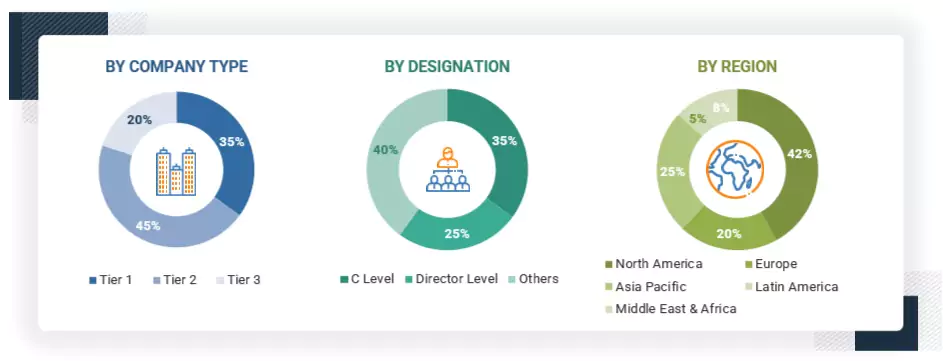
Note: Tier 1 companies account for annual revenue of >USD 10 billion; tier 2 companies’ revenue ranges
between USD 1 billion and USD 10 billion; and tier 3 companies’ revenue ranges between USD 500 million
and USD 1 billion. Other designations include VPs, global heads, and product leaders.
Source: MarketsandMarkets Analysis
To know about the assumptions considered for the study, download the pdf brochure
Market Size Estimation
Multiple approaches were adopted to estimate and forecast the generative AI cybersecurity market. The first approach involved estimating the market size by summing the companies’ revenue generated by selling solutions.
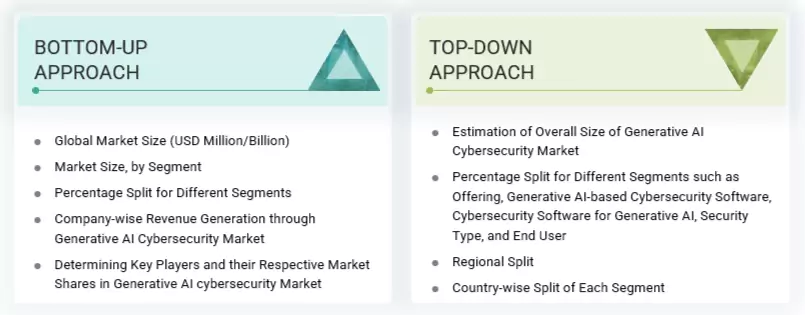
Market Size Estimation Methodology- Top-down approach
In the top-down approach, an exhaustive list of all the vendors offering solutions in the generative AI cybersecurity market was prepared. The revenue contribution of the market vendors was estimated through annual reports, press releases, funding, investor presentations, paid databases, and primary interviews. Each vendor's offerings were evaluated based on the breadth of solutions according to offering type, security type, and end users. The aggregate of all the companies’ revenue was extrapolated to reach the overall market size. Each subsegment was studied and analyzed for its global market size and regional penetration. The markets were triangulated through both primary and secondary research. The primary procedure included extensive interviews for key insights from industry leaders, such as CIOs, CEOs, VPs, directors, and marketing executives. The market numbers were further triangulated with the existing MarketsandMarkets repository for validation.
Market Size Estimation Methodology-Bottom-up approach
In the bottom-up approach, the adoption rate of generative AI cybersecurity solutions among different end users in key countries with respect to their regions contributing the most to the market share was identified. For cross-validation, the adoption of generative AI cybersecurity solutions among industries, along with different use cases with respect to their regions, was identified and extrapolated. Use cases identified in different regions were given weightage for the market size calculation.
Based on the market numbers, the regional split was determined by primary and secondary sources. The procedure included the analysis of the generative AI cybersecurity market’s regional penetration. Based on secondary research, the regional spending on Information and Communications Technology (ICT), socio-economic analysis of each country, strategic vendor analysis of major generative AI cybersecurity providers, and organic and inorganic business development activities of regional and global players were estimated. With the data triangulation procedure and data validation through primary interviews, the exact values of the overall generative AI cybersecurity market size and segments’ size were determined and confirmed using the study.
Generative AI Cybersecurity Market : Top-Down and Bottom-Up Approach
Data Triangulation
The market was split into several segments and subsegments after arriving at the overall market size using the market size estimation processes as explained above. To complete the overall market engineering process and arrive at the exact statistics of each market segment and subsegment, data triangulation and market breakup procedures were employed, wherever applicable. The overall market size was then used in the top-down procedure to estimate the size of other individual markets via percentage splits of the market segmentation.
Market Definition
Generative AI cybersecurity includes the techniques & technology used to secure generative AI systems, as well as the revolutionary impact of generative AI tools on cybersecurity practices. The scope of the generative AI cybersecurity market includes two key angles:
- Cybersecurity with generative AI: investigates how generative AI techniques are transforming the protection of enterprise security architecture, apps, networks, and data. Robust real-time anomaly detection, enhanced threat identification, and advanced threat hunting are all made possible by cybersecurity enhanced by generative AI.
- Cybersecurity for generative AI: focuses on implementing advanced cybersecurity technologies, tools, policies, and practices specifically designed to protect generative AI from threats and vulnerabilities. This involves strategies such as adversarial machine learning, differential privacy, federated learning security, and secure model deployment, aimed at safeguarding data, AI models, and deployment environments.
Stakeholders
- Generative AI cybersecurity providers
- Third-party administrators
- Business analysts
- Cloud service providers
- Consulting service providers
- Enterprise end users
- Distributors and value-added resellers (VARs)
- Government agencies
- Independent software vendors (ISVs)
- Market research and consulting firms
- Support & maintenance service providers
- System integrators (SIs)/migration service providers
- Technology providers
Report Objectives
- To define, describe, and forecast the generative AI cybersecurity market by offering, generative AI-based cybersecurity software, cybersecurity software for generative AI, security type, and end user
- To provide detailed information related to major factors (drivers, restraints, opportunities, and industry-specific challenges) influencing the market growth
- To analyze the micro markets with respect to individual growth trends, prospects, and their contribution to the total market
- To analyze the opportunities in the market for stakeholders by identifying the high-growth segments of the market
- To analyze opportunities in the market and provide details of the competitive landscape for stakeholders and market leaders
- To forecast the market size of segments for the five main regions: North America, Europe, Asia Pacific, the Middle East & Africa, and Latin America
- To profile the key players and comprehensively analyze their market ranking and core competencies
- To analyze competitive developments, such as partnerships, product launches, and mergers & acquisitions, in the generative AI cybersecurity market
Available Customizations
With the given market data, MarketsandMarkets offers customizations as per your company’s specific needs. The following customization options are available for the report:
Product Analysis
- Product quadrant, which gives a detailed comparison of the product portfolio of each company.
Geographic Analysis as per Feasibility
- Further breakup of the North American generative AI cybersecurity market
- Further breakup of the European generative AI cybersecurity market
- Further breakup of the Asia Pacific generative AI cybersecurity market
- Further breakup of the Middle Eastern & African generative AI cybersecurity market
- Further breakup of the Latin American generative AI cybersecurity market
Company Information
- Detailed analysis and profiling of additional market players (up to five)
Get the Full Generative AI Cybersecurity Market Report
Full forecast, segment splits, and company analysis for all Generative AI Cybersecurity Market.
- US Generative AI Cybersecurity Market
- Canada Generative AI Cybersecurity Market
- UK Generative AI Cybersecurity Market
- Germany Generative AI Cybersecurity Market
- France Generative AI Cybersecurity Market
- China Generative AI Cybersecurity Market
- India Generative AI Cybersecurity Market
- Japan Generative AI Cybersecurity Market
- Saudi Arabia Generative AI Cybersecurity Market
- UAE Generative AI Cybersecurity Market
- Brazil Generative AI Cybersecurity Market
- Mexico Generative AI Cybersecurity Market
Need a Tailored Report?
Customize this report to your needs
Get 10% FREE Customization
Customize This Report
