
Asia Pacific Geothermal Energy Market (2025-2030)

The Asia Pacific Geothermal Energy Market was valued at $4977.3 Million in 2025 and projected to reach to $6692.1 Million by 2030, representing a compound annual growth rate of 6.1%. Asia Pacific's geothermal energy market is poised for sustained expansion driven by rising energy demand, climate commitments, and substantial government investments in renewable infrastructure.


| Market Size in | USD 26.32 MN |
| Market Forecast in | |
| CAGR | |
| Forecast Period | |
| Units Considered | Value (USD MN) |
Asia Pacific Geothermal Energy Market Trends and Insights
- Asia Pacific's geothermal sector is advancing through increased investment in renewable infrastructure and technological innovation across the region.
- The 6.1% compound annual growth rate reflects Asia Pacific's commitment to sustainable energy transition and rising demand for baseload renewable power. Asia Pacific's geothermal energy market benefits from abundant geothermal resources, particularly in countries with significant volcanic and tectonic activity.
- Asia Pacific is leveraging these natural advantages to develop both utility-scale and direct-use geothermal applications.
- Between 2025 and 2030, Asia Pacific is expected to see accelerated capacity additions driven by supportive government policies, declining development costs, and growing energy security concerns. Asia Pacific's geothermal market remains strategically important for regional decarbonization goals and energy independence.
- Asia Pacific continues to attract international investment and technology partnerships to unlock its substantial geothermal potential and meet rising electricity demand sustainably..
Key Market Statistics
- CAGR (2025-2030) 6.1% CAGR
- Market Size, 2025 ~USD 4977.3 Million
- Forecast, 2030 ~USD 6692.1 Million
- Geography Asia Pacific
Asia Pacific Geothermal Energy Market Overview
Market Valuation & Growth :
Asia Pacific's geothermal energy market is valued at USD 4,977.3 million in 2025, with a robust 6.1% CAGR outpacing the global average of 5.3%, demonstrating the region's accelerating commitment to renewable energy adoption.
China's Market Dominance :
China leads the Asia Pacific geothermal sector with USD 3,573 million in market size, representing over 71% of the regional market and driving significant technological advancement and capacity expansion across the region.
Emerging Growth Hubs :
Indonesia and the Philippines collectively represent USD 2,346 million in market value, positioning Southeast Asia as a critical growth corridor for geothermal development with abundant natural resources and increasing energy demand.
Forecast Expansion :
The market is projected to reach USD 6,692.1 million by 2030, reflecting sustained investment in renewable infrastructure, government incentives, and technological innovation across Asia Pacific nations.
Asia Pacific Geothermal Energy Market Dynamics
- Countries like China, Indonesia, and the Philippines are leveraging their geothermal resources to diversify energy portfolios and reduce carbon emissions.
- The region's 6.1% CAGR reflects increasing adoption of advanced drilling technologies and enhanced geothermal systems (EGS), alongside supportive regulatory frameworks. Key growth catalysts include escalating electricity consumption in emerging economies, declining geothermal development costs, and strategic partnerships between public and private sectors.
- Asia Pacific's abundant geothermal reserves, particularly in the Pacific Ring of Fire, position the region as a global leader in geothermal capacity expansion.
- By 2030, the market's projected growth to USD 6.6 billion underscores the region's pivotal role in achieving net-zero energy targets and meeting rising industrial and residential energy needs..
Market Ecosystem
Related Ecosystem
Decarbonization
- Battery Electric Vehicle (BEV)
- Energy Management Systems
- Fuel Cell
- Fuel Cell Electric Vehicle (FCEV)
- Geographical Information System (GIS)
- TotalEnergies SE
- Siemens ag
- Mitsui & Co., Ltd.
- General Electric Company
- Thyssenkrupp ag
Energy Circularity
- Epoxy Resin
- Progressive Cavity Pumps
- Amphoteric
- Bisphenol-A
- Cartridge Filters
- TotalEnergies SE
- ENEOS Holdings, Inc.
- Hess Corporation
- Baker Hughes Company
- Weatherford International plc
Power Infrastructure
- Geographical Information System (GIS)
- Cogeneration
- Battery Electric Vehicle (BEV)
- Cellular Network
- Fuel Cell
- Siemens ag
- ABB India Limited
- SCHNEIDER ELECTRIC SE
- General Electric Company
- Eaton Corporation plc
Key Takeaways
- Asia Pacific geothermal energy market valued at USD 4,977.3 million in 2025, expanding to USD 6,692.1 million by 2030
- Asia Pacific demonstrates a 6.1% CAGR, outpacing global growth and reflecting strong regional renewable energy momentum
- Asia Pacific's abundant geothermal resources and supportive policies are driving utility-scale and direct-use project development
- Asia Pacific is attracting significant international investment and technology partnerships to accelerate geothermal capacity expansion
Geothermal Energy Market Report Scope
| Report Metric | Details |
|---|---|
| Base Year | 2025 |
| Fastest Growing Segment | RESIDENTIAL HEATING & COOLING (Application) |
| Forecast Period | 2025–2030 |
| Growth Rate | CAGR of 5.3% from 2025 to 2030 |
| Largest Segment | POWER GENERATION (Application) |
| Market Size Base Year (Billions) | ~USD 10.47 (2025) |
| Revenue Forecast (Billions) | ~USD 13.56 (2030) |
| Segments Covered | Application, Technology, Temperature |
Asia Pacific Geothermal Energy Market Report Segmentation
3 segment dimensions are covered across the global market.
By Application
- Commercial Heating & Cooling
- Power Generation
- Residential Heating & Cooling
By Technology
- Binary Cycle Plants
- Direct Systems
- Dry Steam Plants
- Flash Steam Plants
- Ground Source Heat Pumps
By Temperature
- High Temperature
- Low Temperature
- Medium Temperature
Target Audience
- Energy Utilities & Operators : Utilities expanding renewable portfolios need Asia Pacific market data to identify geothermal development opportunities, assess competitive positioning, and optimize capacity planning across the region's high-potential zones.
- Investment & Private Equity Firms : Investors seeking renewable energy exposure require detailed market sizing, growth forecasts, and country-level analysis to evaluate Asia Pacific geothermal projects and identify attractive entry points.
- Technology & Equipment Manufacturers : Geothermal equipment suppliers need regional market insights to understand demand drivers, technology adoption rates, and competitive dynamics to develop targeted product strategies for Asia Pacific.
- Government & Policy Makers : Policymakers and energy regulators use market intelligence to design renewable energy policies, set capacity targets, and allocate resources aligned with Asia Pacific's geothermal potential and climate goals.
- Consulting & Engineering Firms : Project developers and consultants require comprehensive market data to advise clients on geothermal project feasibility, competitive positioning, and growth opportunities across Asia Pacific markets.
Countries within Asia Pacific - compare and drill down
| Country | 2025 size (native) |
|---|---|
| China | USD 3573 Million |
| Japan | USD 349.1 Million |
| Indonesia | USD 1572.9 Million |
| Philippines | USD 773.1 Million |
| New Zealand | USD 359.8 Million |
| Rest Of Asia Pacific | USD 64.2 Million |
Country market size visualization
Reasons to Buy this Report
- Regional Market Intelligence : Gain comprehensive insights into Asia Pacific's USD 4.98 billion geothermal market with country-level breakdowns, competitive dynamics, and growth drivers specific to the region's unique energy landscape.
- Investment Decision Support : Identify high-potential markets within Asia Pacific—China, Indonesia, and Philippines—with detailed market sizing, CAGR projections, and risk assessments to guide capital allocation and partnership strategies.
- Technology & Innovation Trends : Understand emerging geothermal technologies, enhanced geothermal systems (EGS), and drilling innovations driving the 6.1% regional growth rate, enabling strategic positioning in the evolving market.
- Regulatory & Policy Framework : Access detailed analysis of government incentives, renewable energy mandates, and climate commitments across Asia Pacific nations shaping market opportunities and competitive advantages.
- Competitive Landscape Mapping : Benchmark against regional and global competitors with market share analysis, strategic initiatives, and partnership opportunities specific to Asia Pacific's geothermal sector.
Frequently asked questions
What is the current market size of geothermal energy in Asia Pacific?
Asia Pacific's geothermal energy market is valued at USD 4,977.3 million in 2025 and is projected to grow to USD 6,692.1 million by 2030.
What is the expected growth rate for Asia Pacific's geothermal market?
Asia Pacific's geothermal energy market is expected to grow at a compound annual growth rate (CAGR) of 6.1% from 2025 to 2030.
Which countries in Asia Pacific lead geothermal energy development?
Asia Pacific's geothermal leaders include Indonesia, the Philippines, and New Zealand, which possess significant volcanic and geothermal resources and have established operational capacity.
What factors are driving growth in Asia Pacific's geothermal market?
Asia Pacific's geothermal growth is driven by abundant natural resources, supportive renewable energy policies, declining technology costs, energy security priorities, and increasing electricity demand.
How does Asia Pacific's geothermal growth compare to global trends?
Asia Pacific's 6.1% CAGR exceeds the global geothermal market CAGR of 5.3%, demonstrating the region's accelerated renewable energy transition and investment momentum.
RESEARCH METHODOLOGY
The study involved major activities in estimating the current size of the geothermal energy market. Exhaustive secondary research was done to collect information on the peer and parent markets. The next step was to validate these findings, assumptions, and sizing with industry experts across the value chain through primary research. Both top-down and bottom-up approaches were employed to estimate the complete market size. Thereafter, market breakdown and data triangulation were used to estimate the market size of the segments and subsegments.
Secondary Research
This research study on the geothermal energy market involved the use of extensive secondary sources, directories, and databases, such as Hoovers, Bloomberg, Businessweek, IEA Geothermal, International Energy Agency, and BP Statistical Review of World Energy, to identify and collect information useful for a technical, market-oriented, and commercial study of the market. The other secondary sources included annual reports, press releases & investor presentations of companies, white papers, certified publications, articles by recognized authors, manufacturer associations, trade directories, and databases.
Primary Research
The geothermal energy market comprises several stakeholders such as power plant manufacturers, ground source heat pump manufacturers, manufacturing technology providers, and technical support providers in the supply chain. The demand side of this market is characterized by the rising demand for geothermal energy in power generation, residential heat & cooling, commercial heat & cooling, and other applications. The supply side is characterized by rising demand for contracts from the industrial sector and mergers & acquisitions among big players. Various primary sources from both the supply and demand sides of the market were interviewed to obtain qualitative and quantitative information. Following is the breakdown of primary respondents:
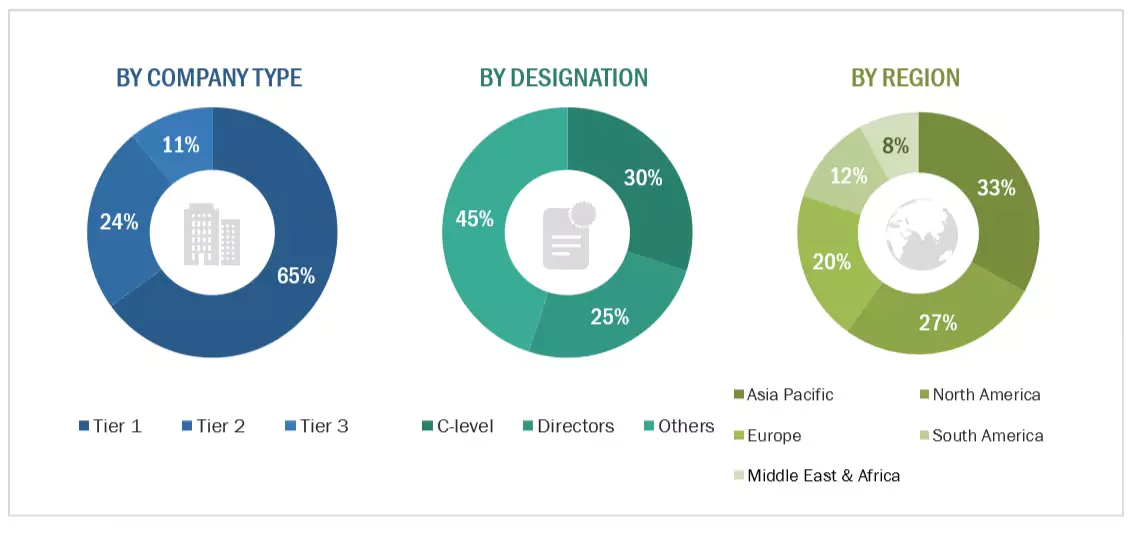
Note: Others include product engineers and product specialists. The tier of the companies is defined on the basis of their total revenue as of 2021: Tier 1 = > USD 1 billion, Tier 2 =
From USD 500 million to USD 1 billion, and Tier 3 = < USD 500 million.
To know about the assumptions considered for the study, download the pdf brochure
Market Size Estimation
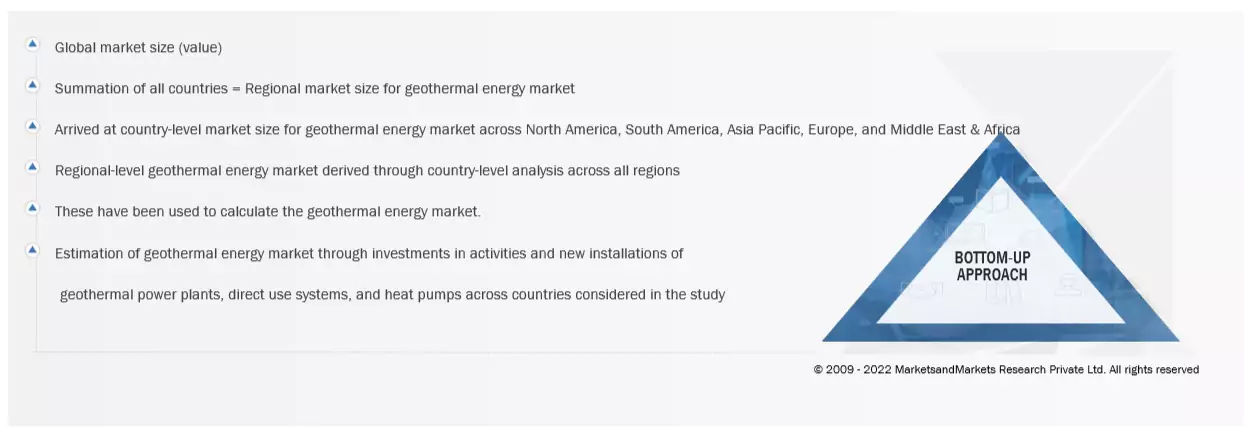
Both top-down and bottom-up approaches were used to estimate and validate the total size of the geothermal energy market. These methods were also used extensively to estimate the size of various subsegments in the market. The research methodology used to estimate the market size includes the following:
Geothermal Energy Market : Top-Down and Bottom-Up Approach
Data Triangulation
After arriving at the overall market size from the above estimation process, the total market has been split into several segments and subsegments. Data triangulation and market breakdown processes have been employed to complete the overall market engineering process and arrive at the exact statistics for all the segments and sub-segments, wherever applicable. The data has been triangulated by studying various factors and trends from both the demand and supply sides. Along with this, the market has been validated using both the top-down and bottom-up approaches.
Market Definition
Geothermal energy is renewable energy that is harnessed from the heat inside the Earth. Water and/or steam carry the geothermal energy to the Earth's surface. Depending on its characteristics, geothermal energy can be used for heating and cooling purposes, be harnessed to generate clean electricity, or be used directly for heating. Geothermal electricity generation relies mainly on technologies, such as steam plants, flash plants (single, double, and triple), binary plants, and combined cycle or hybrid plants, that exploit conventional geothermal resources. However, as high-quality conventional resources become harder to access, deeper resources may become accessible in the future through the development of enhanced geothermal systems. Heat energy can also be stored in the ground, such as in borehole energy storage or aquifer energy storage systems, for later retrieval and use. Another major utilization of geothermal heat is its direct use in space heating, aquaculture, horticulture, swimming pools, and spa treatments. Ground source/geothermal heat pumps use the Earth's shallow ground temperature for heating and cooling, whereas direct-use systems produce heat directly from hot water within the Earth.
Stakeholders
- Government & research organizations
- Institutional investors and investment banks
- Investors/shareholders
- Environmental research institutes
- Consulting companies in the energy & power sector
- Raw materials and component manufacturers
- Geothermal energy systems manufacturers' associations
- Energy efficiency consultancies
- Engineering, procurement, and construction (EPC) contractors
- Standardization and testing firms
- Power plant operators/owners
- District heating plant operators/owners
- Residential end users and real estate companies
- Commercial end users
Report Objectives
- To define, describe, segment, and forecast the geothermal energy market on the basis of technology, temperature, application, and region
- To provide detailed information on the major factors influencing the growth of the market (drivers, restraints, opportunities, and challenges)
- To strategically analyze the market with respect to individual growth trends, future expansions, and the contribution of each segment to the market
- To analyze market opportunities for stakeholders and details of the competitive landscape for market leaders
- To forecast the growth of the market with respect to the main regions (Asia Pacific, Europe, North America, South America, and Middle East & Africa)
- To strategically profile key players and comprehensively analyze their market rankings and core competencies
- To track and analyze competitive developments in the market, such as contracts & agreements, investments & expansions, new product developments, and mergers & acquisitions
Available Customizations
MarketsandMarkets offers customizations according to the specific needs of the companies with the given market data.
The following customization options are available for the report:
Product Analysis
- Product matrix, which gives a detailed comparison of the product portfolio of each company
Geographic Analysis as per Feasibility
- Further breakdown of the geothermal energy market, by country
Company Information
- Detailed analysis and profiling of additional market players (up to five)
Get the Full Geothermal Energy Market Report
Full forecast, segment splits, and company analysis for all Geothermal Energy Market.
- China Geothermal Energy Market
- Japan Geothermal Energy Market
- Indonesia Geothermal Energy Market
- Philippines Geothermal Energy Market
- New Zealand Geothermal Energy Market
- Canada Geothermal Energy Market
- Mexico Geothermal Energy Market
- US Geothermal Energy Market
- Germany Geothermal Energy Market
- Italy Geothermal Energy Market
- Turkey Geothermal Energy Market
- Chile Geothermal Energy Market
- Colombia Geothermal Energy Market
- Kenya Geothermal Energy Market
- Saudi Arabia Geothermal Energy Market
- Iceland Geothermal Energy Market
- Rest Of Europe Geothermal Energy Market
- Rest Of Asia Pacific Geothermal Energy Market
Need a Tailored Report?
Customize this report to your needs
Get 10% FREE Customization
Customize This Report
