
South Africa GFRP Composites Market (2025-2030)

The South Africa GFRP Composites Market was valued at $23024.4 Million in 2025 and projected to reach to $29696.9 Million by 2030, representing a compound annual growth rate of 5.2%. South Africa's GFRP composites market is poised for moderate but consistent growth through 2030, driven by increasing demand from automotive manufacturers seeking lightweight solutions and construction companies investing in durable materials.


| Market Size in | USD 26.32 MN |
| Market Forecast in | |
| CAGR | |
| Forecast Period | |
| Units Considered | Value (USD MN) |
South Africa GFRP Composites Market Trends and Insights
- Polyester's cost-effectiveness and established manufacturing infrastructure continue to drive widespread adoption across automotive, construction, and marine applications.
- The segment is projected to reach $29,696.9 million by 2030, reflecting steady demand for lightweight composite solutions. Polyester resin's competitive advantage lies in its balance of performance and affordability compared to epoxy and vinyl ester alternatives.
- Polyester maintains significant market share due to its compatibility with existing production processes and proven durability in outdoor environments.
- Between 2025 and 2030, Polyester is expected to grow at a 5.2% compound annual growth rate, driven by infrastructure modernization and increased composite adoption in emerging markets. The polyester segment benefits from rising demand in wind energy, consumer goods, and industrial applications where cost optimization is critical.
- Polyester's versatility in both hand-lay-up and automated manufacturing processes supports its continued relevance in the GFRP composites ecosystem through 2030..
Key Market Statistics
- CAGR (2025-2030) 5.2% CAGR
- Market Size, 2025 ~USD 23024.4 Million
- Forecast, 2030 ~USD 29696.9 Million
- Country South Africa
South Africa GFRP Composites Market Overview
Market Size & Growth :
South Africa's GFRP composites market is valued at USD 23,024.4 million in 2025, with a projected CAGR of 5.2% through 2030, reaching USD 29,696.9 million. This steady growth reflects increasing adoption across key industrial sectors.
Polyester Resin Dominance :
Polyester resin maintains its position as the primary material in South Africa's GFRP market due to cost-effectiveness and established local manufacturing capabilities. Its affordability makes it ideal for automotive, construction, and marine applications in the region.
Key Application Sectors :
South Africa's GFRP composites are primarily driven by automotive lightweighting initiatives, construction infrastructure projects, and marine vessel manufacturing. These sectors benefit from composite materials' durability and weight reduction properties in the local market.
Regional Manufacturing Infrastructure :
South Africa possesses established composite manufacturing facilities and supply chains, supporting competitive production costs. This infrastructure advantage positions the country as a regional hub for GFRP composite production and distribution across Southern Africa.
South Africa GFRP Composites Market Dynamics
- The region's established manufacturing base and cost advantages support market expansion, particularly as local industries adopt advanced composite technologies to improve efficiency and reduce operational costs. Government initiatives promoting industrial development and infrastructure projects will further stimulate market demand.
- However, growth may be tempered by competition from alternative materials and supply chain constraints.
- Strategic investments in composite technology and local capacity building will be critical for stakeholders to capitalize on emerging opportunities in South Africa's evolving GFRP market..
Market Ecosystem
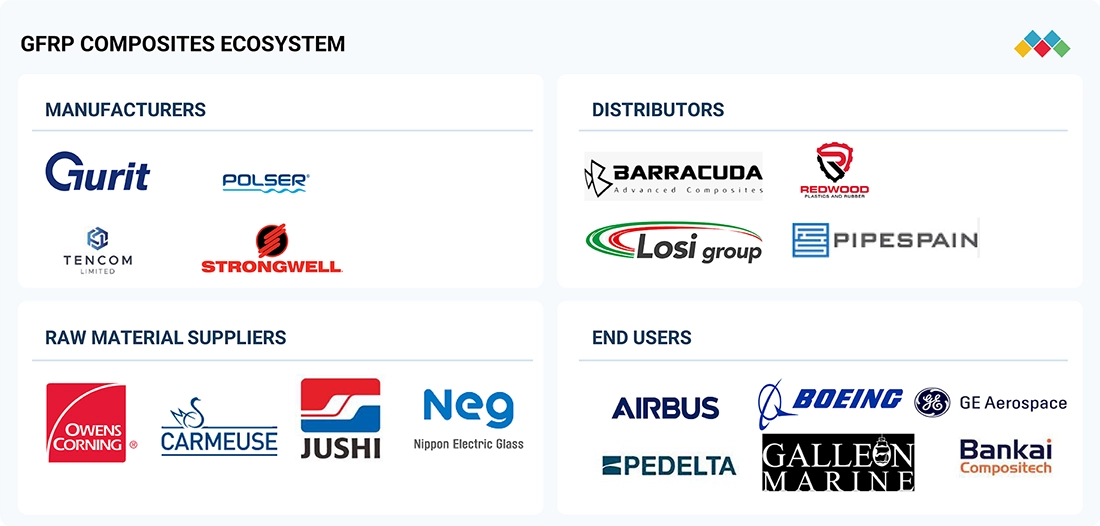
GFRP Composites Marke: COMMERCIAL USE CASES ACROSS INDUSTRIES
| COMPANY | USE CASE DESCRIPTION | BENEFITS |
|---|---|---|
 |
Use of GFRP composites in Boeing 707 for radomes, wing leading, and trailing edge panels | Reduction of overall aircraft weight and improving fuel efficiency |
 |
Use of GFRP composites in secondary aircraft structures such as fuselage panels, interior linings, and wing components | Corrosion resistance, making GFRP composites suitable for harsh environmental conditions faced by aircraft |
 |
Extensive use in marine companies for building vessels, hulls, decks, masts, and interior components | Resist deterioration from harsh saltwater, moisture, UV radiation, and chemicals, extending vessel life and reducing maintenance |
 |
GFRP footbridges used by building & construction companies such as Pedelta Structural Engineers to build the GFRP Lleida Pedestrian Bridge | High mechanical strength and impact resistance, providing durability and long service life |
 |
GFRP composites used primarily by Bankai Compositech in the manufacturing of switchgear components made from GFRP composites | Exceptional electrical insulation properties that prevent electrical leakage and galvanic corrosion |
Logos and trademarks shown above are the property of their respective owners. Their use here is for informational and illustrative purposes only.
Related Ecosystem
Key Takeaways
- Polyester resin commands $23.0 billion in 2025, with projected growth to $29.7 billion by 2030 at a 5.2% CAGR.
- Polyester's cost advantage and manufacturing compatibility position it as the preferred resin type for price-sensitive applications.
- Polyester demand is accelerating in wind energy, construction, and automotive sectors seeking lightweight composite solutions.
- Polyester's established supply chain and process compatibility ensure sustained market leadership through 2030.
GFRP Composites Market Report Scope
| Report Metric | Details |
|---|---|
| Base Year | 2025 |
| Fastest Growing Segment | WIND ENERGY (End-Use Industry) |
| Forecast Period | 2025–2030 |
| Growth Rate | CAGR of 5.5% from 2025 to 2030 |
| Largest Segment | COMPRESSION & INJECTION MOLDING (Manufacturing Process) |
| Market Size Base Year (Billions) | ~USD 64.5 (2025) |
| Revenue Forecast (Billions) | ~USD 84.3 (2030) |
| Segments Covered | Resin Type, Manufacturing Process, End-Use Industry |
South Africa GFRP Composites Market Report Segmentation
3 segment dimensions are covered across the global market.
By Resin Type
- Epoxy
- Other Resins
- Polyester
- Polyurethane
- Thermoplastic
- Thermoplastics
- Vinyl Ester
By Manufacturing Process
- Compression & Injection Molding
- Filament Winding
- Layup
- Other Manufacturing Processes
- Pultrusion
- Resin Transfer Molding
- Resin Transfer Molding (Rtm)
By End-Use Industry
- Aerospace & Defense
- Construction & Infrastructure
- Electrical & Electronics
- Marine
- Other End-Use Industries
- Pipes & Tanks
- Transportation
- Wind Energy
Target Audience
- Automotive Manufacturers & Suppliers : South African automotive companies need market intelligence to optimize composite material sourcing, reduce vehicle weight, and improve fuel efficiency. This data supports supply chain decisions and competitive positioning in the regional automotive sector.
- Construction & Infrastructure Companies : Construction firms and infrastructure developers require insights into GFRP adoption trends for building materials, reinforcement applications, and durability benefits. Market data informs material selection and project cost optimization strategies.
- Composite Material Manufacturers & Distributors : Local and regional composite producers need South Africa-specific market sizing, growth forecasts, and application trends to optimize production capacity, inventory planning, and distribution strategies within the country.
- Marine & Aerospace Industry Players : Marine vessel manufacturers and aerospace component suppliers operating in South Africa require regional market data to assess demand, identify growth opportunities, and benchmark performance against regional competitors.
- Investment & Private Equity Firms : Investors evaluating opportunities in South Africa's composites sector need accurate market valuations, growth projections, and competitive analysis to assess investment viability and identify acquisition or partnership targets.
Key Companies in the South Africa GFRP Composites Market
| Company | HQ | Ownership | Strongest segments |
|---|---|---|---|
| TRINSEO | United States | Public Company | Engineered Materials,Latex Binders,Polymer Solutions, |
| TENSAR | United States | Private Company | Polymer geogrids for roadway and rail stabilization,Retaining walls, reinforced slopes, and foundation improvement systems,Erosion and sediment control mats (permanent and biodegradable), |
| HEXION INC | United States | Private Company | Engineered wood and industrial adhesives,Formaldehyde and derivative products,Performance materials and specialty emulsions, |
| REPSOL S.A. | Spain | Public Company | Industrial (refining, trading, petrochemicals, hydrogen, synthetic fuels),Customer (mobility, gas stations, retail power & gas, lubricants, apps),Upstream (oil & gas exploration and production), |
| EXEL COMPOSITES | Finland | Public Company | Transportation profiles (bus, rail, truck, trailer, automotive),Building components (window, door, sunshades, awnings, structural profiles),Telecom composites (4G, 5G macro, MIMO, small cell mmWave), |
| MITSUBISHI CHEMICAL GROUP CORPORATION | Japan | Public Company | Basic Materials & Polymers,MMA & Derivatives / PMMA,Specialty Materials (performance polymers, carbon fiber, electronic materials), |
| AGY | United States | Public Company | Hospitality Experience Cloud (PMS + POS core),F&B Ecosystem and Experience Enhancers,Hospitality & Leisure Ecosystem (Golf, Spa, Sales & Catering, Loyalty), |
| ASAHI KASEI CORPORATION | Japan | Public Company | Advanced materials for electronics and batteries (Pimel, Sunfort, Hipore, Celgard, glass fabric, photopolymers),Membranes and process systems (Microza, Aciplex, Aqualyzer, industrial systems),Homes, construction systems, and real estate, |
| BASF | Germany | Public Company | Chemicals (petrochemicals and intermediates),Materials (isocyanates, polyamides, inorganic basics, specialties),Industrial Solutions (dispersions, resins, additives, catalysts, electronic materials), |
| SGL CARBON | Germany | Public Company | Graphite Solutions,Process Technology,Carbon Fibers, |
| AVIENT CORPORATION | United States | Public Company | Color, Additives and Inks,Specialty Engineered Materials, |
| LANXESS | Germany | Public Company | Advanced Intermediates (agrochemical, pharma, specialty precursors),Specialty Additives (additives, lubricants, flame retardants, plasticizers, bromine derivatives),Consumer Protection (material protection, disinfectants, hygiene, preservatives, flavors, fragrances, liquid purification), |
TRINSEO
Trinseo is a publicly traded company founded in 2015 in the United States with 2,758 employees.
TENSAR
Tensar is a private company founded in 1983 in the United States with 715 employees.
HEXION INC
Hexion Inc is a private company founded in 1857 in the United States with 2,600 employees.
REPSOL S.A.
Repsol S.A. is a publicly traded Spanish energy company founded in 1927 with 24,523 employees.
EXEL COMPOSITES
Exel Composites is a publicly traded Finnish company founded in 1960 with 656 employees.
MITSUBISHI CHEMICAL GROUP CORPORATION
Mitsubishi Chemical Group Corporation is a publicly traded Japanese company founded in 1933 with 56,678 employees.
AGY
AGY is a publicly traded company founded in 1932 in the United States with 2,413 employees.
ASAHI KASEI CORPORATION
Asahi Kasei Corporation is a publicly traded Japanese company founded in 1922 with 47,895 employees.
BASF
BASF is a publicly traded German chemical company founded in 1865 with 106,428 employees.
SGL CARBON
SGL Carbon is a publicly traded German company founded in 1878 with 3,577 employees.
AVIENT CORPORATION
Avient Corporation is a publicly traded company founded in 1885 in the United States with 9,000 employees.
LANXESS
Lanxess is a publicly traded German company founded in 1863 with 11,630 employees.
Reasons to Buy this Report
- Market-Specific Sizing & Forecasts : Access precise valuation data for South Africa's GFRP market (USD 23.0B in 2025, USD 29.7B by 2030) with country-specific CAGR of 5.2%, enabling accurate business planning and investment decisions tailored to regional dynamics.
- Competitive Landscape Intelligence : Understand South Africa's unique manufacturing ecosystem, local supplier networks, and competitive positioning within the Southern African region. Identify opportunities to leverage the country's cost advantages and established production infrastructure.
- Sector-Specific Application Insights : Gain detailed analysis of GFRP adoption across South Africa's automotive, construction, and marine industries. Understand regional demand drivers and application-specific growth opportunities unique to the South African market.
- Strategic Market Entry & Expansion : Develop informed go-to-market strategies for South Africa with localized insights on regulatory environment, supply chain dynamics, and customer preferences. Reduce market entry risks with country-specific intelligence and competitive benchmarking.
- Investment & Partnership Opportunities : Identify high-potential investment targets, joint venture opportunities, and partnership prospects within South Africa's GFRP ecosystem. Evaluate regional growth potential and stakeholder capabilities for strategic decision-making.
Frequently asked questions
What is the market size of Polyester resin in GFRP composites?
Polyester resin is valued at $23,024.4 million in 2025 and is forecast to reach $29,696.9 million by 2030, representing a 5.2% CAGR.
Why is Polyester the dominant resin type in GFRP composites?
Polyester offers superior cost-effectiveness, proven durability, and compatibility with established manufacturing processes, making it ideal for high-volume production across multiple industries.
Which industries drive Polyester resin demand?
Polyester resin is primarily driven by automotive, construction, marine, wind energy, and consumer goods sectors that prioritize cost optimization and lightweight performance.
How does Polyester compare to epoxy and vinyl ester resins?
Polyester offers lower material costs and faster cure times compared to epoxy, while maintaining better environmental resistance than vinyl ester, making it the most versatile choice for diverse applications.
What growth rate is expected for Polyester resin through 2030?
Polyester resin is expected to grow at a compound annual growth rate of 5.2% from 2025 to 2030, driven by infrastructure development and increased composite adoption in emerging markets.
RESEARCH METHODOLOGY
The study involves two major activities in estimating the current market size for the GFRP composites market. Exhaustive secondary research was done to collect information on the market, peer market, and parent market. The next step was to validate these findings, assumptions, and sizing with industry experts across the value chain through primary research. Both top-down and bottom-up approaches were employed to estimate the complete market size. After that, market breakdown and data triangulation were used to estimate the market size of segments and subsegments.
Secondary Research
Secondary sources referred to for this research study include financial statements of companies offering GFRP composites and information from various trade, business, and professional associations. Secondary research has been used to obtain critical information about the industry’s value chain, the total pool of key players, market classification, and segmentation according to industry trends, to the bottom-most level, and regional markets. The secondary data was collected and analyzed to arrive at the overall size of the GFRP composites market, which was validated by primary respondents.
Primary Research
Extensive primary research was conducted after obtaining information regarding the GFRP composites market scenario through secondary research. Several primary interviews were conducted with market experts from both the demand and supply sides across major countries of North America, Europe, Asia Pacific, the Middle East & Africa, and South America. Primary data was collected through questionnaires, emails, and telephonic interviews. The primary sources from the supply side included various industry experts, such as chief experience officers (CXOs), vice presidents (VPs), business development/marketing directors, product development/innovation teams, related key executives from the GFRP composites industry, system integrators, component providers, distributors, and key opinion leaders. Primary interviews were conducted to gather insights such as market statistics, data on revenue collected from the products and services, market breakdowns, market size estimations, market forecasting, and data triangulation. Primary research also helped in understanding the various trends related to product type, end-use industry, and region. Stakeholders from the demand side, such as CIOs, CTOs, CSOs, and installation teams of the customers/end users who are using 3D printing services, were interviewed to understand the buyer’s perspective on the suppliers, products, component providers, and their current usage of GFRP composites and future outlook of their business, which will affect the overall market.
Breakup of Primary Research
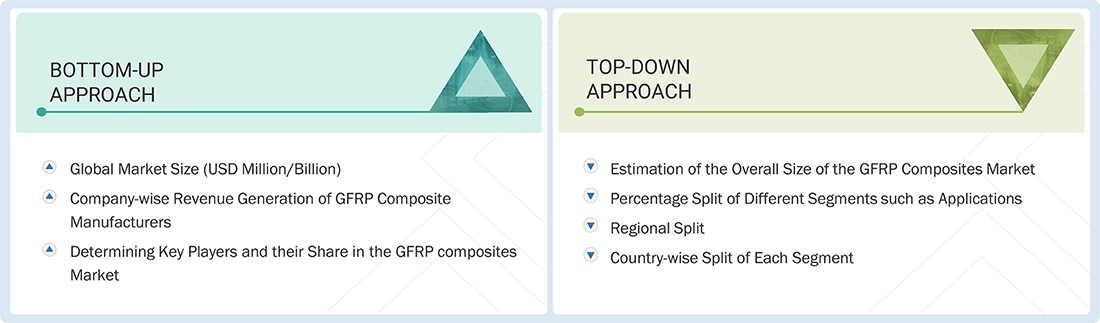
To know about the assumptions considered for the study, download the pdf brochure
Market Size Estimation
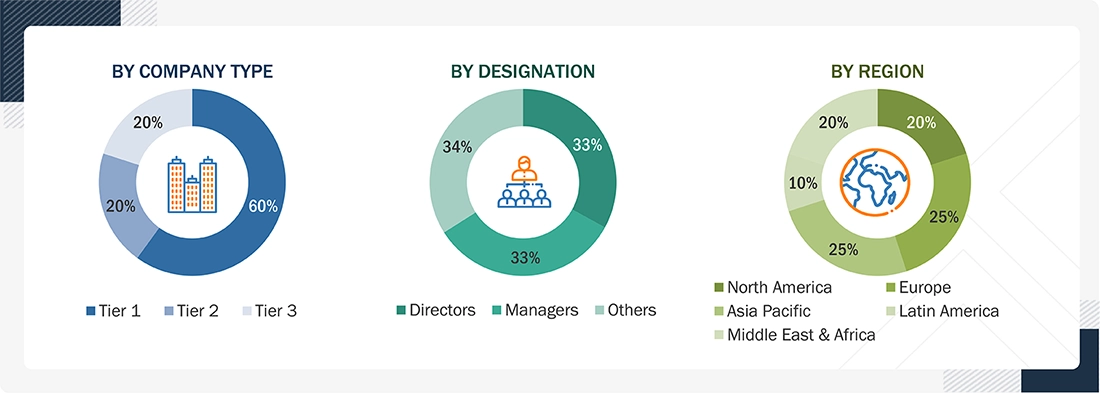
The research methodology used to estimate the size of the GFRP composites market includes the following details. The market size was determined from the demand side. The market was upsized based on the demand for GFRP composites in different applications at the regional level. Such procurements provide information on the demand aspects of the GFRP composites industry for each end-use industry. For each end-use industry, all possible segments of the GFRP composites market were integrated and mapped.
Data Triangulation
After arriving at the overall size from the market size estimation process explained above, the total market was split into several segments and subsegments. The data triangulation procedure was implemented, wherever applicable, to complete the overall market engineering process and arrive at the exact statistics for various market segments and subsegments. The data was triangulated by studying various factors and trends from the demand and supply sides. Along with this, the market size was validated using both the top-down and bottom-up approaches.
Market Definition
GFRP composites comprise thermoset or thermoplastic polymer reinforced with fine glass fibers. Glass fiber is produced by melting glass in a furnace and then transferring the molten glass into superfine holes to create thin glass filaments/fibers. Glass fiber is available in different diameters according to the requirements of the application. GFRP composites are used for their superior mechanical strength, lightweight, corrosion, and thermal resistance properties, and they are easy to form in complex shapes. GFRP composites are created by embedding high-strength glass fibers within a polymer resin, resulting in a material that boasts remarkable strength and durability. The glass fibers in GFRP composites can be made from various types of glass, including E-glass, S-glass, and others, each with distinct properties suitable for specific applications. The polymer resin matrix can consist of thermosetting or thermoplastic resins, which provide different characteristics like enhanced strength, flexibility, and chemical resistance. The combination of these materials leads to a lightweight, corrosion-resistant, and high-strength material that can be customized to meet the specific requirements of diverse industries.
Stakeholders
- GFRP composites manufacturers
- GFRP Composites distributors and suppliers
- Universities, governments, and research organizations
- Associations and industrial bodies
- R&D institutes
- Environmental support agencies
- Investment banks and private equity firms
- Research and consulting firms
Report Objectives
- To define, describe, and forecast the GFRP composites market size in terms of volume and value
- To provide detailed information regarding the key factors, such as drivers, restraints, opportunities, and challenges influencing market growth
- To analyze and project the global GFRP composites market by source, application, and region
- To forecast the market size concerning five main regions (along with country-level data), namely, North America, Europe, Asia Pacific, the Middle East & Africa, and South America, and analyze the significant region-specific trends
- To strategically analyze micro markets with respect to individual growth trends, prospects, and contributions of the submarkets to the overall market
- To analyze the market opportunities and the competitive landscape for stakeholders and market leaders
- To assess recent market developments and competitive strategies, such as agreements, contracts, acquisitions, and product developments/product launches, to draw the competitive landscape
- To strategically profile the key market players and comprehensively analyze their core competencies
Get the Full GFRP Composites Market Report
Full forecast, segment splits, and company analysis for all GFRP Composites Market.
- Germany GFRP Composites Market
- France GFRP Composites Market
- Italy GFRP Composites Market
- UK GFRP Composites Market
- Spain GFRP Composites Market
- Russia GFRP Composites Market
- China GFRP Composites Market
- Japan GFRP Composites Market
- India GFRP Composites Market
- South Korea GFRP Composites Market
- Australia GFRP Composites Market
- Canada GFRP Composites Market
- US GFRP Composites Market
- Brazil GFRP Composites Market
- Mexico GFRP Composites Market
- UAE GFRP Composites Market
- Saudi Arabia GFRP Composites Market
Need a Tailored Report?
Customize this report to your needs
Get 10% FREE Customization
Customize This Report
