
South Korea Glycolic Acid Market (2026-2031)

The South Korea Glycolic Acid Market was valued at $18 Million in 2026 and projected to reach to $27.6 Million by 2031, representing a compound annual growth rate of CAGR 7.4%. South Korea's glycolic acid market is positioned for sustained growth through 2031, driven by increasing consumer demand for advanced skincare solutions and chemical innovation.


| Market Size in | USD 26.32 MN |
| Market Forecast in | |
| CAGR | |
| Forecast Period | |
| Units Considered | Value (USD MN) |
South Korea Glycolic Acid Market Trends and Insights
- This represents a compound annual growth rate (CAGR) of 7.4%, outpacing global averages and reflecting South Korea's robust demand across cosmetics, skincare, and chemical manufacturing sectors.
- South Korea's advanced beauty and personal care industry, combined with increasing consumer awareness of chemical exfoliants, drives sustained market expansion through the forecast period. The South Korea glycolic acid market benefits from the country's strong position as a global beauty innovation hub and its emphasis on high-quality skincare formulations.
- South Korea's manufacturers leverage cutting-edge production capabilities and stringent quality standards to meet both domestic and export demand.
- Between 2026 and 2031, South Korea is expected to capture growing market share through product innovation, regulatory compliance, and strategic partnerships with international distributors, solidifying its role as a critical supply and consumption center in the Asia Pacific glycolic acid landscape..
Key Market Statistics
- CAGR (2026-2031) CAGR 7.4%
- Market Size, 2026 ~USD 18 Million
- Forecast, 2031 ~USD 27.6 Million
- Country South Korea
South Korea Glycolic Acid Market Overview
Market Valuation Growth :
South Korea's glycolic acid market is valued at USD 18.0 million in 2026 and is projected to reach USD 27.6 million by 2031, demonstrating strong regional expansion potential.
Outpacing Global Growth :
With a CAGR of 7.4%, South Korea's glycolic acid market significantly outperforms the global average of 6.9%, indicating accelerated adoption and market maturation in the region.
Cosmetics & Skincare Dominance :
South Korea's thriving beauty and personal care industry drives substantial demand for glycolic acid, leveraging the nation's reputation as a global cosmetics innovation hub.
Chemical Manufacturing Integration :
South Korea's advanced chemical manufacturing sector integrates glycolic acid across multiple industrial applications, supporting diversified end-use demand beyond cosmetics.
South Korea Glycolic Acid Market Dynamics
- The nation's strong cosmetics industry, coupled with rising awareness of chemical exfoliants and anti-aging products, creates favorable conditions for market expansion.
- South Korea's export-oriented economy and manufacturing capabilities further strengthen the market's competitive position within Asia Pacific.
- Continued investment in R&D and product formulation innovations will support the projected 7.4% CAGR, with opportunities emerging across premium skincare segments and industrial chemical applications..
Market Ecosystem
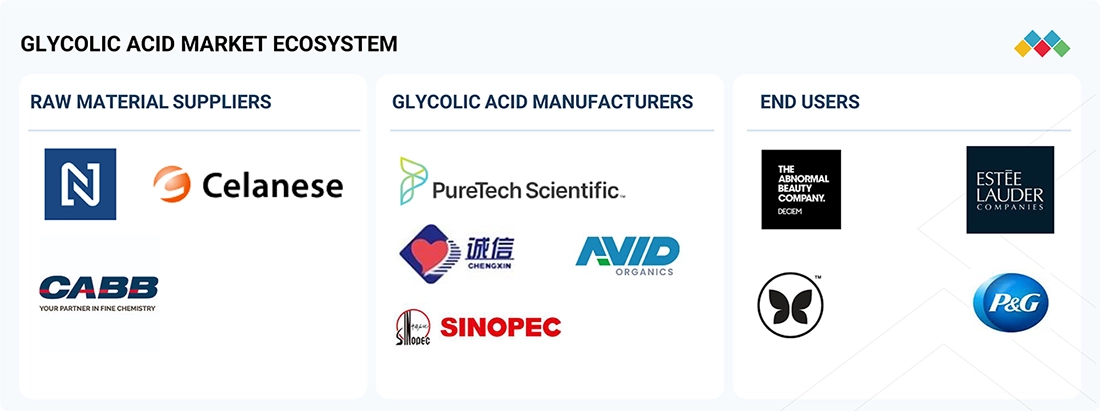
GLYCOLIC ACID MARKET: COMMERCIAL USE CASES ACROSS INDUSTRIES
| COMPANY | USE CASE DESCRIPTION | BENEFITS |
|---|---|---|
 |
Controlled-Release Glycolic Acid for Sensitive Skin (Glypure GL) – Utilizes glycolide technology to gradually release glycolic acid after application, enabling controlled penetration into the skin | Reduces irritation while promoting collagen production, skin hydration, wrinkle reduction, improved elasticity, and effective anti-aging performance for sensitive skin formulations |
 |
Formaldehyde-Free Glycolic Acid Manufacturing (Avid Organics) – Uses an alternative synthesis route that completely eliminates formaldehyde during glycolic acid production while maintaining high purity and batch consistency | Improves worker safety, simplifies regulatory compliance, lowers hazardous waste generation, strengthens ESG credentials, and delivers high-purity glycolic acid for regulated applications |
Logos and trademarks shown above are the property of their respective owners. Their use here is for informational and illustrative purposes only.
Related Ecosystem
Key Takeaways
- South Korea's glycolic acid market is valued at USD 18.0 million in 2026 and is forecast to reach USD 27.6 million by 2031, representing a 7.4% CAGR.
- South Korea's position as a global beauty and skincare innovation leader drives strong domestic demand and export opportunities for glycolic acid products.
- South Korea's advanced manufacturing capabilities and stringent quality standards enable competitive positioning in the Asia Pacific glycolic acid supply chain.
- Between 2026 and 2031, South Korea is expected to experience accelerated growth driven by rising consumer demand for chemical exfoliants and premium skincare formulations.
Glycolic Acid Market Report Scope
| Report Metric | Details |
|---|---|
| Base Year | 2026 |
| Fastest Growing Segment | PERSONAL CARE & DERMATOLOGY (Application) |
| Forecast Period | 2026-2031 |
| Growth Rate | CAGR of 6.9% from 2026 to 2031 |
| Largest Segment | TECHNICAL GRADE (Grade) |
| Market Size Base Year (Billions) | ~USD 0.47 (2026) |
| Revenue Forecast (Billions) | ~USD 0.65 (2031) |
| Segments Covered | Grade, Application |
South Korea Glycolic Acid Market Report Segmentation
2 segment dimensions are covered across the global market.
By Grade
- Cosmetic Grade
- Technical Grade
By Application
- Household
- Industrial
- Other Applications
- Personal Care & Dermatology
Target Audience
- Cosmetics & Skincare Manufacturers : South Korea-based and international beauty companies need market data to develop glycolic acid-based products, optimize formulations, and capitalize on the region's strong skincare demand.
- Chemical Suppliers & Distributors : Suppliers targeting South Korea's chemical manufacturing sector require detailed market insights to identify customer segments, assess demand trends, and establish distribution partnerships.
- Investment & Private Equity Firms : Investors evaluating opportunities in South Korea's chemical and cosmetics industries need accurate market sizing and growth projections to support due diligence and portfolio decisions.
- Market Research & Strategy Consultants : Consulting firms advising clients on South Korea market expansion require region-specific data to develop competitive strategies, market entry plans, and growth recommendations.
- Government & Trade Organizations : South Korean trade bodies and government agencies need market intelligence to support industry development initiatives, export promotion, and regulatory policy formulation.
Reasons to Buy this Report
- Regional Market Specificity : Gain detailed insights exclusive to South Korea's glycolic acid market, including localized demand drivers, competitive landscape, and growth opportunities specific to the region's cosmetics and chemical sectors.
- Accurate Forecasting Data : Access precise market valuations (USD 18.0M in 2026, USD 27.6M in 2031) and the 7.4% CAGR specific to South Korea, enabling accurate business planning and investment decisions.
- Competitive Intelligence : Understand South Korea's market positioning relative to global trends and identify competitive advantages in the region's thriving cosmetics and advanced manufacturing sectors.
- Strategic Market Entry : Develop informed market entry strategies tailored to South Korea's unique regulatory environment, consumer preferences, and distribution channels for glycolic acid products.
- Investment & Growth Opportunities : Identify high-potential segments within South Korea's glycolic acid market, including premium skincare, industrial applications, and emerging consumer trends driving above-average regional growth.
Frequently asked questions
What is the current market size of glycolic acid in South Korea?
South Korea's glycolic acid market is valued at USD 18.0 million in 2026 and is projected to grow to USD 27.6 million by 2031.
What is the expected growth rate for glycolic acid in South Korea?
South Korea's glycolic acid market is expected to grow at a compound annual growth rate (CAGR) of 7.4% from 2026 to 2031.
What are the primary drivers of glycolic acid demand in South Korea?
South Korea's glycolic acid demand is driven by the country's thriving cosmetics and skincare industry, increasing consumer awareness of chemical exfoliants, and the popularity of K-beauty products globally.
How does South Korea's glycolic acid market compare to the global market?
South Korea's glycolic acid market CAGR of 7.4% exceeds the global CAGR of 6.9%, reflecting stronger regional growth momentum and market maturity in the Asia Pacific region.
What role does South Korea play in the Asia Pacific glycolic acid market?
South Korea serves as a key manufacturing and consumption hub in Asia Pacific, leveraging advanced production capabilities, innovation in skincare formulations, and strong export networks to support regional and global glycolic acid demand.
RESEARCH METHODOLOGY
The study involved four major activities to estimate the current size of the global glycolic acid market. Exhaustive secondary research was carried out to collect information on the market, the peer product market, and the parent product group market. The next step was to validate these findings, assumptions, and sizes with the industry experts across the value chain of glycolic acid through primary research. The top-down and bottom-up approaches were employed to estimate the overall size of the glycolic acid market. After that, market breakdown and data triangulation procedures were used to determine the size of different segments of the market.
Secondary Research
The market for companies offering glycolic acid was arrived at by studying the secondary data available through paid and unpaid sources, analyzing the product portfolios of the major companies in the ecosystem, and rating the companies by their performance and quality. Various secondary sources, such as Business Standard, Bloomberg, World Bank, and Factiva, were referred to identify and collect information for this study on the glycolic acid market. In the secondary research process, various secondary sources were referred to identify and collect information related to the study. Secondary sources included annual reports, press releases, investor presentations, glycolic acid vendors, forums, certified publications, and white papers. The secondary research was used to obtain critical information on the industry’s value chain, the total pool of key players, market classification, and segmentation from the market and technology-oriented perspectives.
Primary Research
In the primary research process, various primary sources from the supply and demand sides were interviewed to obtain qualitative and quantitative information for this report. The primary sources from the supply side included industry experts, such as Chief Executive Officers (CEOs), Vice Presidents (VPs), marketing directors, technology and innovation directors, and related key executives from several key companies and organizations operating in the glycolic acid market. After the complete market engineering (calculations for market statistics, market breakdown, market size estimations, market forecasting, and data triangulation), extensive primary research was conducted to gather information and verify and validate the critical numbers arrived at. Primary research was also conducted to identify the segmentation types, industry trends, competitive landscape of glycolic acid offered by various market players, and key market dynamics, such as drivers, restraints, opportunities, challenges, industry trends, and key player strategies. In the complete market engineering process, the top-down and bottom-up approaches and several data triangulation methods were extensively used to perform the market estimation and market forecasting for the overall market segments and subsegments listed in this report. Extensive qualitative and quantitative analysis was performed on the complete market engineering process to list the key information/insights throughout the report.
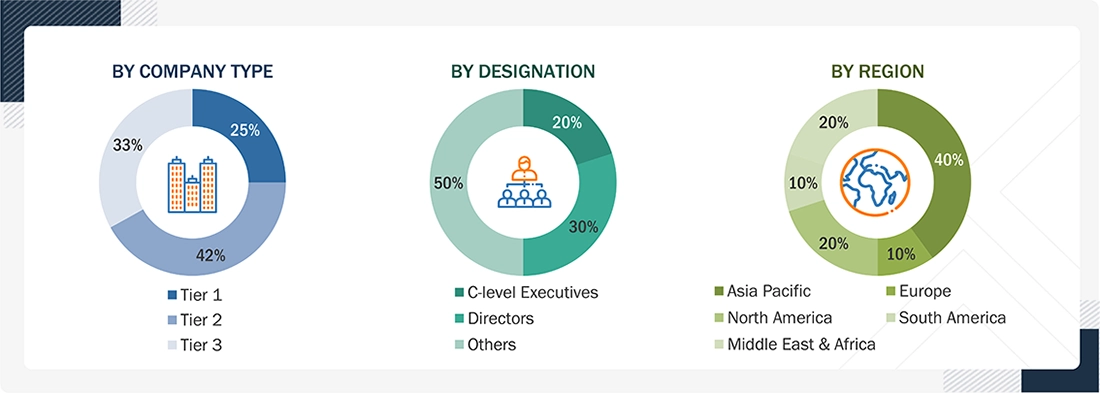
Notes:
Others include Sales, Marketing, and Product Managers.
Tier 1: > USD 1 billion; Tier 2: USD 500 million–1 billion; and Tier 3: < USD 500 million
To know about the assumptions considered for the study, download the pdf brochure
Market Size Estimation
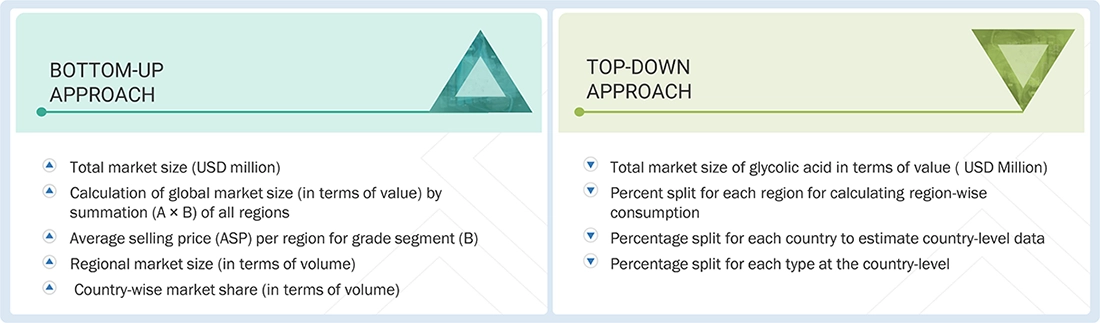
The top-down and bottom-up approaches were used to estimate and validate the size of the global glycolic acid market. These approaches were also used extensively to estimate the size of various dependent market segments.
The research methodology used to estimate the market size included the following approaches:
Data Triangulation
After arriving at the overall market size using the market size estimation processes, the market was split into several segments and subsegments. The data triangulation and market breakup procedures were employed, wherever applicable, to complete the overall market engineering process and arrive at the exact statistics of each market segment and subsegment. The data was triangulated by studying various factors and trends from both the demand and supply sides.
Market Definition
Glycolic acid is an alpha hydroxy acid (AHA), valued for its excellent exfoliating, chelating, descaling, and biodegradable properties. It is widely used in personal care, pharmaceuticals, industrial and household cleaning, oil & gas, textiles, food processing, and specialty chemical manufacturing, making it a versatile specialty chemical with broad industrial applications.
Key Stakeholders
- Glycolic acid manufacturers
- Glycolic acid suppliers
- Industry Associations and Regulatory Bodies
- Research & Development Entities
- Raw Material Suppliers
- End-users
Report Objectives
- To define, describe, and forecast the size of the global glycolic acid market based on grade, application, and region in terms of value and volume
- To provide detailed information on the significant drivers, restraints, opportunities, and challenges influencing the market
- To analyze and forecast the market based on grade and application
- To strategically analyze micro markets concerning individual growth trends, prospects, and their contribution to the market
- To assess the growth opportunities in the market for stakeholders and provide details on the competitive landscape for market leaders
- To forecast the market size of segments for North America, Europe, Asia Pacific, South America, and the Middle East & Africa
- To strategically profile key players and comprehensively analyze their market shares and core competencies
- To analyze competitive developments, such as expansions, product launches, partnerships, and acquisitions in the glycolic acid market
- To provide the impact of AI on the glycolic acid market
Available customizations:
With the given market data, MarketsandMarkets offers customizations according to client-specific needs.
The following customization options are available for the glycolic acid report:
Product Analysis
- A product matrix that gives a detailed comparison of the product portfolio of each company
Regional Analysis
- A further breakdown of the glycolic acid market for additional countries
Company Information
- Detailed analysis and profiling of additional market players (up to five)
Get the Full Glycolic Acid Market Report
Full forecast, segment splits, and company analysis for all Glycolic Acid Market.
- China Glycolic Acid Market
- Japan Glycolic Acid Market
- India Glycolic Acid Market
- Thailand Glycolic Acid Market
- Indonesia Glycolic Acid Market
- Canada Glycolic Acid Market
- Mexico Glycolic Acid Market
- US Glycolic Acid Market
- Germany Glycolic Acid Market
- Italy Glycolic Acid Market
- France Glycolic Acid Market
- UK Glycolic Acid Market
- Spain Glycolic Acid Market
- Russia Glycolic Acid Market
- South Africa Glycolic Acid Market
- Turkey Glycolic Acid Market
- Brazil Glycolic Acid Market
- Argentina Glycolic Acid Market
- Rest Of Europe Glycolic Acid Market
- Rest Of Asia Pacific Glycolic Acid Market
- GCC Countries Glycolic Acid Market
- -Rest Of GCC Countries Glycolic Acid Market
- Rest Of South America Glycolic Acid Market
Need a Tailored Report?
Customize this report to your needs
Get 10% FREE Customization
Customize This Report
