
GCC Countries Green Methanol Market (2025-2030)

The GCC Countries Green Methanol Market was valued at $29.7 Million in 2025 and projected to reach to $71.9 Million by 2030, representing a compound annual growth rate of 19.4%. The GCC Countries green methanol market is poised for significant expansion as regional economies transition toward sustainable fuel solutions.


| Market Size in | USD 26.32 MN |
| Market Forecast in | |
| CAGR | |
| Forecast Period | |
| Units Considered | Value (USD MN) |
GCC Countries Green Methanol Market Trends and Insights
- GCC Countries are strategically positioned to capitalize on the global shift toward sustainable fuels, leveraging abundant renewable energy resources and regional petrochemical expertise.
- The 19.4% compound annual growth rate reflects GCC Countries' commitment to decarbonization and alignment with international climate objectives. GCC Countries' green methanol sector is driven by increasing demand for low-carbon alternatives in transportation, chemicals manufacturing, and power generation.
- Between 2025 and 2030, GCC Countries are expected to strengthen their position as a key producer and exporter of green methanol, supported by government incentives and private sector investment.
- The market dynamics in GCC Countries demonstrate strong potential for industrial adoption and export-oriented growth, positioning the region as a critical player in the global green methanol supply chain..
Key Market Statistics
- CAGR (2025-2030) 19.4% CAGR
- Market Size, 2025 ~USD 29.7 Million
- Forecast, 2030 ~USD 71.9 Million
- Country GCC Countries
GCC Countries Green Methanol Market Overview
Market Valuation Growth :
GCC Countries' green methanol market is projected to grow from $29.7 million in 2025 to $71.9 million by 2030, representing a robust 19.4% CAGR and demonstrating strong regional momentum in sustainable fuel adoption.
Renewable Energy Advantage :
GCC Countries possess abundant solar and wind resources that provide a competitive edge in producing green methanol at scale, enabling cost-effective synthesis and positioning the region as a potential global export hub.
Petrochemical Infrastructure :
Existing world-class petrochemical facilities and technical expertise across GCC Countries enable rapid integration of green methanol production, reducing capital expenditure and accelerating market penetration.
Regional Policy Support :
GCC governments' commitment to diversification and net-zero initiatives creates favorable regulatory frameworks and investment incentives for green methanol projects, driving market expansion and attracting international partnerships.
GCC Countries Green Methanol Market Dynamics
- With abundant renewable energy resources and established petrochemical infrastructure, GCC nations are strategically positioned to become key players in the global green methanol supply chain.
- Government initiatives supporting energy diversification and carbon neutrality targets are catalyzing investment in production facilities and research initiatives. By 2030, the market is expected to reach $71.9 million, driven by increasing demand from maritime, aviation, and chemical sectors.
- Regional collaboration, technology partnerships with global leaders, and competitive production costs will enhance GCC Countries' market share.
- The sector presents substantial opportunities for stakeholders seeking to capitalize on the region's unique advantages in renewable energy integration and industrial expertise..
Market Ecosystem
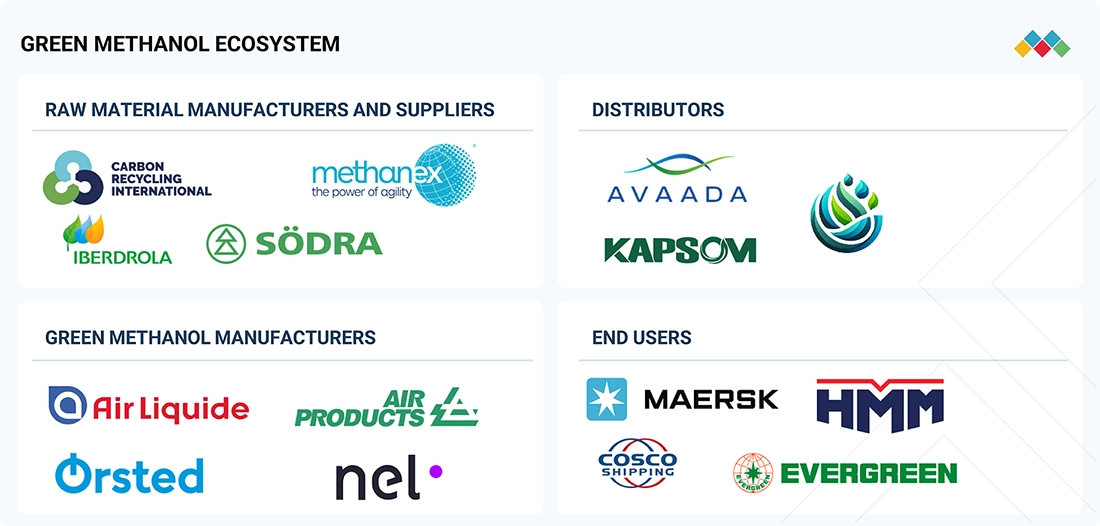
Green Methanol Market: COMMERCIAL USE CASES ACROSS INDUSTRIES
| COMPANY | USE CASE DESCRIPTION | BENEFITS |
|---|---|---|
 |
Shipping companies are adopting green methanol as a marine fuel to reduce greenhouse gas emissions and comply with environmental regulations | Reduction in CO2 emissions by up to 65%, compliance with sulfur emission standards, and alignment with net-zero targets |
 |
Production of plastics and chemicals using green methanol derived from biomass or waste materials | Reduction in fossil fuel dependency, lower carbon footprint, and potential cost savings in plastic production |
 |
Conversion of renewable electricity into green methanol for energy storage and later use in power generation | Enhanced energy storage solutions, reduced reliance on fossil fuels, and improved grid stability |
 |
Integration of biogas plants with Power-to-X technology to produce green methanol from renewable CO2 and hydrogen | Efficient utilization of renewable resources, reduction in greenhouse gas emissions, and potential cost-effective methanol production |
 |
Co-production of cement and green methanol using renewable hydrogen and carbon capture technologies | Lower CO2 abatement costs, efficient use of renewable energy, and support for industrial decarbonization |
Logos and trademarks shown above are the property of their respective owners. Their use here is for informational and illustrative purposes only.
Related Ecosystem
Decarbonization
- Battery Electric Vehicle (BEV)
- Energy Management Systems
- Fuel Cell
- Fuel Cell Electric Vehicle (FCEV)
- Geographical Information System (GIS)
- TotalEnergies SE
- Siemens ag
- Mitsui & Co., Ltd.
- General Electric Company
- Thyssenkrupp ag
Green Bio Chemicals
- Animal-Based Sealants
- Bacterial Fermentation
- Corrosion Inhibitors
- Hydrogen Peroxide
- Nitrile Butadiene Rubber (NBR)
- Basf se
- Evonik industries ag
- Solvay sa
- AZELIS HOLDINGS SA
- CARGILL, INCORPORATED
Renewable Energy Material
- HVAC System
- Actuators
- Aramid Fiber
- Electrical Insulation
- Electrochemical BioSensor
- Basf se
- Evonik industries ag
- Borealis ag
- Wacker chemie ag
- MOMENTIVE PERFORMANCE MATERIALS INC.
Key Takeaways
- GCC Countries' green methanol market is valued at $29.7 million in 2025 and expected to reach $71.9 million by 2030, representing a 19.4% CAGR.
- GCC Countries possess competitive advantages including renewable energy capacity, existing petrochemical infrastructure, and strategic geographic location for global exports.
- Government policies and sustainability initiatives in GCC Countries are accelerating investment in green methanol production and infrastructure development.
- GCC Countries are positioned to serve both domestic industrial demand and international markets, supporting the global transition to sustainable fuels.
Green Methanol Market Report Scope
| Report Metric | Details |
|---|---|
| Base Year | 2025 |
| Fastest Growing Segment | PEM ELECTROLYSIS (Technology) |
| Forecast Period | 2025-2030 |
| Growth Rate | CAGR of 34% from 2025 to 2030 |
| Largest Segment | NATURAL GAS (Feedstock) |
| Market Size Base Year (Billions) | ~USD 2.59 (2025) |
| Revenue Forecast (Billions) | ~USD 11.18 (2030) |
| Segments Covered | Feedstock, Application, Technology |
GCC Countries Green Methanol Market Report Segmentation
3 segment dimensions are covered across the global market.
By Feedstock
- Biomass
- Carbon Capture & Storage
- Coal
- Green Hydrogen
- Natural Gas
By Application
- Chemical Feedstock
- Fuel
By Technology
- Alkaline Electrolysis
- Pem Electrolysis
Target Audience
- Chemical & Energy Companies : Producers and distributors operating in GCC Countries need regional market data to optimize production strategies, identify demand hotspots, and plan capacity expansion aligned with local growth trajectories.
- Investment & Private Equity Firms : Investors evaluating opportunities in GCC's green methanol sector require detailed market sizing, growth forecasts, and competitive analysis to assess returns and identify high-potential investment targets.
- Government & Policy Makers : GCC policymakers and economic development agencies use market intelligence to design supportive regulations, allocate resources, and establish strategic initiatives promoting regional green methanol leadership.
- Technology & Equipment Suppliers : Vendors of green methanol production technology and equipment need GCC-specific demand forecasts and infrastructure insights to tailor solutions and identify partnership opportunities with regional producers.
- Sustainability & Consulting Firms : Consultants advising GCC clients on energy transition strategies require comprehensive market data to benchmark regional progress, identify best practices, and develop actionable sustainability roadmaps.
Reasons to Buy this Report
- Regional Market Sizing & Forecasts : Access precise market valuation data specific to GCC Countries with detailed projections through 2030, enabling accurate business planning and investment decisions tailored to regional dynamics.
- Competitive Landscape Analysis : Understand key players, market share distribution, and competitive positioning within GCC Countries' green methanol sector to identify partnership and acquisition opportunities.
- Growth Driver Identification : Gain insights into region-specific catalysts including renewable energy availability, government policies, and industrial demand patterns driving the 19.4% CAGR in GCC Countries.
- Investment & Expansion Strategy : Leverage GCC-focused market intelligence to develop targeted expansion strategies, assess infrastructure readiness, and identify optimal entry points for production facilities and distribution networks.
- Regulatory & Policy Framework : Stay informed on GCC government initiatives, sustainability mandates, and incentive programs shaping the green methanol market landscape and influencing long-term viability.
Frequently asked questions
What is the current market size of green methanol in GCC Countries?
The green methanol market in GCC Countries was valued at $29.7 million in 2025 and is projected to grow to $71.9 million by 2030.
What is the growth rate for green methanol in GCC Countries?
GCC Countries' green methanol market is expected to grow at a compound annual growth rate (CAGR) of 19.4% from 2025 to 2030.
What factors are driving green methanol demand in GCC Countries?
Key drivers in GCC Countries include renewable energy availability, government sustainability policies, industrial decarbonization requirements, and export opportunities for low-carbon fuels.
How does GCC Countries' green methanol market compare to global trends?
While the global green methanol market grows at 34% CAGR, GCC Countries' 19.4% CAGR reflects a more mature regional market with established infrastructure and strategic positioning as a producer and exporter.
What are the main applications of green methanol in GCC Countries?
Primary applications in GCC Countries include use as a chemical feedstock, marine fuel, transportation fuel, and power generation, with growing adoption across industrial sectors.
RESEARCH METHODOLOGY
The study involved four major activities in estimating the current size of the green methanol market—exhaustive secondary research collected information on the market, peer markets, and parent markets. The subsequent steps involved confirming these findings, assumptions, and sizing with industry experts throughout the green methanol value chain through primary research. Both top-down and bottom-up approaches were utilized to estimate the overall market size. Following this, the market segmentation and data triangulation methods were applied to determine the size of various segments and subsegments.
Secondary Research
For this research, secondary sources include annual reports, press releases, and presentations from companies, as well as white papers, certified publications, articles by reputable authors, and information from trusted websites. These sources were used to gather crucial details about the industry's supply chain, key players, market categories, segmentation based on industry trends down to regional markets, and significant developments from a market-focused viewpoint.
Primary Research
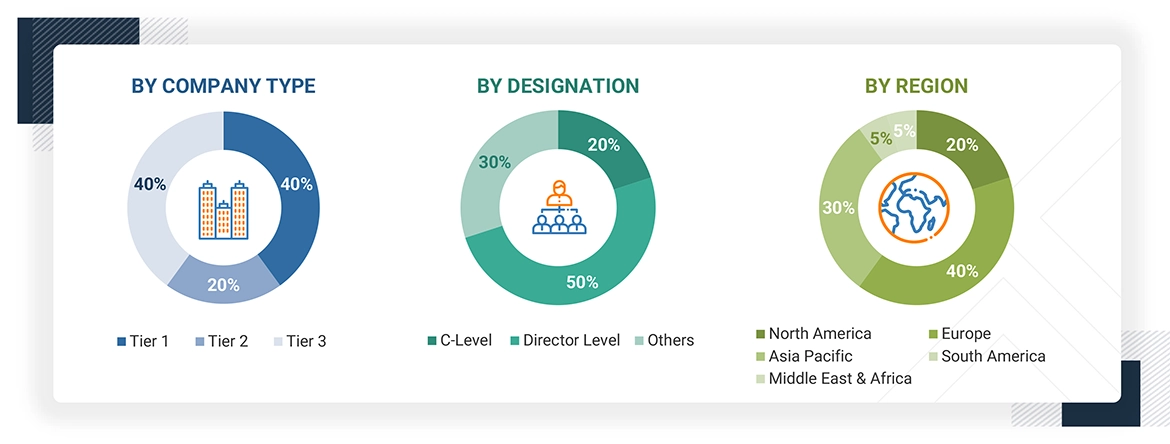
The green methanol market comprises several stakeholders, such as raw material suppliers, technology support providers, green methanol manufacturers, and regulatory organizations in the supply chain. Various primary sources from the supply and demand sides of the market were interviewed to obtain qualitative and quantitative information. Key personnel from both sides of the market—supply and demand—were interviewed to gather detailed information. Supply-side primary sources included industry experts like CEOs, vice presidents, marketing and technology directors, and other key executives from companies in the green methanol market. On the demand side, it included directors, marketing leaders, and procurement managers from various industries sourcing green methanol. Below is a breakdown of the primary respondents.
To know about the assumptions considered for the study, download the pdf brochure
Market Size Estimation
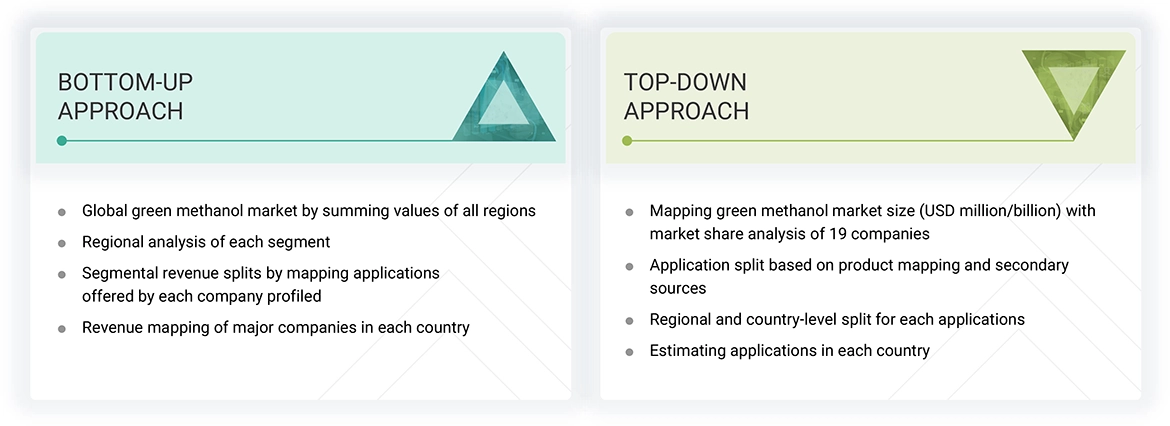
Two methods, top-down and bottom-up, were used to ascertain and confirm the overall size of the green methanol market. These methods were also used to estimate the size of different segments of the market. The approaches used to estimate the market size are given below.
Global Green Methanol Market: Bottom-up and Top-down Approach
The sections below outline how the total market size for this study was calculated.
- The main market participants were identified using secondary research methods.
- The market share across different regions was determined using a combination of primary and secondary research methods.
- The value chain and market size of the green methanol market, in terms of value and volume, were determined through primary and secondary research.
- All percentages, distributions, and divisions were calculated using secondary sources and confirmed through primary sources.
- This research study comprehensively considered all relevant market parameters, examining them in detail, validating them through primary research, and analyzing them to derive the final quantitative and qualitative data.
- The research involved analyzing the annual and financial reports of leading market players and conducting interviews with industry experts, including CEOs, VPs, directors, sales managers, and marketing executives, to gather significant quantitative and qualitative insights.
Data Triangulation
Once the overall market size was determined using the methods described earlier, the market was divided into multiple segments and subsegments. To complete the market engineering process, the data triangulation and market breakdown procedures were utilized to precisely calculate the statistics for each market segment and subsegment. Triangulation involved analyzing factors and trends from both, the demand and supply sides of the chemical sector.
Market Definition
According to the Methanol Institute, methanol (CH3OH) is a liquid chemical used in thousands of everyday products, including plastics, paints, cosmetics, and fuels. Liquid methanol is produced from synthesis gas, which consists of a blend of hydrogen, carbon dioxide, and carbon monoxide. These simple ingredients can be sourced from various feedstocks using different technological approaches.
Green or renewable methanol is an ultra-low-carbon chemical produced through sustainable processes. Green methanol can be categorized into two main types: bio-methanol and e-methanol, which are determined by the green feedstocks employed. Bio-methanol involves replacing traditional coal or natural gas feedstocks with biomass or biogas sources. At the same time, e-methanol is produced by combining green hydrogen with carbon dioxide from direct air carbon capture or biogenic sources.
Stakeholders
- Raw material manufacturers
- Technology support providers
- Manufacturers of green methanol
- Traders, distributors, and suppliers
- Regulatory bodies and government agencies
- Research & development (R&D) institutions
- End-use industries
- Consulting firms, trade associations, and industry bodies
- Investment banks and private equity firms
Report Objectives
- To analyze and forecast the green methanol market size in terms of value and volume
- To offer comprehensive insights into the primary factors (such as drivers, restraints, challenges, and opportunities) impacting the market
- To analyze and forecast the global green methanol market based on feedstock, derivative, application, and region
- To analyze opportunities in the market for stakeholders and provide details of a competitive landscape for market leaders
- To forecast the size of various market segments based on five regions: Asia Pacific, Europe, South America, Middle East & Africa, and North America, along with their respective key countries
- To monitor and assess competitive advancements, including acquisitions, partnerships, collaborations, agreements, and expansions within the market
- To strategically outline the key players and thoroughly evaluate their market position and primary capabilities
Get the Full Green Methanol Market Report
Full forecast, segment splits, and company analysis for all Green Methanol Market.
- US Green Methanol Market
- Canada Green Methanol Market
- Mexico Green Methanol Market
- Germany Green Methanol Market
- Netherlands Green Methanol Market
- Sweden Green Methanol Market
- China Green Methanol Market
- India Green Methanol Market
- Japan Green Methanol Market
- South Korea Green Methanol Market
- Brazil Green Methanol Market
- Argentina Green Methanol Market
- South America Green Methanol Market
- Rest Of Europe Green Methanol Market
- Rest Of Asia Pacific Green Methanol Market
- -Rest Of The GCC Countries Green Methanol Market
- Asia Pacific Green Methanol Market
- Europe Green Methanol Market
- North America Green Methanol Market
- Rest Of South America Green Methanol Market
Need a Tailored Report?
Customize this report to your needs
Get 10% FREE Customization
Customize This Report
