
Singapore Methanol Ships Market (2026-2031)

The Singapore Methanol Ships Market was valued at $9 Million in 2026 and projected to reach to $13 Million by 2031, representing a compound annual growth rate of 16.7%. Singapore's methanol ships market is poised for substantial growth as the nation leverages its world-class maritime infrastructure and regulatory framework to support alternative fuel adoption.


| Market Size in | USD 26.32 MN |
| Market Forecast in | |
| CAGR | |
| Forecast Period | |
| Units Considered | Value (USD MN) |
Singapore Methanol Ships Market Trends and Insights
- Valued at $9.0 million in 2026, Singapore's market is projected to reach $13.0 million by 2031, expanding at a compound annual growth rate of 16.7%.
- This robust growth trajectory reflects Singapore's strategic importance as a global shipping and refueling center, where methanol-powered vessels are increasingly adopted to meet stringent environmental regulations and decarbonization mandates. The expansion of Singapore's methanol ships market is driven by the city-state's advanced port infrastructure, regulatory leadership in sustainable maritime practices, and growing demand from international shipping operators seeking alternative fuels.
- Singapore's position as a leading bunkering hub amplifies its role in the methanol fuel supply chain, attracting investment in methanol-compatible vessel construction and retrofitting services.
- Between 2026 and 2031, Singapore is expected to consolidate its market leadership through technological innovation and strategic partnerships within the aerospace & defence supply chain..
Key Market Statistics
- CAGR (2026-2031) 16.7% CAGR
- Market Size, 2026 ~USD 9 Million
- Forecast, 2031 ~USD 13 Million
- Country Singapore
Singapore Methanol Ships Market Overview
Strategic Port Hub Status :
Singapore's position as one of the world's busiest transshipment ports makes it a critical node for methanol ship operations, with direct access to major Asian shipping lanes and refueling infrastructure.
Rapid Market Expansion :
Singapore's methanol ships market is growing at 16.7% CAGR (2026-2031), significantly outpacing the global growth rate of 12.8%, driven by regional demand for sustainable maritime solutions.
Aerospace & Defence Integration :
Singapore's advanced aerospace and defence sector creates synergies with methanol ship technology development, positioning the nation as an innovation hub for alternative fuel maritime systems.
Market Valuation Trajectory :
The Singapore methanol ships market is valued at $9.0 million in 2026 and projected to reach $13.0 million by 2031, representing a 44% increase over the five-year forecast period.
Singapore Methanol Ships Market Dynamics
- The 16.7% CAGR reflects increasing investments in methanol-powered vessel technology and Singapore's commitment to becoming a green shipping hub.
- Regional demand from Southeast Asian shipping operators and international maritime companies seeking sustainable solutions will drive market expansion. The convergence of Singapore's aerospace & defence capabilities with maritime innovation creates unique opportunities for methanol ship development and deployment.
- Government initiatives promoting decarbonization, combined with Singapore's strategic geographic position and advanced port facilities, position the market for accelerated growth through 2031.
- Industry players are expected to establish regional headquarters and R&D centers in Singapore to capitalize on these advantages..
Market Ecosystem
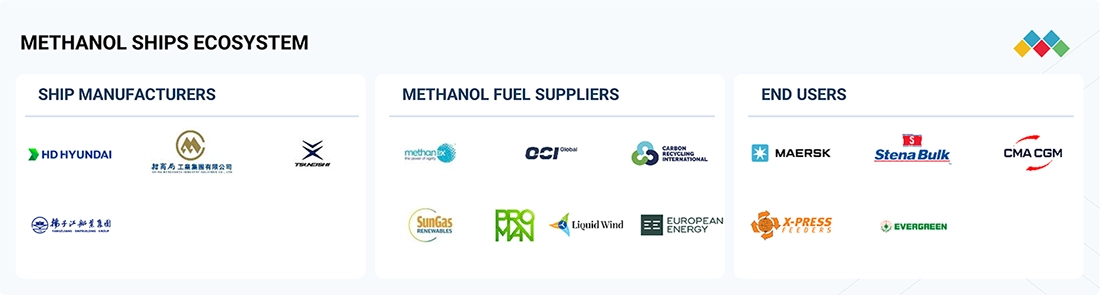
METHANOL SHIPS MARKET SIZE, SHARE & TRENDS: COMMERCIAL USE CASES ACROSS INDUSTRIES
| COMPANY | USE CASE DESCRIPTION | BENEFITS |
|---|---|---|
 |
Deployment of Berlin Maersk, a 17,480 TEU dual-fuel methanol container ship, for regular liner shipping operations | New class of large methanol-capable container ships and part of Maersk’s expanding low-emission flee | Demonstrates commercial use of methanol in large-scale container shipping | Supports emission reduction in long-haul trade while maintaining fleet scale, route flexibility, and mainstream cargo transport capability |
 |
Commercial use of Brave Pioneer, a green methanol dual-fuel dry bulk vessel, for transporting bulk commodities on international routes | First of five chartered by Cargill under its low-carbon shipping initiative | Demonstrates utility of methanol-fueled ships in bulk cargo transport without changing the core commercial role of the vessel | Supports low-emission freight movement and expands methanol adoption beyond container shipping |
 |
Entry into commercial service of New Explorer, the world’s first methanol dual-fuel VLCC, built for crude oil transportation, marking methanol adoption in very large tanker operations | Highlights methanol’s use in large tanker shipping, showing that the fuel is moving beyond pilot-scale deployment into mainstream commercial marine transport | Supports decarbonization in high-capacity crude oil shipping |
Logos and trademarks shown above are the property of their respective owners. Their use here is for informational and illustrative purposes only.
Related Ecosystem
Key Takeaways
- Singapore's methanol ships market will grow from $9.0M (2026) to $13.0M (2031) at 16.7% CAGR, outpacing global growth.
- Singapore's role as Asia's premier bunkering hub positions the country as a critical node in methanol fuel distribution and vessel refueling.
- Regulatory pressure and IMO 2030/2050 decarbonization targets are accelerating methanol vessel adoption across Singapore's shipping corridors.
- Singapore's advanced maritime infrastructure and aerospace & defence capabilities create competitive advantages in methanol ship construction and retrofitting services.
Methanol Ships Market Report Scope
| Report Metric | Details |
|---|---|
| Base Year | 2026 |
| Fastest Growing Segment | OFFSHORE VESSELS (Ship Type) |
| Forecast Period | 2026-2031 |
| Growth Rate | CAGR of 12.8% from 2026 to 2031 |
| Largest Segment | NEWBUILD (Build) |
| Market Size Base Year (Billions) | ~USD 13.71 (2026) |
| Revenue Forecast (Billions) | ~USD 25.03 (2031) |
| Segments Covered | Ship Type, Cargo Vessels, Passenger Vessel, Offshore Vessel, System, Build, Engine Output, Cargo Vessel |
Singapore Methanol Ships Market Report Segmentation
8 segment dimensions are covered across the global market.
By Ship Type
- Cargo Vessels
- Offshore Vessels
- Passenger Vessels
- Research & Survey Vessels
- Tugboats
By Cargo Vessels
- Bulk Carriers
- Car Carriers
- Chemical Tankers
- Container Ships
- Crude Oil Tankers
- Roro Cargo Ships
By Passenger Vessel
- Cruise Ships
- Ropax Vessels
By Offshore Vessel
- Offshore Supply Ships
- Offshore Support Vessels
By System
- Air, Exhaust And Ventilation System
- Air, Exhaust, And Ventilation System
- Cooling And Lubrication System
- Electrical And Control System
- Fuel System
- Propulsion System
- Safety System
By Build
- Newbuild
- Retrofit
By Engine Output
- High Output (>= 20 Mw)
- Low Output (<= 5 Mw)
- Medium Output (5-20 Mw)
By Cargo Vessel
- Bulk Carriers
- Car Carriers
- Chemical Tankers
- Container Ships
- Crude Oil Tankers
- Roro Cargo Ships
Target Audience
- Maritime Operators & Shipping Companies : Need Singapore-specific market data to evaluate fleet conversion opportunities, assess regional demand for methanol-powered vessels, and plan port operations in Asia's leading shipping hub.
- Aerospace & Defence Contractors : Require insights into Singapore's methanol ships market to identify cross-sector opportunities, develop propulsion systems, and establish partnerships with maritime stakeholders.
- Port Authorities & Infrastructure Developers : Seek market forecasts to justify investments in methanol refueling infrastructure, bunkering facilities, and port modernization projects aligned with Singapore's green shipping initiatives.
- Investment & Private Equity Firms : Need Singapore market valuation and growth trajectory data to evaluate investment opportunities in methanol ship technology, maritime startups, and sustainable shipping ventures.
- Government & Policy Makers : Require market intelligence to develop regulatory frameworks, incentive programs, and sustainability policies that support Singapore's position as a leading green maritime hub.
Reasons to Buy this Report
- Localized Market Intelligence : Gain deep insights into Singapore-specific methanol ship market dynamics, regulatory environment, and competitive landscape that differ significantly from global trends.
- Investment Decision Support : Make informed capital allocation decisions with precise Singapore market valuation data ($9M-$13M), growth projections, and regional CAGR analysis for strategic planning.
- Competitive Positioning : Understand Singapore's 16.7% CAGR advantage over global 12.8% growth to identify market opportunities and competitive advantages in Asia's fastest-growing maritime segment.
- Stakeholder Engagement : Access Singapore-focused data to support board presentations, investor pitches, and partnership negotiations with regional maritime operators and port authorities.
- Strategic Expansion Planning : Evaluate Singapore as a hub location for methanol ship operations, R&D facilities, or supply chain integration based on comprehensive market forecasts and infrastructure analysis.
Frequently asked questions
What is the current market size of methanol ships in Singapore?
Singapore's methanol ships market was valued at $9.0 million in 2026 and is projected to reach $13.0 million by 2031.
What is the growth rate of Singapore's methanol ships market?
Singapore's methanol ships market is expanding at a compound annual growth rate (CAGR) of 16.7% from 2026 to 2031.
Why is Singapore important for the methanol ships market?
Singapore is a global bunkering hub and maritime center with advanced port infrastructure, making it critical for methanol fuel supply, vessel refueling, and ship construction services.
What factors are driving growth in Singapore's methanol ships market?
Key drivers include IMO decarbonization regulations, Singapore's regulatory leadership in sustainable maritime practices, and increasing demand from international shipping operators for alternative fuels.
How does Singapore's market compare to global methanol ships market growth?
Singapore's 16.7% CAGR significantly outpaces the global market CAGR of 12.8%, reflecting the country's strategic position and accelerated adoption of methanol-powered vessels.
RESEARCH METHODOLOGY
The study involved four major activities in estimating the current size of the methanol ships market. Exhaustive secondary research was done to collect information on the market, its adjacent markets, and its parent market. The next step was to validate these findings, assumptions, and sizing with industry experts across the value chain through primary research. Demand-side analysis was conducted to estimate the overall market size. After that, market breakdown and data triangulation procedures were employed to estimate the sizes of various segments and subsegments within the market.
Secondary Research
During the secondary research process, various sources were consulted to identify and collect information for this study. The secondary sources included government sources, such as SIPRI; corporate filings, including annual reports, press releases, and investor presentations from companies; white papers, journals, and certified publications; and articles from recognized authors, directories, and databases.
Primary Research
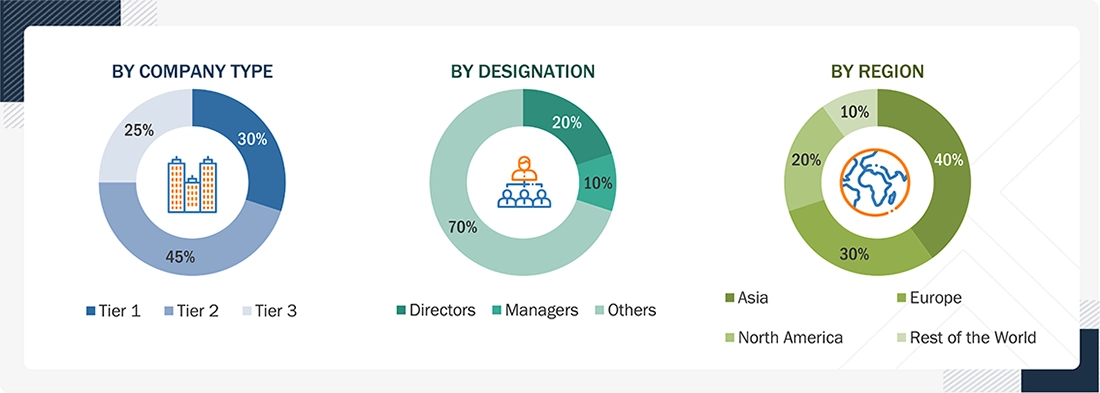
Extensive primary research was conducted after acquiring information regarding the methanol ships market scenario through secondary research. Several primary interviews were conducted with market experts from the demand and supply sides across major countries of North America, Europe, Asia, and RoW. Primary data was collected through questionnaires, emails, and telephonic interviews.
To know about the assumptions considered for the study, download the pdf brochure
Market Size Estimation
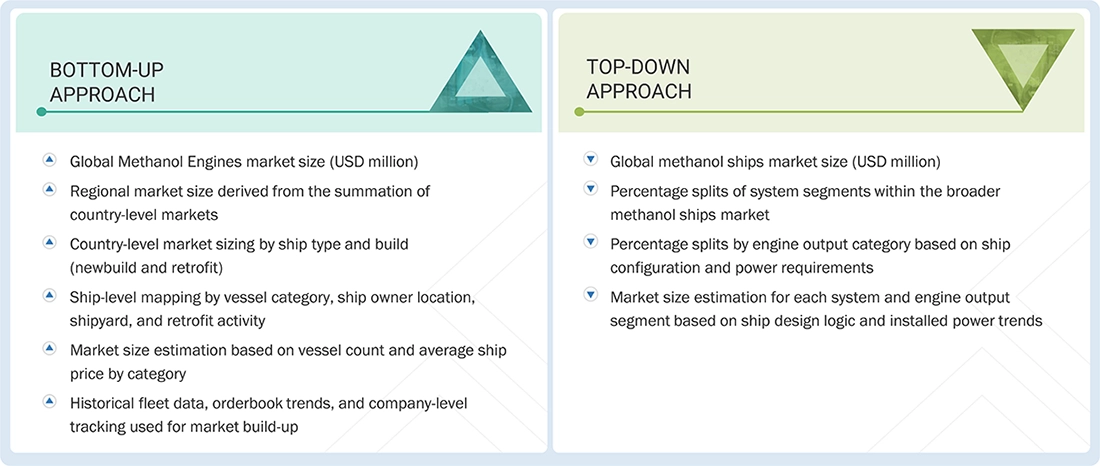
The top-down and bottom-up approaches were used to estimate and validate the size of the methanol ships market. The research methodology used to estimate the size of the market included the following details:
- Key players in the methanol ships market were identified through secondary research, and their market shares were determined through a combination of primary and secondary research. This included a study of the annual and financial reports of the top market players, as well as extensive interviews with leaders, including directors, engineers, marketing executives, and other key stakeholders of leading companies operating in the market.
- All percentage shares, splits, and breakdowns were determined using secondary sources and verified through primary sources.
- All possible parameters that affect the markets covered in this research study were accounted for, viewed in extensive detail, verified through primary research, and analyzed to obtain the final quantitative and qualitative data on the methanol ships market. This data was consolidated, enhanced with detailed inputs, analyzed by MarketsandMarkets, and presented in this report.
Methanol Ships Market Size: Bottom-up & Top-Down Approach
Data Triangulation
After determining the overall market size, the total market was divided into several segments and subsegments. The data triangulation and market breakdown procedures explained below were implemented, wherever applicable, to complete the overall market engineering process and arrive at the estimated market numbers for the market segments and subsegments. The data was triangulated by studying various factors and trends from the demand and supply sides. Additionally, the market size was validated using top-down and bottom-up approaches.
Market Definition
The methanol ships market refers to the market for ships that are built or converted to operate on methanol as a marine fuel. It includes vessels using methanol through dual-fuel or methanol-capable engine systems and covers newbuild and retrofit ships. The market is segmented by engine output, system, ship type, and build. It includes cargo vessels, passenger vessels, offshore vessels, tugboats, and research and survey vessels equipped with the required propulsion, fuel handling, electrical, control, and safety systems for methanol use. The market captures vessel-level demand driven by cleaner fuel adoption across marine applications.
Key Stakeholders
- Shipowners and Fleet Operators
- Shipyards and Vessel Builders
- Methanol Engine and Propulsion System Providers
- Marine System Integrators and Retrofit Solution Providers
- Fuel Suppliers and Methanol Producers
- Bunkering Infrastructure Providers
- Port Authorities and Terminal Operators
- Classification Societies
- Government and Regulatory Bodies
Report Objectives
- To describe, segment, and forecast the size of the methanol ships market, by build, engine output, system, and ship type, in terms of value
- To forecast the size of market segments based on four regions: North America, Europe, Asia, and the Rest of the World, in terms of value and volume
- To identify and analyze key drivers, restraints, opportunities, and challenges influencing the growth of the market
- To identify industry trends, market trends, and technology trends prevailing in the market
- To analyze micromarkets with respect to individual technological trends, prospects, and their contribution to the overall market
- To strategically profile key market players and comprehensively analyze their market ranking and core competencies
- To provide a detailed competitive landscape of the market and analyze competitive growth strategies, such as product developments, contracts, partnerships, agreements, and collaborations, adopted by key players in the market
- To identify the detailed financial position of key players, as well as their key products, unique selling points, and key developments
Available customizations:
MarketsandMarkets offers the following customizations for this market report:
- Additional country-level analysis of the methanol ships market
- Profiling of other market players (up to 5)
Product Analysis
- Product matrix, which provides a detailed comparison of the product portfolio of each company in the methanol ships market
Get the Full Methanol Ships Market Report
Full forecast, segment splits, and company analysis for all Methanol Ships Market.
- Canada Methanol Ships Market
- Denmark Methanol Ships Market
- France Methanol Ships Market
- Germany Methanol Ships Market
- Netherlands Methanol Ships Market
- Norway Methanol Ships Market
- Sweden Methanol Ships Market
- Switzerland Methanol Ships Market
- China Methanol Ships Market
- India Methanol Ships Market
- Japan Methanol Ships Market
- South Korea Methanol Ships Market
- Taiwan Methanol Ships Market
Need a Tailored Report?
Customize this report to your needs
Get 10% FREE Customization
Customize This Report
