
Asia Pacific Healthcare Workforce Management System Market (2024-2029)

The Asia Pacific Healthcare Workforce Management System Market was valued at $378.9 Million in 2024 and projected to reach to $678.8 Million by 2029, representing a compound annual growth rate of 12.4%. The Asia Pacific healthcare workforce management system market is positioned for sustained expansion, growing from $378.9 million in 2024 to $678.8 million by 2029.


| Market Size in | USD 26.32 MN |
| Market Forecast in | |
| CAGR | |
| Forecast Period | |
| Units Considered | Value (USD MN) |
Asia Pacific Healthcare Workforce Management System Market Trends and Insights
- Asia Pacific's healthcare sector is increasingly adopting digital workforce solutions to address labor shortages, improve scheduling efficiency, and enhance staff retention across hospitals, clinics, and care facilities.
- The region's rapid digital transformation, coupled with rising healthcare expenditure and regulatory pressures to optimize staffing models, is driving widespread adoption of these systems throughout Asia Pacific. Asia Pacific's 12.4% compound annual growth rate significantly outpaces global trends, reflecting the region's urgent need for workforce optimization amid demographic shifts and expanding healthcare demand.
- Key markets within Asia Pacific, including China, India, Japan, and Southeast Asia, are investing heavily in healthcare infrastructure modernization.
- Asia Pacific's competitive labor market and increasing focus on operational efficiency are compelling healthcare providers to deploy advanced workforce management platforms that streamline scheduling, reduce administrative burden, and improve clinical outcomes across the region..
Key Market Statistics
- CAGR (2024-2029) 12.4% CAGR
- Market Size, 2024 ~USD 378.9 Million
- Forecast, 2029 ~USD 678.8 Million
- Geography Asia Pacific
Asia Pacific Healthcare Workforce Management System Market Overview
Rapid Digital Adoption :
Asia Pacific healthcare providers are accelerating digital transformation initiatives, with workforce management systems becoming critical infrastructure to address severe labor shortages across hospitals and clinics in the region.
Strong CAGR Performance :
The Asia Pacific market is growing at 12.4% CAGR, outpacing the global average of 10.1%, driven by increasing healthcare demand, regulatory compliance requirements, and rising labor costs across major economies.
Scheduling Efficiency Focus :
Healthcare facilities across Asia Pacific are prioritizing automated scheduling and staff optimization solutions to reduce operational costs, minimize burnout, and improve patient care quality in resource-constrained environments.
Staff Retention Priority :
Rising employee turnover in Asia Pacific healthcare is driving investment in workforce management systems that enhance scheduling fairness, career development tracking, and work-life balance for clinical and non-clinical staff.
Asia Pacific Healthcare Workforce Management System Market Dynamics
- This growth trajectory reflects the region's urgent need to modernize healthcare operations amid rapid population aging, increasing patient volumes, and persistent staffing challenges.
- Major economies including Japan, China, and India are investing heavily in healthcare infrastructure digitalization. Key drivers include regulatory mandates for staff compliance tracking, rising labor costs necessitating operational efficiency, and growing adoption of cloud-based solutions among healthcare networks.
- The region's diverse healthcare landscape—spanning developed markets like Japan and emerging economies like India—creates varied implementation opportunities.
- Integration with electronic health records and telehealth platforms will further accelerate market penetration across Asia Pacific healthcare facilities..
Market Ecosystem
Related Ecosystem
Healthcare It
- Computed Tomography (CT)
- Machine Learning
- Magnetic Resonance Imaging (MRI)
- Natural Language Processing (NLP)
- Predictive Analytics
- CERNER CORPORATION
- PHILIPS HEALTHCARE
- Oracle Corporation
- GE HealthCare Technologies Inc.
- Siemens healthineers
Key Takeaways
- Asia Pacific's healthcare workforce management system market will nearly double from $378.9M (2024) to $678.8M (2029), driven by digital transformation initiatives across the region.
- Asia Pacific's 12.4% CAGR outpaces the global average, reflecting acute workforce challenges and healthcare modernization priorities unique to the region.
- Asia Pacific healthcare providers are prioritizing workforce optimization to address staffing shortages, improve scheduling efficiency, and enhance operational resilience.
- Asia Pacific's emerging markets, particularly in Southeast Asia and India, represent high-growth opportunities as healthcare systems digitalize and expand capacity.
Healthcare Workforce Management System Market Report Scope
| Report Metric | Details |
|---|---|
| Base Year | 2024 |
| Fastest Growing Segment | SMALL (Organization Size) |
| Forecast Period | 2024-2029 |
| Growth Rate | CAGR of 10.1% from 2024 to 2029 |
| Largest Segment | SOFTWARE (Component) |
| Market Size Base Year (Billions) | ~USD 1.73 (2024) |
| Revenue Forecast (Billions) | ~USD 2.8 (2029) |
| Segments Covered | Component, Type, Deployment, Organization Size, End User |
Asia Pacific Healthcare Workforce Management System Market Report Segmentation
5 segment dimensions are covered across the global market.
By Component
- Services
- Software
By Type
- Education & Training Services
- Hr & Payroll Management
- Implementation Services
- Integrated Software
- Optimization & Consulting Services
- Other Standalone Software
- Others Standalone Software
- Scheduling
- Standalone Software
- Support & Maintenance Services
- Talent Management
- Time & Attendance Management
- Workforce Analytics
By Deployment
- Cloud-Based/Web-Based Model
- On-Premise Model
By Organization Size
- Large
- Medium-Sized
- Small
By End User
- Assisted Living Centers
- Hospitals
- Long-Term Care Facilities
- Nursing Homes
- Other End Users
Target Audience
- Healthcare IT Vendors : Software and system providers need Asia Pacific market intelligence to develop region-specific solutions, identify partnership opportunities, and prioritize market expansion across high-growth countries.
- Hospital Networks & Health Systems : Healthcare administrators require market insights to benchmark workforce management investments, evaluate vendor options, and justify digital transformation budgets to stakeholders.
- Healthcare Consultants : Management and technology consultants need regional data to advise clients on workforce optimization strategies, system selection, and implementation roadmaps aligned with Asia Pacific market trends.
- Private Equity & Investors : Investment firms evaluating healthcare IT opportunities need Asia Pacific market forecasts and growth drivers to assess portfolio companies, identify acquisition targets, and evaluate sector valuations.
- Healthcare Policy Makers : Government health agencies and regulators require market intelligence to understand digital workforce adoption trends, inform healthcare workforce planning, and develop supportive regulatory frameworks.
Countries within Asia Pacific - compare and drill down
| Country | 2025 size (native) |
|---|---|
| China | USD 128.5 Million |
| Japan | USD 143.3 Million |
| India | USD 86.1 Million |
| Rest Of Asia Pacific | USD 103.2 Million |
Country market size visualization
Reasons to Buy this Report
- Regional Market Sizing : Gain precise market valuations and growth projections specific to Asia Pacific, including country-level breakdowns for China, Japan, and India to inform localized business strategies.
- Competitive Landscape Analysis : Understand regional vendor positioning, market share dynamics, and competitive strategies tailored to Asia Pacific's unique healthcare regulatory environment and operational challenges.
- Growth Opportunity Identification : Identify high-potential segments and emerging markets within Asia Pacific where workforce management adoption is accelerating, enabling targeted market entry and expansion planning.
- Implementation Insights : Access region-specific deployment trends, integration requirements with local healthcare systems, and adoption barriers unique to Asia Pacific healthcare organizations.
- Strategic Decision Support : Leverage Asia Pacific-focused forecasts and trend analysis to support investment decisions, partnership development, and product localization strategies for the region.
Frequently asked questions
What is the current size of the Asia Pacific healthcare workforce management system market?
The Asia Pacific healthcare workforce management system market was valued at $378.9 million in 2024 and is expected to grow to $678.8 million by 2029.
What is the projected growth rate for Asia Pacific's healthcare workforce management system market?
Asia Pacific's healthcare workforce management system market is projected to grow at a compound annual growth rate (CAGR) of 12.4% from 2024 to 2029.
Why is Asia Pacific's growth rate higher than the global average?
Asia Pacific's 12.4% CAGR exceeds the global 10.1% rate due to acute healthcare workforce shortages, rapid digital transformation, expanding healthcare infrastructure, and increasing regulatory focus on staffing optimization across the region.
Which countries in Asia Pacific are driving market growth?
Key growth drivers in Asia Pacific include China, India, Japan, and Southeast Asian nations, where healthcare modernization, rising patient volumes, and labor market pressures are accelerating workforce management system adoption.
What factors are fueling demand for workforce management systems in Asia Pacific?
Asia Pacific demand is driven by healthcare labor shortages, regulatory compliance requirements, operational efficiency pressures, digital transformation initiatives, and the need to improve staff scheduling and retention across healthcare facilities.
RESEARCH METHODOLOGY
This study involved four major activities in estimating the current size of the healthcare workforce management market. Exhaustive secondary research was carried out to collect information on the market, its peer markets, and its parent market. The next step was to validate these findings, assumptions, and sizing with industry experts across the value chain through primary research. Both top-down and bottom-up approaches were employed to estimate the complete market size. After that, market breakdown and data triangulation procedures were used to estimate the market size of segments and subsegments.
Secondary Research
Secondary research was used mainly to identify and collect information for the extensive, technical, market-oriented, and commercial study of the healthcare workforce management market. The researchers used secondary sources, which means they looked at existing information instead of collecting new data themselves. These secondary sources included reports and publications from organizations like the World Health Organization (WHO), Healthcare Information and Management Systems Society (HIMSS), American Health Information Management Association (AHIMA), Centers for Medicare and Medicaid Services (CMS), US Department of Health and Human Services (HHS), Organisation for Economic Co-operation and Development (OECD), National Institutes of Health (NIH), Centers for Disease Control and Prevention (CDC), Annual Reports, SEC Filings, Investor Presentations, Expert Interviews, and MarketsandMarkets Analysis. This method allowed the researchers to gather information on the market size, segmentation (by component, deployment, organization size, and end-user), regional analysis, future trends, and technological advancements in the healthcare workforce management market.
Primary Research
In-depth interviews were conducted with various primary respondents; researchers conducted in-depth interviews with a variety of people. The primary sources from the supply side include Chief Executive Officers (CEOs), Chief Technology Officers (CTOs), Chief Operating Officers (COOs), Vice Presidents (VPs), Managing Directors (MDs), marketing and sales directors, business development managers of healthcare workforce management companies. On the other hand, primary sources from the demand side include industry experts such as directors of hospitals, nursing homes, physicians, and related key opinion leaders. Primary research was conducted to validate the market segmentation, identify key players in the market, and gather insights on key industry trends and key market dynamics.
Breakdown of the primary respondents:
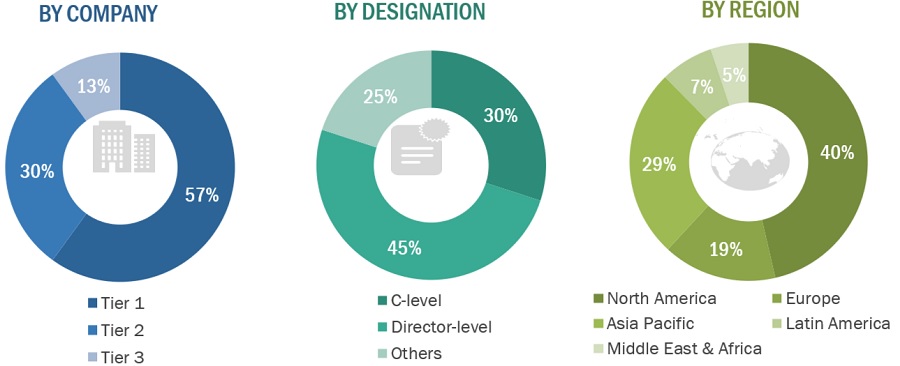
Note 1: C-level primaries include CEOs, COOs, CTOs, and VPs.
Note 2: Other primaries include sales managers, marketing managers, and product and service managers.
Note 3: Companies are classified into tiers based on their total revenue. As of 2023: Tier 1 = >USD 1 billion, Tier 2 = USD 500 million to USD 1 billion, and Tier 3 = <USD 500 million.
To know about the assumptions considered for the study, download the pdf brochure
Market Size Estimation
Both top-down and bottom-up approaches were used to estimate and validate the total size of the healthcare workforce management market as well as to estimate the market size of various other dependent submarkets. These methods were also used extensively to estimate the size of various subsegments in the market. The research methodology used to estimate the market size includes the following:
- The key players in the industry and market have been identified through extensive secondary research.
- The revenues generated from the healthcare workforce management business of leading players have been determined through primary and secondary research.
- All percentage shares, splits, and breakdowns have been determined using secondary sources and verified through primary sources.
Healthcare Workforce Management Systems Market: Bottom-Up Approach
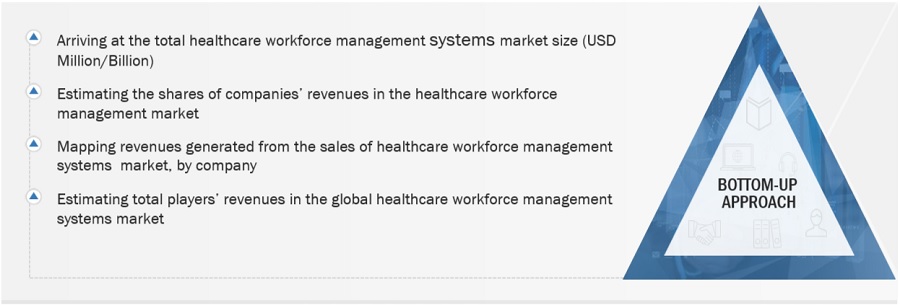
To know about the assumptions considered for the study, Request for Free Sample Report
Healthcare Workforce Management Systems Market: Top-Down Approach
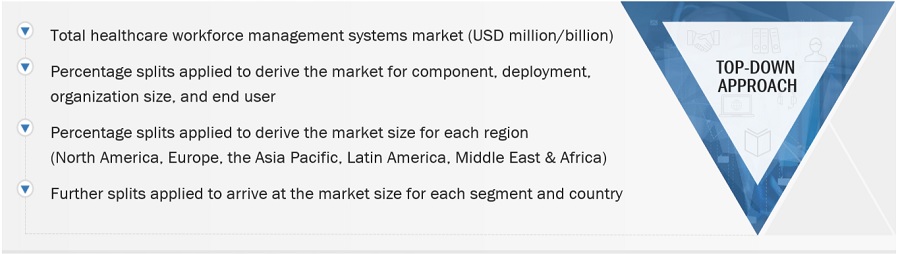
Data Triangulation
After arriving at the overall market size from the market size estimation process, the total market was split into several segments and subsegments. To complete the overall market engineering process and arrive at the exact statistics for all segments and subsegments, data triangulation and market breakdown procedures were employed, wherever applicable. The data was triangulated by studying various factors and trends from both the demand and supply sides.
Market Definition
Healthcare workforce management systems encompass all the solutions needed to manage and maintain the productive workforce in a healthcare organization. Workforce management includes HR administration, career and succession planning, adherence to work schedules, talent acquisition, workforce tracking, payroll and benefits, and leave management.
Key Stakeholders:
- Healthcare Workforce Management Vendors
- Healthcare IT solution providers
- Healthcare IT service providers
- Healthcare providers
- Assisted Living Centers/Nursing Homes
- Ambulatory Care Centers
- Integration Service Providers
- Maintenance And Support Service Providers
- Regulatory Bodies
- Market research and consulting firms
- Venture capitalists and investors
Report Objectives
- To define, describe, and forecast the global healthcare workforce management market based on the component, deployment, organization size, end user and region.
- To provide detailed information regarding the major factors influencing the growth of the market (such as drivers, restraints, challenges, and opportunities)
- To strategically analyze micro markets with respect to individual growth trends, prospects, and contributions to the overall healthcare workforce management market.
- To analyze opportunities in the market for stakeholders and provide details of the competitive landscape for market leaders.
- To forecast the size of the market segments with respect to five main regions, namely, North America, Europe, Asia Pacific, Latin America, Middle East & Africa.
- To strategically profile the key players and comprehensively analyze their product portfolios, market positions, and core competencies.
- To track and analyze competitive developments such as acquisitions, product launches, expansions, agreements, collaboration, and partnerships in the healthcare workforce management market.
Available Customizations
With the given market data, MarketsandMarkets offers customizations as per the company’s specific needs. The following customization options are available for this report:
Company Information
- An additional five company profiles
Get the Full Healthcare Workforce Management System Market Report
Full forecast, segment splits, and company analysis for all Healthcare Workforce Management System Market.
- US Healthcare Workforce Management System Market
- Canada Healthcare Workforce Management System Market
- UK Healthcare Workforce Management System Market
- Germany Healthcare Workforce Management System Market
- France Healthcare Workforce Management System Market
- Italy Healthcare Workforce Management System Market
- Spain Healthcare Workforce Management System Market
- China Healthcare Workforce Management System Market
- Japan Healthcare Workforce Management System Market
- India Healthcare Workforce Management System Market
- Brazil Healthcare Workforce Management System Market
- Mexico Healthcare Workforce Management System Market
- Rest Of Europe Healthcare Workforce Management System Market
- Rest Of Asia Pacific Healthcare Workforce Management System Market
- Rest Of Latin America Healthcare Workforce Management System Market
Need a Tailored Report?
Customize this report to your needs
Get 10% FREE Customization
Customize This Report
