



North America Healthcare IT Market
Report Code
HIT 2055
Published in
Jun, 2026, By MarketsandMarkets™
North America Healthcare IT Market by Solution (Provider, Payer [Clinical {EHR, PHM, PACS & VNA, Telehealth, RCM, CDSS}, Nonclinical {Analytics, Pharmacy, Interoperability}]), Service (Claim, Billing), End User (Hospital, Payer) - Forecast to 2031

$270.94B
MARKET SIZE, 2026
$529.06B
MARKET SIZE, 2031

14.3%
CAGR (2026-2031)

2026-2031
FORECAST PERIOD
NORTH AMERICA HEALTHCARE IT MARKET SIZE, SHARE & GROWTH SNAPSHOT
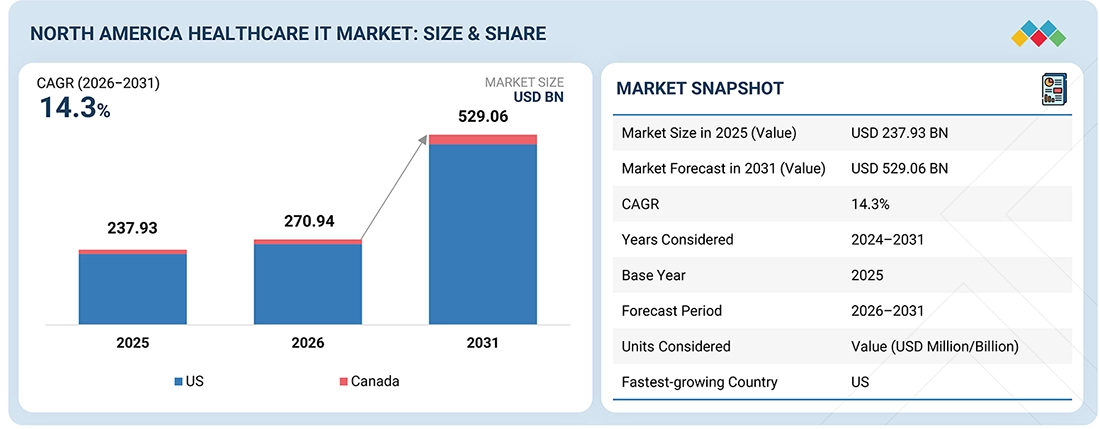
Source: Secondary Research, Interviews with Experts, MarketsandMarkets Analysis
The North America healthcare IT market is projected to grow from USD 270.94 billion in 2026 to USD 529.06 billion by 2031, at a CAGR of 14.3% during the forecast period. The market was valued at USD 237.93 billion in 2025. Market is fueled by the rise in the deployment of interoperable healthcare IT systems, increasing focus on investing in clinical workflow powered by AI technology, an increase in the use of telehealth and remote patient monitoring services, and high demand for cloud-based healthcare infrastructure solutions.
KEY TAKEAWAYS
-
MARKET SNAPSHOT:
Base Year Market Size (2025): USD 237.93 Billion
Current Market Size (2026): USD 270.94 Billion
Forecast Market Size (2031): USD 529.06 Billion
CAGR (2026–2031): 14.3% -
SEGMENT LEADERSHIP:
Country Leader: The US accounted for the dominant share of 94.4% of the North America healthcare IT market in 2025.
Solution Leader: Healthcare provider solutions segment accounted for 78.3% of the North America healthcare IT market in 2025.
Component Leader: Software segment is projected to register the highest CAGR during the forecast period.
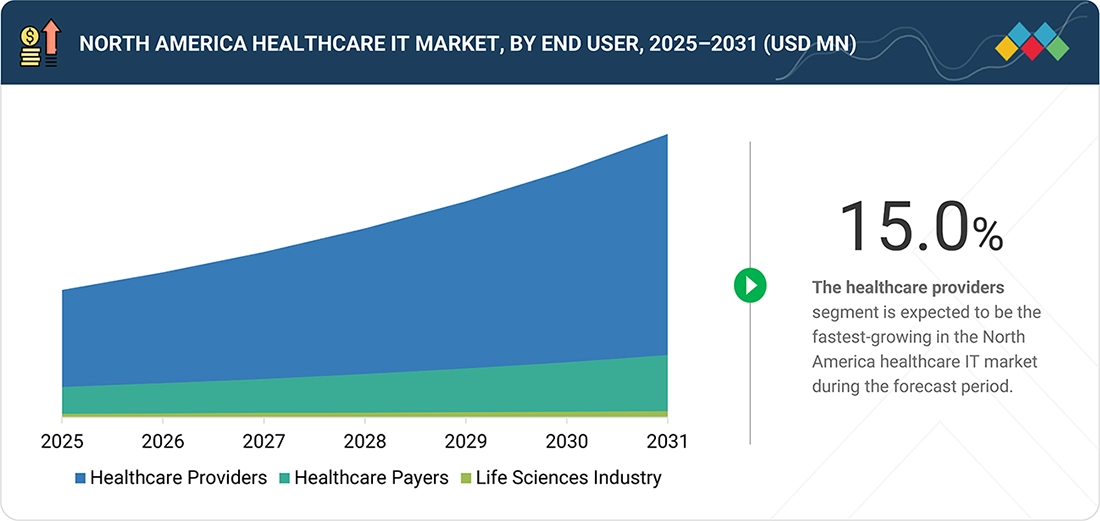
End User Leader: Healthcare providers accounted for the largest share of the North America healthcare IT market and are projected to grow at a CAGR of 15.0% during the forecast period. -
MARKET OUTLOOK & COMPETITIVE LANDSCAPE:
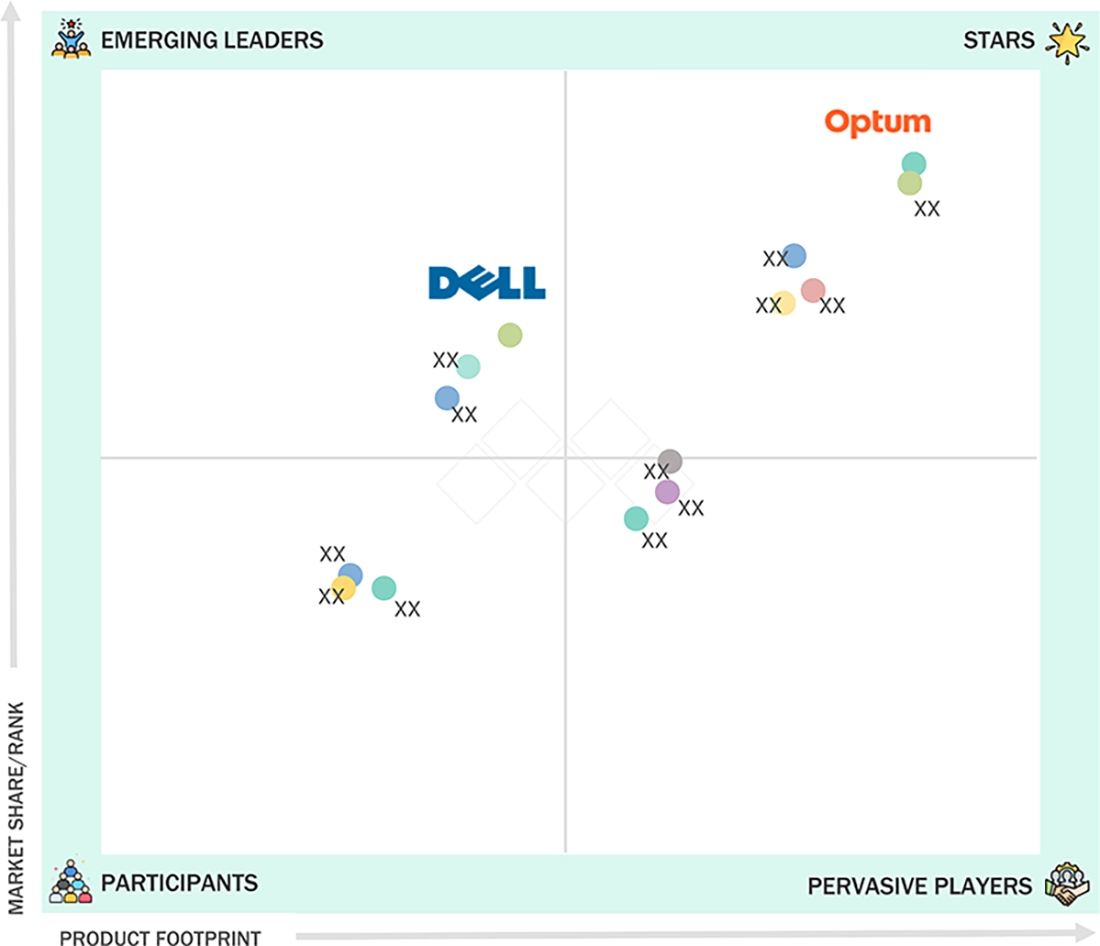
Oracle, Optum, Inc., and Epic Systems Corporation were identified as some of the star players in the North America healthcare IT market, given their strong market share and product footprint.
Conduent, Inc. and Carestream Health, among others, have distinguished themselves among startups and SMEs by securing strong footholds in specialized niche areas, underscoring their potential as emerging market leaders.
The North America healthcare IT market is gaining traction from the rising volumes of healthcare data and increased demand for real-time decision-making. The uptake of the value-based care approach is fueling the uptake of analytical and care coordination technologies by healthcare providers. Furthermore, payers are implementing digital claims processing and population health initiatives to enhance their ability to manage costs and improve patient care outcomes.
TRENDS & DISRUPTIONS IMPACTING CUSTOMERS' CUSTOMERS
Disruption within the North America healthcare IT industry is being driven by an increased use of cloud-based healthcare platforms, AI-driven clinical processes, predictive analysis tools, and other interoperability-focused technologies. Generative AI, remote patient monitoring, process automation, and real-time analytics are becoming more integrated within healthcare service delivery and administrative operations among providers and payers in both the US and Canada. Moreover, growing cybersecurity threats, coupled with increased regulations governing healthcare data exchanges, are further pushing healthcare organizations to embrace modernized legacy healthcare IT systems.
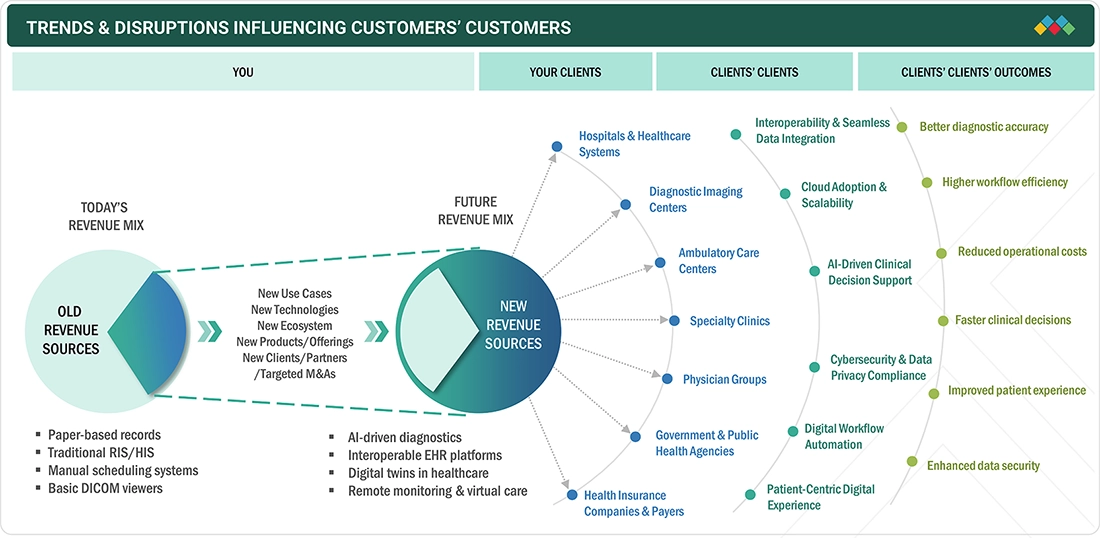
Source: Secondary Research, Interviews with Experts, MarketsandMarkets Analysis
MARKET DYNAMICS

Drivers
Impact
Level
Level
-
Growing need to reduce escalating healthcare costs

-
Strong federal support for interoperability and healthcare data exchange under ONC and CMS initiatives


RESTRAINTS
Impact
Level
Level
-
High implementation and integration costs for small and mid-sized healthcare organizations


OPPORTUNITIES
Impact
Level
Level
-
Increasing deployment of healthcare IT solutions across outpatient and ambulatory care centers in the US

-
Growing adoption of remote patient monitoring and home-based care platforms across North America


CHALLENGES
Impact
Level
Level
-
Rising cybersecurity attacks targeting US healthcare organizations and payer systems

-
Integration challenges between legacy hospital systems and cloud-based healthcare platforms

Source: Secondary Research, Interviews with Experts, MarketsandMarkets Analysis
Driver: Growing need to reduce escalating healthcare costs
The growing need to reduce the increasing healthcare expenses represents one of the main factors driving the healthcare IT market growth in North America. As healthcare providers and payers in the US increasingly turn to technology to optimize operations, automate processes, and maximize resource efficiency, the use of information technology has become more popular. The Centers for Medicare & Medicaid Services estimates that US healthcare expenditures hit USD 4.9 trillion in 2023, which increases the pressure on the organizations to optimize their spending associated with operating costs and delivering medical services. The increasing strain to limit operational and healthcare cost expenditure for healthcare establishments is driving them towards healthcare IT products that automate workflows, enable revenue cycle management, generate healthcare analytics, and offer AI-powered clinical solutions.
Restraint: High implementation and integration costs for small and mid-sized healthcare organizations
The high cost of implementation and integration is one of the key constraints affecting the North American healthcare IT market, especially for small and medium-sized healthcare facilities. Implementation and adoption of sophisticated healthcare IT platforms usually involve considerable spending on software, infrastructure upgrades, security measures, employee training, and integration services. Additionally, several healthcare facilities struggle with the difficulty of integration of new IT technologies with existing ones, making the whole process complex and time-consuming. According to statistics by the American Hospital Association (AHA), almost 50% of US hospitals are dealing with financial burdens due to rising wage and technology costs, preventing them from adopting new technologies.
Opportunity: Increasing deployment of healthcare IT solutions across outpatient and ambulatory care centers in the US
The increased use of healthcare IT solutions by outpatient and ambulatory care facilities in the US is presenting substantial market opportunities for players. As healthcare organizations move towards providing outpatient care as a way of lowering costs and managing larger volumes of patients, there is an increased need for cloud-based EHRs, patient management systems, scheduling solutions, and remote monitoring systems within ambulatory care facilities. Outpatient care costs in the US continue to increase consistently due to the expansion of ambulatory and same-day care offered by healthcare organizations, according to data published by the Centers for Medicare & Medicaid Services (CMS). Also, increased adoption of virtual and connected healthcare solutions has driven outpatient care facilities to adopt healthcare IT solutions.
Challenge: Rising cybersecurity attacks targeting US healthcare organizations and payer systems
The escalation in the number of cybersecurity threats faced by the healthcare industry and the associated payers in the US represents a significant challenge in the North America healthcare IT market. Healthcare organizations are dealing with vast amounts of information concerning their patients and financial transactions via connected digital channels, making them susceptible to ransomware attacks and information leaks. As per the US Department of Health and Human Services (HHS), the number of patients whose data has been leaked due to healthcare data breaches was over 168 million in 2024. Moreover, the adoption of cloud-based solutions in healthcare and remote patient services is also leading to increased vulnerability to attacks.
NORTH AMERICA HEALTHCARE IT MARKET: COMMERCIAL USE CASES ACROSS INDUSTRIES
| COMPANY | USE CASE DESCRIPTION | BENEFITS |
|---|---|---|
 |
Population health analytics solutions enabling payers and providers to leverage claims, EHR, and patient risk data for care optimization and value-based decision-making | Lower healthcare costs, improved care coordination, enhanced population risk management, stronger patient outcomes |
 |
Digital transformation services for healthcare providers focused on EHR integration, workflow automation, interoperability, and operational modernization | Streamlined clinical and administrative workflows, reduced operational errors, improved patient engagement and experience |
 |
Cloud-enabled radiology and imaging workflow platforms supporting PACS, AI-driven reporting, and enterprise imaging management across hospitals and diagnostic centers | Faster diagnostic turnaround, increased radiologist productivity, optimized imaging workflows and resource utilization |
 |
Healthcare IT infrastructure modernization through cloud, edge computing, cybersecurity, and secure data storage solutions for clinical environments | Scalable infrastructure, secure and seamless data access, lower IT complexity and maintenance costs |
 |
AI-powered imaging and clinical decision support solutions integrated into diagnostic modalities and radiology workflows to improve precision and efficiency | Enhanced diagnostic accuracy, reduced reporting turnaround time, improved clinician productivity and workflow efficiency |
Logos and trademarks shown above are the property of their respective owners. Their use here is for informational and illustrative purposes only.
MARKET ECOSYSTEM
The North America healthcare IT market ecosystem includes major technology vendors such as Optum, Oracle, Koninklijke Philips N.V., McKesson Corporation, and Veradigm that provide EHR systems, interoperability platforms, healthcare analytics, and enterprise healthcare infrastructure. Companies such as Carestream, Practice Fusion, Inovalon, and InterSystems support innovation across clinical workflows and population health management. Cloud providers, including Microsoft Azure, AWS, Oracle Cloud, Google Cloud, and IBM Cloud, enable scalable healthcare data management and AI-driven applications. End users such as Cleveland Clinic, Mayo Clinic, GE HealthCare, and Johnson & Johnson are increasingly adopting healthcare IT solutions to improve operational efficiency, care coordination, and digital healthcare delivery across North America.
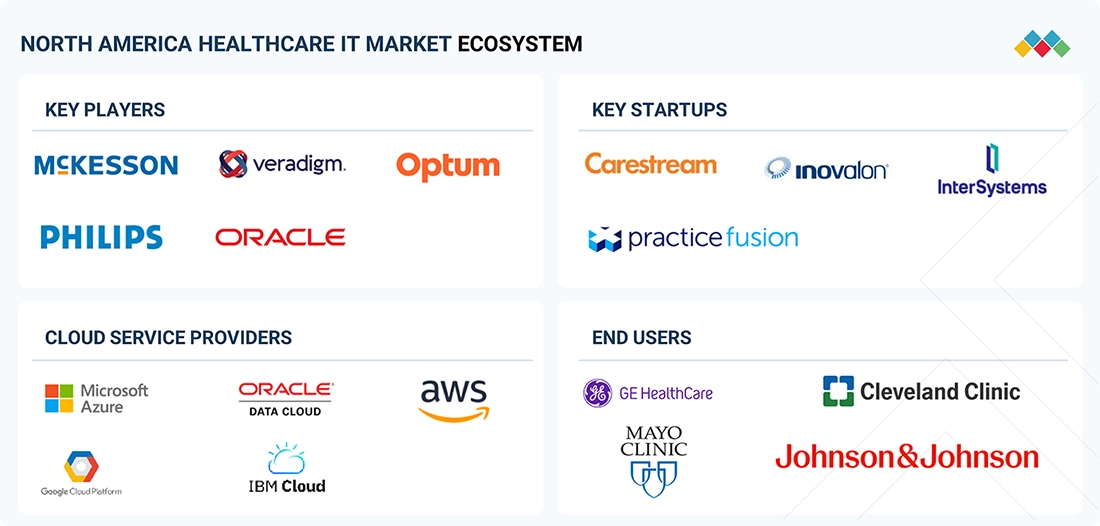
Logos and trademarks shown above are the property of their respective owners. Their use here is for informational and illustrative purposes only.
MARKET SEGMENTS
Source: Secondary Research, Interviews with Experts, MarketsandMarkets Analysis
North America Healthcare IT Market, By Product & Service
On the basis of product & service, the healthcare provider solutions segment accounted for the largest share of the North America healthcare IT market. The reason for the high share of the category is increasing adoption of the value-based care model, investments in interoperable clinical software, and AI-driven healthcare workflows across hospitals and ambulatory care facilities. Providers are increasingly adopting EHRs, telemedicine software, clinical decision support software, and patient engagement software. Moreover, increasing pressure on reducing the administrative burden and improving patient outcomes is fueling the adoption of healthcare IT software. Increasing adoption of cloud-based clinical software and remote patient monitoring software is further supporting the adoption of provider-focused healthcare IT solutions across North America.
North America Healthcare IT Market, By Component
Based on component, the North America healthcare IT market is segmented into services and software. Of these, the services segment held the largest market share in 2025. The large share is attributed to the rising demand for consultation, implementation, integration, maintenance, and migration services in healthcare institutions. Healthcare organizations are moving towards adopting modern IT systems and interoperable infrastructure, thereby creating a high demand for professional and managed services. Further, rising complexity in data management and security compliance, as well as enterprise-level integration needs, have created opportunities for third-party healthcare IT services providers.
North America Healthcare IT Market, By End User
On the basis of the end user, the North America healthcare IT market can be segmented into healthcare providers, healthcare payers, and life sciences. In 2025, the healthcare providers segment dominated the market. The major reasons behind the dominance of the segment are increasing adoption of electronic health records, clinical workflow solutions, telehealth platforms, and AI-based healthcare solutions among hospitals and ambulatory care facilities. Chronic diseases and patient numbers, as well as healthcare expenditure, are also contributing to a greater investment in the healthcare technology space. As per the Centers for Disease Control and Prevention, almost 6 in 10 people in the US suffer from at least one chronic disease. As a result, healthcare providers have started making more investments in connected healthcare technologies and efficient patient care solutions.
REGION
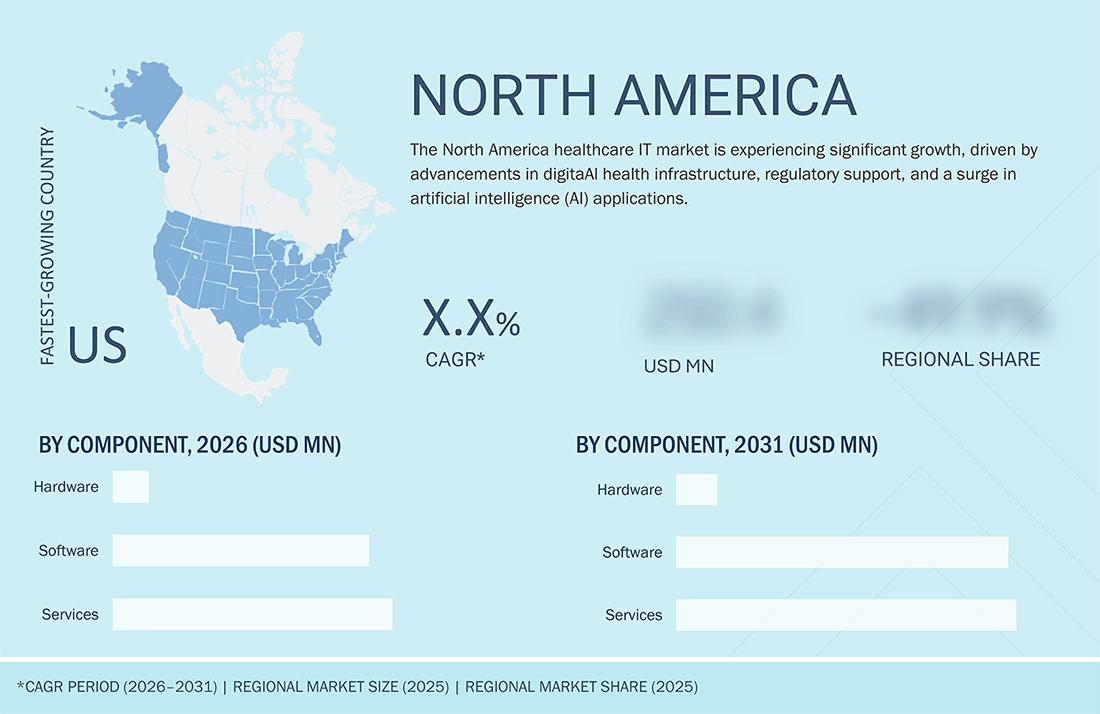
US registered the highest CAGR during the forecast period in the North America healthcare IT market
The North America healthcare IT market is segmented into two major countries: the US and Canada. It is anticipated that the US will lead the way in the growth of the North America healthcare IT market during the forecast period, owing to rising investment in digital health technologies, healthcare interoperability solutions, and AI-driven healthcare applications. There is widespread modernization of legacy technology by healthcare providers and insurance payers to increase operational efficiency and patient engagement. According to the Centers for Medicare & Medicaid Services (CMS), the national healthcare expenditure in the US is above USD 4.9 trillion in 2023, thereby forcing healthcare organizations to embrace digitally enabled healthcare IT systems. Additionally, growing use of telehealth services, remote patient monitoring, and cloud healthcare IT systems is further driving the adoption of healthcare IT across various healthcare facilities in the region.
NORTH AMERICA HEALTHCARE IT MARKET: COMPANY EVALUATION MATRIX
In the market matrix for healthcare information technology, Optum Inc. (Star) stands out with high market revenue and a broad healthcare IT portfolio, supported by its strong presence across payer, provider, pharmacy, analytics, revenue cycle, population health, and care management solutions. Its scale, data assets, technology-enabled services, and integration with UnitedHealth Group strengthen its position across hospitals, payers, employers, government programs, and life sciences organizations. Dell Technologies (Emerging Leader) is considered an emerging player in the healthcare IT solutions market due to its expanding focus on healthcare cloud infrastructure, AI-enabled data management, cybersecurity, interoperability, and digital healthcare transformation solutions.
Source: Secondary Research, Interviews with Experts, MarketsandMarkets Analysis
KEY MARKET PLAYERS
- Optum, Inc. (US)
- Cognizant (US)
- Koninklijke Philips N.V. (Netherlands)
- Dell Inc. (US)
- GE Healthcare (US)
- Oracle (US)
- Epic Systems Corporation (US)
- Veradigm (US)
- SAS Institute Inc. (US)
- Nuance Communications, Inc. (US)
- Wipro (India)
- eClinicalWorks (US)
- Inovalon (US)
- Infor. (US)
- Conifer Health Solutions, LLC. (US)
- Solventum (US)
- Merative (US)
- InterSystems Corporation (US)
- Salesforce, Inc. (US)
- CitiusTech (US)
MARKET SCOPE
| REPORT METRIC | DETAILS |
|---|---|
| Market Size in 2025 (Value) | USD 237.93 Billion |
| Market Forecast in 2026 (Value) | USD 270.94 Billion |
| Market Forecast in 2031 (Value) | USD 529.06 Billion |
| Growth Rate | CAGR of 14.3% from 2026 to 2031 |
| Years Considered | 2024–2031 |
| Base Year | 2025 |
| Forecast Period | 2026–2031 |
| Units Considered | USD Billion |
| Report Coverage | Revenue forecast, company ranking, competitive landscape, growth factors, and trends |
| Segments Covered |
|
| Countries Covered | US, Canada |
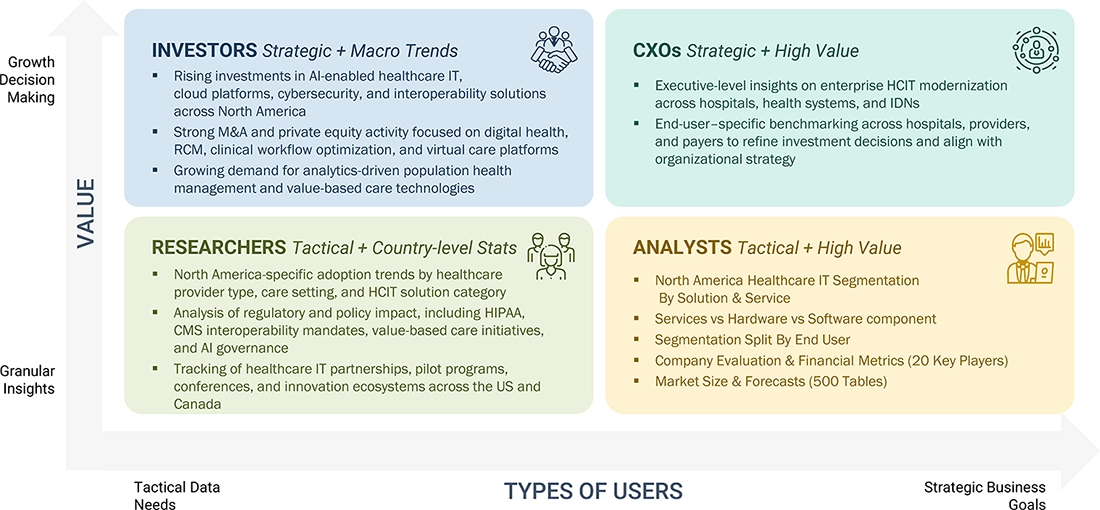
WHAT IS IN IT FOR YOU: NORTH AMERICA HEALTHCARE IT MARKET REPORT CONTENT GUIDE
DELIVERED CUSTOMIZATIONS
We have successfully delivered the following deep-dive customizations:
| CLIENT REQUEST | CUSTOMIZATION DELIVERED | VALUE ADDS |
|---|---|---|
| Detailed Insights on Healthcare Provider IT Solutions | Segmented analysis of clinical & non-clinical solutions with detailed mapping of EHR, PACS/VNA, RCM, telehealth, interoperability, and analytics | Facilitated targeted investment choices within the clusters of high growth solutions |
| Competitive Landscape Enhancement | Additional profiling of 15–20 regional HCIT vendors and emerging digital health startups | Improved vendor benchmarking and partnership strategy development |
| Regional Market Breakout | Country-level data for the US, Canada, Germany, UK, China, India, and Japan with growth drivers | Supported market-entry prioritization based on opportunity size and regulatory landscape |
| End-User Workload & Adoption Insights | Detailed analysis of adoption trends for hospitals, ambulatory centers, payers, and life sciences companies | Strengthened go-to-market strategy with sharper understanding of buyer needs |
| Outsourcing Services Deep-Dive | Expanded view of HCIT outsourcing: RCM services, claims processing, LIMS, IT infrastructure management, BPM | Helped identify high-margin service opportunities and outsourcing hotspots |
RECENT DEVELOPMENTS
- May 2026 : Dell expanded its Dell AI Factory partnership with NVIDIA to strengthen enterprise AI infrastructure, healthcare data platforms, and scalable AI deployment capabilities supporting healthcare and enterprise customers.
- April 2026 : Cognizant announced the acquisition of Astreya to strengthen AI infrastructure, cloud operations, and enterprise digital transformation capabilities supporting healthcare and enterprise clients across North America.
- November 2025 : GE HealthCare announced the acquisition of Intelerad Medical Systems to strengthen its North American healthcare IT and enterprise imaging portfolio with cloud-based PACS, teleradiology, workflow orchestration, and AI-enabled imaging informatics capabilities.
Table of Contents
 Exclusive indicates content/data unique to MarketsandMarkets and not available with any competitors.
TITLE
PAGE NO
1
INTRODUCTION
33
2
EXECUTIVE SUMMARY
38
3
PREMIUM INSIGHTS
45
4
MARKET OVERVIEW
Leverage federal support and big data to navigate regulatory challenges and enhance healthcare IT ROI.
47
4.1
INTRODUCTION
4.2
MARKET DYNAMICS
4.2.1
DRIVERS
4.2.1.1
STRONG FEDERAL SUPPORT FOR INTEROPERABILITY AND HEALTHCARE DATA EXCHANGE UNDER ONC AND CMS INITIATIVES
4.2.1.2
RISING USE OF BIG DATA AND HEALTHCARE ANALYTICS PLATFORMS ACROSS PROVIDER AND PAYER ORGANIZATIONS
4.2.1.3
HIGH RETURN ON INVESTMENT ASSOCIATED WITH HEALTHCARE IT AND WORKFLOW AUTOMATION SOLUTIONS
4.2.1.4
GROWING ADOPTION OF TELEHEALTH, MHEALTH, AND REMOTE PATIENT MONITORING SOLUTIONS ACROSS NORTH AMERICA
4.2.1.5
GROWING NEED TO REDUCE ESCALATING HEALTHCARE COSTS
4.2.2
RESTRAINTS
4.2.2.1
INCREASING COMPLEXITY OF REGULATORY COMPLIANCE AND HEALTHCARE DATA MANAGEMENT REQUIREMENTS
4.2.2.2
HIGH IMPLEMENTATION AND INTEGRATION COSTS FOR SMALL AND MID-SIZED HEALTHCARE ORGANIZATIONS ACROSS NORTH AMERICA
4.2.2.3
RESISTANCE TO DIGITAL WORKFLOW TRANSITION AMONG TRADITIONAL HEALTHCARE SETTINGS
4.2.3
OPPORTUNITIES
4.2.3.1
INCREASING DEPLOYMENT OF HEALTHCARE IT SOLUTIONS ACROSS OUTPATIENT AND AMBULATORY CARE CENTERS IN US
4.2.3.2
RISING ADOPTION OF CLOUD-BASED EHR AND INTEROPERABLE HEALTHCARE PLATFORMS
4.2.3.3
GROWING ADOPTION OF REMOTE PATIENT MONITORING AND HOME-BASED CARE PLATFORMS ACROSS NORTH AMERICA
4.2.4
CHALLENGES
4.2.4.1
RISING CYBERSECURITY ATTACKS TARGETING US HEALTHCARE ORGANIZATIONS AND PAYER SYSTEMS
4.2.4.2
INTEGRATION CHALLENGES BETWEEN LEGACY HOSPITAL SYSTEMS AND CLOUD-BASED HEALTHCARE PLATFORMS
4.2.4.3
SHORTAGE OF SKILLED HEALTHCARE IT AND CYBERSECURITY PROFESSIONALS ACROSS REGION
4.3
UNMET NEEDS AND WHITE SPACES
4.4
INTERCONNECTED MARKETS AND CROSS-SECTOR OPPORTUNITIES
4.5
STRATEGIC MOVES BY TIER 1/2/3 PLAYERS
5
INDUSTRY TRENDS
Discover pivotal pricing trends and technological disruptions shaping North America's healthcare IT landscape.
65
5.1
PORTER’S FIVE FORCES ANALYSIS
5.2
MACROECONOMIC INDICATORS
5.2.1
INTRODUCTION
5.2.2
GDP TRENDS AND FORECAST
5.2.3
TRENDS IN NORTH AMERICA HEALTHCARE IT INDUSTRY
5.3
VALUE CHAIN ANALYSIS
5.4
ECOSYSTEM ANALYSIS
5.5
PRICING ANALYSIS
INDICATIVE PRICE FOR HEALTHCARE IT SOLUTIONS,
5.5.1.1
INDICATIVE PRICING FOR CLINICAL DECISION SUPPORT SYSTEMS, BY PRODUCT
5.5.1.2
INDICATIVE PRICE OF HCIT INTEGRATION SOLUTIONS, BY TYPE
5.5.1.3
INDICATIVE PRICE OF LABORATORY INFORMATION SYSTEMS (LIS)
5.5.1.4
INDICATIVE PRICE OF PATIENT REGISTRY SOFTWARE
5.5.1.5
INDICATIVE PRICE OF HEALTHCARE ANALYTICS SOLUTIONS, BY COMPONENT
5.5.2
INDICATIVE PRICE FOR HEALTHCARE ANALYTICS SOLUTIONS, BY REGION, 2025
5.6
KEY CONFERENCES & EVENTS, 2026–2027
5.7
TRENDS/DISRUPTIONS IMPACTING CUSTOMER BUSINESS
5.8
INVESTMENT & FUNDING SCENARIO
5.9
CASE STUDY ANALYSIS
5.10
NORTH AMERICA HEALTHCARE IT MARKET - IMPACT OF 2025 US TARIFF
5.10.1
INTRODUCTION
5.10.2
KEY TARIFF RATES
5.10.3
PRICE IMPACT ANALYSIS
5.10.4
IMPACT ON COUNTRY
5.10.4.1
US
5.10.4.2
CANADA
5.10.5
IMPACT ON END USERS
5.10.5.1
HEALTHCARE PROVIDERS
5.10.5.2
PAYERS
STRATEGIC DISRUPTION THROUGH TECHNOLOGY, PATENTS, DIGITAL,
6.1
KEY EMERGING TECHNOLOGIES
6.1.1
ARTIFICIAL INTELLIGENCE AND MACHINE LEARNING
6.1.2
CLOUD COMPUTING
6.1.3
BIG DATA & ANALYTICS
6.1.4
INTEROPERABILITY & HEALTHCARE INFORMATION EXCHANGE PLATFORM
6.1.5
APP-ENABLED PATIENT PORTALS
6.2
COMPLEMENTARY TECHNOLOGIES
6.2.1
INTERNET OF MEDICAL THINGS (IOMT)
6.2.2
BLOCKCHAIN
6.2.3
SMART HOSPITAL INFRASTRUCTURE
6.2.4
ROBOTIC PROCESS AUTOMATION
6.3
ADJACENT TECHNOLOGIES
6.3.1
VIRTUAL REALITY (VR) & AUGMENTED REALITY (AR)
6.3.2
EDGE COMPUTING
6.3.3
MEDICAL ROBOTICS
6.4
TECHNOLOGY/PRODUCT ROADMAP
6.5
PATENT ANALYSIS
6.5.1
PATENT PUBLICATION TRENDS FOR NORTH AMERICA HEALTHCARE IT MARKET
6.5.2
INSIGHTS: JURISDICTION AND TOP APPLICANT ANALYSIS
6.6
FUTURE APPLICATIONS
6.6.1
AI-DRIVEN CLINICAL DECISION SUPPORT
6.6.2
PRECISION MEDICINE & GENOMICS INTEGRATION
6.6.3
REMOTE PATIENT MONITORING & VIRTUAL CARE
6.7
IMPACT OF GEN AI IN NORTH AMERICA HEALTHCARE IT MARKET
6.7.1
MARKET POTENTIAL OF AI/GEN AI IN NORTH AMERICA HEALTHCARE IT MARKET
6.7.2
KEY USE CASES OF GEN AI IN HEALTHCARE IT SOLUTIONS
6.7.2.1
AI-DRIVEN CLINICAL SUMMARIZATION AND INTEROPERABILITY INTELLIGENCE AT INTERSYSTEMS HEALTHSHARE
6.7.2.2
AI-POWERED HEALTH INFORMATION EXCHANGE (HIE) AND CLINICAL DATA SUMMARIZATION
6.7.2.3
DIGITAL PATIENT JOURNEY TRANSFORMATION AND DIGITAL FRONT DOOR EXPANSION
6.7.3
IMPACT OF AI/GEN AI ON INTERCONNECTED AND ADJACENT ECOSYSTEMS
6.7.3.1
REVENUE CYCLE MANAGEMENT MARKET
6.7.3.2
TELEHEALTH AND TELEMEDICINE MARKET
6.7.3.3
HEALTHCARE FRAUD ANALYTICS MARKET
6.7.4
USERS READINESS AND IMPACT ASSESSMENT
6.7.4.1
USER READINESS
6.7.4.1.1
PAYERS
6.7.4.1.2
PROVIDERS
6.7.4.2
IMPACT ASSESSMENT
6.7.4.2.1
USER A: PAYERS
6.7.4.2.2
USER B: PROVIDERS
7
REGULATORY LANDSCAPE
Navigate North America's complex regulatory framework with insights into key agencies and compliance standards.
109
7.1
REGIONAL REGULATIONS AND COMPLIANCE
7.1.1
REGULATORY BODIES, GOVERNMENT AGENCIES, AND OTHER ORGANIZATIONS
7.1.2
REGULATORY FRAMEWORK
7.1.2.1
NORTH AMERICA
7.1.3
INDUSTRY STANDARDS
8
CUSTOMER LANDSCAPE & BUYER BEHAVIOR
Unlock buyer dynamics: Navigate stakeholder influence and unmet needs to boost market profitability.
113
8.1
INTRODUCTION
8.2
DECISION-MAKING PROCESS
8.3
BUYER STAKEHOLDERS AND BUYING EVALUATION CRITERIA
8.3.1
KEY STAKEHOLDERS IN BUYING PROCESS
8.3.2
BUYING CRITERIA
8.4
ADOPTION BARRIERS & INTERNAL CHALLENGES
8.5
UNMET NEEDS FROM VARIOUS END-USE INDUSTRIES
8.5.1
UNMET NEEDS
8.5.2
END USER EXPECTATIONS
8.6
MARKET PROFITABILITY
9
NORTH AMERICA HEALTHCARE IT MARKET, BY COMPONENT
Market Size & Growth Rate Forecast Analysis to 2031 in USD Million | 4 Data Tables
120
9.1
INTRODUCTION
9.2
SERVICES
9.2.1
RISING REGULATORY AND CYBERSECURITY PRESSURES TO DRIVE DEMAND FOR MANAGED HEALTHCARE IT SERVICES
9.3
SOFTWARE
9.3.1
CLOUD-BASED SAAS PLATFORMS AND AI-ENABLED APPLICATIONS ARE ACCELERATING SOFTWARE SEGMENT GROWTH
9.4
HARDWARE
9.4.1
EXPANSION OF CONNECTED CARE INFRASTRUCTURE, SUSTAINING HEALTHCARE HARDWARE INVESTMENTS
10
HEALTHCARE IT MARKET, BY SOLUTIONS AND SERVICES
Market Size & Growth Rate Forecast Analysis to 2031 in USD Million | 85 Data Tables
125
10.1
INTRODUCTION
10.2
HEALTHCARE PROVIDER SOLUTIONS
10.2.1
CLINICAL HCIT SOLUTIONS
10.2.1.1
ELECTRONIC HEALTH RECORDS
10.2.1.1.1
CLOUD-BASED EHR DEPLOYMENT FUELING MARKET GROWTH
10.2.1.2
POPULATION HEALTH MANAGEMENT
10.2.1.2.1
VALUE-BASED CARE TRANSITION AND CHRONIC DISEASE BURDEN ARE DRIVING PHM PLATFORM ADOPTION
10.2.1.3
SPECIALTY INFORMATION MANAGEMENT
10.2.1.3.1
ONCOLOGY INFORMATION SYSTEM
10.2.1.3.2
CARDIOLOGY INFORMATION SYSTEM
10.2.1.3.3
OTHER INFORMATION SYSTEMS
10.2.1.4
PACS & VNA
10.2.1.4.1
DRIVING HEALTHCARE DATA INTEROPERABILITY THROUGH VNA DEPLOYMENT
10.2.1.5
MHEALTH APPLICATION
10.2.1.5.1
EXPANDING DIGITAL HEALTH ENGAGEMENT THROUGH SMARTPHONE-BASED CARE SOLUTIONS
10.2.1.6
HCIT INTEGRATION
10.2.1.6.1
ADVANCING API-DRIVEN DATA EXCHANGE ACROSS NORTH AMERICAN HEALTHCARE NETWORKS
10.2.1.7
TELEHEALTH SOLUTION
10.2.1.7.1
DRIVING TELEHEALTH GROWTH THROUGH FAVORABLE CMS REIMBURSEMENT POLICIES
10.2.1.8
MEDICAL IMAGE ANALYSIS
10.2.1.8.1
ACCELERATING ADOPTION OF FDA-CLEARED AI IMAGING SOLUTIONS
10.2.1.9
LABORATORY INFORMATION SYSTEMS
10.2.1.9.1
LABORATORY AUTOMATION IMPERATIVES AND FHIR-BASED RESULTS
10.2.1.10
PRACTICE MANAGEMENT SYSTEMS
10.2.1.10.1
AMBULATORY CARE GROWTH AND REVENUE CYCLE AUTOMATION ARE DRIVING PRACTICE MANAGEMENT PLATFORM MODERNIZATION
10.2.1.11
CLINICAL DECISION SUPPORT SYSTEM
10.2.1.11.1
AI-POWERED EVIDENCE INTEGRATION AND PATIENT SAFETY MANDATES ACCELERATE ADOPTION
10.2.1.12
EPRESCRIBING SOLUTION
10.2.1.12.1
DRIVING ELECTRONIC PRESCRIPTION ADOPTION ACROSS NORTH AMERICAN HEALTHCARE SYSTEMS
10.2.1.13
RADIOLOGY INFORMATION SYSTEMS
10.2.1.13.1
TRANSFORMING RADIOLOGY WORKFLOWS WITH INTEGRATED RIS SOLUTIONS
10.2.1.14
COMPUTERIZED PHYSICIAN ORDER ENTRY
10.2.1.14.1
PATIENT SAFETY IMPERATIVES AND EHR INTEGRATION SUSTAINING CPOE ADOPTION
10.2.1.15
PATIENT REGISTRY SOFTWARE
10.2.1.15.1
ACCELERATING PRECISION MEDICINE INITIATIVES THROUGH ADVANCED PATIENT REGISTRY PLATFORMS
10.2.1.16
INFECTION SURVEILLANCE
10.2.1.16.1
DRIVING ADOPTION OF REAL-TIME INFECTION TRACKING AND REPORTING SOLUTIONS
10.2.1.17
RADIATION DOSE MANAGEMENT
10.2.1.17.1
DRIVING HEALTHCARE ADOPTION OF RADIATION EXPOSURE MONITORING TECHNOLOGIES
10.2.2
NON-CLINICAL HEALTHCARE IT SOLUTIONS
10.2.2.1
HEALTHCARE ASSET MANAGEMENT
10.2.2.1.1
REAL-TIME LOCATION SYSTEMS AND IOT INTEGRATION ARE TRANSFORMING HOSPITAL ASSET VISIBILITY AND UTILIZATION
10.2.2.2
REVENUE CYCLE MANAGEMENT
10.2.2.2.1
FRONT-END RCM SOLUTIONS
10.2.2.2.2
MID-RCM SOLUTIONS
10.2.2.2.3
BACK-END-RCM SOLUTIONS
10.2.2.3
HEALTHCARE ANALYTICS
10.2.2.3.1
CLINICAL ANALYTICS
10.2.2.3.2
FINANCIAL ANALYTICS
10.2.2.3.3
OPERATIONAL AND ADMINISTRATIVE ANALYTICS
10.2.2.4
CUSTOMER RELATIONSHIP MANAGEMENT
10.2.2.4.1
PATIENT ENGAGEMENT MANDATES AND CONSUMER-CENTRIC CARE MODELS ARE DRIVING HEALTHCARE CRM ADOPTION
10.2.2.5
PHARMACY INFORMATION SYSTEMS
10.2.2.5.1
IMPROVING MEDICATION MANAGEMENT THROUGH INTEGRATED PHARMACY INFORMATION PLATFORMS
10.2.2.6
HEALTHCARE INTEROPERABILITY
10.2.2.6.1
FHIR STANDARDIZATION AND REGULATORY INTEROPERABILITY MANDATES ARE ACCELERATING MARKET GROWTH
10.2.2.7
HEALTHCARE QUALITY MANAGEMENT
10.2.2.7.1
ENHANCING PATIENT OUTCOMES THROUGH ADVANCED QUALITY MANAGEMENT SOLUTIONS
10.2.2.8
SUPPLY CHAIN MANAGEMENT
10.2.2.8.1
PROCUREMENT MANAGEMENT
10.2.2.8.2
INVENTORY MANAGEMENT
10.2.2.9
MEDICATION MANAGEMENT
10.2.2.9.1
ELECTRONIC MEDICATION ADMINISTRATION
10.2.2.9.2
BARCODE MEDICATION ADMINISTRATION SYSTEMS
10.2.2.9.3
MEDICATION INVENTORY MANAGEMENT SYSTEMS
10.2.2.9.4
MEDICATION ASSURANCE SYSTEMS
10.2.2.10
WORKFORCE MANAGEMENT
10.2.2.10.1
DRIVING OPERATIONAL EXCELLENCE THROUGH WORKFORCE OPTIMIZATION SOLUTIONS
10.2.2.11
HEALTHCARE INFORMATION EXCHANGE
10.2.2.11.1
ENHANCING CARE COORDINATION THROUGH SECURE HEALTH DATA EXCHANGE SOLUTIONS
10.2.2.12
MEDICAL DOCUMENT MANAGEMENT
10.2.2.12.1
DRIVING OPERATIONAL EFFICIENCY THROUGH DIGITAL MEDICAL DOCUMENT MANAGEMENT
10.3
HEALTHCARE PAYER SOLUTIONS
10.3.1
CLAIMS MANAGEMENT
10.3.1.1
REGULATORY MANDATES AND CLAIMS AUTOMATION TO DRIVE MODERNIZATION OF CLAIMS MANAGEMENT SOLUTIONS
10.3.2
POPULATION HEALTH MANAGEMENT
10.3.2.1
POPULATION HEALTH MANAGEMENT ADOPTION ACCELERATES WITH VALUE-BASED CARE GROWTH
10.3.3
PHARMACY AUDIT & ANALYSIS
10.3.3.1
REGULATORY SCRUTINY TO ACCELERATE PHARMACY AUDIT SOLUTIONS
10.3.4
CUSTOMER RELATIONSHIP MANAGEMENT
10.3.4.1
MEDICARE ADVANTAGE PROGRAMS ACCELERATE CRM ADOPTION
10.3.5
FRAUD ANALYTICS SOLUTIONS
10.3.5.1
HEALTHCARE FRAUD PREVENTION TO ACCELERATE ANALYTICS INVESTMENTS
10.3.6
PROVIDER NETWORK MANAGEMENT
10.3.6.1
GROWING REGULATORY OVERSIGHT SUPPORTS NETWORK MANAGEMENT SOLUTIONS
10.4
HCIT OUTSOURCING SERVICES
10.4.1
IT INFRASTRUCTURE MANAGEMENT
10.4.1.1
CYBERSECURITY AND CLOUD MIGRATION FUEL MARKET GROWTH
10.4.2
PAYER HCIT OUTSOURCING SERVICES
10.4.2.1
CLAIMS MANAGEMENT
10.4.2.1.1
REVENUE CYCLE OPTIMIZATION TO ACCELERATE CLAIMS OUTSOURCING
10.4.2.2
PROVIDER NETWORK MANAGEMENT
10.4.2.2.1
GROWING ADMINISTRATIVE COMPLEXITY SUPPORTS OUTSOURCING
10.4.2.3
BILLING & ACCOUNTS MANAGEMENT
10.4.2.3.1
ADMINISTRATIVE COST REDUCTION OF FUEL BILLING OUTSOURCING
10.4.2.4
FRAUD ANALYTICS
10.4.2.4.1
GROWING CLAIMS VOLUMES TO SUPPORT FRAUD ANALYTICS SERVICES
10.4.2.5
OTHER PAYER HCIT OUTSOURCING SERVICES
10.4.2.5.1
REGULATORY REPORTING COMPLEXITY IS EXPANDING PAYER HCIT OUTSOURCING DEMAND
10.4.3
PROVIDER HCIT OUTSOURCING SERVICES
10.4.3.1
REVENUE CYCLE MANAGEMENT
10.4.3.1.1
REIMBURSEMENT OPTIMIZATION DRIVING RCM SERVICE ADOPTION
10.4.3.2
MEDICAL DOCUMENTS MANAGEMENT
10.4.3.2.1
AI-POWERED DOCUMENT PROCESSING IS ACCELERATING OUTSOURCING DEMAND
10.4.3.3
LABORATORY INFORMATION MANAGEMENT
10.4.3.3.1
INTEROPERABILITY REQUIREMENTS SUPPORTING LIS OUTSOURCING GROWTH
10.4.3.4
OTHER PROVIDER HCIT OUTSOURCING SERVICES
10.4.3.4.1
OPERATIONAL FLEXIBILITY AND SPECIALIZED DIGITAL SUPPORT ARE DRIVING DEMAND
10.4.4
OPERATIONAL HCIT OUTSOURCING SERVICES
10.4.4.1
SUPPLY CHAIN MANAGEMENT
10.4.4.1.1
INVENTORY OPTIMIZATION TO SUPPORT SUPPLY CHAIN OUTSOURCING
10.4.4.2
BUSINESS PROCESS MANAGEMENT
10.4.4.2.1
ADMINISTRATIVE BURDEN REDUCTION TO FUEL BPM OUTSOURCING
10.4.4.3
OTHER OPERATIONAL HCIT OUTSOURCING SERVICES
10.4.4.3.1
CYBERSECURITY RESILIENCE AND ENTERPRISE OPERATIONS MODERNIZATION TO DRIVE DEMAND
11
NORTH AMERICA HEALTHCARE IT MARKET, BY END USER
Market Size & Growth Rate Forecast Analysis to 2031 in USD Million | 13 Data Tables
192
11.1
INTRODUCTION
11.2
HEALTHCARE PROVIDERS
11.2.1
HOSPITALS
11.2.1.1
ENTERPRISE EHR AND AI INTEGRATION ACCELERATING HOSPITAL IT TRANSFORMATION
11.2.2
AMBULATORY CARE CENTERS (OUTPATIENT SETTING)
11.2.2.1
DIGITAL TRANSFORMATION AND OUTPATIENT CARE EXPANSION FUEL MARKET GROWTH
11.2.3
HOME HEALTHCARE AGENCIES & ASSISTED LIVING FACILITIES
11.2.3.1
ASSISTED LIVING FACILITIES ARE INCREASINGLY INVESTING IN DIGITAL HEALTHCARE TECHNOLOGIES
11.2.4
DIAGNOSTIC & IMAGING CENTERS
11.2.4.1
ENTERPRISE IMAGING MODERNIZATION AND INTEROPERABILITY EXPANSION FUEL IMAGING HEALTHCARE IT MARKET
11.2.5
PHARMACIES
11.2.5.1
AI-ENABLED PHARMACY AUTOMATION AND E-PRESCRIBING SOLUTIONS ARE ACCELERATING HEALTHCARE IT ADOPTION
11.3
HEALTHCARE PAYERS
11.3.1
PUBLIC PAYER
11.3.1.1
EXPANSION OF VALUE-BASED CARE AND AUTOMATED CLAIMS MANAGEMENT SUPPORTING MARKET GROWTH
11.3.2
PRIVATE PAYER
11.3.2.1
PRIVATE PAYERS ARE ACCELERATING INVESTMENTS IN AI-ENABLED CLAIMS AND MEMBER MANAGEMENT SOLUTIONS
11.4
LIFE SCIENCE INDUSTRY
11.4.1
STRATEGIC AI PARTNERSHIPS AND DIGITAL RESEARCH PLATFORMS FUEL MARKET GROWTH
12
HEALTHCARE IT MARKET, BY REGION
Comprehensive coverage of 1 Region with country-level deep-dive of 2 Countries | 37 Data Tables.
203
12.1
INTRODUCTION
12.2
NORTH AMERICA
12.2.1
MACROECONOMIC OUTLOOK FOR NORTH AMERICA
12.2.2
US
12.2.2.1
STRATEGIC COLLABORATIONS AND CONNECTED CARE EXPANSION TO FUEL US HEALTHCARE IT MARKET
12.2.3
CANADA
12.2.3.1
CANADA ACCELERATES HEALTHCARE IT MODERNIZATION THROUGH INTEROPERABILITY INITIATIVES
13
COMPETITIVE LANDSCAPE
Uncover strategic insights and market positioning of top players and emerging leaders for 2025.
227
13.1
OVERVIEW
13.2
KEY PLAYER STRATEGIES/RIGHT TO WIN
13.3
REVENUE ANALYSIS
13.4
MARKET SHARE ANALYSIS
13.5
BRAND COMPARISON
13.6
COMPANY VALUATION & FINANCIAL METRICS
13.6.1
FINANCIAL METRICS
13.6.2
COMPANY VALUATION
13.7
COMPANY EVALUATION MATRIX: KEY PLAYERS, 2025
13.7.1
STARS
13.7.2
EMERGING LEADERS
13.7.3
PERVASIVE PLAYERS
13.7.4
PARTICIPANTS
13.7.5
COMPANY FOOTPRINT: KEY PLAYERS, 2025
13.7.5.1
COMPANY FOOTPRINT
13.7.5.2
REGIONAL FOOTPRINT
13.7.5.3
SOLUTION AND SERVICE FOOTPRINT
13.7.5.4
COMPONENT FOOTPRINT
13.7.5.5
END USER FOOTPRINT
13.8
COMPANY EVALUATION MATRIX: STARTUPS/SMES, 2025
13.8.1
PROGRESSIVE COMPANIES
13.8.2
RESPONSIVE COMPANIES
13.8.3
DYNAMIC COMPANIES
13.8.4
STARTING BLOCKS
13.8.5
COMPETITIVE BENCHMARKING
13.8.5.1
DETAILED LIST OF KEY STARTUPS/SMES
13.8.5.2
COMPETITIVE BENCHMARKING OF KEY STARTUPS/SMES
13.9
COMPETITIVE SCENARIO
13.9.1
PRODUCT LAUNCHES & APPROVALS
13.9.2
DEALS
14
COMPANY PROFILES
In-depth Company Profiles of Leading Market Players with detailed Business Overview, Product and Service Portfolio, Recent Developments, and Unique Analyst Perspective (MnM View)
248
14.1
KEY PLAYERS
14.1.1
OPTUM, INC.
14.1.1.1
BUSINESS OVERVIEW
14.1.1.2
PRODUCTS & SERVICES OFFERED
14.1.1.3
RECENT DEVELOPMENTS
14.1.1.3.1
PRODUCT LAUNCHES & APPROVALS
14.1.1.3.2
DEALS
14.1.1.4
MNM VIEW
14.1.1.4.1
KEY STRENGTHS
14.1.1.4.2
STRATEGIC CHOICES
14.1.1.4.3
WEAKNESSES & COMPETITIVE THREATS
14.1.2
COGNIZANT
14.1.3
KONINKLIJKE PHILIPS N.V.
14.1.4
DELL INC.
14.1.5
GE HEALTHCARE
14.1.6
ORACLE
14.1.7
WIPRO
14.1.8
ECLINICALWORKS
14.1.9
SAS INSTITUTE INC.
14.1.10
INOVALON
14.1.11
INFOR (KOCH INDUSTRIES)
14.1.12
CONIFER HEALTH SOLUTIONS, LLC.
14.1.13
NUANCE COMMUNICATIONS, INC.(MICROSOFT)
14.1.14
SOLVENTUM
14.1.15
MERATIVE
14.1.16
EPIC SYSTEMS CORPORATION
14.1.17
INTERSYSTEMS CORPORATION
14.1.18
VERADIGM LLC
14.1.19
SALESFORCE, INC.
14.1.20
CITIUSTECH INC
14.2
OTHER PLAYERS
14.2.1
CONDUENT, INC.
14.2.2
CARESTREAM HEALTH.
14.2.3
PRACTICE FUSION, INC.
14.2.4
POINTCLICKCARE
14.2.5
INNOVACCER
14.2.6
MEDEANALYTICS, INC.
14.2.7
MEDECISION
14.2.8
SUKI AI, INC
14.2.9
CHARTIS
14.2.10
CLEARWAVE CORPORATION
15
RESEARCH METHODOLOGY
352
15.1
RESEARCH APPROACH
15.1.1
SECONDARY RESEARCH
15.1.1.1
KEY DATA FROM SECONDARY SOURCES
15.1.2
PRIMARY RESEARCH
15.1.2.1
PRIMARY SOURCES
15.1.2.2
KEY DATA FROM PRIMARY SOURCES
15.1.2.3
BREAKDOWN OF PRIMARIES
15.1.2.4
INSIGHTS FROM PRIMARY EXPERTS
15.2
RESEARCH METHODOLOGY DESIGN
15.3
MARKET SIZE ESTIMATION
15.4
MARKET BREAKDOWN & DATA TRIANGULATION
15.5
MARKET SHARE ESTIMATION
15.6
STUDY ASSUMPTIONS
15.7
RESEARCH LIMITATIONS
15.7.1
METHODOLOGY-RELATED LIMITATIONS
15.8
RISK ASSESSMENT
16
APPENDIX
365
16.1
DISCUSSION GUIDE
16.2
KNOWLEDGESTORE: MARKETSANDMARKETS’ SUBSCRIPTION PORTAL
16.3
CUSTOMIZATION OPTIONS
16.4
RELATED REPORTS
16.5
AUTHOR DETAILS
LIST OF TABLES
TABLE 1
EXCHANGE RATES, 2022–2025
TABLE 2
HEALTHCARE DATA BREACHES: ENTITIES, IMPACT, AND CAUSES, 2025
TABLE 3
NORTH AMERICA HEALTHCARE IT: PORTER’S FIVE FORCES ANALYSIS
TABLE 4
NORTH AMERICA HEALTHCARE IT MARKET: ROLE IN ECOSYSTEM
TABLE 5
INDICATIVE PRICE OF CLINICAL DECISION SUPPORT SYSTEMS, BY PRODUCT, 2025
TABLE 6
INDICATIVE PRICE OF HCIT INTEGRATION SOLUTIONS, BY SUBSCRIPTION TYPE
TABLE 7
INDICATIVE PRICE OF LABORATORY INFORMATION SYSTEMS
TABLE 8
INDICATIVE PRICE OF HEALTHCARE ANALYTICS SOLUTIONS, BY COMPONENT
TABLE 9
INDICATIVE PRICE OF HEALTHCARE IT SOLUTIONS, BY COUNTRY
TABLE 10
HEALTHCARE IT: KEY CONFERENCES & EVENTS, 2026–2027
TABLE 11
REVOLUTIONIZING PATIENT ENGAGEMENT WITH AI
TABLE 12
ECOA FOR PHASE I ONCOLOGY STUDIES
TABLE 13
REAL-TIME ANALYTICS AND RATER TRAINING FOR PHASE II DERMATOLOGY TRIAL
TABLE 14
US ADJUSTED RECIPROCAL TARIFF RATES
TABLE 15
JURISDICTION ANALYSIS OF TOP APPLICANT COUNTRIES FOR NORTH AMERICA HEALTHCARE IT MARKET
TABLE 16
NORTH AMERICA HEALTHCARE IT MARKET: LIST OF PATENTS/PATENT APPLICATIONS
TABLE 17
NORTH AMERICA: REGULATORY BODIES, GOVERNMENT AGENCIES, AND OTHER ORGANIZATIONS
TABLE 18
REGULATORY SCENARIO IN NORTH AMERICA
TABLE 19
INFLUENCE OF STAKEHOLDERS ON BUYING PROCESS, BY END USER (%)
TABLE 20
KEY BUYING CRITERIA, BY END USER
TABLE 21
UNMET NEEDS IN NORTH AMERICA HEALTHCARE IT MARKET
TABLE 22
END USER EXPECTATIONS IN NORTH AMERICA HEALTHCARE IT MARKET
TABLE 23
NORTH AMERICA HEALTHCARE IT MARKET, BY COMPONENT, 2024–2031 (USD MILLION)
TABLE 24
NORTH AMERICA HEALTHCARE IT MARKET FOR SERVICES, BY REGION, 2024–2031 (USD MILLION)
TABLE 25
NORTH AMERICA HEALTHCARE IT MARKET FOR SOFTWARE, BY REGION, 2024–2031 (USD MILLION)
TABLE 26
HEALTHCARE IT MARKET FOR HARDWARE, BY REGION, 2024–2031 (USD MILLION)
TABLE 27
HEALTHCARE IT MARKET, BY SOLUTION & SERVICE, 2024–2031 (USD MILLION)
TABLE 28
HEALTHCARE IT MARKET BY HEALTHCARE PROVIDER SOLUTIONS, 2024–2031 (USD MILLION)
TABLE 29
HEALTHCARE IT MARKET FOR HEALTHCARE PROVIDER SOLUTIONS, BY COUNTRY, 2024–2031 (USD MILLION)
TABLE 30
HEALTHCARE IT MARKET BY CLINICAL HEALTHCARE IT SOLUTIONS, 2024–2031 (USD MILLION)
TABLE 31
HEALTHCARE IT MARKET FOR CLINICAL HCIT SOLUTIONS, BY COUNTRY, 2024–2031 (USD MILLION)
TABLE 32
HEALTHCARE IT MARKET FOR ELECTRONIC HEALTH RECORDS, BY COUNTRY, 2024–2031 (USD MILLION)
TABLE 33
HEALTHCARE IT MARKET FOR POPULATION HEALTH MANAGEMENT, BY COUNTRY, 2024–2031 (USD MILLION)
TABLE 34
HEALTHCARE IT MARKET BY SPECIALTY INFORMATION MANAGEMENT, 2024–2031 (USD MILLION)
TABLE 35
HEALTHCARE IT MARKET FOR SPECIALTY INFORMATION MANAGEMENT, BY COUNTRY, 2024–2031 (USD MILLION)
TABLE 36
HEALTHCARE IT MARKET FOR ONCOLOGY INFORMATION SYSTEM, BY COUNTRY, 2024–2031 (USD MILLION)
TABLE 37
HEALTHCARE IT MARKET FOR CARDIOLOGY INFORMATION SYSTEM, BY COUNTRY, 2024–2031 (USD MILLION)
TABLE 38
HEALTHCARE IT MARKET FOR OTHER INFORMATION SYSTEMS, BY COUNTRY, 2024–2031 (USD MILLION)
TABLE 39
HEALTHCARE IT MARKET FOR PACS & VNA, BY COUNTRY, 2024–2031 (USD MILLION)
TABLE 40
HEALTHCARE IT MARKET FOR MHEALTH APPLICATION, BY COUNTRY, 2024–2031 (USD MILLION)
TABLE 41
HEALTHCARE IT MARKET FOR HCIT INTEGRATION, BY COUNTRY, 2024–2031 (USD MILLION)
TABLE 42
HEALTHCARE IT MARKET FOR TELEHEALTH SOLUTION, BY COUNTRY, 2024–2031 (USD MILLION)
TABLE 43
HEALTHCARE IT MARKET FOR MEDICAL IMAGE ANALYSIS, BY COUNTRY, 2024–2031 (USD MILLION)
TABLE 44
HEALTHCARE IT MARKET FOR LABORATORY INFORMATION SYSTEMS, BY COUNTRY, 2024–2031 (USD MILLION)
TABLE 45
HEALTHCARE IT MARKET FOR PRACTICE MANAGEMENT SYSTEMS, BY COUNTRY, 2024–2031 (USD MILLION)
TABLE 46
HEALTHCARE IT MARKET FOR CLINICAL DECISION SUPPORT SYSTEM, BY COUNTRY, 2024–2031 (USD MILLION)
TABLE 47
HEALTHCARE IT MARKET FOR E-PRESCRIBING SOLUTION, BY COUNTRY, 2024–2031 (USD MILLION)
TABLE 48
HEALTHCARE IT MARKET FOR RADIOLOGY INFORMATION SYSTEMS, BY COUNTRY, 2024–2031 (USD MILLION)
TABLE 49
HEALTHCARE IT MARKET FOR COMPUTERIZED PHYSICIAN ORDER ENTRY, BY COUNTRY, 2024–2031 (USD MILLION)
TABLE 50
HEALTHCARE IT MARKET FOR PATIENT REGISTRY SOFTWARE, BY COUNTRY, 2024–2031 (USD MILLION)
TABLE 51
HEALTHCARE IT MARKET FOR INFECTION SURVEILLANCE, BY COUNTRY, 2024–2031 (USD MILLION)
TABLE 52
HEALTHCARE IT MARKET FOR RADIATION DOSE MANAGEMENT, BY COUNTRY, 2024–2031 (USD MILLION)
TABLE 53
HEALTHCARE IT MARKET BY NON-CLINICAL HEALTHCARE IT SOLUTIONS, 2024–2031 (USD MILLION)
TABLE 54
HEALTHCARE IT MARKET FOR NON-CLINICAL HEALTHCARE IT SOLUTIONS, BY COUNTRY, 2024–2031 (USD MILLION)
TABLE 55
HEALTHCARE IT MARKET FOR HEALTHCARE ASSET MANAGEMENT, BY COUNTRY, 2024–2031 (USD MILLION)
TABLE 56
HEALTHCARE IT MARKET BY REVENUE CYCLE MANAGEMENT, 2024–2031 (USD MILLION)
TABLE 57
HEALTHCARE IT MARKET FOR REVENUE CYCLE MANAGEMENT, BY COUNTRY, 2024–2031 (USD MILLION)
TABLE 58
HEALTHCARE IT MARKET FOR FRONT END RCM SOLUTIONS, BY COUNTRY, 2024–2031 (USD MILLION)
TABLE 59
HEALTHCARE IT MARKET FOR MID-RCM SOLUTIONS, BY COUNTRY, 2024–2031 (USD MILLION)
TABLE 60
HEALTHCARE IT MARKET FOR BACK END-RCM SOLUTIONS, BY COUNTRY, 2024–2031 (USD MILLION)
TABLE 61
HEALTHCARE IT MARKET BY HEALTHCARE ANALYTICS, 2024–2031 (USD MILLION)
TABLE 62
HEALTHCARE IT MARKET FOR HEALTHCARE ANALYTICS, BY COUNTRY, 2024–2031 (USD MILLION)
TABLE 63
HEALTHCARE IT MARKET FOR CLINICAL ANALYTICS, BY COUNTRY, 2024–2031 (USD MILLION)
TABLE 64
HEALTHCARE IT MARKET FOR FINANCIAL ANALYTICS, BY COUNTRY, 2024–2031 (USD MILLION)
TABLE 65
HEALTHCARE IT MARKET FOR OPERATIONAL AND ADMINISTRATIVE ANALYTICS, BY COUNTRY, 2024–2031 (USD MILLION)
TABLE 66
HEALTHCARE IT MARKET FOR CUSTOMER RELATIONSHIP MANAGEMENT, BY COUNTRY, 2024–2031 (USD MILLION)
TABLE 67
HEALTHCARE IT MARKET FOR PHARMACY INFORMATION SYSTEMS, BY COUNTRY, 2024–2031 (USD MILLION)
TABLE 68
HEALTHCARE IT MARKET FOR HEALTHCARE INTEROPERABILITY, BY COUNTRY, 2024–2031 (USD MILLION)
TABLE 69
HEALTHCARE IT MARKET FOR HEALTHCARE QUALITY MANAGEMENT, BY COUNTRY, 2024–2031 (USD MILLION)
TABLE 70
HEALTHCARE IT MARKET BY SUPPLY CHAIN MANAGEMENT, 2024–2031 (USD MILLION)
TABLE 71
HEALTHCARE IT MARKET FOR SUPPLY CHAIN MANAGEMENT, BY COUNTRY, 2024–2031 (USD MILLION)
TABLE 72
HEALTHCARE IT MARKET FOR PROCUREMENT MANAGEMENT, BY COUNTRY, 2024–2031 (USD MILLION)
TABLE 73
HEALTHCARE IT MARKET FOR INVENTORY MANAGEMENT, BY COUNTRY, 2024–2031 (USD MILLION)
TABLE 74
HEALTHCARE IT MARKET BY MEDICATION MANAGEMENT, 2024–2031 (USD MILLION)
TABLE 75
HEALTHCARE IT MARKET FOR MEDICATION MANAGEMENT, BY COUNTRY, 2024–2031 (USD MILLION)
TABLE 76
HEALTHCARE IT MARKET FOR ELECTRONIC MEDICATION ADMINISTRATION, BY COUNTRY, 2024–2031 (USD MILLION)
TABLE 77
HEALTHCARE IT MARKET FOR BARCODE MEDICATION ADMINISTRATION SYSTEMS, BY COUNTRY, 2024–2031 (USD MILLION)
TABLE 78
HEALTHCARE IT MARKET FOR MEDICATION INVENTORY MANAGEMENT SYSTEMS, BY COUNTRY, 2024–2031 (USD MILLION)
TABLE 79
HEALTHCARE IT MARKET FOR MEDICATION ASSURANCE SYSTEMS, BY COUNTRY, 2024–2031 (USD MILLION)
TABLE 80
HEALTHCARE IT MARKET FOR WORKFORCE MANAGEMENT, BY COUNTRY, 2024–2031 (USD MILLION)
TABLE 81
HEALTHCARE IT MARKET FOR HEALTHCARE INFORMATION EXCHANGE, BY COUNTRY, 2024–2031 (USD MILLION)
TABLE 82
HEALTHCARE IT MARKET FOR MEDICAL DOCUMENT MANAGEMENT, BY COUNTRY, 2024–2031 (USD MILLION)
TABLE 83
HEALTHCARE IT MARKET BY HEALTHCARE PAYER SOLUTIONS, 2024–2031 (USD MILLION)
TABLE 84
HEALTHCARE IT MARKET FOR HEALTHCARE PAYER SOLUTIONS, BY COUNTRY, 2024–2031 (USD MILLION)
TABLE 85
HEALTHCARE IT MARKET FOR CLAIMS MANAGEMENT, BY COUNTRY, 2024–2031 (USD MILLION)
TABLE 86
HEALTHCARE IT MARKET FOR POPULATION HEALTH MANAGEMENT, BY COUNTRY, 2024–2031 (USD MILLION)
TABLE 87
HEALTHCARE IT MARKET FOR PHARMACY AUDIT & ANALYSIS, BY COUNTRY, 2024–2031 (USD MILLION)
TABLE 88
HEALTHCARE IT MARKET FOR CUSTOMER RELATIONSHIP MANAGEMENT, BY COUNTRY, 2024–2031 (USD MILLION)
TABLE 89
HEALTHCARE IT MARKET FOR FRAUD ANALYTICS SOLUTIONS, BY COUNTRY, 2024–2031 (USD MILLION)
TABLE 90
HEALTHCARE IT MARKET FOR PROVIDER NETWORK MANAGEMENT, BY COUNTRY, 2024–2031 (USD MILLION)
TABLE 91
HEALTHCARE IT MARKET BY HEALTHCARE IT OUTSOURCING SERVICES, 2024–2031 (USD MILLION)
TABLE 92
HEALTHCARE IT MARKET FOR HEALTHCARE IT OUTSOURCING SERVICES, BY COUNTRY, 2024–2031 (USD MILLION)
TABLE 93
HEALTHCARE IT MARKET FOR IT INFRASTRUCTURE MANAGEMENT, BY COUNTRY, 2024–2031 (USD MILLION)
TABLE 94
HEALTHCARE IT MARKET BY PAYER HEALTHCARE IT OUTSOURCING SERVICES, 2024–2031 (USD MILLION)
TABLE 95
HEALTHCARE IT MARKET FOR PAYER HEALTHCARE IT OUTSOURCING SERVICES, BY COUNTRY, 2024–2031 (USD MILLION)
TABLE 96
HEALTHCARE IT MARKET FOR CLAIMS MANAGEMENT, BY COUNTRY, 2024–2031 (USD MILLION)
TABLE 97
HEALTHCARE IT MARKET FOR PROVIDER NETWORK MANAGEMENT (OUTSOURCING SERVICES), BY COUNTRY, 2024–2031 (USD MILLION)
TABLE 98
HEALTHCARE IT MARKET FOR BILLING & ACCOUNTS MANAGEMENT, BY COUNTRY, 2024–2031 (USD MILLION)
TABLE 99
HEALTHCARE IT MARKET FOR FRAUD ANALYTICS, BY COUNTRY, 2024–2031 (USD MILLION)
TABLE 100
HEALTHCARE IT MARKET FOR OTHER PAYER HEALTHCARE IT OUTSOURCING SERVICES, BY COUNTRY, 2024–2031 (USD MILLION)
TABLE 101
HEALTHCARE IT MARKET BY PROVIDER HEALTHCARE IT OUTSOURCING SERVICES, 2024–2031 (USD MILLION)
TABLE 102
HEALTHCARE IT MARKET FOR PROVIDER HEALTHCARE IT OUTSOURCING SERVICES, BY COUNTRY, 2024–2031 (USD MILLION)
TABLE 103
HEALTHCARE IT MARKET FOR REVENUE CYCLE MANAGEMENT, BY COUNTRY, 2024–2031 (USD MILLION)
TABLE 104
HEALTHCARE IT MARKET FOR MEDICAL DOCUMENTS MANAGEMENT, BY COUNTRY, 2024–2031 (USD MILLION)
TABLE 105
HEALTHCARE IT MARKET FOR LABORATORY INFORMATION MANAGEMENT, BY COUNTRY, 2024–2031 (USD MILLION)
TABLE 106
HEALTHCARE IT MARKET FOR OTHER PROVIDER HEALTHCARE IT OUTSOURCING SERVICES, BY COUNTRY, 2024–2031 (USD MILLION)
TABLE 107
HEALTHCARE IT MARKET BY OPERATIONAL HEALTHCARE IT OUTSOURCING SERVICES, 2024–2031 (USD MILLION)
TABLE 108
HEALTHCARE IT MARKET FOR OPERATIONAL HEALTHCARE IT OUTSOURCING SERVICES, BY COUNTRY, 2024–2031 (USD MILLION)
TABLE 109
HEALTHCARE IT MARKET FOR SUPPLY CHAIN MANAGEMENT, BY COUNTRY, 2024–2031 (USD MILLION)
TABLE 110
HEALTHCARE IT MARKET FOR BUSINESS PROCESS MANAGEMENT, BY COUNTRY, 2024–2031 (USD MILLION)
TABLE 111
HEALTHCARE IT MARKET FOR OTHER OPERATIONAL HEALTHCARE IT OUTSOURCING SERVICES, BY COUNTRY, 2024–2031 (USD MILLION)
TABLE 112
HEALTHCARE IT MARKET, BY END USER, 2024–2031 (USD MILLION)
TABLE 113
HEALTHCARE IT MARKET BY HEALTHCARE PROVIDERS, 2024–2031 (USD MILLION)
TABLE 114
HEALTHCARE IT MARKET FOR HEALTHCARE PROVIDERS, BY COUNTRY, 2024–2031 (USD MILLION)
TABLE 115
HEALTHCARE IT MARKET FOR HOSPITALS, BY COUNTRY, 2024–2031 (USD MILLION)
TABLE 116
HEALTHCARE IT MARKET FOR AMBULATORY CARE CENTERS (OUTPATIENT SETTING), BY COUNTRY, 2024–2031 (USD MILLION)
TABLE 117
HEALTHCARE IT MARKET FOR HOME HEALTHCARE AGENCIES & ASSISTED LIVING FACILITIES, BY COUNTRY, 2024–2031 (USD MILLION)
TABLE 118
HEALTHCARE IT MARKET FOR DIAGNOSTIC & IMAGING CENTERS, BY COUNTRY, 2024–2031 (USD MILLION)
TABLE 119
HEALTHCARE IT MARKET FOR PHARMACIES, BY COUNTRY, 2024–2031 (USD MILLION)
TABLE 120
HEALTHCARE IT MARKET BY HEALTHCARE PAYERS, 2024–2031 (USD MILLION)
TABLE 121
HEALTHCARE IT MARKET FOR HEALTHCARE PAYERS, BY COUNTRY, 2024–2031 (USD MILLION)
TABLE 122
HEALTHCARE IT MARKET FOR PUBLIC PAYER, BY COUNTRY, 2024–2031 (USD MILLION)
TABLE 123
HEALTHCARE IT MARKET FOR PRIVATE PAYER, BY COUNTRY, 2024–2031 (USD MILLION)
TABLE 124
HEALTHCARE IT MARKET FOR LIFE SCIENCE INDUSTRY, BY COUNTRY, 2024–2031 (USD MILLION)
TABLE 125
NORTH AMERICA: HEALTHCARE IT MARKET, BY COUNTRY, 2024–2031 (USD MILLION)
TABLE 126
US: HEALTHCARE IT MARKET, BY SOLUTION & SERVICE, 2024–2031 (USD MILLION)
TABLE 127
US: HEALTHCARE PROVIDER SOLUTIONS MARKET, BY TYPE, 2024–2031 (USD MILLION)
TABLE 128
US: CLINICAL HEALTHCARE IT SOLUTIONS MARKET, BY TYPE, 2024–2031 (USD MILLION)
TABLE 129
US: NON-CLINICAL HEALTHCARE IT SOLUTIONS MARKET, BY TYPE, 2024–2031 (USD MILLION)
TABLE 130
US: SPECIALTY INFORMATION SYSTEMS MARKET, BY TYPE, 2024–2031 (USD MILLION)
TABLE 131
US: RCM SOLUTIONS MARKET, BY TYPE, 2024–2031 (USD MILLION)
TABLE 132
US: MEDICATION MANAGEMENT SYSTEMS MARKET, BY TYPE, 2024–2031 (USD MILLION)
TABLE 133
US: SCM SOLUTIONS MARKET, BY TYPE, 2024–2031 (USD MILLION)
TABLE 134
US: HEALTHCARE ANALYTICS SOLUTIONS MARKET, BY TYPE, 2024–2031 (USD MILLION)
TABLE 135
US: HEALTHCARE PAYER SOLUTIONS MARKET, BY TYPE, 2024–2031 (USD MILLION)
TABLE 136
US: HEALTHCARE IT OUTSOURCING SERVICES MARKET, BY TYPE, 2024–2031 (USD MILLION)
TABLE 137
US: PROVIDER HEALTHCARE IT OUTSOURCING SERVICES MARKET, BY TYPE, 2024–2031 (USD MILLION)
TABLE 138
US: PAYER HEALTHCARE IT OUTSOURCING SERVICES MARKET, BY TYPE, 2024–2031 (USD MILLION)
TABLE 139
US: OPERATIONAL HEALTHCARE IT OUTSOURCING SERVICES MARKET, BY TYPE, 2024–2031 (USD MILLION)
TABLE 140
US: HEALTHCARE IT MARKET, BY COMPONENT, 2024–2031 (USD MILLION)
TABLE 141
US: HEALTHCARE IT MARKET, BY END USER, 2024–2031 (USD MILLION)
TABLE 142
US: HEALTHCARE IT MARKET FOR HEALTHCARE PROVIDERS, BY TYPE, 2024–2031 (USD MILLION)
TABLE 143
US: HEALTHCARE IT MARKET FOR HEALTHCARE PAYERS, BY TYPE, 2024–2031 (USD MILLION)
TABLE 144
CANADA: HEALTHCARE IT MARKET, BY SOLUTION & SERVICE, 2024–2031 (USD MILLION)
TABLE 145
CANADA: HEALTHCARE PROVIDER SOLUTIONS MARKET, BY TYPE, 2024–2031 (USD MILLION)
TABLE 146
CANADA: CLINICAL HEALTHCARE IT SOLUTIONS MARKET, BY TYPE, 2024–2031 (USD MILLION)
TABLE 147
CANADA: NON-CLINICAL HEALTHCARE IT SOLUTIONS MARKET, BY TYPE, 2024–2031 (USD MILLION)
TABLE 148
CANADA: SPECIALTY INFORMATION SYSTEMS MARKET, BY TYPE, 2024–2031 (USD MILLION)
TABLE 149
CANADA: RCM SOLUTIONS MARKET, BY TYPE, 2024–2031 (USD MILLION)
TABLE 150
CANADA: MEDICATION MANAGEMENT SYSTEMS MARKET, BY TYPE, 2024–2031 (USD MILLION)
TABLE 151
CANADA: SCM SOLUTIONS MARKET, BY TYPE, 2024–2031 (USD MILLION)
TABLE 152
CANADA: HEALTHCARE ANALYTICS SOLUTIONS MARKET, BY TYPE, 2024–2031 (USD MILLION)
TABLE 153
CANADA: HEALTHCARE PAYER SOLUTIONS MARKET, BY TYPE, 2024–2031 (USD MILLION)
TABLE 154
CANADA: HEALTHCARE IT OUTSOURCING SERVICES MARKET, BY TYPE, 2024–2031 (USD MILLION)
TABLE 155
CANADA: PROVIDER HEALTHCARE IT OUTSOURCING SERVICES MARKET, BY TYPE, 2024–2031 (USD MILLION)
TABLE 156
CANADA: PAYER HEALTHCARE IT OUTSOURCING SERVICES MARKET, BY TYPE, 2024–2031 (USD MILLION)
TABLE 157
CANADA: OPERATIONAL HEALTHCARE IT OUTSOURCING SERVICES MARKET, BY TYPE, 2024–2031 (USD MILLION)
TABLE 158
CANADA: HEALTHCARE IT MARKET, BY COMPONENT, 2024–2031 (USD MILLION)
TABLE 159
CANADA: HEALTHCARE IT MARKET, BY END USER, 2024–2031 (USD MILLION)
TABLE 160
CANADA: HEALTHCARE IT MARKET FOR HEALTHCARE PROVIDERS, BY TYPE, 2024–2031 (USD MILLION)
TABLE 161
CANADA: HEALTHCARE IT MARKET FOR HEALTHCARE PAYERS, BY TYPE, 2024–2031 (USD MILLION)
TABLE 162
OVERVIEW OF STRATEGIES DEPLOYED BY KEY PLAYERS, JANUARY 2023–MAY 2026
TABLE 163
NORTH AMERICA HEALTHCARE IT MARKET: DEGREE OF COMPETITION
TABLE 164
NORTH AMERICA HEALTHCARE IT MARKET: COUNTRY FOOTPRINT (20 COMPANIES), 2025
TABLE 165
NORTH AMERICA HEALTHCARE IT MARKET: SOLUTION AND SERVICE FOOTPRINT (20 COMPANIES), 2025
TABLE 166
NORTH AMERICA HEALTHCARE IT MARKET: COMPONENT FOOTPRINT (20 COMPANIES), 2025
TABLE 167
NORTH AMERICA HEALTHCARE IT MARKET: END USER FOOTPRINT (20 COMPANIES), 2025
TABLE 168
NORTH AMERICA HEALTHCARE IT MARKET: DETAILED LIST OF KEY STARTUPS/SMES
TABLE 169
NORTH AMERICA HEALTHCARE IT MARKET: COMPETITIVE BENCHMARKING OF KEY STARTUPS/SMES
TABLE 170
NORTH AMERICA HEALTHCARE IT MARKET: PRODUCT LAUNCHES & APPROVALS, JANUARY 2023–MAY 2026
TABLE 171
NORTH AMERICA HEALTHCARE IT MARKET: DEALS, JANUARY 2023–MAY 2026
TABLE 172
OPTUM, INC.: COMPANY OVERVIEW
TABLE 173
OPTUM, INC.: PRODUCTS & SERVICES OFFERED
TABLE 174
OPTUM, INC.: PRODUCT LAUNCHES & APPROVALS, JANUARY 2023–MAY 2026
TABLE 175
OPTUM, INC.: DEALS, JANUARY 2023–MAY 2026
TABLE 176
COGNIZANT: COMPANY OVERVIEW
TABLE 177
COGNIZANT: PRODUCTS & SERVICES OFFERED
TABLE 178
COGNIZANT: PRODUCT LAUNCHES & APPROVALS, JANUARY 2023–MAY 2026
TABLE 179
COGNIZANT: DEALS, JANUARY 2023–MAY 2026
TABLE 180
KONINKLIJKE PHILIPS N.V.: COMPANY OVERVIEW
TABLE 181
KONINKLIJKE PHILIPS N.V.: PRODUCTS OFFERED
TABLE 182
KONINKLIJKE PHILIPS N.V.: PRODUCT LAUNCHES & APPROVALS, JANUARY 2023–MAY 2026
TABLE 183
KONINKLIJKE PHILIPS N.V.: DEALS, JANUARY 2023–MAY 2026
TABLE 184
DELL INC.: COMPANY OVERVIEW
TABLE 185
DELL INC.: PRODUCTS OFFERED
TABLE 186
DELL INC.: PRODUCT LAUNCHES & APPROVALS, JANUARY 2023–MAY 2026
TABLE 187
DELL INC.: DEALS, JANUARY 2023–MAY 2026
TABLE 188
GE HEALTHCARE: COMPANY OVERVIEW
TABLE 189
GE HEALTHCARE: PRODUCTS OFFERED
TABLE 190
GE HEALTHCARE: PRODUCT LAUNCHES & APPROVALS, JANUARY 2023–MAY 2026
TABLE 191
GE HEALTHCARE: DEALS, JANUARY 2023–MAY 2026
TABLE 192
ORACLE: COMPANY OVERVIEW
TABLE 193
ORACLE: PRODUCTS OFFERED
TABLE 194
ORACLE: PRODUCT LAUNCHES & APPROVALS, JANUARY 2023 TO MAY 2026
TABLE 195
ORACLE: DEALS, JANUARY 2023–MAY 2026
TABLE 196
WIPRO: COMPANY OVERVIEW
TABLE 197
WIPRO: PRODUCTS OFFERED
TABLE 198
WIPRO: PRODUCT LAUNCHES & APPROVALS, JANUARY 2023–MAY 2026
TABLE 199
WIPRO: DEALS, JANUARY 2023–MAY 2026
TABLE 200
ECLINICALWORKS: COMPANY OVERVIEW
TABLE 201
ECLINICALWORKS: PRODUCTS OFFERED
TABLE 202
ECLINICALWORKS: PRODUCT LAUNCHES & APPROVALS, JANUARY 2023–MAY 2026
TABLE 203
ECLINICALWORKS: DEALS, JANUARY 2023–MAY 2026
TABLE 204
SAS INSTITUTE INC.: COMPANY OVERVIEW
TABLE 205
SAS INSTITUTE INC.: PRODUCTS OFFERED
TABLE 206
SAS INSTITUTE INC.: PRODUCT LAUNCHES & APPROVALS, JANUARY 2023–MAY 2026
TABLE 207
SAS INSTITUTE INC.: DEALS, JANUARY 2023–MAY 2026
TABLE 208
INOVALON: COMPANY OVERVIEW
TABLE 209
INOVALON: PRODUCTS OFFERED
TABLE 210
INOVALON: PRODUCT LAUNCHES & APPROVALS, JANUARY 2023–MAY 2026
TABLE 211
INOVALON: DEALS, JANUARY 2023–MAY 2026
TABLE 212
INFOR: COMPANY OVERVIEW
TABLE 213
INFOR: PRODUCTS OFFERED
TABLE 214
INFOR: PRODUCT LAUNCHES & APPROVALS, JANUARY 2023–MAY 2026
TABLE 215
INFOR: DEALS, JANUARY 2023–MAY 2026
TABLE 216
CONIFER HEALTH SOLUTIONS, LLC.: COMPANY OVERVIEW
TABLE 217
CONIFER HEALTH SOLUTIONS, LLC.: PRODUCTS OFFERED
TABLE 218
CONIFER HEALTH SOLUTIONS, LLC.: DEALS, JANUARY 2023–MAY 2026
TABLE 219
NUANCE COMMUNICATIONS, INC.(MICROSOFT): COMPANY OVERVIEW
TABLE 220
NUANCE COMMUNICATIONS, INC. (MICROSOFT): PRODUCTS OFFERED
TABLE 221
NUANCE COMMUNICATIONS, INC.(MICROSOFT): PRODUCT LAUNCHES & APPROVALS, JANUARY 2023–MAY 2026
TABLE 222
NUANCE COMMUNICATIONS, INC. (MICROSOFT): DEALS, JANUARY 2023–MAY 2026
TABLE 223
SOLVENTUM: COMPANY OVERVIEW
TABLE 224
SOLVENTUM: PRODUCTS OFFERED
TABLE 225
SOLVENTUM: PRODUCT LAUNCHES & APPROVALS, JANUARY 2023–MAY 2026
TABLE 226
SOLVENTUM: DEALS, JANUARY 2023–MAY 2026
TABLE 227
MERATIVE: COMPANY OVERVIEW
TABLE 228
MERATIVE: PRODUCTS OFFERED
TABLE 229
MERATIVE: PRODUCT LAUNCHES & APPROVALS, JANUARY 2023–MAY 2026
TABLE 230
MERATIVE: DEALS, JANUARY 2023–MAY 2026
TABLE 231
EPIC SYSTEMS CORPORATION: COMPANY OVERVIEW
TABLE 232
EPIC SYSTEMS CORPORATION.: PRODUCTS OFFERED
TABLE 233
EPIC SYSTEMS CORPORATION.: PRODUCT LAUNCHES & APPROVALS, JANUARY 2023–MAY 2026
TABLE 234
EPIC SYSTEMS CORPORATION.: DEALS, JANUARY 2023–MAY 2026
TABLE 235
INTERSYSTEMS CORPORATION: COMPANY OVERVIEW
TABLE 236
INTERSYSTEMS CORPORATION: PRODUCTS OFFERED
TABLE 237
INTERSYSTEMS CORPORATION: PRODUCT LAUNCHES & APPROVALS, JANUARY 2023–MAY 2026
TABLE 238
INTERSYSTEMS CORPORATION: DEALS, JANUARY 2023–MAY 2026
TABLE 239
VERADIGM LLC: COMPANY OVERVIEW
TABLE 240
VERADIGM LLC: PRODUCTS OFFERED
TABLE 241
VERADIGM LLC: PRODUCT LAUNCHES & APPROVALS, JANUARY 2023–MAY 2026
TABLE 242
VERADIGM LLC: DEALS, JANUARY 2023 TO MAY 2026
TABLE 243
SALESFORCE, INC.: COMPANY OVERVIEW
TABLE 244
SALESFORCE, INC.: PRODUCTS OFFERED
TABLE 245
SALESFORCE, INC: PRODUCT LAUNCHES & APPROVALS, JANUARY 2023–MAY 2026
TABLE 246
SALESFORCE, INC.: DEALS, JANUARY 2023–MAY 2026
TABLE 247
CITIUSTECH INC: COMPANY OVERVIEW
TABLE 248
CITIUSTECH INC: PRODUCTS OFFERED
TABLE 249
CITIUSTECH INC: PRODUCT LAUNCHES & APPROVALS, JANUARY 2023–MAY 2026
TABLE 250
CITIUSTECH INC: DEALS, JANUARY 2023–MAY 2026
TABLE 251
RISK ASSESSMENT: NORTH AMERICA HEALTHCARE IT MARKET
LIST OF FIGURES
FIGURE 1
NORTH AMERICA HEALTHCARE IT MARKET SEGMENTATION
FIGURE 2
MARKET SCENARIO
FIGURE 3
NORTH AMERICA HEALTHCARE IT MARKET, 2024–2031 (USD MILLION)
FIGURE 4
MAJOR STRATEGIES ADOPTED BY KEY PLAYERS IN NORTH AMERICA HEALTHCARE IT MARKET, 2023–2026
FIGURE 5
DISRUPTIONS INFLUENCING GROWTH OF NORTH AMERICA HEALTHCARE IT MARKET
FIGURE 6
HIGH-GROWTH SEGMENTS
FIGURE 7
US TO REGISTER HIGHEST GROWTH, IN TERMS OF VALUE, DURING FORECAST PERIOD
FIGURE 8
RISING HEALTHCARE DIGITIZATION TO DRIVE GROWTH IN NORTH AMERICA HEALTHCARE IT MARKET
FIGURE 9
SERVICES IN US ACCOUNTED FOR LARGEST MARKET SHARE IN 2025
FIGURE 10
US TO REGISTER HIGHEST GROWTH RATE DURING FORECAST PERIOD
FIGURE 11
NORTH AMERICA HEALTHCARE IT MARKET: DRIVERS, RESTRAINTS, OPPORTUNITIES, AND CHALLENGES
FIGURE 12
HEALTHCARE SECURITY BREACHES: REPORTING ENTITY, 2009–2026
FIGURE 13
INDIVIDUALS AFFECTED BY HEALTHCARE SECURITY BREACHES, 2021–2025
FIGURE 14
NORTH AMERICA HEALTHCARE IT MARKET: PORTER’S FIVE FORCES ANALYSIS
FIGURE 15
VALUE CHAIN ANALYSIS
FIGURE 16
ECOSYSTEM ANALYSIS
FIGURE 17
REVENUE SHIFT IN NORTH AMERICA HEALTHCARE IT MARKET
FIGURE 18
RECENT FUNDING OF PLAYERS IN NORTH AMERICA HEALTHCARE IT MARKET
FIGURE 19
PATENT PUBLICATION TRENDS IN NORTH AMERICA HEALTHCARE IT MARKET, 2015–2025
FIGURE 20
JURISDICTION AND TOP APPLICANT ANALYSIS FOR NORTH AMERICA HEALTHCARE IT MARKET
FIGURE 21
TOP APPLICANTS & OWNERS (COMPANIES/INSTITUTIONS) FOR HEALTHCARE IT MARKET (JANUARY 2015 TO DECEMBER 2025)
FIGURE 22
MARKET POTENTIAL OF GENERATIVE AI IN ENHANCING HEALTHCARE IT ACROSS INDUSTRIES
FIGURE 23
IMPACT OF AI/GEN AI ON INTERCONNECTED AND ADJACENT ECOSYSTEMS
FIGURE 24
INFLUENCE OF STAKEHOLDERS ON BUYING PROCESS, BY END USER
FIGURE 25
KEY BUYING CRITERIA, BY END USER
FIGURE 26
NORTH AMERICA: HEALTHCARE IT MARKET SNAPSHOT
FIGURE 27
REVENUE ANALYSIS OF KEY PLAYERS, 2021–2025 (USD MILLION)
FIGURE 28
NORTH AMERICA HEALTHCARE IT MARKET: MARKET SHARE ANALYSIS, 2025
FIGURE 29
NORTH AMERICA HEALTHCARE IT MARKET: BRAND COMPARATIVE ANALYSIS
FIGURE 30
EV/EBITDA OF KEY VENDORS
FIGURE 31
YEAR-TO-DATE (YTD) PRICE, TOTAL RETURN, AND 5-YEAR STOCK BETA OF KEY VENDORS
FIGURE 32
NORTH AMERICA HEALTHCARE IT MARKET: COMPANY EVALUATION MATRIX (KEY PLAYERS), 2025
FIGURE 33
NORTH AMERICA HEALTHCARE IT MARKET: COMPANY FOOTPRINT (20 COMPANIES), 2025
FIGURE 34
NORTH AMERICA HEALTHCARE IT MARKET: COMPANY EVALUATION MATRIX (STARTUPS/SMES), 2025
FIGURE 35
OPTUM, INC.: COMPANY SNAPSHOT (2025)
FIGURE 36
COGNIZANT: COMPANY SNAPSHOT (2025)
FIGURE 37
KONINKLIJKE PHILIPS N.V.: COMPANY SNAPSHOT (2025)
FIGURE 38
DELL INC.: COMPANY SNAPSHOT (2025)
FIGURE 39
GE HEALTHCARE: COMPANY SNAPSHOT (2025)
FIGURE 40
ORACLE: COMPANY SNAPSHOT (2025)
FIGURE 41
WIPRO: COMPANY SNAPSHOT (2025)
FIGURE 42
NUANCE COMMUNICATIONS, INC. (MICROSOFT): COMPANY SNAPSHOT (2025)
FIGURE 43
SOLVENTUM: COMPANY SNAPSHOT (2025)
FIGURE 44
VERADIGM LLC: COMPANY SNAPSHOT (2022)
FIGURE 45
SALESFORCE, INC.: COMPANY SNAPSHOT (2025)
FIGURE 46
RESEARCH DESIGN
FIGURE 47
BREAKDOWN OF PRIMARY INTERVIEWS: BY COMPANY TYPE, DESIGNATION, AND REGION
FIGURE 48
RESEARCH METHODOLOGY: HYPOTHESIS BUILDING
FIGURE 49
BOTTOM-UP APPROACH
FIGURE 50
TOP-DOWN APPROACH
FIGURE 51
CAGR PROJECTIONS FROM ANALYSIS OF MARKET DRIVERS, RESTRAINTS, OPPORTUNITIES, AND CHALLENGES OF HEALTHCARE IT INDUSTRY
FIGURE 52
CAGR PROJECTIONS: SUPPLY-SIDE ANALYSIS
FIGURE 53
DATA TRIANGULATION METHODOLOGY
Methodology
The study involved five major activities to estimate the current size of the North America healthcare IT market. Exhaustive secondary research was conducted to gather information on the market and its subsegments. The next step was to validate these findings, assumptions, and sizing with industry experts across the value chain through primary research. Both top-down and bottom-up approaches were employed to estimate the complete market size. Thereafter, market breakdown and data triangulation procedures were used to estimate the market size of the segments and subsegments.
Secondary Research
This research study used secondary sources, directories, and databases such as Dun & Bradstreet, Bloomberg Business, and Factiva; white papers, annual reports, and companies’ house documents; investor presentations; and companies' SEC filings. The market for medical simulation solutions is assessed using secondary data from both paid and free sources. This involves analyzing the product portfolios of major industry players and evaluating them based on performance and quality. Various resources were utilized in the secondary research process to gather information for this study. The sources include annual reports, press releases, investor presentations, white papers, academic journals, certified publications, articles by recognized authors, directories, and databases. The secondary research process involved consulting various sources to identify and collect information for the study. These sources included annual reports, press releases, investor presentations of medical simulation vendors, forums, certified publications, and white papers. Secondary research was used to obtain critical information on the industry’s value chain, the total pool of key players, and market classification and segmentation from market- and technology-oriented perspectives.
Primary Research
In the primary research process, various supply and demand sources were interviewed to obtain qualitative and quantitative information for this report. Primary sources are primarily industry experts from core and related industries, as well as preferred suppliers, manufacturers, distributors, technology developers, researchers, and organizations across all segments of this industry’s value chain. In-depth interviews were conducted with various primary respondents, including key industry participants, subject-matter experts (SMEs), C-level executives of key market players, and industry consultants, among other experts, to obtain and verify critical qualitative and quantitative information and assess prospects.
Primary research was conducted to identify segmentation types, industry trends, key players, and key market dynamics, including drivers, restraints, opportunities, and challenges, as well as the strategies adopted by key players.
After completing the market engineering process, which includes calculations for market statistics, market breakdown, size estimations, forecasting, and data triangulation, extensive primary research was conducted. This research aimed to gather information and verify the critical numbers obtained during the market analysis. Additionally, primary research was conducted to identify market segmentation types, analyze industry trends, evaluate the competitive landscape of medical simulation solutions offered by various players, and understand key market dynamics, including drivers, restraints, opportunities, challenges, and strategies employed by key market participants.
Throughout the complete market engineering process, the top-down and bottom-up approaches, along with several data triangulation methods, were extensively used to estimate and forecast the overall market segments and subsegments listed in this report. Extensive qualitative and quantitative analysis was performed on the complete market engineering process to list the key information/insights throughout the report.
Breakdown of Primary Respondents:
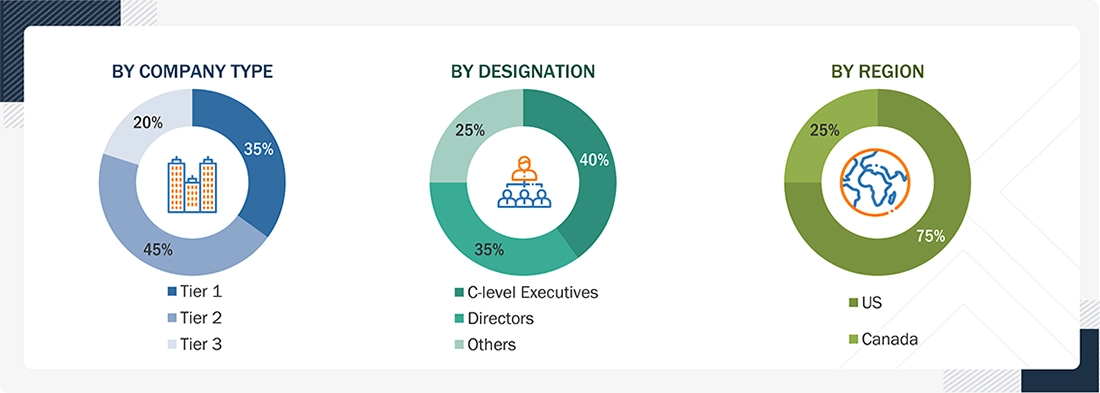
Note: Other designations include sales, marketing, and product managers.
Tiers are defined based on a company’s total revenue as of 2024: Tier 1 = >USD 1 billion, Tier 2 = USD 500 million to USD 1 billion, and Tier 3 = <USD 500 million.
To know about the assumptions considered for the study, download the pdf brochure
Market Size Estimation
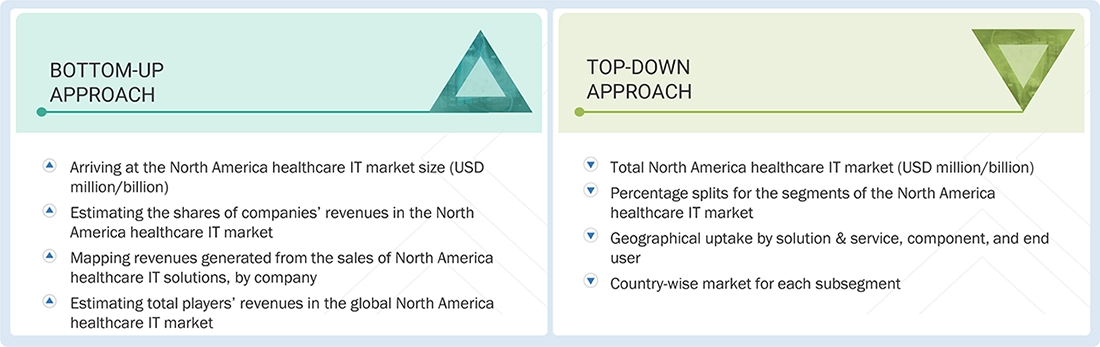
The market size estimates and forecasts provided in this study are derived through a mix of the bottom-up approach (revenue share analysis of leading players) and the top-down approach (assessment of utilization/adoption/penetration trends by solution & service, component, end user, and country).
North America Healthcare IT Market : Top-Down and Bottom-Up Approach
Data Triangulation
After determining the overall market size, the estimation process divided the market into several segments and subsegments. To complete the overall market engineering process and arrive at the exact statistics of each market segment and subsegment, the data triangulation and market breakdown procedures were employed, wherever applicable. The data was triangulated by studying various factors and trends from both the demand and supply sides in the North America healthcare IT market.
Market Definition
Healthcare information technology (HCIT) refers to the use of digital technologies, software platforms, IT infrastructure, and related services to manage, store, exchange, and analyze healthcare information across the healthcare ecosystem. It includes solutions used by healthcare providers, payers, and other stakeholders to support clinical, administrative, operational, and financial workflows. HCIT enables the digitization and integration of healthcare processes to improve patient care, operational efficiency, data accessibility, care coordination, and healthcare decision-making.
Key Stakeholders
- Healthcare IT solution providers
- Healthcare IT vendors
- Healthcare IT service providers
- Healthcare payers
- Laboratory information system (LIS) vendors
- Radiology information system (RIS), PACS, and VNA vendors
- Pharmacy information system & medication management vendors
- Healthcare consulting & IT service providers
- Medical device & connected health companies
- Academic medical centers & research institutions
- Contract research organizations (CROs)
- Cloud & data infrastructure providers
- Cybersecurity solution providers
- Healthcare interoperability & health information exchange vendors
- Telehealth & remote patient monitoring providers
- Population health management solution providers
- Academic research institutes
- Government institutes
- Market research and consulting firms
- Venture capitalists and investors
Report Objectives
- To define, describe, and forecast the North America healthcare IT market by solution & service, component, end user, and country
- To provide detailed information regarding the major factors, such as drivers, restraints, opportunities, and challenges, influencing the growth of the market
- To analyze micromarkets with respect to individual growth trends, prospects, and contributions to the overall North America healthcare IT market
- To assess the North America healthcare IT market with regard to Porter’s five forces, regulatory landscape, value chain, ecosystem map, patent protection, impact of 2025 US tariff, AI/Gen AI on the market under study, and key stakeholders’ buying criteria
- To analyze opportunities in the market for stakeholders and provide details of the competitive landscape for market leaders
- To forecast the size of the North America healthcare IT market with respect to two main countries, namely, the US and Canada
- To profile the key players in the North America healthcare IT market and comprehensively analyze their core competencies and market shares
- To track and analyze competitive developments such as agreements, partnerships, acquisitions, expansions, product launches and enhancements, and R&D activities in the North America healthcare IT market
Available customizations:
With the given market data, MarketsandMarkets offers customizations according to your company’s specific needs. The following customization options are available for the report:
Company Information
-
Detailed analysis and profiling of additional market players (up to 5)
Key Questions Addressed by the Report
Which are the top industry players in the global North American healthcare IT market?
Top players include Oracle (US), Veradigm, Inc. (US), McKesson Corporation (US), Koninklijke Philips N.V. (Netherlands), Optum, Inc. (US), Cognizant (US), and GE Healthcare (US).
Which solutions & services have been included in the North American healthcare IT market report?
The report includes:
- Healthcare provider solutions
- Healthcare payer solutions
- Healthcare outsourcing services
Which country dominates the global North American healthcare IT market?
The United States holds the largest share of the market during the forecast period.
Which end-user segments have been included in the North American healthcare IT market report?
The report includes:
- Healthcare Providers
- Healthcare Payers
- Life Science Industry
Fact checked
Personalize This Research
- Triangulate with your Own Data
- Get Data as per your Format and Definition
- Gain a Deeper Dive on a Specific Application, Geography, Customer or Competitor
- Any level of Personalization
Let Us Help You
- What are the Known and Unknown Adjacencies Impacting the North America Healthcare IT Market
- What will your New Revenue Sources be?
- Who will be your Top Customer; what will make them switch?
- Defend your Market Share or Win Competitors
- Get a Scorecard for Target Partners

Custom Market Research Services
We Will Customise The Research For You, In Case The Report Listed Above Does Not Meet With Your Requirements
Get 10% Free CustomisationTESTIMONIALS

JAYANT RAJPUROHIT
Director of Market Insights, Data and Analytics
SFI Health,
Leading Pharmaceutical Companywww.sfihealth.com/

We at SFI Health approached MarketsandMarkets for an Opportunity Assessment on "Incidence and Prevalence of Focus Indications" as we wanted to know the most attractive HCPs like Physician, Functional MD, Naturopath and Pharmacist. The project was critical for us to ensure our focus on the right target which would enable sustainable growth and profitability for SFI Health. The business insights provided exceeded our expectations and we were extremely impressed. The team at MarketsandMarkets is highly professional and detail oriented and very well understood our business needs. MarketsandMarkets offers a unique combination of expertise and dedicated engagement model. We identified 2 new products to be launched in coming months, based on the research findings provided by MarketsandMarkets. We are happy with the services and would strongly recommend MarketsandMarkets to my peers in the industry.

BEATRIZ DE LA CALLE
Head of Commercial Analytics
Qualicaps,
Leading Pharmaceutical Companywww.qualicaps.com/

We partnered with MarketsandMarkets for an assessment study on hard empty capsules. The team was extremely professional in understanding our business requirements and we received timely responses to all our queries. The market intelligence and the recommendations has met our business requirements. We were extremely impressed to see the final study results; it really exceeded our expectations. The market intelligence offered by MarketsandMarkets, and clarity on next steps will help us achieve our business objective for the Year 2021. We are happy with the services and would strongly recommend MarketsandMarkets to my peers in the industry.

Bob Williams,
Senior Director Business Development & Innovation
Bracco Diagnostics Inc.,
Italian Multinational in life sciences sector and a World Leader in imaging diagnosticsimaging.bracco.com/us-en
We were pleased with targeted insights that MarketsandMarkets identified from a custom study on the 'Radiation Dose Management Solutions Market'. Your team identified and characterized the market participants as well as underlying trends accurately. This study was useful to Bracco in formulating business strategies for our dose monitoring product lines and we thank MarketsandMarkets for the job well done.
Cody Coonradt,
Market Development and Strategy Manager
3M Health Information Systems,
Leader in Health care Coding, Payment & Analytics Solutions.www.3m.com/3M/en_US/health-information-systems-us
The value for our organization comes from three things: depth of research, specificity of segments and being easy to work with. As important as the first two are, the third can't be underestimated. MarketsandMarkets, maybe more than any other research vendor, wants to know what is top of mind for our team and what big questions we are grappling to answer.
Their customer first approach and high value engagement model, have given us great analysis and excellent value for money
Growth opportunities and latent adjacency in North America Healthcare IT Market






Kevin
Jun, 2026
I reviewed the North America Healthcare IT Market report to better understand how interoperability, cloud migration, and digital patient engagement are influencing long-term technology spending across hospitals and payer networks..
Brian
Jun, 2026
What stood out to me in the North America Healthcare IT Market analysis was the shift toward data-driven clinical workflows, especially the growing reliance on AI-supported diagnostics and integrated EHR platforms in large care systems..
George
Jun, 2026
After going through the North America Healthcare IT Market insights, I found the breakdown by deployment models and healthcare providers particularly useful for evaluating where operational efficiencies and investment opportunities are likely to emerge over the next few years..