
China Healthcare Workforce Management System Market (2024-2029)

The China Healthcare Workforce Management System Market was valued at $74.1 Million in 2024 and projected to reach to $128.5 Million by 2029, representing a compound annual growth rate of 11.6%. China's Healthcare Workforce Management System Market is positioned for sustained growth through 2029, expanding from $74.1 million to $128.5 million.


| Market Size in | USD 26.32 MN |
| Market Forecast in | |
| CAGR | |
| Forecast Period | |
| Units Considered | Value (USD MN) |
China Healthcare Workforce Management System Market Trends and Insights
- This expansion reflects China's increasing investment in healthcare infrastructure modernization and digital transformation across hospitals and clinics nationwide.
- China's aging population and rising demand for efficient staff scheduling and resource allocation are driving adoption of advanced workforce management solutions. The market in China is characterized by rapid digitalization of healthcare facilities and government initiatives promoting healthcare IT integration.
- China's healthcare providers are increasingly recognizing the need for sophisticated workforce management systems to optimize labor costs, improve patient care quality, and enhance operational efficiency.
- Between 2024 and 2029, China is expected to see accelerated adoption driven by regulatory support and competitive pressures within the healthcare sector. China's market growth outpaces global trends, with an 11.6% compound annual growth rate compared to the global average of 10.1%.
- This acceleration underscores China's strategic focus on healthcare modernization and the critical role of workforce management in achieving operational excellence across the country's expanding healthcare network..
Key Market Statistics
- CAGR (2024-2029) 11.6% CAGR
- Market Size, 2024 ~USD 74.1 Million
- Forecast, 2029 ~USD 128.5 Million
- Country China
China Healthcare Workforce Management System Market Overview
Rapid Market Expansion :
China's Healthcare Workforce Management System Market is growing at 11.6% CAGR, outpacing the global average of 10.1%, driven by aggressive healthcare digitalization initiatives and government modernization mandates across provincial health systems.
Aging Population Pressure :
With China's rapidly aging demographic, hospitals and clinics face unprecedented staffing challenges. Workforce management systems are becoming critical to optimize scheduling, reduce burnout, and improve patient care delivery across urban and rural healthcare facilities.
Digital Health Infrastructure Investment :
China's substantial investment in healthcare IT infrastructure, including cloud computing and AI-enabled solutions, is accelerating adoption of sophisticated workforce management platforms among major hospital networks and private healthcare providers.
Regulatory Compliance Requirements :
New Chinese healthcare regulations mandate standardized workforce tracking and labor compliance reporting, compelling hospitals to implement integrated management systems to meet government standards and avoid penalties.
China Healthcare Workforce Management System Market Dynamics
- This trajectory is underpinned by China's commitment to healthcare system modernization, increasing hospital automation, and the critical need to address staffing inefficiencies in a healthcare sector serving 1.4 billion people.
- Government initiatives promoting digital health ecosystems and private sector competition are accelerating technology adoption. The market will be shaped by integration of AI and predictive analytics for staff scheduling, mobile-first solutions for frontline workers, and cloud-based platforms enabling real-time workforce visibility.
- Major hospital networks and emerging private healthcare chains will drive demand, while smaller regional facilities gradually adopt solutions.
- Regulatory pressures and labor cost optimization will remain primary adoption drivers through 2029..
Market Ecosystem
Related Ecosystem
Healthcare It
- Computed Tomography (CT)
- Machine Learning
- Magnetic Resonance Imaging (MRI)
- Natural Language Processing (NLP)
- Predictive Analytics
- CERNER CORPORATION
- PHILIPS HEALTHCARE
- Oracle Corporation
- GE HealthCare Technologies Inc.
- Siemens healthineers
Key Takeaways
- China's Healthcare Workforce Management System Market will grow from $74.1M (2024) to $128.5M (2029), representing 73.4% total growth over the forecast period.
- China's 11.6% CAGR exceeds the global average of 10.1%, indicating accelerated market maturation and digital healthcare adoption across the country.
- China's aging demographics and healthcare provider consolidation are primary catalysts driving demand for integrated workforce management solutions.
- China's government healthcare IT initiatives and regulatory mandates are creating favorable conditions for market expansion and vendor competition.
Healthcare Workforce Management System Market Report Scope
| Report Metric | Details |
|---|---|
| Base Year | 2024 |
| Fastest Growing Segment | SMALL (Organization Size) |
| Forecast Period | 2024-2029 |
| Growth Rate | CAGR of 10.1% from 2024 to 2029 |
| Largest Segment | SOFTWARE (Component) |
| Market Size Base Year (Billions) | ~USD 1.73 (2024) |
| Revenue Forecast (Billions) | ~USD 2.8 (2029) |
| Segments Covered | Component, Type, Deployment, Organization Size, End User |
China Healthcare Workforce Management System Market Report Segmentation
5 segment dimensions are covered across the global market.
By Component
- Services
- Software
By Type
- Education & Training Services
- Hr & Payroll Management
- Implementation Services
- Integrated Software
- Optimization & Consulting Services
- Other Standalone Software
- Others Standalone Software
- Scheduling
- Standalone Software
- Support & Maintenance Services
- Talent Management
- Time & Attendance Management
- Workforce Analytics
By Deployment
- Cloud-Based/Web-Based Model
- On-Premise Model
By Organization Size
- Large
- Medium-Sized
- Small
By End User
- Assisted Living Centers
- Hospitals
- Long-Term Care Facilities
- Nursing Homes
- Other End Users
CHINA: HEALTHCARE WORKFORCE MANAGEMENT SYSTEMS MARKET, BY END USER, 2023–2029
| Segment | 2023 | 2024 | 2025 | 2026 | 2027 | 2028 | 2029 | CAGR (%) |
|---|---|---|---|---|---|---|---|---|
| ASSISTED LIVING CENTERS | 10.29 | 11.42 | 12.69 | 14.15 | 15.82 | 17.73 | 19.93 | 11.8 |
| HOSPITALS | 55.85 | 63.06 | 71.36 | 80.97 | 92.12 | 105.08 | 120.21 | 13.8 |
| LONG-TERM CARE FACILITIES | 11.73 | 12.81 | 14.03 | 15.4 | 16.94 | 18.7 | 20.69 | 10.1 |
| NURSING HOMES | 16.45 | 18.1 | 19.97 | 22.08 | 24.48 | 27.22 | 30.35 | 10.9 |
| OTHER END USERS | 9.43 | 10.17 | 11 | 11.93 | 12.97 | 14.13 | 15.45 | 8.7 |
| TOTAL | 103.76 | 115.56 | 129.06 | 144.53 | 162.32 | 182.86 | 206.63 | 12.3 |
Target Audience
- Healthcare IT Solution Providers : Software vendors and system integrators need China-specific market data to develop localized workforce management solutions, understand regulatory requirements, and identify partnership opportunities with hospital networks and healthcare operators.
- Hospital & Healthcare Network Executives : C-suite leaders and operations managers require market insights to justify workforce management system investments, benchmark against peers, and align technology adoption with China's healthcare modernization agenda and staffing challenges.
- Private Equity & Investment Firms : Investors evaluating healthcare IT opportunities in China need validated market sizing, growth projections, and competitive landscape data to assess portfolio companies, identify acquisition targets, and structure funding rounds.
- Healthcare Consultants & Advisors : Management consultants and healthcare strategists require authoritative China market data to advise clients on digital transformation roadmaps, technology selection, and workforce optimization strategies aligned with market trends.
- Government & Policy Makers : Healthcare administrators and policy officials need market intelligence to inform healthcare IT procurement standards, regulatory frameworks, and digital health initiatives that drive workforce management system adoption across China's healthcare system.
Reasons to Buy this Report
- Market Size & Growth Validation : Quantified market data for China showing $74.1M current valuation and 11.6% CAGR through 2029 provides concrete evidence of market opportunity and investment potential for stakeholders planning expansion or entry strategies.
- Competitive Positioning Intelligence : Understand China-specific market dynamics, regulatory drivers, and adoption patterns to benchmark your solutions against local competitors and identify differentiation opportunities in this high-growth healthcare IT segment.
- Strategic Investment Decisions : Data-driven insights into China's aging population pressures, digital infrastructure investments, and compliance requirements enable informed capital allocation and product development prioritization for maximum ROI.
- Customer Segmentation Clarity : Identify and prioritize high-value customer segments including major hospital networks, private healthcare chains, and regional facilities with specific needs and purchasing power in China's fragmented healthcare market.
- Risk Mitigation & Forecasting : Leverage comprehensive market forecasts and trend analysis specific to China to anticipate regulatory changes, competitive threats, and market shifts, enabling proactive business strategy adjustments.
Frequently asked questions
What is the current size of China's Healthcare Workforce Management System Market?
China's Healthcare Workforce Management System Market was valued at $74.1 million in 2024 and is projected to reach $128.5 million by 2029.
What is the expected growth rate for China's market through 2029?
China's Healthcare Workforce Management System Market is expected to grow at a compound annual growth rate (CAGR) of 11.6% from 2024 to 2029.
How does China's market growth compare to global trends?
China's 11.6% CAGR outpaces the global average of 10.1%, reflecting stronger adoption of workforce management solutions in China's healthcare sector.
What factors are driving growth in China's Healthcare Workforce Management System Market?
Key drivers include China's aging population, healthcare digitalization initiatives, government regulatory support, and the need for operational efficiency in healthcare facilities.
What will be the market size of China's Healthcare Workforce Management System Market in 2029?
China's Healthcare Workforce Management System Market is forecasted to reach $128.5 million by 2029, representing significant expansion from the 2024 baseline.
RESEARCH METHODOLOGY
This study involved four major activities in estimating the current size of the healthcare workforce management market. Exhaustive secondary research was carried out to collect information on the market, its peer markets, and its parent market. The next step was to validate these findings, assumptions, and sizing with industry experts across the value chain through primary research. Both top-down and bottom-up approaches were employed to estimate the complete market size. After that, market breakdown and data triangulation procedures were used to estimate the market size of segments and subsegments.
Secondary Research
Secondary research was used mainly to identify and collect information for the extensive, technical, market-oriented, and commercial study of the healthcare workforce management market. The researchers used secondary sources, which means they looked at existing information instead of collecting new data themselves. These secondary sources included reports and publications from organizations like the World Health Organization (WHO), Healthcare Information and Management Systems Society (HIMSS), American Health Information Management Association (AHIMA), Centers for Medicare and Medicaid Services (CMS), US Department of Health and Human Services (HHS), Organisation for Economic Co-operation and Development (OECD), National Institutes of Health (NIH), Centers for Disease Control and Prevention (CDC), Annual Reports, SEC Filings, Investor Presentations, Expert Interviews, and MarketsandMarkets Analysis. This method allowed the researchers to gather information on the market size, segmentation (by component, deployment, organization size, and end-user), regional analysis, future trends, and technological advancements in the healthcare workforce management market.
Primary Research
In-depth interviews were conducted with various primary respondents; researchers conducted in-depth interviews with a variety of people. The primary sources from the supply side include Chief Executive Officers (CEOs), Chief Technology Officers (CTOs), Chief Operating Officers (COOs), Vice Presidents (VPs), Managing Directors (MDs), marketing and sales directors, business development managers of healthcare workforce management companies. On the other hand, primary sources from the demand side include industry experts such as directors of hospitals, nursing homes, physicians, and related key opinion leaders. Primary research was conducted to validate the market segmentation, identify key players in the market, and gather insights on key industry trends and key market dynamics.
Breakdown of the primary respondents:
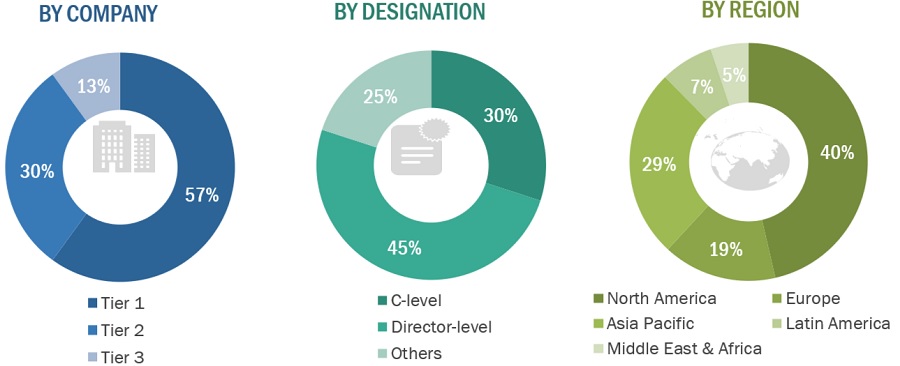
Note 1: C-level primaries include CEOs, COOs, CTOs, and VPs.
Note 2: Other primaries include sales managers, marketing managers, and product and service managers.
Note 3: Companies are classified into tiers based on their total revenue. As of 2023: Tier 1 = >USD 1 billion, Tier 2 = USD 500 million to USD 1 billion, and Tier 3 = <USD 500 million.
To know about the assumptions considered for the study, download the pdf brochure
Market Size Estimation
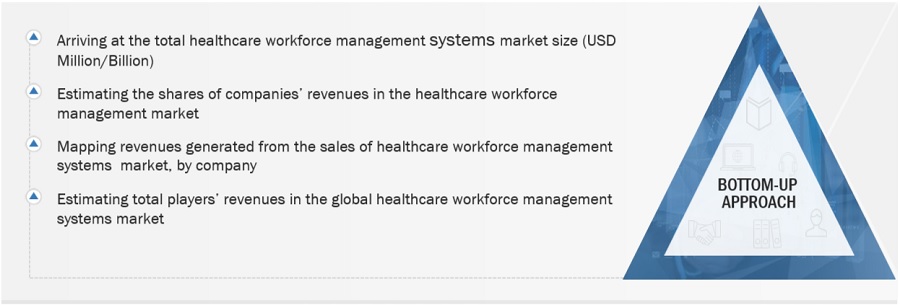
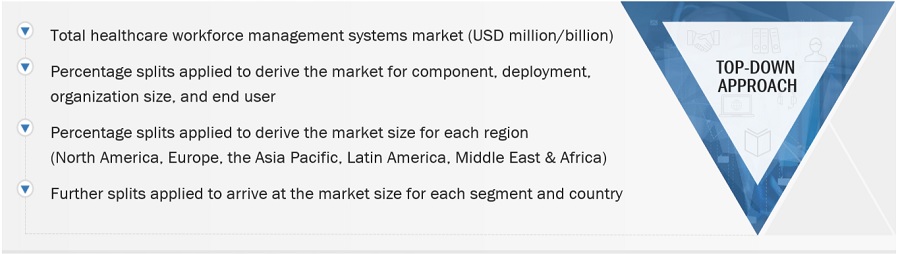
Both top-down and bottom-up approaches were used to estimate and validate the total size of the healthcare workforce management market as well as to estimate the market size of various other dependent submarkets. These methods were also used extensively to estimate the size of various subsegments in the market. The research methodology used to estimate the market size includes the following:
- The key players in the industry and market have been identified through extensive secondary research.
- The revenues generated from the healthcare workforce management business of leading players have been determined through primary and secondary research.
- All percentage shares, splits, and breakdowns have been determined using secondary sources and verified through primary sources.
Healthcare Workforce Management Systems Market: Bottom-Up Approach
To know about the assumptions considered for the study, Request for Free Sample Report
Healthcare Workforce Management Systems Market: Top-Down Approach
Data Triangulation
After arriving at the overall market size from the market size estimation process, the total market was split into several segments and subsegments. To complete the overall market engineering process and arrive at the exact statistics for all segments and subsegments, data triangulation and market breakdown procedures were employed, wherever applicable. The data was triangulated by studying various factors and trends from both the demand and supply sides.
Market Definition
Healthcare workforce management systems encompass all the solutions needed to manage and maintain the productive workforce in a healthcare organization. Workforce management includes HR administration, career and succession planning, adherence to work schedules, talent acquisition, workforce tracking, payroll and benefits, and leave management.
Key Stakeholders:
- Healthcare Workforce Management Vendors
- Healthcare IT solution providers
- Healthcare IT service providers
- Healthcare providers
- Assisted Living Centers/Nursing Homes
- Ambulatory Care Centers
- Integration Service Providers
- Maintenance And Support Service Providers
- Regulatory Bodies
- Market research and consulting firms
- Venture capitalists and investors
Report Objectives
- To define, describe, and forecast the global healthcare workforce management market based on the component, deployment, organization size, end user and region.
- To provide detailed information regarding the major factors influencing the growth of the market (such as drivers, restraints, challenges, and opportunities)
- To strategically analyze micro markets with respect to individual growth trends, prospects, and contributions to the overall healthcare workforce management market.
- To analyze opportunities in the market for stakeholders and provide details of the competitive landscape for market leaders.
- To forecast the size of the market segments with respect to five main regions, namely, North America, Europe, Asia Pacific, Latin America, Middle East & Africa.
- To strategically profile the key players and comprehensively analyze their product portfolios, market positions, and core competencies.
- To track and analyze competitive developments such as acquisitions, product launches, expansions, agreements, collaboration, and partnerships in the healthcare workforce management market.
Available Customizations
With the given market data, MarketsandMarkets offers customizations as per the company’s specific needs. The following customization options are available for this report:
Company Information
- An additional five company profiles
Get the Full Healthcare Workforce Management System Market Report
Full forecast, segment splits, and company analysis for all Healthcare Workforce Management System Market.
- US Healthcare Workforce Management System Market
- Canada Healthcare Workforce Management System Market
- UK Healthcare Workforce Management System Market
- Germany Healthcare Workforce Management System Market
- France Healthcare Workforce Management System Market
- Italy Healthcare Workforce Management System Market
- Spain Healthcare Workforce Management System Market
- Japan Healthcare Workforce Management System Market
- India Healthcare Workforce Management System Market
- Brazil Healthcare Workforce Management System Market
- Mexico Healthcare Workforce Management System Market
- Rest Of Europe Healthcare Workforce Management System Market
- Rest Of Asia Pacific Healthcare Workforce Management System Market
- Rest Of Latin America Healthcare Workforce Management System Market
Need a Tailored Report?
Customize this report to your needs
Get 10% FREE Customization
Customize This Report
