
Latin America Hearing Aids Market (2025-2030)

The Latin America Hearing Aids Market was valued at $643.9 Million in 2025 and projected to reach to $840.2 Million by 2030, representing a compound annual growth rate of 5.5%. Latin America's hearing aids market is positioned for sustained growth driven by demographic shifts and healthcare modernization.


| Market Size in | USD 26.32 MN |
| Market Forecast in | |
| CAGR | |
| Forecast Period | |
| Units Considered | Value (USD MN) |
Latin America Hearing Aids Market Trends and Insights
- Latin America's hearing aids market is driven by an aging population, increasing awareness of hearing health, and improving healthcare infrastructure across the region.
- In 2025, Latin America accounts for a growing share of the global hearing aids market, with demand concentrated in Brazil, Mexico, and Argentina, where healthcare spending and disposable incomes are rising. By 2030, Latin America is expected to see accelerated adoption of advanced hearing aid technologies, including digital and rechargeable devices.
- Latin America's market growth is supported by expanding insurance coverage, government health initiatives, and rising prevalence of age-related hearing loss.
- The region's hearing aids market remains moderately fragmented, with both multinational and regional players competing to capture market share through distribution partnerships and direct-to-consumer channels..
Key Market Statistics
- CAGR (2025-2030) 5.5% CAGR
- Market Size, 2025 ~USD 643.9 Million
- Forecast, 2030 ~USD 840.2 Million
- Geography Latin America
Latin America Hearing Aids Market Overview
Aging Population Driving Demand :
Latin America's rapidly aging demographic is a primary growth catalyst, with increasing prevalence of age-related hearing loss creating sustained demand for hearing aid solutions across the region.
Rising Healthcare Awareness :
Growing consumer awareness of hearing health and its impact on quality of life is encouraging earlier diagnosis and treatment adoption among Latin American populations.
Infrastructure Expansion :
Improving healthcare infrastructure and increased accessibility to audiology services across Latin America are reducing barriers to hearing aid adoption and market penetration.
Steady Regional Growth :
The Latin America hearing aids market is projected to grow from USD 643.9 million in 2025 to USD 840.2 million by 2030, representing a 5.5% CAGR, outpacing some developed markets.
Latin America Hearing Aids Market Dynamics
- The region's aging population, combined with increasing awareness of hearing health benefits, creates a favorable environment for market expansion.
- Healthcare infrastructure improvements and rising disposable incomes in key markets like Brazil and Mexico are facilitating greater access to hearing aid technologies. By 2030, the market is expected to reach USD 840.2 million, reflecting growing adoption rates and improved reimbursement policies.
- Digital transformation in audiology services and the introduction of affordable hearing aid solutions tailored to Latin American consumers will further accelerate market penetration.
- Strategic partnerships between manufacturers and local healthcare providers will be critical to capturing emerging opportunities across the region..
Market Ecosystem

Hearing Aids Market: COMMERCIAL USE CASES ACROSS INDUSTRIES
| COMPANY | USE CASE DESCRIPTION | BENEFITS |
|---|---|---|
 |
Provides a broad portfolio of hearing solutions across styles and channels, supporting in-clinic fittings, audiologist workflows, and consumer connectivity use cases. | Enables rapid, accurate fittings and personalized amplification; strong support for clinic workflows and patient follow-up; improved user uptake due to wide style choice and connectivity features. |
 |
Offers a range of consumer and clinic-oriented hearing products with emphasis on discreet designs and scalable performance levels for diverse hearing losses. | Delivers cosmetic appeal and user acceptance, flexible performance tiers for different needs, and reliable in-clinic outcomes that reduce return rates and improve patient satisfaction. |
 |
Focuses on clinically robust hearing solutions and professional support services aimed at audiology practices and integrated care pathways. | Provides dependable clinical performance, streamlined clinician fitting and verification, and scalable options for pediatric and adult care—improving clinical throughput and treatment outcomes. |
 |
Specializes in implantable auditory systems for severe-to-profound hearing loss, supporting surgical and post-operative rehabilitation pathways. | Restores hearing capability where conventional aids fail, improves speech perception and safety, and enhances long-term quality of life through implanted solutions and rehabilitation support. |
 |
Delivers consumer-friendly and clinic-compatible hearing devices with strong emphasis on wireless connectivity and mobile integration. | Enables seamless streaming and smartphone control, enhances everyday communication and convenience, and supports higher user engagement and adherence through connected features. |
Logos and trademarks shown above are the property of their respective owners. Their use here is for informational and illustrative purposes only.
Related Ecosystem
Medical Devices
- Polymerase Chain Reaction (PCR)
- Magnetic Resonance Imaging (MRI)
- Disposable Autoinjectors
- Pulse Oximeters
- Blood Pressure Monitors
- Medtronic plc
- Abbott Laboratories
- Stryker Corporation
- Becton, Dickinson and Company
- JOHNSON & JOHNSON
Key Takeaways
- Latin America's hearing aids market is valued at USD 643.9 million in 2025 and will grow to USD 840.2 million by 2030 at a 5.5% CAGR.
- Latin America's market growth is driven by demographic aging, rising healthcare awareness, and improved access to hearing health services.
- Latin America is experiencing increased adoption of digital and rechargeable hearing aid technologies by 2030.
- Latin America's competitive landscape includes multinational leaders and regional players leveraging distribution networks and direct-to-consumer strategies.
Hearing Aids Market Report Scope
| Report Metric | Details |
|---|---|
| Base Year | 2025 |
| Fastest Growing Segment | HEARING IMPLANTS (Product) |
| Forecast Period | 2025-2030 |
| Growth Rate | CAGR of 6.8% from 2025 to 2030 |
| Largest Segment | DIGITAL (Technology) |
| Market Size Base Year (Billions) | ~USD 10.38 (2025) |
| Revenue Forecast (Billions) | ~USD 14.42 (2030) |
| Segments Covered | Product, Type, Type Of Hearing Loss, Patient Type, Technology, Distribution Channel |
Latin America Hearing Aids Market Report Segmentation
6 segment dimensions are covered across the global market.
By Product
- Hearing Aid Devices
- Hearing Implants
By Type
- Behind-The-Ear Hearing Aids
- Bone-Anchored Systems
- Canal Hearing Aids
- Cochlear Implants
- In-The-Ear Hearing Aids
- Other Hearing Aid Devices
- Receiver-In-The-Ear Hearing Aids
By Type Of Hearing Loss
- Conductive Hearing Loss
- Sensorineural Hearing Loss
By Patient Type
- Adults
- Pediatrics
By Technology
- Analog
- Digital
By Distribution Channel
- Audiology And Ent Hospital & Clinics
- Audiology And Ent Hospitals & Clinics
- Online Sales
- Retail & Pharmacy Stores
Target Audience
- Hearing Aid Manufacturers : Manufacturers need Latin America-specific market data to identify growth opportunities, optimize product portfolios for regional preferences, and develop localized marketing strategies.
- Healthcare Distributors & Retailers : Distributors require detailed market insights to assess demand trends, identify high-growth countries like Brazil and Mexico, and optimize inventory and supply chain decisions.
- Investment & Private Equity Firms : Investors need comprehensive regional analysis to evaluate market attractiveness, identify acquisition targets, and assess growth potential in Latin America's hearing aids sector.
- Healthcare Policy Makers : Government and regulatory bodies need market data to inform reimbursement policies, healthcare infrastructure investments, and accessibility initiatives for hearing care in Latin America.
- Audiology Service Providers : Audiology clinics and hearing centers require market intelligence to understand patient demographics, competitive positioning, and expansion opportunities across Latin American markets.
Countries within Latin America - compare and drill down
| Country | 2025 size (native) |
|---|---|
| Brazil | USD 250.6 Million |
| Mexico | USD 93.5 Million |
| Rest Of Latin America | USD 191 Million |
Country market size visualization
Reasons to Buy this Report
- Regional Market Sizing & Forecasts : Obtain precise market valuations for Latin America (USD 643.9M in 2025) with detailed 5-year forecasts enabling accurate business planning and investment decisions specific to the region.
- Country-Level Insights : Access granular data on key Latin American markets including Brazil and Mexico, allowing targeted market entry strategies and localized product positioning.
- Growth Driver Analysis : Understand the specific demographic, economic, and healthcare factors propelling Latin America's 5.5% CAGR to identify high-potential segments and expansion opportunities.
- Competitive Landscape Assessment : Benchmark your position against regional competitors and identify market gaps, distribution channels, and partnership opportunities unique to Latin America.
- Strategic Market Entry Planning : Leverage comprehensive regional insights to develop informed go-to-market strategies, pricing models, and regulatory compliance frameworks for Latin American expansion.
Frequently asked questions
What is the current size of the hearing aids market in Latin America?
The hearing aids market in Latin America is valued at USD 643.9 million in 2025.
What is the projected size of Latin America's hearing aids market by 2030?
Latin America's hearing aids market is projected to reach USD 840.2 million by 2030.
What is the CAGR for the hearing aids market in Latin America?
The hearing aids market in Latin America is expected to grow at a CAGR of 5.5% from 2025 to 2030.
Which countries drive the largest demand for hearing aids in Latin America?
Brazil, Mexico, and Argentina are the primary markets driving hearing aids demand in Latin America due to higher healthcare spending and aging populations.
What technologies are gaining adoption in Latin America's hearing aids market?
Digital and rechargeable hearing aid technologies are increasingly adopted in Latin America as consumers seek advanced, convenient solutions.
RESEARCH METHODOLOGY
The study involved key activities in estimating the current market size for the hearing aids industry. Extensive secondary research was conducted to gather information on the hearing aids sector. The next step was to validate these findings, assumptions, and estimates with industry experts across the value chain through primary research. Different methods, such as top-down and bottom-up approaches, were used to determine the total market size. Subsequently, market segmentation and data triangulation techniques were applied to estimate the market sizes of the segments and subsegments within the hearing aids market.
The four steps involved in estimating the market size are:
Secondary Research
The secondary research process involves the widespread use of secondary sources, directories, databases (such as Bloomberg Businessweek, Factiva, and D&B Hoovers), white papers, annual reports, investor presentations, SEC filings of companies and publications from government sources [such as National Institutes of Health (NIH), US FDA, US Census Bureau, World Health Organization (WHO), , Global Burden of Disease Study, and Centers for Medicare and Medicaid Services (CMS) were referred to identify and collect information for the global hearing aids market study. It was also used to obtain important information about the key players and market classification & segmentation according to industry trends, to the bottom-most level, and key developments related to market and technology perspectives. A database of the key industry leaders was also prepared using secondary research.
Primary Research
During the primary research phase, a detailed and structured approach was used, including interviews with sources from both the supply and demand sides of the hearing aids market. These interviews aimed to gather key qualitative and quantitative data for this report. Important sources included industry experts from core and related sectors, leading manufacturers, distributors, suppliers, technology innovators, and stakeholders across the value chain. A diverse group of respondents—such as senior executives, subject-matter experts, industry advisors, and key decision-makers—was interviewed in-depth to validate insights and evaluate future market opportunities.
The following is a breakdown of the primary respondents:
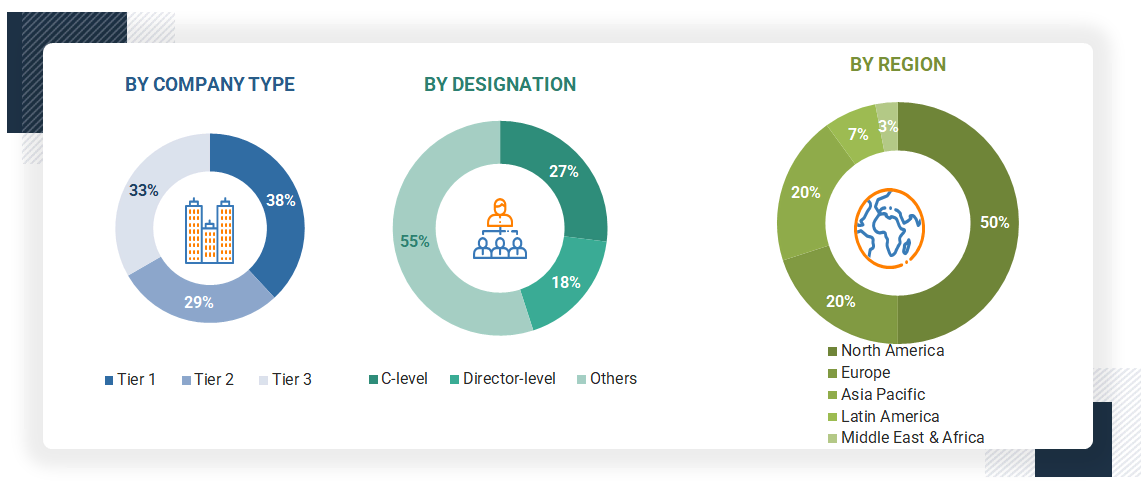
Note 1: Other designations include sales, marketing, and product managers.
Note 2: Companies are classified into tiers based on their total revenues. As of 2024, Tier 1 = >USD 100 million, Tier 2 = USD 10 million to USD 100 million, and Tier 3 = < USD 10 million.
To know about the assumptions considered for the study, download the pdf brochure
Market Size Estimation
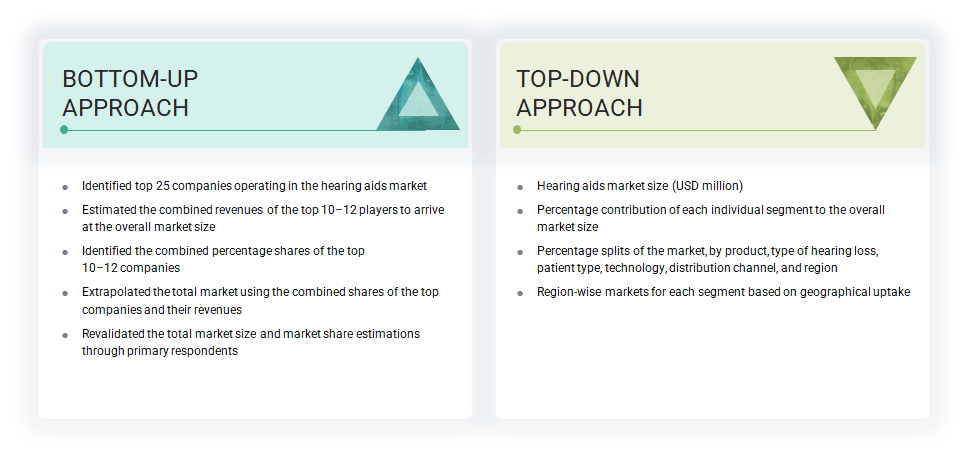
The global market value was estimated by mapping the annual revenues of key product manufacturers and OEMs operating in the global hearing aids market. Major service providers were identified at the global, regional, and country levels. Revenue mapping was conducted for relevant business segments and subsegments of these leading players. This process involved:
- Identifying major players active in the hearing aids market across various regions and countries
- Mapping their product portfolios by region/country
- Analyzing annual revenues generated from hearing aids or the closest reported product categories
- Extrapolating these revenues to estimate the market value of each segment and sub-segment
- Aggregating all segment and sub-segment values to determine the total global market size of the hearing aids market
The above data was consolidated and added with detailed inputs and analysis from MarketsandMarkets and presented in this report.
The research methodology used to estimate the market size includes the following:
Data Triangulation
Once the overall market size was determined using the methodology described earlier, it was divided into multiple categories. A thorough market engineering process was followed to ensure accurate estimates for all segments and sub-segments, including data triangulation and market breakdown methods where applicable. Triangulation was accomplished by analyzing various influencing factors and trends from both the demand and supply sides.
Market Definition
Hearing aids are sophisticated, battery-operated sound amplification devices engineered to assist individuals with varying degrees of hearing loss, ranging from mild to profound. The efficacy of these devices is influenced by multiple factors, including the severity and etiology of the hearing impairment, the specific technology employed in the hearing aid and the precision of its fitting. Users often experience a range of benefits contingent upon these variables and the underlying characteristics of their auditory deficiencies.
Stakeholders
- Manufacturers and distributors of hearing aids
- Hospitals and clinics
- Audiology centers
- Research and development (R&D) companies
- Clinical research organizations
- Research laboratories and academic institutes
- Hearing aids service providers
- Government associations
- Venture capitalists and investors
Report Objectives
- To define, describe, segment, and forecast the global hearing aids market by product, type of hearing loss, patient type, technology, distribution channel, and region
- To provide detailed information regarding the major factors influencing market growth (such as drivers, restraints, opportunities, and challenges
- To analyze the micromarkets1 concerning individual growth trends, prospects, and contributions to the overall wound care market
- To analyze market opportunities for stakeholders and provide details of the competitive landscape for key players
- To forecast the size of the market segments concerning five regions: North America, Europe, the Asia Pacific, Latin America, and the Middle East & Africa
- To profile the key players and comprehensively analyze their product portfolios, market positions, and core competencies2
- To benchmark players within the market using the proprietary Company Evaluation Matrix framework, which analyzes market players on various parameters within the broad categories of business and product excellence
- To study the impact of AI/Gen AI on the market, along with the macroeconomic outlook for each region
Get the Full Hearing Aids Market Report
Full forecast, segment splits, and company analysis for all Hearing Aids Market.
- Brazil Hearing Aids Market
- Mexico Hearing Aids Market
- Rest Of Europe Hearing Aids Market
- Rest Of Asia Pacific Hearing Aids Market
- Rest Of Latin America Hearing Aids Market
- Canada Hearing Aids Market
- US Hearing Aids Market
- Germany Hearing Aids Market
- UK Hearing Aids Market
- France Hearing Aids Market
- Spain Hearing Aids Market
- Italy Hearing Aids Market
- China Hearing Aids Market
- India Hearing Aids Market
- Japan Hearing Aids Market
- Australia Hearing Aids Market
Need a Tailored Report?
Customize this report to your needs
Get 10% FREE Customization
Customize This Report
