
Rest Of Europe Hearth Market (2024-2029)

The Rest Of Europe Hearth Market was valued at $302.8 Million in 2024 and projected to reach to $369.5 Million by 2029, representing a compound annual growth rate of 4.1%. Rest Of Europe's hearth market is poised for moderate but consistent expansion through 2029, driven by increasing semiconductor manufacturing investments and industrial electronics production across the region.


| Market Size in | USD 26.32 MN |
| Market Forecast in | |
| CAGR | |
| Forecast Period | |
| Units Considered | Value (USD MN) |
Rest Of Europe Hearth Market Trends and Insights
- Rest Of Europe encompasses a diverse range of markets with varying demand drivers, regulatory frameworks, and consumer preferences across the semiconductor and electronics sectors.
- The region's hearth market growth is supported by steady industrial activity, modernization of manufacturing facilities, and increasing adoption of advanced heating technologies in both residential and commercial applications throughout Rest Of Europe. Rest Of Europe's hearth market demonstrates resilience amid evolving energy efficiency standards and sustainability mandates across member states.
- The forecast period from 2024 to 2029 reflects Rest Of Europe's commitment to balancing economic growth with environmental compliance, driving innovation in hearth design and materials.
- Rest Of Europe's market participants are increasingly investing in product development and localized supply chains to capture emerging opportunities in this moderately growing segment..
Key Market Statistics
- CAGR (2024-2029) 4.1% CAGR
- Market Size, 2024 ~USD 302.8 Million
- Forecast, 2029 ~USD 369.5 Million
- Country Rest Of Europe
Rest Of Europe Hearth Market Overview
Market Valuation :
Rest Of Europe's hearth market is valued at USD 302.8 million in 2024, with steady growth trajectory driven by industrial modernization and semiconductor manufacturing expansion across diverse European economies.
Growth Trajectory :
The region demonstrates a CAGR of 4.1% through 2029, reaching USD 369.5 million, slightly outpacing global average growth and reflecting increasing adoption of advanced heating technologies in electronics production.
Market Fragmentation :
Rest Of Europe encompasses heterogeneous markets with distinct regulatory frameworks, industrial capabilities, and consumer preferences, requiring localized strategies across Eastern, Central, and Southern European nations.
Regulatory Landscape :
Varying EU compliance standards, energy efficiency directives, and environmental regulations across Rest Of Europe create both challenges and opportunities for hearth manufacturers and semiconductor equipment suppliers.
Rest Of Europe Hearth Market Dynamics
- The market benefits from EU industrial policy initiatives promoting domestic chip production and advanced manufacturing capabilities.
- However, growth is tempered by economic disparities across member states and varying levels of industrial infrastructure development. Key opportunities emerge from digital transformation initiatives, renewable energy integration in manufacturing processes, and supply chain diversification away from Asia.
- Regional manufacturers are increasingly adopting advanced hearth technologies to improve efficiency and meet stringent environmental standards.
- Strategic investments in R&D and localized production facilities will be critical for capturing market share in this fragmented but growing landscape..
Market Ecosystem
Related Ecosystem
Electronics System And Components
- Sensors
- Temperature Sensors
- Pressure Sensors
- Actuators
- Image Sensors
- Lenovo
- Samsung
- Texas Instruments Incorporated
- HONEYWELL INTERNATIONAL INC.
- Teledyne Technologies Incorporated
Smart Home
- Sensors
- Pressure Sensors
- Temperature Sensors
- Actuators
- Face Recognition
- HONEYWELL INTERNATIONAL INC.
- SCHNEIDER ELECTRIC SE
- Siemens ag
- Samsung
- Godrej Industries Limited
Smart Lighting
- Fiber Laser
- Fluorescent Lighting
- Gas Lasers
- Sensors
- 3D Sensors
- Zumtobel group ag
- Nedap n.v.
- Acuity Brands, Inc.
- OSRAM Licht AG
- Philips
Key Takeaways
- Rest Of Europe's hearth market is valued at USD 302.8 million in 2024 and will grow to USD 369.5 million by 2029 at a 4.1% CAGR.
- Rest Of Europe's market growth is driven by industrial modernization, energy efficiency regulations, and increased adoption of advanced heating technologies.
- Rest Of Europe demonstrates steady demand across both residential and commercial segments, supported by diverse regional economic activity.
- Rest Of Europe's market participants are focusing on sustainable product innovation and localized supply chains to capitalize on forecast period opportunities.
Hearth Market Report Scope
| Report Metric | Details |
|---|---|
| Base Year | 2024 |
| Fastest Growing Segment | MODERN (Design) |
| Forecast Period | 2024-2029 |
| Growth Rate | CAGR of 4.2% from 2024 to 2029 |
| Largest Segment | ELECTRONIC (Ignition Type) |
| Market Size Base Year (Billions) | ~USD 10.91 (2024) |
| Revenue Forecast (Billions) | ~USD 13.4 (2029) |
| Segments Covered | Product, Fuel Type, Placement, Design, Ignition Type, Vent Availability, Application |
Rest Of Europe Hearth Market Report Segmentation
7 segment dimensions are covered across the global market.
By Product
- Fireplaces
- Inserts
- Stoves
By Fuel Type
- Electricity
- Gas
- Pellet
- Wood
By Placement
- Indoor
- Outdoor
- Portable
By Design
- Modern
- Traditional
- Traditional/Conventional
By Ignition Type
- Electronic
- Standing Pilot
By Vent Availability
- Unvented
- Vented
By Application
- Commercial
- Hospitality
- Residential
Target Audience
- Equipment Manufacturers : Hearth and semiconductor equipment manufacturers need Rest Of Europe-specific data to develop localized product strategies, identify distribution partnerships, and optimize production capacity for regional demand.
- Electronics Producers : Semiconductor and electronics manufacturers operating in Rest Of Europe require market intelligence to assess supply chain reliability, equipment availability, and technology adoption rates for production planning.
- Investment & Private Equity : Investors evaluating opportunities in European semiconductor and electronics sectors need detailed Rest Of Europe market analysis to assess growth potential, competitive dynamics, and risk factors for portfolio decisions.
- Market Consultants : Business consultants and strategy firms advising clients on European expansion require granular Rest Of Europe market data to develop market entry strategies and competitive positioning recommendations.
- Government & Policy Bodies : European regulatory agencies and industrial policy makers need Rest Of Europe hearth market insights to inform semiconductor manufacturing incentives, environmental standards, and industrial development initiatives.
Reasons to Buy this Report
- Regional Market Segmentation : Gain detailed insights into Rest Of Europe's distinct market dynamics, including country-specific demand patterns, competitive landscapes, and growth drivers that differ significantly from Western European markets.
- Localized Growth Opportunities : Identify high-potential markets within Rest Of Europe experiencing accelerated semiconductor and electronics manufacturing expansion, enabling targeted market entry and investment strategies.
- Regulatory Compliance Intelligence : Navigate complex and varying EU regulatory frameworks across Rest Of Europe with comprehensive analysis of compliance requirements, environmental standards, and industry-specific certifications affecting hearth equipment.
- Competitive Positioning : Benchmark your operations against regional competitors and understand market consolidation trends, supplier relationships, and distribution channels specific to Rest Of Europe's fragmented market structure.
- Strategic Investment Planning : Make informed decisions on manufacturing facility locations, partnership development, and resource allocation across Rest Of Europe based on 5-year market forecasts and regional growth trajectories.
Frequently asked questions
What is the current market size of the hearth market in Rest Of Europe?
The Rest Of Europe hearth market is valued at USD 302.8 million in 2024.
What is the projected market size for Rest Of Europe's hearth market by 2029?
Rest Of Europe's hearth market is projected to reach USD 369.5 million by 2029.
What is the CAGR for the hearth market in Rest Of Europe?
Rest Of Europe's hearth market is expected to grow at a compound annual growth rate (CAGR) of 4.1% from 2024 to 2029.
What are the primary growth drivers for Rest Of Europe's hearth market?
Rest Of Europe's hearth market growth is driven by industrial modernization, energy efficiency standards, sustainability mandates, and increased adoption of advanced heating technologies in residential and commercial applications.
How is Rest Of Europe's hearth market responding to regulatory changes?
Rest Of Europe's market participants are investing in sustainable product innovation and compliance with evolving energy efficiency standards and environmental regulations across member states.
RESEARCH METHODOLOGY
The research study involved 4 major activities in estimating the size of the hearth market. Exhaustive secondary research has been done to collect important information about the market and peer markets. The validation of these findings, assumptions, and sizing with the help of primary research with industry experts across the value chain has been the next step. Both top-down and bottom-up approaches have been used to estimate the market size. Post which the market breakdown and data triangulation have been adopted to estimate the market sizes of segments and sub-segments.
Secondary Research
In the secondary research process, various secondary sources have been referred to for identifying and collecting information required for this study. The secondary sources include annual reports, press releases, and investor presentations of companies, white papers, and articles from recognized authors. Secondary research has been mainly done to obtain key information about the market’s value chain, the pool of key market players, market segmentation according to industry trends, regional outlook, and developments from both market and technology perspectives.
Primary Research
In primary research, various primary sources from both supply and demand sides have been interviewed to obtain the qualitative and quantitative insights required for this report. Primary sources from the supply side include experts such as CEOs, vice presidents, marketing directors, manufacturers, technology and innovation directors, end users, and related executives from multiple key companies and organizations operating in the hearth ecosystem.
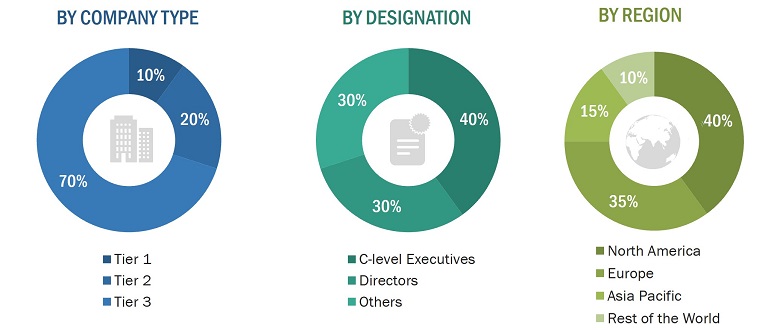
To know about the assumptions considered for the study, download the pdf brochure
Market Size Estimation
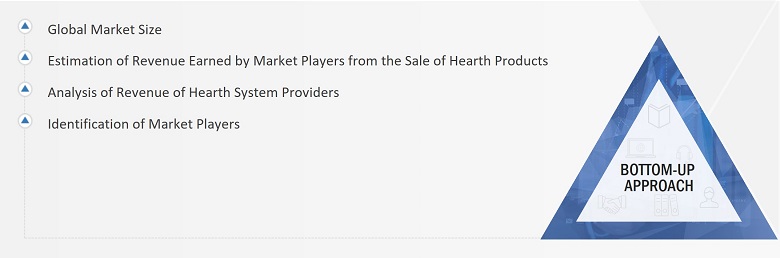
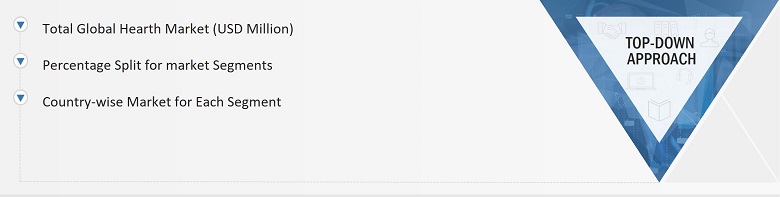
In the market engineering process, both top-down and bottom-up approaches have been used, along with data triangulation methods, to estimate and validate the size of the hearth market and other dependent submarkets. The research methodology used to estimate the market sizes includes the following:
- Identifying stakeholders in the hearth market that influence the entire market, along with participants across the value chain.
- Analyzing major manufacturers of hearth products and studying their product portfolios
- Analyzing trends related to the adoption of hearth products
- Tracking the recent and upcoming developments in the market that include investments, R&D activities, product launches, and acquisitions as well as forecasting the market size based on these developments and other critical parameters
- Carrying out multiple discussions with key opinion leaders to identify the adoption trends of hearth market
- Segmenting the overall market into various other market segments
- Validating the estimates at every level through discussions with key opinion leaders, such as chief executives (CXOs), directors, and operation managers, and finally with the domain experts at MarketsandMarkets
Market Size Estimation Methodology-Bottom-up Approach
Market Size Estimation Methodology-Top-Down Approach
Data Triangulation
After arriving at the overall market size by the market size estimation process explained in the earlier section, the overall hearth market has been divided into several segments and subsegments. The data triangulation and market breakdown procedures have been used to complete the overall market engineering process and arrive at the exact statistics for all segments, wherever applicable. The data has been triangulated by studying various factors and trends from both the demand and supply sides. Along with data triangulation and market breakdown, the market has been validated by top-down and bottom-up approaches.
Market Definition
A hearth is the floor of a fireplace extending into a room, serving both functional and decorative purposes in homes. Made from durable, non-combustible materials like brick, stone, tile, or concrete, hearths withstand heat and prevent fire hazards. The hearth market encompasses products and services related to home heating appliances, such as fireplaces, stoves, inserts, and accessories. This includes traditional wood-burning, gas, electric, and ethanol fireplaces, as well as wood, pellet, gas, and electric stoves. Additionally, the market covers outdoor heating solutions like fire pits and patio heaters, and services like installation, maintenance, and chimney cleaning. Catering to residential and commercial customers, the hearth market combines efficient heating solutions with aesthetic enhancements. Influenced by energy efficiency trends, environmental regulations, and consumer preferences, the market is segmented by fuel type, product type, application, design, placement, material, and region. Demand is driven by weather conditions, energy costs, and the housing market, with the residential sector being the primary contributor.
Stakeholders
- Homeowners
- Builders and Contractors
- Interior Designers
- Retailers
- Hearth Product Manufacturers
- Raw Material Suppliers
- System Integration Providers
- Technology Solution Providers
- Distributors and Resellers
- Service Providers
- Regulatory Bodies
- Research and Development Institutes
- End Users
The main objectives of this study are as follows:
- Define, analyze, and forecast the hearth market, in terms of value, based on products, placement, design, ignition type, vent availability, application, fireplace type and material
- Define, analyze, and forecast the hearth market, in terms of volume, based on fuel type
- Forecast the market size for various segments with respect to 4 main regions: North America, Europe, Asia Pacific, and Rest of the World
- Provide detailed information regarding the major factors (drivers, restraints, opportunities, and challenges) influencing the growth of the hearth market
- Study the complete value chain and related industry segments for the hearth market
- Strategically analyze the micromarkets with respect to individual growth trends, prospects, and contributions to the overall market
- To analyze trends and disruptions; pricing trends; patents and innovations; trade data (export and import data); regulatory environment; Porter’s five forces analysis; case studies; key stakeholders & buying criteria; technology trends; the market ecosystem; and key conferences and events related to the hearth market
- Analyze opportunities in the market for various stakeholders by identifying the high-growth segments of the market
- Strategically profile the key players and comprehensively analyze their market position in terms of revenue, market share and core competencies, along with detailing the competitive landscape for the market leaders
- To analyze competitive developments such as product launches/developments, expansions, acquisitions, partnerships, collaborations, agreements, and research and development (R&D) activities carried out by players in the hearth market
Available Customizations:
With the given market data, MarketsandMarkets offers customizations according to the specific requirements of companies. The following customization options are available for the report:
Country-wise Information:
- Analysis for additional countries (up to five)
Company Information:
- Detailed analysis and profiling of additional market players (up to five)
Get the Full Hearth Market Report
Full forecast, segment splits, and company analysis for all Hearth Market.
Need a Tailored Report?
Customize this report to your needs
Get 10% FREE Customization
Customize This Report
