
Canada Hindered Amine Light Stabilizers (HALS) Market (2024-2029)

The Canada Hindered Amine Light Stabilizers (HALS) Market was valued at $39.51 Million in 2024 and projected to reach to $60.33 Million by 2029, representing a compound annual growth rate of 7.31%. Canada's Hindered Amine Light Stabilizers market is poised for sustained expansion driven by robust demand from the polymers, coatings, and adhesives sectors.


| Market Size in | USD 26.32 MN |
| Market Forecast in | |
| CAGR | |
| Forecast Period | |
| Units Considered | Value (USD MN) |
Canada Hindered Amine Light Stabilizers (HALS) Market Trends and Insights
- This growth trajectory reflects Canada's increasing demand for advanced light stabilizers across polymers, coatings, and adhesives applications.
- Canada's chemical manufacturing sector is leveraging HALS technology to enhance product durability and UV resistance, particularly in automotive, packaging, and construction industries. The Canadian market benefits from robust industrial infrastructure and stringent regulatory standards that drive adoption of high-performance stabilizers.
- Canada's position within North America's supply chain and its emphasis on sustainable manufacturing practices are accelerating HALS market penetration.
- Between 2024 and 2029, Canada is expected to see accelerated investment in polymer processing and specialty chemicals, supporting the 7.31% compound annual growth rate. Canada's HALS market is characterized by increasing competition among global suppliers and growing preference for environmentally compliant formulations.
- The country's commitment to reducing plastic degradation and extending material lifecycles continues to fuel demand for innovative light stabilizer solutions across multiple industrial verticals..
Key Market Statistics
- CAGR (2024-2029) 7.31% CAGR
- Market Size, 2024 ~USD 39.51 Million
- Forecast, 2029 ~USD 60.33 Million
- Country Canada
Canada Hindered Amine Light Stabilizers (HALS) Market Overview
Market Valuation Growth :
Canada's HALS market is valued at $39.51 million in 2024, with a robust CAGR of 7.31% projected through 2029, reaching $60.33 million. This outpaces the global CAGR of 7.01%, indicating Canada's accelerating adoption of light stabilizer technologies.
Key Application Sectors :
Canadian manufacturers are increasingly deploying HALS across polymers, coatings, and adhesives applications. The country's advanced chemical manufacturing sector is driving demand for enhanced product durability and UV protection capabilities in industrial and consumer products.
Regional Manufacturing Strength :
Canada's established chemical manufacturing infrastructure and proximity to North American markets position it as a strategic hub for HALS production and distribution. Local producers are investing in advanced stabilizer formulations to meet stringent environmental and performance standards.
Sustainability Focus :
Canadian chemical manufacturers are prioritizing eco-friendly HALS formulations aligned with federal environmental regulations. This shift toward sustainable light stabilizers is creating new market opportunities and differentiating Canadian producers in the competitive North American landscape.
Canada Hindered Amine Light Stabilizers (HALS) Market Dynamics
- The country's stringent environmental regulations are accelerating the adoption of advanced HALS technologies that enhance product longevity while meeting sustainability requirements.
- Canadian manufacturers are increasingly investing in R&D to develop innovative stabilizer solutions tailored to regional market needs. The forecast period through 2029 presents significant growth opportunities as end-use industries expand their production capacities and upgrade to higher-performance materials.
- Strategic partnerships between Canadian chemical producers and downstream manufacturers, coupled with growing consumer demand for durable, UV-resistant products, will continue to fuel market expansion.
- The market's outperformance relative to global growth rates underscores Canada's strategic importance in the North American HALS supply chain..
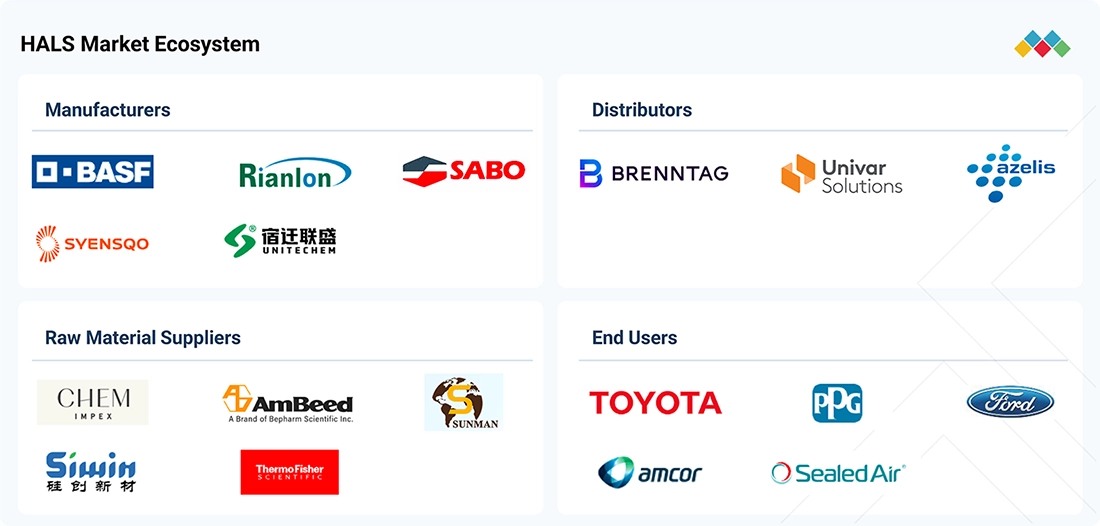
Market Ecosystem
HINDERED AMINE LIGHT STABILIZERS (HALS) MARKET: COMMERCIAL USE CASES ACROSS INDUSTRIES
| COMPANY | USE CASE DESCRIPTION | BENEFITS |
|---|---|---|
 |
Use of hindered amine light stabilizers (HALS) in automotive exterior plastics, coatings, and polymer components exposed to prolonged sunlight. | Improved ultraviolet resistance, reduced surface degradation, longer component life, and sustained appearance under outdoor exposure. |
 |
Incorporation of HALS into bumper systems, exterior trims, and other polymer-based automotive parts to maintain performance during vehicle operation. | Enhanced color retention, improved resistance to cracking, extended durability, and reduced maintenance requirements. |
 |
Integration of HALS into automotive and protective coatings to protect polymer binders from degradation caused by ultraviolet radiation. | Improved coating durability, better gloss retention, reduced chalking, and longer-lasting surface protection. |
 |
Application of HALS in flexible and rigid plastic packaging used for products exposed to light during storage, distribution, and retail display. | Enhanced polymer stability, improved package appearance, extended material durability, and reliable performance throughout the packaging lifecycle. |
Logos and trademarks shown above are the property of their respective owners. Their use here is for informational and illustrative purposes only.
Related Ecosystem
Speciality Chemicals
- Corrosion Inhibitors
- Polyetheretherketone (PEEK)
- Acrylonitrile Butadiene Styrene (ABS)
- Epoxy Resin
- Polycarbonate
- Basf se
- DOW CHEMICAL COMPANY
- Evonik industries ag
- Clariant ag.
- Solvay sa
Key Takeaways
- Canada's HALS market is valued at $39.51 million in 2024 and is forecast to reach $60.33 million by 2029, representing a 7.31% CAGR.
- Canada's automotive and packaging industries are primary drivers of HALS demand, requiring enhanced UV protection and material longevity.
- Canada's regulatory environment and sustainability initiatives are accelerating the adoption of advanced light stabilizer technologies.
- Canada's strategic position in North America's supply chain creates opportunities for market expansion and increased manufacturing investments.
Hindered Amine Light Stabilizers (HALS) Market Report Scope
| Report Metric | Details |
|---|---|
| Base Year | 2024 |
| Fastest Growing Segment | AUTOMOTIVE (End-Use Industry) |
| Forecast Period | 2024–2029 |
| Growth Rate | CAGR of 7.01% from 2024 to 2029 |
| Largest Segment | POLYMERIC HALS (Type) |
| Market Size Base Year (Billions) | ~USD 1.55 (2024) |
| Revenue Forecast (Billions) | ~USD 2.32 (2029) |
| Segments Covered | Type, End-Use Industry |
Canada Hindered Amine Light Stabilizers (HALS) Market Report Segmentation
2 segment dimensions are covered across the global market.
By Type
- Monomeric Hals
- Oligomeric Hals
- Polymeric Hals
By End-Use Industry
- Agriculture
- Automotive
- Building & Construction
- Other End-Use Industries
- Packaging
Target Audience
- Chemical Manufacturers & Producers : Canadian and international HALS producers need market intelligence to optimize production strategies, identify growth opportunities, and benchmark competitive positioning within Canada's expanding market. Critical for capacity planning and product portfolio development.
- Polymer & Plastics Manufacturers : Canadian plastics and polymer processors require detailed HALS market data to source optimal stabilizers, negotiate supplier contracts, and ensure product compliance with regulatory standards. Essential for maintaining product quality and UV resistance.
- Coatings & Adhesives Producers : Manufacturers in Canada's coatings and adhesives sectors need market insights to select appropriate HALS formulations, understand pricing trends, and identify innovative stabilizer solutions that enhance product durability and performance.
- Investment & Private Equity Firms : Investors evaluating opportunities in Canada's chemical sector require comprehensive market data, growth projections, and competitive analysis. Critical for M&A decisions, portfolio company valuations, and strategic investment planning in the HALS market.
- Regulatory & Compliance Consultants : Consultants advising Canadian manufacturers on environmental compliance and product standards need detailed market intelligence on regulatory trends, sustainability requirements, and their impact on HALS formulation and market dynamics.
Key Companies in the Canada Hindered Amine Light Stabilizers (HALS) Market
| Company | HQ | Ownership | Strongest segments |
|---|---|---|---|
| POLYONE CORPORATION | United States | Public Company | Color, Additives and Inks,Specialty Engineered Materials, |
| BASF SE | Germany | Public Company | Chemicals (petrochemicals and intermediates),Materials (isocyanates, polyamides, inorganic basics),Industrial Solutions (dispersions, resins, additives, catalysts), |
| RIANLON CORPORATION | China | Public Company | Primary antioxidants,Secondary antioxidants,UV absorbers, |
| SUQIAN UNITECH CORP., LTD. | China | Public Company | Light stabilizers,UV absorbers,Antioxidants, |
| ADEKA CORPORATION | Japan | Public Company | Polymer additives (antioxidants, UV/HALS, nucleating, flame retardants, PVC stabilizers),Electronics and semiconductor materials (photo/thermal curing, resists, circuit and resin materials, thermal paper),Food products (margarines, shortenings, specialty fats, creams, mayonnaise, fillings), |
| ARKEMA | France | Public Company | Advanced Materials (high-performance polymers and additives),Adhesive Solutions,Coating Solutions, |
| SONGWON INDUSTRIAL CO., LTD. | South Korea | Public Company | Polymer stabilizers (antioxidants, HALS, UV absorbers, blends),PVC stabilizers and plasticizers,Tin intermediates and fuel/lube antioxidants, |
| CLARIANT AG | Switzerland | Public Company | Care Chemicals,Catalysts,Adsorbents & Additives, |
| EVERLIGHT CHEMICAL INDUSTRIAL CORPORATION | Taiwan | Public Company | Textile, leather, metallic and paper dyes, textile functional chemicals,Digital textile inkjet inks and inkjet-related chemistries,Light stabilizers, anti-yellowing agents, solar-sensitized dyes, |
| YUANLI CHEMICAL GROUP CO., LTD. | China | Public Company | Green solvents and coalescing agents,Dibasic alcohol products,Polycarbonate diols and new material products, |
| CHEMIPRO KASEI | Japan | Public Company | Plastic additives (UV absorbers, light stabilizers, antioxidants),Organic electronic materials and color developers,Papermaking chemicals, |
POLYONE CORPORATION
PolyOne Corporation is a United States-based public company founded in 1885 that employs 9,000 people. The company operates as a global provider of specialized polymer materials and services.
BASF SE
BASF SE is a German public company founded in 1865 with 94,910 employees, making it one of the world's largest chemical producers. The company operates globally across diverse segments including chemicals, materials, and performance products.
RIANLON CORPORATION
Rianlon Corporation is a Chinese public company founded in 2003 with 3,068 employees. The company operates in the chemical manufacturing sector.
SUQIAN UNITECH CORP., LTD.
Suqian Unitech Corp., Ltd. is a Chinese public company founded in 1997 with 1,333 employees. The company operates in the chemical manufacturing industry.
ADEKA CORPORATION
Adeka Corporation is a Japanese public company founded in 1917 with 5,434 employees. The company manufactures specialty chemicals and additives for various industrial applications.
ARKEMA
Arkema is a French public company founded in 2003 with 20,648 employees. The company is a global specialty chemicals manufacturer serving diverse markets including coatings, adhesives, and performance materials.
SONGWON INDUSTRIAL CO., LTD.
Songwon Industrial Co., Ltd. is a South Korean public company founded in 1965 with 602 employees. The company specializes in chemical additives and specialty chemicals.
CLARIANT AG
Clariant AG is a Swiss public company founded in 1886 with 9,998 employees. The company is a global specialty chemicals manufacturer serving industries including textiles, mining, and oil and gas.
EVERLIGHT CHEMICAL INDUSTRIAL CORPORATION
Everlight Chemical Industrial Corporation is a Taiwanese public company founded in 1972 with 1,004 employees. The company manufactures specialty chemicals and chemical additives.
YUANLI CHEMICAL GROUP CO., LTD.
Yuanli Chemical Group Co., Ltd. is a Chinese public company founded in 2003 with 1,116 employees. The company manufactures specialty chemicals for industrial applications.
CHEMIPRO KASEI
Chemipro Kasei is a Japanese public company founded in 1949 with 193 employees. The company manufactures specialty chemicals for industrial use.
Reasons to Buy this Report
- Market-Specific Sizing & Forecasts : Access precise valuation data for Canada's HALS market with detailed 2024-2029 projections. Understand market dynamics specific to Canadian regulations, manufacturing capabilities, and regional demand patterns that differ from global trends.
- Competitive Landscape Intelligence : Identify leading Canadian HALS manufacturers, their market positioning, and strategic initiatives. Gain insights into competitive advantages, production capacities, and innovation strategies of key players operating in the Canadian market.
- Application & End-Use Analysis : Detailed breakdown of HALS demand across Canadian polymers, coatings, and adhesives sectors. Understand which applications are driving growth and identify emerging opportunities in high-growth segments specific to Canada's industrial base.
- Regulatory & Sustainability Insights : Comprehensive analysis of Canadian environmental regulations, sustainability requirements, and their impact on HALS formulation trends. Stay informed on compliance standards shaping product development and market opportunities in Canada.
- Strategic Market Entry & Expansion : Actionable intelligence for market entry, partnership development, and expansion strategies tailored to Canada's unique market conditions. Identify growth corridors, distribution channels, and customer segments for targeted business development.
Frequently asked questions
What is the current market size of HALS in Canada?
Canada's HALS market was valued at $39.51 million in 2024 and is projected to grow to $60.33 million by 2029.
What is the expected growth rate for Canada's HALS market?
Canada's HALS market is expected to grow at a compound annual growth rate (CAGR) of 7.31% from 2024 to 2029.
Which industries drive HALS demand in Canada?
Canada's primary HALS consumers include automotive, packaging, construction, and coatings industries, where UV protection and material durability are critical.
What factors are supporting HALS market growth in Canada?
Canada's growth is driven by stringent environmental regulations, increasing demand for durable polymers, and the country's commitment to sustainable manufacturing practices.
How does Canada's HALS market compare to North America?
Canada represents a significant segment of North America's HALS market, with its growth rate of 7.31% reflecting strong regional demand and industrial investment.
RESEARCH METHODOLOGY
This study involved four major activities in estimating the market size for HALS. Exhaustive secondary research was conducted to collect information on the market, the peer market, and the parent market. The next step involved validating these findings, assumptions, and sizing with industry experts across the value chain through primary research. Both top-down and bottom-up approaches were employed to estimate the complete market size. After that, the market breakdown and data triangulation procedures were used to estimate the market size of the segments and subsegments.
Secondary Research
Secondary sources used in this study included annual reports, press releases, and investor presentations of companies; white papers; certified publications; articles from recognized authors; and gold-standard and silver-standard websites, such as Factiva, ICIS, Bloomberg, and others. The findings of this study were verified through primary research, which involved conducting extensive interviews with key officials, including CEOs, VPs, directors, and other executives. The breakdown of profiles of the primary interviewees is illustrated in the figure below:
Primary Research
The HALS market comprises several stakeholders, such as raw material suppliers, end-product manufacturers, and regulatory organizations in the supply chain. Various primary sources from both the supply and demand sides of the market were interviewed to obtain qualitative and quantitative information.
Breakdown of Primary Participants:
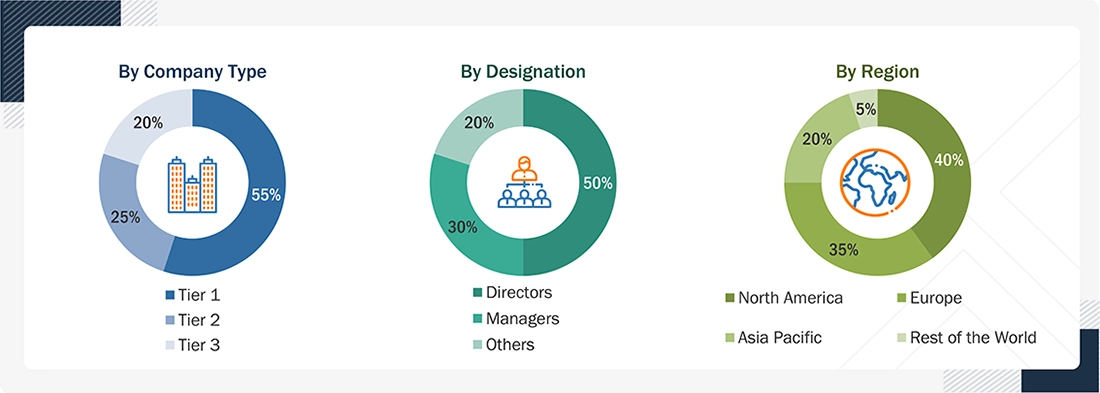
Note: Tier 1, Tier 2, and Tier 3 companies are classified based on their market revenue in 2024/2025 available in the public domain, product portfolios, and geographical presence. Other designations include consultants and sales, marketing, and procurement managers.
|
COMPANY NAME |
DESIGNATION |
|
BASF SE |
Senior Manager |
|
Rianlon Corporation |
Innovation Manager |
|
SABO S.p.A. |
Development Manager |
|
Syensqo SA/NV |
Production Supervisor |
|
Suqian Unitech Corp., Ltd. |
Sales Manager |
To know about the assumptions considered for the study, download the pdf brochure
Market Size Estimation
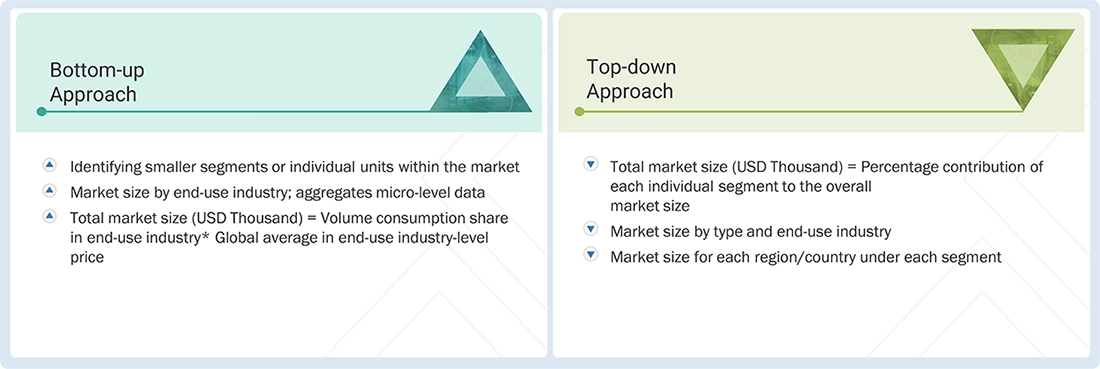
Both top-down and bottom-up approaches were used to estimate and validate the total size of the HALS market. These methods were also used extensively to estimate the size of various subsegments in the market. The research methodology used to estimate the market size includes the following:
- The key players in the industry were identified through extensive secondary research.
- The supply chain of the industry was determined through primary and secondary research.
- All percentage shares, splits, and breakdowns were determined using secondary sources and verified through primary sources.
- All possible parameters that affect the markets covered in this research study were accounted for, viewed in extensive detail, verified through primary research, and analyzed to obtain the final quantitative and qualitative data.
Hindered Amine Light Stabilizers (HALS) Market : Top-Down and Bottom-Up Approach
Data Triangulation
After determining the overall market size using the market size estimation processes explained above, the market was divided into several segments and subsegments. To complete the overall market engineering process and determine the exact statistics for each market segment and subsegment, data triangulation and market breakdown procedures were employed, as applicable. The data were triangulated by studying various factors and trends from both the demand and supply sides in the HALS industry.
Market Definition
According to the American Coatings Association, HALS are a group of chemical additives based on 2,2,6,6-tetramethyl piperidine (TMP) that function as radical scavengers to prevent photo-oxidative degradation of polymers. They are widely employed in coatings, adhesives, and sealants to resist surface defects like loss of gloss, cracking, and discoloration. In contrast to UV absorbers, HALS deliver long-term stabilization by functioning independently of film thickness and regenerating their active species during the stabilization process.
Key Stakeholders
- HALS manufacturers
- HALS distributors
- Raw material suppliers
- Government and research organizations
- Investment banks and private equity firms
Report Objectives
- To analyze and forecast the size of the HALS market in terms of value and volume
- To provide detailed information about the major drivers, restraints, challenges, and opportunities influencing the market growth
- To define, describe, and segment the market based on type, end-use industry, and region
- To forecast the size of the market segments based on regions such as Asia Pacific, North America, Europe, the Middle East & Africa, and South America
- To strategically analyze micromarkets with respect to individual growth trends, prospects, and their contribution to the overall market
- To strategically analyze the segmented markets with respect to individual growth trends, prospects, and contributions to the overall market
- To identify and analyze opportunities for stakeholders in the market
- To analyze competitive developments such as expansions, partnerships, joint ventures, mergers & acquisitions, agreements, and product launches in the market
- To strategically profile the key companies and comprehensively analyze their core competencies
Available customizations:
Along with the given market data, MarketsandMarkets offers customizations according to the company’s specific needs. The following customization options are available for the report:
Regional Analysis
- Further breakdown of a region with respect to a particular country or additional application
Company Information
- Detailed analysis and profiles of additional market players (up to five)
Get the Full Hindered Amine Light Stabilizers (HALS) Market Report
Full forecast, segment splits, and company analysis for all Hindered Amine Light Stabilizers (HALS) Market.
- China Hindered Amine Light Stabilizers (HALS) Market
- India Hindered Amine Light Stabilizers (HALS) Market
- Japan Hindered Amine Light Stabilizers (HALS) Market
- South Korea Hindered Amine Light Stabilizers (HALS) Market
- Thailand Hindered Amine Light Stabilizers (HALS) Market
- Malaysia Hindered Amine Light Stabilizers (HALS) Market
- Mexico Hindered Amine Light Stabilizers (HALS) Market
- US Hindered Amine Light Stabilizers (HALS) Market
- Germany Hindered Amine Light Stabilizers (HALS) Market
- France Hindered Amine Light Stabilizers (HALS) Market
- Spain Hindered Amine Light Stabilizers (HALS) Market
- Italy Hindered Amine Light Stabilizers (HALS) Market
- UK Hindered Amine Light Stabilizers (HALS) Market
- Turkey Hindered Amine Light Stabilizers (HALS) Market
- Saudi Arabia Hindered Amine Light Stabilizers (HALS) Market
- UAE Hindered Amine Light Stabilizers (HALS) Market
- South Africa Hindered Amine Light Stabilizers (HALS) Market
- Brazil Hindered Amine Light Stabilizers (HALS) Market
- Rest Of Europe Hindered Amine Light Stabilizers (HALS) Market
- Rest Of Asia Pacific Hindered Amine Light Stabilizers (HALS) Market
Need a Tailored Report?
Customize this report to your needs
Get 10% FREE Customization
Customize This Report
