
India Human Identification Market (2026-2031)

The India Human Identification Market was valued at $23.69 Million in 2026 and projected to reach to $48.35 Million by 2031, representing a compound annual growth rate of 15.3%. India's human identification market is poised for accelerated growth as the healthcare sector undergoes digital transformation.


| Market Size in | USD 26.32 MN |
| Market Forecast in | |
| CAGR | |
| Forecast Period | |
| Units Considered | Value (USD MN) |
India Human Identification Market Trends and Insights
- India's healthcare sector is increasingly adopting advanced identification technologies to enhance patient safety, streamline medical records management, and improve operational efficiency across hospitals and diagnostic centers.
- The market growth in India is driven by rising healthcare digitalization, government initiatives promoting digital health infrastructure, and growing demand for biometric solutions in clinical settings. India's human identification market is outpacing global growth trends, with a 15.3% compound annual growth rate significantly exceeding the global average of 10.9%.
- India's expanding population, increasing healthcare accessibility, and investments in health technology infrastructure are key catalysts for this accelerated expansion.
- By 2031, India's market is expected to more than double from its 2026 baseline, reflecting the country's commitment to modernizing healthcare delivery and strengthening patient identification systems across the Asia Pacific region..
Key Market Statistics
- CAGR (2026-2031) 15.3% CAGR
- Market Size, 2026 ~USD 23.69 Million
- Forecast, 2031 ~USD 48.35 Million
- Country India
India Human Identification Market Overview
Market Valuation Growth :
India's human identification market is valued at $23.69 million in 2026 and is projected to reach $48.35 million by 2031, representing a robust 15.3% CAGR, outpacing the global growth rate of 10.9%.
Healthcare Digitalization Drive :
Indian hospitals and diagnostic centers are rapidly adopting biometric and digital identification technologies to enhance patient safety, reduce medical errors, and streamline electronic health records management across urban and emerging healthcare facilities.
Regulatory Support & Infrastructure :
Government initiatives like Ayushman Bharat and the National Digital Health Mission are creating favorable conditions for human identification technology adoption in India's healthcare ecosystem, driving market expansion.
Operational Efficiency Gains :
Healthcare providers in India are leveraging advanced identification solutions to improve operational efficiency, reduce administrative burden, and enhance patient experience across multi-specialty hospitals and primary care centers.
India Human Identification Market Dynamics
- The increasing number of hospitals, diagnostic centers, and healthcare facilities across tier-2 and tier-3 cities are investing in advanced identification technologies to meet patient safety standards and regulatory compliance requirements.
- Government-backed health initiatives and rising healthcare expenditure are creating substantial opportunities for market expansion. The market will be driven by growing awareness of patient identification benefits, integration with electronic health records systems, and the need for interoperability across healthcare networks.
- As India's healthcare infrastructure modernizes and private healthcare providers expand, adoption of biometric and digital identification solutions will accelerate, positioning the country as a significant growth driver in the Asia-Pacific region..
Market Ecosystem
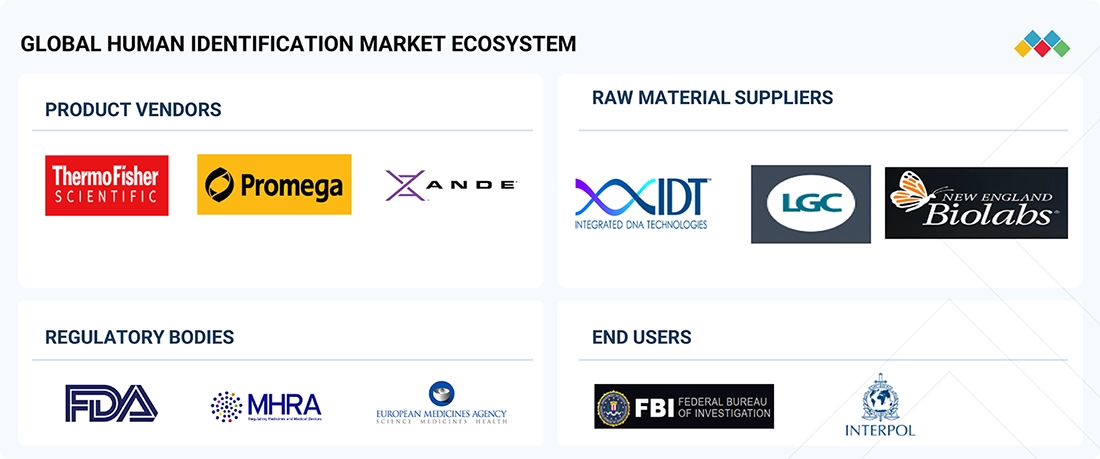
HUMAN IDENTIFICATION MARKET: COMMERCIAL USE CASES ACROSS INDUSTRIES
| COMPANY | USE CASE DESCRIPTION | BENEFITS |
|---|---|---|
 |
Provides advanced DNA extraction kits, STR analysis kits, and real-time PCR systems widely used by forensic laboratories for criminal investigations, paternity testing, and disaster victim identification. | Enables fast, accurate, and high-quality DNA profiling, improving case resolution rates and reducing turnaround time for human identification workflows. |
 |
Offers automated sample-preparation instruments and DNA purification consumables for forensic evidence processing, including degraded and trace biological samples. | Improves reliability of results from complex or low-quality samples, supports standardized processing, and enhances laboratory productivity. |
 |
Develops STR kits, genetic analyzers, and workflow-integrated solutions used by crime labs and research institutes for identity verification and forensic DNA testing. | Provides consistent, reproducible, and court-admissible DNA profiles, ensuring high confidence in forensic outcomes and compliance with global quality standards. |
Logos and trademarks shown above are the property of their respective owners. Their use here is for informational and illustrative purposes only.
Related Ecosystem
Biotechnology
- Reagents
- Polymerase Chain Reaction (PCR)
- Stem Cells
- Assay Kits
- Flow Cytometers
- Thermo Fisher Scientific Inc.
- Merck KGaA
- Danaher Corporation
- Agilent Technologies, Inc.
- Bio-Rad Laboratories, Inc.
Key Takeaways
- India's human identification market will grow from $23.69M (2026) to $48.35M (2031) at a 15.3% CAGR, outpacing global growth.
- India's healthcare digitalization initiatives and government support are primary drivers of market expansion through 2031.
- India's biometric and identification technology adoption in hospitals is accelerating patient safety and operational efficiency improvements.
- India's market growth reflects broader Asia Pacific trends toward modernized healthcare infrastructure and digital patient identification systems.
Human Identification Market Report Scope
| Report Metric | Details |
|---|---|
| Base Year | 2026 |
| Fastest Growing Segment | RAPID DNA ANALYSIS KITS & REAGENTS (Type) |
| Forecast Period | 2026–2031 |
| Growth Rate | CAGR of 10.9% from 2026 to 2031 |
| Largest Segment | FORENSICS (Application) |
| Market Size Base Year (Billions) | ~USD 1.01 (2026) |
| Revenue Forecast (Billions) | ~USD 1.69 (2031) |
| Segments Covered | Product, Type, Technology, Application, End User |
India Human Identification Market Report Segmentation
5 segment dimensions are covered across the global market.
By Product
- Consumables
- Instruments
- Software
By Type
- Dna Amplification Kits & Reagents
- Dna Amplification Systems
- Dna Analysis Systems
- Dna Extraction Kits & Reagents
- Dna Quantification Kits & Reagents
- Dna Quantification Systems
- Rapid Dna Analysis Kits & Reagents
- Sample Preparation & Extraction
- Sample Preparation & Extraction Systems
By Technology
- Capillary Electrophoresis
- Microarrays
- Next-Generation Sequencing
- Polymerase Chain Reaction
- Rapid Dna Analysis
By Application
- Forensics
- Other Applications
- Paternity Testing
By End User
- Forensic Laboratories
- Other End Users
- Research Centers And Academic & Government Institutes
INDIA: HUMAN IDENTIFICATION MARKET, BY END USER, 2024–2031
| Segment | 2024 | 2025 | 2026 | 2027 | 2028 | 2029 | 2030 | 2031 | CAGR (%) |
|---|---|---|---|---|---|---|---|---|---|
| FORENSIC LABORATORIES | 17 | 20.39 | 24.14 | 28.26 | 32.75 | 37.63 | 42.82 | 48.75 | 15.1 |
| OTHER END USERS | 4.17 | 4.99 | 5.89 | 6.87 | 7.94 | 9.09 | 10.31 | 11.7 | 14.7 |
| RESEARCH CENTERS AND ACADEMIC & GOVERNMENT INSTITUTES | 6.25 | 7.45 | 8.77 | 10.2 | 11.75 | 13.41 | 15.16 | 17.15 | 14.4 |
| TOTAL | 27.42 | 32.83 | 38.8 | 45.32 | 52.44 | 60.12 | 68.29 | 77.6 | 14.9 |
Target Audience
- Healthcare Technology Vendors : Biometric and identification solution providers need India-specific market data to assess market potential, identify customer segments, and develop localized product strategies for hospitals and diagnostic centers.
- Hospital & Healthcare Administrators : Decision-makers in Indian healthcare facilities require market insights to justify technology investments, benchmark adoption rates, and understand competitive positioning of identification solutions in their region.
- Private Equity & Investment Firms : Investors evaluating healthcare technology opportunities in India need comprehensive market sizing and growth forecasts to assess portfolio companies, identify acquisition targets, and evaluate market entry timing.
- Government & Policy Bodies : Healthcare regulators and government agencies developing digital health policies need market data to understand technology adoption trends, infrastructure requirements, and alignment with national health missions.
- Management Consultants & Analysts : Consulting firms advising healthcare clients in India require detailed market intelligence to support strategic recommendations, competitive analysis, and technology implementation roadmaps for identification systems.
Key Companies in the India Human Identification Market
| Company | HQ | Ownership | Strongest segments |
|---|---|---|---|
| ALERE INC | United States | Private Company | Infectious disease diagnostics,Cardiometabolic and point-of-care analyzers,Toxicology and workplace drug testing, |
| PERKIN ELMER INC | United States | Public Company | Diagnostics instruments and automation platforms,Diagnostics reagents, assays, and test kits,Life-science reagents and genomic workflow tools, |
| TECAN GROUP LTD. | Switzerland | Public Company | Liquid handling and automation platforms,Microplate readers, washers, and detection,Consumables, reagents, immunoassays, and antibodies, |
| BECKMAN COULTER | United States | Private Company | Clinical diagnostics and core lab systems,Life science research and discovery tools,Industrial and particle characterization systems, |
| NATERA INC | United States | Public Company | Reproductive Health (Panorama, Horizon, Vistara, Fetal Focus, Anora),Oncology MRD & Genomic Profiling (Signatera, Latitude, Altera, Empower),Transplant & Renal (Prospera, Renasight), |
| THERMO FISHER SCIENTIFIC INC. | United States | Public Company | Life Sciences Solutions,Analytical Instruments,Specialty Diagnostics, |
| QIAGEN N.V. | Netherlands | Public Company | Sample technology consumables and instruments,Molecular diagnostics assays (immune response, oncology, sexual and reproductive health),Research PCR, enzymes, and PCR instruments (qPCR, digital PCR), |
| ANDE CORPORATION | United States | Public Company | Grain and Oilseed Merchandising,Plant Nutrients and Fertilizers,Ethanol Production and Trading, |
| HAMILTON COMPANY | United States | Public Investment Firm | Primary and secondary fund-of-funds,Direct credit,Direct/co-investments and buyouts, |
| AUTOGEN INC. | Australia | Private Company | Motor Insurance,Home and Contents Insurance,Pet Insurance, |
| OXFORD NANOPORE TECHNOLOGIES PLC | United Kingdom | Public Company | PromethION (P2, P24, P48),GridION / GridION Q,MinION Mk 1D and other portable devices, |
| BODE CELLMARK FORENSICS, INC. | United States | Private Company | Forensic DNA casework and missing person identification services,CODIS and private DNA databanking services,Software (BodeLIMS, Bode Match, Bode Collection Point, Qualtrax), |
| BIO-RAD LABORATORIES, INC. | United States | Public Company | Life Science segment,Clinical Diagnostics segment,Other / Software and Services, |
| ZEISS | Germany | Public Company | Ophthalmology – Diagnostics (slit lamps, OCT, fundus, perimetry),Ophthalmology – Surgical (microscopes, phaco, vitrectomy, IOLs, laser vision correction),Microsurgery – Visualization and Tumor Workflow, |
ALERE INC
Alere Inc is a United States-based private company founded in 1981 with 9,700 employees. The company operates in the diagnostics and healthcare industry.
PERKIN ELMER INC
PerkinElmer Inc is a United States-based public company founded in 1937 with 11,000 employees. The company provides diagnostics, life sciences, and analytical solutions.
TECAN GROUP LTD.
Tecan Group Ltd is a Switzerland-based public company founded in 1980 with 3,166 employees. The company specializes in laboratory automation and diagnostics solutions.
BECKMAN COULTER
Beckman Coulter is a United States-based private company founded in 1935 with 11,900 employees. The company provides diagnostics and laboratory equipment solutions.
NATERA INC
Natera Inc is a United States-based public company founded in 2003 with 6,138 employees. The company specializes in genetic testing and diagnostics.
THERMO FISHER SCIENTIFIC INC.
Thermo Fisher Scientific Inc is a United States-based public company founded in 1956 with 125,000 employees. The company is a global leader in life sciences, diagnostics, and laboratory solutions.
QIAGEN N.V.
QIAGEN N.V. is a Netherlands-based public company founded in 1984 with 5,500 employees. The company provides molecular diagnostics and life sciences solutions.
ANDE CORPORATION
ANDE Corporation is a United States-based public company founded in 1947 with 2,028 employees. The company operates in the diagnostics and life sciences sector.
HAMILTON COMPANY
Hamilton Company is a United States-based private investment firm founded in 1991 with 785 employees. The company operates in the investment and financial services sector.
AUTOGEN INC.
Autogen Inc is an Australia-based private company founded in 2004 with 50 employees. The company operates in the diagnostics and life sciences sector.
OXFORD NANOPORE TECHNOLOGIES PLC
Oxford Nanopore Technologies PLC is a United Kingdom-based public company founded in 2005 with 1,316 employees. The company develops nanopore sequencing technology for genomic analysis.
BODE CELLMARK FORENSICS, INC.
Bode Cellmark Forensics, Inc is a United States-based private company founded in 1995 with 85 employees. The company provides forensic DNA analysis and services.
BIO-RAD LABORATORIES, INC.
Bio-Rad Laboratories, Inc is a United States-based public company founded in 1952 with 7,450 employees. The company provides diagnostics and life sciences research products.
ZEISS
Zeiss is a Germany-based public company founded in 1846 with 5,798 employees. The company provides optical and imaging solutions for diagnostics and research.
Reasons to Buy this Report
- Market Size & Growth Validation : Obtain precise valuation data for India's human identification market with verified CAGR of 15.3% (2026-2031), enabling accurate financial forecasting and investment decision-making for healthcare technology initiatives.
- India-Specific Growth Drivers : Understand unique market dynamics including government health missions, hospital expansion in tier-2/tier-3 cities, and regulatory compliance requirements that differentiate India's market from global trends.
- Competitive Landscape Intelligence : Identify key market players, adoption rates across hospital segments, and technology preferences specific to India's healthcare ecosystem to inform market entry and expansion strategies.
- Investment & Partnership Opportunities : Discover high-growth segments within India's healthcare sector, emerging healthcare providers, and technology integration opportunities aligned with digital health initiatives and infrastructure modernization.
- Strategic Planning & Forecasting : Leverage India-focused market projections through 2031 to develop targeted go-to-market strategies, resource allocation plans, and long-term business development roadmaps in the healthcare identification space.
Frequently asked questions
What is the current size of India's human identification market?
India's human identification market is valued at $23.69 million in 2026 and is projected to reach $48.35 million by 2031.
What is the growth rate of India's human identification market?
India's human identification market is growing at a compound annual growth rate (CAGR) of 15.3% from 2026 to 2031.
What factors are driving growth in India's human identification market?
India's market growth is driven by healthcare digitalization, government digital health initiatives, increasing patient safety awareness, and rising adoption of biometric technologies in clinical settings.
How does India's market growth compare to global trends?
India's 15.3% CAGR significantly exceeds the global average of 10.9%, positioning India as a high-growth market within the Asia Pacific region.
What applications are driving India's human identification market?
India's market is driven by patient identification systems, electronic health records integration, biometric authentication, and hospital management system implementations across healthcare facilities.
RESEARCH METHODOLOGY
This research study extensively used secondary sources, directories, and databases to identify and collect valuable information to analyze the global human identification market. In-depth interviews were conducted with primary respondents, including key industry participants, subject-matter experts (SMEs), C-level executives of leading market players, and industry consultants, to obtain and verify critical qualitative and quantitative information and to assess the market's growth prospects. The global market size estimated through secondary research was then triangulated with primary research inputs to arrive at the final market size.
Secondary Research
Secondary research was used mainly to identify and collect information for the extensive, technical, market-oriented, and commercial study of the global human identification market. The secondary sources used for this study include World Health Organization (WHO), Organisation for Economic Co-operation and Development (OECD), World Bank, INTERPOL, Scientific Working Group on DNA Analysis Methods (SWGDAM), Combined DNA Index System (CODIS), National DNA Data Bank of Canada, US Census Bureau, Federal Bureau of Investigation (FBI, US), American Society of Crime Laboratory Directors, American Academy of Forensic Sciences, National Center for Forensic Science (US), Forensic Science Regulator (UK), Australian Criminal Intelligence Commission (Australia), Medicines & Healthcare Products Regulatory Agency (UK), Statistics Canada, Ministry of Attorney General (UK), Federal Criminal Police Office (BKA, Germany), Pharmaceuticals and Medical Devices Agency (Japan), and National Crime Records Bureau (NCRB, India); corporate filings such as annual reports, SEC filings, investor presentations, and financial statements; press releases; and trade, business, professional associations. These sources were also used to obtain key information on major players, market classification, and segmentation aligned with industry trends, regional/country-level markets, market developments, and technology perspectives.
Primary Research
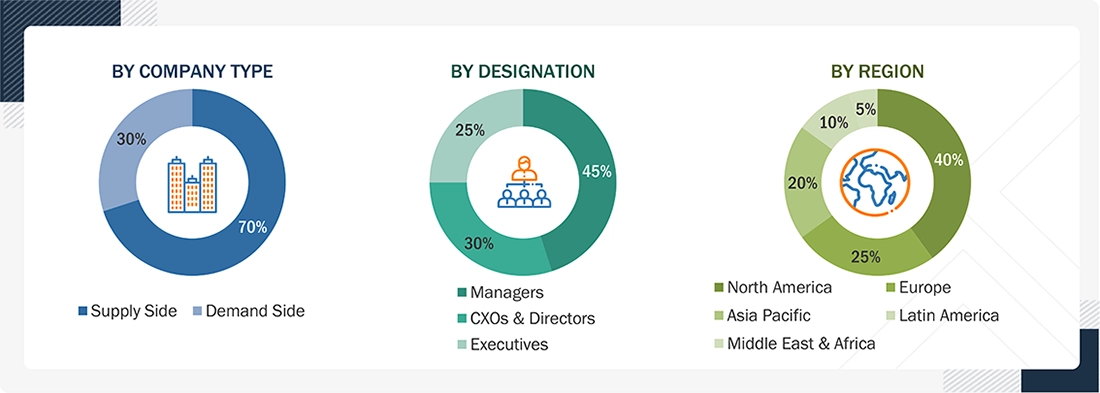
Following an initial assessment of the global human identification market landscape through secondary research, comprehensive primary research was undertaken. This involved conducting in-depth interviews with market experts from the demand side, including stakeholders from pharmaceutical and biotechnology firms, CROs, CMOs, and academic and research institutions. Additionally, interviews were conducted with key supply-side participants, including C-suite and senior executives, product managers, and marketing and sales leaders from prominent manufacturers, distributors, and channel partners. The research covered six major geographical regions: North America, Europe, Asia Pacific, Latin America, the Middle East, and Africa. Approximately 70% of the primary interviews were conducted with supply-side participants, while 30% were conducted with demand-side experts. Data collection methods included structured questionnaires, email correspondence, online surveys, personal interviews, and telephonic discussions to comprehensively understand market dynamics.
The following is a breakdown of the primary respondents:
To know about the assumptions considered for the study, download the pdf brochure
Market Size Estimation
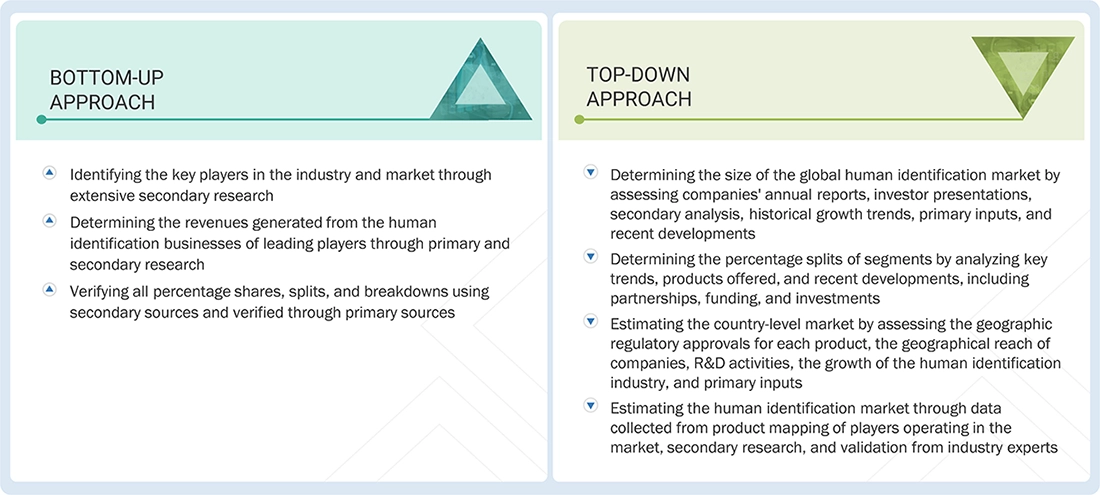
Both bottom-up and top-down approaches were used to estimate and validate the total size of the global human identification market. These methods were also widely used to estimate the sizes of various subsegments in the market. The research methodology used to estimate the market size includes the following:
- A list of the major global players operating in the human identification market was generated.
- The revenues generated from their human identification product portfolios have been determined through annual reports and secondary sources (including paid databases).
- The products were mapped according to the segments of the market. Percentage shares and splits were determined based on each segment's revenue contribution. This was verified using secondary sources and by industry experts.
- All assumptions, approaches, and individual shares/revenue estimates were validated through expert interviews.
Data Triangulation
After arriving at the market size from the estimation process explained above, the total market was divided into several segments and subsegments. To complete the overall market engineering process and obtain exact statistics for all segments and subsegments, data triangulation and market breakdown procedures were employed, as applicable. The data was triangulated by studying various factors and trends from both the demand and supply sides.
Market Definition
Human identification is the process of establishing and confirming an individual's unique identity. This process involves various techniques and methods that help determine individuality and link unknown materials or evidence to known identities. Human identification is widely used in forensics, paternity testing, disaster victim identification, and anthropology, among other applications, with DNA analysis and profiling a key tool in this sector. It also builds citizen databases to ensure better healthcare and develops an organized set of records.
Key Stakeholders
- Technology & Product Providers
- Forensic Laboratories
- Law Enforcement & Public Safety Agencies
- Government & Regulatory Bodies
- Academic & Research Institutions
- Contract Research & Forensic Service Providers
- Healthcare & Clinical Institutions
- Database & IT Infrastructure Providers
- Rapid DNA & Field Deployment Stakeholders
- Funding Bodies & Investors
Report Objectives
- To define, describe, and forecast the global human identification market based on product, technology, application, and end user
- To provide detailed information regarding the major factors influencing market growth (such as drivers, restraints, opportunities, and challenges)
- To strategically analyze micromarkets concerning individual growth trends, prospects, and contributions to the human identification market
- To analyze the opportunities in the market for stakeholders and provide details of the competitive landscape for market leaders
- To forecast the size of the market segments concerning six main regions: North America, Europe, the Asia Pacific, Latin America, the Middle East, and Africa
- To profile the key players in the global human identification market and comprehensively analyze their product portfolios, market positions, and core competencies
- To track and analyze competitive developments such as product approvals and launches, expansions, agreements, and collaborations in the human identification market
- To benchmark players within the human identification market using the company evaluation matrix framework, which analyzes market players based on various parameters within the broad categories of business and service strategy.
Available customizations:
With the given market data, MarketsandMarkets offers customizations to meet your company’s needs. The following customization options are available for this report:
Portfolio Assessment- Product Matrix, which gives a detailed comparison of the product portfolios of the top three companies.
- Detailed analysis and profiling of additional market players (up to three).
- A further breakdown of the Rest of Asia Pacific human identification market into countries
- A further breakdown of the Rest of Europe human identification market into countries
- A further breakdown of the Rest of Latin America human identification market into countries
Get the Full Human Identification Market Report
Full forecast, segment splits, and company analysis for all Human Identification Market.
- Canada Human Identification Market
- US Human Identification Market
- Germany Human Identification Market
- UK Human Identification Market
- France Human Identification Market
- Italy Human Identification Market
- Spain Human Identification Market
- China Human Identification Market
- Japan Human Identification Market
- Australia Human Identification Market
- South Korea Human Identification Market
- Brazil Human Identification Market
- Mexico Human Identification Market
- Saudi Arabia Human Identification Market
- Rest Of Europe Human Identification Market
- Rest Of Asia Pacific Human Identification Market
- Rest Of Latin America Human Identification Market
- Rest Of GCC Countries Human Identification Market
- United Arab Emirates Human Identification Market
Need a Tailored Report?
Customize this report to your needs
Get 10% FREE Customization
Customize This Report
