
UK Human Machine Interface Market (2023-2028)

The UK Human Machine Interface Market was valued at $192.9 Million in 2023 and projected to reach to $252.7 Million by 2028, representing a compound annual growth rate of 5.5%. The UK Human Machine Interface market is positioned for sustained growth through 2028, driven by accelerating automation in manufacturing and the automotive sector's shift toward smart production systems.


| Market Size in | USD 26.32 MN |
| Market Forecast in | |
| CAGR | |
| Forecast Period | |
| Units Considered | Value (USD MN) |
UK Human Machine Interface Market Trends and Insights
- The UK market reflects steady adoption of HMI technologies across manufacturing, automotive, and consumer electronics sectors, driven by increasing automation and digital transformation initiatives.
- The UK's position as a technology hub supports innovation in touchscreen displays, voice interfaces, and gesture recognition systems that enhance user interaction with industrial and consumer devices. Growth in the UK HMI market is underpinned by rising demand for intuitive control interfaces in smart appliances, industrial IoT applications, and automotive infotainment systems.
- The UK's regulatory environment and investment in Industry 4.0 initiatives encourage manufacturers to integrate advanced HMI solutions.
- Between 2023 and 2028, the UK market will benefit from increased R&D spending and partnerships between semiconductor firms and system integrators, positioning the country as a key player in European HMI innovation..
Key Market Statistics
- CAGR (2023-2028) 5.5% CAGR
- Market Size, 2023 ~USD 192.9 Million
- Forecast, 2028 ~USD 252.7 Million
- Country UK
UK Human Machine Interface Market Overview
Market Valuation :
The UK Human Machine Interface market reached £192.9 million in 2023, with projections to grow to £252.7 million by 2028, demonstrating consistent market expansion and investment confidence.
Growth Trajectory :
At a CAGR of 5.5%, the UK market is experiencing steady growth, outpacing some European peers while reflecting the nation's measured approach to industrial automation and digital transformation adoption.
Key Vertical Adoption :
Manufacturing, automotive, and consumer electronics sectors are driving HMI technology adoption across the UK, with increasing demand for intuitive interfaces in production environments and smart devices.
Digital Transformation Driver :
UK enterprises are leveraging HMI solutions to enhance operational efficiency, reduce downtime, and improve workforce productivity as part of broader Industry 4.0 and digital modernization initiatives.
UK Human Machine Interface Market Dynamics
- Government initiatives supporting industrial digitalization and the UK's strong engineering heritage create favorable conditions for HMI technology adoption.
- Investment in Industry 4.0 infrastructure and increasing demand for user-centric interface solutions across consumer electronics will further propel market expansion.
- The market's 5.5% CAGR reflects a balanced growth trajectory as organizations prioritize operational efficiency and workforce enablement through advanced HMI technologies..
Market Ecosystem
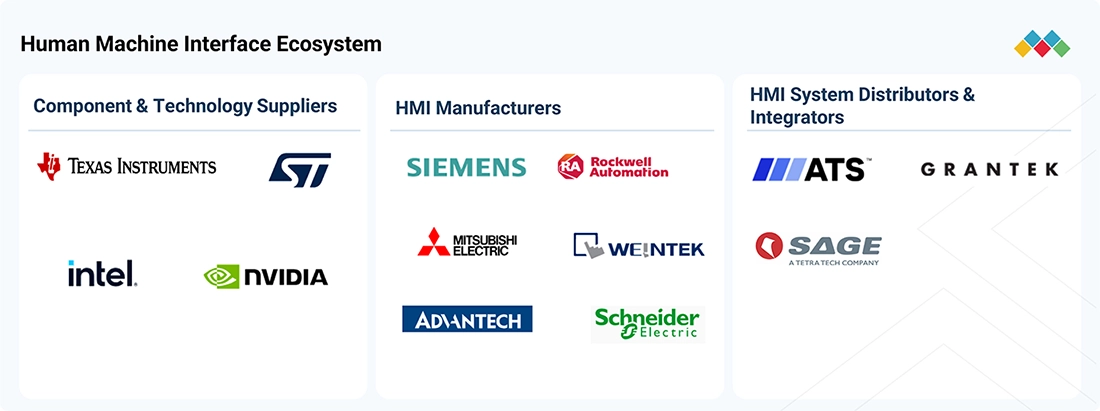
HUMAN MACHINE INTERFACE MARKET SIZE, SHARE & GROWTH REPORT: COMMERCIAL USE CASES ACROSS INDUSTRIES
| COMPANY | USE CASE DESCRIPTION | BENEFITS |
|---|---|---|
 |
Rockwell Automation Deploys PanelView operator terminals and FactoryTalk View software across automotive assembly, packaging lines, and pharmaceutical batch facilities. The systems provide graphic machine visualization, real time process alarm management, and direct integration with Logix programmable automation controllers. | Simplifies operator interaction through unified machine diagnostics | Accelerates troubleshooting by logging timestamped fault histories | Reduces operational overhead via direct controller tag sharing | Minimizes production errors with recipe and batch management tools |
 |
Siemens Delivers SIMATIC HMI Comfort and Unified panels combined with WinCC visualization software for discrete production lines and process manufacturing plants. The platform coordinates machine monitoring through HTML5 web clients, edge apps, and engineering workflows inside the TIA Portal framework. | Delivers platform independent machine monitoring across web browsers | Speeds configuration time through standardized drag and drop engineering objects | Decreases unplanned plant downtime via integrated hardware diagnostics | Improves visualization consistency across single machines and plantwide SCADA nodes |
 |
Schneider Implements Harmony industrial touchscreen terminals and EcoStruxure Machine SCADA software across water treatment plants, packaging machinery, and material handling systems. The interfaces process field telemetry, log equipment parameters, and support remote diagnostics over mobile devices. | Facilitates fast equipment servicing with remote web-based operator access | Protects electronics in harsh environments via IP66 and IP69K sealed enclosures | Streamlines machine integration through preconfigured communication drivers | Lowers programming overhead using modular application templates |
 |
ABB Deploys CP600 operator panels and ABB Ability digital interfaces across utility plants, power distribution facilities, and heavy process manufacturing sites. The systems handle centralized process visualization, multi protocol communication translation, and continuous sensor data collection. | Ensures uninterrupted operations in high electrical noise environments | Simplifies multi vendor hardware connectivity via native protocol conversion | Decreases operator response latency through prioritized visual alarm hierarchies | Reduces system engineering costs using scalable graphical interfaces |
 |
Honeywell international Integrates Experion panel PCs and industrial control stations across oil refining, chemical processing, and life sciences production lines. The hardware and software environments execute real time process visualization, high consequence alarm monitoring, and safety instrumented system oversight. | Enhances situational awareness through prioritized abnormal situation management | Complies with stringent life science regulatory reporting and electronic audit trails | Mitigates industrial safety hazards by isolating critical process alarms | Extends operating life cycles under extreme industrial temperatures and hazardous classifications |
Logos and trademarks shown above are the property of their respective owners. Their use here is for informational and illustrative purposes only.
Related Ecosystem
Industrial Automation
- Sensors
- Image Sensors
- Manufacturing Execution System (MES)
- Actuators
- Flow Sensors
- Siemens ag
- ABB India Limited
- Emerson Electric Co.
- HONEYWELL INTERNATIONAL INC.
- SCHNEIDER ELECTRIC SE
Industrial Iot
- Sensors
- Pressure Sensors
- Flow Sensors
- Gas Sensors
- Image Sensors
- Siemens ag
- ABB India Limited
- HONEYWELL INTERNATIONAL INC.
- Emerson Electric Co.
- SCHNEIDER ELECTRIC SE
Automotive Systems
- Light Commercial Vehicles (LCVs)
- Battery Electric Vehicle (BEV)
- Hybrid Electric Vehicle (HEV)
- Agricultural Tractors
- Fuel Cell Electric Vehicle (FCEV)
- BOSCH LIMITED
- DENSO Corporation
- ZF FRIEDRICHSHAFEN AG
- Continental ag
- GORKOVSKY AVTOMOBILNY ZAVOD
Key Takeaways
- The UK HMI market is valued at £192.9 million in 2023 and will reach £252.7 million by 2028 at a 5.5% CAGR.
- The UK market is driven by automation, IoT adoption, and digital transformation across manufacturing and automotive sectors.
- Touchscreen, voice, and gesture recognition technologies are key growth areas in the UK HMI landscape.
- The UK's tech ecosystem and Industry 4.0 investments position it as a regional innovation leader for HMI solutions.
Human Machine Interface Market Report Scope
| Report Metric | Details |
|---|---|
| Base Year | 2023 |
| Fastest Growing Segment | PHARMACEUTICALS (Process Industry) |
| Forecast Period | 2023-2030 |
| Growth Rate | CAGR of 8.2% from 2023 to 2030 |
| Largest Segment | EMBEDDED (Configuration) |
| Market Size Base Year (Billions) | ~USD 5.19 (2023) |
| Revenue Forecast (Billions) | ~USD 9.01 (2030) |
| Segments Covered | Offering, Type, Deployment Mode, Configuration, Process Industry, Discrete Industry, End-User Industry |
UK Human Machine Interface Market Report Segmentation
7 segment dimensions are covered across the global market.
By Offering
- Hardware
- Software
By Type
- Advanced Panel-Based Hmi
- Advanced Pc-Based Hmi
- Basic Hmi
- Din Rail Ipc
- Embedded Ipc
- Other Hardware Types
- Panel Ipc
- Rack Mount Ipc
By Deployment Mode
- Cloud-Based
- On-Premises
By Configuration
- Embedded
- Standalone
By Process Industry
- Chemicals
- Energy & Power
- Food & Beverages
- Metal & Mining
- Metals & Mining
- Oil & Gas
- Other Process Industries
- Others Process Industries
- Pharmaceuticals
- Water & Wastewater
- Water & Wastewater Treatment
By Discrete Industry
- Aerospace
- Automobile
- Automotive
- Medical Devices
- Other Discrete Industries
- Packaging
- Semiconductor & Electronics
By End-User Industry
- Discrete Industries
- Process Industries
Target Audience
- UK Manufacturing Executives : Require market data to justify automation investments, benchmark HMI adoption rates against competitors, and align digital transformation roadmaps with industry trends and growth opportunities.
- Automotive Sector Leaders : Need UK-specific HMI market intelligence to evaluate supplier capabilities, assess technology integration requirements, and plan smart production system implementations across UK facilities.
- HMI Solution Providers : Depend on accurate UK market sizing and forecasts to develop go-to-market strategies, allocate sales resources, identify high-potential customer segments, and measure market penetration.
- Technology Investors & PE Firms : Seek UK market validation data to evaluate investment opportunities in HMI companies, assess growth potential, understand competitive landscapes, and support portfolio company expansion strategies.
- Enterprise IT & Operations Teams : Use market research to evaluate HMI solution options, understand vendor landscape maturity, benchmark pricing and capabilities, and support technology selection and procurement decisions.
Reasons to Buy this Report
- UK-Specific Market Sizing : Access precise valuation data for the UK HMI market with verified 2023 baseline (£192.9M) and 2028 forecasts, enabling accurate budget allocation and investment planning for UK operations.
- Sector-Focused Insights : Understand HMI adoption patterns specific to UK manufacturing, automotive, and consumer electronics verticals, identifying growth opportunities and competitive dynamics within your target industries.
- Growth Rate Benchmarking : Compare UK's 5.5% CAGR against global 8.2% growth to assess market maturity, competitive intensity, and strategic positioning for UK-based or UK-focused HMI solution providers.
- Digital Transformation Context : Leverage insights into UK enterprise digital transformation initiatives and Industry 4.0 adoption to identify customer pain points, buying triggers, and optimal market entry strategies.
- Strategic Decision Support : Make informed decisions on market entry, expansion, product development, and partnership strategies with comprehensive UK market intelligence and forward-looking forecasts through 2028.
Frequently asked questions
What is the current size of the UK Human Machine Interface market?
The UK HMI market was valued at £192.9 million in 2023 and is expected to grow to £252.7 million by 2028.
What is the growth rate of the UK HMI market?
The UK HMI market is projected to grow at a compound annual growth rate (CAGR) of 5.5% from 2023 to 2028.
Which industries drive HMI adoption in the UK?
Key UK industries include manufacturing, automotive, consumer electronics, and industrial IoT, all increasingly adopting HMI technologies for automation and user engagement.
What HMI technologies are most prevalent in the UK market?
Touchscreen displays, voice interfaces, and gesture recognition systems are among the most widely adopted HMI technologies in the UK.
How does the UK HMI market compare to Europe?
The UK represents a significant portion of the European HMI market, with strong growth driven by its advanced tech ecosystem and Industry 4.0 initiatives.
RESEARCH METHODOLOGY
The research process for this study involved the systematic gathering, recording, and analysis of data on customers and companies operating in the human machine interface market. This process involved the extensive use of secondary sources, directories, and databases (Factiva and OANDA) to identify and collect valuable information for the comprehensive, technical, market-oriented, and commercial study of the human machine interface market. In-depth interviews were conducted with primary respondents, including experts from core and related industries, as well as preferred manufacturers, to obtain and verify critical qualitative and quantitative information and assess growth prospects. Key players in the human machine interface market were identified through secondary research, and their market rankings were determined through a combination of primary and secondary research. This research involved studying the annual reports of top players and conducting interviews with key industry experts, including CEOs, directors, and marketing executives.
Secondary Research
Various sources were referred to in the secondary research process to identify and collect information relevant to this study. These include company annual reports, press releases, investor presentations, white papers, technology journals, certified publications, articles by recognized authors, directories, and databases.
Secondary research was primarily used to gather key information on the industry’s value chain, the total pool of market players, market classification by industry trends at the most detailed level, regional markets, and key developments from both market- and technology-oriented perspectives.
Primary Research
Primary research was also conducted to identify the segmentation types, key players, competitive landscape, and key market dynamics, including drivers, restraints, opportunities, challenges, and industry trends, as well as the key strategies adopted by players operating in the human machine interface market. Extensive qualitative and quantitative analyses were conducted across the complete market engineering process to present key information and insights throughout the report.
Extensive primary research was conducted following the acquisition of knowledge about the human machine interface market scenarios through secondary research. Several primary interviews were conducted with experts from the demand side (end-use industry and region) and the supply side (offering and configuration) across four major geographic regions: North America, Europe, Asia Pacific, and RoW. Approximately 60% and 40% of the primary interviews were conducted from the supply and demand sides, respectively. These primary data was collected through questionnaires, emails, and telephonic interviews.
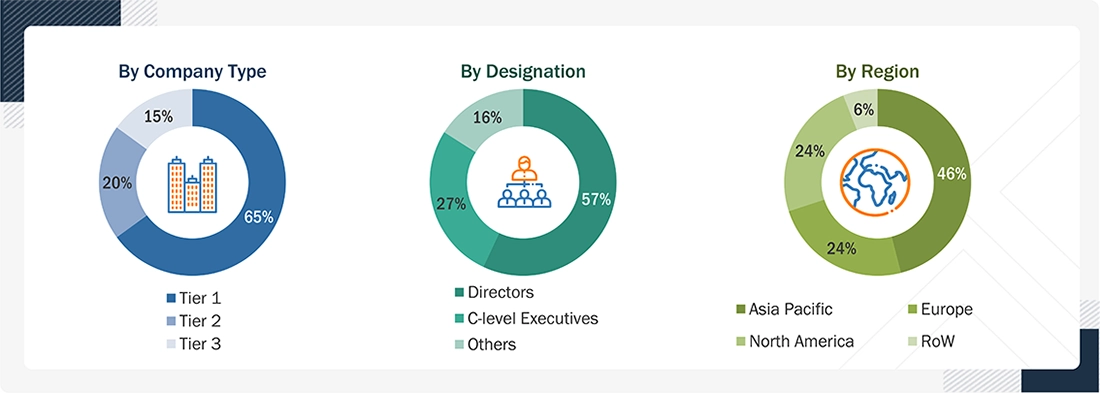
Notes: The three tiers of companies were defined based on their total/segmental revenue as of 2025: Tier 1 = >USD 1 billion, Tier 2 = USD 1 billion–USD 500 million, and Tier 3 = <USD 500 million.
To know about the assumptions considered for the study, download the pdf brochure
Market Size Estimation
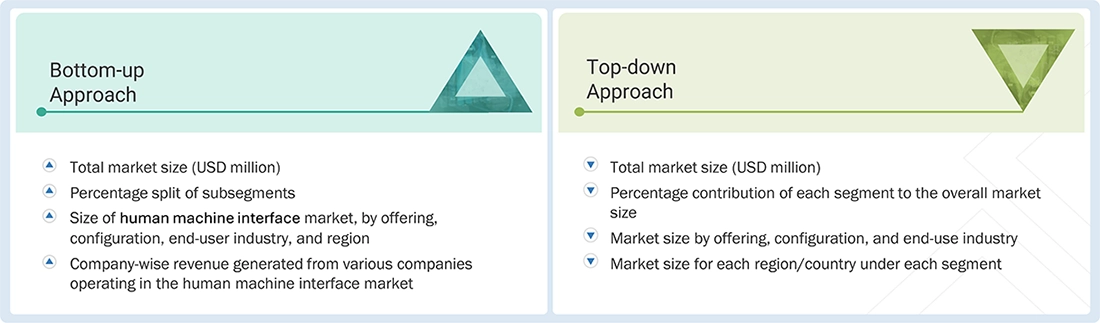
In the complete market engineering process, top-down and bottom-up approaches, along with several data triangulation methods, were used to estimate and validate the size of the Human machine interface market and various other dependent submarkets. Key players in the market were identified through secondary research, and their market share in each region was determined through a combination of primary and secondary research. This research methodology involved analyzing the annual and financial reports of the top players and conducting interviews with experts (including CEOs, VPs, directors, and marketing executives) to gather key insights (both quantitative and qualitative).
All percentage shares, splits, and breakdowns were determined using secondary sources and verified through primary sources. All possible parameters affecting the markets covered in this study were accounted for, examined in detail, verified through primary research, and analyzed to obtain final quantitative and qualitative data. This data was consolidated and supplemented with detailed inputs and analysis from MarketsandMarkets and presented in this report.
Data Triangulation
After determining the overall market size through the estimation process, as explained above, the total market was divided into several segments and subsegments. To complete the overall market engineering process and obtain precise statistics for all segments and subsegments, the data triangulation procedure was employed, as applicable. The data was triangulated by studying various factors and trends from the demand and supply sides. Additionally, the market was validated using both top-down and bottom-up approaches.
Market Definition
HMI, commonly known as the man-machine interface (MMI), enables operators and line supervisors to coordinate and control the manufacturing process. It acts as an interface between the user and the machine. The interface comprises hardware and software that assist operators in converting complex process variables into actionable and usable information. It reduces human involvement in the manufacturing process, thereby increasing the productivity and safety of operators.
Key Stakeholders
- Associations and industrial bodies
- Component suppliers and distributors
- HMI system end users
- Government bodies such as regulatory authorities and policymakers
- HMI hardware manufacturers
- HMI software and service providers
- Industrial automation equipment providers
- Market research and consulting firms
- Original equipment manufacturers (OEMs)
- Research institutes and organizations
Report Objectives
- To describe and forecast the human machine interface market, in terms of value, based on offering, configuration, and end-use industry
- To define and forecast the market size, in terms of value, with regard to four main regions: North America, Europe, Asia Pacific, and the Rest of the World (RoW)
- To describe technologies deployed in HMI devices, trends and emerging applications of HMI technologies, components of HMI solutions, screen size-based classification of HMI systems, and sales channels of HMI solutions
- To provide detailed information regarding drivers, restraints, opportunities, and challenges influencing the growth of the market
- To understand the impact of artificial intelligence (AI) on the market
- To strategically analyze micromarkets with respect to individual growth trends, prospects, and contributions to the total market
- To provide a qualitative overview of different human machine interface technologies
- To analyze opportunities for various stakeholders by identifying high-growth segments of the market
- To strategically profile key players and comprehensively analyze their market position in terms of ranking and core competencies, along with detailing the competitive landscape of the market
- To analyze competitive developments, such as acquisitions, product launches, developments, and partnerships in the market
- To provide a detailed overview of the ecosystem analysis, case study analysis, patent analysis, trade analysis, technology analysis, average selling price (ASP) analysis, AI/Gen AI impact analysis, Porter’s five forces analysis, macroeconomic outlook, and regulatory landscape pertaining to the Human machine interface market
Available customizations:
With the given market data, MarketsandMarkets offers customizations according to the company’s specific needs. The following customization options are available for the report:
Company Information
- Detailed analysis and profiling of additional market players (up to 5)
Get the Full Human Machine Interface Market Report
Full forecast, segment splits, and company analysis for all Human Machine Interface Market.
- US Human Machine Interface Market
- Canada Human Machine Interface Market
- Mexico Human Machine Interface Market
- Germany Human Machine Interface Market
- France Human Machine Interface Market
- Rest Of Europe Human Machine Interface Market
- China Human Machine Interface Market
- Japan Human Machine Interface Market
- India Human Machine Interface Market
- Rest Of Asia Pacific Human Machine Interface Market
Need a Tailored Report?
Customize this report to your needs
Get 10% FREE Customization
Customize This Report
