
Asia Pacific Humanoid Robot Market (2026-2031)

The Asia Pacific Humanoid Robot Market was valued at $25477.5 Million in 2026 and projected to reach to $33058.5 Million by 2031, representing a compound annual growth rate of CAGR 15.8%. The Asia Pacific humanoid robot market is positioned for substantial growth through 2031, driven by rapid industrialization, labor shortages, and technological advancement across the region.


| Market Size in | USD 26.32 MN |
| Market Forecast in | |
| CAGR | |
| Forecast Period | |
| Units Considered | Value (USD MN) |
Asia Pacific Humanoid Robot Market Trends and Insights
- Asia Pacific's growth trajectory reflects strong demand from manufacturing, healthcare, and service sectors across the region.
- The 15.8% compound annual growth rate demonstrates Asia Pacific's critical role in the global humanoid robotics ecosystem, driven by technological advancement and industrial automation adoption. Asia Pacific's market expansion is underpinned by increasing labor costs, aging demographics, and government initiatives supporting robotics innovation.
- Between 2026 and 2031, Asia Pacific is expected to capture substantial market share as countries like Japan, China, and South Korea lead in humanoid robot development and deployment.
- Asia Pacific's competitive advantage stems from established semiconductor manufacturing capabilities and significant R&D investments in robotics technology. The region's humanoid robot market reflects broader trends in industrial automation and AI integration.
- Asia Pacific continues to attract major robotics manufacturers and startups, positioning the region as a key growth engine for the global humanoid robot market through 2031..
Key Market Statistics
- CAGR (2026-2031) CAGR 15.8%
- Market Size, 2026 ~USD 25477.5 Million
- Forecast, 2031 ~USD 33058.5 Million
- Geography Asia Pacific
Asia Pacific Humanoid Robot Market Overview
China Dominates Regional Market :
China commands the Asia Pacific humanoid robot market with USD 23,792.2 million in 2026, representing over 93% of the region's total market value and driving significant innovation in manufacturing automation and service robotics.
Strong 15.8% Regional CAGR :
Asia Pacific's humanoid robot market is projected to grow from USD 25,477.5 million in 2026 to USD 33,058.5 million by 2031, demonstrating robust expansion driven by manufacturing, healthcare, and service sector adoption across the region.
Japan's Advanced Robotics Ecosystem :
Japan contributes USD 4,895.3 million to the Asia Pacific market, leveraging its established robotics expertise and aging population demographics to drive demand for humanoid robots in healthcare and elderly care applications.
Emerging Growth in South Korea and Singapore :
South Korea (USD 2,051.5 million) and Singapore (USD 1,029.7 million) are emerging as secondary growth hubs, with strong technology sectors and government support for robotics innovation accelerating market penetration.
Asia Pacific Humanoid Robot Market Dynamics
- China's manufacturing dominance and Japan's robotics expertise create a powerful innovation ecosystem, while emerging economies like India and Southeast Asia present untapped opportunities.
- Government initiatives supporting automation and AI development, combined with increasing investment in R&D, will accelerate adoption across manufacturing, healthcare, and service sectors. The region's demographic challenges, particularly aging populations in Japan and South Korea, are creating urgent demand for humanoid robots in elderly care and healthcare services.
- Strategic partnerships between local tech companies and global robotics manufacturers are expanding market accessibility.
- By 2031, Asia Pacific is expected to solidify its position as the global leader in humanoid robot deployment, with diversified applications spanning industrial automation, medical assistance, and consumer services..
Market Ecosystem
HUMANOID ROBOT MARKET SIZE, SHARE, AND TRENDS: COMMERCIAL USE CASES ACROSS INDUSTRIES
| COMPANY | USE CASE DESCRIPTION | BENEFITS |
|---|---|---|
 |
Provides humanoid robots such as G1 for education, research, AI training, mobility testing, and manipulation-related development. | Supports humanoid robot experimentation, AI-driven learning, dexterous manipulation testing, and advanced mobility development. |
 |
Offers full-size humanoid robots such as A2 Ultra for reception, route guidance, explanation, obstacle avoidance, commercial performance, and brand ambassador applications. | Improves visitor engagement, supports autonomous service interaction, enhances brand visibility, and enables multi-scenario commercial deployment. |
 |
Provides Walker S industrial humanoid robot for factory assembly-line operations, object detection, grasping, navigation, and manufacturing system integration. | Improves industrial automation, supports safe synchronized operations, enhances object handling, and enables real-time production data exchange. |
 |
Develops general-purpose humanoid robots, small/medium biped humanoid robots, and educational programming robots for research, business services, industrial manufacturing, training, and education. | Supports wider humanoid adoption across research, industrial, service, and education use cases, while enabling training and application development. |
 |
Offers humanoid robots such as PM01, SE01, T800, and SA01 for embodied intelligence, general-purpose humanoid development, mobility testing, and service/retail applications. | Enhances humanoid mobility development, supports service interaction, enables embodied AI testing, and strengthens deployment potential across commercial environments. |
Logos and trademarks shown above are the property of their respective owners. Their use here is for informational and illustrative purposes only.
Related Ecosystem
Drones And Robotics
- Sensors
- Articulated Robots
- Cartesian Robots
- Scara Robots
- Actuators
- ABB India Limited
- KUKA AG
- MOMENTIVE PERFORMANCE MATERIALS INC.
- Fanuc Corporation
- STAUBLI INTERNATIONAL AG
Key Takeaways
- Asia Pacific's humanoid robot market will grow from USD 25.5B (2026) to USD 33.1B (2031) at a 15.8% CAGR, reflecting strong regional demand.
- Asia Pacific leads in humanoid robot adoption across manufacturing, healthcare, and service industries due to labor shortages and automation needs.
- Japan, China, and South Korea drive Asia Pacific innovation through advanced R&D, semiconductor capabilities, and government robotics initiatives.
- Asia Pacific's aging population and rising labor costs accelerate humanoid robot deployment across the region through 2031.
Humanoid Robot Market Report Scope
| Report Metric | Details |
|---|---|
| Base Year | 2026 |
| Fastest Growing Segment | SOFTWARE (Offering) |
| Forecast Period | 2026–2031 |
| Growth Rate | CAGR of 28.1% from 2026 to 2031 |
| Largest Segment | BIPED (Type) |
| Market Size Base Year (Billions) | ~USD 5.41 (2026) |
| Revenue Forecast (Billions) | ~USD 18.67 (2031) |
| Segments Covered | Type, Offering, Application, Component, Actuator Type, Sensor Type, System Type, Controller Type, Communication Network |
Asia Pacific Humanoid Robot Market Report Segmentation
9 segment dimensions are covered across the global market.
By Type
- Biped
- Torso & Stationary
- Wheel Drive
By Offering
- Hardware
- Services
- Software
By Application
- Education
- Healthcare
- Hospitality & Entertainment
- Manufacturing
- Other Applications
- Personal Assistance & Caregiving
- Warehousing & Distribution
By Component
- Actuation Systems
- Actuator Electronics
- Communication Systems
- Compute & Control Systems
- Motion Components
- Motors
- Other Hardware Components
- Perception Systems
- Power Systems
- Robot Control Systems
By Actuator Type
- Linear Actuators
- Rotary Actuators
By Sensor Type
- Audio Sensors
- Cameras & Spatial Awareness Sensors
- External Sensors
- Force & Contact Sensors
- Health Monitoring Sensors
- Infrared Sensors
- Internal Sensors
- Motion & Position Sensors
- Thermal & Proximity Sensors
By System Type
- Battery Management Systems
- Battery Packs
- Cpus
- Gpus
- Npus
- Power & Charging Management Components
- Wired Systems
- Wireless Systems
By Controller Type
- Joint Controllers
- Motion Controllers
By Communication Network
- 5G/Cellular
- Controller Area Network (Can)
- Ethercat
- Ethernet
- Wi-Fi
Target Audience
- Robotics Manufacturers : Identify market expansion opportunities across Asia Pacific's diverse economies, understand regional demand drivers, and develop localized product strategies for manufacturing, healthcare, and service applications.
- Technology Investors : Evaluate investment potential in Asia Pacific's high-growth humanoid robot sector, with detailed market sizing, growth projections, and country-specific opportunities from China to emerging markets.
- Industrial Automation Companies : Assess humanoid robot integration opportunities in Asia Pacific's manufacturing sector, particularly in China and Japan, to enhance production efficiency and address regional labor market challenges.
- Healthcare & Elderly Care Providers : Understand humanoid robot adoption trends in Asia Pacific's healthcare sector, driven by aging populations in Japan and South Korea, to improve patient care and operational efficiency.
- Government & Policy Makers : Access regional market data to inform robotics policy, innovation incentives, and workforce development strategies aligned with Asia Pacific's economic priorities and technological advancement goals.
Key Companies in the Asia Pacific Humanoid Robot Market
| Company | HQ | Ownership | Strongest segments |
|---|---|---|---|
| IROBOT CORPORATION | United States | Private Company | Roomba robot vacuums,Roomba vacuum and mop combos,Robot mop accessories, |
| FUJISOFT INCORPORATED | Japan | Private Company | Systems integration, outsourcing, and data warehousing,Embedded software, mobile development, and information appliances,Cloud integration and security solutions, |
| AGIBOT INNOVATION (SHANGHAI) TECHNOLOGY CO., LTD. | China | Private Company | Integrated robotic systems (hardware + AI software),Software, perception, and control platforms,Services, integration, and maintenance, |
| UBTECH ROBOTICS CORP LTD. | China | Public Company | Logistics and industrial robots (AMRs, forklifts, omnidirectional, Chitu L4),Humanoid and commercial service robots (Walker, Panda, delivery, smart service),AI education robots and platforms (Alpha Mini, Alpha 1E, UGOT, uKit, Yanshee), |
| TESLA | United States | Public Company | Automotive vehicles (new and used),Software, services, and regulatory credits,Energy generation and storage, |
| ROBOTIS | South Korea | Public Company | DYNAMIXEL robot actuators,DYNAMIXEL DRIVE cycloid gears,Autonomous indoor delivery robots, |
IROBOT CORPORATION
iRobot Corporation is a United States-based private company founded in 1990 with 541 employees.
FUJISOFT INCORPORATED
Fujisoft Incorporated is a Japan-based private company founded in 1970 with 19,689 employees.
AGIBOT INNOVATION (SHANGHAI) TECHNOLOGY CO., LTD.
Agibot Innovation (Shanghai) Technology Co., Ltd. is a China-based private company founded in 2019.
UBTECH ROBOTICS CORP LTD.
UBTech Robotics Corp Ltd. is a China-based public company founded in 2012 with 2,550 employees.
TESLA
Tesla is a United States-based public company founded in 2003 with 134,785 employees.
ROBOTIS
Robotis is a South Korea-based public company founded in 1999 with 103 employees.
Countries within Asia Pacific - compare and drill down
| Country | 2025 size (native) |
|---|---|
| China | USD 23792.2 Million |
| Japan | USD 4895.3 Million |
| South Korea | USD 2051.5 Million |
| Singapore | USD 1029.7 Million |
| Australia | USD 420 Million |
| India | USD 221.8 Million |
| Rest Of Asia Pacific | USD 648 Million |
Country market size visualization
Reasons to Buy this Report
- China Market Intelligence : Gain deep insights into China's USD 23.8 billion humanoid robot market, the region's largest segment, including competitive dynamics, manufacturing applications, and technology leadership positioning.
- Regional Growth Forecasting : Access detailed 5-year projections for Asia Pacific's 15.8% CAGR expansion, enabling strategic planning and investment decisions across the region's diverse markets and application sectors.
- Country-Level Market Breakdown : Analyze individual market sizes for China, Japan, South Korea, Singapore, Australia, and India to identify high-potential entry points and competitive opportunities within Asia Pacific.
- Sector-Specific Demand Analysis : Understand humanoid robot adoption patterns across manufacturing, healthcare, and service sectors specific to Asia Pacific, with insights into regional regulatory environments and customer preferences.
- Competitive Landscape Mapping : Benchmark against regional and global competitors with market share data, technology trends, and strategic initiatives specific to Asia Pacific's rapidly evolving robotics ecosystem.
Frequently asked questions
What is the projected size of the Asia Pacific humanoid robot market by 2031?
Asia Pacific's humanoid robot market is projected to reach USD 33,058.5 million by 2031, up from USD 25,477.5 million in 2026.
What is the CAGR for the Asia Pacific humanoid robot market?
Asia Pacific's humanoid robot market is expected to grow at a compound annual growth rate of 15.8% between 2026 and 2031.
Which countries are driving growth in Asia Pacific's humanoid robot market?
Japan, China, and South Korea are leading Asia Pacific's humanoid robot market through advanced R&D, manufacturing capabilities, and government support for robotics innovation.
What industries are adopting humanoid robots in Asia Pacific?
Asia Pacific's humanoid robot adoption is strongest in manufacturing, healthcare, logistics, and service sectors, driven by labor shortages and automation demands.
What factors are accelerating humanoid robot adoption in Asia Pacific?
Asia Pacific's aging demographics, rising labor costs, government robotics initiatives, and advanced semiconductor infrastructure are key drivers of humanoid robot market growth.
RESEARCH METHODOLOGY
This study involved four major activities in estimating the current size of the humanoid robot market. Exhaustive secondary research was conducted to collect information on the market, peer market, and parent market. Validating these findings, assumptions, and sizing with industry experts across the value chain through primary research was the next step. Both top-down and bottom-up approaches were employed to estimate the complete market size. After that, market breakdown and data triangulation methods were used to estimate the market size of segments and subsegments. Two sources of information, secondary and primary, were used to identify and collect information for an extensive technical and commercial study of the humanoid robot market.
Secondary Research
Various secondary sources were referred to in the secondary research process to identify and collect information relevant to this study. The secondary sources included annual reports, press releases, investor presentations, company websites, product brochures, white papers, journals and other certified publications, articles by recognized authors, directories, and databases. Secondary research was conducted to obtain key information on the industry’s supply chain, the market’s value chain, the total pool of key players, market segmentation by type, offering, application, and region, regional markets, and key developments from market- and technology-oriented perspectives. The secondary data was collected and analyzed to determine the overall size of the humanoid robot market, and the results were further validated through primary research.
Primary Research
Extensive primary research was conducted after gaining an understanding of the current state of the humanoid robot market through secondary research. Several primary interviews were conducted with experts from the demand and supply sides across four major regions: North America, Europe, Asia Pacific, and the Rest of the World. This primary data was collected through questionnaires, emails, and telephonic interviews.
Breakdown of Primary Interviews
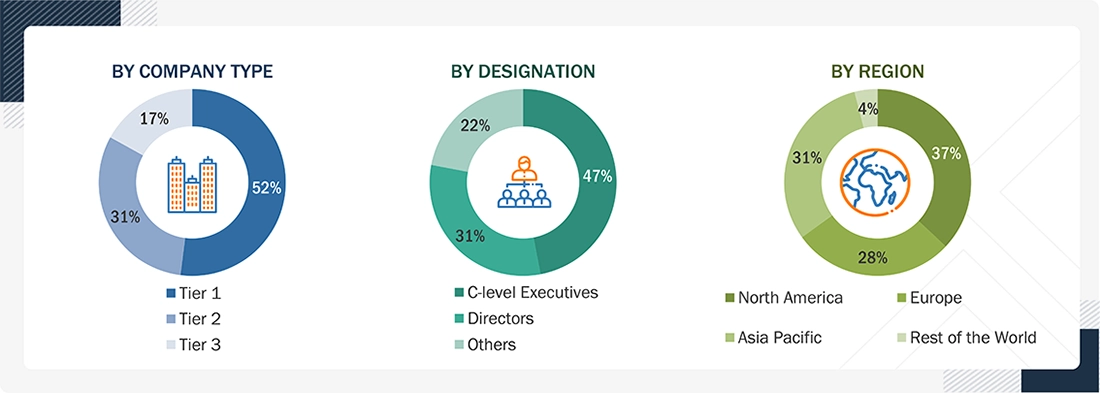
Note: Three tiers of companies were defined based on their total revenue as of 2025: tier 3: revenue less than USD 500 million; tier 2: revenue between USD 500 million and USD 5 billion; and tier 1: revenue more than USD 5 billion. Other designations include product, sales, and marketing managers. Rest of the World mainly includes South America, Africa, and the Middle East.
To know about the assumptions considered for the study, download the pdf brochure
Market Size Estimation
Both top-down and bottom-up approaches were used to estimate and validate the total size of the humanoid robot market. These methods were also used extensively to estimate the size of various market subsegments. The following research methodology was used to estimate the market size:
- Major players in the industry and markets were identified through extensive secondary research.
- The industry’s value chain and market size (in terms of value) were determined through primary and secondary research processes.
- All percentage shares, splits, and breakdowns were determined using secondary sources and verified through primary sources
Humanoid Robot Market: Top-Down and Bottom-Up Approach
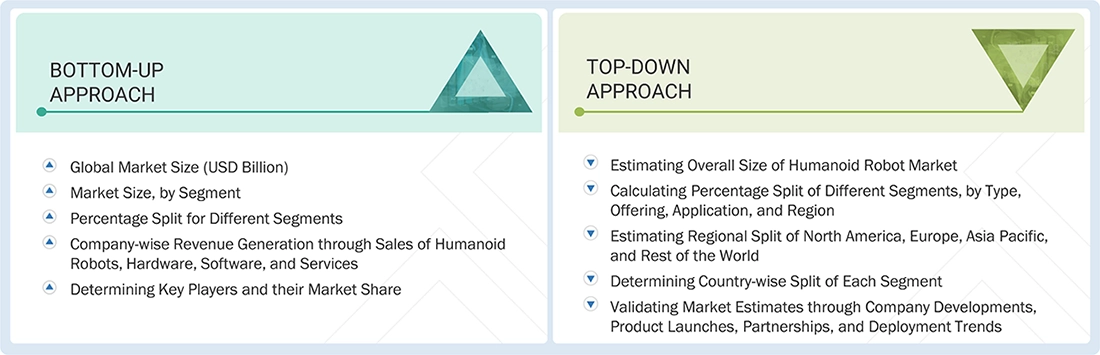
Data Triangulation
After arriving at the overall size of the humanoid robot market from the market size estimation process explained above, the total market was split into several segments and subsegments. Data triangulation and market breakdown procedures were employed, where applicable, to complete the overall market engineering process and derive the exact statistics for all market segments and subsegments. The data was triangulated by studying various factors and trends from both the demand and supply sides. Additionally, the market size was validated using both top-down and bottom-up approaches.
Market Definition
The humanoid robot market comprises robots designed with human-like physical structures, mobility systems, sensing capabilities, control systems, and AI-enabled software to perform tasks in human-designed environments. It has a torso, a head, two arms, and two legs; however, some humanoid robots may replicate specific parts of the human body. It is a complex machine equipped with hardware, software, and cutting-edge technologies to perform various tasks in different industries. These robots are used to support automation, interaction, assistance, mobility, manipulation, and operational tasks across industrial, commercial, healthcare, education, hospitality, retail, and personal assistance environments. Humanoid robots play a vital role in improving productivity, supporting labor-intensive operations, enabling safer task execution, enhancing human–robot interaction, and expanding automation into environments where traditional robots may require major infrastructure changes. As physical AI, robot foundation models, sensors, actuators, control systems, and fleet-management platforms continue to advance, humanoid robots are becoming essential components of next-generation automation ecosystems.
Key Stakeholders
- Government bodies and policymakers
- Industry organizations, forums, alliances, and associations
- Market research and consulting firms
- Raw material suppliers and distributors
- Research institutes and organizations
- Traders and suppliers
- Raw material suppliers
- Original equipment manufacturers (OEMs)
- OEM technology solution providers
- Technology, service, and solution providers
- Intellectual property (IP) core and licensing providers
- Suppliers and distributors
- Forums, alliances, and associations
- Technology investors
- Research institutes and organizations
- Analysts and strategic business planners
- Market research and consulting firms
Report Objectives
- To define, describe, and forecast the humanoid robot market based on type, offering, and application, in terms of value
- To describe and forecast the size of the market in four regions: North America, Europe, Asia Pacific, and the Rest of the World (RoW), along with their respective countries, in terms of value
- To provide detailed information regarding drivers, restraints, opportunities, and challenges influencing market growth
- To strategically analyze micromarkets with respect to individual growth trends, prospects, and contributions to the overall market size
- To study the complete value chain of the market
- To analyze opportunities for stakeholders by identifying high-growth segments of the market
- To strategically profile the key players and comprehensively analyze their market positions in terms of their ranking and core competencies
- To analyze competitive developments, such as product launches, acquisitions, collaborations, and partnerships, in the market
- To provide ecosystem analysis, case study analysis, patent analysis, technology analysis, impact of AI/Gen AI, impact of 2025 US tariffs, key conferences and events, Porter’s five forces analysis, and regulations pertaining to the market under study
- To provide a macroeconomic outlook for all the regions
Available customizations:
With the market data given, MarketsandMarkets offers customizations according to the company’s specific needs. The following customization options are available for the report:
Company Information
-
Detailed analysis and profiling of additional market players (up to 5)
Get the Full Humanoid Robot Market Report
Full forecast, segment splits, and company analysis for all Humanoid Robot Market.
- Rest Of Europe Humanoid Robot Market
- Rest Of Asia Pacific Humanoid Robot Market
- GCC Countries Humanoid Robot Market
- Rest Of Middle East Humanoid Robot Market
- US Humanoid Robot Market
- Canada Humanoid Robot Market
- Mexico Humanoid Robot Market
- UK Humanoid Robot Market
- Germany Humanoid Robot Market
- France Humanoid Robot Market
- Italy Humanoid Robot Market
- Spain Humanoid Robot Market
- China Humanoid Robot Market
- Japan Humanoid Robot Market
- India Humanoid Robot Market
- South Korea Humanoid Robot Market
- Australia Humanoid Robot Market
- Singapore Humanoid Robot Market
Need a Tailored Report?
Customize this report to your needs
Get 10% FREE Customization
Customize This Report
