
UK Hydrogen Generation Market (2025-2030)

The UK Hydrogen Generation Market was valued at $770 Million in 2025 and projected to reach to $1361 Million by 2030, representing a compound annual growth rate of 12.1%. The UK hydrogen generation market is positioned for substantial expansion as the nation accelerates its transition toward net-zero emissions by 2050.


| Market Size in | USD 26.32 MN |
| Market Forecast in | |
| CAGR | |
| Forecast Period | |
| Units Considered | Value (USD MN) |
UK Hydrogen Generation Market Trends and Insights
- The UK's commitment to decarbonization and net-zero targets is driving significant investment in hydrogen production technologies, positioning the nation as a leader in clean energy transition within Europe.
- The UK's strategic focus on green hydrogen infrastructure and industrial applications is accelerating market expansion during this forecast period. The UK hydrogen generation sector benefits from strong government support, including funding mechanisms and regulatory frameworks that encourage both electrolyzer deployment and hydrogen infrastructure development.
- By 2030, the UK is expected to substantially increase its hydrogen production capacity to meet growing demand from industrial, transport, and power generation sectors.
- The UK's market growth outpaces the global average of 7.5% CAGR, reflecting the country's advanced energy policies and investment in hydrogen as a cornerstone of its energy security strategy..
Key Market Statistics
- CAGR (2025-2030) 12.1% CAGR
- Market Size, 2025 ~USD 770 Million
- Forecast, 2030 ~USD 1361 Million
- Country UK
UK Hydrogen Generation Market Overview
Strong Growth Trajectory :
The UK hydrogen generation market is projected to grow from $770 million in 2025 to $1,361 million by 2030, driven by aggressive net-zero commitments and government support for clean hydrogen initiatives.
Government Policy Support :
The UK government's Hydrogen Strategy and substantial funding through the Industrial Decarbonisation Challenge Fund are accelerating investment in hydrogen production infrastructure across the nation.
Technology Diversification :
UK market is witnessing adoption of multiple hydrogen generation methods including electrolysis, steam methane reforming with carbon capture, and emerging green hydrogen technologies.
Industrial Decarbonization Focus :
Heavy industries including steel, chemicals, and refining sectors in the UK are increasingly transitioning to hydrogen as a primary energy source to meet environmental regulations.
UK Hydrogen Generation Market Dynamics
- Government backing, coupled with declining electrolysis costs and increased private sector investment, creates a favorable environment for market growth.
- The UK's strategic focus on developing a domestic hydrogen economy, supported by infrastructure development and supply chain establishment, will drive demand across industrial, power generation, and transportation sectors. Key growth drivers include regulatory mandates for emissions reduction, corporate sustainability commitments, and the UK's competitive advantage in offshore wind integration for green hydrogen production.
- Investment in hydrogen hubs and regional clusters will further stimulate market expansion, positioning the UK as a European leader in hydrogen technology and production capacity..
Market Ecosystem
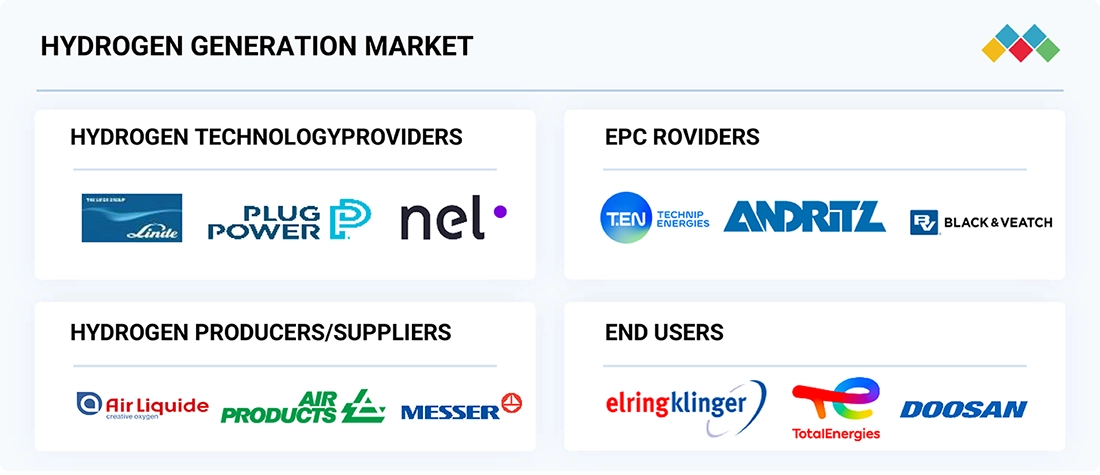
Hydrogen Generation Market: COMMERCIAL USE CASES ACROSS INDUSTRIES
| COMPANY | USE CASE DESCRIPTION | BENEFITS |
|---|---|---|
 |
SSAB, Sweden’s leading steelmaker, sought to decarbonize its operations by transitioning to hydrogen-based Direct Reduced Iron (DRI) technology. However, sourcing reliable, large-scale green hydrogen presented a significant challenge. To address this, SSAB partnered with Vattenfall and LKAB under the HYBRIT (Hydrogen Breakthrough Ironmaking Technology) initiative. The project deployed a 4.5 MW pilot electrolyzer powered by renewable electricity to produce fossil-free hydrogen for iron and steelmaking, demonstrating the feasibility of a sustainable production pathway. | The HYBRIT initiative proved that green hydrogen can replace coal in steelmaking, enabling fossil-free steel production. By integrating renewable electricity with electrolyzer technology, the project showcased a scalable solution for hydrogen generation at industrial levels. Upon full-scale commercialization, HYBRIT has the potential to reduce Sweden’s total CO2 emissions by nearly 10%, marking a major milestone in decarbonizing one of the most emission-intensive sectors. The project not only enhances hydrogen’s role as a clean industrial feedstock but also sets a blueprint for global steelmakers to adopt hydrogen-based pathways for sustainable operations. |
 |
The National Renewable Energy Laboratory (NREL) and Electric Hydrogen have entered into a three-year, USD 3.6 million collaboration to advance the development of high-performance electrolyzer components. This partnership focuses on improving the durability and efficiency of electrolysis cells by identifying degradation mechanisms and validating next-generation designs capable of operating at higher stack currents. The collaboration leverages both organizations’ technical expertise in renewable energy innovation and builds upon their prior success—several team members from both sides were part of the long-term NREL–First Solar partnership that helped commercialize cadmium telluride (CdTe) solar photovoltaics. | This joint initiative is expected to accelerate the scalability and cost-effectiveness of clean hydrogen production, enabling broader deployment of renewable hydrogen across industries. By enhancing electrolyzer performance and lifespan, the project supports decarbonization of hard-to-abate sectors such as heavy industry, energy storage, and transportation. Additionally, the partnership strengthens the knowledge base in renewable hydrogen technologies, fostering innovation and driving progress toward a sustainable, low-carbon energy ecosystem |
Logos and trademarks shown above are the property of their respective owners. Their use here is for informational and illustrative purposes only.
Related Ecosystem
Decarbonization
- Battery Electric Vehicle (BEV)
- Energy Management Systems
- Fuel Cell
- Fuel Cell Electric Vehicle (FCEV)
- Geographical Information System (GIS)
- TotalEnergies SE
- Siemens ag
- Mitsui & Co., Ltd.
- General Electric Company
- Thyssenkrupp ag
Key Takeaways
- The UK hydrogen generation market will grow from $770.0M (2025) to $1,361.0M (2030) at a 12.1% CAGR, significantly outpacing global growth.
- The UK's net-zero commitments and government hydrogen strategy are primary drivers of accelerated market expansion through 2030.
- Green hydrogen production via electrolysis is becoming the dominant technology pathway in the UK market.
- The UK's hydrogen market is positioned to support industrial decarbonization, transport, and power generation sectors by 2030.
Hydrogen Generation Market Report Scope
| Report Metric | Details |
|---|---|
| Base Year | 2025 |
| Fastest Growing Segment | TRANSPORTATION (Application) |
| Forecast Period | 2025–2030 |
| Growth Rate | CAGR of 7.5% from 2025 to 2030 |
| Largest Segment | PETROLEUM REFINERY (Application) |
| Market Size Base Year (Billions) | ~USD 157.68 (2025) |
| Revenue Forecast (Billions) | ~USD 226.37 (2030) |
| Segments Covered | Technology, Source, Generation & Delivery Mode, Delivery Mode, State, Application |
UK Hydrogen Generation Market Report Segmentation
6 segment dimensions are covered across the global market.
By Technology
- Auto Thermal Reforming (Atr)
- Coal Gasification
- Electrolysis
- Partial Oxidation (Pox)
- Steam Methane Reforming (Smr)
By Source
- Blue Hydrogen
- Gray Hydrogen
- Green Hydrogen
- Grey Hydrogen
By Generation & Delivery Mode
- Captive
- Merchant
By Delivery Mode
- Bulk & Cylinder (Gaseous Form)
- Bulk (Liquid Form)
- Large On-Site Plant & Pipeline
- Small On-Site
By State
- Gas
- Liquid
By Application
- Ammonia Production
- Methanol Production
- Other Applications
- Petroleum Refinery
- Power Generation
- Transportation
UK: HYDROGEN GENERATION MARKET, BY APPLICATION, 2025–2030
| Segment | 2025 | 2026 | 2027 | 2028 | 2029 | 2030 | CAGR (%) |
|---|---|---|---|---|---|---|---|
| AMMONIA PRODUCTION | 444 | 502.6 | 562.6 | 630.5 | 721.4 | 806.3 | 12.7 |
| METHANOL PRODUCTION | 47 | 53.2 | 56.3 | 63.8 | 70.5 | 76.9 | 10.4 |
| OTHER APPLICATIONS | 33.3 | 36.8 | 43.5 | 47 | 55.1 | 62.1 | 13.3 |
| PETROLEUM REFINERY | 693.6 | 790.6 | 891.1 | 1005.4 | 1158.4 | 1303.7 | 13.5 |
| POWER GENERATION | 17.2 | 19.9 | 22.6 | 25.8 | 30.1 | 34.2 | 14.7 |
| TRANSPORTATION | 15 | 17.2 | 19.6 | 22.2 | 25.7 | 29.1 | 14.1 |
| TOTAL | 1250.1 | 1420.3 | 1595.7 | 1794.7 | 2061.2 | 2312.3 | 13.1 |
Target Audience
- Energy & Utility Companies : UK-based energy providers need market data to evaluate hydrogen generation investments, assess competitive positioning, and develop hydrogen-integrated business models aligned with net-zero targets.
- Industrial Manufacturers : Steel, chemical, and refining companies operating in the UK require market insights to plan hydrogen adoption strategies, evaluate supply chain readiness, and forecast decarbonization costs.
- Government & Policy Bodies : UK government agencies and regulatory bodies utilize market research to inform hydrogen strategy development, allocate funding effectively, and monitor progress toward net-zero commitments.
- Investment & Financial Firms : Private equity, venture capital, and institutional investors need UK hydrogen market data to identify investment opportunities, assess portfolio companies, and evaluate sector growth potential.
- Technology & Equipment Providers : Hydrogen technology manufacturers and equipment suppliers require UK market intelligence to guide product development, identify customer segments, and plan market expansion strategies.
Key Companies in the UK Hydrogen Generation Market
| Company | HQ | Ownership | Strongest segments |
|---|---|---|---|
| INTERTEK GROUP PLC | United Kingdom | Public Company | Consumer Products,Corporate Assurance,Health and Safety, |
| AIRGAS INC | United States | Private Company | Industrial gases (incl. atmospheric gases and carbon dioxide),Medical and specialty gases,Welding equipment, tools, and hardware, |
| WORLEYPARSONS LIMITED | Australia | Public Company | Project delivery (engineering, procurement, construction/fabrication, commissioning),Asset performance (operations, maintenance, workflow optimization),Professional & consulting (planning, investment, digital, environment & sustainability, optimize/repurpose/decommission), |
| TOTAL SA | France | Public Company | Oil exploration, production, and refining,Natural gas, LNG, and biogas,Power generation, renewables, and electricity marketing, |
| HALDOR TOPSOE A/S | Denmark | Private Company | Ammonia and fertilizer catalysts and licenses,Refining and petrochemical catalysts and technologies,Methanol and other chemical process technologies, |
| VALMET CORPORATION | Finland | Public Company | Biomaterial Solutions and Services (pulp, paper, packaging, tissue, bioenergy lines and lifecycle services),Process Performance Solutions (automation systems, DCS, analyzers, industrial internet, automation services),Flow Control and Related (valves, pumps, valve automation, energy and industrial gas solutions), |
| ENI SPA | Italy | Public Company | Exploration & Production (oil, condensates, natural gas),Global Gas & LNG Portfolio and Power,Refining and Chemicals, |
| EMERSON ELECTRIC CO. | United States | Public Company | Final Control,Measurement & Analytical,Control Systems & Software, |
| NEXTERA ENERGY RESOURCES | United States | Private Company | Wind power generation,Solar power generation,Natural gas and oil-fired generation, |
| EMERA INCORPORATED | Canada | Public Company | Florida Electric Utility (vertically integrated),Canadian Electric Utilities,Gas Utilities and Infrastructure, |
| ENEL | Italy | Public Company | End-User Markets (retail power, gas, and services),Enel Grids (distribution and transmission),Enel Green Power (renewables), |
| MOL GROUP | Hungary | Public Company | Refining and wholesale fuels (gasoline, diesel, heating oil, bunker diesel, LPG, JET A-1),Retail network and convenience (MOL, Slovnaft, INA, Tifon, Energopetrol, Fresh Corner, e-charging),Petrochemicals and black products (bitumen, HFO, petrolcoke, liquid sulphur, residues), |
| PETROBRAS | Brazil | Public Company | Exploration and Production,Refining, Transportation & Marketing,Gas and Low Carbon Energies, |
| LINDE PLC | United Kingdom | Public Company | Atmospheric gases (oxygen, nitrogen, argon, rare gases),Process and specialty gases (hydrogen, helium, CO2, CO, electronic and specialty gases, acetylene),Engineering and turnkey process plants, |
| AIR LIQUIDE | France | Public Company | Large Industries (oxygen, nitrogen, argon, hydrogen, CO, cogeneration),Industrial Merchant (packaged and bulk gases, equipment, services),Healthcare (medical gases, home healthcare, equipment, specialty ingredients), |
| SAUDI ARABIAN OIL CO. | Saudi Arabia | Public Company | Crude oil and condensate,Natural gas and NGLs,Refined products, |
| AIR PRODUCTS AND CHEMICALS, INC. | United States | Public Company | Hydrogen & syngas (process gases),Atmospheric gases (oxygen, nitrogen, argon),Other process gases (helium, CO2, CO), |
| SHELL PLC | United Kingdom | Public Company | Integrated Gas (LNG and GTL),Upstream (Oil, Gas, NGLs),Marketing (Mobility, Lubricants, Commercial Fuels), |
| ENGIE | France | Public Company | Renewables & Flex Power,Networks (Gas & Power Infrastructure),Local Energy Infrastructures, |
| CHEVRON CORPORATION | United States | Public Company | Upstream oil & gas (incl. LNG),Refined products & lubricants,Petrochemicals, plastics & additives, |
| MESSER SE & CO. KGAA | Germany | Private Company | Bulk & onsite industrial gases (O2, N2, Ar),Carbon dioxide & dry ice solutions,Hydrogen, helium & specialty gases, |
| EQUINOR ASA | Norway | Public Company | Exploration & Production Norway,Exploration & Production International,Exploration & Production USA, |
| UNIPER SE | Germany | Public Company | Greener Commodities,Flexible Generation,Green Generation, |
| EXXON MOBIL CORPORATION | United States | Public Company | Upstream (crude oil and natural gas),Energy Products (fuels, aromatics, catalysts, licensing),Chemical Products (olefins, polyolefins, intermediates), |
| BP P.L.C. | United Kingdom | Public Company | Oil Production & Operations (upstream liquids and related trading),Gas & Low Carbon Energy (gas production, marketing, renewables, hydrogen),Customers & Products – Retail Fuels and Convenience, |
| IWATANI CORPORATION | Japan | Public Company | Integrated Energy (LPG, LNG, petroleum products, home energy and appliances),Industrial Gases & Machinery (air gases, hydrogen, helium, gas facilities, welding, FA equipment),Materials (PET resins, biomass fuels, battery and semiconductor materials, metals), |
INTERTEK GROUP PLC
Intertek Group PLC is a United Kingdom-based public company founded in 1885 that employs 45,425 people. The company operates as a global leader in testing, inspection, and certification services across multiple industries.
AIRGAS INC
AirGas Inc is a United States-based private company founded in 1982 with 17,000 employees. The company specializes in the distribution of industrial gases and related equipment and supplies.
WORLEYPARSONS LIMITED
WorleyParsons Limited is an Australian public company founded in 1971 with 38,224 employees. The company provides engineering, procurement, and construction services to the energy and resources sectors.
TOTAL SA
Total SA is a French public company founded in 1924 with 94,847 employees. The company is a major integrated oil and gas producer with operations spanning exploration, production, refining, and renewable energy.
HALDOR TOPSOE A/S
Haldor Topsoe A/S is a Danish private company founded in 1940 with 2,739 employees. The company specializes in catalysts and technology solutions for the chemical and energy industries.
VALMET CORPORATION
Valmet Corporation is a Finnish public company founded in 1750 with 18,370 employees. The company provides technologies, automation, and services for the pulp, paper, energy, and oil and gas industries.
ENI SPA
ENI SpA is an Italian public company founded in 1953 with 32,349 employees. The company is an integrated energy company engaged in oil and gas exploration, production, refining, and renewable energy development.
EMERSON ELECTRIC CO.
Emerson Electric Co. is a United States-based public company founded in 1890 with 71,000 employees. The company manufactures and provides technology solutions for industrial, commercial, and consumer markets.
NEXTERA ENERGY RESOURCES
NextEra Energy Resources is a United States-based private company founded in 1997 with 900 employees. The company develops and operates renewable energy projects and clean energy solutions.
EMERA INCORPORATED
Emera Incorporated is a Canadian public company founded in 1998 with 7,812 employees. The company is an energy and services company that generates, transmits, and distributes electricity and provides energy services.
ENEL
Enel is an Italian public company founded in 1962 with 61,544 employees. The company is a major integrated energy company focused on electricity generation, distribution, and renewable energy development.
MOL GROUP
MOL Group is a Hungarian public company founded in 1991 with 24,744 employees. The company is an integrated oil and gas company engaged in exploration, production, refining, and retail operations.
PETROBRAS
Petrobras is a Brazilian public company founded in 1953 with 43,199 employees. The company is an integrated energy company engaged in oil and gas exploration, production, refining, and distribution.
LINDE PLC
Linde PLC is a United Kingdom-based public company founded in 1879 with 65,034 employees. The company is a global leader in industrial gases and engineering services for various industries.
AIR LIQUIDE
Air Liquide is a French public company founded in 1902 with 63,126 employees. The company is a leading supplier of industrial gases, welding equipment, and related services worldwide.
SAUDI ARABIAN OIL CO.
Saudi Arabian Oil Co. is a Saudi Arabian public company founded in 1933 with 79,000 employees. The company is one of the world's largest oil producers engaged in exploration, production, refining, and distribution.
AIR PRODUCTS AND CHEMICALS, INC.
Air Products and Chemicals, Inc. is a United States-based public company founded in 1940 with 21,194 employees. The company manufactures and supplies industrial gases, chemicals, and equipment for various industries.
SHELL PLC
Shell PLC is a United Kingdom-based public company founded in 1897 with 84,000 employees. The company is a major integrated oil and gas company engaged in exploration, production, refining, and renewable energy.
ENGIE
ENGIE is a French public company founded in 1880 with 84,809 employees. The company is a global energy and services company focused on electricity generation, distribution, and energy efficiency solutions.
CHEVRON CORPORATION
Chevron Corporation is a United States-based public company founded in 1879 with 43,039 employees. The company is an integrated energy company engaged in oil and gas exploration, production, refining, and marketing.
MESSER SE & CO. KGAA
Messer SE & Co. KGaA is a German private company founded in 1898 with 11,701 employees. The company is a leading supplier of industrial gases and related services across Europe and beyond.
EQUINOR ASA
Equinor ASA is a Norwegian public company founded in 1972 with 23,843 employees. The company is an integrated energy company engaged in oil and gas exploration, production, and renewable energy development.
UNIPER SE
Uniper SE is a German public company founded in 1894 with 7,177 employees. The company is an energy company focused on power generation, energy trading, and gas supply.
EXXON MOBIL CORPORATION
ExxonMobil Corporation is a United States-based public company founded in 1870 with 57,900 employees. The company is one of the world's largest integrated oil and gas companies with global operations.
BP P.L.C.
BP P.L.C. is a United Kingdom-based public company founded in 1908 with 93,700 employees. The company is a major integrated oil and gas company engaged in exploration, production, refining, and renewable energy.
IWATANI CORPORATION
Iwatani Corporation is a Japanese public company founded in 1930 with 12,113 employees. The company is a diversified energy company engaged in gas supply, energy solutions, and related services.
Reasons to Buy this Report
- Market Size & Growth Data : Access precise UK market valuations ($770M in 2025) and forecasts through 2030 with detailed CAGR analysis to support investment decisions and business planning.
- Competitive Landscape Intelligence : Understand UK-specific market dynamics, key players, and competitive positioning to identify partnership opportunities and market entry strategies tailored to the British hydrogen sector.
- Policy & Regulatory Insights : Gain comprehensive analysis of UK government hydrogen strategy, net-zero regulations, and funding mechanisms that directly impact market opportunities and investment timelines.
- Technology & Segment Analysis : Detailed breakdown of hydrogen generation technologies prevalent in the UK market, including electrolysis, SMR with CCS, and emerging methods with adoption rates and growth projections.
- Strategic Planning Support : Leverage UK-focused market intelligence for strategic planning, resource allocation, and identifying high-growth segments within the hydrogen generation value chain.
Frequently asked questions
What is the current size of the UK hydrogen generation market?
The UK hydrogen generation market is valued at $770.0 million in 2025 and is expected to reach $1,361.0 million by 2030.
What is the growth rate of the UK hydrogen generation market?
The UK hydrogen generation market is growing at a compound annual growth rate (CAGR) of 12.1% from 2025 to 2030.
What are the main drivers of growth in the UK hydrogen market?
Key drivers include the UK's net-zero 2050 target, government hydrogen strategy funding, industrial decarbonization requirements, and increasing demand for clean energy solutions.
Which technologies dominate the UK hydrogen generation market?
Green hydrogen production via water electrolysis is increasingly dominant in the UK market, supported by renewable energy availability and government incentives.
How does the UK market compare to global hydrogen generation growth?
The UK's 12.1% CAGR significantly exceeds the global average of 7.5%, reflecting stronger policy support and investment in hydrogen infrastructure.
RESEARCH METHODOLOGY
The study involved major activities in estimating the current size of the hydrogen generation market. Exhaustive secondary research was done to collect information on the peer and parent markets. The next step was to validate these findings, assumptions, and sizing with industry experts across the value chain through primary research. Both top-down and bottom-up approaches were employed to estimate the complete market size. Thereafter, market breakdown and data triangulation were used to estimate the market size of the segments and subsegments.
Secondary Research
The secondary sources referred to for this research study include annual reports, press releases, investor presentations of companies, white papers, certified publications, articles from recognized authors, and databases of various companies and associations. Secondary research was mainly used to obtain key information about the industry’s supply chain, the market’s monetary chain, the total pool of key players, market classification and segmentation according to industry trends to the bottom-most level, regional markets, and key developments from market- and technology-oriented perspectives.
Primary Research
In the primary research process, various primary sources from the supply and demand sides were interviewed to obtain qualitative and quantitative information for this report. Primary sources from the supply side include industry experts, such as CEOs, vice presidents, marketing directors, technology & innovation directors, and related key executives from various companies and organizations operating in the hydrogen generation market.
In the complete market engineering process, the top-down and bottom-up approaches and several data triangulation methods were extensively used to perform market estimation and market forecasts for the overall market segments and subsegments listed in this report. Extensive qualitative and quantitative analysis was conducted on the complete market engineering process to list key information/insights throughout the report.
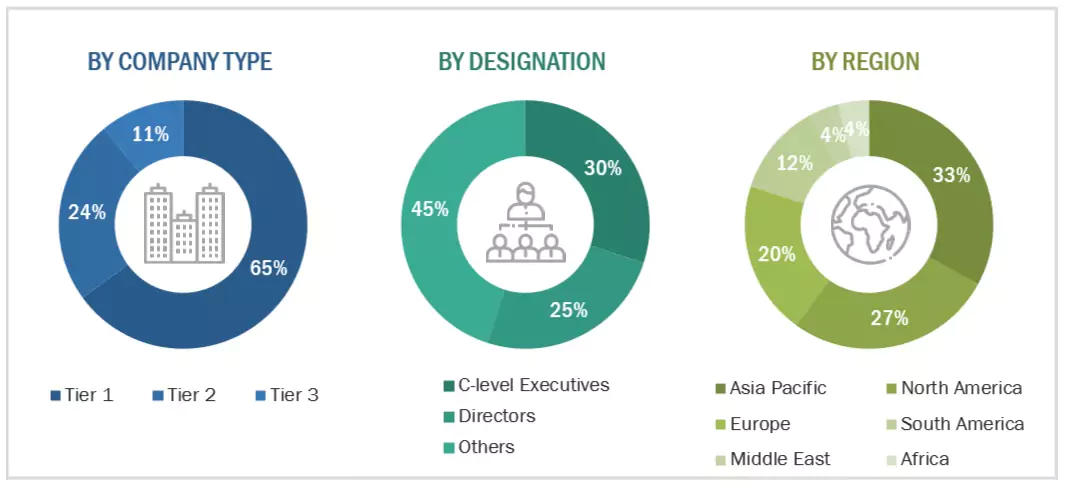
Note 1: Others include sales managers, marketing managers, and product managers.
Note 2: Tier 1 companies’ revenues are more than USD 10 billion; tier 2 companies’ revenues range between USD 1 and 10 billion; and tier 3 companies’ revenues range between USD 500 million and USD 1 billion.
Source: Industry Experts
To know about the assumptions considered for the study, download the pdf brochure
Market Size Estimation
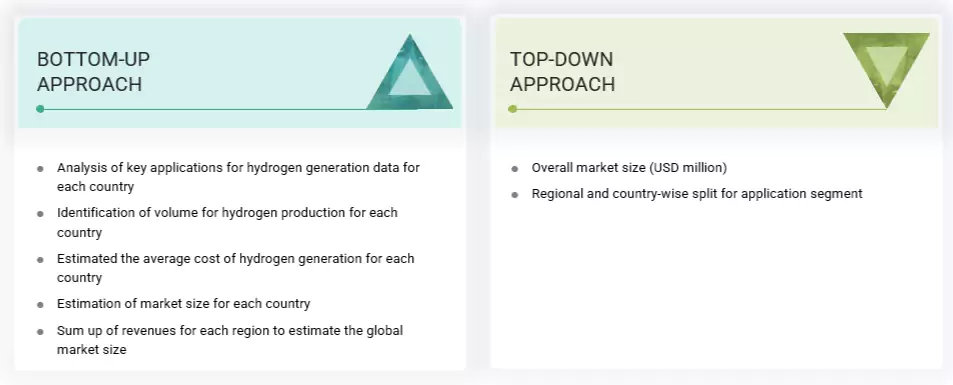
The top-down and bottom-up approaches were used to estimate and validate the size of the global hydrogen generation market and to evaluate the sizes of various other dependent submarkets. Key players in the market were identified through secondary research, and their shares in the respective regions were determined through primary and secondary research. This entire procedure included the study of annual and financial reports of top market players and extensive interviews for key insights with industry leaders, such as CEOs, VPs, directors, and marketing executives. All percentage shares, splits, and breakdowns were determined using secondary sources and verified through primary sources. All possible parameters that affect the markets covered in this research study were accounted for, viewed in extensive detail, verified through primary research, and analyzed to get the final quantitative and qualitative data.
Hydrogen Generation Market : Top-Down and Bottom-Up Approach
Data Triangulation
After arriving at the overall market size from the estimation process explained below, the total market was split into several segments and subsegments. The data triangulation and market breakdown procedures were employed, wherever applicable, to complete the overall market engineering process and arrive at the exact statistics for all the segments and subsegments. The data was triangulated by studying various factors and trends from the demand and supply sides.
Market Definition
Hydrogen is the lightest and most abundant element in the universe, widely valued for its exceptional energy-carrying capacity. It can be produced either as a primary product or as a by-product from diverse energy sources, including renewables (wind and solar), fossil fuels (coal and natural gas), and nuclear power. Due to its high energy content per unit mass, hydrogen serves as a highly versatile energy carrier. It is critical in various industrial processes, chemical manufacturing, and emerging clean energy applications. The hydrogen generation market is defined as the sum of the revenue generated by companies producing hydrogen through various technologies, such as electrolysis, steam methane reforming (SMR), auto thermal reforming (ATR), partial oxidation (POX), and coal gasification.
Stakeholders
- Fuel cell electric vehicle (FCEV) manufacturers
- Government organizations
- Hydrogen charging station owners
- Hydrogen fuel pump developers and operators
- Hydrogen generation equipment manufacturers and suppliers
- Hydrogen generation infrastructure developers
- Institutional investors
- Merchant hydrogen producers
- Methanol producers
- Refinery operators
- Research institutes
Report Objectives
- To describe and forecast the hydrogen generation market, by technology, generation and delivery mode, application, source, and region, in terms of value
- To describe and forecast the hydrogen generation market, by technology, generation and delivery mode, application, source, and region, in terms of volume
- To forecast the market size across four key regions: North America, Europe, Asia Pacific, the Middle East, Africa, and South America, along with country-level analysis, in terms of value and volume
- To provide detailed information regarding key drivers, restraints, opportunities, and challenges influencing the growth of the hydrogen generation market
- To provide the supply chain analysis, trends/disruptions impacting customer business, ecosystem analysis, regulatory landscape, patent analysis, case study analysis, technology analysis, key conferences & events, the impact of AI/Gen AI, pricing analysis, porter’s five forces analysis, regulatory analysis, and the impact of 2025 US tariff on the hydrogen generation market
- To analyze opportunities for stakeholders and provide a detailed competitive landscape of the market leaders
- To strategically analyze micromarkets with respect to individual growth trends, prospects, and contributions to the overall market size
- To benchmark players within the market using the company evaluation matrix, which analyzes market players based on several parameters within the broad categories of business and product strategies
- To compare key market players with respect to product specifications and applications
- To strategically profile key players and comprehensively analyze their market rankings and core competencies
- To analyze competitive developments, such as contracts, agreements, expansions, investments, acquisitions, partnerships, collaborations, and joint ventures, in the hydrogen generation market
Available Customizations
MarketsandMarkets offers customizations according to the specific needs of the companies using the given market data.
The following customization options are available for the report:
Product Analysis
- Product matrix, which gives a detailed comparison of the product portfolio of each company
Geographic Analysis as per Feasibility
- Further breakdown of the hydrogen generation market, by country for the Europe, Asia Pacific, North America, Middle East, Africa, and South America regions
Company Information
- Detailed analysis and profiling of additional market players (up to five)
Get the Full Hydrogen Generation Market Report
Full forecast, segment splits, and company analysis for all Hydrogen Generation Market.
- Canada Hydrogen Generation Market
- Mexico Hydrogen Generation Market
- US Hydrogen Generation Market
- Germany Hydrogen Generation Market
- France Hydrogen Generation Market
- Russia Hydrogen Generation Market
- China Hydrogen Generation Market
- Japan Hydrogen Generation Market
- India Hydrogen Generation Market
- Australia Hydrogen Generation Market
- South Korea Hydrogen Generation Market
- Brazil Hydrogen Generation Market
- Argentina Hydrogen Generation Market
- Saudi Arabia Hydrogen Generation Market
- Qatar Hydrogen Generation Market
- UAE Hydrogen Generation Market
- Iran Hydrogen Generation Market
- South Africa Hydrogen Generation Market
Need a Tailored Report?
Customize this report to your needs
Get 10% FREE Customization
Customize This Report
