
US Hydrogen Storage Tanks and Transportation Market (2026-2031)

The US Hydrogen Storage Tanks and Transportation Market was valued at $8.85 Million in 2026 and projected to reach to $40.97 Million by 2031, representing a compound annual growth rate of 35.9%. The US hydrogen storage tanks and transportation market stands at an inflection point, driven by aggressive decarbonization targets and substantial federal funding mechanisms.


| Market Size in | USD 26.32 MN |
| Market Forecast in | |
| CAGR | |
| Forecast Period | |
| Units Considered | Value (USD MN) |
US Hydrogen Storage Tanks and Transportation Market Trends and Insights
- This exceptional growth reflects the US commitment to decarbonization and the scaling of hydrogen infrastructure across industrial, mobility, and energy sectors.
- The US market is driven by federal incentives, including the Inflation Reduction Act, which accelerates hydrogen production and distribution capabilities. In the US, hydrogen storage and transportation solutions are becoming critical infrastructure components as the nation transitions toward clean energy.
- Between 2026 and 2031, the US is expected to see substantial investments in tank manufacturing, pipeline development, and logistics networks.
- The US market's 35.9% CAGR significantly outpaces global growth, positioning the country as a leader in hydrogen economy development and technology deployment..
Key Market Statistics
- CAGR (2026-2031) 35.9% CAGR
- Market Size, 2026 ~USD 8.85 Million
- Forecast, 2031 ~USD 40.97 Million
- Country US
US Hydrogen Storage Tanks and Transportation Market Overview
Explosive Growth Trajectory :
The US hydrogen storage tanks and transportation market is projected to grow from $8.85 billion in 2026 to $40.97 billion by 2031, representing a remarkable 35.9% CAGR. This growth significantly outpaces many other energy infrastructure segments.
Federal Policy Support :
The Inflation Reduction Act and other federal incentives are catalyzing hydrogen infrastructure development across the US. Government backing for hydrogen production, storage, and transportation is creating unprecedented investment opportunities and market acceleration.
Multi-Sector Adoption :
US hydrogen storage and transportation solutions are scaling across industrial manufacturing, heavy-duty mobility, power generation, and energy storage applications. This diversification reduces market concentration risk and ensures sustained demand growth.
Infrastructure Buildout Phase :
The US is transitioning from pilot projects to commercial-scale hydrogen infrastructure deployment. Major investments in storage facilities, pipeline networks, and transportation systems are positioning the country as a hydrogen economy leader.
US Hydrogen Storage Tanks and Transportation Market Dynamics
- The 35.9% CAGR through 2031 reflects accelerating adoption across industrial, transportation, and energy sectors as companies seek to meet ESG commitments and regulatory requirements.
- State-level hydrogen initiatives, particularly in California and the Northeast, are creating regional demand hubs. Looking ahead, the US market will be shaped by technological advancements in tank materials, cost reduction in storage solutions, and expansion of hydrogen distribution networks.
- Strategic partnerships between energy companies, automotive manufacturers, and infrastructure developers will drive commercialization.
- By 2031, the market's maturation will establish hydrogen as a critical component of America's energy transition strategy..
Market Ecosystem
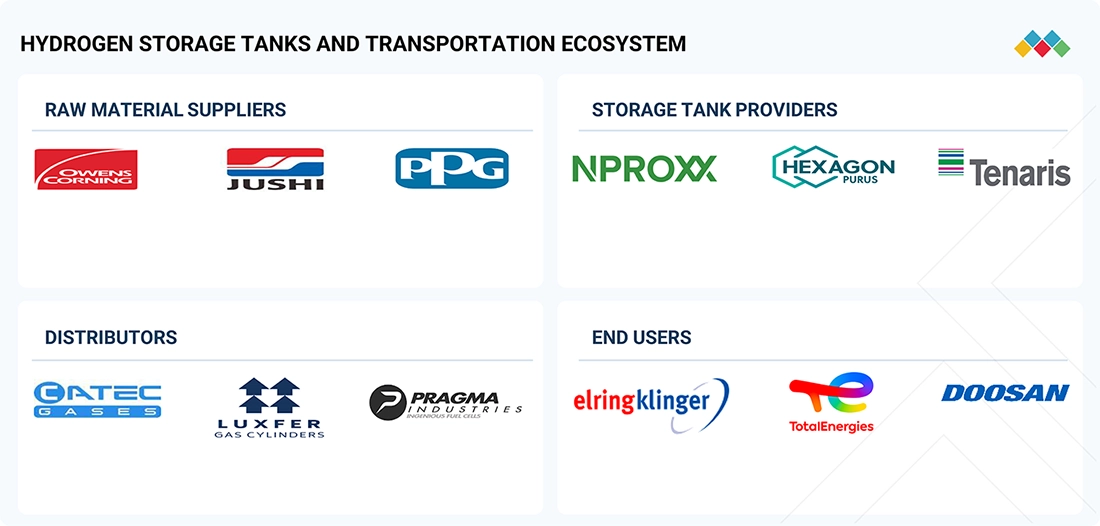
HYDROGEN STORAGE TANKS AND TRANSPORTATION MARKET: COMMERCIAL USE CASES ACROSS INDUSTRIES
| COMPANY | USE CASE DESCRIPTION | BENEFITS |
|---|---|---|
 |
Nel Hydrogen aims to revolutionize hydrogen production and distribution for transit depots by implementing a novel approach. The company seeks to develop an efficient system that supports clusters of transit depot fueling sites. Specifically, it aims to produce green hydrogen at a low cost in regions that are abundant in renewable energy resources. The hydrogen will then be transported short distances to various fueling locations, facilitating easy swapping of full and empty trailers. The challenge lies in efficiently coordinating production, transportation, and distribution to meet the demands of multiple transit agencies while ensuring economic viability and environmental sustainability. | Nel Hydrogen's innovative strategy for low-cost green hydrogen production and efficient distribution presents a sustainable solution for supporting transit depot fueling sites. By installing an electrolyzer system with a capacity of 8,000 kg/day in an area abundant in renewable energy resources near the metro LA area, Nel secures a cost-effective Power Purchase Agreement (PPA) for hydrogen production. Transportation is optimized through the use of high-pressure trailers, facilitating uninterrupted supply to transit depots through seamless swapping and simultaneous filling at production and fueling sites. Leveraging renewable power ensures low carbon intensity, maximizing the value of Low Carbon Fuel Standard (LCFS) credits to offset operational costs. This approach is tailored to support four bus depots, each with a daily demand of 2,000 kg of hydrogen, thereby contributing to the transition toward clean energy transportation while addressing the specific challenges of transit depot fueling. Overall, Nel Hydrogen's integrated approach promises a sustainable and economically viable model for the hydrogen economy. |
 |
Honda Motor Company in Torrance, California, endeavored to create a smaller and more effective solar-hydrogen refueling station with the goal of making it suitable for household use. This station incorporates solar PV panels to generate electricity, enabling the production of hydrogen through electrolysis. While previous versions of Honda's refueling stations demonstrated progress in solar power technology, the newest iteration, introduced in early 2010, aimed to improve efficiency and affordability even further. Moreover, the station aimed to take advantage of emerging grid technologies such as net metering and smart grids to make the most efficient use of energy. | Honda Motor Company addressed the challenges and objectives by introducing a novel high-differential-pressure electrolyzer in its new solar-hydrogen refueling station, eliminating the need for a compressor. This technological innovation resulted in a 25% improvement in system efficiency compared to previous iterations while simultaneously reducing the size and cost of critical components. The station's capacity and flow rate, albeit modest, were designed to produce 0.5 kg of hydrogen over an 8-hour period, deemed sufficient for a consumer with a consistent commute of 10,000 miles per year. Furthermore, the station was engineered to capitalize on net metering and anticipated smart grid advancements. By exporting surplus electrical power to the grid during daylight hours and drawing energy during off-peak times, the station optimally utilized resources, thereby enhancing sustainability and cost-effectiveness. Through this integrated approach, Honda Motor Company showcased a pioneering solution in sustainable transportation infrastructure, setting a benchmark for compact and efficient hydrogen refueling systems with potential household applications. |
Logos and trademarks shown above are the property of their respective owners. Their use here is for informational and illustrative purposes only.
Related Ecosystem
Decarbonization
- Battery Electric Vehicle (BEV)
- Energy Management Systems
- Fuel Cell
- Fuel Cell Electric Vehicle (FCEV)
- Geographical Information System (GIS)
- TotalEnergies SE
- Siemens ag
- Mitsui & Co., Ltd.
- General Electric Company
- Thyssenkrupp ag
Key Takeaways
- The US hydrogen storage tanks and transportation market will grow from $8.85B (2026) to $40.97B (2031), representing a 35.9% CAGR.
- US federal policies, particularly the Inflation Reduction Act, are primary catalysts driving hydrogen infrastructure investment and market expansion.
- The US is establishing itself as a global leader in hydrogen storage technology and transportation logistics between 2026 and 2031.
- US market growth significantly exceeds global trends, indicating accelerated domestic adoption and commercialization of hydrogen solutions.
Hydrogen Storage Tanks and Transportation Market Report Scope
| Report Metric | Details |
|---|---|
| Base Year | 2026 |
| Fastest Growing Segment | 200 TO 500 BAR (Pressure) |
| Forecast Period | 2026-2031 |
| Growth Rate | CAGR of 50.5% from 2026 to 2031 |
| Largest Segment | COMMERCIAL/HEAVY-DUTY VEHICLES (Vehicle Type) |
| Market Size Base Year (Billions) | ~USD 0.3 (2026) |
| Revenue Forecast (Billions) | ~USD 2.28 (2031) |
| Segments Covered | Pressure, Type, Application, Tank Type, Vehicle Type, Modular Storage, Container Storage Capacity |
US Hydrogen Storage Tanks and Transportation Market Report Segmentation
7 segment dimensions are covered across the global market.
By Pressure
- 200 To 500 Bar
- Above 500 Bar
- Below 200 Bar
By Type
- Commercial/Heavy-Duty Vehicles
- ICE Hydrogen Vehicles
- Passenger Fuel Cell Cars
- Type I
- Type Ii
- Type Iii
- Type Iv
By Application
- Hydrogen Transportation Trailers
- Marine
- Railways
- Stationary Storage
- Vehicle
- Vehicles
By Tank Type
- Type I
- Type Ii
- Type Iii
- Type Iv
By Vehicle Type
- Commercial/Heavy-Duty Vehicles
- ICE Hydrogen Vehicles
- Passenger Fuel Cell Vehicles
By Modular Storage
- Hydrogen Distribution Systems
- Hydrogen Fuel Storage Systems
By Container Storage Capacity
- 20 Ft
- 30 Ft
- 40 Ft
Target Audience
- Energy & Utility Companies : US energy providers need market intelligence to evaluate hydrogen storage and transportation investments, assess infrastructure opportunities, and align capital allocation with the growing hydrogen economy. Critical for long-term energy transition planning.
- Industrial Equipment Manufacturers : Tank manufacturers, compressor suppliers, and equipment producers require US market data to forecast demand, plan production capacity, and identify customer segments. Essential for product development and market positioning strategies.
- Transportation & Mobility Sector : Heavy-duty vehicle manufacturers, fuel cell developers, and fleet operators need US hydrogen infrastructure insights to plan hydrogen refueling networks and vehicle deployment strategies. Critical for hydrogen mobility commercialization.
- Infrastructure & Engineering Firms : Engineering companies and infrastructure developers require detailed US market forecasts to bid on hydrogen pipeline, storage facility, and distribution network projects. Essential for project pipeline development and revenue forecasting.
- Investment & Financial Institutions : Private equity, venture capital, and institutional investors need credible US hydrogen market data to evaluate investment opportunities, assess portfolio companies, and identify emerging growth segments in the hydrogen economy.
Reasons to Buy this Report
- Market Size Validation : Obtain precise US market valuation ($8.85B in 2026) and 5-year forecast ($40.97B by 2031) to benchmark competitive positioning and identify growth opportunities within the rapidly expanding hydrogen storage and transportation sector.
- Regional Investment Strategy : Understand US-specific growth drivers, federal incentive structures, and state-level hydrogen initiatives to develop targeted investment and expansion strategies. Identify high-potential geographic markets and infrastructure development corridors.
- Competitive Landscape Intelligence : Gain insights into US market dynamics, key players, technology trends, and competitive positioning specific to hydrogen storage and transportation. Make informed decisions about market entry, partnerships, and product development priorities.
- Sector-Specific Demand Analysis : Access detailed breakdown of hydrogen demand across US industrial, mobility, power generation, and energy storage sectors. Identify which applications offer the highest growth potential and revenue opportunities for your business.
- Risk Mitigation & Forecasting : Leverage comprehensive US market data to assess regulatory risks, technology adoption rates, and infrastructure development timelines. Build accurate financial projections and strategic plans based on credible market intelligence and growth forecasts.
Frequently asked questions
What is the current size of the US hydrogen storage tanks and transportation market?
The US market is valued at $8.85 billion in 2026 and is projected to reach $40.97 billion by 2031.
What is the CAGR for the US hydrogen storage market?
The US hydrogen storage tanks and transportation market is expected to grow at a 35.9% CAGR from 2026 to 2031.
What are the primary drivers of growth in the US market?
Key drivers include federal incentives like the Inflation Reduction Act, decarbonization commitments, industrial hydrogen demand, and expanding fuel cell vehicle infrastructure in the US.
How does the US market compare to global hydrogen storage growth?
The US market CAGR of 35.9% significantly exceeds the global CAGR of 50.5%, reflecting strong domestic policy support and accelerated commercialization in the US.
Which sectors are driving US hydrogen storage and transportation demand?
Industrial manufacturing, heavy-duty transportation, energy storage, and fuel cell vehicle infrastructure are primary demand sectors in the US market.
RESEARCH METHODOLOGY
The research process for this technical, market-oriented, and commercial study of the hydrogen storage tanks and transportation market included systematic gathering, recording, and analysis of data about companies operating in the market. It involved the extensive use of secondary sources, directories, and databases (Factiva, OANDA) to identify and collect relevant information. In-depth interviews were conducted with various primary respondents, including experts from core and related industries and preferred manufacturers, to obtain and verify critical qualitative and quantitative information, as well as to assess the growth prospects of the market. Key players in the hydrogen storage tanks and transportation market were identified through secondary research, and their market rankings were determined through primary and secondary research. This included studying annual reports of top players and interviewing key industry experts, such as CEOs, directors, and marketing executives.
Secondary Research
In the secondary research process, various secondary sources were referred to for identifying and collecting information relevant to this study. Secondary sources include annual reports, press releases, and investor presentations of companies; white papers, certified publications, and articles from recognized authors; directories; and databases. Secondary research was mainly conducted to obtain key information about the supply of the industry; a total pool of key players; segmentation of the market according to industry trends, geographic markets, and key developments from market- and technology-oriented perspectives.
Primary Research
During the primary research phase, various key sources from the demand side and supply side have been interviewed to gather qualitative and quantitative data for this report. Throughout the comprehensive market engineering process, a combination of top-down and bottom-up approaches, along with multiple data triangulation methods, has been extensively employed to estimate market sizes and forecast all segments and subsegments outlined in this report. Extensive qualitative and quantitative analyses have been undertaken to ensure the integrity of the market engineering process, providing key insights throughout the report. Following completion of the market engineering process, which involved calculations of market statistics, breakdowns, size estimates, forecasts, and data triangulation, thorough primary research has been conducted to gather, verify, and validate critical data points. Primary research has also been conducted to identify market segments, industry trends, and the competitive landscape in the hydrogen storage tanks and transportation market.
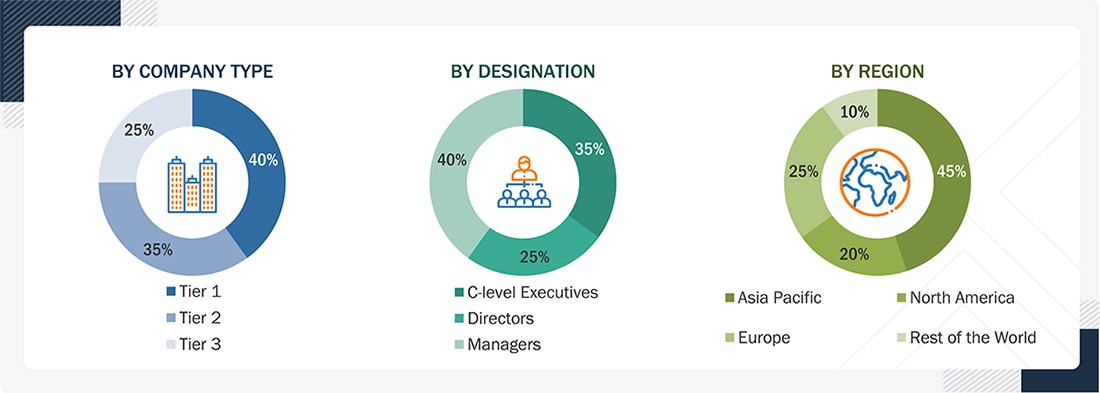
Note: Managers include sales managers, production managers, and regional managers.
Tier 1 company: revenue >USD 5 billion; tier 2 company: revenue between USD 1 and USD 5 billion; and tier 3 company: revenue <USD 1 billion in 2025
To know about the assumptions considered for the study, download the pdf brochure
Market Size Estimation
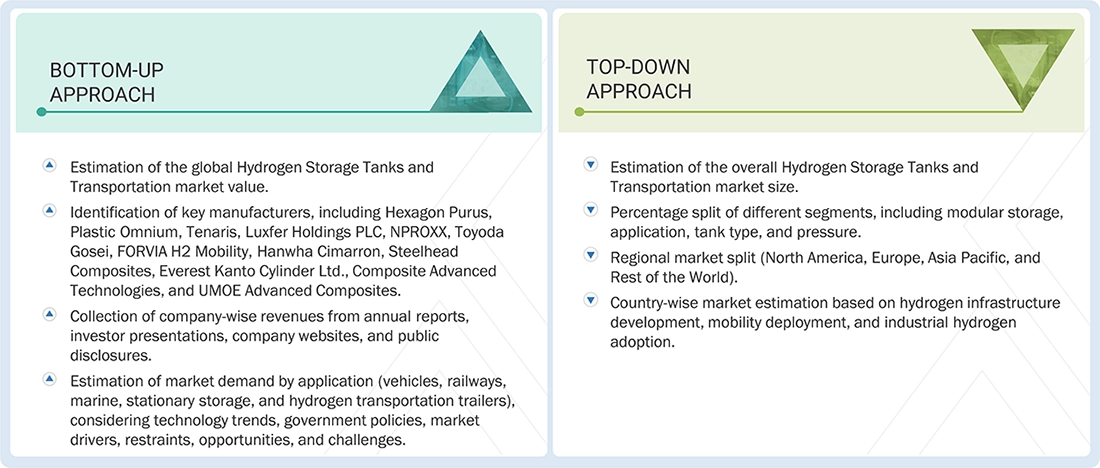
The estimation and validation of the hydrogen storage tanks and transportation market size were conducted using both bottom-up and top-down approaches. These methodologies were employed to estimate the market size across different segments and validate the overall market through extensive secondary research, primary interviews, and data triangulation.
Bottom-up Approach
- Estimating the overall market size by analyzing the revenues generated from manufacturers offering hydrogen storage tanks and transportation solutions for gaseous and liquid hydrogen
- Mapping leading market participants, including Hexagon Purus, Plastic Omnium, Tenaris, Luxfer Holdings PLC, NPROXX, Toyoda Gosei, FORVIA H2 Mobility, Hanwha Cimarron, Steelhead Composites, and Everest Kanto Cylinder
- Collecting segment-wise revenue information from annual reports, investor presentations, company websites, press releases, and other public disclosures
- Estimating demand across key applications, including vehicles, railways, marine, stationary storage (hydrogen refueling stations), and hydrogen transportation trailers, using installed base, production, and deployment data
- Incorporating qualitative factors such as technology advancements, government policies, hydrogen infrastructure investments, and adoption trends into the forecasting model
Top-down Approach
- Assessing the overall hydrogen storage tanks and transportation market using industry adoption trends, hydrogen production capacity, and hydrogen infrastructure investments
- Allocating the market across tank type (Type I, Type II, Type III, and Type IV), pressure (below 200 bar, 200–500 bar, above 500 bar), application (vehicles, railways, marine, stationary storage, and hydrogen transportation), and modular storage (fuel storage and distribution systems)
- Distributing market shares across North America, Europe, Asia Pacific, and the Rest of the World, followed by country-level estimates based on hydrogen mobility deployment, hydrogen refueling infrastructure, and clean hydrogen project investments
- Validating the final market estimates through primary interviews with manufacturers, hydrogen infrastructure providers, system integrators, and industry experts, followed by data triangulation to ensure consistency and accuracy.
Global Hydrogen Storage Tanks and Transportation Market Size: Bottom-up Approach and Top-down Approach
Data Triangulation
The process of determining the overall market size involved the methodologies described earlier, followed by segmenting the market into multiple segments and subsegments. To finalize the comprehensive market analysis and obtain precise statistics for each market segment and subsegment, data triangulation and market segmentation techniques were applied, as appropriate. Data triangulation was accomplished by examining various factors and trends from both the demand and supply perspectives within the ecosystem of the hydrogen storage tanks and transportation market.
Market Definition
The hydrogen storage tanks and transportation market comprises revenues generated from companies that design, manufacture, and supply hydrogen storage tanks and transportation systems for the storage, handling, and distribution of gaseous hydrogen. The market includes storage tanks used across mobility applications, such as vehicles, hydrogen ICE vehicles, rail, marine, stationary storage, as well as trailers for H2 applications.
Key Stakeholders
- Hydrogen Storage Tanks and Transportation Dealers and Suppliers
- Government and Research Organizations
- Power and Energy Associations
- Repairs and Maintenance Service Providers
- State and National Regulatory Authorities
- Research And Consulting Companies in the Clean Energy Generation Sector
- Organizations, Forums, Alliances, And Associations
- Industrial Authorities and Associations
Report Objectives
- To describe and forecast the hydrogen storage tanks and transportation market in terms of value, considering factors such as modular storage, tank type, pressure, and application
- To project the market sizes for each of the four major regions—North America, Europe, Asia Pacific, and Rest of the World (RoW), which comprises South America and the Middle East & Africa—as well as the individual country levels by value and volume
- To describe the market of hydrogen storage tanks and transportation qualitatively based on material type
- To provide detailed information about the key drivers, restraints, opportunities, and industry-specific challenges influencing the growth of the market
- To strategically analyze the market with respect to individual growth trends, prospects, and contributions of each segment to the market
- To provide value chain analysis, trends/disruptions impacting customer business, market maps, ecosystem analysis, sustainability and regulatory landscape, pricing analysis, patent analysis, case study analysis, technology analysis, key conferences and events, Porter’s five forces analysis, macroeconomic outlook, customer landscape & buyer behavior, regulatory analysis, and AI/GenAI impact on the market
- To strategically analyze micromarkets with respect to individual growth trends, upcoming expansions, and their contribution to the overall market
- To analyze opportunities for stakeholders in the market and draw a competitive landscape for market players
- To benchmark players within the market using the company evaluation matrix, which analyzes market players based on several parameters within the broad categories of business and product strategies.
- To compare the key market players with respect to the market share, product specifications, and applications
- To strategically profile the key players and comprehensively analyze their market ranking and core competencies
- To analyze competitive developments in the market, such as contracts, agreements, investments, expansions, product launches, partnerships, and collaborations
Available customizations:
With the given market data, MarketsandMarkets offers customizations based on the company’s specific needs. The following customization options are available for the report:
PRODUCT ANALYSIS
- Product Matrix, which provides a detailed comparison of the product portfolio of each company
COMPANY INFORMATION
- Detailed analyses and profiling of additional market players (up to five)
Get the Full Hydrogen Storage Tanks and Transportation Market Report
Full forecast, segment splits, and company analysis for all Hydrogen Storage Tanks and Transportation Market.
- Canada Hydrogen Storage Tanks and Transportation Market
- China Hydrogen Storage Tanks and Transportation Market
- Japan Hydrogen Storage Tanks and Transportation Market
- India Hydrogen Storage Tanks and Transportation Market
- South Korea Hydrogen Storage Tanks and Transportation Market
- Germany Hydrogen Storage Tanks and Transportation Market
- UK Hydrogen Storage Tanks and Transportation Market
- Italy Hydrogen Storage Tanks and Transportation Market
- France Hydrogen Storage Tanks and Transportation Market
- Netherlands Hydrogen Storage Tanks and Transportation Market
- Rest Of Europe Hydrogen Storage Tanks and Transportation Market
- Rest Of Asia Pacific Hydrogen Storage Tanks and Transportation Market
Need a Tailored Report?
Customize this report to your needs
Get 10% FREE Customization
Customize This Report
