
UK Immersive VR Market (2024-2029)

The UK Immersive VR Market was valued at $515 Million in 2024 and projected to reach to $1496 Million by 2029, representing a compound annual growth rate of 23.8%. The UK Immersive VR Market is poised for significant expansion through 2029, driven by enterprise adoption of VR for training, simulation, and collaborative work environments.


| Market Size in | USD 26.32 MN |
| Market Forecast in | |
| CAGR | |
| Forecast Period | |
| Units Considered | Value (USD MN) |
UK Immersive VR Market Trends and Insights
- The UK market is growing at a compound annual growth rate of 23.8%, driven by increasing adoption of virtual reality technologies across enterprise, gaming, and training sectors.
- This accelerated growth reflects the UK's strong position in digital innovation and rising investment in immersive technologies. During the 2024-2029 forecast period, the UK Immersive VR Market will nearly triple in value, signaling substantial commercial opportunity.
- The UK's mature tech infrastructure, coupled with growing consumer and corporate demand for VR applications, positions the country as a key European hub for immersive technology development.
- Enterprise adoption in the UK is particularly strong, with organizations leveraging VR for training, simulation, and collaborative environments. The UK market's 23.8% CAGR outpaces many mature markets, reflecting both technological advancement and regulatory support for digital transformation initiatives across the UK economy..
Key Market Statistics
- CAGR (2024-2029) 23.8% CAGR
- Market Size, 2024 ~USD 515 Million
- Forecast, 2029 ~USD 1496 Million
- Country UK
UK Immersive VR Market Overview
Market Valuation Growth :
The UK Immersive VR Market is valued at $515.0 million in 2024, with projections reaching $1,496.0 million by 2029, representing a 191% increase over five years.
Strong CAGR Performance :
The UK market is expanding at 23.8% CAGR, outpacing many European counterparts and demonstrating sustained investor confidence in immersive technologies across multiple sectors.
Sector Diversification :
Growth is driven by adoption across enterprise solutions, gaming entertainment, professional training, and healthcare applications, creating multiple revenue streams for UK-based and international vendors.
Digital Innovation Leadership :
The UK's established position as a digital innovation hub, combined with strong tech infrastructure and talent pools, positions it as a key market for VR technology deployment and development.
UK Immersive VR Market Dynamics
- Gaming and entertainment sectors continue to fuel consumer demand, while emerging applications in healthcare, architecture, and retail create new growth vectors.
- Investment in VR infrastructure and content development is accelerating across the UK, supported by government digital initiatives and private sector innovation. Key growth catalysts include declining hardware costs, improved software ecosystems, and increasing awareness of VR's ROI in corporate settings.
- The UK's creative industries and tech talent base provide competitive advantages for content creation and platform development.
- Market consolidation and strategic partnerships are expected to intensify, with both established tech companies and startups competing for market share in this high-growth segment..
Market Ecosystem
Related Ecosystem
Augmented Virtual Reality
- Sensors
- Virtual Reality Devices
- Augmented Reality
- Virtual Reality
- Augmented Reality Devices
- MICROSOFT CORPORATION
- Lenovo
- VIVITEK CORPORATION
- Apple Inc.
Display Technology
- Augmented Reality
- Liquid Crystal Display (LCD)
- Sensors
- Virtual Reality Devices
- Liquid Crystal on Silicon (LCOS)
- VIVITEK CORPORATION
- Samsung
- Lenovo
- Panasonic Holdings Corporation
- Lg corp
Defence Platforms And Systems
- Sensors
- Unmanned Ground Vehicles (UGV)
- Fighter Aircraft
- Special Mission Aircraft
- Antennas
- BAE Systems plc
- Thales group
- LOCKHEED MARTIN CORPORATION
- Northrop Grumman Corporation
- L3Harris Technologies, Inc.
Key Takeaways
- The UK Immersive VR Market will grow from $515.0M (2024) to $1,496.0M (2029) at a 23.8% CAGR.
- The UK is a leading European hub for immersive technology adoption, particularly in enterprise and training applications.
- Strong digital infrastructure and corporate investment drive the UK market's above-average growth trajectory.
- The UK Immersive VR Market is expected to nearly triple in value over the five-year forecast period.
Immersive VR Market Report Scope
| Report Metric | Details |
|---|---|
| Base Year | 2024 |
| Fastest Growing Segment | COMMERCIAL (Application) |
| Forecast Period | 2024-2029 |
| Growth Rate | CAGR of 28% from 2024 to 2029 |
| Largest Segment | SOFTWARE (Offering) |
| Market Size Base Year (Billions) | ~USD 10.16 (2024) |
| Revenue Forecast (Billions) | ~USD 34.9 (2029) |
| Segments Covered | Device Type, Offering, Component, Application, Technology, Type |
UK Immersive VR Market Report Segmentation
6 segment dimensions are covered across the global market.
By Device Type
- Gesture-Tracking Devices
- Head-Mounted Displays
- Projectors & Display Walls
By Offering
- Hardware
- Software
By Component
- Cameras
- Displays & Projectors
- Other Components
- Position & Room Trackers
- Semiconductor Components
- Sensors
By Application
- Aerospace & Defense
- Commercial
- Consumer
- Enterprise
- Healthcare
- Other Applications
By Technology
- Lcd
- Oled
By Type
- Content-Related Software
- Software Development Kits
- Vr Platforms
Target Audience
- VR Hardware Manufacturers : Need UK market sizing and growth projections to plan production capacity, distribution partnerships, and regional marketing investments aligned with local demand forecasts.
- Enterprise Software Developers : Require insights into UK corporate VR adoption rates, industry verticals, and use cases to develop solutions addressing specific business needs and competitive positioning in the enterprise segment.
- Investment & Private Equity Firms : Seek validated UK market data and growth trajectories to evaluate investment opportunities, assess portfolio company performance, and identify acquisition targets in the immersive technology space.
- Gaming & Entertainment Studios : Need UK consumer VR adoption metrics, gaming preferences, and market trends to guide content development, platform selection, and go-to-market strategies for VR entertainment products.
- Corporate Training & Development Providers : Require UK enterprise VR adoption data and training sector insights to develop immersive learning solutions, justify investment to clients, and compete effectively in the professional development market.
Reasons to Buy this Report
- Market Entry Strategy : Comprehensive UK-specific data enables vendors and investors to develop targeted market entry strategies, identify key customer segments, and allocate resources effectively within the British VR ecosystem.
- Competitive Positioning : Detailed UK market insights reveal competitive dynamics, emerging players, and market gaps, allowing businesses to differentiate offerings and capture market share in this high-growth region.
- Investment Decision Support : Validated forecasts and growth metrics provide institutional investors, venture capitalists, and corporate development teams with data-driven confidence for funding decisions and M&A activities in the UK VR sector.
- Sector-Specific Opportunities : Analysis of UK adoption patterns across enterprise, gaming, training, and healthcare sectors identifies high-potential verticals and customer segments for targeted product development and marketing campaigns.
- Risk Mitigation : UK-focused market intelligence helps stakeholders understand regulatory environment, technology adoption barriers, and competitive threats specific to the British market, reducing investment and operational risks.
Frequently asked questions
What is the current size of the UK Immersive VR Market?
The UK Immersive VR Market was valued at $515.0 million in 2024.
What is the projected size of the UK Immersive VR Market by 2029?
The UK Immersive VR Market is forecast to reach $1,496.0 million by 2029.
What is the growth rate of the UK Immersive VR Market?
The UK Immersive VR Market is growing at a compound annual growth rate (CAGR) of 23.8% from 2024 to 2029.
Which sectors are driving growth in the UK Immersive VR Market?
Enterprise training, gaming, simulation, and collaborative workplace applications are primary growth drivers in the UK market.
Why is the UK Immersive VR Market growing faster than global average?
The UK's advanced digital infrastructure, strong corporate investment in digital transformation, and supportive regulatory environment accelerate immersive technology adoption compared to global trends.
RESEARCH METHODOLOGY
The research study involved 4 major activities in estimating the size of the immersive VR market. Exhaustive secondary research has been done to collect important information about the market and peer markets. The validation of these findings, assumptions, and sizing with the help of primary research with industry experts across the supply chain has been the next step. Both top-down and bottom-up approaches have been used to estimate the market size. Post which the market breakdown and data triangulation have been adopted to estimate the market sizes of segments and sub-segments.
Secondary Research
In the secondary research process, various secondary sources have been referred to for identifying and collecting information required for this study. The secondary sources include annual reports, press releases, and investor presentations of companies, white papers, and articles from recognized authors. Secondary research has been mainly done to obtain key information about the market’s value chain, the pool of key market players, market segmentation according to industry trends, regional outlook and developments from both market and technology perspectives.
Primary Research
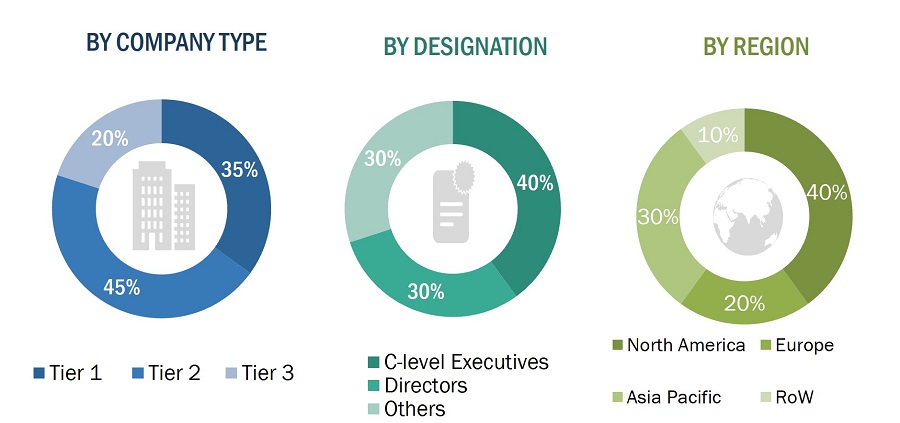
In primary research, various primary sources from both supply and demand sides have been interviewed to obtain qualitative and quantitative insights required for this report. Primary sources from the supply side include experts such as CEOs, vice presidents, marketing directors, manufacturers, technology and innovation directors, end users, and related executives from multiple key companies and organizations operating in the augmented and immersive VR market ecosystem. After interacting with industry experts, brief sessions were conducted with highly experienced independent consultants to reinforce the findings from our primary. This, along with the in-house subject matter experts’ opinions, has led us to the findings as described in the remainder of this report. The breakdown of primary respondents is as follows:
Market Size Estimation
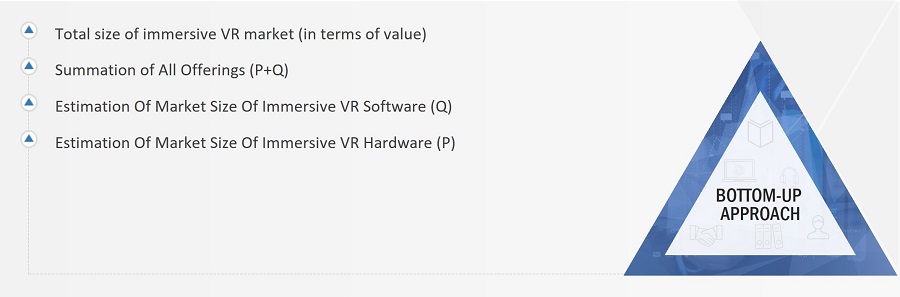
The bottom-up procedure has been employed to arrive at the overall size of the immersive VR market.
- Identifying applications wherein immersive VR systems are deployed or are expected to use
- Analyzing major providers of immersive VR equipment and original equipment manufacturers (OEMs), as well as studying their portfolios and understanding different technologies used
- Analyzing the average selling price of immersive VR systems
- Arriving at the market estimates by analyzing the revenue of companies and then combining these figures to arrive at the market size
- Studying various paid and unpaid sources, such as annual reports, press releases, white papers, and databases, to gather the required information
- Tracking the ongoing developments and identifying the upcoming developments in the market that include investments, research and development activities, product launches, contracts, collaborations, and partnerships undertaken, and forecasting the market size based on these developments
- Carrying out multiple discussions with key opinion leaders to understand the types of immersive VR hardware and software designed and developed, thereby analyzing the break-up of the scope of work carried out by the major companies in the immersive VR market
- Arriving at the market estimates by analyzing the revenue generated by key companies providing immersive VR products on the basis of their locations (countries) and then combining the market size for each country to get the market estimate by region
- Verifying and crosschecking the estimates at every level by discussing with key opinion leaders, including CXOs, directors, and operation managers, and then finally with the domain experts at MarketsandMarkets
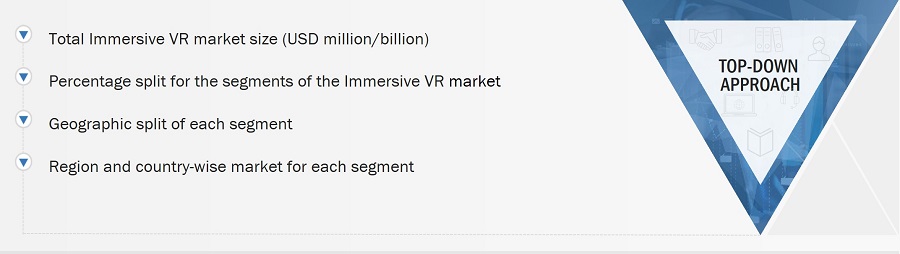
The top-down approach has been used to estimate and validate the total size of the immersive VR market.
- Focusing on top-line investments and expenditures being made in the ecosystems of various applications
- Calculating the market size, considering revenues from major players through the cost of immersive VR systems
- Segmenting each application of the immersive VR system in each region and deriving the global market size based on the region
- Acquiring and analyzing information related to revenues generated by players through their crucial product offerings
- Conducting multiple on-field discussions with key opinion leaders involved in developing various immersive VR solutions
- Estimating geographical splits by using secondary sources on the basis of various factors, such as the number of players in a specific country and region, types of immersive VR products/solutions offered across various applications.
Data Triangulation
After arriving at the overall market size-using the market size estimation processes as explained above-the market has been split into several segments and subsegments. To complete the entire market engineering process and arrive at the exact statistics of each market segment and subsegment, data triangulation and market breakdown procedures have been employed, wherever applicable. The data has been triangulated by studying various factors and trends from the demand and supply sides of the immersive VR market.
Market Definition
Immersive VR is the simulated experience using 3D near-eye displays and pose tracking that makes the user feel as if they are actually present in the virtual world. It creates similar or entirely different simulated environments for applications in entertainment, education, and healthcare. These environments are meant to be interactive and immersive such that users believe they are actually within these virtual settings. VR usually employs headsets with near-eye displays and tracking mechanisms for creating movement and position within the visualization. Additionally, other senses including sound as well as haptics might be included to make the whole experience better.
Key Stakeholders
- Raw material and manufacturing equipment suppliers
- Semiconductor foundries
- Original equipment manufacturers (OEMs)
- Immersive VR device manufacturers
- Original design manufacturers (ODMs) and OEM technology solution providers
- Research organizations
- Technology standard organizations, forums, alliances, and associations
- Technology investors
- Governments, financial institutions, and investment communities
- Analysts and strategic business planners
Report Objectives
- To describe and forecast the size of the immersive VR market by offering, device type, application, and region in terms of value
- To describe and forecast the market size of various segments across four key regions—North America, Europe, Asia Pacific, and Rest of the World (RoW), in terms of value
- To forecast the size of the immersive VR market by device type in terms of volume
- To provide detailed information regarding the drivers, restraints, opportunities, and challenges influencing the growth of the immersive VR market
- To analyze the immersive VR value chain and ecosystem, along with the average selling price of immersive VR systems
- To strategically analyze the regulatory landscape, tariff, standards, patents, Porter’s five forces, import and export scenarios, trade values, and case studies pertaining to the market under study
- To strategically analyze micromarkets with regard to individual growth trends, prospects, and contributions to the overall market
- To analyze opportunities in the market for stakeholders by identifying high-growth segments
- To provide details of the competitive landscape for market leaders
- To analyze strategies such as product launches, expansion, collaborations, acquisitions, partnerships, and expansions adopted by players in the immersive VR market
- To profile key players in the immersive VR market and comprehensively analyze their market ranking based on their revenue, market share, and core competencies.
Available customizations:
With the given market data, MarketsandMarkets offers customizations according to the specific requirements of companies. The following customization options are available for the report:
- Detailed analysis and profiling of additional market players based on various blocks of the supply chain
Get the Full Immersive VR Market Report
Full forecast, segment splits, and company analysis for all Immersive VR Market.
- US Immersive VR Market
- Canada Immersive VR Market
- Mexico Immersive VR Market
- Germany Immersive VR Market
- France Immersive VR Market
- Rest Of Europe Immersive VR Market
- China Immersive VR Market
- Japan Immersive VR Market
- South Korea Immersive VR Market
- India Immersive VR Market
- Rest Of Asia Pacific Immersive VR Market
- GCC Countries Immersive VR Market
Need a Tailored Report?
Customize this report to your needs
Get 10% FREE Customization
Customize This Report
