
Australia In-flight Content Market (2024-2029)

The Australia In-flight Content Market was valued at $10.8 Million in 2024 and projected to reach to $14.1 Million by 2029, representing a compound annual growth rate of 5.6%. Australia's in-flight content market is positioned for steady expansion as the nation's aviation sector continues to prioritize passenger experience enhancements.


| Market Size in | USD 26.32 MN |
| Market Forecast in | |
| CAGR | |
| Forecast Period | |
| Units Considered | Value (USD MN) |
Australia In-flight Content Market Trends and Insights
- The Australian aviation sector is increasingly investing in passenger entertainment systems to enhance the travel experience and differentiate service offerings.
- Australia's geographic isolation and long-haul flight dominance create strong demand for premium in-flight content solutions across major carriers operating domestic and international routes. The market expansion in Australia is driven by rising passenger expectations for diverse entertainment options, including streaming capabilities and personalized content delivery.
- Australia's airlines are modernizing cabin systems to compete globally, with in-flight content becoming a critical component of passenger satisfaction metrics.
- Between 2024 and 2029, Australia's market will benefit from fleet upgrades, increased international tourism, and technological advancements in content distribution systems tailored to the Asia-Pacific region..
Key Market Statistics
- CAGR (2024-2029) 5.6% CAGR
- Market Size, 2024 ~USD 10.8 Million
- Forecast, 2029 ~USD 14.1 Million
- Country Australia
Australia In-flight Content Market Overview
Market Valuation :
Australia's in-flight content market is valued at $10.8 million in 2024, with projected growth to $14.1 million by 2029, representing a steady 5.6% CAGR driven by long-haul aviation dominance.
Long-Haul Flight Advantage :
Australia's geographic isolation and reliance on long-haul international flights create sustained demand for premium in-flight entertainment systems, as passengers require extended content consumption during extended flight durations.
Competitive Differentiation :
Australian airlines are increasingly leveraging advanced passenger entertainment systems as a key service differentiator, investing in content libraries and technology upgrades to enhance passenger experience and loyalty.
Growth Trajectory :
With a 5.6% CAGR through 2029, Australia's market growth is supported by rising passenger volumes, fleet modernization initiatives, and increased focus on premium cabin experiences across domestic and international carriers.
Australia In-flight Content Market Dynamics
- The country's unique geographic position, requiring extensive long-haul flights for international connectivity, creates sustained demand for comprehensive entertainment solutions.
- Airlines operating from major hubs like Sydney and Melbourne are investing in next-generation IFE systems to remain competitive in premium travel segments. The forecast period through 2029 will see continued investment in content libraries, streaming capabilities, and personalized entertainment options.
- Rising passenger traffic, fleet modernization programs, and the recovery of international travel post-pandemic will drive market growth.
- Australian carriers are expected to adopt advanced technologies including wireless streaming, on-demand content, and enhanced connectivity solutions to meet evolving passenger expectations..
Market Ecosystem
Related Ecosystem
Aviation
- Narrow Body Aircraft
- Wide Body Aircraft
- Military Helicopters
- Special Mission Aircraft
- Fighter Aircraft
- HONEYWELL INTERNATIONAL INC.
- COLLINS AEROSPACE
- Thales group
- Safran group
- HEICO Corporation
Key Takeaways
- Australia's in-flight content market will grow from $10.8M (2024) to $14.1M (2029) at a 5.6% CAGR.
- Australia's long-haul flight routes and geographic isolation drive premium content demand among carriers.
- Australian airlines are prioritizing passenger entertainment modernization to enhance competitive positioning.
- Australia's market growth is supported by fleet upgrades and increased international tourism through 2029.
In-flight Content Market Report Scope
| Report Metric | Details |
|---|---|
| Base Year | 2024 |
| Fastest Growing Segment | PORTABLE DEVICE (Access) |
| Forecast Period | 2024-2029 |
| Growth Rate | CAGR of 6.1% from 2024 to 2029 |
| Largest Segment | STORED (Operation) |
| Market Size Base Year (Billions) | ~USD 0.69 (2024) |
| Revenue Forecast (Billions) | ~USD 0.93 (2029) |
| Segments Covered | Type, Access, Operation, Platform |
Australia In-flight Content Market Report Segmentation
4 segment dimensions are covered across the global market.
By Type
- Game
- Games
- Magazine
- Movie
- Music
- News
- Other Types
- Tv Show
By Access
- Portable Device
- Seatback Display Unit (Sdu)
By Operation
- Stored
- Streamed
By Platform
- Business Aviation
- Commercial Aviation
Target Audience
- Airline Operators : Australian and international carriers operating flights to/from Australia need detailed market data to justify IFE system investments, evaluate technology upgrades, and benchmark competitive offerings in the region.
- In-Flight Entertainment Vendors : IFE hardware and software providers require Australia-specific market sizing and growth forecasts to develop localized go-to-market strategies, allocate sales resources, and identify partnership opportunities with regional airlines.
- Content Providers : Digital content and streaming companies need insights into Australian airline content consumption patterns and market growth to develop licensing strategies and content libraries tailored for long-haul passenger demographics.
- Aviation Consultants : Management consulting firms advising airlines on digital transformation and passenger experience strategies require Australia-specific market data to support strategic recommendations and business case development.
- Investment & Private Equity Firms : Investors evaluating opportunities in aerospace technology, aviation services, or digital entertainment need regional market analysis to assess growth potential and identify acquisition targets in the Australian aviation ecosystem.
Reasons to Buy this Report
- Market-Specific Sizing Data : Access precise valuation figures for Australia's in-flight content market with historical baselines and five-year forecasts, enabling accurate budget allocation and investment planning specific to the Australian aviation sector.
- Long-Haul Aviation Insights : Understand how Australia's geographic isolation and long-haul flight dominance create unique market dynamics and sustained demand for premium content solutions, differentiating this market from global trends.
- Competitive Landscape Analysis : Identify key Australian airlines' investment strategies in passenger entertainment systems and understand how service differentiation through IFE is reshaping competitive positioning in the region.
- Growth Driver Identification : Discover specific catalysts driving the 5.6% CAGR in Australia, including fleet modernization, passenger volume trends, and premium cabin expansion, to inform strategic market entry and expansion decisions.
- Regional Investment Opportunities : Leverage Australia-focused market intelligence to identify partnership opportunities with airlines, content providers, and technology vendors operating in this high-growth, geographically-isolated aviation market.
Frequently asked questions
What is the current size of Australia's in-flight content market?
Australia's in-flight content market was valued at $10.8 million in 2024 and is expected to grow to $14.1 million by 2029.
What is the projected growth rate for Australia's in-flight content market?
Australia's in-flight content market is projected to grow at a compound annual growth rate (CAGR) of 5.6% from 2024 to 2029.
What factors are driving growth in Australia's in-flight content market?
Growth in Australia's market is driven by rising passenger expectations, fleet modernization, increased international tourism, and technological advancements in content delivery systems.
Why is in-flight content important for Australian airlines?
In-flight content is critical for Australian airlines to enhance passenger satisfaction, differentiate service offerings, and remain competitive in the global aviation market.
How does Australia's geography influence its in-flight content market?
Australia's geographic isolation and dominance of long-haul flights create strong demand for premium in-flight entertainment solutions among carriers serving international routes.
RESEARCH METHODOLOGY
This research study involved the extensive use of secondary sources, directories, and databases, such as the International Air Transport Association (IATA), Federal Aviation Administration (FAA), and CAPA- Center for Aviation to identify and collect relevant information on the in-flight content market. The primary sources included industry experts from the concerned market, preferred suppliers, manufacturers, solution providers, technology developers, alliances, and organizations related to all segments of the industry’s value chain. All primary sources were interviewed to obtain and verify critical qualitative and quantitative information as well as to assess the prospects of the market.
Secondary Research
The market share of the companies offering in-flight content for airlines was procured based on the secondary data available through paid and unpaid sources and by analyzing the product portfolios of major companies and rating them based on their performance and quality. In the secondary research process, sources such as corporate filings; annual reports, press releases, and investor presentations of companies; white papers, journals, and certified publications; articles by recognized authors; and directories & databases were used to identify and collect information for this study.
Secondary research was mainly used to obtain key information about the industry's value and supply chain. The method was also used to identify the essential players by various products, market classifications, and segmentations according to their offerings. Secondary information helped to understand the industry trends related to the type, access, operation, platform and critical developments from the market and technology-oriented perspectives.
Primary Research
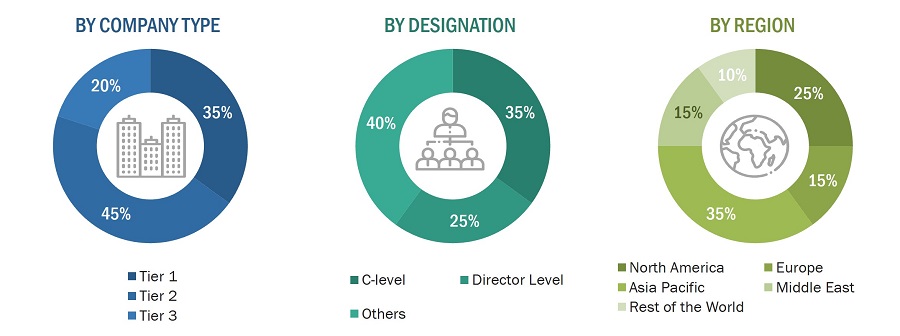
Extensive primary research was conducted after obtaining information about the current scenario of the inflight content market through secondary research. Several primary interviews were conducted with market experts from both demand and supply sides across North America, Europe, Asia Pacific, Middle East and Rest of the World. This primary data was collected through questionnaires, emails, and telephonic interviews. Primary sources from the supply side included various industry experts, such as chief experience officers (CXOs), vice presidents (VPs), directors from business development, marketing, and product development/innovation teams, related key executives from airline cloud providers, independent aviation consultants, aircraft manufactures, integrators and inflight content providers. Interviews were conducted to gather insights such as market statistics, data on revenue collected from the products & services, market breakdowns, market size estimations, market forecasting, and data triangulation. Primary research also helped understand trends related to type, access operation, platform and region.
To know about the assumptions considered for the study, download the pdf brochure
Market Size Estimation
Both top-down and bottom-up approaches were used to estimate and validate the size of the in-flight content market. The research methodology used to estimate the market size also included the following details:
- The key players were identified through secondary research, and their market ranking was determined through primary and secondary research. This included a study of the annual and financial reports of the top market players and extensive interviews of leaders, including chief executive officers (CEOs), directors, and marketing executives.
- All percentage shares, splits, and breakdowns were determined using secondary sources and verified through primary sources. All possible parameters that affect the markets covered in this research study were accounted for, viewed in extensive detail, verified through primary research, and analyzed to obtain the final quantitative and qualitative data. This data was consolidated, enhanced with detailed inputs, analyzed by MarketsandMarkets, and presented in this report.
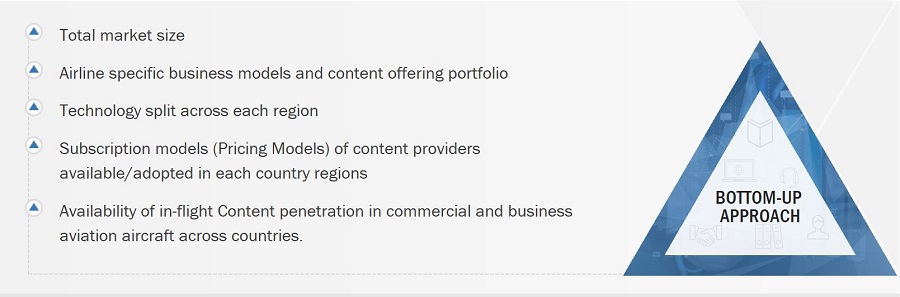
Bottom-Up Approach
The bottom-up approach was employed to arrive at the overall size of the in-flight content market. The growth in the penetration of in-flight content has been tracked through primary avenue such as penetration of Inflight content in the current fleet of aircraft.
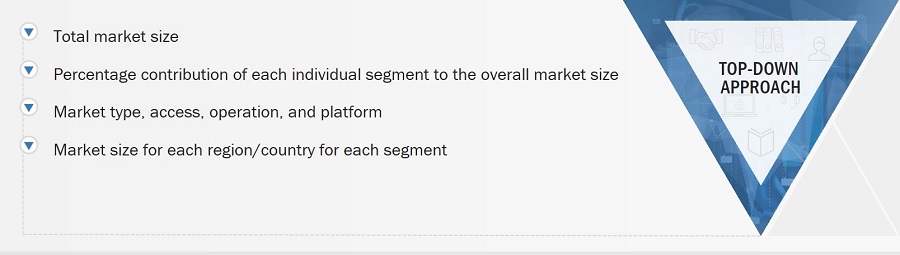
Top-Down Approach
In the top-down approach, the size of the in-flight content market was used to estimate the size of individual markets (mentioned in the market segmentation) through percentage splits from secondary and primary research. For the calculation of the sizes of specific segments, the size of the most appropriate immediate parent market was used to implement the top-down approach.
Data triangulation
After arriving at the overall size of the in-flight content market from the market size estimation process explained above, the total market was split into several segments and subsegments. The data triangulation and market breakdown procedures explained below were implemented, wherever applicable, to complete the overall market engineering process and arrive at the estimated sizes of different market segments and subsegments. The data was triangulated by studying various factors and trends from both the demand and supply sides. Additionally, the market size was validated using both the top-down and bottom-up approaches.
Market Definition
In-flight content refers to a wide range of multimedia entertainment options available for passengers during air travel, including movies, TV shows, music, audiobooks, podcasts, and interactive games, all accessible through the aircraft's in-flight entertainment system. This content selection by airlines aims to enhance the passenger experience during long flights and provide relaxation. In-flight content allows passengers to engage in entertainment and interactive digital games of various genres, from puzzles to immersive adventures, catering to diverse demographics and preferences of different age groups. Airlines invest in sourcing and curating high-quality content to differentiate their services, grow customer loyalty, and elevate the overall in-flight experience for travelers.
Stakeholders
Various stakeholders of the market are listed below:
- Airlines
- In-flight Content Providers
- Internet Service Providers
- Satellite Operators
- Aircraft Manufacturers
- Regulatory Bodies
- Technology Providers
- Content Providers
- Investors
- Passengers
Report Objectives
- To define, describe, segment, and forecast the size of the in-flight content market based on type, access, operation, platform, and region
- To forecast the size of market segments with respect to five major regions, namely North America, Europe, Asia Pacific, the Middle East, and the Rest of the World, along with the major countries in each region
- To identify and analyze key drivers, restraints, opportunities, and challenges influencing the market growth
- To strategically analyze micromarkets1 with respect to individual growth trends, prospects, and their contribution to the overall market
- To analyze opportunities for stakeholders in the market by identifying key trends
- To profile key players and comprehensively analyze their market shares and core competencies2
- To provide a detailed competitive landscape of the in-flight content market, along with a ranking analysis, market share analysis, and revenue analysis of key players
- To identify detailed financial positions, key products, and unique selling points of leading companies in the market
- To analyze the degree of competition in the market by identifying key growth strategies, such as, product/service launches, contracts, and partnerships, adopted by key players
1. Micromarkets are further segments and subsegments of the In-flight Content market.
2. Core competencies of companies were captured in terms of their key developments and strategies adopted to sustain their position in the market.
Available Customizations:
Along with the market data, MarketsandMarkets offers customizations as per the specific needs of companies. The following customization options are available for the report:
Product Analysis
- Product matrix, which gives a detailed comparison of the product portfolio of each company.
Regional Analysis
- Further breakdown of the market segments at the country level
Company Information
- Detailed analysis and profiling of additional market players (up to 5)
Get the Full In-flight Content Market Report
Full forecast, segment splits, and company analysis for all In-flight Content Market.
- Rest Of Asia Pacific In-flight Content Market
- Canada In-flight Content Market
- US In-flight Content Market
- UK In-flight Content Market
- Germany In-flight Content Market
- France In-flight Content Market
- Italy In-flight Content Market
- Spain In-flight Content Market
- China In-flight Content Market
- India In-flight Content Market
- Japan In-flight Content Market
- South Korea In-flight Content Market
- UAE In-flight Content Market
- Saudi Arabia In-flight Content Market
- Qatar In-flight Content Market
- Turkey In-flight Content Market
- Brazil In-flight Content Market
- Mexico In-flight Content Market
- South Africa In-flight Content Market
- Rest Of Europe In-flight Content Market
Need a Tailored Report?
Customize this report to your needs
Get 10% FREE Customization
Customize This Report
