
Rest Of Asia Pacific Industrial Communication Market (2025-2030)

The Rest Of Asia Pacific Industrial Communication Market was valued at $253.5 Million in 2025 and projected to reach to $299.2 Million by 2030, representing a compound annual growth rate of 3.4%. Rest Of Asia Pacific's industrial communication market is positioned for steady growth as emerging economies accelerate their digital transformation initiatives.


| Market Size in | USD 26.32 MN |
| Market Forecast in | |
| CAGR | |
| Forecast Period | |
| Units Considered | Value (USD MN) |
Rest Of Asia Pacific Industrial Communication Market Trends and Insights
- The region is experiencing steady growth driven by increasing digitalization of manufacturing processes and rising adoption of IoT-enabled communication systems across emerging economies.
- Rest Of Asia Pacific is projected to expand to $299.2 million by 2030, reflecting a compound annual growth rate of 3.4% over the forecast period. The industrial communication landscape in Rest Of Asia Pacific is characterized by growing investments in smart factory infrastructure and automation technologies.
- Rest Of Asia Pacific's growth trajectory, though more moderate than leading Asia Pacific markets, demonstrates resilience and sustained demand for reliable communication protocols in industrial settings.
- Key drivers include expanding manufacturing sectors, government initiatives supporting Industry 4.0 adoption, and increasing cross-border trade requiring standardized communication solutions. Rest Of Asia Pacific's market development is supported by the region's diverse industrial base spanning automotive, electronics, chemicals, and food processing sectors.
- Rest Of Asia Pacific continues to attract technology investments and partnerships aimed at modernizing legacy industrial systems with contemporary communication standards..
Key Market Statistics
- CAGR (2025-2030) 3.4% CAGR
- Market Size, 2025 ~USD 253.5 Million
- Forecast, 2030 ~USD 299.2 Million
- Country Rest Of Asia Pacific
Rest Of Asia Pacific Industrial Communication Market Overview
Steady Regional Growth :
Rest Of Asia Pacific industrial communication market is projected to grow from $253.5 million in 2025 to $299.2 million by 2030, representing a CAGR of 3.4%, indicating consistent expansion in emerging economies across the region.
Manufacturing Digitalization Drive :
Increasing digitalization of manufacturing processes in Rest Of Asia Pacific is accelerating adoption of advanced industrial communication systems, as enterprises seek to modernize operations and improve efficiency across production facilities.
IoT-Enabled Communication Adoption :
Rising implementation of IoT-enabled communication systems across emerging economies in Rest Of Asia Pacific is transforming industrial connectivity, enabling real-time data exchange and predictive maintenance capabilities for manufacturers.
Emerging Market Opportunities :
Rest Of Asia Pacific presents untapped growth potential with developing industrial sectors increasingly investing in communication infrastructure, creating significant opportunities for technology providers and solution integrators in the region.
Rest Of Asia Pacific Industrial Communication Market Dynamics
- The region's manufacturing sector is increasingly recognizing the value of IoT-enabled communication systems for operational efficiency and competitive advantage.
- Government initiatives supporting Industry 4.0 adoption and rising foreign direct investment in manufacturing hubs are key growth catalysts. The forecast period through 2030 will see Rest Of Asia Pacific gradually closing the technology adoption gap with developed markets.
- While the regional CAGR of 3.4% trails the global average of 5%, this reflects the region's development stage and presents substantial upside potential as infrastructure investments mature.
- Key growth drivers include expanding industrial bases, rising labor costs driving automation, and increasing connectivity requirements across supply chains..
Market Ecosystem
Related Ecosystem
Communication And Connectivity Technology
- Sensors
- Smart Card & Readers
- Cellular Network
- Femtocell
- Image Sensors
- Cisco Systems, Inc.
- HUAWEI TECHNOLOGIES CO LTD
- Lenovo
- CommScope Holding Company, Inc.
- Nokia corporation
Industrial Automation
- Sensors
- Image Sensors
- Manufacturing Execution System (MES)
- Actuators
- Flow Sensors
- ABB India Limited
- Siemens ag
- Emerson Electric Co.
- HONEYWELL INTERNATIONAL INC.
- SCHNEIDER ELECTRIC SE
Industrial Iot
- Sensors
- Pressure Sensors
- Flow Sensors
- Gas Sensors
- Image Sensors
- Siemens ag
- ABB India Limited
- HONEYWELL INTERNATIONAL INC.
- Emerson Electric Co.
- SCHNEIDER ELECTRIC SE
Key Takeaways
- Rest Of Asia Pacific industrial communication market valued at $253.5 million in 2025, growing to $299.2 million by 2030
- Rest Of Asia Pacific demonstrates a 3.4% CAGR, reflecting steady but measured growth compared to global average of 5%
- Rest Of Asia Pacific's growth is driven by Industry 4.0 adoption, manufacturing expansion, and IoT integration across diverse industrial sectors
- Rest Of Asia Pacific represents emerging opportunities for communication technology providers targeting mid-tier manufacturing and automation upgrades
Industrial Communication Market Report Scope
| Report Metric | Details |
|---|---|
| Base Year | 2025 |
| Fastest Growing Segment | IO-LINK (Communication Protocol) |
| Forecast Period | 2025–2030 |
| Growth Rate | CAGR of 5% from 2025 to 2030 |
| Largest Segment | INDUSTRIAL ETHERNET (Communication Protocol) |
| Market Size Base Year (Billions) | ~USD 20.42 (2025) |
| Revenue Forecast (Billions) | ~USD 26.06 (2030) |
| Segments Covered | Offering, Type, Communication Protocol, Protocol Type, Industry, Industry2025–2030 |
Rest Of Asia Pacific Industrial Communication Market Report Segmentation
6 segment dimensions are covered across the global market.
By Offering
- Components
- Services
- Software
By Type
- Communication Interfaces & Protocol Converters
- Controllers & Connectors
- Gateways
- Other Components
- Power Supply Devices
- Routers & Wap
- Switches
By Communication Protocol
- Fieldbus
- Industrial Ethernet
- Io-Link
- Wireless
By Protocol Type
- Bluetooth
- Can Open
- Cc-Link
- Cc-Link Ie
- Cellular
- Devicenet
- Ethercat
- Ethernet/Ip
- Isa-100.11A
- Modbus
- Modbus-Tcp
- Other Fieldbus Protocols
- Other Industrial Ethernet Protocols
- Other Wireless Protocols
- Powerlink
- Profibus
- Profinet
- Sercos Iii
- Whart
- Wlan
- Zigbee
By Industry
- Aerospace & Defense
- Automotive
- Chemicals & Fertilizers
- Electrical & Electronics
- Energy & Power
- Engineering & Fabrication
- Food & Beverages
- Metals & Mining
- Oil & Gas
- Other Industries
- Pharmaceuticals & Medical Devices
- Water & Wastewater Management
By Industry2025–2030
- Aerospace & Defense
- Automotive
- Chemicals & Fertilizers
- Electrical & Electronics
- Energy & Power
- Engineering & Fabrication
- Food & Beverages
- Metals & Mining
- Oil & Gas
- Other Industries
- Pharmaceuticals & Medical Devices
- Water & Wastewater Management
Target Audience
- Industrial Communication Equipment Manufacturers : Manufacturers need Rest Of Asia Pacific-specific market data to identify expansion opportunities, assess regional demand for communication systems, and develop localized product strategies for emerging economies.
- IoT Solution Providers & Integrators : Solution providers require detailed insights into Rest Of Asia Pacific's IoT adoption rates, manufacturing digitalization trends, and customer requirements to tailor offerings and capture growing market share.
- Investment & Private Equity Firms : Investors need comprehensive Rest Of Asia Pacific market analysis to evaluate acquisition targets, assess regional growth potential, and make informed capital allocation decisions in industrial communication technology.
- Enterprise Manufacturing Companies : Manufacturing enterprises operating in Rest Of Asia Pacific need market intelligence on communication technology trends, competitive offerings, and best practices to optimize their industrial connectivity investments.
- Technology Consultants & System Integrators : Consultants require Rest Of Asia Pacific-specific market data to advise clients on technology adoption strategies, competitive positioning, and digital transformation roadmaps aligned with regional growth dynamics.
Key Companies in the Rest Of Asia Pacific Industrial Communication Market
| Company | HQ | Ownership | Strongest segments |
|---|---|---|---|
| TEXAS INSTRUMENTS INC | United States | Public Company | Fieldbus communication ICs and interfaces,Industrial Ethernet PHYs, switches, and controllers,Wireless connectivity for industrial (Wi-Fi, Sub-GHz, BLE), |
| FOXCONN INDUSTRIAL INTERNET CO LTD | United States | Public Company | Industrial Ethernet (switches, gateways, communication interfaces),Routers & WAP, Wireless Communication,Controllers, Connectors & IO-Link / Communication Interfaces, |
| VOLEX GROUP | United Kingdom | Public Company | Power cords, plugs, connectors, and receptacles for industrial and data-center equipment,Custom ruggedised wiring harnesses, battery cables, and complex cable assemblies,Integrated Manufacturing Services (PCB assembly, box build, electromechanical systems), |
| ACES ELECTRONIC CO., LTD. | Taiwan | Public Company | Controller & Connector,Communication Interface & Converter,Industrial Ethernet & Fieldbus Connectivity Hardware, |
| LEONI AG | Germany | Private Company | Fieldbus Cabling & Connectivity,Industrial Ethernet Cabling & Connectivity,Wireless Infrastructure Cabling & Power, |
| SOITEC | France | Public Company | Power-SOI for industrial and automotive power electronics,FD-SOI and AUTO FD-SOI for controllers and processors,PD-SOI for cloud and network equipment, |
| CISCO SYSTEMS, INC. | United States | Public Company | Industrial Ethernet (switches, routers, gateways),Wireless (industrial Wi-Fi, WAPs, routers),Fieldbus & communication interfaces/converters, |
| SIEMENS | Germany | Public Company | Industrial Ethernet (switches, routers, WAPs, gateways),Controllers & connectors,Fieldbus devices, |
| ROCKWELL AUTOMATION | United States | Public Company | Industrial Ethernet (switches, routers, WAPs),Controllers & Connectors,Gateways, Communication Interfaces & Converters, |
TEXAS INSTRUMENTS INC
Texas Instruments Inc. is a public company founded in the United States in 1930 with 33,000 employees, a leading manufacturer of semiconductors and analog integrated circuits.
FOXCONN INDUSTRIAL INTERNET CO LTD
Foxconn Industrial Internet Co Ltd. is a public company founded in the United States in 2015 with 217,084 employees, operating as a major electronics manufacturing and industrial internet services provider.
VOLEX GROUP
Volex Group is a public company founded in the United Kingdom in 1892 with 13,000 employees, specializing in power and connectivity solutions for various industries.
ACES ELECTRONIC CO., LTD.
ACES Electronic Co., Ltd. is a public company founded in Taiwan in 1996 with 215 employees, engaged in electronic component manufacturing and distribution.
LEONI AG
Leoni AG is a private company founded in Germany in 1569 with 95,090 employees, a major manufacturer of cables, wiring systems, and related products.
SOITEC
Soitec is a public company founded in France in 1992 with 1,961 employees, specializing in semiconductor materials and engineered substrates.
CISCO SYSTEMS, INC.
Cisco Systems, Inc. is a public company founded in the United States in 1984 with 86,200 employees, a global leader in networking, cybersecurity, and IT infrastructure solutions.
SIEMENS
Siemens is a public company founded in Germany in 1847 with 310,312 employees, a diversified industrial conglomerate operating across electrification, automation, and digitalization sectors.
ROCKWELL AUTOMATION
Rockwell Automation is a public company founded in the United States in 1903 with 26,000 employees, specializing in industrial automation and digital transformation solutions.
Reasons to Buy this Report
- Regional Market Sizing & Forecasts : Obtain precise market size data specific to Rest Of Asia Pacific with detailed 2025-2030 projections, enabling accurate budget allocation and investment planning tailored to this emerging region's growth trajectory.
- Competitive Landscape Intelligence : Understand key players, market share distribution, and competitive dynamics unique to Rest Of Asia Pacific, identifying partnership and expansion opportunities in this underserved but growing market segment.
- Emerging Economy Insights : Gain deep understanding of digitalization trends, IoT adoption patterns, and manufacturing modernization drivers specific to Rest Of Asia Pacific's developing industrial sectors and emerging markets.
- Growth Opportunity Identification : Identify high-potential sub-segments, technology gaps, and unmet customer needs within Rest Of Asia Pacific that present first-mover advantages and premium growth opportunities through 2030.
- Strategic Market Entry Planning : Develop informed go-to-market strategies for Rest Of Asia Pacific with regional context on infrastructure readiness, regulatory environment, and customer adoption patterns for industrial communication solutions.
Frequently asked questions
What is the current market size of industrial communication in Rest Of Asia Pacific?
Rest Of Asia Pacific's industrial communication market is estimated at $253.5 million in 2025 and is projected to reach $299.2 million by 2030.
What is the growth rate for Rest Of Asia Pacific industrial communication market?
Rest Of Asia Pacific is experiencing a compound annual growth rate (CAGR) of 3.4% from 2025 to 2030.
Which industries drive demand in Rest Of Asia Pacific industrial communication market?
Rest Of Asia Pacific's industrial communication demand is driven by automotive, electronics, chemicals, food processing, and manufacturing sectors undergoing digital transformation.
How does Rest Of Asia Pacific growth compare to the global industrial communication market?
Rest Of Asia Pacific's 3.4% CAGR is lower than the global average of 5%, indicating more conservative but stable market expansion in the region.
What factors are accelerating industrial communication adoption in Rest Of Asia Pacific?
Rest Of Asia Pacific adoption is accelerated by Industry 4.0 initiatives, government support for manufacturing modernization, IoT integration, and increasing cross-border trade requirements.
RESEARCH METHODOLOGY
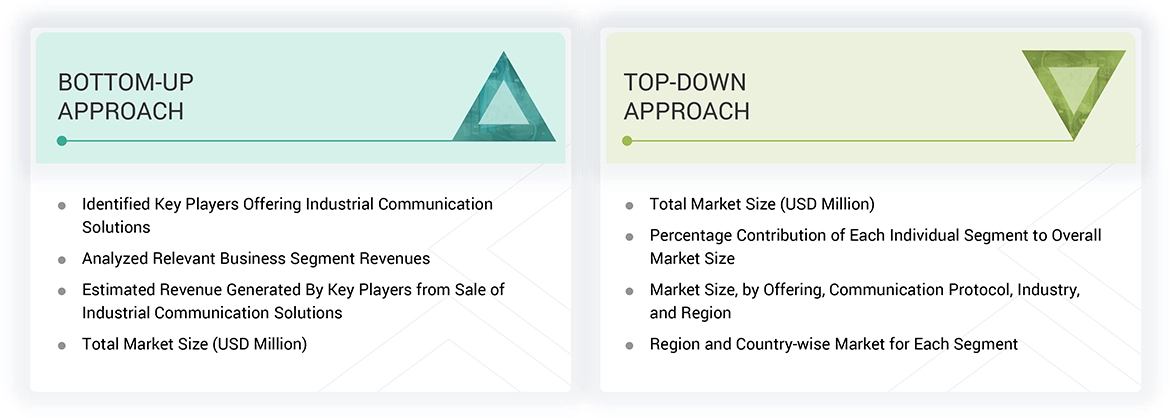
The study involved major activities in estimating the current market size for the industrial communication market. Exhaustive secondary research was done to collect information on the market. The next step was to validate these findings, assumptions, and sizing with industry experts across the value chain using primary research. Different approaches, such as top-down and bottom-up, were employed to estimate the total market size. After that, the market breakup and data triangulation procedures were used to estimate the market size of the segments and subsegments of the industrial communication market.
Secondary Research
The secondary research for this study involved gathering information from various credible sources. These included company annual reports, investor presentations, press releases, whitepapers, certified publications, and articles from reputable associations and government publications. Additional data was obtained from corporate filings, professional and trade associations, journals, and industry-recognized authors. Research from consortiums, councils, and gold- and silver-standard websites, directories, and databases also contributed to the qualitative framework. Key global sources such as the International Trade Centre (ITC) and the International Monetary Fund (IMF) were consulted to support and validate the market analysis.
Primary Research
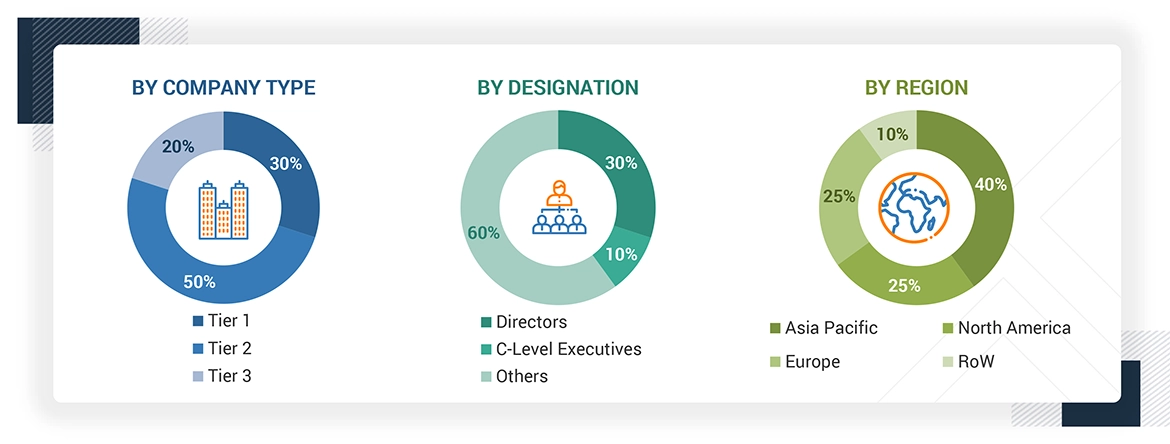
Extensive primary research was accomplished after understanding and analyzing the industrial communication market scenario through secondary research. Several primary interviews were conducted with key opinion leaders from demand- and supply-side vendors across four major regions—North America, Europe, Asia Pacific, and RoW. Approximately 20% of the primary interviews were conducted with the demand side and 80% with the supply side. Primary data was collected through questionnaires, e-mails, and telephonic interviews. Various departments within organizations, such as sales, operations, and administration, were contacted to provide a holistic viewpoint in the report.
To know about the assumptions considered for the study, download the pdf brochure
Market Size Estimation
Both top-down and bottom-up approaches were used to estimate and validate the total size of the industrial communication market. These methods were also used extensively to estimate the size of various subsegments in the market. The research methodology used to estimate the market size includes the following:
Industrial Communication Market : Top-Down and Bottom-Up Approach
Data Triangulation
After arriving at the overall size of the industrial communication market through the process explained above, the overall market has been split into several segments. Data triangulation procedures have been employed to complete the overall market engineering process and arrive at the exact statistics for all the segments, wherever applicable. The data has been triangulated by studying various factors and trends from the demand and supply sides. The market has also been validated using top-down and bottom-up approaches.
Market Definition
Industrial communication is the interaction of information and data between control systems, machines, and human beings within industries, making the operations automated, reliable, and efficient. Industrial communication is the backbone of the modern process industries and manufacturing through real-time monitoring, control, and coordination among equipment and systems. In contrast to general-purpose communications networks, industrial communication systems are intended to fulfill the particular needs of industrial environments, such as high reliability, low latency, and durability under harsh conditions, making them crucial for implementing Industry 4.0 and smart factory strategies.
Key Stakeholders
- Brand Product Manufacturers/Original Equipment Manufacturers (OEMs)/Original Device Manufacturers (ODMs)
- Industrial Communications Product Manufacturers
- Semiconductor Component Suppliers/Foundries
- Industrial Communication Material and Component Suppliers
- Manufacturing Equipment Suppliers
- System Integrators
- Technology/IP Developers
- Consulting and Market Research Service Providers
- Industrial Communications and Material-related Associations, Organizations, Forums, and Alliances
- Venture Capitalists and Startups
- Research and Educational Institutes
- Distributors and Resellers
- End Users
Report Objectives
- To define, describe, and forecast the industrial communication market size, by offering, communication protocol, and industry, in terms of value
- To describe and forecast the market size for four key regions: North America, Europe, Asia Pacific, and the RoW, in terms of value
- To define, describe, and forecast the industrial communication market size, by component (gateways and switches), in terms of volume
- To provide detailed insights regarding drivers, restraints, opportunities, and challenges influencing the growth of the market
- To analyze emerging applications and standards in the industrial communication market
- To examine manufacturers of industrial communication solutions, their strategies, production plans, and the overall value chain, including material and component suppliers
- To strategically analyze the micromarkets1 with respect to individual growth trends, prospects, and contributions to the overall market
- To analyze the market opportunities for stakeholders and provide a comprehensive competitive landscape analysis
- To provide a detailed overview of the industrial communication ecosystem
- To provide a detailed overview of the impact of AI/Gen AI, macroeconomic outlook for all regions, and the 2025 US tariff impact on the industrial communication market
- To provide information about the key technology trends, trade analysis, and patents related to the industrial communication market
- To strategically analyze average selling price trends, trends impacting customer business, regulatory landscape, patent landscape, Porter’s five forces, import and export scenarios, trade landscape, and case studies pertaining to the market under study
- To benchmark the market players using the proprietary company evaluation matrix framework, which analyzes them on various parameters within the broad categories of market ranking/share and product portfolio
- To analyze competitive developments, such as partnerships, acquisitions, expansions, collaborations, and product launches, in the market
- To strategically profile key players and analyze their market share, ranking, and core competencies
Available Customizations
With the market data given, MarketsandMarkets offers customizations according to the company’s specific needs. The following customization options are available for the report:
Company Information
- Detailed analysis and profiling of additional market players (up to 7)
Get the Full Industrial Communication Market Report
Full forecast, segment splits, and company analysis for all Industrial Communication Market.
- Bahrain Industrial Communication Market
- Kuwait Industrial Communication Market
- Oman Industrial Communication Market
- Qatar Industrial Communication Market
- Rest Of Middle East Industrial Communication Market
- Saudi Arabia Industrial Communication Market
- UAE Industrial Communication Market
- Other African Countries Industrial Communication Market
- South Africa Industrial Communication Market
- US Industrial Communication Market
- Canada Industrial Communication Market
- Mexico Industrial Communication Market
- UK Industrial Communication Market
- Germany Industrial Communication Market
- France Industrial Communication Market
- Spain Industrial Communication Market
- Italy Industrial Communication Market
- Poland Industrial Communication Market
- China Industrial Communication Market
- Japan Industrial Communication Market
- India Industrial Communication Market
- South Korea Industrial Communication Market
- Australia Industrial Communication Market
- Indonesia Industrial Communication Market
- Malaysia Industrial Communication Market
- Thailand Industrial Communication Market
- Vietnam Industrial Communication Market
- Nordics Industrial Communication Market
- Rest Of Europe Industrial Communication Market
Need a Tailored Report?
Customize this report to your needs
Get 10% FREE Customization
Customize This Report
