
ITALY Industrial Evaporators Market (2025-2030)

The ITALY Industrial Evaporators Market was valued at $389 Million in 2025 and projected to reach to $480.1 Million by 2030, representing a compound annual growth rate of 4.3%. Italy's industrial evaporators market demonstrates steady growth momentum, supported by the country's well-established chemical and material processing industries.


| Market Size in | USD 26.32 MN |
| Market Forecast in | |
| CAGR | |
| Forecast Period | |
| Units Considered | Value (USD MN) |
ITALY Industrial Evaporators Market Trends and Insights
- This steady expansion reflects Italy's strong chemical and material processing sectors, which rely on evaporation technology for concentration, separation, and waste management applications.
- Italy's established manufacturing base and regulatory focus on sustainable industrial practices are driving adoption of advanced evaporator systems across food, pharmaceutical, and chemical industries. The Italian market benefits from the country's position as a leading European chemical processor and its commitment to circular economy principles.
- Between 2025 and 2030, Italy is expected to see increased investment in energy-efficient evaporator technologies and modernization of aging equipment.
- Italy's industrial evaporators market growth is supported by rising demand for process optimization, stricter environmental compliance, and the need to reduce operational costs in competitive manufacturing sectors..
Key Market Statistics
- CAGR (2025-2030) 4.3% CAGR
- Market Size, 2025 ~USD 389 Million
- Forecast, 2030 ~USD 480.1 Million
- Country ITALY
ITALY Industrial Evaporators Market Overview
Market Size & Growth :
Italy's industrial evaporators market is valued at USD 389.0 million in 2025, with a projected CAGR of 4.3% through 2030, reaching USD 480.1 million by forecast end.
Chemical Processing Dominance :
Italy's robust chemical and material processing sectors drive significant demand for evaporation technology in concentration, separation, and waste management applications across the country.
Regional Industrial Strength :
Italy's established manufacturing base and specialized chemical industries position the country as a key market for industrial evaporators in Southern Europe.
Steady Market Expansion :
The 4.3% CAGR reflects consistent growth driven by modernization of Italian industrial facilities and increased adoption of efficient evaporation technologies for sustainability.
ITALY Industrial Evaporators Market Dynamics
- The 4.3% CAGR through 2030 reflects sustained demand for evaporation technologies across concentration, separation, and waste management applications.
- Italian manufacturers are increasingly investing in modernized equipment to enhance operational efficiency and meet stringent environmental regulations. The market outlook for Italy remains positive as industries prioritize sustainable processing solutions and waste reduction.
- Growing emphasis on circular economy principles and energy-efficient technologies will drive adoption of advanced evaporator systems.
- Additionally, Italy's strategic position in European supply chains and its specialized chemical sector will continue to support market expansion through 2030..
Market Ecosystem
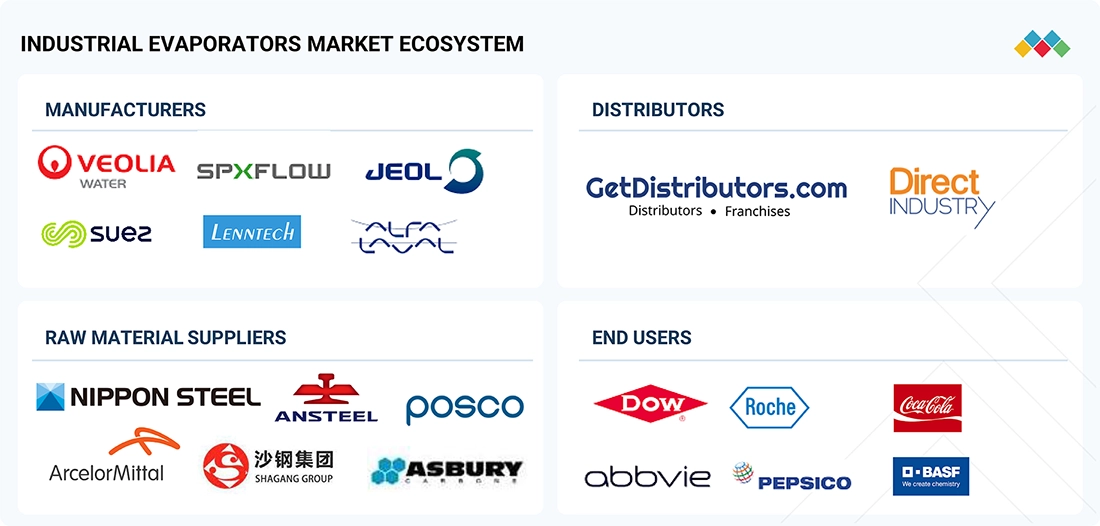
Industrial Evaporators Market: COMMERCIAL USE CASES ACROSS INDUSTRIES
| COMPANY | USE CASE DESCRIPTION | BENEFITS |
|---|---|---|
 |
Delivers advanced industrial evaporator and crystallization systems designed for wastewater minimization, resource recovery, and process water recycling. These solutions integrate seamlessly with treatment facilities to help industries achieve zero-liquid-discharge goals. | Enables closed-loop water operations, minimizes waste discharge, and ensures long-term compliance with tightening environmental standards. |
 |
Provides high-efficiency evaporators engineered for thermal separation, concentration, and purification across chemical, food, and pharmaceutical industries. Its modular systems are optimized for energy recovery and process scalability. | Enhances process efficiency, reduces thermal energy demand, and delivers consistent product yield with lower operational expenditure. |
 |
Designs versatile evaporator systems with automated controls and robust materials for continuous and demanding industrial applications. The company emphasizes ease of maintenance and operational reliability. | Improves process reliability, extends equipment lifecycle, and ensures optimal performance under varying industrial load conditions. |
 |
Develops compact evaporator units integrating advanced heat exchange and vapor recovery technologies. These are suited for facilities with limited space or specialized process requirements. | Delivers high concentration performance in limited footprints, reduces utility consumption, and supports efficient thermal resource management. |
 |
Offers customized multiple-effect and mechanical vapor recompression (MVR) evaporators tailored to energy-intensive industries. Its smart monitoring and predictive maintenance systems ensure long-term operational efficiency. | Achieves superior energy recovery, ensures sustainable plant operation, and lowers overall lifecycle costs through intelligent system integration. |
Logos and trademarks shown above are the property of their respective owners. Their use here is for informational and illustrative purposes only.
Related Ecosystem
Equipment Machine And Tooling
- Wastewater Treatment
- Air Cooled Heat Exchangers
- Diaphragm Pumps
- Fiberglass
- HVAC System
- Alfa Laval Corporate AB
- Veolia
- Johnson Controls International plc
- Daikin Industries,Ltd.
- Parker-Hannifin Corporation
Key Takeaways
- Italy's industrial evaporators market is valued at USD 389.0 million in 2025 and will reach USD 480.1 million by 2030, growing at a 4.3% CAGR.
- Italy's chemical and pharmaceutical sectors are primary drivers of evaporator demand, supported by strict EU environmental regulations.
- Energy efficiency and sustainability are key purchasing criteria for Italian manufacturers seeking to reduce operational costs and carbon footprint.
- Italy's established industrial base and focus on circular economy principles position the country for steady, sustainable market growth through 2030.
Industrial Evaporators Market Report Scope
| Report Metric | Details |
|---|---|
| Base Year | 2025 |
| Fastest Growing Segment | PLATE (Construction Type) |
| Forecast Period | 2025–2030 |
| Growth Rate | CAGR of 5% from 2025 to 2030 |
| Largest Segment | SHELL & TUBE (Construction Type) |
| Market Size Base Year (Billions) | ~USD 22.05 (2025) |
| Revenue Forecast (Billions) | ~USD 28.14 (2030) |
| Segments Covered | Construction Type |
ITALY Industrial Evaporators Market Report Segmentation
1 segment dimensions are covered across the global market.
By Construction Type
- Plate
- Shell & Tube
ITALY: INDUSTRIAL EVAPORATORS MARKET, BY END-USE INDUSTRY, 2025–2030
| Segment | 2025 | 2026 | 2027 | 2028 | 2029 | 2030 | CAGR (%) |
|---|---|---|---|---|---|---|---|
| AUTOMOTIVE | 64.9 | 68.4 | 72.1 | 76 | 80.1 | 84.4 | 5.4 |
| CHEMICALS & PETROCHEMICALS | 90.2 | 93.4 | 96.7 | 100.1 | 103.6 | 107.2 | 3.5 |
| ELECTRONICS & SEMICONDUCTOR | 53.7 | 56.1 | 58.7 | 61.4 | 64.2 | 67.2 | 4.6 |
| FOOD & BEVERAGES | 119.4 | 126.3 | 133.7 | 141.4 | 149.6 | 158.3 | 5.8 |
| OTHER END-USE INDUSTRIES | 48.1 | 50.2 | 52.4 | 54.7 | 57 | 59.4 | 4.3 |
| PHARMACEUTICALS | 101.3 | 105.2 | 109.3 | 113.6 | 118 | 122.6 | 3.9 |
| PULP & PAPER | 58.3 | 60.2 | 62.2 | 64.3 | 66.4 | 68.6 | 3.3 |
| TOTAL | 535.9 | 560 | 585.2 | 611.5 | 639 | 667.8 | 4.5 |
Target Audience
- Equipment Manufacturers : Italian and European evaporator manufacturers need market-specific data to benchmark performance, identify growth opportunities, and develop products tailored to Italian industrial requirements.
- Chemical Industry Players : Italian chemical processors require market intelligence to evaluate evaporator technology investments, understand competitive offerings, and optimize operational efficiency in their facilities.
- Investment & Private Equity Firms : Investors targeting Italy's industrial sector need detailed market analysis to assess growth potential, identify acquisition targets, and evaluate returns in the evaporators market.
- Distributors & System Integrators : Italian distributors and integrators need market forecasts and segment analysis to plan inventory, develop sales strategies, and capitalize on growing demand across customer segments.
- Sustainability & Environmental Consultants : Consultants advising Italian industries on waste management and sustainability need market data to recommend appropriate evaporation solutions and track technology adoption trends.
Key Companies in the ITALY Industrial Evaporators Market
| Company | HQ | Ownership | Strongest segments |
|---|---|---|---|
| SUMITOMO HEAVY INDUSTRIES, LTD. | Japan | Public Company | Mechatronics (gearmotors, gearboxes, motion control, precision positioning),Industrial Machinery (plastics machinery, film forming, semiconductor and medical equipment),Logistics & Construction (hydraulic excavators, cranes, logistics systems), |
| SPX FLOW, INC. | United States | Private Company | Nutrition & Health (dairy, food, beverage, hygienic processing),Precision Solutions – Air Dryers & Filtration,Precision Solutions – Pumps & Mixers, |
| JEOL LTD. | Japan | Public Company | Scientific and Metrology Instruments (TEM, SEM, NMR, MS, XRF, microanalysis),Industrial Equipment (thin film, material processing, electron beam metal AM, lithography),Medical Equipment (clinical chemistry analyzers and related), |
| GEA GROUP AKTIENGESELLSCHAFT | Germany | Public Company | Separation & Flow Technologies (separators, decanters, valves, pumps),Liquid & Power Technologies (brewing, liquid processing, thermal, carbon capture),Food & Health Technologies (meat/vegan processing, slicing, pharma solids), |
| H2O GMBH | Romania | Public Company | Electricity generation (hydropower),Electricity generation (wind),Electricity supply (retail and wholesale), |
| DE DIETRICH | France | Private Company | Glass-lined and enamel-coated reactors and vessels,Process systems for extraction, reaction, agitation, and filtration,Thermal separation and solvent renewal systems, |
| ALFA LAVAL | Sweden | Public Company | Plate and other heat exchangers,Separators and decanters,Pumps and fluid handling, |
| SASAKURA ENGINEERING CO, LTD. | Japan | Private Company | Desalination plants and water treatment systems,Marine environmental equipment,Other environmental and engineered systems, |
| PRAJ INDUSTRIES | India | Public Company | Ethanol and biofuels plants (including modernization, BioCNG, iso-butanol),High purity systems (biopharma, sterile, personal care, nutraceuticals),Brewery and beverage plants, |
SUMITOMO HEAVY INDUSTRIES, LTD.
Sumitomo Heavy Industries, Ltd. is a Japanese public company founded in 1888 with 25,123 employees, operating across industrial machinery and equipment sectors.
SPX FLOW, INC.
SPX Flow, Inc. is a United States-based private company founded in 2015 with 4,900 employees, providing flow control and industrial processing solutions.
JEOL LTD.
JEOL Ltd. is a Japanese public company established in 1949 with 3,731 employees, specializing in electron microscopy and scientific instrumentation.
GEA GROUP AKTIENGESELLSCHAFT
GEA Group Aktiengesellschaft is a German public company founded in 1881 with 19,670 employees, providing process technology and equipment for various industries.
H2O GMBH
H2O GmbH is a Romanian public company founded in 2000 with 5,249 employees, specializing in water treatment and management solutions.
DE DIETRICH
De Dietrich is a French private company with roots dating back to 1684, operating in industrial equipment and heating solutions.
ALFA LAVAL
Alfa Laval is a Swedish public company established in 1883 with 24,399 employees, providing heat transfer, separation, and fluid handling technologies.
SASAKURA ENGINEERING CO, LTD.
Sasakura Engineering Co, Ltd. is a Japanese private company founded in 1949 with 473 employees, operating in industrial engineering and manufacturing.
PRAJ INDUSTRIES
Equipment Manufacturing Company is a Netherlands-based private company founded in 2019 with no current employees.
Reasons to Buy this Report
- Italy-Specific Market Sizing : Access precise market valuation data for Italy's industrial evaporators sector with detailed 2025-2030 forecasts, enabling accurate investment and expansion planning in the Italian market.
- Competitive Landscape Intelligence : Understand Italy's unique competitive dynamics, local manufacturer strategies, and market positioning specific to the Italian chemical and material processing industries.
- Regulatory & Compliance Insights : Gain knowledge of Italy-specific environmental regulations, sustainability requirements, and compliance standards driving evaporator technology adoption across Italian industrial sectors.
- Growth Driver Analysis : Identify key growth catalysts unique to Italy's market, including industrial modernization trends, waste management priorities, and energy efficiency initiatives shaping demand.
- Strategic Market Entry Planning : Develop targeted go-to-market strategies for Italy with localized insights on customer segments, distribution channels, and partnership opportunities in the Italian industrial sector.
Frequently asked questions
What is the current size of Italy's industrial evaporators market?
Italy's industrial evaporators market is estimated at USD 389.0 million in 2025.
What is the projected market size for Italy's industrial evaporators by 2030?
Italy's industrial evaporators market is forecast to reach USD 480.1 million by 2030.
What is the CAGR for Italy's industrial evaporators market?
Italy's industrial evaporators market is expected to grow at a compound annual growth rate (CAGR) of 4.3% between 2025 and 2030.
Which industries drive demand for industrial evaporators in Italy?
Italy's chemical processing, pharmaceutical, food and beverage, and waste management sectors are the primary drivers of industrial evaporator demand.
What factors are supporting growth in Italy's industrial evaporators market?
Italy's market growth is driven by EU environmental regulations, demand for energy-efficient technologies, process optimization needs, and the country's commitment to circular economy principles.
RESEARCH METHODOLOGY
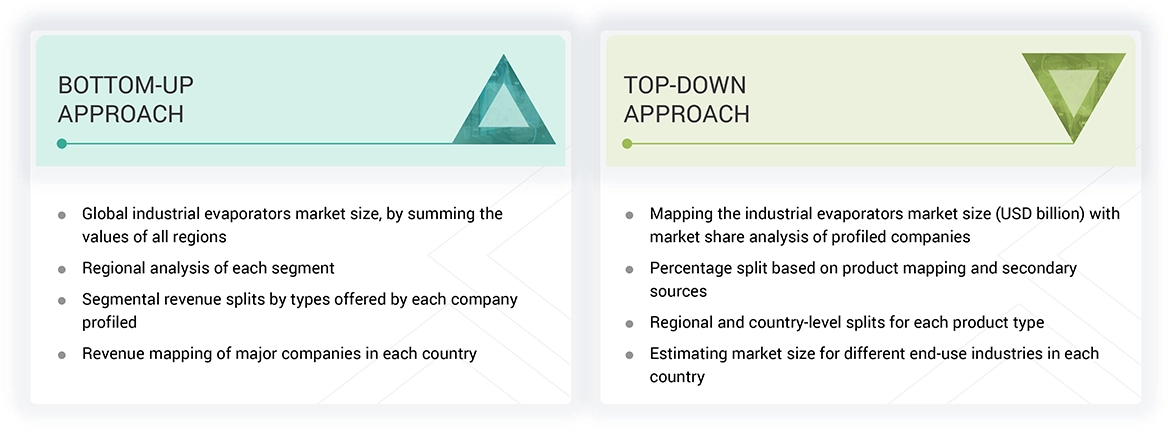
The study involved four major activities in estimating the size of the industrial evaporators market. Exhaustive secondary research was done to collect information related to the market, peer markets, and parent markets. The next step was to validate these findings, assumptions, and sizing with the industry experts across the industrial evaporators value chain through primary research. Both top-down and bottom-up approaches were employed to estimate the complete market size. Thereafter, market breakdown and data triangulation were used to estimate the market size of segments and subsegments.
Secondary Research
Secondary sources for this research study included annual reports, press releases, and investor presentations of companies; white papers; certified publications; and articles by recognized authors; gold- and silver-standard websites; Industrial evaporators manufacturing companies, regulatory bodies, trade directories, and databases. The secondary research was mainly used to obtain key information about the industry’s supply chain, the total pool of key players, market classification, and segmentation according to industry trends to the bottom-most level and regional markets. It was also used to obtain information about key developments from a market-oriented perspective.
Primary Research
The industrial evaporators market comprises several stakeholders, such as raw material suppliers, technology support providers, Industrial evaporators manufacturers, and regulatory organizations in the supply chain. Various primary sources from the supply and demand sides of the market were interviewed to obtain qualitative and quantitative information. Primary sources from the supply side included industry experts such as Chief Executive Officers (CEOs), vice presidents, marketing directors, technology and innovation directors, and related key executives from various key companies and organizations operating in the industrial evaporators market. Primary sources from the demand side included directors, marketing heads, and purchase managers from various sourcing industries.
Following is the breakdown of the primary respondents:
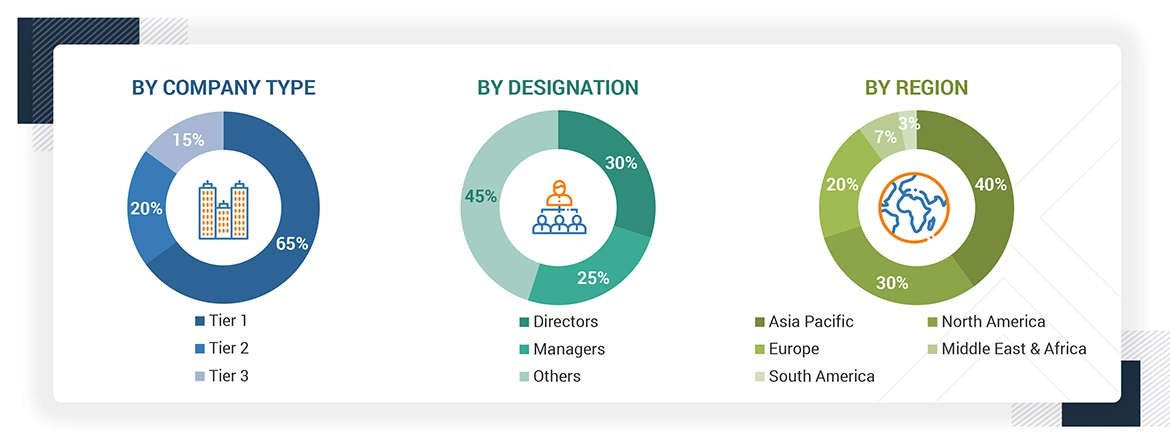
To know about the assumptions considered for the study, download the pdf brochure
Market Size Estimation
Both the top-down and bottom-up approaches were used to estimate and validate the total size of the industrial evaporators market. These approaches were also used extensively to estimate the size of various dependent subsegments of the market. The research methodology used to estimate the market size included the following: The following segments provide details about the overall market size estimation process employed in this study:
- The key players in the market were identified through secondary research.
- The market shares in the respective regions were identified through primary and secondary research.
- The value chain and market size of the industrial evaporators market, in terms of value and volume, were determined through primary and secondary research.
- All percentage shares, splits, and breakdowns were determined using secondary sources and verified through primary sources.
- All possible parameters that affect the market covered in this research study were accounted for, viewed in extensive detail, verified through primary research, and analyzed to obtain the final quantitative and qualitative data.
- The research included the study of annual and financial reports of the top market players and interviews with industry experts, such as CEOs, VPs, directors, sales managers, and marketing executives, for key quantitative and qualitative insights.
Global Industrial Evaporators Market Size: Bottom-Up and Top-Down Approaches
Data Triangulation
The market was split into several segments and sub-segments after arriving at the overall market size using the market size estimation processes as explained above. Data triangulation and market breakdown procedures were employed to complete the overall market engineering process and arrive at the exact statistics of each market segment and subsegment. The data was triangulated by studying various factors and trends from both the demand and supply sides.
Market Definition
According to the Handbook of Evaporation Technology, industrial evaporators are specialized process equipment designed primarily for the concentration of solutions containing target products or for the recovery of solvents, predominantly water. These systems are fundamentally based on three essential principles: heat transfer, vapor-liquid separation, and energy efficiency. Heat is typically delivered through the condensation of steam, which is transferred indirectly via metal surfaces. The selection of construction materials is influenced by several factors, including the frequency of cleaning required and the corrosiveness of the fluids in use. Common materials employed in the construction of these systems include copper, aluminum alloys, carbon steel, various grades of stainless steel (304 and 316), high-alloy or duplex stainless steels, titanium, nickel, graphite, and rubber-lined carbon steel.
In operation, the feed solution is introduced into the evaporator, where it traverses a heating surface. The application of heat induces the evaporation of water, resulting in a more concentrated solution. This vapor is subsequently separated and condensed, while the concentrated liquid either undergoes further processing in an additional evaporator or is collected as the final product. A typical industrial evaporator comprises four principal components: a heating unit, a concentration chamber, a vapor separation section, and a condenser. Given their high efficiency, industrial evaporators are extensively utilized across various industries involved in liquid and chemical processing. They are particularly advantageous in applications that require low-temperature operations, such as food and pharmaceutical production, and play a significant role in effluent and wastewater treatment.
Stakeholders
- Raw material manufacturers
- Technology support providers
- Manufacturers of industrial evaporators
- Traders, distributors, and suppliers
- Regulatory bodies and government agencies
- Research & development (R&D) institutions
- End-use industries
- Consulting firms, trade associations, and industry bodies
- Investment banks and private equity firms
Report Objectives
- To analyze and forecast the market size of industrial evaporators market in terms of value and volume
- To provide detailed information regarding the major factors (drivers, restraints, challenges, and opportunities) influencing the regional market
- To analyze and forecast the global industrial evaporators market based on construction type, functionality, end-use industry, and region
- To analyze the opportunities in the market for stakeholders and provide details of a competitive landscape for market leaders
- To forecast the size of various market segments based on major regions: Asia Pacific, Europe, North America, Middle East & Africa, and South America, along with their respective key countries
- To track and analyze the competitive developments, such as agreements, product launches, and expansions, in the market
- To strategically profile the key players and comprehensively analyze their market shares and core competencies
Get the Full Industrial Evaporators Market Report
Full forecast, segment splits, and company analysis for all Industrial Evaporators Market.
- CHINA Industrial Evaporators Market
- SOUTH KOREA Industrial Evaporators Market
- JAPAN Industrial Evaporators Market
- INDIA Industrial Evaporators Market
- MALAYSIA Industrial Evaporators Market
- AUSTRALIA Industrial Evaporators Market
- CANADA Industrial Evaporators Market
- US Industrial Evaporators Market
- MEXICO Industrial Evaporators Market
- GERMANY Industrial Evaporators Market
- UK Industrial Evaporators Market
- FRANCE Industrial Evaporators Market
- RUSSIA Industrial Evaporators Market
- SPAIN Industrial Evaporators Market
- SOUTH AFRICA Industrial Evaporators Market
- ARGENTINA Industrial Evaporators Market
- BRAZIL Industrial Evaporators Market
Need a Tailored Report?
Customize this report to your needs
Get 10% FREE Customization
Customize This Report
