
UK Industrial Gases Market (2025-2030)

The UK Industrial Gases Market was valued at $2613.5 Million in 2025 and projected to reach to $3319.8 Million by 2030, representing a compound annual growth rate of 4.9%. The UK industrial gases market is positioned for steady expansion through 2030, supported by recovery in construction activities and sustained demand from the packaging sector.


| Market Size in | USD 26.32 MN |
| Market Forecast in | |
| CAGR | |
| Forecast Period | |
| Units Considered | Value (USD MN) |
UK Industrial Gases Market Trends and Insights
- The UK market benefits from robust demand across packaging, construction, and mining sectors, where industrial gases play a critical role in manufacturing and operational efficiency.
- The UK's established infrastructure and regulatory framework support steady adoption of specialty gases and cryogenic solutions across diverse end-use industries. Driving the UK market's growth trajectory through 2030 are increasing investments in construction projects, modernization of mining operations, and rising demand for packaged gases in food and beverage processing.
- The UK's commitment to sustainability and energy efficiency is spurring adoption of advanced gas technologies and cleaner production methods.
- Market participants in the UK are responding to these trends by expanding distribution networks and developing innovative gas solutions tailored to regional industrial requirements..
Key Market Statistics
- CAGR (2025-2030) 4.9% CAGR
- Market Size, 2025 ~USD 2613.5 Million
- Forecast, 2030 ~USD 3319.8 Million
- Country UK
UK Industrial Gases Market Overview
Market Valuation :
The UK industrial gases market is valued at £2,613.5 million in 2025, with strong growth trajectory driven by established manufacturing and infrastructure sectors.
Projected Growth :
Expected to reach £3,319.8 million by 2030, representing a steady CAGR of 4.9%, outpacing broader economic growth in the UK.
Key Demand Drivers :
Robust demand from UK packaging, construction, and mining sectors where industrial gases are essential for manufacturing efficiency and operational performance.
Market Infrastructure :
The UK's established industrial infrastructure and supply chain networks provide competitive advantages for market participants and end-users.
UK Industrial Gases Market Dynamics
- Manufacturing modernisation initiatives and increased focus on operational efficiency across mining operations will continue to drive gas consumption.
- The market benefits from the UK's mature industrial base and regulatory frameworks that support safe gas handling and distribution.
- However, energy costs and supply chain considerations remain key factors influencing market dynamics and pricing strategies for industrial gas suppliers..
Market Ecosystem
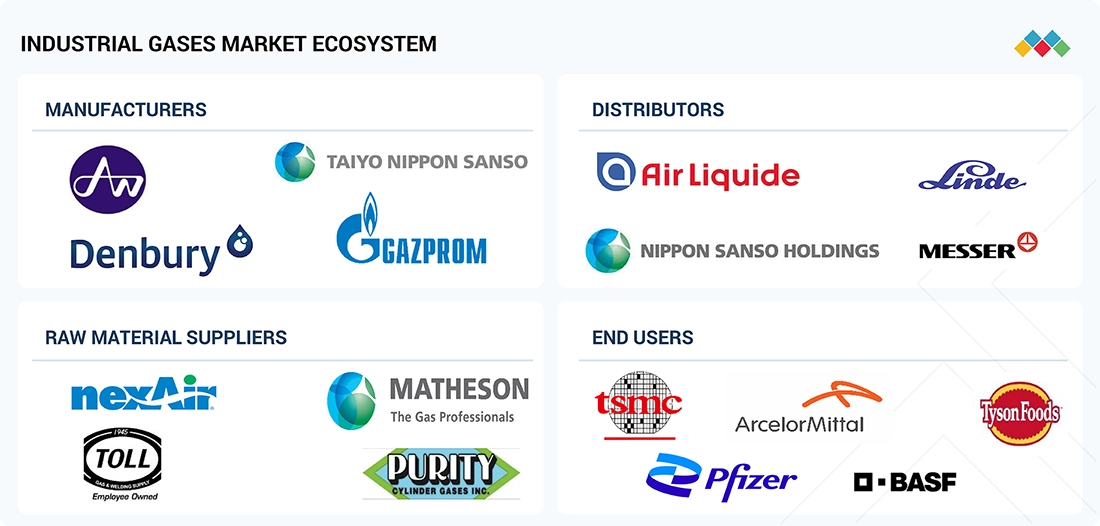
Industrial Gases Market: COMMERCIAL USE CASES ACROSS INDUSTRIES
| COMPANY | USE CASE DESCRIPTION | BENEFITS |
|---|---|---|
 |
Linde provided precise nitrogen and CO2 gas control during plastics compounding to minimize oxidation, moisture interference, and inconsistencies in polymer production | Improved product uniformity, reduced scrap, higher throughput, lower operating costs, and enhanced end-product performance |
 |
Air Liquide implemented a CO2 recycling system in lithium carbonate purification, enabling closed-loop recovery and reuse of CO2 in battery material production | Reduced fresh CO2 consumption by up to 80%, lower emissions, cost savings, sustainable operations, and minimal process disruption |
 |
Messer supplied high-purity CO2 for injection into mature oilfields to enhance oil recovery while sequestering CO2 underground | Increased oil recovery by 10–15%, extended field life, safe CO2 storage, and dual benefits of production and carbon mitigation |
Logos and trademarks shown above are the property of their respective owners. Their use here is for informational and illustrative purposes only.
Related Ecosystem
Bulk Chemicals And Inorganics
- Corrosion Inhibitors
- Glycol Ethers
- Acetic Acid
- Acetone
- Ammonium Nitrate
- Basf se
- DOW CHEMICAL COMPANY
- Exxon Mobil Corporation
- AZELIS HOLDINGS SA
- Sinopec limited
Energy Storage
- Energy Harvesting
- HVAC System
- Applicant Tracking System
- Battery Electric Vehicle (BEV)
- Carboxymethyl Cellulose (CMC)
- MOMENTIVE PERFORMANCE MATERIALS INC.
- Panasonic Holdings Corporation
- ABB India Limited
- Lg corp
- FDK Corporation
Industrial Gases
- Dry Cooling Tower
- HVAC System
- Heat Exchanger
- Hybrid Cooling Tower
- Industrial Refrigeration
- Linde plc
- AIR LIQUIDE
- MESSER GROUP GMBH
- Air Products and Chemicals, Inc.
- Iwatani Corporation
Key Takeaways
- The UK industrial gases market is valued at £2,613.5 million in 2025 and will reach £3,319.8 million by 2030, growing at a 4.9% CAGR.
- The UK market is driven by strong demand from construction, mining, and packaging sectors requiring reliable gas supply chains.
- Sustainability initiatives and energy efficiency regulations in the UK are accelerating adoption of advanced industrial gas technologies.
- The UK's mature distribution infrastructure and regulatory environment position it as a stable market for industrial gas suppliers.
Industrial Gases Market Report Scope
| Report Metric | Details |
|---|---|
| Base Year | 2025 |
| Fastest Growing Segment | FOOD & BEVERAGES (End-Use Industry) |
| Forecast Period | 2025-2030 |
| Growth Rate | CAGR of 5.1% from 2025 to 2030 |
| Largest Segment | OXYGEN (Type) |
| Market Size Base Year (Billions) | ~USD 98.67 (2025) |
| Revenue Forecast (Billions) | ~USD 126.53 (2030) |
| Segments Covered | Type, End-Use Industry |
UK Industrial Gases Market Report Segmentation
2 segment dimensions are covered across the global market.
By Type
- Acetylene
- Carbon Dioxide
- Hydrogen
- Inert Gases
- Nitrogen
- Other Gases
- Oxygen
By End-Use Industry
- Chemicals
- Electronics
- Food & Beverages
- Food And Beverages
- Healthcare
- Manufacturing
- Metallurgy
- Other End-Use Industries
- Refining
UK: INDUSTRIAL GASES MARKET, BY END-USE INDUSTRY, 2024–2030
| Segment | 2024 | 2025 | 2026 | 2027 | 2028 | 2029 | 2030 | CAGR (%) |
|---|---|---|---|---|---|---|---|---|
| CHEMICALS | 372.1 | 389.6 | 407.8 | 426.9 | 446.7 | 467.5 | 489.2 | 4.7 |
| ELECTRONICS | 125.6 | 132.3 | 139.4 | 146.8 | 154.6 | 162.8 | 171.5 | 5.3 |
| FOOD & BEVERAGES | 504.6 | 532.4 | 561.8 | 592.8 | 625.5 | 660.1 | 696.5 | 5.5 |
| HEALTHCARE | 248.8 | 260.8 | 273.3 | 286.5 | 300.3 | 314.8 | 329.9 | 4.8 |
| MANUFACTURING | 673 | 706.1 | 740.9 | 777.3 | 815.6 | 855.7 | 897.8 | 4.9 |
| METALLURGY | 417.8 | 435.4 | 453.8 | 473 | 492.9 | 513.7 | 535.4 | 4.2 |
| OTHER END-USE INDUSTRIES | 99.9 | 104.9 | 110.2 | 115.7 | 121.5 | 127.6 | 134 | 5 |
| REFINING | 49.7 | 52 | 54.4 | 57 | 59.7 | 62.5 | 65.5 | 4.7 |
| TOTAL | 2491.5 | 2613.5 | 2741.6 | 2876 | 3016.9 | 3164.7 | 3319.8 | 4.9 |
Target Audience
- Industrial Gas Suppliers : Manufacturers and distributors need UK market data to assess growth opportunities, competitive positioning, and demand forecasts across key customer segments.
- Packaging Companies : UK packaging manufacturers require insights into gas market trends and pricing to optimize procurement strategies and production efficiency.
- Construction & Engineering Firms : Construction companies need market intelligence on industrial gas availability and costs to plan projects and manage operational budgets effectively.
- Mining & Extraction Operators : UK mining operations require detailed market forecasts to plan gas supply contracts and anticipate cost implications for extraction and processing activities.
- Investment & Strategy Teams : Corporate strategists and investors need UK-specific market data to evaluate acquisition targets, market entry strategies, and portfolio diversification opportunities.
Reasons to Buy this Report
- UK-Specific Market Sizing : Accurate valuation and forecasting data exclusive to the UK market, enabling precise budget allocation and investment decisions for regional operations.
- Sector-Focused Insights : Detailed analysis of industrial gas demand across UK packaging, construction, and mining sectors with growth trajectories specific to each vertical.
- Competitive Positioning : Understand UK market dynamics, supplier landscape, and competitive advantages to develop targeted strategies for market penetration and expansion.
- Investment Planning : Reliable 5-year forecast data (2025-2030) supports strategic planning, capital expenditure decisions, and long-term business development initiatives in the UK.
- Risk Mitigation : Identify market trends, regulatory considerations, and supply chain factors specific to the UK to anticipate challenges and optimize operational resilience.
Frequently asked questions
What is the current size of the UK industrial gases market?
The UK industrial gases market is valued at £2,613.5 million in 2025 and is expected to grow to £3,319.8 million by 2030.
What is the projected growth rate for the UK industrial gases market?
The UK industrial gases market is projected to grow at a compound annual growth rate (CAGR) of 4.9% from 2025 to 2030.
Which sectors drive demand for industrial gases in the UK?
The UK industrial gases market is primarily driven by packaging, construction, mining, and food and beverage processing sectors.
How are sustainability trends affecting the UK industrial gases market?
The UK's focus on sustainability and energy efficiency is driving adoption of advanced gas technologies and cleaner production methods among industrial operators.
What competitive advantages does the UK market offer to industrial gas suppliers?
The UK offers a mature distribution infrastructure, established regulatory framework, and stable demand from diversified industrial sectors, making it an attractive market for gas suppliers.
RESEARCH METHODOLOGY
The study involved four key activities to estimate the current global size of the industrial gases market. Extensive secondary research was conducted to collect information on the market, its peer markets, and the parent market. The next step was to validate these findings, assumptions, and sizes with industry experts across the entire industrial gases value chain through primary research. Both the top-down and bottom-up methods were used to estimate the overall market size. Following that, market segmentation and data triangulation techniques were applied to determine the size of various segments and sub-segments of the market.
Secondary Research
In the secondary research process, various secondary sources such as Business Standard, Bloomberg, World Bank, and Factiva were used to identify and gather information for this study on the industrial gases market. These sources included annual reports, press releases & investor presentations of companies, white papers, certified publications, articles by recognized authors, regulatory bodies, trade directories, and databases.
Primary Research
Various primary sources from the supply and demand sides of the industrial gases market were interviewed to gather qualitative and quantitative information. The primary sources from the supply side included industry experts such as Chief Executive Officers (CEOs), vice presidents, marketing directors, sales professionals, and other key executives from leading companies and organizations operating in the industrial gases industry. The breakdown of the profiles of primary respondents is as follows:
The following is a breakdown of the primary respondents:
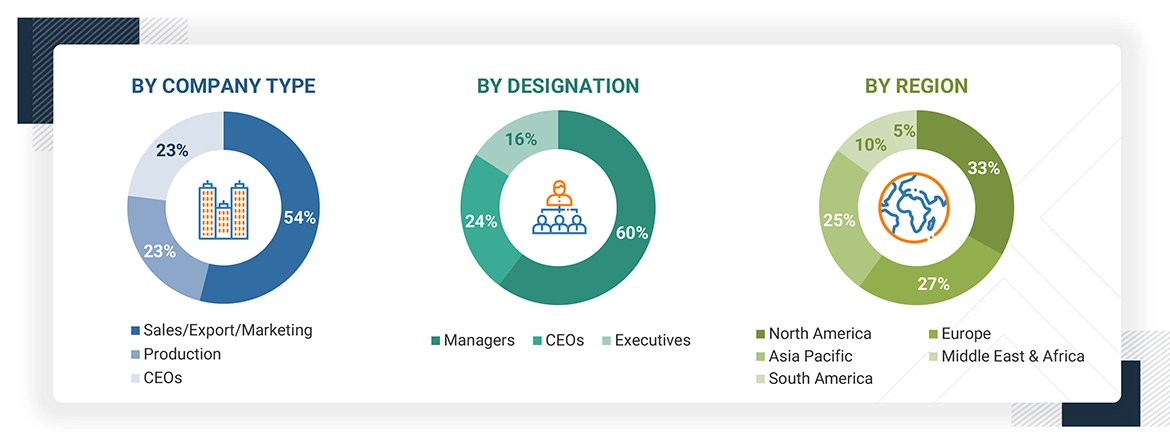
Notes: Companies are classified based on their revenue–Tier 1 = >USD 7 billion, Tier 2 = USD 500 million to USD 7 billion, and Tier 3 = < USD 500 million.
Other designations include sales, marketing, and product managers.
To know about the assumptions considered for the study, download the pdf brochure
Market Size Estimation
Both the top-down and bottom-up approaches were used to estimate and validate the global size of the industrial gases market. These methods were also extensively employed to determine the size of various related market segments. The research methodology used to estimate the market size included the following details:
- The key players were identified through extensive secondary research.
- In terms of value, the industry’s supply chain and market size were determined through primary and secondary research methods.
- All percentage shares, splits, and breakdowns were calculated using secondary sources and verified through primary sources.
- All relevant parameters influencing the markets covered in this study were considered, analyzed in detail, verified through primary research, and used to derive both final quantitative and qualitative data.
- The research includes an evaluation of reports, reviews, and newsletters of key industry players, along with extensive interviews with key officials, such as directors and marketing executives.
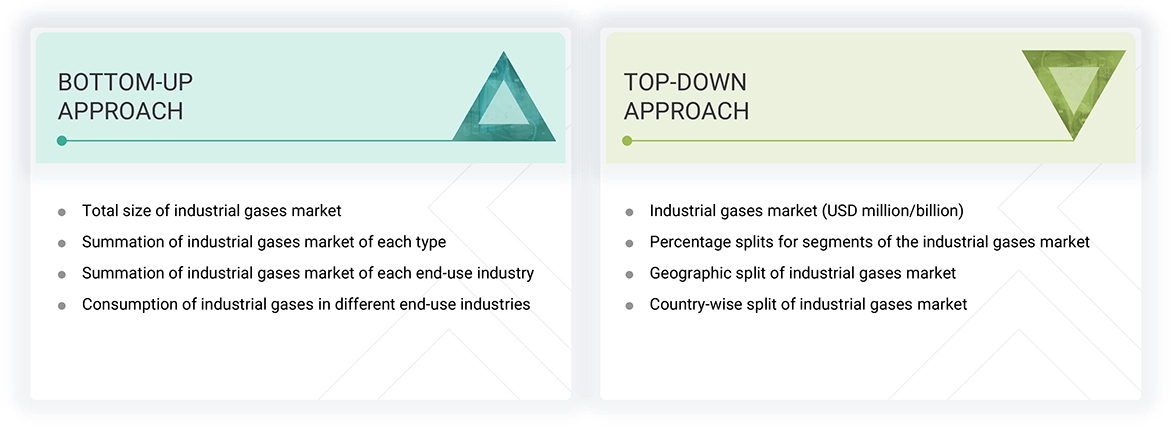
Data Triangulation
After estimating the overall market size using the process described above, the total market was divided into several segments and sub-segments. Data triangulation and market breakdown methods were used, where applicable, to complete the overall market analysis and determine accurate statistics for all segments and sub-segments of the industrial gases market. The data was triangulated by examining various factors and trends from both the demand and supply sides. Additionally, the market size was validated using both top-down and bottom-up approaches and confirmed through primary interviews. Therefore, three sources were used for each data segment—top-down approach, bottom-up approach, and expert interviews. The data was considered accurate when the values from all three sources matched.
Market Definition
Industrial gases are gaseous substances created and used for various industrial and commercial activities. Much of the manufacturing and delivery of industrial gases involves large-scale processes, typically through air separation, chemical reactions, or purifying natural gas sources and then separating the desired gases. Industrial gases can be delivered compressed, in liquid form, or cryogenically. They are vital to many sectors, supporting production efficiency, quality, and innovation. The delivery, handling, and supply of industrial gases require specialized equipment, infrastructure, and processes, along with strict safety, purity, and quality standards. Industrial gases play a crucial role in modern industry, enabling technological advancement, supporting economic growth, and powering various sectors worldwide.
Stakeholders
- Industrial gases producers
- Industrial gases distributors
- Raw material suppliers
- Research & development entities
- Industry associations and regulatory bodies
- End users
Report Objectives
- To estimate and forecast the industrial gases market, in terms of value
- To provide detailed information about the major factors (drivers, restraints, opportunities, and challenges) influencing the market growth
- To define, describe, and forecast the market size based on type, end-use industry, and region
- To forecast the market size along with segments and submarkets, in key regions: North America, Europe, Asia Pacific, the Middle East & Africa, and South America, along with their key countries
- To strategically analyze micromarkets for individual growth trends, prospects, and their contribution to the total market
- To analyze growth opportunities in the market for stakeholders and provide details on the competitive landscape for market leaders
- To strategically profile key players and comprehensively analyze their market shares and core competencies
- To analyze competitive developments, such as mergers & acquisitions, expansions & investments, and agreements in the industrial gases market
Get the Full Industrial Gases Market Report
Full forecast, segment splits, and company analysis for all Industrial Gases Market.
- France Industrial Gases Market
- Italy Industrial Gases Market
- China Industrial Gases Market
- Japan Industrial Gases Market
- India Industrial Gases Market
- South Korea Industrial Gases Market
- Brazil Industrial Gases Market
- Argentina Industrial Gases Market
- South Africa Industrial Gases Market
- Rest Of Europe Industrial Gases Market
- Oceania Industrial Gases Market
- Rest Of Asia Pacific Industrial Gases Market
- GCC Countries Industrial Gases Market
- -Rest Of GCC Countries Industrial Gases Market
- Rest Of South America Industrial Gases Market
- US Industrial Gases Market
- Canada Industrial Gases Market
- Mexico Industrial Gases Market
- Germany Industrial Gases Market
Need a Tailored Report?
Customize this report to your needs
Get 10% FREE Customization
Customize This Report
