
South Africa Industrial Rubber Market (2025-2030)

The South Africa Industrial Rubber Market was valued at $100.2 Million in 2025 and projected to reach to $119.6 Million by 2030, representing a compound annual growth rate of 3.6%. South Africa's industrial rubber market demonstrates steady growth driven by sustained demand from the automotive and mining sectors, which remain cornerstones of the national economy.


| Market Size in | USD 26.32 MN |
| Market Forecast in | |
| CAGR | |
| Forecast Period | |
| Units Considered | Value (USD MN) |
South Africa Industrial Rubber Market Trends and Insights
- South Africa's industrial rubber sector is driven by demand from automotive, mining, and manufacturing industries that rely on rubber components for operational efficiency and durability.
- The market in South Africa reflects steady expansion as regional industries modernize and increase production capacity to meet both domestic and export requirements. Growth in South Africa's industrial rubber market is supported by infrastructure development, rising vehicle production, and increased mining activity across the country.
- South Africa's position as a major industrial hub in Africa continues to attract investment in rubber processing and manufacturing facilities.
- Between 2025 and 2030, South Africa is expected to see incremental gains as end-use industries adopt advanced rubber materials and sustainable production practices to enhance product performance and environmental compliance..
Key Market Statistics
- CAGR (2025-2030) 3.6% CAGR
- Market Size, 2025 ~USD 100.2 Million
- Forecast, 2030 ~USD 119.6 Million
- Country South Africa
South Africa Industrial Rubber Market Overview
Market Size & Growth :
South Africa's industrial rubber market is valued at USD 100.2 million in 2025, with projected growth to USD 119.6 million by 2030, reflecting a steady CAGR of 3.6%.
Key Driving Industries :
Automotive, mining, and manufacturing sectors are primary demand drivers in South Africa, utilizing rubber components for critical operational applications and equipment durability.
Regional Performance :
South Africa's 3.6% CAGR is below the global average of 5.4%, indicating moderate growth potential compared to international markets but stable domestic demand.
Industrial Applications :
Rubber components are essential across South African industries for sealing, vibration isolation, wear resistance, and operational efficiency in harsh mining and manufacturing environments.
South Africa Industrial Rubber Market Dynamics
- The market's 3.6% CAGR reflects consistent industrial activity and infrastructure maintenance requirements across these key industries.
- However, growth remains moderate compared to global trends, influenced by economic constraints and competition from imported materials. Looking ahead to 2030, the South African market will benefit from ongoing mining operations, vehicle production, and manufacturing expansion.
- Investment in local rubber processing capabilities and development of specialized compounds for extreme operating conditions will support market expansion.
- Strategic partnerships between local manufacturers and international suppliers are expected to enhance product innovation and market penetration..
Market Ecosystem
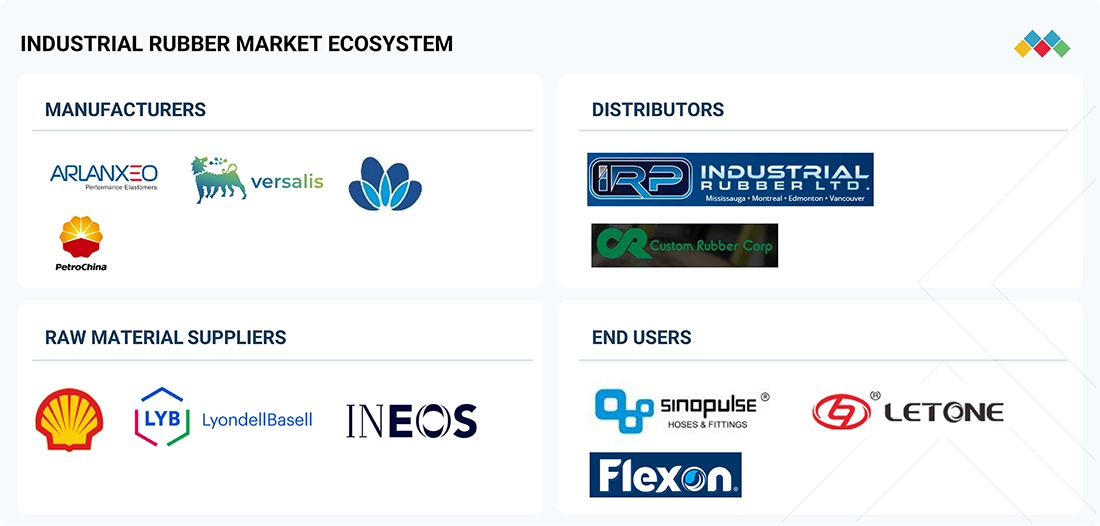
Industrial Rubber Market: COMMERCIAL USE CASES ACROSS INDUSTRIES
| COMPANY | USE CASE DESCRIPTION | BENEFITS |
|---|---|---|
 |
Develops high-performance synthetic rubbers such as butyl, halobutyl, and EPDM for automotive, construction, and consumer goods applications. | Excellent air retention, superior weatherability, enhanced durability, and reduced rolling resistance for improved fuel efficiency. |
 |
Manufactures styrene-butadiene-styrene (SBS) and styrene-isoprene-styrene (SIS) block copolymers for adhesives, asphalt modification, and footwear. | Enhanced elasticity, superior adhesion, improved impact resistance, and extended product lifespan. |
 |
Produces high-grade synthetic rubbers including SBR, NBR, and BR for tire, sealant, and hose manufacturing. | Improved wear resistance, higher elasticity, and enhanced processability for industrial applications. |
 |
Develops synthetic rubbers such as emulsion SBR, Nd-BR, and high-performance polymers for tire and construction sectors. | Enhanced abrasion resistance, improved rolling efficiency, and sustainability through eco-friendly production technologies. |
 |
Manufactures a wide range of synthetic rubbers (EPDM, NBR, CR, HNBR) used in automotive, oil & gas, and industrial sealing systems. | Superior heat and chemical resistance, extended service life, and enhanced mechanical strength. |
Logos and trademarks shown above are the property of their respective owners. Their use here is for informational and illustrative purposes only.
Related Ecosystem
Resins And Polymers
- Polycarbonate
- Acrylonitrile Butadiene Styrene (ABS)
- Epoxy Resin
- Light Commercial Vehicles (LCVs)
- Polypropylene (PP)
- Basf se
- DOW CHEMICAL COMPANY
- Solvay sa
- Saudi arabia basic industries corporation (sabic)
- DuPont de Nemours, Inc.
Key Takeaways
- South Africa's industrial rubber market is valued at USD 100.2 million in 2025 and will reach USD 119.6 million by 2030.
- South Africa's market is growing at a 3.6% CAGR, driven by automotive, mining, and manufacturing demand.
- South Africa's industrial hub status attracts investment in rubber processing and advanced material adoption.
- South Africa's market expansion is supported by infrastructure development and increased regional production capacity through 2030.
Industrial Rubber Market Report Scope
| Report Metric | Details |
|---|---|
| Base Year | 2025 |
| Fastest Growing Segment | AUTOMOTIVE (Application) |
| Forecast Period | 2025–2030 |
| Growth Rate | CAGR of 5.4% from 2025 to 2030 |
| Largest Segment | SYNTHETIC RUBBER (Type) |
| Market Size Base Year (Billions) | ~USD 11.45 (2025) |
| Revenue Forecast (Billions) | ~USD 14.9 (2030) |
| Segments Covered | Type, Product, Application, Manufacturing Process |
South Africa Industrial Rubber Market Report Segmentation
4 segment dimensions are covered across the global market.
By Type
- Natural Rubber
- Synthetic Rubber
- –Acrylic
- –Epdm
- –Others
- –Sbr
By Product
- Mechanical Rubber Goods
- Other Products
- Rubber Belts
- Rubber Hoses
- Rubber Roofing
By Application
- Automotive
- Bitumen Modification
- Building & Construction
- Coating, Sealant, & Adhesive
- Coatings, Sealant & Adhesive
- Electrical & Electronics
- Industrial Manufacturing
- Medical & Healthcare
- Other Applications
- Polymer Modification
- Wire & Cable
By Manufacturing Process
- Gas-Phase Polymerization Process
- Slurry/Suspension Process
- Solution Polymerization Process
Target Audience
- Rubber Component Manufacturers : Manufacturers need South Africa-specific data to assess market demand, identify growth opportunities in automotive and mining segments, and plan production capacity investments.
- Automotive & Mining Companies : OEMs and mining operators require insights into local rubber supply availability, pricing trends, and supplier capabilities to optimize procurement strategies and ensure operational continuity.
- Distributors & Importers : South African distributors need market forecasts and competitive intelligence to stock appropriate inventory levels, negotiate supplier contracts, and identify emerging customer segments.
- Investment & Private Equity Firms : Investors evaluating South African industrial opportunities need market sizing, growth projections, and sector dynamics to assess investment returns and portfolio diversification potential.
- Government & Trade Organizations : Policy makers and industry associations require market data to develop industrial strategies, support local manufacturing initiatives, and understand South Africa's competitive position globally.
Key Companies in the South Africa Industrial Rubber Market
| Company | HQ | Ownership | Strongest segments |
|---|---|---|---|
| MOL GROUP | Hungary | Public Company | Automotive rubber applications,Building & construction rubber,Industrial manufacturing rubber, |
| LG CORP | South Korea | Public Company | Automotive applications,Industrial manufacturing,Building & construction, |
| TSRC | Taiwan | Public Company | ESBR (emulsion SBR),SSBR (solution SBR),BR (butadiene rubber), |
| SYNTHOS | Poland | Private Company | Styrene-butadiene rubber (KER, KRALEX),Butadiene rubber (SYNTECA),Nitrile butadiene rubber and specialty elastomers, |
| EXXON MOBIL CORPORATION | United States | Public Company | Automotive applications,Building & Construction applications,Industrial Manufacturing applications, |
| ENEOS MATERIALS CORPORATION | Japan | Private Company | Automotive applications,Industrial manufacturing and polymer modification,Building & construction and wire & cable, |
| KUMHO PETROCHEMICAL | South Korea | Public Company | Styrene Butadiene Rubber (emulsion and solution),Polybutadiene Rubber (high-cis, low-cis, ultra-high-cis),Acrylonitrile Butadiene Rubber (NBR) and NBR-based compounds, |
| LG CHEM | South Korea | Public Company | Butadiene Rubber (BR),Solution Styrene Butadiene Rubber (SSBR),Nitrile Butadiene Rubber (NBR) Solid, |
| ZEON CORPORATION | Japan | ||
| DL CHEMICAL CO., LTD. | South Korea | Private Company | Automotive rubber and polymer-modification feedstocks,Industrial manufacturing and building & construction rubber inputs,Wire & cable and electrical & electronics elastomer inputs, |
| VERSALIS S.P.A. | Italy | Private Company | Styrene-butadiene rubber (emulsion and solution),Polybutadiene rubber,EPDM and other ethylene-propylene elastomers, |
| PETROCHINA COMPANY LIMITED | China | Public Company | Synthetic rubber feedstocks and base polymers for tires and automotive components,Industrial manufacturing and building & construction rubber intermediates,Polymer modification, wire & cable, and electrical & electronics applications, |
| LCY | Australia | Public Company | Iron ore linked to industrial manufacturing and construction rubber demand,Gold with limited industrial rubber correlation,Base metals and other critical minerals (nickel, copper, lithium, rare earths), |
MOL GROUP
MOL GROUP is a Hungarian public company founded in 1991 with 24,744 employees. The company operates as an integrated oil and gas enterprise.
LG CORP
LG CORP is a South Korean public company founded in 1947. The company operates as a diversified conglomerate with interests across multiple industries.
TSRC
TSRC is a Taiwanese public company founded in 1973 with 1,011 employees. The company is engaged in synthetic rubber and chemical production.
SYNTHOS
SYNTHOS is a Polish private company founded in 1945 with 2,975 employees. The company specializes in synthetic rubber and chemical products.
EXXON MOBIL CORPORATION
EXXON MOBIL CORPORATION is a United States-based public company founded in 1870 with 57,900 employees. The company is a major integrated oil and gas corporation.
ENEOS MATERIALS CORPORATION
ENEOS MATERIALS CORPORATION is a Japanese private company founded in 1888 with 13,855 employees. The company produces petrochemical and polymer materials.
KUMHO PETROCHEMICAL
KUMHO PETROCHEMICAL is a South Korean public company founded in 1970 with 1,490 employees. The company manufactures synthetic rubber and chemical products.
LG CHEM
LG CHEM is a South Korean public company founded in 1947 with 14,019 employees. The company operates as a diversified chemical and materials manufacturer.
ZEON CORPORATION
Insufficient data available to provide a factual business description for ZEON CORPORATION.
DL CHEMICAL CO., LTD.
DL CHEMICAL CO., LTD. is a South Korean private company founded in 1979. The company operates in the chemical manufacturing sector.
VERSALIS S.P.A.
VERSALIS S.P.A. is an Italian private company founded in 1995 with 7,389 employees. The company specializes in chemical and polymer production.
PETROCHINA COMPANY LIMITED
PETROCHINA COMPANY LIMITED is a Chinese public company founded in 1999 with 367,173 employees. The company is a major integrated oil and gas enterprise.
LCY
LCY is an Australian public company established in 2007. The company operates in the chemical and materials sector.
Reasons to Buy this Report
- Targeted South Africa Market Intelligence : Gain precise insights into South Africa's USD 100.2M industrial rubber market with country-specific growth projections, competitive dynamics, and localized demand drivers.
- Sector-Specific Opportunity Analysis : Understand how automotive, mining, and manufacturing industries in South Africa create distinct rubber component requirements and purchasing patterns for strategic market entry.
- Competitive Positioning Strategy : Benchmark your business against South African market trends, identify gaps in local supply chains, and develop targeted strategies to capture market share in this 3.6% CAGR growth environment.
- Investment & Expansion Planning : Make informed decisions on manufacturing facility locations, distribution partnerships, and product portfolio development based on South Africa's specific industrial rubber demand forecast through 2030.
- Risk Mitigation & Market Timing : Evaluate South Africa's economic stability, regulatory environment, and supply chain resilience to optimize market entry timing and minimize operational risks in the region.
Frequently asked questions
What is the current size of South Africa's industrial rubber market?
South Africa's industrial rubber market is estimated at USD 100.2 million in 2025.
What is the projected market size for South Africa's industrial rubber sector by 2030?
South Africa's industrial rubber market is forecast to reach USD 119.6 million by 2030.
What is the growth rate of South Africa's industrial rubber market?
South Africa's industrial rubber market is growing at a CAGR of 3.6% from 2025 to 2030.
Which industries drive demand for industrial rubber in South Africa?
South Africa's industrial rubber demand is primarily driven by automotive, mining, and manufacturing sectors that require durable rubber components.
What factors support growth in South Africa's industrial rubber market?
South Africa's market growth is supported by infrastructure development, rising vehicle production, increased mining activity, and adoption of advanced rubber materials.
RESEARCH METHODOLOGY
The research encompassed four primary actions in assessing the present market size of industrial rubber. Comprehensive secondary research was conducted to gather information on the market, the peer market, and the parent market. The subsequent stage involved corroborating these findings, assumptions, and dimensions with industry specialists throughout the industrial rubber value chain via primary research. The total market size is ascertained using both top-down and bottom-up methodologies. Subsequently, market segmentation analysis and data triangulation were employed to ascertain the dimensions of the market segments and subsegments.
Secondary Research
The research approach employed to assess and project the market begins with the collection of revenue data from prominent suppliers using secondary research. In the course of secondary research, many secondary sources, such as Hoovers, Bloomberg BusinessWeek, Factiva, the World Bank, and industry magazines, were utilized to identify and compile information for this study. The secondary sources comprised annual reports, press releases, and investor presentations from corporations, white papers, accredited periodicals, writings by esteemed authors, announcements from regulatory agencies, trade directories, and databases. Vendor offerings have been considered to ascertain market segmentation.
Primary Research
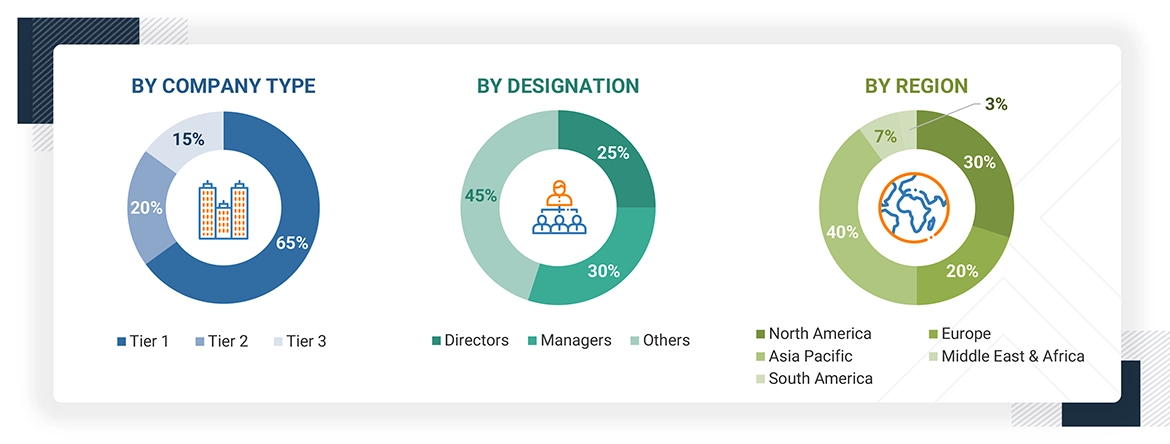
The industrial rubber market comprises several stakeholders, such as manufacturers, suppliers, traders, associations, and regulatory organizations, in the supply chain. The demand side of this market is characterized by the development of various industries, including automotive, building & construction, industrial manufacturing, polymer modification, wire & cable, electrical & electronics, bitumen modification, coating, sealants & adhesives, and medical & healthcare. Advancements in technology characterize the supply side. Various primary sources from both the supply and demand sides of the market were interviewed to obtain qualitative and quantitative information. The following is the breakdown of the primary respondents.
The following is a breakdown of the primary respondents:
To know about the assumptions considered for the study, download the pdf brochure
Market Size Estimation
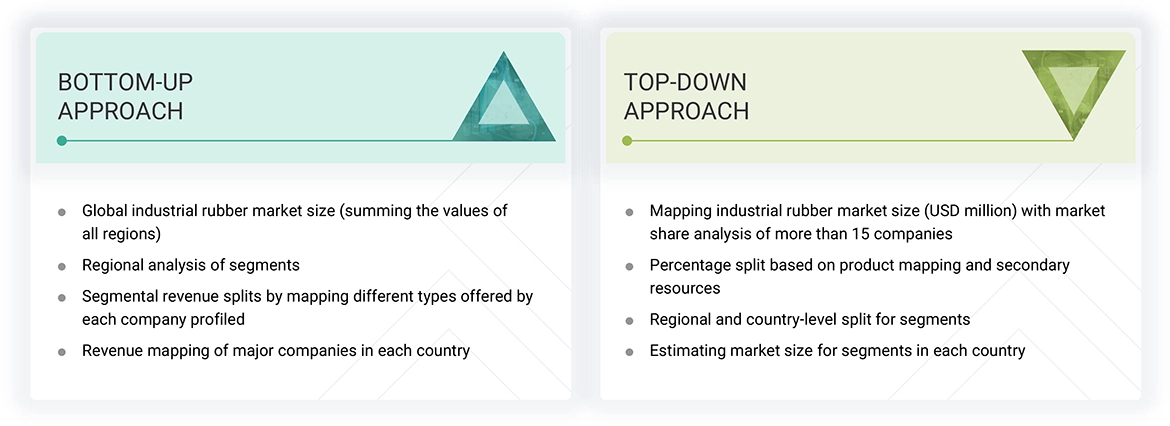
Both the top-down and bottom-up approaches were used to estimate and validate the total size of the industrial rubber market. These methods were also used extensively to determine the size of various subsegments in the market. The research methodology used to estimate the market size included the following:
- The key players were identified through extensive primary and secondary research.
- The value chain and market size of the industrial rubber market, in terms of value and volume, were determined through primary and secondary research.
- All percentage shares, splits, and breakdowns were determined using secondary sources and verified through primary sources.
- All possible parameters that affect the market covered in this research study were accounted for, viewed in extensive detail, verified through primary research, and analyzed to obtain the final quantitative and qualitative data.
- The research included the study of reports, reviews, and newsletters of top market players, along with extensive interviews for opinions from key leaders, such as CEOs, directors, and marketing executives.
Global Industrial Rubber Market Size: Bottom-up and Top-down Approach
Data Triangulation
After arriving at the overall market size using the market size estimation processes as explained above, the market was split into several segments and subsegments. To complete the overall market engineering process and arrive at the exact statistics of each market segment and subsegment, data triangulation and market breakdown procedures were employed, wherever applicable. The market size was calculated globally by summing up the country-level and regional-level data.
Market Definition
Industrial rubber refers to natural or synthetic elastomers that exhibit elastic deformation under stress and return to their original shape once the stress is removed. These materials are valued for their high durability, flexibility, and resistance to heat, chemicals, and abrasion. Industrial rubber plays a critical role in the automotive sector, where it is used in tires, seals, gaskets, and vibration-dampening components. Beyond automotive, it finds wide application in building & construction, industrial manufacturing, polymer modification, wire & cable, electrical & electronics, bitumen modification, coating, sealant, & adhesive, medical & healthcare, and others. Its versatility and performance characteristics make it essential across a broad range of industrial uses.
Stakeholders
- Industrial Rubber Manufacturers
- Industrial Rubber Suppliers
- Industrial Rubber Traders, Distributors, and Suppliers
- Investment Banks and Private Equity Firms
- Raw Material Suppliers
- Government and Research Organizations
- Consulting Companies/Consultants in the Chemicals and Materials Sectors
- Industry Associations
- Contract Manufacturing Organizations (CMOs)
- NGOs, Governments, Investment Banks, Venture Capitalists, and Private Equity Firms
Report Objectives
- To define, describe, and forecast the size of the global industrial rubber market in terms of volume and value
- To provide detailed information regarding the key factors, such as drivers, restraints, opportunities, and challenges, influencing the growth of the global industrial rubber market
- To analyze and forecast the size of various segments of the industrial rubber market based on five major regions—North America, Asia Pacific, Europe, South America, and the Middle East & Africa, along with key countries in each of these regions
- To analyze recent developments and competitive strategies, such as product launches, acquisitions, agreements, and expansions, to draw the competitive landscape of the market
- To strategically profile the key players in the market and comprehensively analyze their core competencies
Get the Full Industrial Rubber Market Report
Full forecast, segment splits, and company analysis for all Industrial Rubber Market.
- China Industrial Rubber Market
- Japan Industrial Rubber Market
- India Industrial Rubber Market
- South Korea Industrial Rubber Market
- Thailand Industrial Rubber Market
- Malaysia Industrial Rubber Market
- Vietnam Industrial Rubber Market
- Indonesia Industrial Rubber Market
- Germany Industrial Rubber Market
- UK Industrial Rubber Market
- France Industrial Rubber Market
- Italy Industrial Rubber Market
- Russia Industrial Rubber Market
- Canada Industrial Rubber Market
- Mexico Industrial Rubber Market
- US Industrial Rubber Market
- Brazil Industrial Rubber Market
- Chile Industrial Rubber Market
- Argentina Industrial Rubber Market
- Rest Of Europe Industrial Rubber Market
- Rest Of Asia Pacific Industrial Rubber Market
- GCC Countries Industrial Rubber Market
- –Rest Of GCC Countries Industrial Rubber Market
- Rest Of South America Industrial Rubber Market
Need a Tailored Report?
Customize this report to your needs
Get 10% FREE Customization
Customize This Report
