
Middle East Integrated Air and Missile Defense Market (2025-2030)

The Middle East Integrated Air and Missile Defense Market was valued at $4197.3 Million in 2025 and projected to reach to $9410.5 Million by 2030, representing a compound annual growth rate of 17.5%. The Middle East Integrated Air and Missile Defense Market is poised for accelerated expansion through 2030, driven by persistent regional security concerns and the modernization of defense infrastructure across GCC nations and neighboring countries.


| Market Size in | USD 26.32 MN |
| Market Forecast in | |
| CAGR | |
| Forecast Period | |
| Units Considered | Value (USD MN) |
Middle East Integrated Air and Missile Defense Market Trends and Insights
- This represents a compound annual growth rate of 17.5%, significantly outpacing global market growth of 12.5%.
- The Middle East's strategic geopolitical position and escalating regional security threats are driving substantial investment in advanced air defense systems and integrated missile defense capabilities throughout 2025-2030. The Middle East market is characterized by heightened demand for sophisticated defense technologies to counter evolving aerial and ballistic threats.
- Regional governments are prioritizing modernization of air defense infrastructure, with the Middle East becoming a critical hub for integrated defense solutions.
- The forecast period through 2030 reflects sustained capital allocation toward next-generation systems, positioning the Middle East as one of the fastest-growing segments within the global integrated air and missile defense sector..
Key Market Statistics
- CAGR (2025-2030) 17.5% CAGR
- Market Size, 2025 ~USD 4197.3 Million
- Forecast, 2030 ~USD 9410.5 Million
- Geography Middle East
Middle East Integrated Air and Missile Defense Market Overview
Exceptional Growth Trajectory :
The Middle East Integrated Air and Missile Defense Market is expanding at 17.5% CAGR, significantly outpacing the global rate of 12.5%, driven by escalating regional security threats and geopolitical tensions.
Substantial Market Valuation :
Market size is projected to nearly double from $4,197.3 million in 2025 to $9,410.5 million by 2030, reflecting heightened defense spending and modernization initiatives across the region.
GCC Leadership Position :
The Gulf Cooperation Council countries dominate the Middle East market with $4,485.7 million in 2025, representing the primary driver of regional defense procurement and technology advancement.
Strategic Geopolitical Imperative :
Regional security challenges, including air threats and missile proliferation, are compelling Middle Eastern nations to invest heavily in advanced integrated defense systems and capabilities.
Middle East Integrated Air and Missile Defense Market Dynamics
- Increased military expenditures, coupled with technological advancements in radar systems, command centers, and interoperable platforms, will fuel market growth.
- Strategic partnerships with global defense contractors and indigenous capability development initiatives will further strengthen the market landscape. Key growth catalysts include rising tensions in the region, the need for enhanced air defense capabilities against evolving threats, and government commitments to strengthen national security postures.
- Investment in next-generation systems, integration of artificial intelligence and automation, and development of indigenous defense technologies will create substantial opportunities for market participants through 2030..
Market Ecosystem
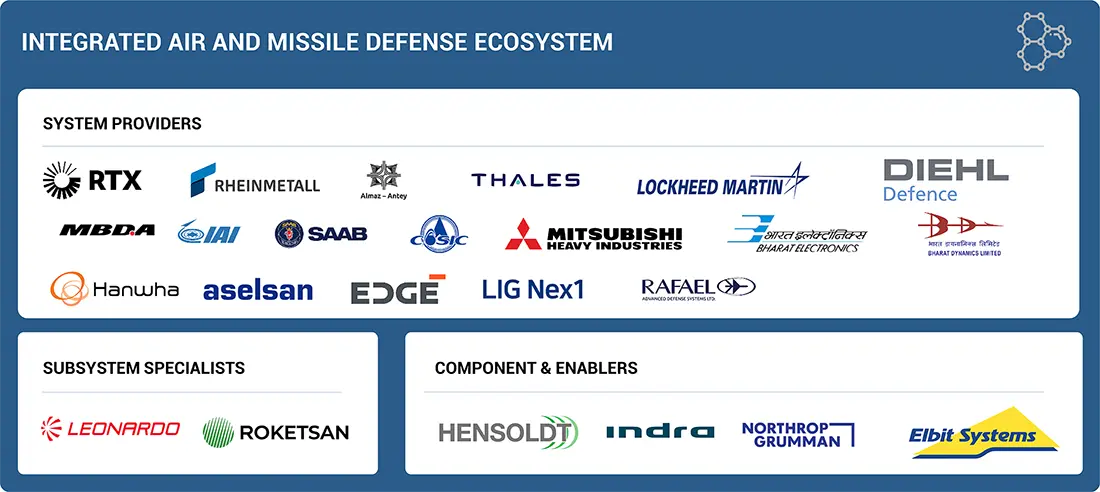
IAMD Market: COMMERCIAL USE CASES ACROSS INDUSTRIES
| COMPANY | USE CASE DESCRIPTION | BENEFITS |
|---|---|---|
 |
Deployment of PAC-3 interceptors with NATO support to counter Russian ballistic/cruise missiles and UAVs | Validated mobility, interoperability, and effectiveness against hypersonic/cruise threats; strengthened layered IAMD |
 |
Deployment of NASAMS batteries by Kongsberg and Raytheon to NATO allies (2022–2023) for layered air defense against cruise missiles and UAVs | Enhanced scalability, interoperability with NATO ACCS, and wide-area coverage strengthening NATO’s IAMD posture |
 |
Delivery of S-400 systems to India (2021–2023) to counter long-range missile threats from Pakistan and China | Provided layered defense with interceptor variants, boosted deterrence, and reinforced India’s strategic IAMD capabilities |
Logos and trademarks shown above are the property of their respective owners. Their use here is for informational and illustrative purposes only.
Related Ecosystem
Defence Platforms And Systems
- Sensors
- Unmanned Ground Vehicles (UGV)
- Fighter Aircraft
- Special Mission Aircraft
- Antennas
- BAE Systems plc
- Thales group
- LOCKHEED MARTIN CORPORATION
- Northrop Grumman Corporation
- L3Harris Technologies, Inc.
Key Takeaways
- The Middle East market will more than double from $4,197.3M (2025) to $9,410.5M (2030), driven by regional security imperatives and geopolitical tensions.
- The Middle East's 17.5% CAGR significantly exceeds the global average of 12.5%, reflecting accelerated defense modernization across the region.
- The Middle East is investing heavily in integrated air and missile defense systems to counter advanced aerial threats and ballistic missile capabilities.
- The Middle East represents a strategic growth opportunity for defense contractors, with sustained government spending through 2030 supporting market expansion.
Integrated Air and Missile Defense Market Report Scope
| Report Metric | Details |
|---|---|
| Base Year | 2025 |
| Fastest Growing Segment | COUNTER-UNMANNED AERIAL SYSTEMS (System) |
| Forecast Period | 2025-2030 |
| Growth Rate | CAGR of 12.5% from 2025 to 2030 |
| Largest Segment | MISSILE DEFENSE SYSTEMS (System) |
| Market Size Base Year (Billions) | ~USD 37.95 (2025) |
| Revenue Forecast (Billions) | ~USD 68.38 (2030) |
| Segments Covered | System, Component, Type, Range, End User |
Middle East Integrated Air and Missile Defense Market Report Segmentation
5 segment dimensions are covered across the global market.
By System
- Anti-Aircraft Systems
- Counter-Hypersonic Defense Systems
- Counter-Rocket Artillery And Mortar Systems
- Counter-Unmanned Aerial Systems
- Integrated Multi-Threat Systems
- Missile Defense Systems
By Component
- Command & Control
- Fire Control Systems
- Launchers
- Radars & Sensors
- System Integration
- Weapon Systems
By Type
- Centralized Command & Control
- Close-In Weapon Systems & Guns
- Coalition Interoperability Software
- Data Fusion Systems
- Directed Energy Weapons
- Early Warning Radars
- Elint
- Engagement Operation Centers
- Eo/Ir & Space Sensors
- Fire Control Radars
- Integrated Battle Management Systems
- Interceptors
- Man-Portable Air Defense Systems
- Mobile Launchers
- Target Acquisition & Tracking Systems
- Vertical Launching Systems
By Range
- Long Range
- Medium Range
- Short Range
By End User
- Air Force
- Army
- Navy
Target Audience
- Defense Contractors & OEMs : Manufacturers and systems integrators require detailed Middle East market intelligence to identify procurement opportunities, establish regional partnerships, and tailor solutions to GCC and regional requirements.
- Government & Military Procurement : Defense ministries and military organizations across the Middle East need market analysis to benchmark spending, evaluate technology options, and plan capability modernization programs.
- Investment & Private Equity Firms : Investors seeking high-growth aerospace and defense opportunities in emerging markets require comprehensive Middle East market data to evaluate portfolio companies and identify acquisition targets.
- Technology & Systems Integrators : Companies developing advanced air defense and missile systems need regional market insights to understand customer requirements, competitive landscapes, and technology adoption trends.
- Strategic Consultants & Analysts : Management consulting firms and research organizations require detailed Middle East market forecasts to support client advisory services, market entry strategies, and competitive intelligence.
Countries within Middle East - compare and drill down
| Country | 2025 size (native) |
|---|---|
| Israel | USD 3046.9 Million |
| Turkey | USD 1307.7 Million |
| GCC | USD 4485.7 Million |
| Rest Of Middle East | USD 570.3 Million |
Country market size visualization
Reasons to Buy this Report
- Regional Market Dominance Insights : Gain comprehensive understanding of the Middle East's 17.5% CAGR growth trajectory and identify which sub-regions and countries offer the highest investment returns and market opportunities.
- GCC Market Segmentation : Access detailed breakdowns of the $4,485.7 million GCC market segment, including country-level analysis, procurement patterns, and competitive dynamics specific to Gulf nations.
- Strategic Threat Assessment : Understand the geopolitical drivers and security threats propelling defense spending in the Middle East, enabling informed business strategy and market entry planning.
- Competitive Positioning : Identify key players, market share distribution, and partnership opportunities within the Middle East integrated defense ecosystem to optimize competitive positioning.
- Forecast-Driven Planning : Leverage 2030 market projections ($9.4B) to develop long-term business strategies, resource allocation plans, and investment decisions aligned with regional growth trajectories.
Frequently asked questions
What is the current market size of Integrated Air and Missile Defense in the Middle East?
The Middle East Integrated Air and Missile Defense Market is valued at $4,197.3 million in 2025, with expectations to grow substantially through the forecast period.
What is the projected market size for the Middle East by 2030?
The Middle East market is forecast to reach $9,410.5 million by 2030, representing more than a doubling of the 2025 baseline.
What is the CAGR for the Middle East Integrated Air and Missile Defense Market?
The Middle East market is expected to grow at a compound annual growth rate of 17.5% from 2025 to 2030, outpacing global growth.
Why is the Middle East market growing faster than the global average?
The Middle East's elevated geopolitical tensions, regional security threats, and government prioritization of defense modernization are driving above-average growth compared to the global 12.5% CAGR.
What factors are driving demand for air and missile defense systems in the Middle East?
The Middle East's strategic location, evolving aerial and ballistic threats, and sustained government investment in defense infrastructure are primary growth catalysts for integrated air and missile defense solutions.
RESEARCH METHODOLOGY
The research study conducted on the integrated air & missile defense market involved the extensive use of secondary sources, directories, and databases, such as D&B Hoovers, Bloomberg, and Factiva, to identify and collect relevant information. Primary sources included industry experts from the market as well as suppliers, manufacturers, solution providers, technology developers, alliances, and organizations related to all segments of the value chain of this industry. In-depth interviews of various primary respondents, including key industry participants, subject matter experts (SMEs), industry consultants, and C-level executives, were conducted to obtain and verify critical qualitative and quantitative information pertaining to the market as well as assess the growth prospects of the market. A deductive approach, also known as the bottom-up approach combined with the top-down approach, was used to forecast the market size of different market segments.
Secondary Research
The share of companies in the integrated air & missile defense market was determined based on secondary data made available through paid and unpaid sources and an analysis of the product portfolios of major companies. These companies were rated based on their performance and quality. These data points were further validated by primary sources. Secondary sources for this research study included corporate filings, such as annual reports, investor presentations, and financial statements from trade, business, and professional associations. The secondary data was collected and analyzed to arrive at the overall market size, which was further validated by primary respondents.
Primary Research
Extensive primary research was conducted after obtaining information about the current scenario of the integrated air & missile defense market through secondary research. Several primary interviews were conducted with market experts from both, the demand and supply sides across different regions. This primary data was collected through questionnaires, emails, and telephonic interviews.
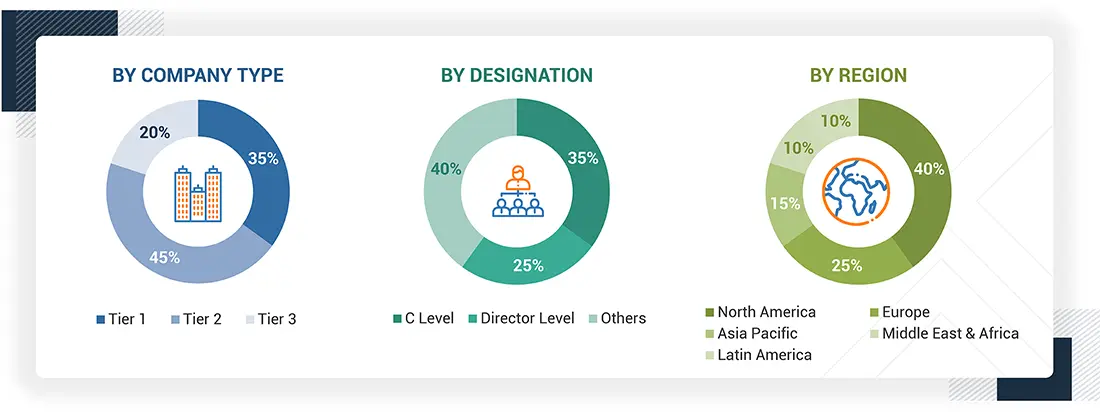
Note 1: Others include sales, marketing, and product managers.
Note 2: The tiers of companies have been defined based on their total revenue as of 2024.
Note 3: Tier 1 = Larger than or equal to USD 1 billion; tier 2 = between USD 100 million and USD 1 billion; and tier 3 = lesser than or equal to USD 100 million
To know about the assumptions considered for the study, download the pdf brochure
Market Size Estimation
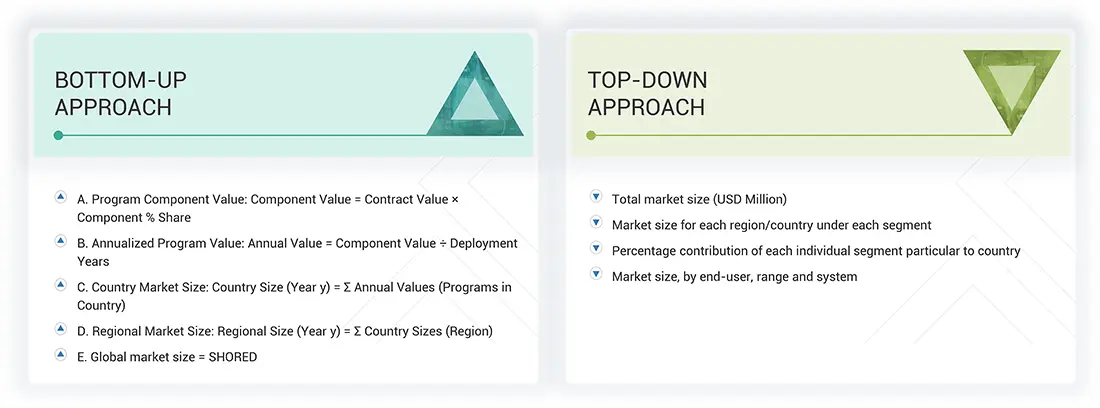
The top-down and bottom-up approaches were used to estimate and validate the size of the integrated air & missile defense market. The research methodology used to estimate the market size includes the following details.
Key players in the market were identified through secondary research, and their market share was determined through primary and secondary research. This included a study of the annual and financial reports of top market players and extensive interviews with industry stakeholders such as CEOs, technical advisors, military experts, and SMEs of leading companies operating in the military connectors market.
All percentage shares, splits, and breakdowns were determined using secondary sources and verified through primary sources. All possible parameters that affect the markets covered in this research study were accounted for, viewed in extensive detail, verified through primary research, and analyzed to obtain the final quantitative and qualitative data on the military connectors market. This data was consolidated, enhanced with detailed inputs, analyzed by MarketsandMarkets, and presented in this report.
Integrated Air and Missile Defense Market: Top-Down and Bottom-Up Approach
Data Triangulation
After arriving at the total market size of the integrated air & missile defense market through the process of market size estimation discussed above, the total market was segmented into various segments and sub-segments. The data triangulation methodology discussed below were utilized wherever possible to finalize the overall market engineering process and arrive at the precise numbers for different segments and sub-segments of the market. The data were triangulated by reviewing multiple factors and trends on both the supply and demand sides. The size of the market was validated using top-down and bottom-up strategies.
Market Definition
The integrated air & missile defense (IAMD) comprises all systems, subsystems, and supporting infrastructure designed to detect, track, intercept, and neutralize airborne and missile threats across multiple domains.
Key Stakeholders
- OEMs
- System Integrators & Defense Primes
- Armed Forces & Defense Ministries
- Standards & Regulatory Bodies
- Testing & Certification Agencies
- Distributors & Supply Chain Players
- Research & Technical Bodies
Report Objectives
- To define, describe, and forecast the size of the market based on system, component, range, and end user
- To forecast the size of various market segments within five regions: North America, Europe, Asia Pacific, the Middle East, and Rest of the World
- To identify and analyze the key drivers, restraints, opportunities, and challenges influencing the growth of the market across the globe
- To identify industry trends, market trends, and technology trends that are currently prevailing in the market
- To analyze micro-markets with respect to individual growth trends, prospects, and their contribution to the overall market
- To analyze opportunities in the market for stakeholders by identifying key market trends
- To profile key market players and comprehensively analyze their market share and core competencies
- To analyze the degree of competition in the market by identifying key growth strategies adopted by leading market players, such as acquisitions, product launches, contracts, and partnerships.
- To identify detailed financial positions, key products, and unique selling points of leading companies in the market.
- To provide a detailed competitive landscape of the market, along with market ranking analysis, market share analysis, and revenue analysis of key players.
Available customizations
Along with the market data, MarketsandMarkets offers customizations as per the specific needs of companies. The following customization options are available for the report:
Product Analysis
- Product matrix, which gives a detailed comparison of the product portfolio of each company
Regional Analysis
- Further breakdown of the market segments at country-level
Company Information
- Detailed analysis and profiling of additional market players (up to five)
Get the Full Integrated Air and Missile Defense Market Report
Full forecast, segment splits, and company analysis for all Integrated Air and Missile Defense Market.
- Rest Of Europe Integrated Air and Missile Defense Market
- Rest Of Asia Pacific Integrated Air and Missile Defense Market
- GCC Integrated Air and Missile Defense Market
- Rest Of Middle East Integrated Air and Missile Defense Market
- Canada Integrated Air and Missile Defense Market
- US Integrated Air and Missile Defense Market
- UK Integrated Air and Missile Defense Market
- Germany Integrated Air and Missile Defense Market
- France Integrated Air and Missile Defense Market
- Italy Integrated Air and Missile Defense Market
- Spain Integrated Air and Missile Defense Market
- Poland Integrated Air and Missile Defense Market
- China Integrated Air and Missile Defense Market
- Japan Integrated Air and Missile Defense Market
- India Integrated Air and Missile Defense Market
- South Korea Integrated Air and Missile Defense Market
- Australia Integrated Air and Missile Defense Market
- Singapore Integrated Air and Missile Defense Market
- Israel Integrated Air and Missile Defense Market
- Turkey Integrated Air and Missile Defense Market
Need a Tailored Report?
Customize this report to your needs
Get 10% FREE Customization
Customize This Report
