
Rest Of Asia Pacific Integrated Visual Augmentation System Market (2024-2029)

The Rest Of Asia Pacific Integrated Visual Augmentation System Market was valued at $24.7 Million in 2024 and projected to reach to $38.8 Million by 2029, representing a compound annual growth rate of 9.4%. Rest Of Asia Pacific's Integrated Visual Augmentation System Market is poised for sustained growth as regional defence budgets expand and modernization programs accelerate across emerging economies.


| Market Size in | USD 26.32 MN |
| Market Forecast in | |
| CAGR | |
| Forecast Period | |
| Units Considered | Value (USD MN) |
Rest Of Asia Pacific Integrated Visual Augmentation System Market Trends and Insights
- Rest Of Asia Pacific's aerospace and defence sector is increasingly adopting advanced visual augmentation technologies to enhance pilot situational awareness, aircraft navigation, and combat effectiveness.
- This growth trajectory reflects rising defence spending across emerging economies in Rest Of Asia Pacific and growing modernization initiatives within regional air forces. Rest Of Asia Pacific's market growth is driven by technological advancement, increased military procurement budgets, and regional geopolitical tensions that necessitate upgraded avionics systems.
- The 9.4% compound annual growth rate demonstrates Rest Of Asia Pacific's commitment to integrating cutting-edge visual systems into next-generation military platforms.
- Rest Of Asia Pacific's defence manufacturers and international suppliers are collaborating to develop localized solutions that meet regional operational requirements and regulatory standards..
Key Market Statistics
- CAGR (2024-2029) 9.4% CAGR
- Market Size, 2024 ~USD 24.7 Million
- Forecast, 2029 ~USD 38.8 Million
- Country Rest Of Asia Pacific
Rest Of Asia Pacific Integrated Visual Augmentation System Market Overview
Regional Market Valuation :
Rest Of Asia Pacific's Integrated Visual Augmentation System Market is valued at USD 24.7 million in 2024, demonstrating significant growth potential within the aerospace and defence sector across emerging economies in the region.
Strong Growth Trajectory :
With a CAGR of 9.4% through 2029, Rest Of Asia Pacific is experiencing robust expansion, reaching USD 38.8 million by forecast end, driven by increasing defence modernization initiatives and pilot training enhancements.
Pilot Situational Awareness Enhancement :
Regional defence forces are prioritizing advanced visual augmentation technologies to improve pilot situational awareness, navigation accuracy, and real-time tactical decision-making capabilities across military aviation operations.
Combat Effectiveness Improvement :
Rest Of Asia Pacific's aerospace and defence sector is leveraging integrated visual systems to enhance combat effectiveness, aircraft performance monitoring, and mission-critical operational capabilities in increasingly complex threat environments.
Rest Of Asia Pacific Integrated Visual Augmentation System Market Dynamics
- Countries in the region are investing heavily in upgrading military aviation capabilities, with visual augmentation systems becoming essential for enhancing pilot training, operational efficiency, and tactical superiority.
- The adoption of advanced display technologies and augmented reality solutions is expected to drive market expansion through 2029. Key growth drivers include increasing geopolitical tensions, rising defence spending, and the need for advanced pilot training infrastructure.
- Regional aerospace manufacturers and defence contractors are collaborating with technology providers to integrate cutting-edge visual systems into new aircraft platforms.
- The market will benefit from government initiatives focused on indigenous defence production and technology localization, creating opportunities for both established players and emerging solution providers in Rest Of Asia Pacific..
Market Ecosystem
Related Ecosystem
Defence Platforms And Systems
- Sensors
- Unmanned Ground Vehicles (UGV)
- Fighter Aircraft
- Special Mission Aircraft
- Antennas
- BAE Systems plc
- Thales group
- LOCKHEED MARTIN CORPORATION
- Northrop Grumman Corporation
- L3Harris Technologies, Inc.
Key Takeaways
- Rest Of Asia Pacific's Integrated Visual Augmentation System Market is valued at USD 24.7 million in 2024 and will reach USD 38.8 million by 2029, representing a 9.4% CAGR.
- Rest Of Asia Pacific's defence modernization programs and increased military budgets are primary catalysts for market expansion in the aerospace and defence sector.
- Rest Of Asia Pacific's growing adoption of advanced avionics and pilot-assistance technologies reflects regional focus on enhancing operational capabilities and situational awareness.
- Rest Of Asia Pacific's market is characterized by partnerships between international suppliers and local defence manufacturers to develop region-specific visual augmentation solutions.
Integrated Visual Augmentation System Market Report Scope
| Report Metric | Details |
|---|---|
| Base Year | 2024 |
| Fastest Growing Segment | COMBAT MISSIONS (Application) |
| Forecast Period | 2024-2029 |
| Growth Rate | CAGR of 11.1% from 2024 to 2029 |
| Largest Segment | HELMET-MOUNTED DISPLAY (Product) |
| Market Size Base Year (Billions) | ~USD 1 (2024) |
| Revenue Forecast (Billions) | ~USD 1.7 (2029) |
| Segments Covered | Product, Technology, Application, End User |
Rest Of Asia Pacific Integrated Visual Augmentation System Market Report Segmentation
4 segment dimensions are covered across the global market.
By Product
- Helmet-Mounted Display
- Night Vision Device
By Technology
- Augmented Reality
- Mixed Reality
- Virtual Reality
By Application
- Combat Missions
- Simulation & Training
By End User
- Air Force
- Army
- Navy
Target Audience
- Defence Procurement Officials : Regional defence ministry and military procurement teams need detailed market intelligence to evaluate visual augmentation system investments, justify budget allocations, and align technology acquisitions with modernization roadmaps.
- Aerospace & Defence Manufacturers : Regional and international aircraft manufacturers require market data to assess demand for integrated visual systems, identify customer requirements, and develop competitive offerings tailored to Rest Of Asia Pacific's defence specifications.
- Technology Solution Providers : Augmented reality, display technology, and avionics companies need regional market insights to prioritize product development, establish distribution channels, and capture growth opportunities in Rest Of Asia Pacific's expanding defence sector.
- Investment & Strategy Consultants : Business strategists and investment firms advising aerospace and defence clients require region-specific market data to evaluate expansion opportunities, assess competitive positioning, and guide capital allocation decisions in Rest Of Asia Pacific.
- Military Training & Simulation Providers : Flight training organizations and simulation system developers need market intelligence to understand pilot training technology adoption trends and identify opportunities to integrate visual augmentation systems into Rest Of Asia Pacific's military training infrastructure.
Reasons to Buy this Report
- Regional Market Sizing & Forecasting : Obtain precise market valuation data specific to Rest Of Asia Pacific, including 2024 baseline (USD 24.7M) and 2029 projections (USD 38.8M), enabling accurate budget allocation and investment planning for regional operations.
- Growth Opportunity Identification : Understand the 9.4% CAGR trajectory unique to Rest Of Asia Pacific, identifying high-potential market segments and emerging opportunities within the region's aerospace and defence sector before competitors establish dominance.
- Competitive Landscape Intelligence : Gain insights into regional adoption patterns, key defence modernization initiatives, and technology preferences specific to Rest Of Asia Pacific's military aviation sector to inform product development and market entry strategies.
- Strategic Partnership Development : Identify regional stakeholders, defence contractors, and government agencies driving visual augmentation system adoption in Rest Of Asia Pacific, facilitating targeted partnership and collaboration opportunities.
- Risk Assessment & Market Dynamics : Evaluate region-specific factors influencing market growth, including defence budget trends, geopolitical developments, and technology adoption barriers unique to Rest Of Asia Pacific's aerospace and defence ecosystem.
Frequently asked questions
What is the market size of Integrated Visual Augmentation Systems in Rest Of Asia Pacific?
Rest Of Asia Pacific's Integrated Visual Augmentation System Market was valued at USD 24.7 million in 2024 and is forecast to reach USD 38.8 million by 2029.
What is the expected growth rate for Rest Of Asia Pacific's market?
Rest Of Asia Pacific's market is expected to grow at a compound annual growth rate (CAGR) of 9.4% from 2024 to 2029.
What factors are driving growth in Rest Of Asia Pacific's Integrated Visual Augmentation System Market?
Rest Of Asia Pacific's market growth is driven by increased defence spending, military modernization initiatives, geopolitical tensions, and technological advancements in avionics systems.
Which countries comprise Rest Of Asia Pacific in this market analysis?
Rest Of Asia Pacific includes emerging and developing economies in the Asia-Pacific region outside of major markets, with significant defence procurement activities and aerospace development programs.
How is Rest Of Asia Pacific's market positioned relative to global trends?
Rest Of Asia Pacific's 9.4% CAGR is slightly below the global average of 11.1%, reflecting a maturing but still-expanding regional market with strong defence modernization momentum.
RESEARCH METHODOLOGY
The study involved four major activities in estimating the current size of the The Integrated Visual Augmentation System (IVAS) Market. Exhaustive secondary research was done to collect information on the The Integrated Visual Augmentation System (IVAS) Market, its adjacent markets, and its parent market. The next step was to validate these findings, assumptions, and sizing with industry experts across the value chain through primary research. Demand-side analyses were carried out to estimate the overall size of the market. After that, market breakdown and data triangulation procedures were used to estimate the sizes of different segments and subsegments of the The Integrated Visual Augmentation System (IVAS) Market.
Secondary Research
In the secondary research process, various sources were referred to for identifying and collecting information for this study. The secondary sources included government sources, such as SIPRI; corporate filings such as annual reports, press releases, and investor presentations of companies; white papers, journals, and certified publications; and articles from recognized authors, directories, and databases.
Primary Research
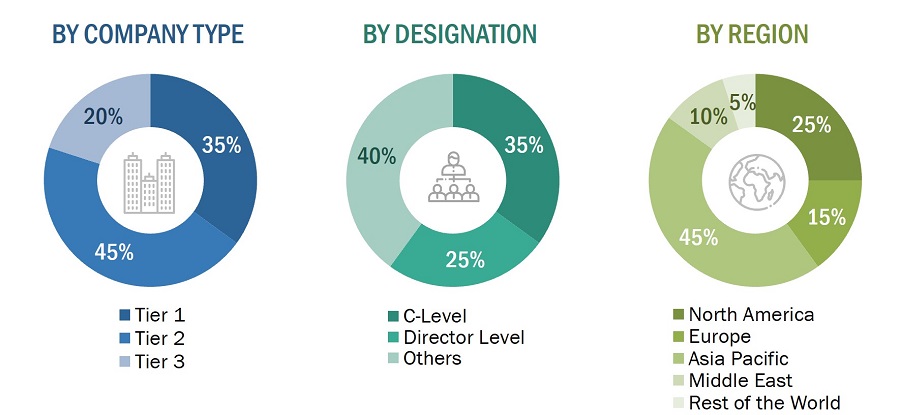
Extensive primary research was conducted after acquiring information regarding the the Integrated Visual Augmentation System (IVAS) Market scenario through secondary research. Several primary interviews were conducted with market experts from both the demand and supply sides across major countries of North America, Europe, Asia Pacific, the Middle East, and the Rest of the World, which includes Africa and Latin America. Primary data was collected through questionnaires, emails, and telephonic interviews.
To know about the assumptions considered for the study, download the pdf brochure
Market Size Estimation
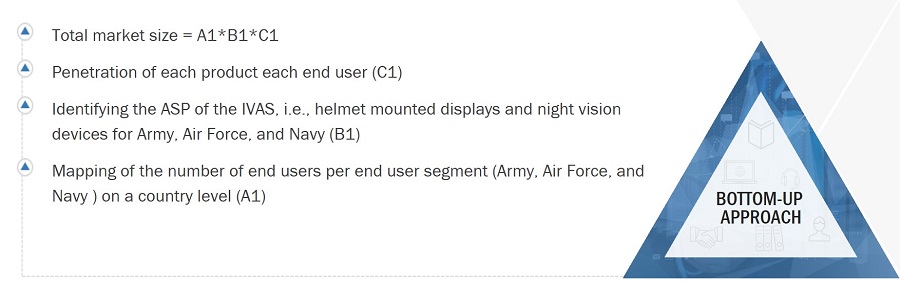
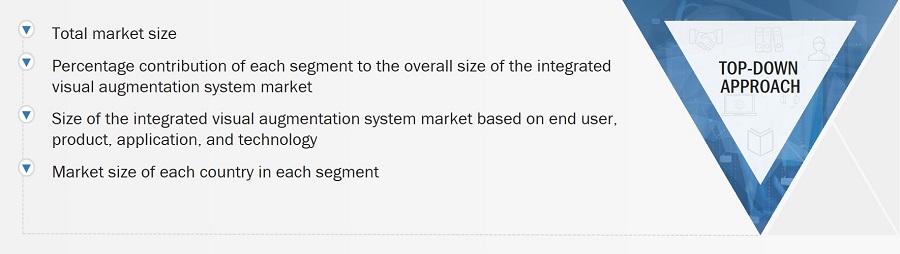
The top-down and bottom-up approaches were used to estimate and validate the size of the Integrated Visual Augmentation System Market. The research methodology used to estimate the size of the market includes the following details.
Key players in the Integrated Visual Augmentation System Market were identified through secondary research, and their market share was determined through primary and secondary research. This included a study of the annual and financial reports of the top market players and extensive interviews with leaders such as directors, engineers, marketing executives, and other stakeholders of leading companies operating in the Integrated Visual Augmentation System Market.
All percentage shares, splits, and breakdowns were determined using secondary sources and verified through primary sources. All possible parameters that affect the markets covered in this research study were accounted for, viewed in extensive detail, verified through primary research, and analyzed to obtain the final quantitative and qualitative data on the Integrated Visual Augmentation System market. This data was consolidated, enhanced with detailed inputs, analyzed by MarketsandMarkets, and presented in this report.
Integrated Visual Augmentation System Market Size: Bottom-up Approach
Integrated Visual Augmentation System Market Size: Top-Down Approach
Data Triangulation
After arriving at the overall market size, the total market was split into several segments and subsegments. The data triangulation and market breakdown procedures explained below were implemented, wherever applicable, to complete the overall market engineering process and arrive at the estimated market numbers for the market segments and subsegments. The data was triangulated by studying various factors and trends from the demand and supply sides. Along with this, the market size was validated using the top-down and bottom-up approaches.
Market Definition
The Integrated Virtual Augmented System (IVAS) market integrates virtual reality (VR) and augmented reality (AR) technologies into a single system that improves situational awareness for military personnel. IVAS incorporates helmet-mounted displays (HMDs), night vision devices (NVDs), and AR/VR systems, among other wearable technologies, to create practical, interactive experiences that combine digital content with the real-world setting. This technology is used in various applications including combat missions, simulations, and training exercises.
Market Stakeholders
- Army
- Navy
- Air Force
- Special Forces
- Traing and Simulation Troops
Report Objectives
- To define, describe, and forecast the Integrated Virtual Augmented System (IVAS) market size based on end-user, application, technology,product and Region.
- To forecast the size of different segments of the market with respect to five major regions: North America, Europe, Asia Pacific, the Middle East, and the Rest of the World, along with their respective key countries
- To identify and analyze key drivers, restraints, opportunities, and challenges influencing the market’s growth
- To identify industry trends and technology trends currently prevailing in the market
- To analyze micromarkets1 with respect to their individual growth trends, prospects, and contribution to the overall market
- To profile companies operating in the market based on their product portfolios, market share, and key growth strategies
- To analyze the degree of competition among players in the market by identifying and analyzing their business revenues, products offered, and recent developments and ranking them based on these parameters
- To analyze competitive developments such as deals, new product launches/developments, and partnerships/acquisitions undertaken by key market players
- To strategically profile key players and comprehensively analyze their share and core competencies in the market
Available Customizations
MarketsandMarkets offers the following customizations for this market report:
- Additional country-level analysis of the Integrated Virtual Augmented System (IVAS) market
- Profiling of other market players (up to 5)
Product Analysis
- Product matrix, which provides a detailed comparison of the product portfolio of each company in the Integrated Virtual Augmented System (IVAS)
Get the Full Integrated Visual Augmentation System Market Report
Full forecast, segment splits, and company analysis for all Integrated Visual Augmentation System Market.
- Canada Integrated Visual Augmentation System Market
- US Integrated Visual Augmentation System Market
- UK Integrated Visual Augmentation System Market
- France Integrated Visual Augmentation System Market
- Germany Integrated Visual Augmentation System Market
- Italy Integrated Visual Augmentation System Market
- India Integrated Visual Augmentation System Market
- Japan Integrated Visual Augmentation System Market
- South Korea Integrated Visual Augmentation System Market
- Australia Integrated Visual Augmentation System Market
- Saudi Arabia Integrated Visual Augmentation System Market
- UAE Integrated Visual Augmentation System Market
- Israel Integrated Visual Augmentation System Market
- Rest Of Europe Integrated Visual Augmentation System Market
- GCC Countries Integrated Visual Augmentation System Market
- Türkiye Integrated Visual Augmentation System Market
Need a Tailored Report?
Customize this report to your needs
Get 10% FREE Customization
Customize This Report
