
Rest Of South America Inverter Market (2025-2030)

The Rest Of South America Inverter Market was valued at $83.3 Million in 2025 and projected to reach to $135.8 Million by 2030, representing a compound annual growth rate of 10.3%. Rest Of South America's inverter market is positioned for sustained growth as the region accelerates its energy transition and renewable energy infrastructure development.


| Market Size in | USD 26.32 MN |
| Market Forecast in | |
| CAGR | |
| Forecast Period | |
| Units Considered | Value (USD MN) |
Rest Of South America Inverter Market Trends and Insights
- This 10.3% compound annual growth rate reflects increasing demand for renewable energy infrastructure and grid modernization across the region.
- Rest Of South America is capitalizing on rising solar adoption and energy transition initiatives, positioning itself as a growing hub for inverter deployment in the broader South American market. The inverter market in Rest Of South America is driven by expanding renewable energy capacity and government incentives supporting clean energy adoption.
- Rest Of South America's diverse energy landscape creates opportunities for both string inverters and distributed solar solutions.
- Between 2025 and 2030, Rest Of South America is expected to see accelerated investment in energy storage systems and hybrid inverter technologies, supporting the region's shift toward sustainable power generation and grid resilience..
Key Market Statistics
- CAGR (2025-2030) 10.3% CAGR
- Market Size, 2025 ~USD 83.3 Million
- Forecast, 2030 ~USD 135.8 Million
- Country Rest Of South America
Rest Of South America Inverter Market Overview
Market Growth Trajectory :
Rest Of South America's inverter market is projected to grow from $83.3 million in 2025 to $135.8 million by 2030, representing a robust 10.3% CAGR driven by renewable energy expansion and infrastructure modernization.
Solar Adoption Acceleration :
Rising solar energy adoption across Rest Of South America is a primary growth catalyst, with increasing investments in distributed solar systems and utility-scale projects driving inverter demand.
Grid Modernization Initiatives :
Regional governments are prioritizing grid modernization and energy transition programs, creating substantial opportunities for advanced inverter technologies and smart grid solutions.
Competitive Regional Landscape :
Rest Of South America presents emerging opportunities for both established inverter manufacturers and local players seeking to capture market share in this developing renewable energy sector.
Rest Of South America Inverter Market Dynamics
- The 10.3% CAGR reflects growing investments in solar capacity, grid modernization, and energy storage solutions across multiple countries in the region.
- Increasing government support for clean energy initiatives and rising electricity demand are key drivers. Looking ahead to 2030, the market will benefit from declining inverter costs, technological advancements, and expanding electrification efforts.
- Regional players and international manufacturers are expected to intensify competition, driving innovation in string inverters, central inverters, and hybrid solutions.
- Strategic partnerships and localized manufacturing capabilities will be critical for capturing growth opportunities in this emerging market..
Market Ecosystem
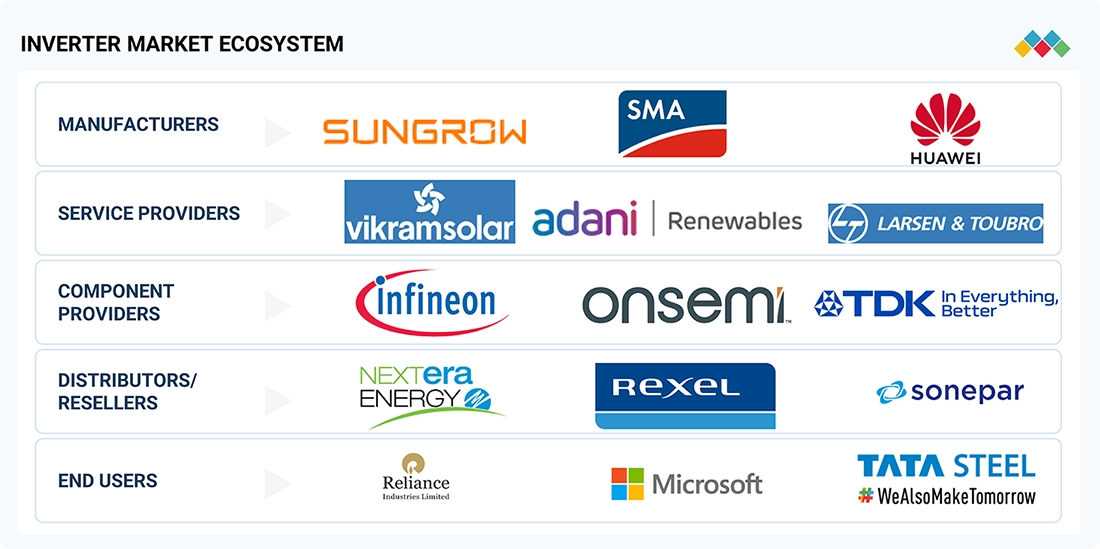
INVERTER MARKET SIZE, SHARE & TRENDS: COMMERCIAL USE CASES ACROSS INDUSTRIES
| COMPANY | USE CASE DESCRIPTION | BENEFITS |
|---|---|---|
 |
Sungrow has deployed its utility-scale string/central inverters and PowerTitan grid-forming energy storage systems in large solar + storage projects worldwide, including major deployments supporting India's renewable expansion and the world's largest grid-forming storage project. | Improved grid stability and virtual inertia in renewable-heavy systems | 20 ms reactive power response and microsecond-level voltage support | Suppressed wideband oscillations and enhanced fault ride-through |
 |
SMA has deployed its Sunny Central Storage UP grid-forming battery inverters and Large Scale Energy Solutions in utility and island projects, such as the 15 MW / 15 MWh BESS for Versorgungsbetriebe Bordesholm and the St. Eustatius island microgrid. | Enhanced grid reliability and resilience with inverter-based inertia | Revenue from balancing/primary control reserve markets | Blackstart and 100% renewable islanded operation |
 |
Huawei has supplied its FusionSolar smart string inverters at scale across Indian utility projects (including large solar farms in Rajasthan, Gujarat, and other high-growth states) and other emerging markets with weak grids. | Superior performance in weak/fluctuating Indian grids | Improved voltage stability and reduced harmonics | Higher energy yield and lower system costs vs. central inverters |
Logos and trademarks shown above are the property of their respective owners. Their use here is for informational and illustrative purposes only.
Related Ecosystem
Power Infrastructure
- Geographical Information System (GIS)
- Cogeneration
- Battery Electric Vehicle (BEV)
- Cellular Network
- Fuel Cell
- Siemens ag
- ABB India Limited
- SCHNEIDER ELECTRIC SE
- General Electric Company
- Eaton Corporation plc
Key Takeaways
- Rest Of South America's inverter market is valued at $83.3 million in 2025 and is forecast to reach $135.8 million by 2030, representing a 10.3% CAGR.
- Rest Of South America is experiencing increased adoption of renewable energy infrastructure, driving demand for advanced inverter technologies across residential, commercial, and utility-scale segments.
- Rest Of South America's market growth is supported by government renewable energy incentives, grid modernization projects, and rising energy storage integration.
- Rest Of South America presents significant opportunities for hybrid inverter solutions and distributed solar systems as the region transitions toward sustainable energy generation.
Inverter Market Report Scope
| Report Metric | Details |
|---|---|
| Base Year | 2025 |
| Fastest Growing Segment | 101–500 KW (Power Rating) |
| Forecast Period | 2025–2030 |
| Growth Rate | CAGR of 16.6% from 2025 to 2030 |
| Largest Segment | 100–300 V (Output Voltage) |
| Market Size Base Year (Billions) | ~USD 25.32 (2025) |
| Revenue Forecast (Billions) | ~USD 54.57 (2030) |
| Segments Covered | Connection Type, Sub-Type, Output Voltage, Sales Channel, Power Rating, Type, End User, Output Power Rating |
Rest Of South America Inverter Market Report Segmentation
8 segment dimensions are covered across the global market.
By Connection Type
- Grid-Tied
- Standalone
By Sub-Type
- Battery Electric Vehicle (Bev)
- Conventional Inverter
- Hybrid Electric Vehicle (Hev)
- Plug-In Hybrid Electric Vehicle (Phev)
- Smart Inverter
By Output Voltage
- 100–300 V
- 301–500 V
- Above 500 V
By Sales Channel
- Direct
- Indirect
By Power Rating
- 101–500 Kw
- 10–50 Kw
- 51–100 Kw
- Above 500 Kw
- Below 10 Kw
By Type
- Battery Electric Vehicles (Bevs)
- Central Inverter
- Conventional Inverter
- Hybrid Electric Vehicles (Hevs)
- Hybrid Inverter
- Micro-Inverter
- Microinverter
- Other Types
- Plug-In Hybrid Electric Vehicles (Phevs)
- Smart Inverter
- Solar Inverter
- String Inverter
- Vehicle Inverter
By End User
- Commercial And Industrial
- Residential
- Utility
By Output Power Rating
- 101–500 Kw
- 10–50 Kw
- 51–100 Kw
- Above 500 Kw
- Below 10 Kw
Target Audience
- Inverter Manufacturers & OEMs : Manufacturers need Rest Of South America-specific market data to assess regional demand, plan production capacity, develop localized products, and identify distribution partnerships in this growing market.
- Solar Energy Companies & Installers : Solar developers and installation firms require market forecasts and inverter technology trends for Rest Of South America to optimize equipment sourcing, pricing strategies, and project planning.
- Energy & Utility Companies : Utilities and energy providers need regional market intelligence to understand grid modernization requirements, inverter adoption rates, and technology investments needed for Rest Of South America's energy transition.
- Investment & Private Equity Firms : Investors evaluating opportunities in Rest Of South America's renewable energy sector require detailed market sizing, growth projections, and competitive analysis to support investment decisions.
- Government & Policy Makers : Regional policymakers and government agencies need market data on Rest Of South America's inverter sector to inform renewable energy targets, infrastructure planning, and incentive program design.
Key Companies in the Rest Of South America Inverter Market
| Company | HQ | Ownership | Strongest segments |
|---|---|---|---|
| TOSHIBA CORPORATION | Japan | Private Company | Energy Systems & Solutions,Infrastructure Systems & Solutions,Building Solutions, |
| ABB LTD | Switzerland | Public Company | Electrification,Motion,Automation, |
| SUNGROW | China | Public Company | Photovoltaic inverters,Energy storage systems,Wind power converters and transmission products, |
| SMA SOLAR TECHNOLOGY AG | Germany | Public Company | Home & Business Solutions (residential and C&I inverters, batteries, e-mobility, energy management),Large Scale & Project Solutions (utility-scale PV and storage inverters, project systems),Digital and Monitoring Solutions (software, design, O&M, data services), |
| TBEA CO., LTD. | China | Public Company | Power transmission and distribution equipment (transformers, switches, reactors, smart grids),Renewable energy systems and EPC (PV, inverters, charging, power control),New materials and aluminum products (alloy rods, foils, profiles, high-purity aluminum), |
| ENPHASE ENERGY | United States | Public Company | Microinverters and related accessories,IQ Battery and IQ PowerPack,Gateways, routers, and monitoring services, |
| GE VERNOVA | United States | Public Company | Power (gas, nuclear, hydro, steam),Wind (onshore and offshore),Electrification (grid, power conversion, software, solar and storage), |
| SOLAREDGE | Israel | Public Company | Inverters and power optimizers,Storage solutions (home battery 400V, CSS-OD),EV chargers (residential and commercial), |
| GOODWE | China | Public Company | Residential grid-tied inverters,Residential energy storage (hybrid, AC-coupled, split-phase),Commercial & industrial inverters and storage, |
| DARFON | Taiwan | Public Company | IT peripherals (computer, mobile, gaming),Passive components (MLCC, inductors, EMI, circuit protection, antennas),Green energy and battery systems (micro-inverters, hybrid systems, BMS, e-bike and EV batteries), |
| SCHNEIDER ELECTRIC | France | Public Company | Low- and Medium-Voltage Products & Switchgear,Building Management Systems & Power Metering,Industrial Automation & Variable Speed Drives, |
| DELTA ELECTRONICS, INC. | Taiwan | Public Company | Power Electronics (including embedded power, adapters, modules, components),Infrastructure (telecom power, UPS, data center, energy storage, PV inverters),Automation (industrial drives, motion, control, robots, building management), |
| EXIDE INDUSTRIES LTD. | India | Public Company | Automotive lead-acid batteries (OEM + replacement),Inverter, home UPS, and institutional UPS batteries,Industrial, infrastructural, genset, and telecom batteries, |
| SINENG ELECTRIC | China | Public Company | Utility-scale PV inverters and power conversion systems,C&I string inverters and storage systems,Residential PV and solar-plus-storage, |
TOSHIBA CORPORATION
Toshiba Corporation is a Japanese private company founded in 1875 with 106,648 employees. The company operates as a diversified conglomerate with operations across multiple industrial sectors.
ABB LTD
ABB Ltd is a Swiss public company established in 1883 with 111,900 employees. The company is a global leader in electrification and automation technologies.
SUNGROW
Sungrow is a Chinese public company founded in 1997 with 19,006 employees. The company specializes in renewable energy power conversion and energy storage solutions.
SMA SOLAR TECHNOLOGY AG
SMA Solar Technology AG is a German public company established in 1981 with 3,659 employees. The company is a leading provider of solar inverters and energy management solutions.
TBEA CO., LTD.
TBEA Co., Ltd. is a Chinese public company founded in 1949 with 31,806 employees. The company operates in the power transmission, transformation, and new energy sectors.
ENPHASE ENERGY
Enphase Energy is a United States public company founded in 2006 with 2,872 employees. The company designs and manufactures microinverter systems and energy management software for residential solar applications.
GE VERNOVA
GE Vernova is a United States public company established in 2023 with 78,000 employees. The company focuses on energy transition solutions including renewable power and energy storage.
SOLAREDGE
SolarEdge is an Israeli public company founded in 2006 with 3,576 employees. The company develops and manufactures power optimizers and inverters for solar photovoltaic systems.
GOODWE
GoodWe is a Chinese public company founded in 2010 with 4,521 employees. The company manufactures solar inverters and energy storage solutions for residential and commercial applications.
DARFON
Darfon is a Taiwanese public company established in 1997 with 1,067 employees. The company operates in the electronics and technology manufacturing sectors.
SCHNEIDER ELECTRIC
Schneider Electric is a French public company founded in 1836 with 158,122 employees. The company is a global leader in digital transformation and energy management solutions.
DELTA ELECTRONICS, INC.
Delta Electronics, Inc. is a Taiwanese public company established in 1971 with 85,684 employees. The company manufactures power management and thermal management solutions for various industrial applications.
EXIDE INDUSTRIES LTD.
Exide Industries Ltd. is an Indian public company founded in 1916 with 5,143 employees. The company is a leading manufacturer of batteries and energy storage solutions.
SINENG ELECTRIC
Sineng Electric is a Chinese public company founded in 2012 with 1,942 employees. The company specializes in the design and manufacture of solar inverters and power conversion equipment.
Reasons to Buy this Report
- Regional Market Sizing & Forecasts : Obtain precise market size data for Rest Of South America ($83.3M in 2025) with detailed 5-year forecasts to 2030, enabling accurate business planning and investment decisions specific to this region.
- Growth Driver Analysis : Understand the specific factors driving 10.3% CAGR in Rest Of South America, including solar adoption rates, grid modernization timelines, and government renewable energy policies unique to the region.
- Competitive Landscape Intelligence : Identify key market players, competitive dynamics, and market share distribution within Rest Of South America's inverter sector to inform strategic positioning and partnership opportunities.
- Technology & Product Trends : Discover which inverter technologies (string, central, hybrid) are gaining traction in Rest Of South America and align your product development roadmap with regional demand patterns.
- Investment & Expansion Strategy : Leverage regional market insights to evaluate expansion opportunities, identify high-growth sub-segments, and prioritize market entry strategies for Rest Of South America.
Frequently asked questions
What is the current size of the inverter market in Rest Of South America?
Rest Of South America's inverter market is estimated at $83.3 million in 2025 and is projected to grow to $135.8 million by 2030.
What is the expected growth rate for inverters in Rest Of South America?
Rest Of South America's inverter market is expected to grow at a compound annual growth rate (CAGR) of 10.3% from 2025 to 2030.
What factors are driving inverter market growth in Rest Of South America?
Rest Of South America's inverter market growth is driven by increasing renewable energy adoption, government clean energy incentives, grid modernization initiatives, and rising demand for energy storage integration.
Which inverter types are most in demand in Rest Of South America?
Rest Of South America shows strong demand for string inverters, hybrid inverters, and distributed solar solutions, reflecting the region's diverse renewable energy deployment patterns.
How does Rest Of South America's inverter market compare to the global market?
Rest Of South America's inverter market is growing at 10.3% CAGR, which is below the global average of 16.6%, indicating a more moderate but steady expansion trajectory within the broader South American region.
RESEARCH METHODOLOGY
This research study involved major activities in estimating the current size of the inverter market. Exhaustive secondary research was carried out to collect information on the peer and parent markets. The next step was to validate these findings, assumptions, and sizing with industry experts across the value chain through primary research. Both top-down and bottom-up approaches were employed to estimate the complete market size. Thereafter, market breakdown and data triangulation were used to estimate the market size of the segments and subsegments.
Secondary Research
This research study on the inverter market involved the use of extensive secondary sources, directories, and databases, such as D&B Hoovers, Bloomberg, Businessweek, Factiva, International Energy Agency, and BP Statistical Review of World Energy, to identify and collect valuable information for a technical, market-oriented, and commercial study of the inverter market. The other secondary sources included annual reports, press releases, and investor presentations of companies, white papers, certified publications, articles by recognized authors, manufacturer associations, trade directories, and databases.
Primary Research
The inverter market comprises stakeholders such as inverter manufacturers, technology providers, and support providers in the supply chain. On the demand side, the market is driven by the growing adoption of inverters across sectors, including renewable energy and industrial applications, due to their high energy efficiency, ability to provide reactive power support, and superior grid stability compared to conventional systems. On the supply side, manufacturers are seeing increasing opportunities through contracts with utility and industrial distribution networks, as well as through strategic initiatives such as contracts, acquisitions, and partnerships among major players to expand their market presence and technological capabilities. Various primary sources from both the supply and demand sides of the market were interviewed to obtain qualitative and quantitative information. The following is the breakdown of primary respondents:
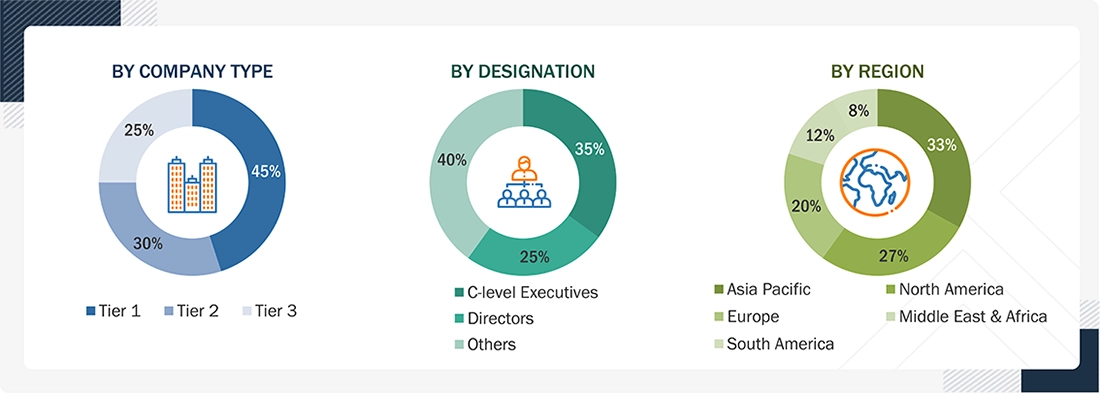
Note: The tiers of the companies are defined based on their total revenue as of 2024: Tier 1: >USD 1 billion, Tier 2: USD 500 million–1 billion, and Tier 3: <USD 500 million. Other designations include sales managers, engineers, and regional managers
To know about the assumptions considered for the study, download the pdf brochure
Market Size Estimation
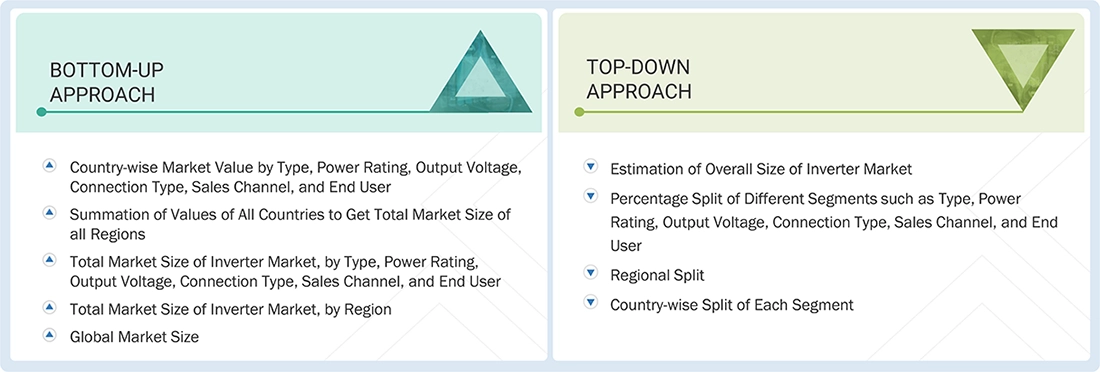
Both top-down and bottom-up approaches were employed to estimate and validate the size of the inverter market and its dependent submarkets. The key players in the market were identified through secondary research, and their market share in the respective regions was determined through a combination of primary and secondary research. The research methodology involved analyzing the annual and financial reports of top market players and conducting interviews with industry experts, including chief executive officers, vice presidents, directors, sales managers, and marketing executives, to gather key quantitative and qualitative insights related to the inverter market.
Inverter Market: Top-Down and Bottom-Up Approach
Data Triangulation
After determining the overall market size through the estimation process explained above, the total market was divided into several segments and subsegments. To complete the overall market engineering process and obtain the exact statistics for all segments and subsegments, data triangulation and market breakdown processes were employed, where applicable. The data was triangulated by studying various factors and trends from both the demand and supply sides. Additionally, the market was validated using both top-down and bottom-up approaches.
Market Definition
An inverter transforms direct current (DC) voltage to alternating current (AC) voltage. In most circumstances, the input DC voltage is lower, but the output AC voltage is equivalent to the grid supply voltage, which might be 120 or 240 V, depending on the country. The inverter is designed to act as a standalone piece of equipment for applications such as solar power generation or as a backup power supply from batteries that are charged separately. The global inverter ecosystem comprises manufacturers and distributors of inverters. The inverter market is diversified, with over 50 companies competing across its value chain to sustain their positions in the market and increase their market share. The scope of the report only covers solar inverters, vehicle inverters, and battery/UPS inverters. The inverter market is likely to witness significant growth in the coming years, owing to the increase in the number of residential solar PV installations, wherein inverters are widely used.
Key Stakeholders
- Government and research organizations
- Institutional investors and investment banks
- Environmental research institutes
- Consulting companies in the energy & power sector
- Raw material and component manufacturers
- Renewable energy companies
- Manufacturers’ associations
- Process and power industry associations
- Refinery operators
- Manufacturing sector
- Energy efficiency consultants
- Energy utilities
- Investors/shareholders
- Process industries and power and energy associations
- Public and private operators of power plants
- Inverter manufacturers, dealers, and suppliers
Report Objectives
- To describe and forecast the inverter market, by type, power rating, output voltage, connection type, sales channel, and end user, in terms of value
- To provide detailed information regarding the major drivers, restraints, opportunities, and industry-specific challenges influencing the growth of the market
- To analyze market opportunities for stakeholders and provide a detailed competitive landscape for market leaders
- To strategically analyze micromarkets with regard to individual growth trends, prospects, and contributions to the total market
- To strategically profile the key players and comprehensively analyze their market shares and core competencies
- To provide a detailed overview of the inverter supply chain analysis, use case analysis, key stakeholders and buying criteria, patent analysis, trade analysis, tariff analysis, regulations, macroeconomic outlook, pricing analysis, Porter’s five forces analysis, impact of gen AI, and the 2025 US tariff impact
- To analyze competitive developments, such as contracts, investments, partnerships, product launches, and acquisitions, in the market
- To describe and forecast the inverter market for various segments with respect to five main regions: North America, Europe, Asia Pacific, Latin America, and the Middle East & Africa, in terms of value
Available customizations:
MarketsandMarkets offers customizations tailored to the specific needs of companies using the given market data.
The following customization options are available for the report:
Product Analysis
- Product matrix, which gives a detailed comparison of the product portfolio of each company
Regional Analysis
- Further breakdown of the inverter market, by country
Company Information
- Detailed analysis and profiling of additional market players (up to five)
Get the Full Inverter Market Report
Full forecast, segment splits, and company analysis for all Inverter Market.
- China Inverter Market
- India Inverter Market
- Japan Inverter Market
- Australia Inverter Market
- US Inverter Market
- Canada Inverter Market
- Mexico Inverter Market
- UK Inverter Market
- France Inverter Market
- Germany Inverter Market
- Italy Inverter Market
- Spain Inverter Market
- Brazil Inverter Market
- Argentina Inverter Market
- Saudi Arabia Inverter Market
- UAE Inverter Market
- South Africa Inverter Market
- Rest Of Europe Inverter Market
- Rest Of Asia Pacific Inverter Market
Need a Tailored Report?
Customize this report to your needs
Get 10% FREE Customization
Customize This Report
