
South Africa Isocyanates Market (2025-2030)

The South Africa Isocyanates Market was valued at $287.3 Million in 2025 and projected to reach to $342.2 Million by 2030, representing a compound annual growth rate of 3.6%. South Africa's isocyanates market is positioned for moderate growth through 2030, supported by recovering automotive manufacturing and expanding construction sectors.


| Market Size in | USD 26.32 MN |
| Market Forecast in | |
| CAGR | |
| Forecast Period | |
| Units Considered | Value (USD MN) |
South Africa Isocyanates Market Trends and Insights
- South Africa's isocyanates sector is driven by demand from polyurethane foam production, automotive coatings, and construction applications, which remain critical end-use industries across the region.
- The market in South Africa reflects steady industrial expansion, supported by infrastructure development and manufacturing activity in the Middle East Africa region. During the forecast period from 2025 to 2030, South Africa's isocyanates market is expected to benefit from increased adoption in rigid and flexible foam applications, particularly in the building and construction sector.
- South Africa's chemical manufacturing base and regional trade position strengthen its role as a key market within the Middle East Africa geography.
- Growth in South Africa will be moderated by economic constraints and competition from alternative materials, yet the country remains strategically important for isocyanate consumption across polyurethane-dependent industries..
Key Market Statistics
- CAGR (2025-2030) 3.6% CAGR
- Market Size, 2025 ~USD 287.3 Million
- Forecast, 2030 ~USD 342.2 Million
- Country South Africa
South Africa Isocyanates Market Overview
Market Size & Growth :
South Africa's isocyanates market is valued at USD 287.3 million in 2025, with projected growth to USD 342.2 million by 2030, reflecting a steady CAGR of 3.6% driven by regional industrial expansion.
Key End-Use Industries :
Polyurethane foam production, automotive coatings, and construction applications are the primary demand drivers in South Africa, supported by growing infrastructure development and vehicle manufacturing sectors.
Regional Manufacturing Hub :
South Africa serves as a critical manufacturing and distribution center for isocyanates across Southern Africa, with established chemical production facilities and logistics networks supporting regional demand.
Growth Catalysts :
Rising construction activity, automotive sector recovery, and increased adoption of polyurethane-based products in industrial applications are fueling market expansion across South Africa.
South Africa Isocyanates Market Dynamics
- The country's established chemical infrastructure and regional trade advantages create opportunities for market participants.
- However, growth remains constrained by economic volatility, currency fluctuations, and competition from imported products.
- Investment in local production capacity and innovation in sustainable isocyanate formulations will be critical for capturing market share.
- The polyurethane foam segment is expected to remain the largest end-use category, driven by demand from furniture, bedding, and insulation applications across residential and commercial construction projects..
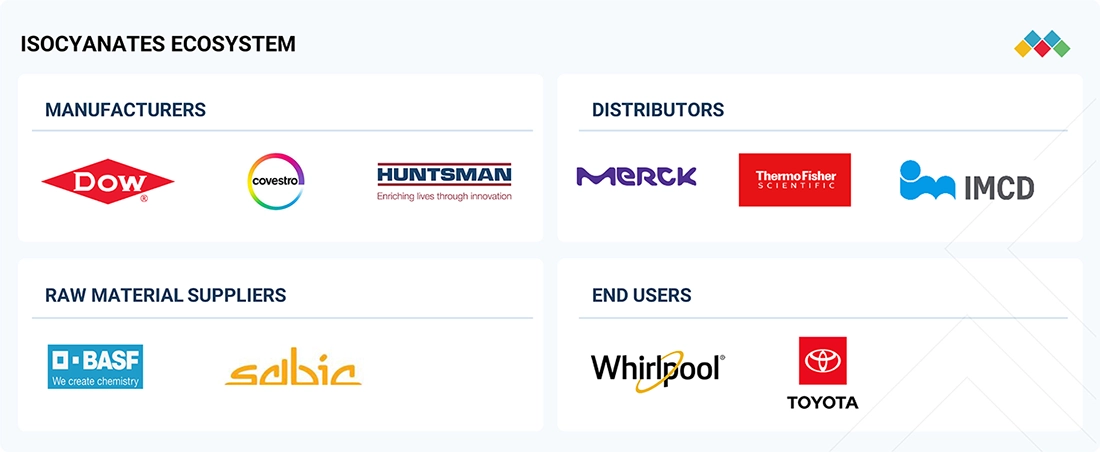
Market Ecosystem
ISOCYANATE MARKET: COMMERCIAL USE CASES ACROSS INDUSTRIES
| COMPANY | USE CASE DESCRIPTION | BENEFITS |
|---|---|---|
 |
Production of MDI and TDI for rigid and flexible polyurethane foams used in construction insulation, refrigeration, and automotive seating | Superior thermal insulation performance, lightweight structures, improved energy efficiency, reduced carbon footprint in buildings and appliances |
 |
Advanced MDI-based polyurethane systems for automotive lightweight components, coatings, adhesives, and elastomers | Weight reduction, high mechanical strength, design flexibility, durability, enhanced fuel efficiency and EV range |
 |
Large-scale MDI production for construction insulation panels, cold chain logistics, and industrial applications | Cost competitiveness, improved insulation performance, growing infrastructure demand support, energy savings in cold storage |
 |
Specialty isocyanates for CASE (coatings, adhesives, sealants, elastomers) applications across construction, footwear, and industrial sectors | Enhanced abrasion resistance, chemical resistance, longer service life, improved bonding strength |
Logos and trademarks shown above are the property of their respective owners. Their use here is for informational and illustrative purposes only.
Related Ecosystem
Bulk Chemicals And Inorganics
- Corrosion Inhibitors
- Glycol Ethers
- Acetic Acid
- Acetone
- Ammonium Nitrate
- Basf se
- DOW CHEMICAL COMPANY
- Exxon Mobil Corporation
- AZELIS HOLDINGS SA
- Sinopec limited
Key Takeaways
- South Africa's isocyanates market is valued at USD 287.3 million in 2025 and will reach USD 342.2 million by 2030.
- South Africa will experience a 3.6% CAGR over the forecast period, reflecting moderate but consistent market expansion.
- South Africa's demand is anchored in polyurethane foam, automotive coatings, and construction end-use sectors.
- South Africa's market growth will be supported by regional infrastructure development and manufacturing activity within Middle East Africa.
Isocyanates Market Report Scope
| Report Metric | Details |
|---|---|
| Base Year | 2025 |
| Fastest Growing Segment | AUTOMOTIVE (End-Use Industry) |
| Forecast Period | 2025–2030 |
| Growth Rate | CAGR of 4.2% from 2025 to 2030 |
| Largest Segment | AROMATIC (Type) |
| Market Size Base Year (Billions) | ~USD 32.3 (2025) |
| Revenue Forecast (Billions) | ~USD 39.68 (2030) |
| Segments Covered | Application, End-Use Industry, Type |
South Africa Isocyanates Market Report Segmentation
3 segment dimensions are covered across the global market.
By Application
- Adhesives & Sealants
- Coatings
- Elastomers & Cast Systems
- Foams
- Other Applications
By End-Use Industry
- Automotive
- Building & Construction
- Consumer Goods
- Electrical & Electronics
- Furniture & Bedding
- Industrial Coatings
- Other End-Use Industries
By Type
- Aliphatic
- Aromatic
- Other Types
- –Mdi
- –Tdi
Target Audience
- Chemical Manufacturers & Producers : Evaluate South Africa's isocyanates production capacity, local demand, and export opportunities to optimize manufacturing footprint and regional supply chain positioning.
- Automotive & Coatings Companies : Understand South Africa's automotive sector dynamics and coating application trends to identify growth opportunities and supplier partnerships in this key end-use segment.
- Construction & Building Materials Firms : Assess polyurethane foam and insulation demand driven by South Africa's construction activity to align product portfolios with regional market requirements.
- Distributors & Trading Companies : Identify market size, growth rates, and regional distribution channels in South Africa to optimize inventory management and expand market penetration across Southern Africa.
- Investment & Strategy Consultants : Access detailed South Africa market data and forecasts to support M&A due diligence, market entry strategies, and investment recommendations for chemical sector clients.
Key Companies in the South Africa Isocyanates Market
| Company | HQ | Ownership | Strongest segments |
|---|---|---|---|
| BORSODCHEM | Hungary | Private Company | MDI (Ongronat),TDI (Ongronat),PVC resins (Ongrovil), |
| BASF | Germany | Public Company | Chemicals,Materials,Industrial Solutions, |
| COVESTRO AG | Germany | Public Company | Performance Materials – Polyurethanes (MDI, TDI, polyols),Performance Materials – Polycarbonates and base chemicals,Solutions & Specialties – Coatings, adhesives, MDI specialties, polyols, |
| TOSOH CORPORATION | Japan | Public Company | Basic chemicals (caustic soda, vinyl chloride monomer, sodium bicarbonate, related chlor-alkali),Petrochemicals and polymers (ethylene, propylene, polyethylene, EVA, synthetic rubbers, functional polymers, PVC pastes),Advanced materials (battery materials, quartzware, silica glass, thin films, zeolites, zirconia components, fine beads and powders), |
| WANHUA | China | Public Company | Polyurethane (isocyanates, polyether polyols, systems),Petrochemical (olefin derivatives, ethylene, chlorine chain),Fine Chemicals and New Materials, |
| SABIC | Saudi Arabia | Public Company | Commodity polymers (PE, PP, PVC, PS, PET, ABS),Base chemicals & intermediates (olefins, methanol, aromatics, glycols, MTBE, CO2),Agri-nutrients (urea, ammonia, phosphate, compound fertilizers), |
| HANWHA SOLUTIONS | South Korea | Public Company | Basic Materials (PE, PVC, TDI, CA, hydrogenated petroleum resin),Renewable Energy (solar ingots, wafers, cells, modules, energy distribution, software),Processed Materials (lightweight composites, automotive and industrial materials, solar materials, electronic materials), |
| HUNTSMAN INTERNATIONAL LLC | United States | Private Company | MDI, polyols, and polyurethane systems,TPU, aniline, benzene, nitrobenzene, and intermediates,Amines, maleic anhydride, and carbonates, |
| DOW | United States | Public Company | Packaging & Specialty Plastics,Industrial Intermediates & Infrastructure,Performance Materials & Coatings, |
| MITSUI CHEMICALS INC | Japan | Public Company | Basic & Green Materials (petrochemicals, basic chemicals, polyurethane raw materials),Mobility Solutions (elastomers, performance and polypropylene compounds, battery material solutions),Life & Healthcare Solutions (vision care, nonwovens, personal care, agrochemicals, medical/dental), |
| OCI COMPANY LTD. | Netherlands | Public Company | Nitrogen fertilizers (urea, UAN, CAN, ammonium nitrate/sulphate),Ammonia (anhydrous, renewable/lower-carbon, storage services),Methanol, |
| ASAHI KASEI CORPORATION | Japan | Public Company | Advanced materials for electronics and energy (Pimel, Sunfort, Hipore, Celgard, glass fabric, plastic optical fiber),Membranes and process systems (Microza, Aciplex, Aqualyzer),Fibers and performance textiles (Bemberg, Bemliese, NanoAct, ROICA, Dinamica), |
BORSODCHEM
BORSODCHEM is a private chemical manufacturing company established in 1949 and headquartered in Hungary. The company employs 4,186 people and produces chemicals for industrial use.
BASF
BASF is a German multinational public company founded in 1865 and one of the world's largest chemical producers. With 106,428 employees globally, BASF manufactures a diverse portfolio of chemicals, plastics, and performance products.
COVESTRO AG
COVESTRO AG is a German public company founded in 1863 specializing in high-performance polymer materials. The company operates with 17,806 employees and produces innovative solutions for industries including automotive, construction, and electronics.
TOSOH CORPORATION
TOSOH CORPORATION is a Japanese public company established in 1935 that manufactures specialty chemicals and materials. With 14,850 employees, the company serves diverse markets including petrochemicals, electronics, and pharmaceuticals.
WANHUA
WANHUA is a Chinese public company founded in 1978 specializing in polyurethane and chemical production. The company employs 30,772 people and is a major producer of polyols and isocyanates for global markets.
SABIC
SABIC is a Saudi Arabian public company established in 1976 as a leading petrochemical manufacturer. With 35,000 employees, the company produces chemicals, plastics, and agrinutrients serving customers worldwide.
HANWHA SOLUTIONS
HANWHA SOLUTIONS is a South Korean public company founded in 1965 with diversified operations in chemicals and advanced materials. The company employs 5,656 people and serves industries including semiconductors, displays, and specialty chemicals.
HUNTSMAN INTERNATIONAL LLC
HUNTSMAN INTERNATIONAL LLC is a private chemical company founded in 1970 and based in the United States. With 6,000 employees, the company manufactures specialty chemicals, pigments, and polyurethane products.
DOW
DOW is an American public company founded in 1897 and a global leader in materials science and specialty chemicals. With 34,600 employees, the company produces plastics, chemicals, and agricultural products for diverse industrial applications.
MITSUI CHEMICALS INC
MITSUI CHEMICALS INC is a Japanese public company established in 1892 specializing in chemicals and advanced materials. The company employs 16,967 people and serves markets including automotive, packaging, and electronics.
OCI COMPANY LTD.
OCI COMPANY LTD. is a Dutch public company established in 2013 focused on specialty chemicals and materials. With 761 employees, the company serves industrial and commercial markets.
ASAHI KASEI CORPORATION
ASAHI KASEI CORPORATION is a Japanese public company founded in 1922 with operations in chemicals, fibers, and electronics. The company employs 47,895 people globally and produces innovative materials and chemical products.
Reasons to Buy this Report
- Country-Specific Market Sizing : Obtain precise market valuation for South Africa (USD 287.3M in 2025) with detailed 5-year forecasts, enabling accurate budgeting and investment decisions tailored to the local market.
- End-Use Segment Analysis : Understand demand patterns across polyurethane foam, automotive coatings, and construction applications specific to South Africa's industrial landscape and regional preferences.
- Competitive Landscape Intelligence : Identify key market players, regional suppliers, and distribution channels operating in South Africa to develop targeted go-to-market strategies and partnership opportunities.
- Growth Driver Identification : Analyze South Africa-specific catalysts including infrastructure projects, automotive manufacturing trends, and construction activity to anticipate market opportunities and risks.
- Regional Trade & Logistics Insights : Leverage South Africa's role as a Southern African hub to understand supply chain dynamics, import/export trends, and regional distribution advantages for strategic planning.
Frequently asked questions
What is the current size of South Africa's isocyanates market?
South Africa's isocyanates market is estimated at USD 287.3 million in 2025.
What is the projected market size for South Africa's isocyanates by 2030?
South Africa's isocyanates market is forecast to reach USD 342.2 million by 2030.
What is the CAGR for South Africa's isocyanates market?
South Africa's isocyanates market is expected to grow at a compound annual growth rate of 3.6% from 2025 to 2030.
Which industries drive isocyanate demand in South Africa?
South Africa's isocyanate demand is primarily driven by polyurethane foam production, automotive coatings, and construction applications.
What factors will influence South Africa's isocyanates market growth?
South Africa's market growth will be influenced by infrastructure development, manufacturing expansion, economic conditions, and competition from alternative materials.
RESEARCH METHODOLOGY
The study involved four major activities to estimate the isocyanates market size. Exhaustive secondary research was conducted to collect information on the market, the peer market, and the parent market. The next step was to validate these findings, assumptions, and sizing with industry experts across the value chain through primary research. Both top-down and bottom-up approaches were employed to estimate the total market size. Thereafter, market breakdown and data triangulation procedures were used to estimate the market size of the segments and subsegments.
Secondary Research
In the secondary research process, various secondary sources have been consulted to identify and collect information for this study. These sources include annual reports, press releases, company investor presentations, white papers, certified publications, trade directories, articles by recognized authors, gold standard and silver standard websites, and databases.
Secondary research has been used to obtain key information about the industry's value chain, the market's monetary chain, the total pool of key Isocyanates players, market classification and segmentation by industry trends down to the bottom-most level, and regional markets. It was also used to obtain information about key developments from a market-oriented perspective.
Primary Research
The isocyanates market comprises several stakeholders in the value chain, including raw material suppliers, manufacturers, distributors, and end users. Primary sources from both the supply and demand sides of the isocyanates market have been interviewed to obtain qualitative and quantitative information. The primary interviewees from the demand side include key opinion leaders in end-use sectors. The primary sources from the supply side include manufacturers, associations, and institutions involved in the isocyanates industry.
Primary interviews were conducted to gather insights such as market statistics, revenue data for products and services, market breakdowns, market size estimates, market forecasts, and data triangulation. Primary research also helped in understanding the various trends related to type, application, end-use industry, and region. Stakeholders from the demand side, such as CIOs, CTOs, and CSOs, were interviewed to understand the buyer’s perspective on suppliers, products, component providers, current usage of Isocyanates, and the future outlook of their business, which will affect the overall market.
The breakdown of profiles of the primary interviews is illustrated in the figure below:
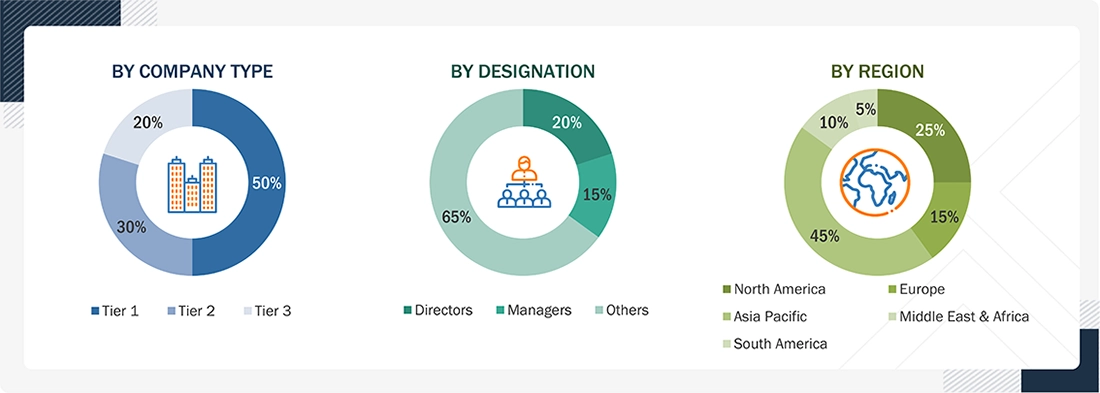
Note: Tier 1, Tier 2, and Tier 3 companies are classified based on their market revenue in 2024 available in the public domain, product portfolios, and geographical presence.
Other designations include sales representatives, production heads, and technicians.
Market Size Estimation
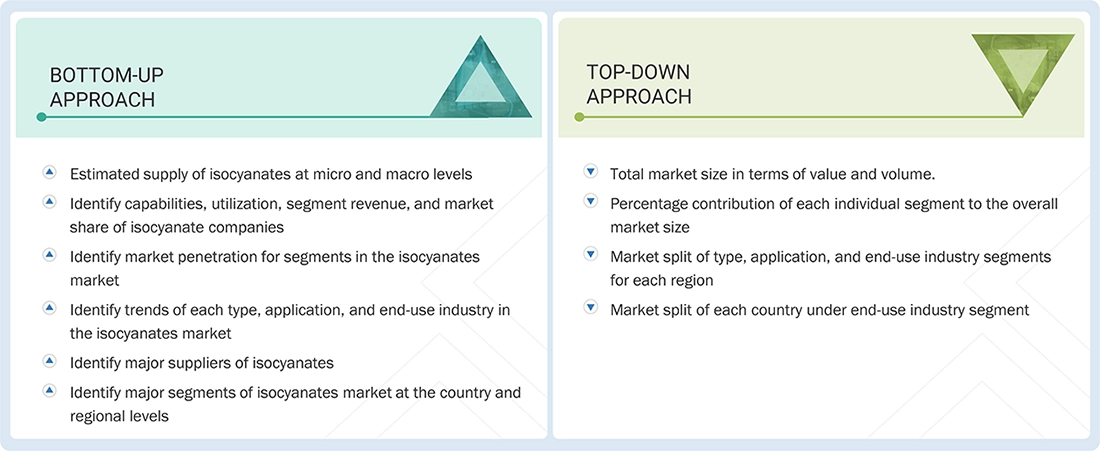
A top-down approach was used to estimate and validate the sizes of various isocyanate submarkets in each region. The research methodology used to estimate the market size included the following steps:
- The key players in the industry have been identified through extensive secondary research.
- The supply chain of the industry has been determined through primary and secondary research.
- The global market was then segmented into five major regions and validated by industry experts.
- All percentage shares, splits, and breakdowns based on type, application, end-use industry, and region were determined using secondary sources and verified through primary sources.
- All possible parameters that affect the markets covered in this research study were accounted for, viewed in extensive detail, verified through primary research, and analyzed to get the final quantitative and qualitative data. This data was consolidated and added with detailed inputs and analysis, and presented in this report.
Data Triangulation
After determining the total market size for isocyanates through the estimation process outlined above, the overall market has been divided into several segments and sub-segments. To complete the overall market engineering process and arrive at the exact statistics for all segments and sub-segments, data triangulation and market breakdown procedures have been employed wherever applicable. The data has been triangulated by analyzing various factors and trends from both the demand and supply sides. In addition, the market size has been validated using both the top-down and bottom-up approaches, as well as primary interviews. Hence, for every data segment, there have been three sources—top-down approach, bottom-up approach, and expert interviews. The data was considered correct when the values from the three sources matched.
Market Definition
The isocyanates market includes the global production, distribution, and consumption of isocyanate-based chemicals, primarily used as key raw materials in the manufacture of polyurethane products. Isocyanates such as methylene diphenyl diisocyanate (MDI), toluene diisocyanate (TDI), and aliphatic isocyanates react with polyols to form polyurethane foams, coatings, adhesives, sealants, and elastomers. These materials are widely used across the construction, automotive, furniture, appliance, electronics, and industrial sectors. The market includes raw material suppliers, manufacturers, distributors, and end-use industries, with demand largely influenced by infrastructure development, industrial growth, energy-efficiency regulations, technological advancements, and evolving sustainability standards worldwide.
Key Stakeholders
- Isocyanate Manufacturers
- Isocyanate Traders, Distributors, and Suppliers
- Raw Material Suppliers
- Government and Private Research Organizations
- Associations and Industrial Bodies
- R&D Institutions
- Environmental Support Agencies
Report Objectives
- To define, describe, and forecast the size of the Isocyanates market, in terms of value and volume
- To provide detailed information regarding the major factors (drivers, opportunities, restraints, and challenges) influencing the growth of the market
- To estimate and forecast the market size based on type, end-use industry, application, and region
- To forecast the size of the market with respect to major regions, namely, Europe, North America, Asia Pacific, Middle East & Africa, and South America, along with their key countries
- To strategically analyze micromarkets with respect to individual growth trends, prospects, and their contribution to the overall market
- To analyze opportunities in the market for stakeholders and provide a competitive landscape of market leaders
- To analyze recent developments such as product launches, collaborations, contracts, acquisitions, and expansion in the market.
- To strategically profile key market players and comprehensively analyze their core competencies
Available customizations:
Along with the given market data, MarketsandMarkets offers customizations according to the company’s specific needs. The following customization options are available for the report:
1. Regional Analysis
Further breakdown of a region with respect to a particular country or additional application.
2. Company Information
Detailed analysis and profiles of additional market players.
3. Tariff & Regulations
Regulations and impact on isocyanates market.
4. By Type Analysis
Market size for isocyanates in terms of value and volume.
Get the Full Isocyanates Market Report
Full forecast, segment splits, and company analysis for all Isocyanates Market.
- China Isocyanates Market
- Japan Isocyanates Market
- India Isocyanates Market
- South Korea Isocyanates Market
- Canada Isocyanates Market
- Mexico Isocyanates Market
- US Isocyanates Market
- Germany Isocyanates Market
- Italy Isocyanates Market
- France Isocyanates Market
- UK Isocyanates Market
- Spain Isocyanates Market
- Argentina Isocyanates Market
- Brazil Isocyanates Market
- Rest Of Europe Isocyanates Market
- Rest Of Asia Pacific Isocyanates Market
- GCC Countries Isocyanates Market
- –Other GCC Countries Isocyanates Market
- Rest Of South America Isocyanates Market
Need a Tailored Report?
Customize this report to your needs
Get 10% FREE Customization
Customize This Report
