
China IVD Reagents Market (2024-2029)

The China IVD Reagents Market was valued at $2899.4 Million in 2024 and projected to reach to $4967.3 Million by 2029, representing a compound annual growth rate of 11.4%. China's IVD reagents market is poised for sustained high-growth expansion through 2029, driven by structural factors including rising per capita healthcare spending, government initiatives to expand diagnostic infrastructure, and growing awareness of preventive healthcare.


| Market Size in | USD 26.32 MN |
| Market Forecast in | |
| CAGR | |
| Forecast Period | |
| Units Considered | Value (USD MN) |
China IVD Reagents Market Trends and Insights
- This represents a compound annual growth rate (CAGR) of 11.4%, significantly outpacing global market growth.
- China's rapid urbanization, rising healthcare expenditure, and increasing prevalence of chronic diseases are driving demand for diagnostic testing across clinical laboratories, hospitals, and point-of-care settings. The Chinese market benefits from strong government support for healthcare infrastructure modernization and diagnostic accessibility in both urban and rural regions.
- China's expanding middle class and aging population are accelerating the adoption of preventive screening and routine diagnostic testing.
- Additionally, China's domestic IVD manufacturers are gaining competitive advantage through cost-effective production and localized distribution networks, further stimulating market penetration. By 2029, China is expected to consolidate its position as a key growth engine within the Asia Pacific region, driven by technological advancement in reagent formulations, increased laboratory automation, and growing integration of molecular diagnostics into standard clinical practice across China..
Key Market Statistics
- CAGR (2024-2029) 11.4% CAGR
- Market Size, 2024 ~USD 2899.4 Million
- Forecast, 2029 ~USD 4967.3 Million
- Country China
China IVD Reagents Market Overview
Exceptional Growth Trajectory :
China's IVD reagents market is expanding at 11.4% CAGR, nearly 50% faster than the global average of 7.7%, reflecting strong domestic demand and healthcare modernization initiatives.
Rapid Market Expansion :
Market valuation is projected to grow from USD 2,899.4 million in 2024 to USD 4,967.3 million by 2029, representing an increase of USD 2,067.9 million over five years.
Urbanization & Healthcare Investment :
China's accelerating urbanization and rising healthcare expenditure are creating unprecedented demand for diagnostic testing, driving adoption of advanced IVD reagent technologies across tier-1 and tier-2 cities.
Chronic Disease Prevalence :
Increasing prevalence of diabetes, cardiovascular diseases, and cancer in China is fueling demand for diagnostic reagents, positioning the market as a critical growth engine for global IVD manufacturers.
China IVD Reagents Market Dynamics
- The market's 11.4% CAGR significantly outpaces global growth, reflecting China's position as a key growth market for in vitro diagnostics. Key growth catalysts include increasing chronic disease burden, expansion of hospital laboratory networks, and rising adoption of advanced diagnostic technologies in secondary and tertiary care facilities.
- Strategic investments by both domestic and international players, coupled with regulatory improvements and healthcare digitalization, will further accelerate market penetration and create substantial opportunities for reagent manufacturers targeting China's evolving diagnostic landscape..
Market Ecosystem
Related Ecosystem
Medical Devices
- Polymerase Chain Reaction (PCR)
- Magnetic Resonance Imaging (MRI)
- Disposable Autoinjectors
- Pulse Oximeters
- Blood Pressure Monitors
- Medtronic plc
- Abbott Laboratories
- Stryker Corporation
- Becton, Dickinson and Company
- CONMED Corporation
Key Takeaways
- China's IVD reagents market is projected to grow from USD 2,899.4 million in 2024 to USD 4,967.3 million by 2029, representing an 11.4% CAGR.
- China's market growth rate significantly exceeds the global average of 7.7%, positioning China as a high-growth priority market within Asia Pacific.
- Government healthcare reforms, aging demographics, and rising chronic disease prevalence are primary catalysts driving diagnostic reagent demand across China.
- China's domestic manufacturers are strengthening market share through cost-competitive production and expanded rural healthcare distribution networks.
IVD Reagents Market Report Scope
| Report Metric | Details |
|---|---|
| Base Year | 2024 |
| Fastest Growing Segment | MOLECULAR DIAGNOSTICS (Technology) |
| Forecast Period | 2024-2029 |
| Growth Rate | CAGR of 7.7% from 2024 to 2029 |
| Largest Segment | LABORATORY TESTS (Test Type) |
| Market Size Base Year (Billions) | ~USD 0.06 (2024) |
| Revenue Forecast (Billions) | ~USD 0.09 (2029) |
| Segments Covered | Type, Technology, Application, Test Type, End User |
China IVD Reagents Market Report Segmentation
5 segment dimensions are covered across the global market.
By Type
- Antibodies
- Antigen, Purified Proteins, And Peptides
- Antigens, Purified Proteins, And Peptides
- Large Reference Laboratories
- Monoclonal Antibodies
- Nucleic Acid Probes
- Oligonucleotides
- Other Ivd Reagents
- Polyclonal Antibodies
- Small & Medium-Sized Laboratories
- Small And Medium-Sized Laboratories
By Technology
- Chromatography & Mass Spectrometry
- Clinical Chemistry
- Coagulation & Hemostasis
- Hematology
- Immunoassays
- Immunohistochemistry
- Microbiology
- Molecular Diagnostics
- Urinalysis
By Application
- Allergy Diagnostics
- Autoimmune Diseases
- Blood Screening
- Cardiological Applications
- Drug Monitoring & Testing
- Endocrinological Applications
- Genetic Testing
- Infectious Diseases
- Oncological Applications
- Other Applications
By Test Type
- Laboratory Tests
- Point-Of-Care Tests
By End User
- Academic Institutes
- Blood Banks
- Clinical Laboratories
- Home Care Settings
- Hospitals & Clinics
- Other End Users
- Pharmaceutical & Biotechnology Companies
CHINA: IVD REAGENTS MARKET, BY END USER, 2022–2029
| Segment | 2022 | 2023 | 2024 | 2025 | 2026 | 2027 | 2028 | 2029 | CAGR (%) |
|---|---|---|---|---|---|---|---|---|---|
| ACADEMIC INSTITUTES | 228.3 | 244 | 261.4 | 282.3 | 306.8 | 335.7 | 369.6 | 408.8 | 9.4 |
| BLOOD BANKS | 202.5 | 218 | 235.4 | 256 | 280.3 | 308.9 | 342.7 | 381.9 | 10.2 |
| CLINICAL LABORATORIES | 1789.6 | 1956.9 | 2145.9 | 2371.1 | 2637.2 | 2952.3 | 3326.5 | 3765.5 | 11.9 |
| HOME CARE SETTINGS | 111.4 | 119.4 | 128.3 | 139 | 151.5 | 166.3 | 183.6 | 203.7 | 9.7 |
| HOSPITALS & CLINICS | 2345.1 | 2531.3 | 2739.7 | 2987.3 | 3278.2 | 3620.4 | 4023.7 | 4491.8 | 10.4 |
| OTHER END USERS | 137 | 145.3 | 154.6 | 165.8 | 178.9 | 194.4 | 212.5 | 233.4 | 8.6 |
| PHARMACEUTICAL & BIOTECHNOLOGY COMPANIES | 180.3 | 192.1 | 205.2 | 220.9 | 239.3 | 261 | 286.6 | 316 | 9 |
| TOTAL | 4994.1 | 5406.9 | 5870.6 | 6422.4 | 7072.3 | 7839 | 8745.2 | 9801.1 | 10.8 |
Target Audience
- IVD Manufacturers & Reagent Suppliers : Need China-specific market sizing and growth forecasts to develop localized product strategies, optimize manufacturing capacity, and identify high-potential customer segments in this rapidly expanding diagnostic market.
- Healthcare Investment Firms : Require validated market data and CAGR projections for China to evaluate investment opportunities, assess portfolio company growth potential, and make informed capital allocation decisions in the diagnostics sector.
- Hospital & Laboratory Networks : Need market intelligence on reagent demand trends and supplier landscape in China to optimize procurement strategies, negotiate better terms with suppliers, and plan laboratory expansion initiatives.
- Market Entry & Business Development Teams : Require comprehensive China market analysis to support feasibility studies, business case development, and strategic planning for market entry, partnerships, or acquisition opportunities in the IVD reagents space.
- Healthcare Policy & Government Agencies : Need market data on China's IVD reagents sector to inform healthcare policy decisions, diagnostic infrastructure planning, and regulatory frameworks supporting domestic industry development and healthcare accessibility.
Reasons to Buy this Report
- Market Size & Growth Validation : Obtain precise market valuation data for China (USD 2,899.4M in 2024) and verified 5-year forecasts to support investment decisions, business planning, and competitive positioning in Asia's largest diagnostic market.
- Competitive Intelligence : Understand China-specific market dynamics, growth drivers, and regional trends that differentiate it from global markets, enabling targeted go-to-market strategies and competitive advantage in this high-growth segment.
- Strategic Expansion Planning : Leverage detailed China market insights to identify optimal entry points, partnership opportunities, and distribution channels for IVD reagent products in a market growing 48% faster than global average.
- Risk Assessment & Forecasting : Access reliable China-specific CAGR projections (11.4%) and market forecasts through 2029 to mitigate investment risks, allocate resources effectively, and align long-term business strategies with market realities.
- Stakeholder Alignment : Present credible, data-driven market evidence to investors, boards, and partners regarding China's IVD reagents opportunity, supporting funding requests and strategic partnership negotiations with quantified growth potential.
Frequently asked questions
What is the current size of China's IVD reagents market?
China's IVD reagents market was valued at USD 2,899.4 million in 2024 and is expected to grow to USD 4,967.3 million by 2029.
What is the projected growth rate for China's IVD reagents market?
China's IVD reagents market is projected to grow at a compound annual growth rate (CAGR) of 11.4% from 2024 to 2029.
How does China's market growth compare to global trends?
China's 11.4% CAGR significantly outpaces the global IVD reagents market CAGR of 7.7%, making China one of the fastest-growing markets.
What factors are driving growth in China's IVD reagents market?
Key drivers include rising healthcare expenditure, aging population, increasing chronic disease prevalence, government healthcare infrastructure investments, and expansion of diagnostic testing accessibility across China.
Who are the main players in China's IVD reagents market?
China's market includes both international IVD manufacturers and domestic Chinese companies that are gaining market share through cost-effective solutions and localized distribution networks.
RESEARCH METHODOLOGY
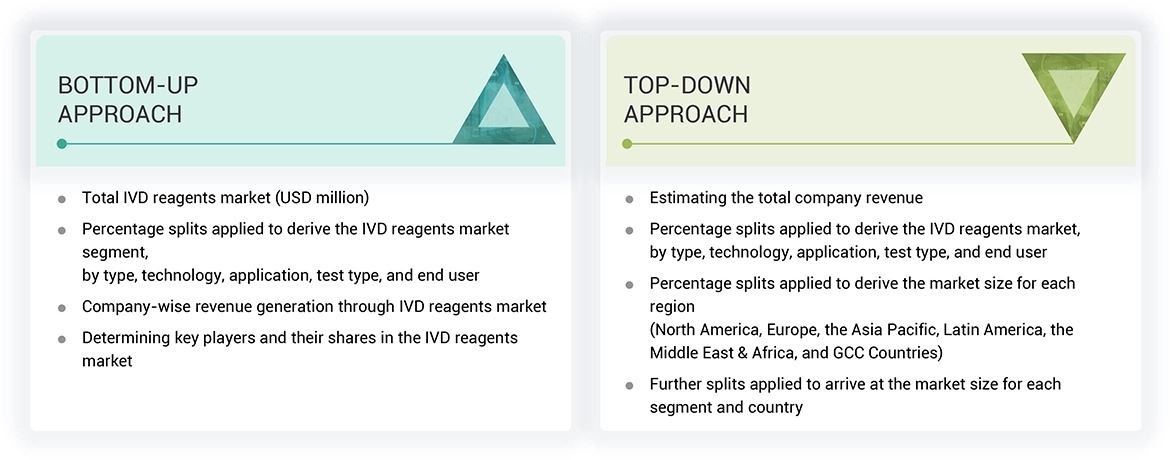
To determine the current size of the IVD reagents market, this study engaged in four main activities. A comprehensive study was conducted using secondary research methods to gather data about the market, its parent market, and its peer markets. The next stage involved conducting primary research to confirm these conclusions, assumptions, and sizing with industry experts throughout the value chain. A combination of top-down and bottom-up methods was used to assess the overall market size. The market sizes of segments and subsegments were then estimated using data triangulation techniques and market breakdown.
The four steps involved in estimating the market size are
Secondary Research
Within the secondary data collection process, a range of secondary sources were reviewed so as to identify and gather data for this study, including regulatory bodies, databases (World Bank, World Health Organization, Centers for Disease Control and Prevention, and the US Food and Drug Administration); corporate filings (annual reports, SEC filings, investor presentations, and financial statements); research journals; press releases; and trade, business, and professional associations.
Primary Research
A thorough method was used in the primary research phase, which involved interviewing a wide range of sources from the supply and demand sides. The purpose of these interviews was to obtain the quantitative and qualitative information needed to put up this report. The main sources of information were industry experts from both core and related sectors, as well as preferred service provider, pioneers in technology, and organizations involved in every aspect of this industry's value chain. A variety of primary respondents, including important industry stakeholders, subject-matter experts, C-level executives from crucial market companies, and industry advisers, were carefully questioned in-depth. The goal was to gather and validate important qualitative and quantitative insights and to conduct a thorough assessment of future possibilities.
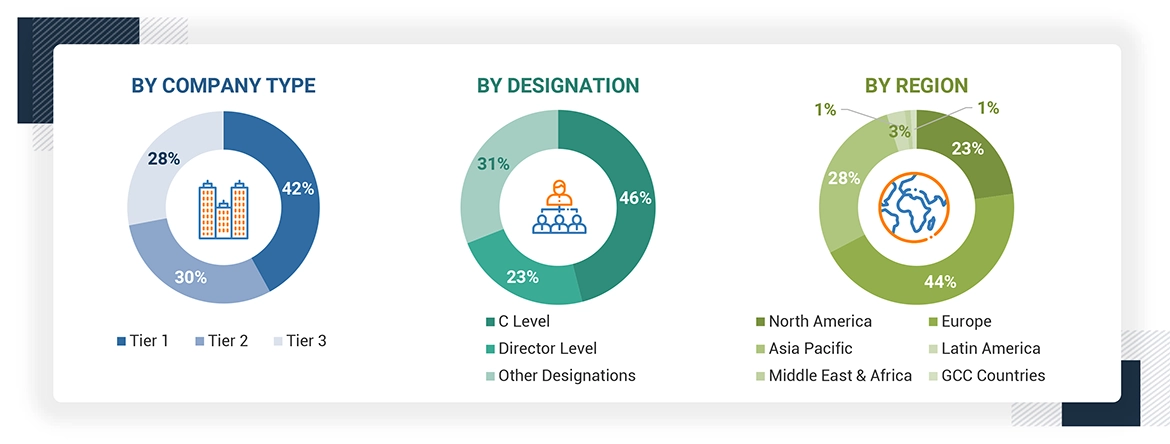
Note 1: Other designations include sales, marketing, and product managers.
Note 2: Tiers are defined based on a company’s total revenue. As of 2024, Tier 1= >USD 1 billion, Tier 2 = USD 500 million to USD 1 billion, and Tier 3 = < USD 500 million.
To know about the assumptions considered for the study, download the pdf brochure
| COMPANY NAME | DESIGNATION | |
|---|---|---|
| Enzene Biosciences Ltd. | Scientist | |
| Danaher Corporation | Director of Research & Development | |
| Thermo Fisher Scientific Inc. | Sales Manager | |
Market Size Estimation
All major product providers offering various products and services were identified at the global/regional level. Revenue mapping was done for the major players and was extrapolated to arrive at the global market value of each type of segment. The market value of the IVD reagents market was also split into various segments and subsegments at the region and country level based on:
- Offering mapping of various service provider for each type in the IVD reagents market at the regional and country level
- Relative adoption pattern of each IVD reagents market among key application segments at the regional and/or country-level
- Detailed primary research to gather qualitative and quantitative information related to segments and subsegments at the regional and/or country level.
- Detailed secondary research to gauge the prevailing market trends at the regional and/or country level
Data Triangulation
After arriving at the overall market size applying the process mentioned above, the total market was split into several segments and subsegments. To complete the overall market engineering process and arrive at the exact statistics for all segments and subsegments, data triangulation and market breakdown procedures were employed, wherever applicable. The data was triangulated by studying various factors and trends from both the demand and supply sides.
Market Definition
In vitro diagnostic (IVD) reagents are chemicals or substances used to detect, measure, or produce a reaction with components of a sample in an IVD test. They are essential for accurately detecting biological markers or analytes in samples.
Stakeholders
- IVD Reagents Manufacturers
- Pathologists and Pathology Laboratories
- Distributors of IVD Products
- Hospitals and Clinics
- Healthcare Institutions
- Research Institutes
- Market Research and Consulting Firms
- Venture Capitalists and Investors
Report Objectives
- To define, describe, segment, and forecast the global IVD reagents market by type, technology, application, test type, end user, and region
- To provide detailed information regarding the major factors influencing the market growth (such as drivers, restraints, opportunities, and challenges)
- To analyze the micro markets with respect to individual growth trends, prospects, and contributions to the overall IVD reagents market
- To analyze market opportunities for stakeholders and provide details of the competitive landscape for key players
- To forecast the size of the market segments with respect to six regions: North America, Europe, the Asia Pacific, Latin America, the Middle East & Africa, and the GCC Countries
- To profile the key players and comprehensively analyze their product portfolios, market positions, and core competencies
- To benchmark players within the market using the proprietary Company Evaluation Matrix framework, which analyzes market players on various parameters within the broad categories of business and product excellence
Get the Full IVD Reagents Market Report
Full forecast, segment splits, and company analysis for all IVD Reagents Market.
- US IVD Reagents Market
- Canada IVD Reagents Market
- Germany IVD Reagents Market
- UK IVD Reagents Market
- France IVD Reagents Market
- Italy IVD Reagents Market
- Spain IVD Reagents Market
- Japan IVD Reagents Market
- India IVD Reagents Market
- Brazil IVD Reagents Market
- Mexico IVD Reagents Market
- Rest Of Europe IVD Reagents Market
- Rest Of Asia Pacific IVD Reagents Market
- Rest Of Latin America IVD Reagents Market
- Kingdom Of Saudi Arabia (Ksa) IVD Reagents Market
- Other GCC Countries IVD Reagents Market
- United Arab Emirates (UAE) IVD Reagents Market
Need a Tailored Report?
Customize this report to your needs
Get 10% FREE Customization
Customize This Report
