
Europe Laboratoray Centrifuges Market (2025-2030)

The Europe Laboratoray Centrifuges Market was valued at $95.31 Million in 2025 and projected to reach to $107.08 Million by 2030, representing a compound annual growth rate of 2.0%. Europe's laboratory centrifuges market is poised for steady growth through 2030, driven by the region's advanced healthcare infrastructure and sustained investment in diagnostic capabilities.


| Market Size in | USD 26.32 MN |
| Market Forecast in | |
| CAGR | |
| Forecast Period | |
| Units Considered | Value (USD MN) |
Europe Laboratoray Centrifuges Market Trends and Insights
- This steady growth reflects Europe's strong healthcare infrastructure and continued investment in diagnostic and research capabilities across the region.
- Europe maintains a mature market characterized by established laboratory networks and regulatory frameworks that support consistent demand for centrifuge equipment. The European market benefits from advanced healthcare systems and significant pharmaceutical and biotechnology research activities throughout the continent.
- Europe's growth trajectory from 2025 to 2030 is driven by modernization of existing laboratory facilities and adoption of automated centrifuge systems.
- The region's emphasis on quality standards and compliance with stringent regulations ensures sustained demand for reliable laboratoray centrifuges across clinical, research, and industrial applications..
Key Market Statistics
- CAGR (2025-2030) 2.0% CAGR
- Market Size, 2025 ~USD 95.31 Million
- Forecast, 2030 ~USD 107.08 Million
- Geography Europe
Europe Laboratoray Centrifuges Market Overview
Market Valuation :
Europe's laboratory centrifuges market is valued at $95.31 million in 2025, with a projected growth to $107.08 million by 2030, representing a steady 2.0% CAGR.
Mature Market Infrastructure :
Europe maintains a mature and well-established laboratory centrifuges market, supported by strong healthcare infrastructure and continuous investment in diagnostic and research capabilities across the region.
Regional Leadership :
Germany leads the European market with $156.9 million, followed by the UK at $133.8 million and France at $74.7 million, reflecting robust healthcare and research sectors.
Steady Growth Trajectory :
Europe's 2.0% CAGR reflects conservative but consistent market expansion, driven by aging populations, increased diagnostic demand, and modernization of laboratory facilities across member states.
Europe Laboratoray Centrifuges Market Dynamics
- The mature market landscape is characterized by established laboratory networks and regulatory frameworks that support consistent demand for centrifuge equipment.
- Key growth drivers include aging populations requiring increased diagnostic testing, modernization of existing laboratory facilities, and ongoing research initiatives across academic and clinical institutions.
- While growth rates remain moderate compared to emerging markets, Europe's market stability and high equipment adoption rates ensure reliable revenue streams for manufacturers and suppliers operating in the region..
Market Ecosystem
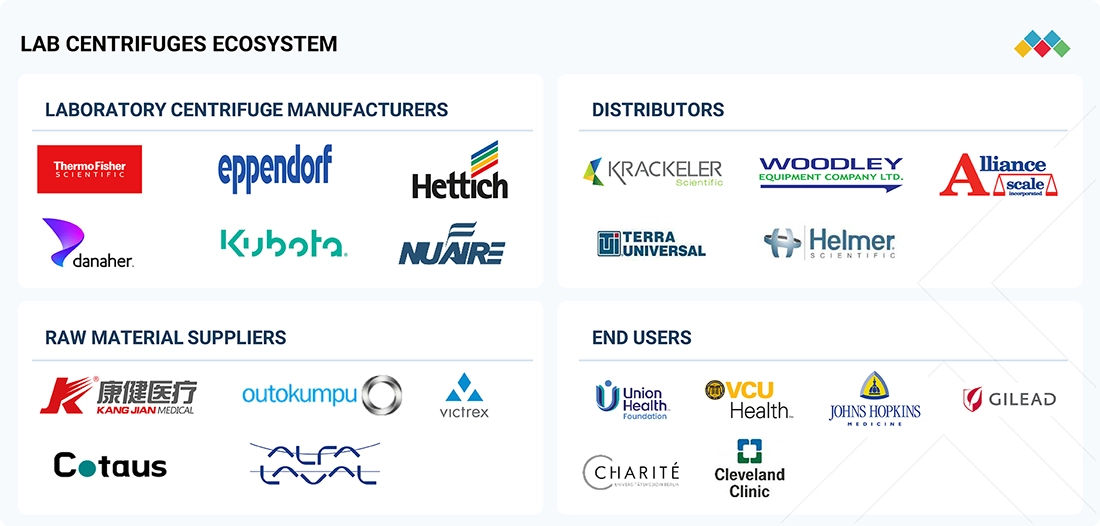
Laboratory Centrifuges Market: COMMERCIAL USE CASES ACROSS INDUSTRIES
| COMPANY | USE CASE DESCRIPTION | BENEFITS |
|---|---|---|
 |
Launch of Cryofuge refrigerated floor models and benchtop centrifuges for precision medicine labs and diagnostic hospitals, optimized for automation and integration in high-throughput clinical settings | Reliable precision for large-volume sample separation in clinical diagnostics and personalized medicine; energy-efficient cooling for sensitive samples; improved workflow efficiency and reduced downtime due to advanced automation and integrated controls |
 |
OptiMATE Gradient Maker and Biomek acoustic liquid handling system for molecular biology, genomics, and proteomics research, helping labs automate density gradient preparation and high-throughput nucleic acid extractions | Drastic reduction in prep time (up to 75%), superior reproducibility in molecular assays, streamlined NGS/sample processing workflows, and integration with data management platforms for error reduction and enhanced research productivity |
 |
Centrifuge 5427 R microcentrifuge with environmentally friendly hydrocarbon cooling, designed for sustainability and sensitive molecular and cell biology workflows (DNA/RNA, protein extraction) in academic and pharmaceutical labs | Minimized ecological impact (near-zero GWP), robust cooling for precision sample integrity, and flexibility for a wide range of genomics and proteomics protocols, while supporting green laboratory initiatives |
 |
Modular benchtop and floor centrifuges adopted by biotechnology and hospital networks for blood separation, cell therapy, and research; partnership expansion in Asia and US for integrated bioprocessing and diagnostic laboratory systems | Fast, robust cell and blood separation, scalable for both small and large labs; international support and modular upgrades for regional and workflow-specific needs, enabling laboratories to respond quickly to evolving bioprocess and diagnostic volumes |
Logos and trademarks shown above are the property of their respective owners. Their use here is for informational and illustrative purposes only.
Related Ecosystem
Analytical And Scientific Instrumentation
- Environmental Testing
- Gas Chromatography
- Polymerase Chain Reaction (PCR)
- Automated Liquid Handling Systems
- Flow Cytometry
- Thermo Fisher Scientific Inc.
- Danaher Corporation
- Agilent Technologies, Inc.
- Merck KGaA
- Shimadzu Corporation
Key Takeaways
- Europe's laboratoray centrifuges market is valued at $95.31 million in 2025 with projected growth to $107.08 million by 2030.
- Europe experiences a moderate 2.0% CAGR, reflecting a mature and stable healthcare market with established laboratory infrastructure.
- Europe's market growth is supported by pharmaceutical research, biotechnology innovation, and modernization of diagnostic facilities.
- Europe's regulatory environment and quality standards drive consistent demand for advanced laboratoray centrifuge technologies.
Laboratoray Centrifuges Market Report Scope
| Report Metric | Details |
|---|---|
| Base Year | 2025 |
| Fastest Growing Segment | AUTOMATED CENTRIFUGES (Type) |
| Forecast Period | 2025–2030 |
| Growth Rate | CAGR of 2.8% from 2025 to 2030 |
| Largest Segment | EQUIPMENT (Product) |
| Market Size Base Year (Billions) | ~USD 1.62 (2025) |
| Revenue Forecast (Billions) | ~USD 1.86 (2030) |
| Segments Covered | Product, Type, Platform Type, Rotor Type, Usage Type, Application, End User |
Europe Laboratoray Centrifuges Market Report Segmentation
7 segment dimensions are covered across the global market.
By Product
- Accessories
- Equipment
By Type
- Automated Centrifuges
- Centrifuge Bottles
- Centrifuge Buckets
- Centrifuge Plates
- Microcentrifuges
- Minicentrifuges
- Multi-Purpose Centrifuges
- Other Accessories
- Other Centrifuges
- Rotors
- Tubes
- Ultracentrifuges
By Platform Type
- Benchtop Centrifuges
- Floor-Standing Centrifuges
By Rotor Type
- Fixed-Angle Rotors
- Other Rotors
- Swinging-Bucket Rotors
- Vertical Rotors
By Usage Type
- Clinical Centrifuges
- General-Purpose Centrifuges
- Other Usage Types
- Preclinical Centrifuges
By Application
- Blood Component Separation
- Cellomics
- Diagnostics
- Genomics
- Microbiology
- Other Applications
- Proteomics
By End User
- Academic & Research Institutes
- Biotechnology & Pharmaceutical Companies
- Hospitals
- Other End Users
EUROPE: LABORATORY CENTRIFUGES MARKET, BY END USER, 2024–2031
| Segment | 2024 | 2025 | 2026 | 2027 | 2028 | 2029 | 2030 | 2031 | CAGR (%) |
|---|---|---|---|---|---|---|---|---|---|
| ACADEMIC & RESEARCH INSTITUTES | 70.76 | 71.64 | 72.75 | 74.24 | 75.89 | 77.81 | 79.93 | 82.27 | 2.3 |
| BIOTECHNOLOGY & PHARMACEUTICAL COMPANIES | 140.51 | 142.69 | 145.34 | 148.76 | 152.56 | 156.91 | 161.7 | 166.96 | 2.7 |
| HOSPITALS | 180 | 182.55 | 185.7 | 189.82 | 194.43 | 199.73 | 205.57 | 212.01 | 2.5 |
| OTHER END USERS | 18.97 | 18.89 | 18.86 | 18.9 | 18.98 | 19.1 | 19.25 | 19.42 | 0.5 |
| TOTAL | 410.24 | 415.78 | 422.64 | 431.72 | 441.85 | 453.55 | 466.45 | 480.66 | 2.4 |
Target Audience
- Medical Device Manufacturers : Manufacturers need detailed European market data to optimize product portfolios, identify regional demand patterns, and develop localized go-to-market strategies for centrifuge equipment.
- Healthcare Facility Operators : Hospital networks, diagnostic centers, and research institutions require market intelligence to benchmark equipment investments, evaluate supplier options, and plan laboratory modernization initiatives.
- Investment & Private Equity Firms : Investors evaluating opportunities in European healthcare and laboratory equipment sectors need comprehensive market sizing, growth forecasts, and competitive analysis for due diligence.
- Distributors & Suppliers : Laboratory equipment distributors and suppliers need country-specific market data to allocate inventory, identify growth markets, and develop targeted sales strategies across Europe.
- Research & Academic Institutions : Universities and research organizations require market insights to understand equipment availability, pricing trends, and procurement benchmarks for laboratory centrifuge acquisitions.
Key Companies in the Europe Laboratoray Centrifuges Market
| Company | HQ | Ownership | Strongest segments |
|---|---|---|---|
| GEA GROUP | United States | Public Company | Equipment – Microcentrifuge,Equipment – Ultracentrifuge,Accessories – Tubes, |
| BECKMAN COULTER | United States | Private Company | Equipment – Microcentrifuge,Equipment – Ultracentrifuge,Equipment – Other Clinical Benchtop Centrifuges, |
| FLUOR CORPORATION | United States | Public Company | Centrifuge Equipment (Microcentrifuge, Ultracentrifuge) – EPC integration and facility design,Centrifuge Accessories (Tube, Plate) – logistics and lab fit-out services,Benchtop Platform – clinical diagnostics labs in hospitals, |
| THERMO FISHER SCIENTIFIC INC. | United States | Public Company | Equipment – Microcentrifuge,Equipment – Ultracentrifuge,Accessories – Tubes, |
| DANAHER | United States | Public Company | Equipment – Benchtop Microcentrifuges (Clinical Diagnostics in Hospitals),Equipment – Benchtop Ultracentrifuges (Clinical/Advanced Diagnostics in Hospitals),Accessories – Tubes, |
| EPPENDORF | Germany | Private Company | Equipment – Microcentrifuge,Equipment – Ultracentrifuge,Accessories – Tubes, |
| QIAGEN N.V. | Netherlands | Public Company | Equipment – Microcentrifuge (Benchtop, Clinical Diagnostics, Hospitals),Equipment – Ultracentrifuge,Accessories – Tubes, |
| SARTORIUS AG | United States | Public Company | Equipment - Microcentrifuge,Equipment - Ultracentrifuge,Accessories - Tubes, |
| BIO-RAD | United States | Public Company | Equipment – Microcentrifuge,Equipment – Ultracentrifuge,Accessories – Tubes, |
| AGILENT TECHNOLOGIES, INC. | United States | Public Company | Equipment – Microcentrifuge (Benchtop, clinical diagnostics use in hospitals),Equipment – Ultracentrifuge (specialized clinical and translational diagnostics workflows),Accessories – Tubes, |
| HAIER BIOMEDICAL | China | Public Company | Benchtop clinical centrifuge equipment (swinging-bucket, diagnostics, hospitals),Microcentrifuges and ultracentrifuges (equipment),Centrifuge accessories (tubes, plates, rotors, consumables), |
GEA GROUP
GEA GROUP is a publicly traded German-American industrial equipment manufacturer founded in 1881 with 19,670 employees. The company specializes in process technology and components for various industries including food, beverage, and pharmaceuticals.
BECKMAN COULTER
Beckman Coulter is a privately held United States company founded in 1935 with 11,900 employees. The company manufactures and distributes life science and diagnostic instruments and reagents.
FLUOR CORPORATION
Fluor Corporation is a publicly traded engineering and construction company founded in 1912 with 22,995 employees. The company provides services across energy, chemicals, infrastructure, and government sectors.
THERMO FISHER SCIENTIFIC INC.
Thermo Fisher Scientific Inc. is a publicly traded life sciences company founded in 1956 with 125,000 employees. The company provides laboratory equipment, reagents, software, and services for research, diagnostics, and bioproduction.
DANAHER
Danaher is a publicly traded diversified conglomerate founded in 1969 with 59,000 employees. The company operates across life sciences, diagnostics, environmental and applied solutions, and product identification segments.
EPPENDORF
Eppendorf is a privately held German laboratory equipment manufacturer founded in 1945 with 4,358 employees. The company produces centrifuges, pipettes, and other instruments for life science research and diagnostics.
QIAGEN N.V.
QIAGEN N.V. is a publicly traded Dutch molecular diagnostics company founded in 1984 with 5,500 employees. The company develops and manufactures sample preparation and molecular testing technologies.
SARTORIUS AG
Sartorius AG is a publicly traded German life sciences company founded in 1870 with 14,242 employees. The company provides laboratory and bioprocess equipment, including centrifuges and filtration systems.
BIO-RAD
Bio-Rad is a publicly traded life sciences company founded in 1952 with 7,450 employees. The company manufactures and distributes reagents, instruments, and software for research and diagnostics.
AGILENT TECHNOLOGIES, INC.
Agilent Technologies, Inc. is a publicly traded United States company founded in 1999 with 18,000 employees. The company provides analytical instruments, software, and services for life sciences, diagnostics, and applied markets.
HAIER BIOMEDICAL
Haier Biomedical is a publicly traded Chinese company founded in 2005 with 2,945 employees. The company manufactures biomedical refrigeration and laboratory equipment.
Countries within Europe - compare and drill down
| Country | 2025 size (native) |
|---|---|
| Germany | USD 156.9 Million |
| UK | USD 133.8 Million |
| France | USD 74.7 Million |
| Italy | USD 46.3 Million |
| Spain | USD 38.5 Million |
| Rest Of Europe | USD 30.4 Million |
Country market size visualization
Reasons to Buy this Report
- Country-Level Market Insights : Gain detailed market sizing and growth projections for major European markets including Germany ($156.9M), UK ($133.8M), France ($74.7M), Italy, and Spain with specific CAGR data.
- Competitive Landscape Analysis : Understand market dynamics across Europe's mature laboratory centrifuges sector, including key players, market consolidation trends, and regional competitive positioning strategies.
- Regulatory & Healthcare Framework : Access insights into European healthcare regulations, CE marking requirements, and how different national healthcare systems impact laboratory equipment procurement and adoption rates.
- Growth Opportunity Identification : Identify high-potential segments within Europe's market, including emerging applications in research, diagnostics, and clinical laboratories, plus underserved regional markets.
- Strategic Planning & Forecasting : Leverage 5-year forecasts and trend analysis to inform product development, market entry strategies, and investment decisions specific to European laboratory centrifuge segments.
Frequently asked questions
What is the current size of Europe's laboratoray centrifuges market?
Europe's laboratoray centrifuges market is valued at $95.31 million in 2025, representing a mature segment within the broader European healthcare equipment industry.
What is the projected market size for Europe's laboratoray centrifuges by 2030?
Europe's laboratoray centrifuges market is forecast to reach $107.08 million by 2030, reflecting steady expansion over the five-year period.
What is the CAGR for Europe's laboratoray centrifuges market?
Europe's laboratoray centrifuges market is expected to grow at a compound annual growth rate of 2.0% from 2025 to 2030.
What factors drive growth in Europe's laboratoray centrifuges market?
Europe's market growth is driven by modernization of laboratory facilities, pharmaceutical research expansion, biotechnology innovation, and compliance with stringent regulatory standards.
Why does Europe's laboratoray centrifuges market grow slower than the global average?
Europe's 2.0% CAGR reflects a mature, saturated market with established laboratory infrastructure, whereas emerging regions experience higher growth rates from initial market development.
RESEARCH METHODOLOGY
The study involved four main activities to determine the current size of the laboratory centrifuges market. Comprehensive secondary research was conducted to gather information on the market and its various subsegments. The next step was to confirm these findings, assumptions, and size estimates with industry experts across the value chain through primary research. Both top-down and bottom-up approaches were used to calculate the global market size. Afterwards, market segmentation and data triangulation methods were applied to estimate the size of segments and subsegments.
Secondary Research
Secondary research sources included directories, Factiva, white papers, Bloomberg Business, annual reports, SEC filings, business filings, and investor presentations. These sources offered valuable insights into market leaders, sector divisions, and technological differences within various segments of the laboratory centrifuges market.
Primary Research
Several stakeholders, including manufacturers of laboratory centrifuge products, vendors, distributors, and technologists from hospitals and clinics, were consulted for this report. The demand side of this market is characterized by increasing R&D investments and research grants, technological advancements and innovative rotor designs, the rising prevalence of infectious diseases leading to higher volumes of sample testing and cell-based research in laboratory centrifuges, and expanding applications of laboratory centrifuges. Various primary sources from both the supply and demand sides of the market were interviewed to gather qualitative and quantitative information.
A breakdown of the primary respondents is provided below.
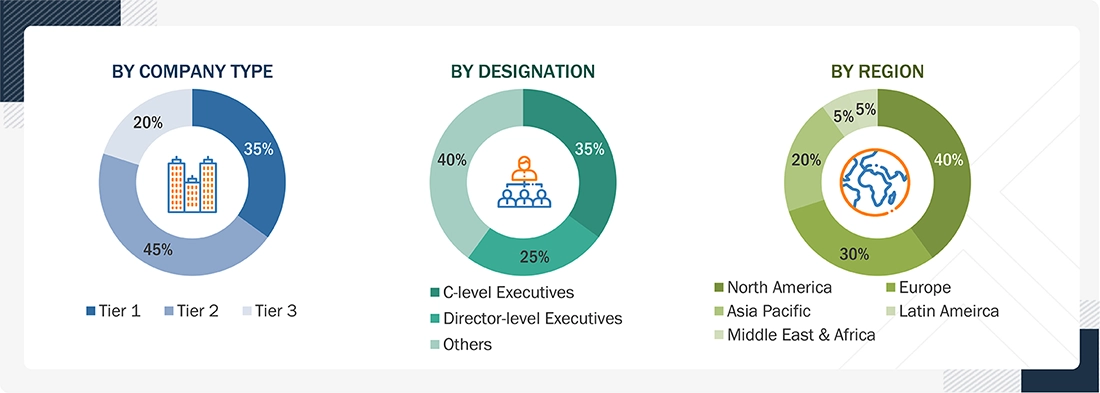
Note q: Others include sales managers, marketing managers, business development managers, product managers, distributors, and suppliers.
Note 2: Companies are classified into tiers based on their total revenue. As of 2024, Tier 1 = >USD 1 billion, Tier 2 = < USD 500 million, and Tier 3 = < USD 100 million.
To know about the assumptions considered for the study, download the pdf brochure
Market Size Estimation
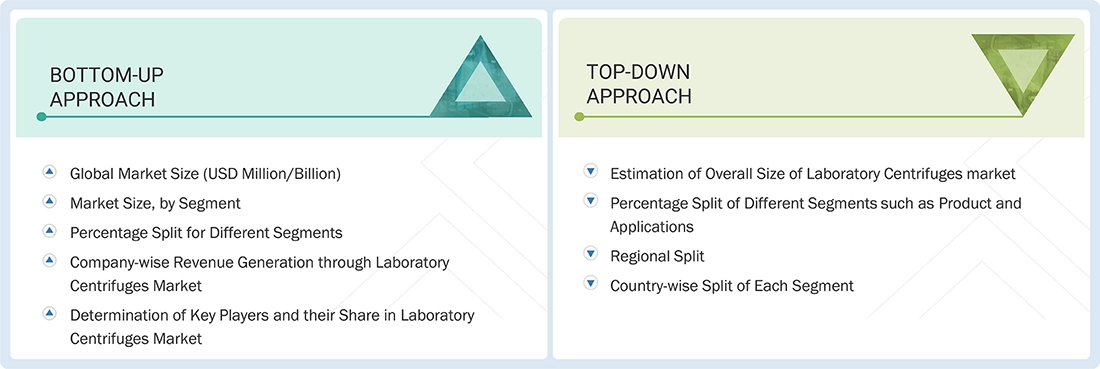
Both top-down and bottom-up approaches were used to estimate and validate the total size of the laboratory centrifuges market. These methods were also used extensively to estimate the size of various subsegments in the market. The research methodology used to estimate the market size includes the following:
- The key players in the industry and markets have been identified through extensive secondary research.
- The industry’s supply chain and market size, in terms of value, have been determined through primary and secondary research processes.
- All percentage shares, splits, and breakdowns have been determined using secondary sources and verified through primary sources.
This report utilized the revenue share analysis of major companies to evaluate the size of the global laboratory centrifuges market. This analysis involved identifying key market participants and calculating their revenue from laboratory centrifuges using a variety of data.
Global Laboratory Centrifuges Market: Bottom-up and Top-down Approach
Data Triangulation
To ensure precise data, the laboratory centrifuges market was segmented into various parts and subparts. A data triangulation method using both top-down and bottom-up approaches was employed. This involved examining factors and trends from both the demand and supply sides to confirm the findings for each segment. Combining this segmentation with the triangulation method helps make sure that the market data is both accurate and trustworthy.
Market Definition
A laboratory centrifuge is a motor-powered device used in labs to quickly spin liquid samples, applying centrifugal force to separate components based on their density. Its primary purpose is to speed up the sedimentation of suspended particles—such as cells, blood components, organelles, or macromolecules—inside a tube or container. Laboratory centrifuges are essential in diagnostics, biomedical research, pharmaceutical development, and industrial labs, allowing efficient separation, purification, and preparation of biological and chemical samples for further analysis or processing.
Stakeholders
- Suppliers and distributors of laboratory equipment
- Hospitals and clinical laboratories
- Biotechnology and pharmaceutical companies
- Academic and research institutions
- Regulatory and standards agencies
- Contract research organizations (CROs)
- End users such as laboratory technicians, clinicians, and researchers
- Manufacturers of laboratory centrifuges
Report Objectives
- To define, describe, and forecast the laboratory centrifuges market based on product, platform type, rotor design, application. intended use, end user, and region
- To provide detailed information regarding the major factors influencing the growth of the market (drivers, restraints, opportunities, and industry-specific challenges)
- To strategically analyze micromarkets with respect to individual growth trends, prospects, and contributions to the total market
- To analyze opportunities in the market for stakeholders and provide details of the competitive landscape for market leaders
- To forecast the revenue of market segments with respect to five regions: North America, Europe, the Asia Pacific, Latin America, and the Middle East & Africa
- To profile key players and comprehensively analyze their market ranking and core competencies
- To benchmark players within the market using a proprietary Company Evaluation Matrix framework, which analyzes market players on various parameters within the broad categories of business strategy excellence and strength of product portfolio
- To analyze competitive developments such as product launches, agreements, expansions, collaborations, and acquisitions in the laboratory centrifuges market
Get the Full Laboratoray Centrifuges Market Report
Full forecast, segment splits, and company analysis for all Laboratoray Centrifuges Market.
- US Laboratoray Centrifuges Market
- Canada Laboratoray Centrifuges Market
- Germany Laboratoray Centrifuges Market
- UK Laboratoray Centrifuges Market
- France Laboratoray Centrifuges Market
- Italy Laboratoray Centrifuges Market
- Spain Laboratoray Centrifuges Market
- China Laboratoray Centrifuges Market
- Japan Laboratoray Centrifuges Market
- India Laboratoray Centrifuges Market
- South Korea Laboratoray Centrifuges Market
- Australia Laboratoray Centrifuges Market
- Brazil Laboratoray Centrifuges Market
- Mexico Laboratoray Centrifuges Market
- Rest Of Europe Laboratoray Centrifuges Market
- Rest Of Asia Pacific Laboratoray Centrifuges Market
- Rest Of Latin America Laboratoray Centrifuges Market
- GCC Countries Laboratoray Centrifuges Market
Need a Tailored Report?
Customize this report to your needs
Get 10% FREE Customization
Customize This Report
