
Brazil Laminated Busbar Market (2023-2028)

The Brazil Laminated Busbar Market was valued at $28.7 Million in 2023 and projected to reach to $40 Million by 2028, representing a compound annual growth rate of 4.8%. Brazil's laminated busbar market is positioned for steady expansion driven by the country's commitment to modernizing electrical infrastructure and integrating renewable energy sources.


| Market Size in | USD 26.32 MN |
| Market Forecast in | |
| CAGR | |
| Forecast Period | |
| Units Considered | Value (USD MN) |
Brazil Laminated Busbar Market Trends and Insights
- Brazil's market expansion is driven by increasing demand for efficient power distribution solutions in industrial and renewable energy sectors.
- The country's growing focus on electrical infrastructure modernization and renewable energy integration supports steady adoption of laminated busbar technology across manufacturing and utility applications in Brazil..
Key Market Statistics
- CAGR (2023-2028) 4.8% CAGR
- Market Size, 2023 ~USD 28.7 Million
- Forecast, 2028 ~USD 40 Million
- Country Brazil
Brazil Laminated Busbar Market Overview
Market Valuation :
Brazil's laminated busbar market reached USD 28.7 million in 2023, with projections to expand to USD 40.0 million by 2028, reflecting steady growth in the region's power infrastructure sector.
Industrial Modernization Driver :
Increasing investments in electrical infrastructure modernization across Brazilian industrial facilities are accelerating adoption of laminated busbar solutions for improved power distribution efficiency.
Renewable Energy Integration :
Brazil's expanding renewable energy sector, particularly hydroelectric and wind power projects, is creating significant demand for advanced busbar systems to support grid modernization and energy distribution.
Growth Trajectory :
With a CAGR of 4.8% through 2028, Brazil's market demonstrates consistent growth potential, outpacing some regional peers while remaining below the global average of 6% CAGR.
Brazil Laminated Busbar Market Dynamics
- Industrial sectors are increasingly adopting laminated busbar solutions to enhance power distribution efficiency and reduce operational costs.
- The market benefits from Brazil's strategic investments in grid upgrades and the growing electrification of manufacturing facilities. Looking ahead, the forecast period through 2028 presents opportunities for market participants to capitalize on infrastructure development projects and renewable energy integration initiatives.
- Government policies supporting energy efficiency and industrial modernization will continue to support market growth, though the 4.8% CAGR suggests a measured expansion compared to global trends, reflecting Brazil's unique market dynamics and competitive landscape..
Market Ecosystem
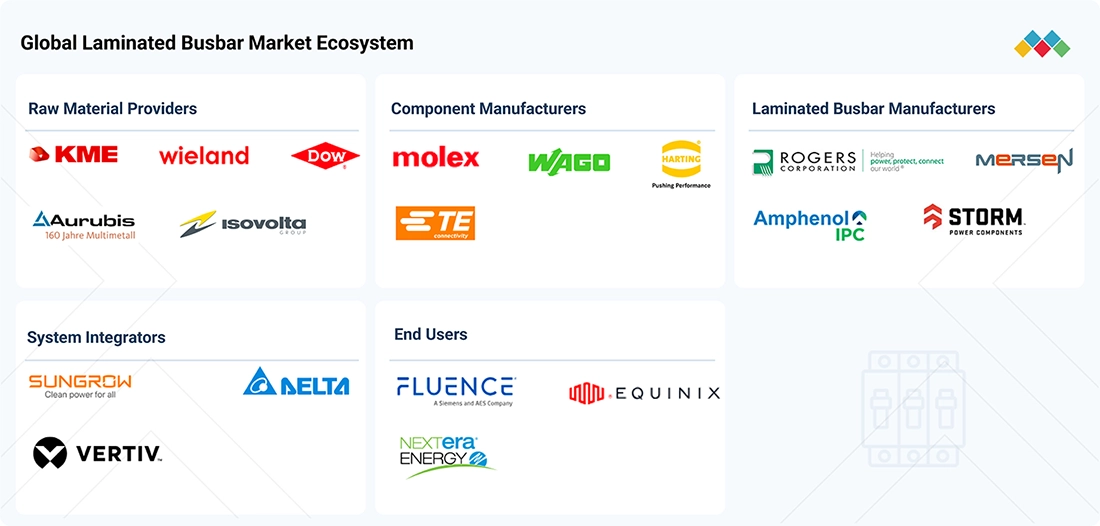
LAMINATED BUSBAR MARKET SIZE, SHARE, GROWTH, ANALYSIS: COMMERCIAL USE CASES ACROSS INDUSTRIES
| COMPANY | USE CASE DESCRIPTION | BENEFITS |
|---|---|---|
 |
Rogers' ROLINX laminated busbars are used in the DC-link and power-distribution circuitry of high-power EV charging stations, transferring electricity from the power source to the vehicle charging circuit. | Supports high-voltage and high-current operation, while reducing inductance and power losses, minimizing heat generation, and enabling higher power density for fast-charging systems |
 |
Mersen uses laminated busbars in photovoltaic inverter applications to interconnect diodes, power semiconductor modules such as IGBT, SiC or GaN devices, and capacitors within the power-conversion system. | Provides low-inductance interconnection, improves electrical performance and system reliability, while simplifying the integration of multiple power-electronic components into a single assembly |
 |
Storm Power develops laminated busbars for high-current power distribution in data centers and server farms, where power electronics and high-density computing equipment require efficient and reliable electrical interconnections. The company specifically highlights laminated busbars for applications involving hundreds of amps per rack. | Reduces inductance and heat generation, improves power-distribution efficiency and reliability, and supports high-current, high-density electrical architectures |
Logos and trademarks shown above are the property of their respective owners. Their use here is for informational and illustrative purposes only.
Related Ecosystem
Decarbonization
- Battery Electric Vehicle (BEV)
- Energy Management Systems
- Fuel Cell
- Fuel Cell Electric Vehicle (FCEV)
- Geographical Information System (GIS)
- TotalEnergies SE
- Siemens ag
- Mitsui & Co., Ltd.
- General Electric Company
- Thyssenkrupp ag
Power Infrastructure
- Geographical Information System (GIS)
- Cogeneration
- Battery Electric Vehicle (BEV)
- Cellular Network
- Fuel Cell
- ABB India Limited
- Siemens ag
- SCHNEIDER ELECTRIC SE
- General Electric Company
- Eaton Corporation plc
Key Takeaways
- Brazil's laminated busbar market reached USD 28.7 million in 2023 with a projected value of USD 40.0 million by 2028.
- Brazil is experiencing a 4.8% CAGR, reflecting moderate but consistent growth in power distribution infrastructure.
- Industrial modernization and renewable energy expansion are primary growth catalysts for laminated busbar adoption in Brazil.
- Brazil's market growth is supported by increasing investments in electrical grid efficiency and manufacturing sector development.
Laminated Busbar Market Report Scope
| Report Metric | Details |
|---|---|
| Base Year | 2023 |
| Fastest Growing Segment | PVF FILM (Insulation Material) |
| Forecast Period | 2023-2028 |
| Growth Rate | CAGR of 6% from 2023 to 2028 |
| Largest Segment | COPPER (Material) |
| Market Size Base Year (Billions) | ~USD 0.86 (2023) |
| Revenue Forecast (Billions) | ~USD 1.15 (2028) |
| Segments Covered | Material, Insulation Material, End User |
Brazil Laminated Busbar Market Report Segmentation
3 segment dimensions are covered across the global market.
By Material
- Aluminum
- Copper
By Insulation Material
- Epoxy Powder Coating
- Heat-Resistant Fiber
- Polyester Film
- Polyester Resin
- Polyimide Film
- Pvf Film
By End User
- Commercial
- Industrial
- Residential
- Utilities
BRAZIL: LAMINATED BUSBAR MARKET, BY END USER, 2023–2030
| Segment | 2023 | 2024 | 2025 | 2026 | 2027 | 2028 | 2029 | 2030 | CAGR (%) |
|---|---|---|---|---|---|---|---|---|---|
| COMMERCIAL | 4.4 | 4.6 | 4.7 | 4.9 | 5.2 | 5.5 | 5.8 | 6.2 | 4.9 |
| INDUSTRIAL | 8.9 | 9.2 | 9.5 | 9.9 | 10.4 | 10.9 | 11.6 | 12.4 | 4.7 |
| RESIDENTIAL | 4.9 | 5.1 | 5.2 | 5.4 | 5.7 | 6 | 6.3 | 6.7 | 4.6 |
| UTILITIES | 10.4 | 10.8 | 11.2 | 11.7 | 12.2 | 12.9 | 13.8 | 14.7 | 5.1 |
| TOTAL | 28.7 | 29.6 | 30.7 | 31.9 | 33.5 | 35.3 | 37.5 | 40 | 4.8 |
Target Audience
- Electrical Equipment Manufacturers : Manufacturers need Brazil-specific market data to assess production capacity requirements, localization strategies, and competitive positioning in South America's largest industrial market.
- Power Distribution Companies : Utility operators and distribution companies require detailed market insights to plan infrastructure upgrades, evaluate busbar technology investments, and optimize grid modernization budgets.
- Industrial Facility Operators : Manufacturing and processing facilities need market intelligence to justify capital expenditures on laminated busbar systems and understand ROI potential for power distribution upgrades.
- Investment & Strategy Consultants : Business consultants and investment advisors require Brazil market data to support client recommendations, feasibility studies, and strategic planning in the energy infrastructure sector.
- Renewable Energy Project Developers : Solar, wind, and hydroelectric project developers need market insights to understand grid integration requirements and busbar technology specifications for Brazilian renewable energy installations.
Reasons to Buy this Report
- Market-Specific Sizing Data : Access precise valuation figures for Brazil's laminated busbar market with historical baseline (2023: USD 28.7M) and verified forecasts through 2028, enabling accurate business planning and investment decisions.
- Regional Growth Insights : Understand Brazil's unique 4.8% CAGR trajectory and how it compares to global trends, identifying market maturity levels and growth acceleration opportunities specific to the Brazilian economy.
- Sector-Specific Drivers : Gain detailed intelligence on industrial modernization and renewable energy integration trends driving demand in Brazil, allowing targeted product development and market entry strategies.
- Infrastructure Investment Tracking : Monitor Brazil's electrical infrastructure modernization initiatives and grid upgrade projects that directly influence laminated busbar adoption rates and market expansion potential.
- Competitive Positioning : Leverage Brazil-focused market analysis to benchmark competitive positioning, identify white space opportunities, and develop localized go-to-market strategies for the Brazilian energy sector.
Frequently asked questions
What is the current size of Brazil's laminated busbar market?
Brazil's laminated busbar market was valued at USD 28.7 million in 2023.
What is the projected market size for Brazil by 2028?
Brazil's laminated busbar market is forecast to reach USD 40.0 million by 2028.
What is the CAGR for Brazil's laminated busbar market?
Brazil's laminated busbar market is expected to grow at a CAGR of 4.8% from 2023 to 2028.
What are the main drivers of growth in Brazil's laminated busbar market?
Key drivers include industrial modernization, renewable energy integration, electrical infrastructure upgrades, and increased manufacturing activity in Brazil.
Which industries are driving demand for laminated busbars in Brazil?
Primary demand comes from renewable energy, industrial manufacturing, power distribution utilities, and electrical equipment manufacturers operating in Brazil.
RESEARCH METHODOLOGY
The research process for this technical, market-oriented, and commercial study of the global laminated busbar market included systematic gathering, recording, and analysis of data about companies operating in the market. It involved the extensive use of secondary sources, directories, and databases (Factiva, OANDA) to identify and collect relevant information. In-depth interviews were conducted with various primary respondents, including experts from core and related industries and preferred manufacturers, to obtain and verify critical qualitative and quantitative information, as well as to assess the growth prospects of the market. Key players in the global laminated busbar market were identified through secondary research, and their market rankings were determined through primary and secondary research. This included studying annual reports of top players and interviewing key industry experts, such as CEOs, directors, and marketing executives.
Secondary Research
In the secondary research process, various secondary sources were referred to for identifying and collecting information relevant to this study. Secondary sources include annual reports, press releases, and investor presentations of companies; white papers, certified publications, and articles from recognized authors; directories; and databases. Secondary research was mainly conducted to obtain key information about the supply of the industry; a total pool of key players; segmentation of the market according to industry trends, geographic markets, and key developments from market- and technology-oriented perspectives.
Primary Research
During the primary research phase, various key sources from the demand side and supply side have been interviewed to gather qualitative and quantitative data for this report. Throughout the comprehensive market engineering process, a combination of top-down and bottom-up approaches, along with multiple data triangulation methods, has been extensively employed to estimate market sizes and forecast all segments and subsegments outlined in this report. Extensive qualitative and quantitative analyses have been undertaken to ensure the integrity of the market engineering process, providing key insights throughout the report. Following completion of the market engineering process, which involved calculations of market statistics, breakdowns, size estimates, forecasts, and data triangulation, thorough primary research has been conducted to gather, verify, and validate critical data points. Primary research has also been conducted to identify market segments, industry trends, and the competitive landscape in the global laminated busbar market.
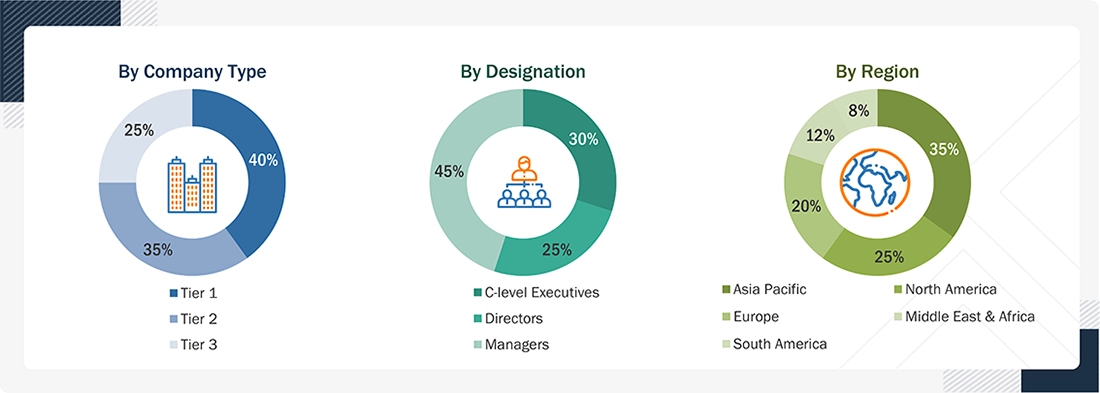
Notes: Managers include sales managers, production managers, and regional managers.
Tier 1 company: revenue >USD 5 billion; tier 2 company: revenue between USD 1 and USD 5 billion; and tier 3 company: revenue <USD 1 billion in 2025.
To know about the assumptions considered for the study, download the pdf brochure
Market Size Estimation
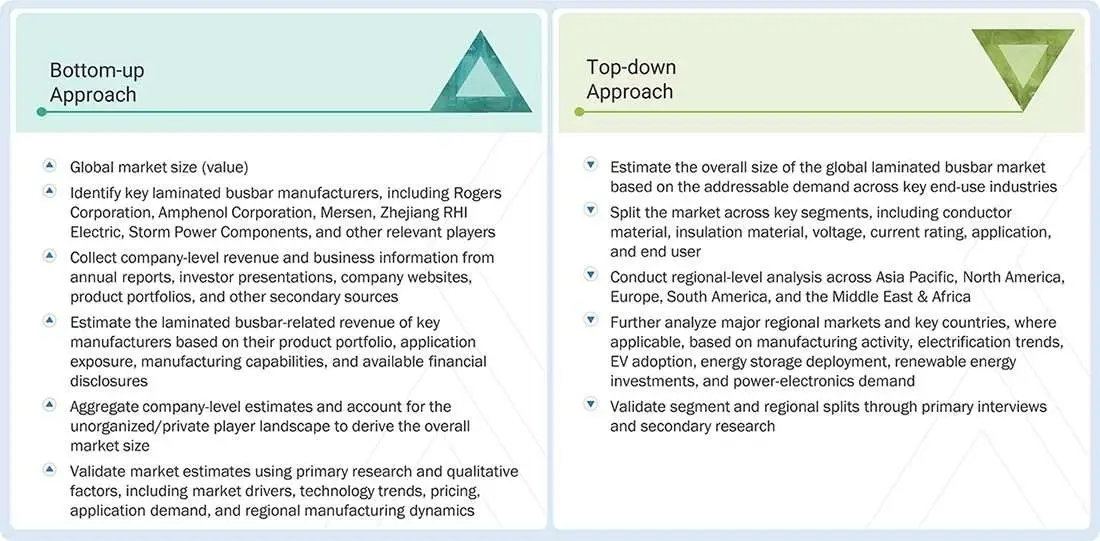
The estimation and validation of the global laminated busbar market size have been conducted using a bottom-up approach and a top-down approach. These approaches were rigorously employed to ascertain the dimensions of multiple subsegments within the market. The research process comprises the following key stages.
Bottom-up Approach
- Determining the overall value of the global laminated busbar market
- Mapping leading players in the industry, such as Amphenol Corporation, Rogers Corporation, Mersen Group, Methode Electronics, Inc., Zhuzhou CRRC Times Electric Co., Ltd., and Sun.King Technology Group Limited
- Gathering segment-specific revenue data for these companies from annual reports, investor presentations, and public disclosures
- Considering key qualitative inputs, including market drivers, restraints, opportunities, and challenges, into the forecasting process
Top-down Approach
- Assessing the total size of the global laminated busbar market
- Breaking this down by segment, covering conductor material, insulation material, voltage, current rating, application, and end-use industry categories
- Allocating market share across regions
- Further refining figures down to individual country-level estimates
Global Laminated Busbar Market Size: Bottom-up Approach and Top-down Approach
Data Triangulation
The process of determining the overall market size involved the methodologies described earlier, followed by segmenting the market into various segments and subsegments. To finalize the comprehensive market analysis and obtain precise statistics for each market segment and subsegment, data triangulation and market segmentation techniques were applied, as appropriate. Data triangulation was accomplished by examining various factors and trends from both the demand and supply perspectives within the ecosystem of the global laminated busbar market
Market Definition
The global laminated busbar market comprises the design, manufacture, and sale of laminated busbar systems used for electrical power distribution and interconnection in high-current and power-electronic applications. Laminated busbars consist of multiple conductive layers, typically copper or aluminum, separated by dielectric insulation materials and bonded into a compact assembly. They are designed to provide efficient current distribution, reduce inductance, optimize space utilization, and support improved thermal and electrical performance.
The market includes copper, aluminum, and copper-aluminum hybrid laminated busbars deployed across end-use industries such as utilities & grid infrastructure, electric mobility, renewable energy, energy storage, industrial, and data centers. These busbars are integrated into equipment, including battery systems, inverters, converters, power modules, industrial drives, charging systems, and other high-power electrical and electronic assemblies.
The global laminated busbar market represents the sum of revenues generated from the sales of laminated busbars across Asia Pacific, Europe, North America, South America, and the Middle East & Africa. Market revenues are derived from the sale of laminated busbar products supplied to various end-use industries across these regions. The market is supported by the increasing electrification of transportation and infrastructure, expansion of renewable energy and energy storage capacity, and the growing requirement for compact, reliable, and high-power-density electrical architectures.Key Stakeholders
- Laminated Busbar Manufacturers/Suppliers
- Conductor Material Suppliers (Copper & Aluminum)
- Insulation and Dielectric Material Suppliers
- Component and Power Electronics Manufacturers
- OEMs/Equipment Manufacturers
- Electric Vehicle Manufacturers
- EV Battery and Battery Pack Manufacturers
- Renewable Energy Equipment Manufacturers
- Energy Storage System Providers
- Utilities & Grid Infrastructure Companies
- Industrial Equipment Manufacturers
- Data Center Operators and Power Infrastructure Providers
- System Integrators
- Power Electronics and Converter Manufacturers
- Engineering, Procurement & Construction (EPC) Companies
- Electrical Contractors and Engineering Consultants
- Testing & Certification Organizations
- Standards & Regulatory Bodies
Report Objectives
- To describe, segment, and forecast the global laminated busbar market by conductor material, voltage, insulation material, application, current rating, and end-use industry, in terms of value
- To describe and forecast the global laminated busbar market, by region, in terms of volume
- To forecast the market size for five regions: Asia Pacific, Europe, North America, the Middle East & Africa, and South America, along with their key countries
- To provide detailed information about the key factors, such as drivers, restraints, opportunities, and challenges, influencing the growth of the market
- To describe the value chain and several government regulations contributing to the growth of the global laminated busbar market
- To provide value chain analysis, trends/disruptions impacting customer business, market maps, ecosystem analysis, sustainability and regulatory landscape, pricing analysis, patent analysis, case study analysis, technology analysis, key conferences and events, Porter’s five forces analysis, macroeconomic outlook, customer landscape & buyer behavior, regulatory analysis, and AI/Gen AI impact on the market
- To strategically analyze micromarkets with respect to individual growth trends, upcoming expansions, and their contribution to the overall market
- To analyze market opportunities for stakeholders and details of the competitive landscape for market leaders
- To strategically profile the key players and comprehensively analyze their market share and core competencies
- To analyze competitive developments in the global laminated busbar market, such as product launches, investments, agreements, acquisitions, partnerships, and expansions and contracts
Available customizations:
With the given market data, MarketsandMarkets offers customizations based on the company’s specific needs. The following customization options are available for the report:
PRODUCT ANALYSIS
- Product Matrix, which provides a detailed comparison of the product portfolio of each company
COMPANY INFORMATION
- Detailed analyses and profiling of additional market players (up to 5)
Get the Full Laminated Busbar Market Report
Full forecast, segment splits, and company analysis for all Laminated Busbar Market.
- US Laminated Busbar Market
- Canada Laminated Busbar Market
- Mexico Laminated Busbar Market
- UK Laminated Busbar Market
- Germany Laminated Busbar Market
- France Laminated Busbar Market
- Russia Laminated Busbar Market
- China Laminated Busbar Market
- Japan Laminated Busbar Market
- India Laminated Busbar Market
- South Korea Laminated Busbar Market
- Argentina Laminated Busbar Market
- Saudi Arabia Laminated Busbar Market
- UAE Laminated Busbar Market
- Qatar Laminated Busbar Market
- South Africa Laminated Busbar Market
- Rest Of Europe Laminated Busbar Market
- Rest Of Asia Pacific Laminated Busbar Market
- Rest Of South America Laminated Busbar Market
Need a Tailored Report?
Customize this report to your needs
Get 10% FREE Customization
Customize This Report
