
Japan Lateral Flow Assays Market (2025-2030)

The Japan Lateral Flow Assays Market was valued at $447.9 Million in 2025 and projected to reach to $687.1 Million by 2030, representing a compound annual growth rate of 8.9%. Japan's lateral flow assays market is positioned for sustained growth through 2030, driven by the country's aging population requiring frequent diagnostic testing and the government's emphasis on preventive healthcare.


| Market Size in | USD 26.32 MN |
| Market Forecast in | |
| CAGR | |
| Forecast Period | |
| Units Considered | Value (USD MN) |
Japan Lateral Flow Assays Market Trends and Insights
- Japan's advanced healthcare infrastructure, aging population, and strong demand for rapid diagnostic solutions are driving market expansion.
- The country's emphasis on point-of-care testing and home-based diagnostics aligns with global trends toward decentralized healthcare delivery. In Japan, lateral flow assays are increasingly adopted across clinical laboratories, hospitals, and retail pharmacies for infectious disease screening, pregnancy testing, and chronic disease management.
- Japan's regulatory environment and quality standards support the deployment of high-performance assay platforms.
- Between 2025 and 2030, Japan is expected to see accelerated adoption driven by technological innovation, rising healthcare expenditure, and growing consumer awareness of preventive diagnostics..
Key Market Statistics
- CAGR (2025-2030) 8.9% CAGR
- Market Size, 2025 ~USD 447.9 Million
- Forecast, 2030 ~USD 687.1 Million
- Country Japan
Japan Lateral Flow Assays Market Overview
Aging Population Driving Demand :
Japan's rapidly aging demographic, with over 29% of the population aged 65+, is significantly increasing demand for rapid diagnostic solutions and point-of-care testing in both clinical and home settings.
Advanced Healthcare Infrastructure :
Japan's world-class healthcare system and high adoption of medical technologies create a favorable environment for lateral flow assay integration across hospitals, clinics, and retail pharmacies.
Strong Home Diagnostics Adoption :
Japanese consumers show high preference for convenient, at-home diagnostic testing, supported by government initiatives promoting preventive healthcare and self-monitoring solutions.
Robust Market Growth Trajectory :
The Japan lateral flow assays market is expanding at 8.9% CAGR, outpacing the global growth rate of 8%, driven by innovation in rapid testing technologies and increased healthcare spending.
Japan Lateral Flow Assays Market Dynamics
- The market's expansion from USD 447.9 million in 2025 to USD 687.1 million by 2030 reflects strong demand for point-of-care testing solutions across clinical laboratories, pharmacies, and home healthcare settings.
- Japan's technological advancement and regulatory support for rapid diagnostics further accelerate market penetration.
- The shift toward decentralized testing and remote patient monitoring aligns with Japan's healthcare modernization strategy, ensuring continued market momentum..
Market Ecosystem
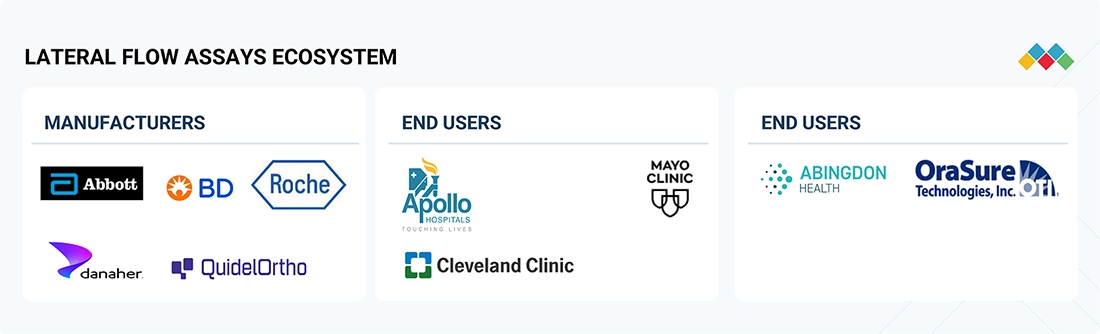
LATERAL FLOW ASSAYS MARKET: COMMERCIAL USE CASES ACROSS INDUSTRIES
| COMPANY | USE CASE DESCRIPTION | BENEFITS |
|---|---|---|
 |
The BinaxNOW and Panbio lateral flow assay platforms are used in hospitals, pharmacies, airports, and community testing centers for the rapid detection of infectious diseases such as influenza, malaria, HIV, and RSV. | These assays deliver accurate results within 15–20 minutes, enabling fast clinical decisions and reducing dependency on centralized laboratories. Their scalability supports mass-screening programs, and digital connectivity features allow seamless reporting and public health surveillance. |
 |
Roche’s rapid antigen and multimarker LFA tests, including Influenza A/B tests, are used in hospitals, urgent care centers, and corporate or community screening setups for rapid infectious disease identification. | These products offer high diagnostic accuracy validated across global healthcare networks, helping clinicians reduce misdiagnosis and streamline infection-control protocols. Their rapid turnaround enhances outbreak response and minimizes patient waiting times. |
 |
Cepheid collaborates on LFA-compatible workflows for decentralized infectious disease and respiratory testing in settings where molecular platforms are not feasible. | These solutions support hybrid testing pathways where LFAs provide quick initial screening followed by confirmatory molecular tests, improving diagnostic efficiency in low-resource or high-volume environments. |
 |
The BD Veritor Plus System is used in hospitals, clinics, pharmacies, schools, and occupational health centers for rapid antigen testing, including influenza A/B, RSV, and Group A Strep. | The system’s analyzer-based interpretation improves accuracy, minimizes user error, and provides connectivity for electronic medical record (EMR) integration and large-scale surveillance. |
 |
The Sofia Flu A+B and Strep A lateral flow assays are used across hospitals, urgent care centers, and physician offices with the Sofia Analyzer for rapid respiratory and infectious disease diagnostics. | Their fluorescent immunoassay technology provides higher sensitivity than traditional LFAs, while the analyzer automates result interpretation and supports rapid “test-and-treat” decision-making. |
Logos and trademarks shown above are the property of their respective owners. Their use here is for informational and illustrative purposes only.
Related Ecosystem
Key Takeaways
- Japan's lateral flow assays market is valued at USD 447.9 million in 2025 and will reach USD 687.1 million by 2030 at an 8.9% CAGR.
- Japan's aging demographic and advanced healthcare infrastructure create strong demand for rapid, accessible diagnostic solutions.
- Point-of-care testing adoption in Japan is accelerating due to regulatory support and consumer preference for home-based diagnostics.
- Japan's market growth is driven by technological innovation, rising healthcare spending, and increased focus on preventive medicine.
Lateral Flow Assays Market Report Scope
| Report Metric | Details |
|---|---|
| Base Year | 2025 |
| Fastest Growing Segment | SEXUALLY TRANSMITTED INFECTION TESTING (Disease Type) |
| Forecast Period | 2025–2030 |
| Growth Rate | CAGR of 8% from 2025 to 2030 |
| Largest Segment | KITS & REAGENTS (Product) |
| Market Size Base Year (Billions) | ~USD 8.52 (2025) |
| Revenue Forecast (Billions) | ~USD 12.52 (2030) |
| Segments Covered | Product, Application, Type, Disease Type, Technique |
Japan Lateral Flow Assays Market Report Segmentation
5 segment dimensions are covered across the global market.
By Product
- Kits & Reagents
- Readers
By Application
- Clinical Testing
- Drug Development & Quality Testing
- Food Safety & Environmental Testing
- Veterinary Diagnostics
By Type
- Bnp Or Nt-Probnp Testing
- Cardiac Marker Testing
- Chlamydia
- Cholesterol/Lipid Profile
- Ck-Mb Testing
- D-Dimer Testing
- Drugs Of Abuse Testing
- Fertility Testing
- Gonorrhea
- Hiv
- Hpv
- Infectious Disease Testing
- Myoglobin Testing
- Other Cardiac Marker Testing
- Other Clinical Tests
- Other Sexually Transmitted Diseases
- Pregnancy & Fertility Testing
- Pregnancy Testing
- Syphilis
- Troponin I & T Testing
By Disease Type
- Hepatitis
- Influenza
- Mosquito-Borne Diseases
- Other Infectious Diseases
- Sexually Transmitted Infection Testing
- Tuberculosis
By Technique
- Competitive Assays
- Multiplex Detection Assays
- Sandwich Assays
JAPAN: LATERAL FLOW ASSAYS MARKET, BY END USER, 2023–2030
| Segment | 2023 | 2024 | 2025 | 2026 | 2027 | 2028 | 2029 | 2030 | CAGR (%) |
|---|---|---|---|---|---|---|---|---|---|
| DIAGNOSTIC LABORATORIES | 111.8 | 121.7 | 132.5 | 144.7 | 158.4 | 173.7 | 190.8 | 209.8 | 9.6 |
| HOME CARE SETTINGS | 121.4 | 132.7 | 145.3 | 159.4 | 175.3 | 193.3 | 213.3 | 235.8 | 10.2 |
| HOSPITALS & CLINICS | 211.3 | 227.3 | 244.6 | 263.8 | 285.1 | 308.8 | 334.9 | 363.7 | 8.3 |
| OTHER END USERS | 11.8 | 12.6 | 13.4 | 14.4 | 15.4 | 16.6 | 17.9 | 19.3 | 7.5 |
| PHARMACEUTICAL & BIOTECHNOLOGY COMPANIES | 8 | 8.5 | 9.1 | 9.7 | 10.4 | 11.1 | 11.9 | 12.8 | 7.1 |
| TOTAL | 464.3 | 502.8 | 545 | 592 | 644.6 | 703.5 | 768.9 | 841.5 | 9.1 |
Target Audience
- In Vitro Diagnostics Manufacturers : IVD companies need Japan-specific market data to assess market opportunity, benchmark competitive positioning, and develop localized product strategies for the rapidly growing lateral flow assay segment.
- Healthcare System Operators : Hospital networks and clinic operators require market insights to evaluate rapid diagnostic adoption trends, procurement strategies, and technology investments aligned with Japan's point-of-care testing initiatives.
- Pharmaceutical & Biotech Companies : Pharma firms need Japan market intelligence to identify diagnostic partnerships, companion testing opportunities, and distribution channels for lateral flow assay-based solutions in this aging population.
- Medical Device Investors & PE Firms : Investment professionals require validated Japan market data, growth projections, and competitive analysis to evaluate acquisition targets and portfolio companies in the diagnostics sector.
- Healthcare Policy & Government Agencies : Japanese health authorities and policy makers need market research to inform healthcare infrastructure planning, reimbursement policies, and regulatory frameworks for rapid diagnostic technologies.
Reasons to Buy this Report
- Market Size & Growth Validation : Obtain precise market valuation for Japan (USD 447.9M in 2025) and verified 5-year forecast (USD 687.1M by 2030) to support investment decisions and business planning in this high-growth market.
- Competitive Landscape Intelligence : Understand Japan-specific market dynamics, key players, and competitive positioning to identify partnership opportunities and market entry strategies tailored to the Japanese healthcare ecosystem.
- Demographic & Regulatory Insights : Access Japan-specific analysis of aging population trends, healthcare policies, and regulatory frameworks that directly influence lateral flow assay adoption and market expansion.
- Segment & Application Analysis : Identify high-opportunity segments within Japan's market, including point-of-care testing, home diagnostics, and clinical applications, with detailed demand forecasts by use case.
- Strategic Market Entry Planning : Leverage Japan-focused market intelligence to develop localized go-to-market strategies, distribution channel optimization, and product positioning aligned with Japanese consumer preferences and healthcare standards.
Frequently asked questions
What is the current size of Japan's lateral flow assays market?
Japan's lateral flow assays market is valued at USD 447.9 million in 2025.
What is the projected market size for Japan by 2030?
Japan's lateral flow assays market is projected to reach USD 687.1 million by 2030.
What is the growth rate of Japan's lateral flow assays market?
Japan's lateral flow assays market is expected to grow at a compound annual growth rate of 8.9% from 2025 to 2030.
What are the primary applications of lateral flow assays in Japan?
In Japan, lateral flow assays are used for infectious disease screening, pregnancy testing, chronic disease management, and point-of-care diagnostics in hospitals, clinics, and retail pharmacies.
What factors are driving growth in Japan's lateral flow assays market?
Japan's market growth is driven by an aging population, advanced healthcare infrastructure, regulatory support for point-of-care testing, technological innovation, and increasing consumer demand for home-based diagnostics.
RESEARCH METHODOLOGY
The study involved major activities in estimating the current market size for the global lateral flow assays market.
Exhaustive secondary research was done to collect information on the lateral flow assays industry. The next step was to validate these findings, assumptions, and sizing with industry experts across the value chain using primary research. Different approaches, such as top-down and bottom-up, were employed to estimate the total market size. After that, the market breakup and data triangulation procedures were used to estimate the market size of the segments and subsegments of the lateral flow assays market.
The four steps involved in estimating the market size are:
Secondary Research
The secondary research process involves the widespread use of secondary sources, directories, databases, white papers, annual reports, investor presentations, SEC filings of companies and publications from government sources [such as US Food and Drug Administration, World Health Organization (WHO), Centers for Disease Control and Prevention, International Organization for Standardization (ISO), Agency for Healthcare Research and Quality, were referred to identify and collect information for the global lateral flow assays market study. It was also used to obtain important information about the key players and market classification & segmentation according to industry trends, to the bottom-most level, and key developments related to market and technology perspectives. A database of the key industry leaders was also prepared using secondary research.
Primary Research
In the primary research process, various sources from both the supply and demand sides were interviewed to obtain qualitative and quantitative information for this report. The primary sources from the supply side include industry experts such as CEOs, vice presidents, marketing and sales directors, technology & innovation directors, and related key executives from various key companies and organizations in the lateral flow assays market. The primary sources from the demand side include hospitals, clinics, diagnostic laboratories, pharmaceutical and biotechnology companies. Primary research was conducted to validate the market segmentation, identify key players, and gather insights on key industry trends & key market dynamics.
The following is a breakdown of the primary respondents:
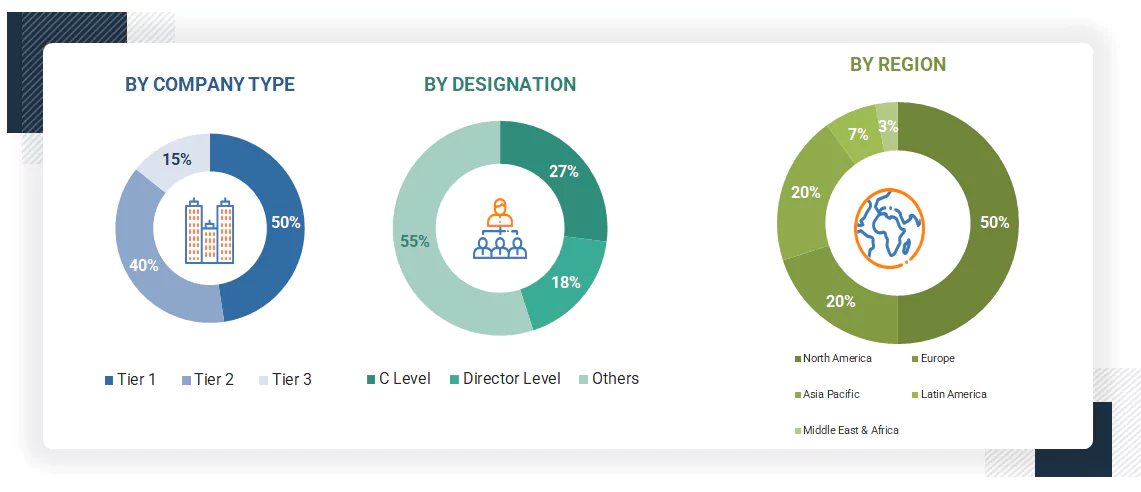
Note 1: Other designations include sales managers, marketing managers, and product managers.
Note 2: Companies are classified into tiers based on their total revenues. As of 2024, Tier 1 = >USD 100 million, Tier 2 = USD 10 million to USD 100 million, and Tier 3 = < USD 10 million.
To know about the assumptions considered for the study, download the pdf brochure
Market Size Estimation
For the global market value, annual revenues were calculated based on the revenue mapping of major product manufacturers and OEMs active in the global lateral flow assays market. All the major service providers were identified at the global and/or country/regional level. Revenue mapping for the respective business segments/sub-segments was done for the major players. The global lateral flow assays market was split into various segments and sub-segments based on:
- List of major players operating in the market at the regional and/or country level
- Product mapping of lateral flow assay providers at the regional and/or country level
- Mapping of annual revenue generated by listed major players from lateral flow assays (or the nearest reported business unit/product category)
- Extrapolation of the revenue mapping of the listed major players to derive the global market value of the respective segments/subsegments
- Summation of the market value of all segments/subsegments to arrive at the global lateral flow assays market
The above-mentioned data was consolidated and added with detailed inputs and analysis from MarketsandMarkets and presented in this report.
The research methodology used to estimate the market size includes the following:
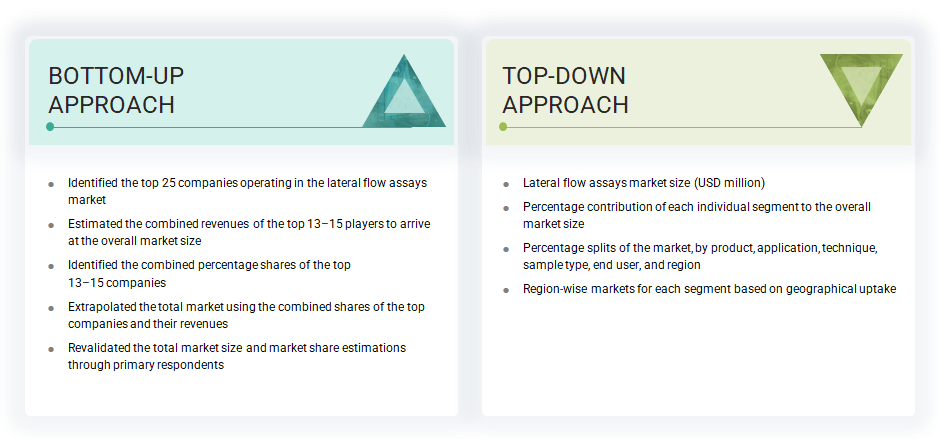
Data Triangulation
After arriving at the overall market size by applying the process mentioned above, the total market was split into several segments. To complete the overall market engineering process and arrive at the exact statistics for all segments and subsegments, data triangulation and market breakdown procedures were employed, wherever applicable. The data was triangulated by studying various factors and trends from both the demand and supply sides.
Market Definition
Lateral flow assays, or lateral flow immunochromatographic assays, are simple-to-use diagnostic devices to confirm the presence or absence of a target analyte, such as pathogens or biomarkers in humans or animals, or contaminants in water supplies, without requiring specialized equipment.
Stakeholders
- Lateral flow assay product manufacturers
- Lateral flow assay vendors and distributors
- Hospitals
- Clinical and diagnostic laboratories
- Pharmaceutical and biotechnological companies
- Venture capitalists and investors
Report Objectives
- To define, describe, analyze, and forecast the global lateral flow assays (LFA) market by product, application, technique, sample type, end user, and region
- To provide detailed information regarding the major factors influencing market growth (such as drivers, restraints, opportunities, and challenges)
- To analyze the micromarkets with respect to individual growth trends, prospects, and contributions to the overall lateral flow assays market
- To analyze market opportunities for stakeholders and provide details of the competitive landscape for key players
- To forecast the size of the market segments with respect to five regions: North America, Europe, the Asia Pacific, Latin America, the Middle East & Africa, and GCC Countries.
- To profile the key players and comprehensively analyze their product portfolios, market positions, and core competencies
- To benchmark players within the market using the proprietary Company Evaluation Matrix framework, which analyzes market players on various parameters within the broad categories of business and product excellence
- To study the impact of AI/Gen AI on the market, along with the macroeconomic outlook for each region
Get the Full Lateral Flow Assays Market Report
Full forecast, segment splits, and company analysis for all Lateral Flow Assays Market.
- Canada Lateral Flow Assays Market
- US Lateral Flow Assays Market
- Germany Lateral Flow Assays Market
- UK Lateral Flow Assays Market
- France Lateral Flow Assays Market
- Italy Lateral Flow Assays Market
- Spain Lateral Flow Assays Market
- China Lateral Flow Assays Market
- India Lateral Flow Assays Market
- Australia Lateral Flow Assays Market
- South Korea Lateral Flow Assays Market
- Brazil Lateral Flow Assays Market
- Mexico Lateral Flow Assays Market
- Argentina Lateral Flow Assays Market
Need a Tailored Report?
Customize this report to your needs
Get 10% FREE Customization
Customize This Report
