
Netherlands Layered Double Hydroxide Market (2025-2030)

The Netherlands Layered Double Hydroxide Market was valued at $5.3 Million in 2025 and projected to reach to $7.4 Million by 2030, representing a compound annual growth rate of 6.8%. The Netherlands LDH market is poised for steady growth, expanding from USD 5.3 million in 2025 to USD 7.4 million by 2030 at a CAGR of 6.8%.


| Market Size in | USD 26.32 MN |
| Market Forecast in | |
| CAGR | |
| Forecast Period | |
| Units Considered | Value (USD MN) |
Netherlands Layered Double Hydroxide Market Trends and Insights
- Netherlands serves as a strategic hub for specialty chemicals in Europe, with LDH applications spanning flame retardants, polymer additives, and pharmaceutical excipients.
- The market in Netherlands is driven by increasing demand from the polymer and construction sectors, alongside regulatory pressures favoring halogen-free flame retardants. During the 2025–2030 forecast period, Netherlands will benefit from growing adoption of LDH in sustainable material formulations and green chemistry initiatives.
- The country's advanced manufacturing infrastructure and proximity to key European markets position Netherlands as a critical node for LDH production and distribution.
- Netherlands chemical industry's focus on innovation and compliance with EU environmental standards will further accelerate LDH market penetration across end-use industries..
Key Market Statistics
- CAGR (2025-2030) 6.8% CAGR
- Market Size, 2025 ~USD 5.3 Million
- Forecast, 2030 ~USD 7.4 Million
- Country Netherlands
Netherlands Layered Double Hydroxide Market Overview
Strategic European Hub :
Netherlands positions itself as a critical distribution and manufacturing center for specialty chemicals in Europe, with Rotterdam serving as a major logistics gateway for LDH products across the continent.
Diverse Application Portfolio :
Dutch manufacturers leverage LDH in flame retardants for construction materials, polymer additives for automotive components, and pharmaceutical excipients, driven by stringent EU safety and environmental regulations.
Sustainable Chemistry Focus :
The Netherlands emphasizes green chemistry initiatives, with LDH producers increasingly adopting eco-friendly synthesis methods and sustainable sourcing practices aligned with EU circular economy directives.
Strong R&D Infrastructure :
Dutch research institutions and chemical companies collaborate extensively on LDH innovation, particularly in advanced material applications and performance enhancement for high-value industrial sectors.
Netherlands Layered Double Hydroxide Market Dynamics
- This growth is underpinned by increasing demand from the European construction and automotive sectors, where flame retardant and polymer additive applications are expanding due to stricter EU safety standards.
- The country's robust chemical infrastructure and proximity to key European markets position it favorably for LDH distribution and value-added processing. Key growth drivers include rising adoption of LDH in pharmaceutical formulations, growing investments in sustainable material solutions, and the Netherlands' role as a regional innovation hub.
- However, market expansion may be tempered by raw material supply chain complexities and competition from alternative additives.
- Strategic partnerships with European manufacturers and continued R&D investments will be critical for capturing emerging opportunities in specialty applications..
Market Ecosystem
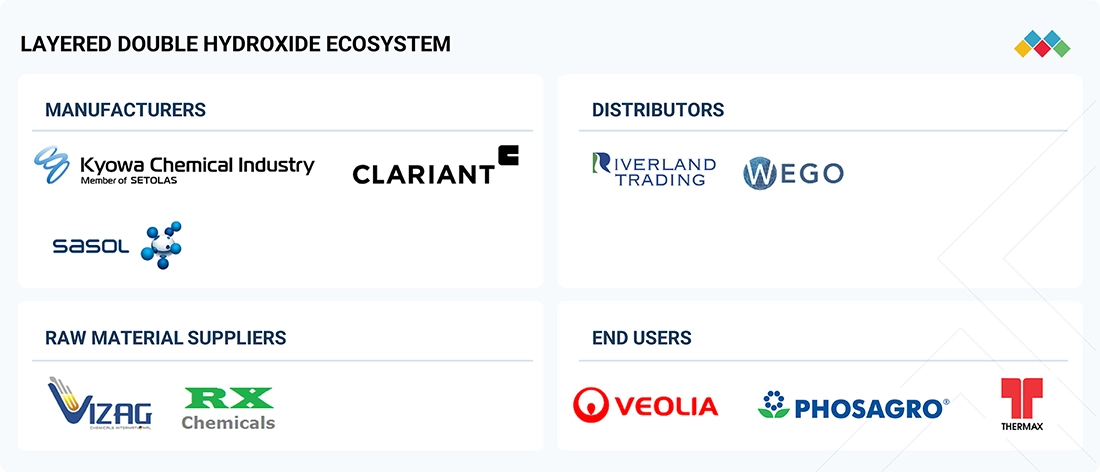
Layered Double Hydroxide Market: COMMERCIAL USE CASES ACROSS INDUSTRIES
| COMPANY | USE CASE DESCRIPTION | BENEFITS |
|---|---|---|
 |
Produces LDH-based additives (Hycite series) for plastics and polyolefins as acid scavengers and halogen-free stabilizers | Improves polymer stability, prevents degradation, supports high-performance and eco-friendly plastics |
 |
Utilizes LDHs in catalyst formulations and specialty chemicals for refining and petrochemical processes | Enhances catalytic efficiency, enables cleaner fuel production, and reduces environmental impact |
 |
Boosts energy storage performance, improves color stability in pigments, and supports advanced material innovation | Boosts energy storage performance, improves color stability in pigments, and supports advanced material innovation |
 |
Produces synthetic hydrotalcite (Kyowatalc series) for PVC stabilization and polymer applications | Provides non-toxic heat stabilizers, enhances flame retardancy, and ensures product safety in consumer goods |
 |
Develops advanced LDH nanocomposites for water treatment, coatings, and specialty applications | Improves contaminant adsorption, enhances coating durability, and enables sustainable environmental solutions |
Logos and trademarks shown above are the property of their respective owners. Their use here is for informational and illustrative purposes only.
Related Ecosystem
Speciality Chemicals
- Corrosion Inhibitors
- Polyetheretherketone (PEEK)
- Acrylonitrile Butadiene Styrene (ABS)
- Epoxy Resin
- Polycarbonate
- Basf se
- DOW CHEMICAL COMPANY
- Evonik industries ag
- Clariant ag.
- Solvay sa
Key Takeaways
- Netherlands LDH market valued at USD 5.3 million in 2025, forecast to reach USD 7.4 million by 2030 at 6.8% CAGR
- Halogen-free flame retardant regulations in Netherlands drive adoption of LDH in polymer and construction applications
- Netherlands strategic position as European chemical hub enables efficient LDH distribution and manufacturing integration
- Sustainability initiatives and green chemistry focus in Netherlands accelerate LDH demand across pharmaceutical and industrial sectors
Layered Double Hydroxide Market Report Scope
| Report Metric | Details |
|---|---|
| Base Year | 2025 |
| Fastest Growing Segment | OTHER APPLICATIONS (Application) |
| Forecast Period | 2025–2030 |
| Growth Rate | CAGR of 8.5% from 2025 to 2030 |
| Largest Segment | MG–AL (Type) |
| Market Size Base Year (Billions) | ~USD 0.81 (2025) |
| Revenue Forecast (Billions) | ~USD 1.22 (2030) |
| Segments Covered | Type, Grade, Application, End Use |
Netherlands Layered Double Hydroxide Market Report Segmentation
4 segment dimensions are covered across the global market.
By Type
- Ca-AI
- Mg–Al
- Other Types
- Zn–Al
By Grade
- Other Grades
- Pharmaceutical Grade
- Plastic Grade
- Rubber Grade
By Application
- Absorbent
- Additives
- Catalysts
- Catalysts & Precursors
- Other Applications
- Water Treatment
By End Use
- Agriculture
- Chemicals
- Construction
- Electronics
- Other End Uses
Target Audience
- Chemical Manufacturers & Producers : Dutch and European LDH producers need market-specific data to optimize production capacity, identify growth segments, and benchmark competitive positioning within the Netherlands market.
- Distributors & Supply Chain Partners : Regional distributors and logistics providers require insights into Netherlands demand patterns, customer segments, and supply chain dynamics to optimize inventory and service offerings.
- End-User Industries : Automotive, construction, and pharmaceutical companies operating in Netherlands need LDH market forecasts to plan material sourcing, supplier relationships, and product development strategies.
- Investment & Private Equity Firms : Investors evaluating opportunities in Dutch specialty chemicals require detailed market sizing, growth trajectories, and competitive dynamics to assess acquisition and expansion targets.
- Regulatory & Compliance Consultants : Consultants advising chemical companies on EU and Netherlands-specific regulations need market context and application trends to guide compliance strategies and product positioning.
Key Companies in the Netherlands Layered Double Hydroxide Market
| Company | HQ | Ownership | Strongest segments |
|---|---|---|---|
| CLARIANT | Switzerland | Public Company | Care Chemicals,Catalysts,Adsorbents & Additives, |
| DOOBON | South Korea | Private Company | Core flagship line,Adjacency products/services,Custom/ODM or project-based work, |
| SAKAI CHEMICAL INDUSTRY CO., LTD. | Japan | Public Company | Titanium Oxide and Zinc Products,Resin Additives,Catalyst, |
| SASOL | South Africa | Public Company | Transport and Automotive Fuels (petrol, diesel, jet, paraffin),Industrial Heating, Burner, and LPG Fuels,Chemicals for Agriculture, Construction, and Industrial (ammonium nitrate, waxes, alumina, solvents), |
| BASF | Germany | Public Company | Chemicals,Materials,Industrial Solutions, |
| TODA KOGYO CORP. | Japan | Public Company | Electronic printing materials (toner, carriers, magnetic materials),Battery materials (lithium cobaltate, lithium-nickel oxide, lithium manganate),Ferrite-based NFC/RFID, noise suppression, and wireless power components, |
| CONSCIENTIA INDUSTRIAL CO., LTD. | Taiwan | Core industrial components,Customized/engineered solutions,Aftermarket and spares, |
CLARIANT
CLARIANT is a Swiss public company founded in 1886 with approximately 9,998 employees, operating as a global specialty chemicals manufacturer.
DOOBON
DOOBON is a South Korean private chemical company established in 1997 with 64 employees.
SAKAI CHEMICAL INDUSTRY CO., LTD.
SAKAI CHEMICAL INDUSTRY CO., LTD. is a Japanese public company founded in 1918 with 1,942 employees, specializing in chemical manufacturing.
SASOL
SASOL is a South African public company founded in 1950 with 27,107 employees, operating as a major chemical and energy corporation.
BASF
BASF is a German public company founded in 1865 with 106,428 employees, operating as one of the world's largest chemical manufacturers.
TODA KOGYO CORP.
TODA KOGYO CORP. is a Japanese public company founded in 1823 with 1,037 employees, specializing in chemical production.
CONSCIENTIA INDUSTRIAL CO., LTD.
Insufficient data available for CONSCIENTIA INDUSTRIAL CO., LTD.
Reasons to Buy this Report
- Localized Market Intelligence : Gain detailed insights specific to the Netherlands market, including regional demand drivers, local regulatory requirements, and country-specific growth opportunities that differ from broader European trends.
- Competitive Landscape Analysis : Understand the competitive positioning of Dutch LDH manufacturers, key players in the region, market share distribution, and strategic initiatives tailored to the Netherlands chemical sector.
- Application-Specific Demand Mapping : Identify which LDH applications (flame retardants, polymer additives, pharmaceuticals) are driving growth in Netherlands and forecast sector-specific demand through 2030.
- Strategic Market Entry Planning : Develop targeted go-to-market strategies for the Netherlands, including distribution channel insights, regulatory compliance pathways, and partnership opportunities with local chemical clusters.
- Investment and Expansion Guidance : Make informed decisions on capacity investments, facility locations, and R&D priorities based on Netherlands-specific growth projections and emerging market segments.
Frequently asked questions
What is the current market size of layered double hydroxides in Netherlands?
The Netherlands LDH market is estimated at USD 5.3 million in 2025 and is expected to grow to USD 7.4 million by 2030.
What is the projected growth rate for the LDH market in Netherlands?
The Netherlands layered double hydroxide market is projected to grow at a CAGR of 6.8% from 2025 to 2030.
Which industries drive LDH demand in Netherlands?
Primary demand drivers in Netherlands include polymer additives, flame retardants, construction materials, and pharmaceutical excipients sectors.
Why is Netherlands important for the European LDH market?
Netherlands serves as a strategic chemical hub with advanced manufacturing infrastructure, regulatory compliance expertise, and proximity to key European markets, making it critical for LDH production and distribution.
How do EU regulations impact the LDH market in Netherlands?
EU environmental standards and halogen-free flame retardant regulations drive Netherlands adoption of LDH as a sustainable alternative in polymer and construction applications.
RESEARCH METHODOLOGY
The research encompassed four primary actions in assessing the present market size of layered double hydroxide. Comprehensive secondary research was conducted to gather information on the market, the peer market, and the parent market. The subsequent stage involved corroborating these findings, assumptions, and dimensions with industry specialists throughout the layered double hydroxide value chain via primary research. The total market size is ascertained with both top-down and bottom-up methodologies. Subsequently, market segmentation analysis and data triangulation were employed to determine the dimensions of the market segments and sub-segments.
Secondary Research
The research approach employed to assess and project the access control market begins with the collection of revenue data from prominent suppliers using secondary research. During the secondary research, various sources, including Hoover's, Bloomberg Businessweek, Factiva, the World Bank, and industry magazines, were utilized to identify and compile information for this study. The secondary sources comprised annual reports, press releases, and investor presentations from corporations; white papers; accredited periodicals; writings by esteemed authors; announcements from regulatory agencies; trade directories; and databases. Vendor offerings have been considered to ascertain market segmentation.
Primary Research
The layered double hydroxide market encompasses a range of stakeholders, including manufacturers, suppliers, traders, associations, and regulatory agencies, across the entire supply chain. The demand side is driven by developments in chemicals, electronics, construction, agriculture, and other sectors. Advances in technology define the supply side. Interviews with key sources from both the supply and demand sides provided qualitative and quantitative data.
The following is the list of primary respondents:
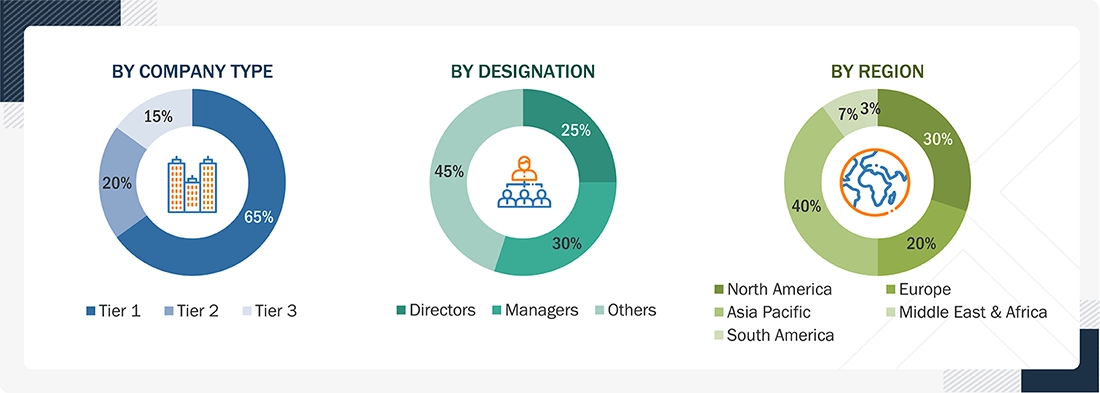
To know about the assumptions considered for the study, download the pdf brochure
Market Size Estimation
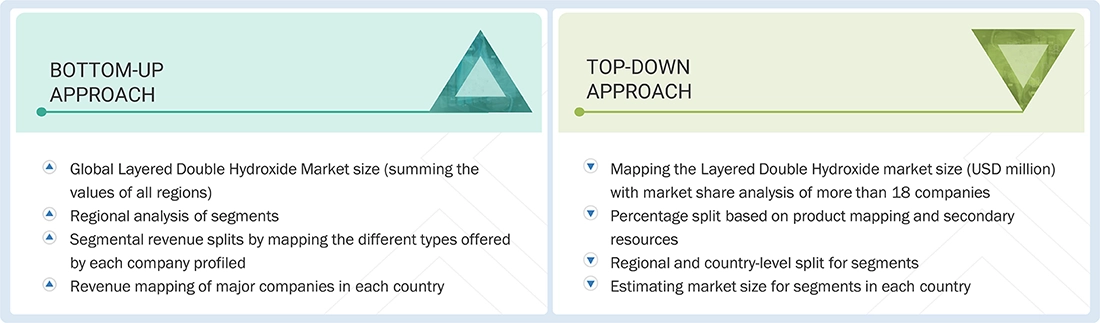
Both the top-down and bottom-up approaches were used to estimate and validate the total size of the layered double hydroxide market. These methods were also used extensively to determine the size of various market segments. The research methodology used to estimate the market size included the following:
- The key players were identified through extensive primary and secondary research.
- The value chain and market size of the layered double hydroxide market, in terms of value, were determined through primary and secondary research.
- All percentage shares, splits, and breakdowns were determined using secondary sources and verified through primary sources.
- All possible parameters that affect the market covered in this research study were accounted for, viewed in extensive detail, verified through primary research, and analyzed to obtain the final quantitative and qualitative data.
- The research included the study of reports, reviews, and newsletters of top market players, along with extensive interviews for opinions from key leaders, such as CEOs, directors, and marketing executives.
Global Layered Double Hydroxide Market Size: Bottom-Up and Top-Down Approach
Data Triangulation
After determining the overall market size using the market size estimation processes explained above, the market was divided into several segments and sub-segments. To complete the overall market engineering process and determine the exact statistics for each market segment and subsegment, data triangulation and market breakdown procedures were employed, as applicable. The market size was calculated globally by summing up the country-level and regional-level data.
Market Definition
Layered Double Hydroxides (LDHs), also known as hydrotalcite-like compounds or anionic clays, are a class of nanostructured materials made up of positively charged metal hydroxide layers separated by interlayer regions containing anions and water molecules. Their unique layered structure allows for ion exchange, tunable composition, and controlled release properties, making them highly versatile. LDHs are widely used in catalysis, flame retardancy, polymer stabilization, pharmaceuticals, and other applications.
Stakeholders
- Layered Double Hydroxide Manufacturers
- Layered Double Hydroxide Suppliers
- Layered Double Hydroxide Traders, Distributors, And Suppliers
- Investment Banks and Private Equity Firms
- Raw Material Suppliers
- Government and Research Organizations
- Consulting Companies/Consultants in the Chemicals and Materials Sectors
- Industry Associations
- Contract Manufacturing Organizations (CMOs)
- NGOs, Governments, Investment Banks, Venture Capitalists, and Private Equity Firms
Report Objectives
- To define, describe, and forecast the size of the global layered double hydroxide market in terms of volume and value
- To provide detailed information regarding the key factors, such as drivers, restraints, opportunities, and industry-specific challenges, influencing the growth of the global layered double hydroxide market
- To analyze and forecast the size of various segments (raw material and application) of the layered double hydroxide market based on five major regions—North America, Asia Pacific, Europe, the Middle East & Africa, and South America, along with key countries in each of these regions
- To strategically profile the key players in the market and comprehensively analyze their core competencies
Get the Full Layered Double Hydroxide Market Report
Full forecast, segment splits, and company analysis for all Layered Double Hydroxide Market.
- China Layered Double Hydroxide Market
- Japan Layered Double Hydroxide Market
- India Layered Double Hydroxide Market
- South Korea Layered Double Hydroxide Market
- Australia Layered Double Hydroxide Market
- US Layered Double Hydroxide Market
- Canada Layered Double Hydroxide Market
- Mexico Layered Double Hydroxide Market
- Germany Layered Double Hydroxide Market
- France Layered Double Hydroxide Market
- UK Layered Double Hydroxide Market
- Spain Layered Double Hydroxide Market
- South Africa Layered Double Hydroxide Market
- Brazil Layered Double Hydroxide Market
- Rest Of Europe Layered Double Hydroxide Market
- Rest Of Asia Pacific Layered Double Hydroxide Market
- GCC Countries Layered Double Hydroxide Market
- –Rest Of GCC Layered Double Hydroxide Market
Need a Tailored Report?
Customize this report to your needs
Get 10% FREE Customization
Customize This Report
