
Canada Liquid Cooled EV Charging Cable Market (2025-2030)

The Canada Liquid Cooled EV Charging Cable Market was valued at $0.62 Million in 2025 and projected to reach to $2.05 Million by 2030, representing a compound annual growth rate of 18.7%. Canada's liquid cooled EV charging cable market is positioned for substantial growth as the nation intensifies its transition to electric vehicles.


| Market Size in | USD 26.32 MN |
| Market Forecast in | |
| CAGR | |
| Forecast Period | |
| Units Considered | Value (USD MN) |
Canada Liquid Cooled EV Charging Cable Market Trends and Insights
- This represents a compound annual growth rate of 18.7%, significantly outpacing global trends as Canada accelerates its electric vehicle infrastructure development.
- The market expansion in Canada reflects increasing adoption of high-power charging solutions and government incentives supporting EV proliferation across the country. The Canadian market benefits from strong regulatory support and substantial investment in charging infrastructure modernization.
- Canada's commitment to net-zero emissions and the growing prevalence of fast-charging networks drive demand for advanced liquid-cooled cable technologies that enhance charging efficiency and safety.
- Between 2025 and 2030, Canada is positioned to capture increasing market share as automotive manufacturers and charging network operators prioritize thermal management solutions for ultra-fast charging applications. Canada's geographic advantages, including proximity to major North American EV markets and established automotive manufacturing capabilities, further strengthen the market outlook.
- The country's focus on sustainable transportation and renewable energy integration creates favorable conditions for liquid-cooled charging infrastructure deployment throughout 2025–2030..
Key Market Statistics
- CAGR (2025-2030) 18.7% CAGR
- Market Size, 2025 ~USD 0.62 Million
- Forecast, 2030 ~USD 2.05 Million
- Country Canada
Canada Liquid Cooled EV Charging Cable Market Overview
Exceptional Growth Trajectory :
Canada's liquid cooled EV charging cable market is growing at 18.7% CAGR, substantially exceeding the global rate of 14%, driven by aggressive EV adoption targets and federal infrastructure investments.
Rapid Market Expansion :
Market valuation is projected to grow from $0.62 million in 2025 to $2.05 million by 2030, representing a 230% increase over five years as high-power charging infrastructure becomes critical.
Infrastructure Development Focus :
Canada's commitment to EV infrastructure through federal and provincial programs is accelerating demand for advanced liquid cooling technology to support fast-charging networks across major corridors.
High-Power Charging Adoption :
Increasing deployment of high-power DC fast-charging stations across Canada necessitates liquid cooled cables to manage thermal loads and enable efficient, rapid vehicle charging capabilities.
Canada Liquid Cooled EV Charging Cable Market Dynamics
- Government incentives, including federal EV rebates and infrastructure funding, combined with provincial charging network expansions, are creating favorable conditions for market development.
- The 18.7% CAGR reflects strong momentum in high-power charging infrastructure deployment across urban centers and highway corridors. Looking ahead to 2030, Canada's market will benefit from increasing EV penetration rates, technological advancements in thermal management, and continued public and private investment in charging infrastructure.
- As automakers introduce more high-performance EVs requiring rapid charging capabilities, demand for liquid cooled cables will accelerate, positioning Canada as a key growth market within North America's broader EV charging ecosystem..
Market Ecosystem
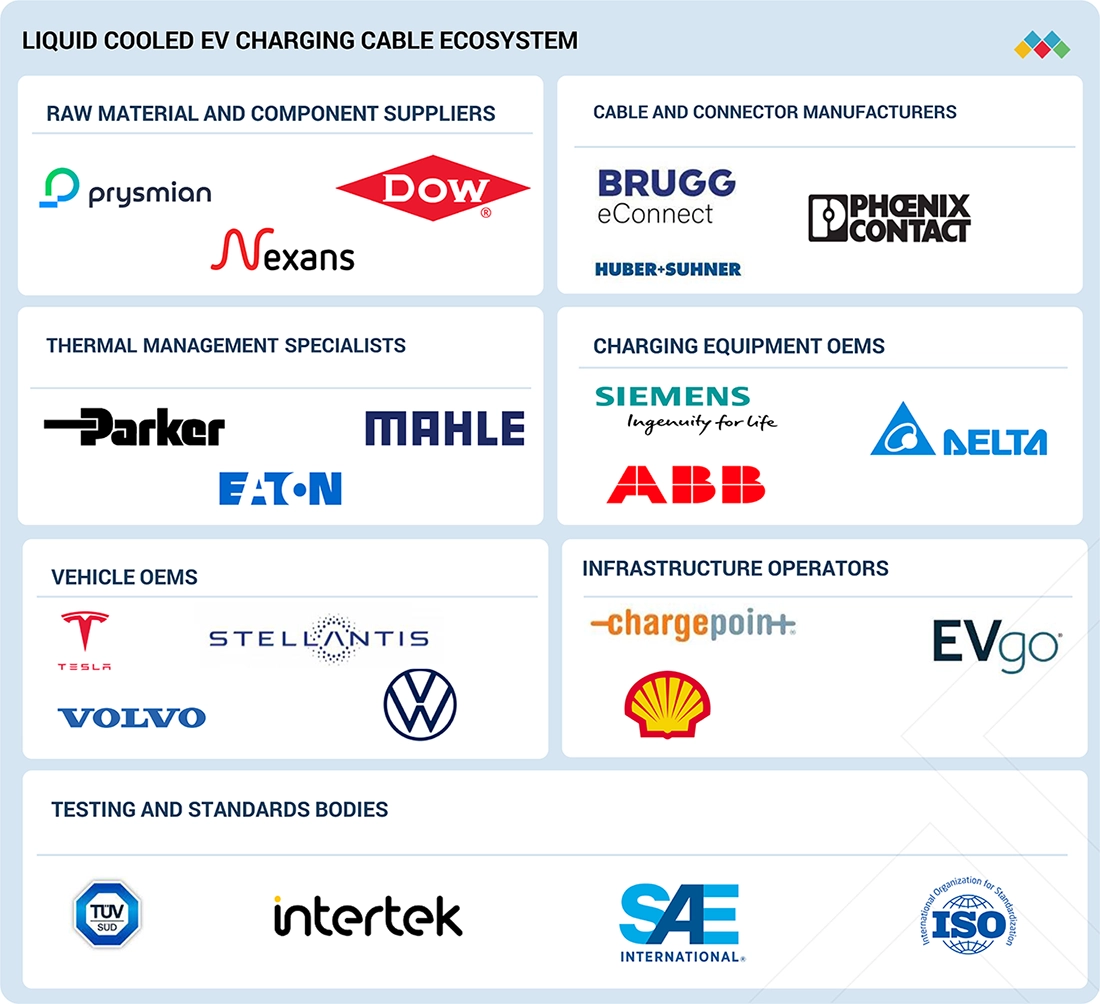
LIQUID COOLED EV CHARGING CABLE MARKET: COMMERCIAL USE CASES ACROSS INDUSTRIES
| COMPANY | USE CASE DESCRIPTION | BENEFITS |
|---|---|---|
 |
Provides liquid cooled DC charging cable systems integrated with connectors and power electronics for public and fleet fast charging installations | Improve charging reliability by maintaining stable thermal performance at sustained high current levels |
 |
Supplies liquid cooled charging cables for highway and ultrafast charging corridors with continuous high power demand | Enable consistent high power delivery by minimizing electrical losses during extended charging sessions |
 |
Delivers liquid cooled charging cables designed for high utilization commercial and heavy duty charging environments | Extend cable service life through enhanced mechanical strength under intensive operational use |
 |
Provides liquid cooled charging cable assemblies as part of integrated charger systems for fast charging deployments | Reduce installation complexity by offering system-ready and customized cable solutions |
 |
Supplies liquid cooled charging cables for public fast charging stations requiring compact routing and ease of handling | Enhance user handling and station ergonomics while sustaining high power charging capability |
Logos and trademarks shown above are the property of their respective owners. Their use here is for informational and illustrative purposes only.
Related Ecosystem
Automotive Electronics And Electrical Equipment
- Battery Electric Vehicle (BEV)
- Light Commercial Vehicles (LCVs)
- Fuel Cell Electric Vehicle (FCEV)
- Sensors
- Hybrid Electric Vehicle (HEV)
- BOSCH LIMITED
- Continental ag
- DENSO Corporation
- Texas Instruments Incorporated
- Panasonic Holdings Corporation
Key Takeaways
- Canada's liquid cooled EV charging cable market will grow from $0.62M (2025) to $2.05M (2030) at an 18.7% CAGR, outpacing global growth rates.
- Canada's strong regulatory framework and net-zero commitments are driving accelerated adoption of advanced thermal management charging solutions.
- High-power charging infrastructure expansion across Canada creates sustained demand for liquid-cooled cable technologies through 2030.
- Canada's strategic position in North American EV supply chains positions the country as a key market for premium charging cable innovations.
Liquid Cooled EV Charging Cable Market Report Scope
| Report Metric | Details |
|---|---|
| Base Year | 2025 |
| Fastest Growing Segment | ABOVE 50 MM (Cable Diameter) |
| Forecast Period | 2025–2030 |
| Growth Rate | CAGR of 14% from 2025 to 2030 |
| Largest Segment | ULTRAFAST CHARGING (Application) |
| Market Size Base Year (Billions) | ~USD 0.51 (2025) |
| Revenue Forecast (Billions) | ~USD 0.98 (2030) |
| Segments Covered | Application, Cable Diameter, Cable Length, Cooling Technology, Jacket Material, Cable Power Capacity |
Canada Liquid Cooled EV Charging Cable Market Report Segmentation
6 segment dimensions are covered across the global market.
By Application
- Megawatt Charging
- Ultrafast Charging
By Cable Diameter
- 30–50 Mm
- Above 50 Mm
- Below 30 Mm
By Cable Length
- 5–8 Meters
- Above 8 Meters
- Below 5 Meters
By Cooling Technology
- Water Glycol
By Jacket Material
- Polyvinyl Chloride
- Rubber
- Thermoplastic Elastomer
By Cable Power Capacity
- 300–499 Kw
- 500900 Kw
- 500–900 Kw
- > 900 Kw
Target Audience
- EV Charging Infrastructure Developers : Need Canada-specific market data to plan charging network expansion, select appropriate cable technologies, and align investments with regional growth projections.
- Automotive OEMs & Suppliers : Require insights into Canadian EV market dynamics and charging infrastructure requirements to develop compatible vehicles and supply chain strategies for the region.
- Government & Policy Makers : Utilize market intelligence to inform EV infrastructure policies, funding allocation, and regulatory frameworks supporting Canada's electrification targets.
- Cable & Component Manufacturers : Need Canada market forecasts and technology trends to guide R&D investments, production capacity planning, and regional distribution strategies.
- Investment & Venture Capital Firms : Seek market validation and growth projections for Canadian EV charging companies to identify investment opportunities in this high-growth sector.
Key Companies in the Canada Liquid Cooled EV Charging Cable Market
| Company | HQ | Ownership | Strongest segments |
|---|---|---|---|
| SINBON ELECTRONICS CO., LTD. | Taiwan | Public Company | High-power liquid-cooled DC cables (>350 kW),Mid-power liquid-cooled DC cables (150–350 kW),Custom assemblies and harnesses for liquid-cooled systems, |
| HUBER+SUHNER | Switzerland | Public Company | High-power liquid-cooled DC charging cables (>350 kW),Mid-power liquid-cooled DC charging cables (150–350 kW),Custom assemblies and system solutions for EV charging, |
| LEONI AG | United States | Private Company | High-power (=350 kW) liquid-cooled DC charging cables,Mid-power (150–350 kW) liquid-cooled DC charging cables,Vehicle-side liquid-cooled charging leads and assemblies, |
| KEMPOWER | Finland | Public Company | Liquid-cooled satellite system cables (public fast charging hubs),Liquid-cooled depot and fleet cables (buses, trucks, logistics),Marine, port, and specialty machinery liquid-cooled cables, |
| TE CONNECTIVITY | Switzerland | Public Company | High-power liquid-cooled DC charging cables (>350 kW),Mid-power liquid-cooled DC charging cables (150–350 kW),Liquid-cooled cable assemblies for commercial and fleet applications, |
| ZHEJIANG YONGGUI ELECTRIC EQUIPMENT CO., LTD. | China | Public Company | High-power liquid-cooled DC charging guns and cables (>250 kW),Integrated charging interfaces and harness assemblies (liquid-cooled capable),AC/DC charging guns and accessories (non-liquid and hybrid portfolios), |
| SUZHOU YIHANG ELECTRONIC SCIENCE & TECHNOLOGY CO., LTD. | China | Private Company | High-power liquid-cooled DC charging cables (>250 kW),Mid-power liquid-cooled DC charging cables (100–250 kW),Integrated cable-connector assemblies and accessories, |
SINBON ELECTRONICS CO., LTD.
Sinbon Electronics Co., Ltd. is a Taiwanese public company founded in 1989 with 8,254 employees. The company operates in the electronics manufacturing industry.
HUBER+SUHNER
Huber+Suhner is a Swiss public company founded in 1864 with 4,224 employees. The company specializes in electrical and optical connectivity solutions.
LEONI AG
Leoni AG is a private company based in the United States with 95,090 employees. The company operates as a major industrial manufacturer with a substantial global workforce.
KEMPOWER
Kempower is a Finnish public company founded in 1949 with 772 employees. The company operates in the energy and technology sectors.
TE CONNECTIVITY
TE Connectivity is a Swiss public company founded in 1941 with 80,000 employees. The company is a global leader in connectivity and sensor solutions.
ZHEJIANG YONGGUI ELECTRIC EQUIPMENT CO., LTD.
Zhejiang Yonggui Electric Equipment Co., Ltd. is a Chinese public company founded in 1973 with 3,171 employees. The company operates in the electrical equipment manufacturing sector.
SUZHOU YIHANG ELECTRONIC SCIENCE & TECHNOLOGY CO., LTD.
Suzhou Yihang Electronic Science & Technology Co., Ltd. is a Chinese private company founded in 2007. The company operates in the electronics and technology sector.
Reasons to Buy this Report
- Market-Specific Growth Intelligence : Gain detailed insights into Canada's 18.7% CAGR trajectory, significantly outpacing global trends, enabling strategic positioning in this high-growth regional market.
- Infrastructure Investment Tracking : Understand federal and provincial EV infrastructure programs driving demand for liquid cooled cables, identifying key investment opportunities and government-backed initiatives.
- Competitive Landscape Analysis : Access Canada-specific competitive dynamics, market players, and regional partnerships essential for market entry or expansion strategies in this emerging segment.
- Forecast-Driven Planning : Leverage precise 2025-2030 projections ($0.62M to $2.05M) for accurate business planning, resource allocation, and revenue forecasting in the Canadian market.
- Technology Adoption Insights : Understand Canadian adoption patterns for high-power charging and thermal management solutions, informing product development and go-to-market strategies.
Frequently asked questions
What is the current market size of liquid cooled EV charging cables in Canada?
Canada's liquid cooled EV charging cable market was valued at $0.62 million in 2025 and is expected to grow to $2.05 million by 2030.
What is the projected growth rate for Canada's liquid cooled EV charging cable market?
Canada's market is projected to grow at a compound annual growth rate (CAGR) of 18.7% between 2025 and 2030.
Why is Canada's liquid cooled EV charging cable market growing faster than the global average?
Canada's market growth is driven by strong government net-zero commitments, substantial EV infrastructure investment, and increasing adoption of ultra-fast charging networks requiring advanced thermal management solutions.
What factors are driving demand for liquid cooled charging cables in Canada?
Key drivers include Canada's regulatory support for EV adoption, expansion of high-power charging networks, thermal efficiency requirements for fast charging, and automotive manufacturer investments in charging infrastructure.
Which regions in Canada are seeing the highest adoption of liquid cooled EV charging cables?
Major urban centers and regions with established EV charging networks, particularly in Ontario, Quebec, and British Columbia, are leading adoption of liquid-cooled charging cable technologies.
RESEARCH METHODOLOGY
The study involved four major activities in estimating the current size of the liquid cooled EV charging cable market. Exhaustive secondary research was done to collect information on the market, the peer market, and the parent market. The next step was to validate these findings, assumptions, and sizing with the industry experts across value chains through primary research. The top-down and bottom-up approaches were employed to estimate the complete market size. Thereafter, market breakdown and data triangulation processes were used to estimate the market size of segments and subsegments.
Secondary Research
In the secondary research process, various secondary sources, such as company annual reports/presentations, press releases, industry association publications [publications of electric vehicle manufacturers, International Energy Agency (IEA), Alternative Fuel Data Centre (AFDC), European Alternate Fuels Observatory (EAFO), Federal Transit Administration (FTA), Regional Transportation Authority (RTA), country-level vehicle associations and trade organizations, and the US Department of Transportation (DOT)], EV-related magazine articles, directories, technical handbooks, World Economic Outlook, trade websites, government organizations websites, and technical articles, company websites, whitepapers, databases, and articles from recognized associations and government publishing sources, were referred to. The secondary data was collected and analyzed to arrive at the overall market size, which was further validated by primary research for an extensive commercial study of the liquid cooled EV charging cable market.
Primary Research
Extensive primary research was conducted after acquiring an understanding of this market scenario through secondary research. Several primary interviews were conducted with market experts from the demand- and supply-side OEMs (in terms of component supply, country-level government associations, and trade associations) and component manufacturers across three major regions, namely Asia Pacific, Europe, and North America. Approximately 40% and 60% of primary interviews were conducted from the demand and supply sides, respectively. Primary data was collected through questionnaires, emails, LinkedIn, and telephonic interviews. In the canvassing of primaries, we have strived to cover various departments within organizations to provide a holistic viewpoint in our report. Brief sessions with highly experienced independent consultants were conducted to reinforce findings from primaries after interacting with industry experts. This, along with the in-house subject matter experts’ opinions, led to the findings, as described in the remainder of this report.
In the primary research process, various primary sources from the supply and demand sides were interviewed to obtain qualitative and quantitative information for the report. The primary sources from the supply side included industry experts, such as Vice Presidents (VPs), marketing directors, technology and innovation directors, and related key executives from various key companies and organizations. The primary sources from the demand side included end users, such as Chief Information Officers (CIOs), consultants, service professionals, technicians and technologists, and managers at public and investor-owned utilities.
Breakdown of Primaries
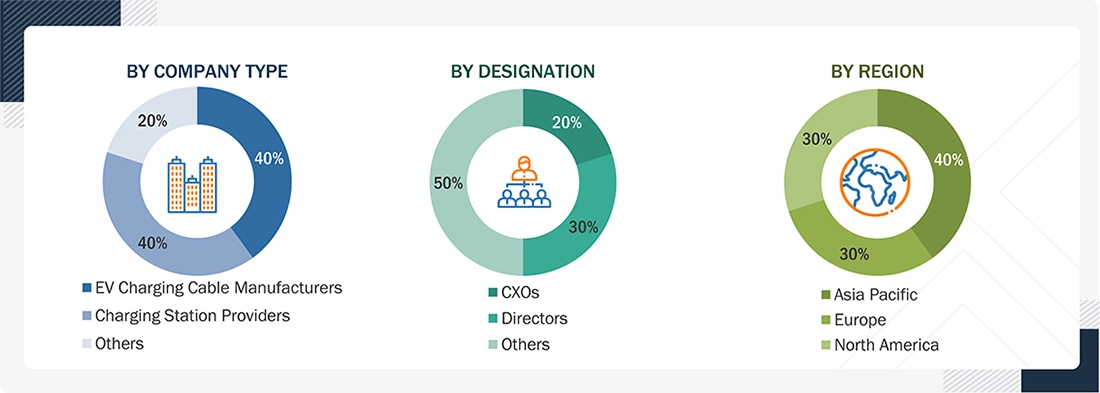
Note: Others include Purchase and Sales Managers, Marketing Managers, and Product Managers.
To know about the assumptions considered for the study, download the pdf brochure
Market Size Estimation
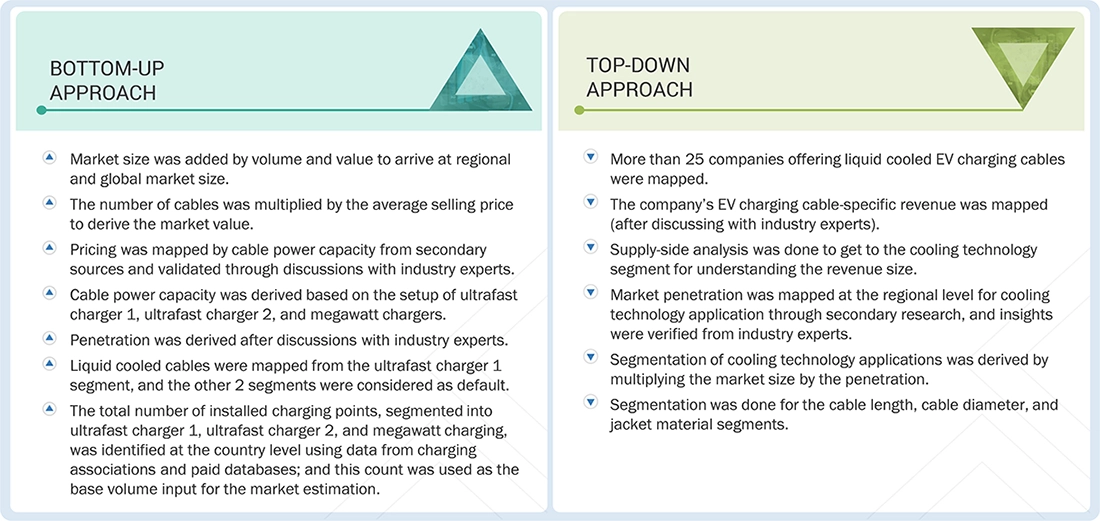
The bottom-up methodology was followed to estimate the size of the liquid cooled EV charging cable market by application. It involved the identification of the number of ultrafast 1, ultrafast 2, and megawatt charging points from country-level associations and paid databases. Also, the penetration for liquid cooled cables was derived through discussions with industry experts, while the other two segments were considered as default users of liquid cooled cables. Cable power capacity was then derived based on the setup of ultrafast 1, ultrafast 2, and megawatt chargers. Pricing was mapped by cable power capacity from secondary sources and validated through discussions with industry experts. The number of cables was multiplied by the average selling price to derive the market value. Market size by volume and value was then aggregated to arrive at regional and global market size estimates.
Data Triangulation
More than 25 companies were mapped as providers of liquid cooled EV charging cables. Company-specific revenue for EV charging cables was mapped after discussions with industry experts. Supply-side analysis was conducted to identify the cooling technology segment and understand its revenue contribution. Market penetration for cooling technology applications was mapped at the regional level through secondary research, with insights validated by industry experts. Segmentation by cooling technology application was calculated by multiplying the market size by penetration rates. A similar approach was applied for segmentation by cable length, cable diameter, and jacket material.
Market Definition
A liquid cooled EV charging cable is a high-power charging cable that circulates a non-conductive coolant (like a dielectric fluid) through internal channels to dissipate heat, allowing for much faster charging by preventing overheating, and resulting in thinner, lighter, and safer cables compared to bulky air-cooled versions. This system uses a pump to circulate the liquid, removing heat from the conductors and connectors for sustained high current flow, enabling rapid charging times for electric vehicles.
Report Objectives
- To segment and forecast the liquid cooled EV charging cable market in terms of volume (Thousand Units) and value (USD Million)
- To define, describe, and forecast the market based on cable power capacity, cable length, cable diameter, application, jacket material, and cooling fluid
- To analyze regional markets for growth trends, prospects, and their contribution to the overall market
- To define, describe, and forecast the size of the liquid cooled EV charging cable market with respect to growth trends and prospects, and determine the contribution of the segments to the total market
- To segment the market and forecast its size, by volume and value, based on region (Asia Pacific, Europe, and North America)
- To segment and forecast the market size, by volume and value, based on cable power capacity (300–499 kW, 500–900 kW, and Above 900 kW)
- To segment and forecast the market size, by volume and value, based on application (Ultrafast Charging and Megawatt Charging)
- To segment and forecast the market size, by volume, based on cable length (Below 5 Meters, 5-8 Meters, and Above 8 Meters)
- To segment and forecast the market size, by volume, based on cable diameter (Below 30 mm, 30–50 mm, and Above 50 mm)
- To segment and forecast the market size, by volume, based on jacket material (Rubber, Thermoplastic Elastomer, and Polyvinyl Chloride)
- To segment and forecast the market size, by volume, based on cooling fluid (Water Glycol and Others)
- To provide detailed information regarding the major factors (drivers, challenges, restraints, and opportunities) influencing market growth
- To strategically analyze markets with respect to individual growth trends, prospects, and contribution to the total market
- To analyze opportunities for stakeholders and the competitive landscape for market leaders
-
To study the following with respect to the market:
- Supply Chain Analysis
- Ecosystem Analysis
- Technology Analysis
- HS Code
- Case Study Analysis
- Patent Analysis
- Regulatory Landscape
- Key Stakeholders and Buying Criteria
- Funding, By Application
- Key Conferences & Events
- To strategically profile key players and comprehensively analyze their market share and core competencies
- To analyze the impact of AI on the liquid cooled EV charging cable market
- To track and analyze competitive developments, such as deals (mergers & acquisitions, partnerships, collaborations), product developments, and other activities carried out by key industry participants
Get the Full Liquid Cooled EV Charging Cable Market Report
Full forecast, segment splits, and company analysis for all Liquid Cooled EV Charging Cable Market.
- China Liquid Cooled EV Charging Cable Market
- India Liquid Cooled EV Charging Cable Market
- Japan Liquid Cooled EV Charging Cable Market
- South Korea Liquid Cooled EV Charging Cable Market
- Germany Liquid Cooled EV Charging Cable Market
- France Liquid Cooled EV Charging Cable Market
- Italy Liquid Cooled EV Charging Cable Market
- Spain Liquid Cooled EV Charging Cable Market
- UK Liquid Cooled EV Charging Cable Market
- US Liquid Cooled EV Charging Cable Market
- Rest Of Europe Liquid Cooled EV Charging Cable Market
Need a Tailored Report?
Customize this report to your needs
Get 10% FREE Customization
Customize This Report
