
US Lithium-ion Battery Anode Market (2025-2030)

The US Lithium-ion Battery Anode Market was valued at $52079.4 Million in 2025 and projected to reach to $150177.2 Million by 2030, representing a compound annual growth rate of CAGR 23.6%. The US lithium-ion battery anode market is positioned for exceptional growth through 2030, supported by the Biden administration's clean energy policies, substantial Inflation Reduction Act investments, and accelerating EV adoption targets.


| Market Size in | USD 26.32 MN |
| Market Forecast in | |
| CAGR | |
| Forecast Period | |
| Units Considered | Value (USD MN) |
US Lithium-ion Battery Anode Market Trends and Insights
- This 23.6% compound annual growth rate reflects the US's critical role in the global energy transition, driven by accelerating electric vehicle adoption, grid-scale energy storage deployment, and domestic battery manufacturing investments.
- The US market benefits from supportive federal policies, including the Inflation Reduction Act, which incentivizes domestic anode material production and supply chain localization. In 2025, the US anode market is characterized by increasing demand from major EV manufacturers and battery producers establishing or expanding US operations.
- By 2030, the US is expected to solidify its position as a key hub for advanced anode technologies, including synthetic graphite, natural graphite, and silicon-based materials.
- The market's growth trajectory outpaces global expansion, positioning the US as a strategic center for battery innovation and production capacity..
Key Market Statistics
- CAGR (2025-2030) CAGR 23.6%
- Market Size, 2025 ~USD 52079.4 Million
- Forecast, 2030 ~USD 150177.2 Million
- Country US
US Lithium-ion Battery Anode Market Overview
Market Valuation Growth :
The US lithium-ion battery anode market is valued at $52,079.4 million in 2025, with projections reaching $150,177.2 million by 2030, representing a robust 23.6% CAGR driven by domestic EV expansion and battery manufacturing initiatives.
EV Adoption Acceleration :
US electric vehicle sales continue to surge, directly driving demand for advanced anode materials. Domestic automakers' commitment to EV production and federal incentives are accelerating battery component consumption across the country.
Domestic Manufacturing Expansion :
Major battery manufacturing facilities are being established across the US through government support and private investment. This localization of production is reducing supply chain dependencies and creating significant demand for domestically-sourced anode materials.
Grid Storage Deployment :
Large-scale energy storage systems for grid stabilization are proliferating across US regions. Renewable energy integration and grid modernization initiatives are creating substantial secondary demand for lithium-ion battery anodes beyond the automotive sector.
US Lithium-ion Battery Anode Market Dynamics
- Domestic battery manufacturing capacity expansions by Tesla, Ultium, and other producers will significantly boost anode material demand.
- The market will benefit from supply chain localization efforts and reduced reliance on international sources, creating competitive advantages for US-based anode manufacturers and material suppliers. Long-term growth will be sustained by grid-scale energy storage deployment, renewable energy integration, and evolving battery technologies requiring advanced anode materials.
- Strategic partnerships between automakers, battery manufacturers, and material suppliers will drive innovation in anode performance and cost reduction.
- The US market's maturation and regulatory environment will establish it as a critical hub for battery supply chain development, supporting sustained 23.6% CAGR through the forecast period..
Market Ecosystem
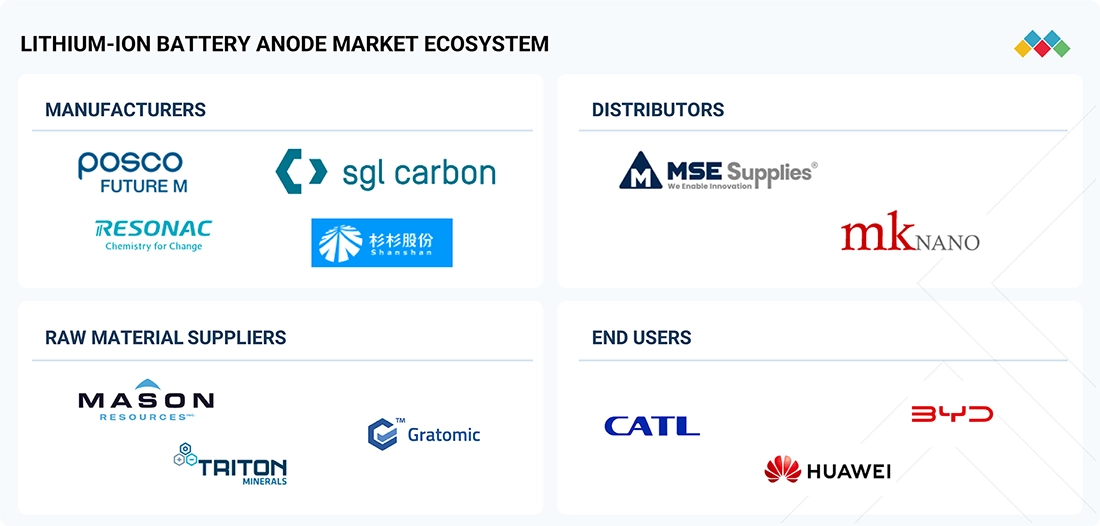
Lithium-ion Battery Anode Market: COMMERCIAL USE CASES ACROSS INDUSTRIES
| COMPANY | USE CASE DESCRIPTION | BENEFITS |
|---|---|---|
 |
Resonac Holdings Corporation produces graphite anode materials used in lithium-ion batteries for electric vehicles, consumer electronics, and energy storage systems. | Offers high capacity and stable cycling performance, supporting long battery life and consistent power output in EVs and portable devices. |
 |
JFE Chemical manufactures artificial graphite anode materials for lithium-ion batteries utilized in automotive and industrial energy storage applications. | Provides uniform particle structure for improved conductivity and reliability, ensuring stable battery performance under demanding conditions. |
 |
Kureha develops carbon materials and polymer binders for lithium-ion battery anodes, widely used in electric mobility and electronics sectors. | Enhances anode structural integrity and charge efficiency, contributing to greater durability and safety of lithium-ion batteries. |
 |
SGL Carbon supplies synthetic graphite and composite materials for lithium-ion battery anodes used in electric vehicles and stationary energy storage systems. | Delivers high electrical conductivity and thermal stability, improving energy density and overall efficiency of battery systems. |
 |
Ningbo Shanshan produces both natural and artificial graphite anode materials for lithium-ion batteries used in EVs, consumer electronics, and industrial applications. | Ensures high performance, fast charging capability, and extended battery cycle life, supporting the growing electrification trend across sectors. |
Logos and trademarks shown above are the property of their respective owners. Their use here is for informational and illustrative purposes only.
Related Ecosystem
Automotive Advance Technologies
- Battery Electric Vehicle (BEV)
- Light Commercial Vehicles (LCVs)
- Fuel Cell Electric Vehicle (FCEV)
- Hybrid Electric Vehicle (HEV)
- Internal Combustion Engine (ICE)
- BOSCH LIMITED
- Continental ag
- Visteon Corporation
- DENSO Corporation
- ZF FRIEDRICHSHAFEN AG
Equipment Machine And Tooling
- Wastewater Treatment
- Air Cooled Heat Exchangers
- Diaphragm Pumps
- Fiberglass
- HVAC System
- Alfa Laval Corporate AB
- Veolia
- Johnson Controls International plc
- Daikin Industries,Ltd.
- Parker-Hannifin Corporation
Battery And Wireless Charging
- Nickel-Cadmium Battery
- Battery Electric Vehicle (BEV)
- Energy Harvesting
- Hybrid Electric Vehicle (HEV)
- Smart Cards
- Panasonic Holdings Corporation
- MOMENTIVE PERFORMANCE MATERIALS INC.
- Lg corp
- FDK Corporation
- Samsung
Key Takeaways
- The US lithium-ion battery anode market is valued at $52,079.4 million in 2025 and will grow to $150,177.2 million by 2030, representing a 23.6% CAGR.
- US market growth is driven by EV adoption acceleration, domestic battery manufacturing expansion, and federal incentives supporting supply chain localization.
- The US anode market encompasses synthetic graphite, natural graphite, and silicon-based materials, with increasing focus on advanced technologies.
- By 2030, the US will emerge as a critical global hub for battery anode production, supported by policy frameworks and manufacturing investments.
Lithium-ion Battery Anode Market Report Scope
| Report Metric | Details |
|---|---|
| Base Year | 2025 |
| Fastest Growing Segment | NATURAL GRAPHITE (Active Anode Material) |
| Forecast Period | 2025-2030 |
| Growth Rate | CAGR of 33.6% from 2025 to 2030 |
| Largest Segment | ELECTRIC VEHICLES (Application) |
| Market Size Base Year (Billions) | ~USD 19.09 (2025) |
| Revenue Forecast (Billions) | ~USD 81.24 (2030) |
| Segments Covered | Material, Active Anode Material, End Use, Application |
US Lithium-ion Battery Anode Market Report Segmentation
4 segment dimensions are covered across the global market.
By Material
- Active Anode Materials
- Anode Binders
By Active Anode Material
- Li-Compounds & Li-Metals
- Natural Graphite
- Silicon
- Synthetic Graphite
By End Use
- Aerospace
- Automotive
- Energy Storage
- Marine
- Non-Automotive
- Other End Uses
By Application
- Electric Vehicles
- Industrial
- Other Applications
- Portable Devices
Target Audience
- Battery Manufacturers : US-based and international battery producers need precise anode market data to optimize sourcing strategies, plan capacity expansions, and align production with domestic demand growth driven by EV and energy storage markets.
- Anode Material Suppliers : Graphite, silicon, and lithium metal anode material producers require detailed US market insights to identify growth opportunities, assess competitive positioning, and develop targeted sales strategies for domestic battery manufacturers.
- Automotive OEMs : US automakers and EV manufacturers need comprehensive anode market analysis to secure reliable domestic supply chains, negotiate material costs, and ensure production continuity for accelerating EV manufacturing programs.
- Investment & Private Equity Firms : Investors evaluating opportunities in US battery supply chain companies require detailed market forecasts, growth drivers, and competitive analysis to identify high-potential acquisition and funding targets through 2030.
- Government & Policy Makers : US federal and state officials developing clean energy policies and manufacturing incentives need market data to assess domestic battery supply chain capabilities, identify infrastructure gaps, and optimize public investment allocation.
Reasons to Buy this Report
- Strategic Market Sizing : Obtain precise valuation data for the US market ($52.1B in 2025) with detailed forecasts through 2030, enabling accurate financial planning and investment decisions specific to the American lithium-ion anode sector.
- Competitive Landscape Intelligence : Understand the competitive dynamics of US-based anode manufacturers, material suppliers, and battery producers. Identify market leaders, emerging players, and partnership opportunities within the domestic supply chain.
- Regulatory & Policy Insights : Gain comprehensive analysis of US government incentives, Inflation Reduction Act provisions, and domestic manufacturing requirements that directly impact anode market growth and supply chain localization strategies.
- Growth Driver Analysis : Detailed examination of EV adoption rates, grid storage deployment, and domestic battery manufacturing expansion specific to the US market, with quantified impact on anode material demand through 2030.
- Investment & Expansion Planning : Support capital allocation decisions, facility location strategies, and partnership development with data-driven insights into regional demand patterns, manufacturing capacity trends, and supply chain opportunities across the US.
Frequently asked questions
What is the current size of the US lithium-ion battery anode market in 2025?
The US lithium-ion battery anode market is valued at $52,079.4 million in 2025.
What is the projected size of the US anode market by 2030?
The US market is projected to reach $150,177.2 million by 2030, growing at a 23.6% CAGR.
What factors are driving growth in the US lithium-ion battery anode market?
Key drivers include electric vehicle adoption, grid-scale energy storage demand, domestic battery manufacturing expansion, and federal policies like the Inflation Reduction Act.
Which anode materials dominate the US market?
The US market includes synthetic graphite, natural graphite, and silicon-based anode materials, with growing emphasis on advanced and high-performance technologies.
How does the US anode market growth compare to global trends?
The US market's 23.6% CAGR outpaces the global 33.6% CAGR in absolute terms, reflecting the US's strategic importance in battery supply chain development.
RESEARCH METHODOLOGY
The research encompassed four primary actions in assessing the present market size of lithium-ion battery anode. Comprehensive secondary research was conducted to gather information on the market, the peer market, and the parent market. The subsequent stage involved corroborating these findings, assumptions, and dimensions with industry specialists throughout the lithium-ion battery anode value chain via primary research. The total market size is ascertained using both top-down and bottom-up methodologies. Subsequently, market segmentation analysis and data triangulation were employed to ascertain the dimensions of the market segments and subsegments.
Secondary Research
The research approach employed to assess and project the market begins with the collection of revenue data from prominent suppliers using secondary research. In the course of secondary research, many secondary sources, such as D&B Hoovers, Bloomberg BusinessWeek, Factiva, the World Bank, and industry magazines, were utilized to identify and compile information for this study. The secondary sources comprised annual reports, press releases, and investor presentations from corporations, white papers, accredited periodicals, writings by esteemed authors, announcements from regulatory agencies, trade directories, and databases. Vendor offerings have been considered to ascertain market segmentation.
Primary Research
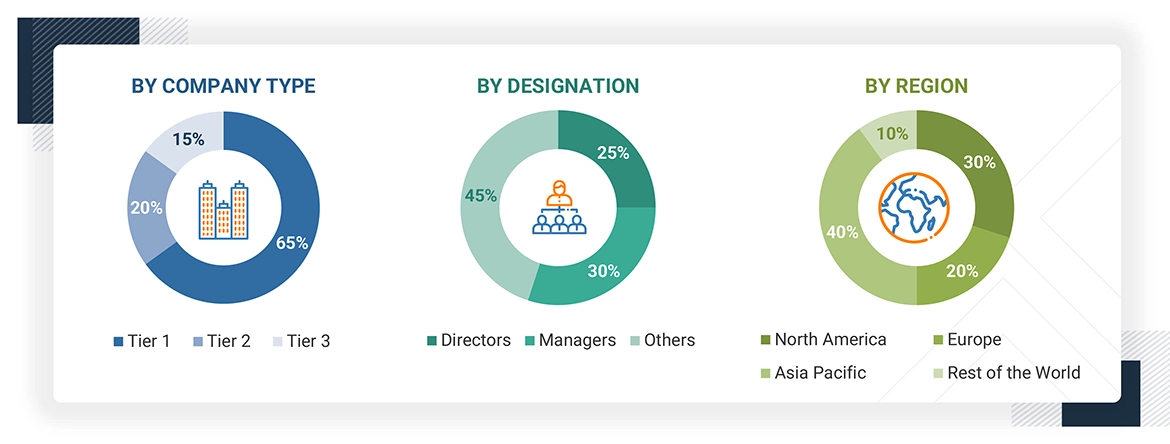
The lithium-ion battery anode market comprises several stakeholders, such as manufacturers, suppliers, traders, associations, and regulatory organizations, in the supply chain. The demand side of this market is characterized by the development of various industries, including automotive, energy storage, aerospace, marine, and others. Advancements in technology characterize the supply side. Various primary sources from both the supply and demand sides of the market were interviewed to obtain qualitative and quantitative information.
The following is the breakdown of the primary respondents.
To know about the assumptions considered for the study, download the pdf brochure
Market Size Estimation
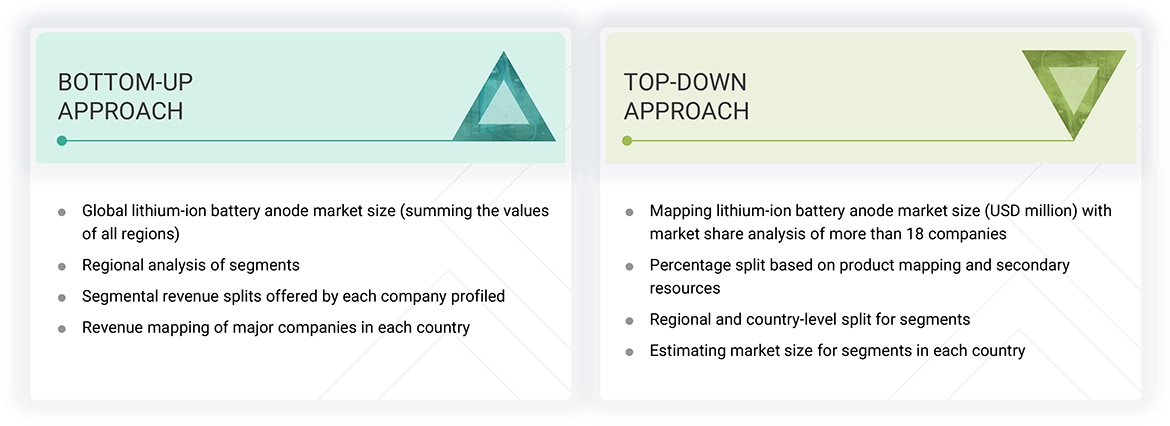
Both the top-down and bottom-up approaches were used to estimate and validate the total size of the lithium-ion battery anode market. These methods were also used extensively to determine the size of various subsegments in the market. The research methodology used to estimate the market size included the following:
- The key players were identified through extensive primary and secondary research
- Primary and secondary research determined the value chain and market size of the lithium-ion battery anode market in terms of value and volume
- All percentage shares, splits, and breakdowns were determined using secondary sources and verified through primary sources.
- All possible parameters that affect the market covered in this research study were accounted for, viewed in extensive detail, verified through primary research, and analyzed to obtain the final quantitative and qualitative data
- The research included the study of reports, reviews, and newsletters of top market players, along with extensive interviews for opinions from key leaders, such as CEOs, directors, and marketing executives
Global Lithium-ion Battery Anode Market Size: Bottom-up and Top-down Approach
Data Triangulation
After arriving at the overall market size using the market size estimation processes as explained above, the market was split into several segments and subsegments. To complete the overall market engineering process and arrive at the exact statistics of each market segment and subsegment, data triangulation and market breakdown procedures were employed, wherever applicable. The market size was calculated globally by summing up the country-level and regional-level data.
Market Definition
The lithium-ion battery anode is a negative electrode in a lithium-ion battery paired with a cathode electrode. It acts as a host to reversibly allow lithium-ion intercalation, discharge cycles, and deintercalation during charge. The lithium-ion battery anode is used mainly in lithium-ion batteries. It is a strong reducing agent, highly electropositive, has high electrochemical equivalence with high capacity & energy density, is a strong conducting agent, and has high mechanical stability. Lithium-ion batteries, along with the lithium anode as an electrode, are mainly rechargeable batteries used for portable electronic products. These batteries have a low self-discharge rate and slow loss of charge when not in use. They are used in industries such as automotive, industrial & energy storage, and consumer electronics.
Stakeholders
- Lithium-ion Battery Anode Manufacturers
- Lithium-ion Battery Anode Suppliers
- Lithium-ion Battery Anode Traders, Distributors, and Suppliers
- Investment Banks and Private Equity Firms
- Raw Material Suppliers
- Government and Research Organizations
- Consulting Companies/Consultants in the Chemicals and Materials Sectors
- Industry Associations
- Contract Manufacturing Organizations (CMOs)
- NGOs, Governments, Investment Banks, Venture Capitalists, and Private Equity Firms
Report Objectives
- To define, describe, and forecast the size of the global lithium-ion battery anode market in terms of volume and value
- To provide detailed information regarding the key factors, such as drivers, restraints, opportunities, and challenges, influencing the growth of the global lithium-ion battery anode market
- To analyze and forecast the size of various segments of the lithium-ion battery anode market based on five major regions—North America, Asia Pacific, Europe, and the Rest of the World, along with key countries in each of these regions
- To analyze recent developments and competitive strategies, such as acquisitions, agreements, partnerships, collaborations, product launches, expansions, and others, to draw the competitive landscape of the market
- To strategically profile the key players in the market and comprehensively analyze their core competencies
Get the Full Lithium-ion Battery Anode Market Report
Full forecast, segment splits, and company analysis for all Lithium-ion Battery Anode Market.
- China Lithium-ion Battery Anode Market
- South Korea Lithium-ion Battery Anode Market
- Japan Lithium-ion Battery Anode Market
- Thailand Lithium-ion Battery Anode Market
- Australia Lithium-ion Battery Anode Market
- Germany Lithium-ion Battery Anode Market
- Poland Lithium-ion Battery Anode Market
- Sweden Lithium-ion Battery Anode Market
- France Lithium-ion Battery Anode Market
- UK Lithium-ion Battery Anode Market
- Hungary Lithium-ion Battery Anode Market
- Rest Of Europe Lithium-ion Battery Anode Market
Need a Tailored Report?
Customize this report to your needs
Get 10% FREE Customization
Customize This Report
