
Europe Lithium-Ion Battery Materials Market (2025-2030)

The Europe Lithium-Ion Battery Materials Market was valued at $2373.5 Million in 2025 and projected to reach to $4938.8 Million by 2030, representing a compound annual growth rate of 15.8%. Europe's lithium-ion battery materials market is poised for exceptional growth, expanding from $2,373.5 million in 2025 to $4,938.8 million by 2030.


| Market Size in | USD 26.32 MN |
| Market Forecast in | |
| CAGR | |
| Forecast Period | |
| Units Considered | Value (USD MN) |
Europe Lithium-Ion Battery Materials Market Trends and Insights
- This represents a compound annual growth rate of 15.8%, outpacing global growth trends.
- Europe's strategic position in the global battery supply chain, coupled with stringent environmental regulations and aggressive electrification targets, is driving substantial investment in battery material production and innovation across the region. The European market is characterized by strong demand from the automotive sector, where electric vehicle adoption continues to accelerate.
- Europe's commitment to carbon neutrality and the European Green Deal has catalyzed significant capital allocation toward domestic battery material manufacturing, reducing supply chain dependencies.
- Key material categories including cathodes, anodes, electrolytes, and separators are witnessing heightened competition and technological advancement throughout the forecast period from 2025 to 2030. Europe's regulatory framework and circular economy initiatives are reshaping the competitive landscape, with battery recycling and sustainable sourcing becoming critical differentiators.
- The region's established chemical and materials infrastructure positions Europe as a critical hub for advanced battery material development and production..
Key Market Statistics
- CAGR (2025-2030) 15.8% CAGR
- Market Size, 2025 ~USD 2373.5 Million
- Forecast, 2030 ~USD 4938.8 Million
- Geography Europe
Europe Lithium-Ion Battery Materials Market Overview
Market Leadership Position :
Europe commands a significant share of the global lithium-ion battery materials market, with Germany alone accounting for $1,814.3 million in 2025, establishing itself as the regional powerhouse in battery material production and innovation.
Accelerated Growth Trajectory :
Europe's 15.8% CAGR (2025-2030) outpaces the global average of 14.6%, driven by aggressive EV adoption targets, EU battery regulations, and substantial investments in domestic supply chain development to reduce Asian dependency.
Regulatory Catalyst Effect :
Stringent EU environmental standards, including the Battery Regulation and Critical Raw Materials Act, are compelling manufacturers to establish advanced processing facilities across Europe, creating sustained demand for high-quality battery materials.
Strategic Supply Chain Localization :
European governments and OEMs are prioritizing domestic battery material production to secure supply chains, with major investments in cathode, anode, and electrolyte manufacturing facilities across Germany, France, and the UK.
Europe Lithium-Ion Battery Materials Market Dynamics
- This expansion is underpinned by the continent's commitment to carbon neutrality, with electric vehicle penetration accelerating across major markets.
- Germany's manufacturing expertise, combined with France and the UK's strategic investments, positions Europe as a critical hub for battery material innovation and production. The regulatory environment, particularly EU mandates on battery recycling and critical mineral sourcing, is reshaping the competitive landscape.
- European manufacturers are increasingly focusing on sustainable extraction methods and circular economy principles, creating premium market segments.
- Strategic partnerships between automotive OEMs, battery producers, and material suppliers are intensifying, ensuring robust demand for specialized cathode materials, lithium compounds, and electrolyte solutions throughout the forecast period..
Market Ecosystem
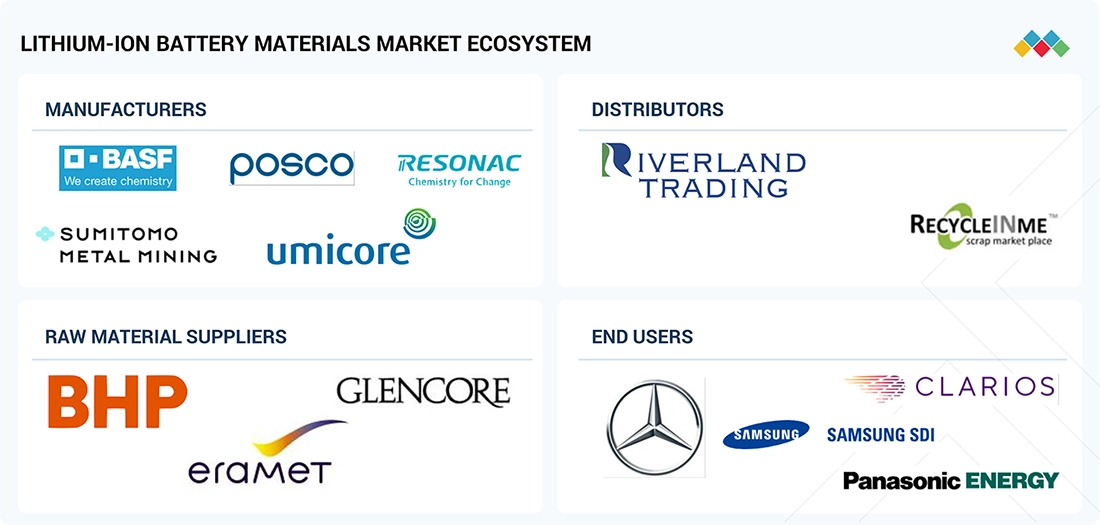
LITHIUM-ION BATTERY MATERIALS MARKET: COMMERCIAL USE CASES ACROSS INDUSTRIES
| COMPANY | USE CASE DESCRIPTION | BENEFITS |
|---|---|---|
 |
Supplies cathode materials, electrolytes, binders, and additives used as raw materials in lithium-ion batteries for EVs, stationary energy storage, and industrial applications | Improves battery energy density, thermal stability, safety, and scalability for high-volume battery manufacturing |
 |
Produces cathode and anode materials used in lithium-ion batteries for electric vehicles and grid-scale energy storage systems | Enables longer driving range, fast charging, improved durability, and cost-efficient battery production |
 |
Provides high-purity nickel, cobalt, and cathode materials used in lithium-ion batteries for automotive, electronics, and industrial energy storage applications | Delivers high energy density, consistent electrochemical performance, and extended battery lifecycle |
 |
Develops cathode materials and precursors used in lithium-ion batteries for EVs, plug-in hybrids, and stationary energy storage systems | Supports high-performance batteries, sustainable sourcing, recycling integration, and reduced lifecycle emissions |
 |
Supplies graphite anodes and conductive materials for EV and industrial batteries | Enhances charging efficiency, power output, and battery reliability |
Logos and trademarks shown above are the property of their respective owners. Their use here is for informational and illustrative purposes only.
Related Ecosystem
Homeland Security
- Heat Pumps
- Humidifiers
- Ip Cameras
- Monitors
- Navigation Systems
- Thales group
- Northrop Grumman Corporation
- LOCKHEED MARTIN CORPORATION
- L3Harris Technologies, Inc.
- Elbit Systems Ltd.
Electric Hybrid Vehicles
- Battery Electric Vehicle (BEV)
- Fuel Cell Electric Vehicle (FCEV)
- Light Commercial Vehicles (LCVs)
- Hybrid Electric Vehicle (HEV)
- Agricultural Tractors
- Visteon Corporation
- BOSCH LIMITED
- Byd company ltd.
- Tesla, Inc.
- FORD MOTOR COMPANY
Equipment Machine And Tooling
- Wastewater Treatment
- Air Cooled Heat Exchangers
- Diaphragm Pumps
- Fiberglass
- HVAC System
- Alfa Laval Corporate AB
- Veolia
- Daikin Industries,Ltd.
- Johnson Controls International plc
- Parker-Hannifin Corporation
Key Takeaways
- Europe's lithium-ion battery materials market will more than double from $2,373.5M (2025) to $4,938.8M (2030), driven by EV electrification and regulatory mandates.
- Europe's 15.8% CAGR significantly exceeds the global average of 14.6%, reflecting the region's strategic focus on battery supply chain localization.
- Europe's circular economy regulations and battery recycling requirements are creating new opportunities for sustainable material sourcing and secondary battery material production.
- Europe's automotive and energy storage sectors are the primary demand drivers, with cathode and anode materials commanding the largest market share through 2030.
Lithium-Ion Battery Materials Market Report Scope
| Report Metric | Details |
|---|---|
| Base Year | 2025 |
| Fastest Growing Segment | LITHIUM IRON PHOSPHATE (Battery Chemistry) |
| Forecast Period | 2025–2030 |
| Growth Rate | CAGR of 14.6% from 2025 to 2030 |
| Largest Segment | ELECTRIC VEHICLES (Application) |
| Market Size Base Year (Billions) | ~USD 48.23 (2025) |
| Revenue Forecast (Billions) | ~USD 95.34 (2030) |
| Segments Covered | Material, Battery Chemistry, Application |
Europe Lithium-Ion Battery Materials Market Report Segmentation
3 segment dimensions are covered across the global market.
By Material
- Anode Material
- Anode Materials
- Cathode Material
- Cathode Materials
- Electrolyte Materials
- Other Materials
By Battery Chemistry
- Lithium Cobalt Oxide
- Lithium Iron Phosphate
- Lithium Manganese Oxide
- Lithium Nickel Cobalt Aluminum Oxide
- Lithium Nickel Manganese Cobalt
By Application
- Electric Vehicles
- Industrial
- Other Applications
- Portable Devices
EUROPE: LITHIUM-ION BATTERY MATERIALS MARKET, BY APPLICATION, 2025–2030
| Segment | 2025 | 2026 | 2027 | 2028 | 2029 | 2030 | CAGR (%) |
|---|---|---|---|---|---|---|---|
| ELECTRIC VEHICLES | 1708.5 | 2013.3 | 2387.2 | 2810.5 | 3401.5 | 4134.9 | 19.3 |
| INDUSTRIAL | 97.3 | 101.5 | 106.3 | 110.3 | 114.6 | 119.3 | 4.2 |
| OTHER APPLICATIONS | 177 | 185.7 | 195.3 | 203.6 | 212.4 | 222 | 4.6 |
| PORTABLE DEVICES | 390.7 | 404.7 | 420.6 | 433.4 | 447.2 | 462.6 | 3.4 |
| TOTAL | 2373.5 | 2705.3 | 3109.4 | 3558 | 4175.8 | 4938.8 | 15.8 |
Target Audience
- Battery Material Manufacturers : European and global producers need regional market intelligence to optimize production capacity, identify growth segments, and align manufacturing strategies with EU regulatory requirements and supply chain localization trends.
- Automotive OEMs & Suppliers : Car manufacturers and Tier-1 suppliers require detailed material cost forecasts, supply availability analysis, and regional sourcing strategies to secure battery materials and meet EV production targets across Europe.
- Investment & Private Equity Firms : Investors evaluating European battery material companies need market sizing, growth projections, regulatory risk assessments, and competitive landscape analysis to inform M&A and venture capital decisions.
- Government & Policy Makers : EU and national policymakers require market data to design effective industrial policies, incentivize domestic production, assess supply chain resilience, and allocate resources for battery material infrastructure development.
- Raw Material & Chemical Suppliers : Lithium, cobalt, and chemical suppliers need European demand forecasts, end-user concentration analysis, and pricing trends to optimize supply contracts, production planning, and market positioning in the region.
Key Companies in the Europe Lithium-Ion Battery Materials Market
| Company | HQ | Ownership | Strongest segments |
|---|---|---|---|
| UMICORE | Belgium | Public Company | Battery Materials,Catalysis,Recycling, |
| SUMITOMO METAL MINING CO., LTD. | Japan | Public Company | Mineral Resources (copper, gold, nickel ores including Hishikari and other mines),Smelting and Refining (copper, nickel, cobalt, precious metals, sulfuric acid, by-products),Battery Materials (cathode materials for vehicles and other battery applications), |
| BASF | Germany | Public Company | Chemicals,Materials,Industrial Solutions, |
| POSCO FUTURE M | South Korea | Public Company | Cathode active materials,Anode materials (synthetic and natural graphite, Si-blends),Other battery materials and precursors, |
| RESONAC HOLDINGS CORPORATION | Japan | Public Company | Semiconductor and Electronic Materials,Mobility (automotive plastics, powder metals, aluminum, friction materials),Innovation Enabling Materials (batteries, ceramics, resins, adhesives, tapes), |
| TANAKA CHEMICAL CORPORATION | Japan | Private Company | Precursors for lithium-ion battery cathodes,Cathode materials for nickel-metal hydride batteries,Other inorganic chemical products, |
| TODA KOGYO CORP. | Japan | Public Company | Electronic printing materials (toner, carriers, magnetic materials),Battery materials (lithium cobaltate, lithium-nickel oxide, lithium manganate),Ferrite sheets, noise suppression, wireless power coils, RFID/NFC materials, |
| 3M | United States | Public Company | Safety and Industrial,Transportation and Electronics,Consumer, |
| SGL CARBON | Germany | Public Company | Graphite Solutions,Process Technology,Carbon Fibers, |
| UBE CORPORATION | United States | Public Company | Mobility,Delivery,Freight, |
| KURARAY CO., LTD. | Japan | Public Company | Vinyl Acetate (PVOH, PVB, EVOH resins and films),Isoprene (chemicals and thermoplastic elastomers),Functional Materials (medical, dental, activated carbon, membranes, lipids, CMP pads), |
UMICORE
Umicore is a Belgian public company founded in 1805 with 10,963 employees, specializing in materials technology and recycling.
SUMITOMO METAL MINING CO., LTD.
Sumitomo Metal Mining Co., Ltd. is a Japanese public company with roots dating back to 1590 and 7,507 employees, operating in metal mining and processing.
BASF
BASF is a German public company founded in 1865 with 106,428 employees, serving as one of the world's largest chemical producers.
POSCO FUTURE M
POSCO Future M is a South Korean public company founded in 1971, operating in advanced materials and related industries.
RESONAC HOLDINGS CORPORATION
Resonac Holdings Corporation is a Japanese public company founded in 1939 with 21,525 employees, engaged in specialty chemicals and advanced materials.
TANAKA CHEMICAL CORPORATION
Tanaka Chemical Corporation is a Japanese private company founded in 1957 with 151 employees, specializing in chemical manufacturing.
TODA KOGYO CORP.
Toda Kogyo Corp. is a Japanese public company with a history dating back to 1823 and 1,037 employees, operating in the chemical industry.
3M
3M is a United States public company founded in 1902 with 60,500 employees, known for diversified manufacturing across multiple industries.
SGL CARBON
SGL Carbon is a German public company founded in 1878 with 3,577 employees, specializing in carbon-based materials and solutions.
UBE CORPORATION
Ube Corporation is a United States public company founded in 2009 with 35,000 employees, operating in specialty chemicals and materials.
KURARAY CO., LTD.
Kuraray Co., Ltd. is a Japanese public company founded in 1926 with 12,117 employees, specializing in specialty chemicals and synthetic resins.
Countries within Europe - compare and drill down
| Country | 2025 size (native) |
|---|---|
| Germany | USD 1814.3 Million |
| UK | USD 877.3 Million |
| France | USD 650.2 Million |
| Rest Of Europe | USD 1597 Million |
Country market size visualization
Reasons to Buy this Report
- Regional Market Segmentation : Gain detailed insights into Europe's three largest markets—Germany ($1,814.3M), UK ($877.3M), and France ($650.2M)—with country-specific growth drivers, regulatory impacts, and competitive dynamics unavailable in global reports.
- Supply Chain Localization Strategy : Understand how European manufacturers are reshoring battery material production, identify emerging manufacturing hubs, and capitalize on opportunities in cathode, anode, and electrolyte segments across the continent.
- Regulatory Compliance Roadmap : Navigate complex EU regulations including the Battery Regulation, Critical Raw Materials Act, and sustainability mandates with actionable intelligence on compliance costs, market opportunities, and competitive advantages.
- Investment & Partnership Opportunities : Identify high-growth segments, emerging players, and strategic partnership opportunities within Europe's rapidly consolidating battery materials ecosystem, with market size projections through 2030.
- Competitive Benchmarking : Analyze regional competitive positioning, market share trends, and technology differentiation strategies specific to European manufacturers, enabling data-driven business decisions and market entry strategies.
Frequently asked questions
What is the projected market size for lithium-ion battery materials in Europe by 2030?
Europe's lithium-ion battery materials market is projected to reach $4,938.8 million by 2030, growing from $2,373.5 million in 2025.
What is the CAGR for Europe's lithium-ion battery materials market?
Europe's lithium-ion battery materials market is expected to grow at a compound annual growth rate of 15.8% between 2025 and 2030.
Which sectors are driving demand for battery materials in Europe?
Europe's automotive sector, particularly electric vehicle manufacturing, and stationary energy storage applications are the primary demand drivers for battery materials.
How are European regulations impacting the battery materials market?
Europe's Battery Regulation and circular economy directives are mandating sustainable sourcing, recycling, and domestic production, reshaping the competitive landscape and creating opportunities for innovative material solutions.
What role does battery recycling play in Europe's market growth?
Europe's stringent recycling requirements and circular economy initiatives are driving secondary material production and creating a new revenue stream for battery material manufacturers through recovered lithium, cobalt, and nickel.
RESEARCH METHODOLOGY
The research methodology used to estimate the current size of the lithium-ion battery materials market consisted of four major activities. Extensive secondary research was conducted to obtain detailed information on the market, peer markets, and parent markets. These findings, assumptions, and metrics were verified through primary research with experts from both the demand and supply sides of the lithium-ion battery materials value chain. Both top-down and bottom-up approaches were used to estimate the total market size. The estimation of market sizes for various segments and subsegments in the market was finalized using complete market segmentation and data triangulation techniques.
Secondary Research
The research methodology for estimating and forecasting the lithium-ion battery materials market begins with gathering data on key vendors' revenues through secondary research. The secondary research process involves consulting a range of secondary sources, including D&B Hoover's, Bloomberg Businessweek, Factiva, the World Bank, and industry-specific journals. These sources include annual reports, press releases, investor presentations, white papers, peer-reviewed publications, articles from recognized authors, regulatory notifications, trade directories, and databases. Vendor offerings are also considered to inform market segmentation.
Primary Research
The lithium-ion battery materials market comprises several stakeholders throughout the supply chain, including raw material suppliers, processors, end-product manufacturers, and regulatory organizations. The demand side of this market is characterized by the development of various industries, including portable devices, electric vehicles, and industrial applications, among others. The supply side is characterized by technological advancements and a wide range of diverse applications. Various primary sources from both the supply and demand sides of the market were interviewed to obtain qualitative and quantitative information. The following is the breakdown of the primary respondents:
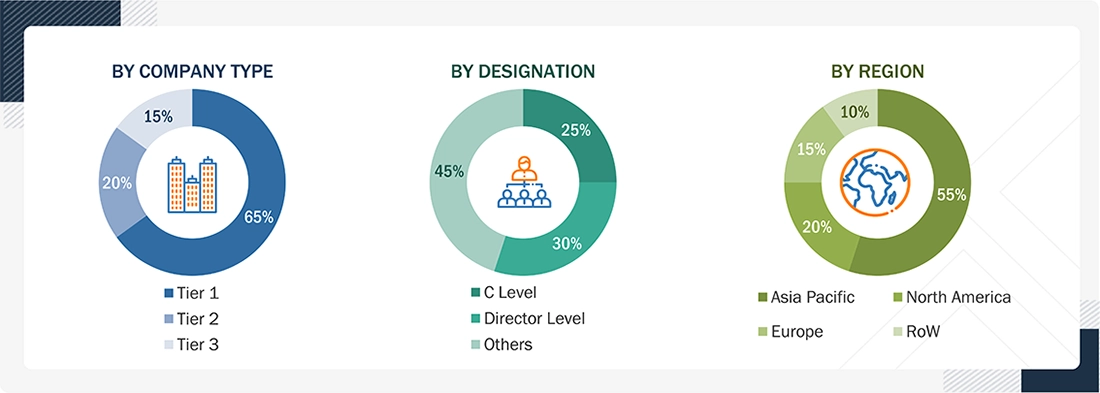
To know about the assumptions considered for the study, download the pdf brochure
Market Size Estimation
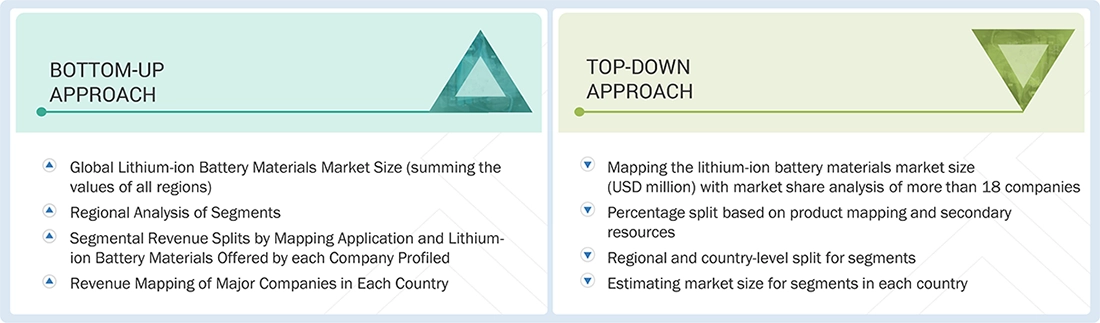
The top-down and bottom-up approaches have been employed to estimate and validate the total size of the lithium-ion battery materials market. These approaches have also been widely used to estimate the sizes of various dependent market subsegments. The research methodology used to estimate the market size included the following:
The following segments provide details about the overall market size estimation process employed in this study:
- Extensive primary and secondary research was done to identify the key players.
- The value chain and market size of the lithium-ion battery materials market, in terms of value, were determined through primary and secondary research.
- All percentage shares, splits, and breakdowns were collected through secondary sources and verified through primary sources.
- All possible parameters that affect the market were covered in this research study and are viewed in extensive detail, verified through primary research, and analyzed to obtain the final quantitative and qualitative data.
- The study of reports, reviews, and newsletters of top market players, along with extensive interviews for opinions from key leaders, such as CEOs, directors, and marketing executives, is included in this research.
Lithium-lon Battery Materials Market : Top-Down and Bottom-Up Approach
Data Triangulation
After estimating the overall market size using the above estimation, the market was split into various segments and subsegments. Data triangulation and market segmentation techniques, along with the market engineering process, were employed to obtain precise market analysis data for each segment and its subsegments. Research Methodology: The research methodology used to estimate and forecast the global market size began by aggregating data and information from various levels, including country-level data.
Market Definition
Lithium-ion battery materials are the components and substances used in the construction of lithium-ion batteries. These materials include the cathode and anode materials that store and release lithium ions, the separator that prevents electrical contact between them, the electrolyte that facilitates ion movement, and collector foils for electrical connections. These materials, when installed and built in the required format, enable the operation of lithium-ion batteries, which are widely used in electronic devices and electric vehicles due to their high energy density and rechargeability.
Key Stakeholders
- Lithium-ion battery materials manufacturers, processors, and refining technology providers
- End-use/application, including portable devices, electric vehicles, industrial, and other applications
- Research institutions, standards organizations, and regulatory agencies such as ASTM, ISO, IAEA, and National Materials Authorities
- NGOs, governments, investment banks, venture capitalists, and private equity firms
Report Objectives
- To define, describe, and forecast the market size of lithium-ion battery materials, in terms of value and volume
- To provide detailed information regarding the key factors, such as drivers, restraints, opportunities, and industry-specific challenges, influencing the growth of the lithium-ion battery materials market
- To analyze and forecast the size of various segments (battery material, battery chemistry, and application) of the lithium-ion battery materials market based on four major regions - North America, Europe, Asia Pacific, and Rest of the World, along with key countries in each of these regions
- To analyze recent developments and competitive strategies, including expansions, partnerships, and acquisitions, to understand the market's competitive landscape
- To strategically profile the key players in the market and comprehensively analyze their core competencies
Available customizations:
Based on the given market data, MarketsandMarkets offers customizations tailored to client-specific needs.
The following customization options are available for the report:
Product Analysis
- Additional country-level analysis of the lithium-ion battery materials market
- Profiling of additional market players (up to 5)
Get the Full Lithium-Ion Battery Materials Market Report
Full forecast, segment splits, and company analysis for all Lithium-Ion Battery Materials Market.
- Germany Lithium-Ion Battery Materials Market
- UK Lithium-Ion Battery Materials Market
- France Lithium-Ion Battery Materials Market
- China Lithium-Ion Battery Materials Market
- Japan Lithium-Ion Battery Materials Market
- India Lithium-Ion Battery Materials Market
- South Korea Lithium-Ion Battery Materials Market
- Canada Lithium-Ion Battery Materials Market
- Mexico Lithium-Ion Battery Materials Market
- US Lithium-Ion Battery Materials Market
- Rest Of Europe Lithium-Ion Battery Materials Market
- Rest Of Asia Pacific Lithium-Ion Battery Materials Market
Need a Tailored Report?
Customize this report to your needs
Get 10% FREE Customization
Customize This Report
