
Japan Live Entertainment Market (2025-2030)

The Japan Live Entertainment Market was valued at $9150 Million in 2025 and projected to reach to $13410 Million by 2030, representing a compound annual growth rate of CAGR 7.9%. Japan's live entertainment market is positioned for sustained expansion through 2030, driven by rising disposable incomes, increased tourism, and a cultural preference for experiential entertainment.


| Market Size in | USD 26.32 MN |
| Market Forecast in | |
| CAGR | |
| Forecast Period | |
| Units Considered | Value (USD MN) |
Japan Live Entertainment Market Trends and Insights
- This 7.9% compound annual growth rate significantly outpaces the global average of 5.9%, reflecting Japan's strong cultural affinity for live events, concerts, and theatrical performances.
- Japan's mature entertainment infrastructure, coupled with rising consumer spending on experiential entertainment, positions the country as a key growth engine within the Asia Pacific region. The Japanese live entertainment sector benefits from a diverse portfolio of events spanning music festivals, sports entertainment, theater productions, and gaming tournaments.
- Japan's technological advancement in event production and venue management enhances the quality and accessibility of live experiences.
- Between 2025 and 2030, Japan is expected to capture increasing market share through innovation in hybrid event formats and digital integration, appealing to both domestic and international audiences seeking premium entertainment experiences..
Key Market Statistics
- CAGR (2025-2030) CAGR 7.9%
- Market Size, 2025 ~USD 9150 Million
- Forecast, 2030 ~USD 13410 Million
- Country Japan
Japan Live Entertainment Market Overview
Outpacing Global Growth :
Japan's live entertainment market grows at 7.9% CAGR, significantly exceeding the global average of 5.9%, driven by strong consumer demand for live experiences and cultural events.
Substantial Market Valuation :
The Japanese market is valued at $9,150 million in 2025, with projections reaching $13,410 million by 2030, representing a $4,260 million expansion over five years.
Cultural Entertainment Affinity :
Japan's deep-rooted cultural appreciation for live performances, concerts, and theatrical arts creates a resilient and expanding consumer base for entertainment venues and events.
Mature Infrastructure Advantage :
Japan's well-established entertainment infrastructure, including world-class venues and event management systems, supports consistent market growth and premium event experiences.
Japan Live Entertainment Market Dynamics
- The market's 7.9% CAGR reflects strong recovery momentum post-pandemic and growing investment in entertainment venues across major metropolitan areas including Tokyo, Osaka, and Kyoto. Key growth catalysts include the proliferation of international touring acts, expansion of domestic concert and festival circuits, and technological innovations enhancing live event experiences.
- Japan's aging yet affluent population and younger demographics' appetite for live entertainment create diverse revenue streams.
- Strategic venue development and digital ticketing integration will further accelerate market penetration through 2030..
Market Ecosystem
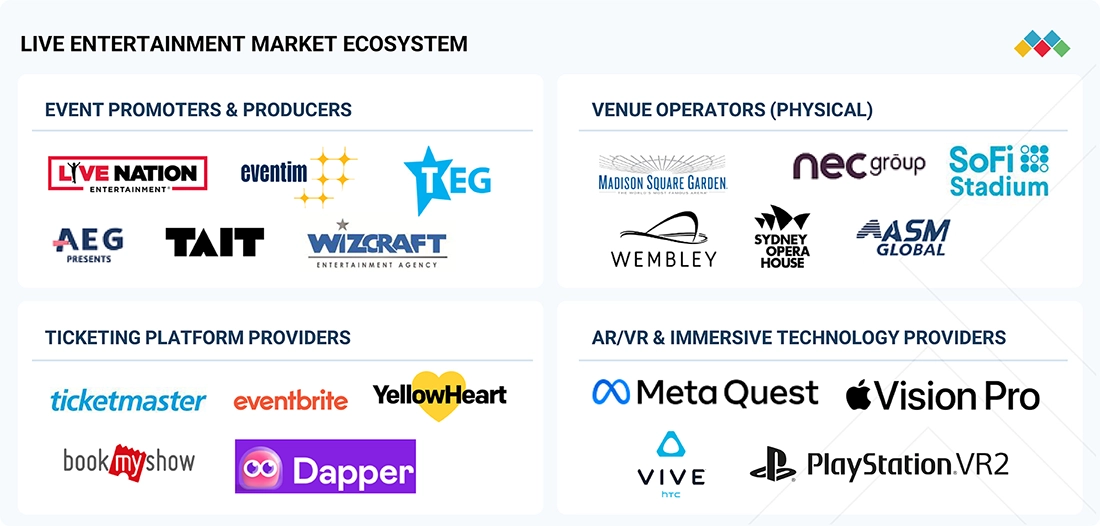
LIVE ENTERTAINMENT MARKET SIZE, SHARE, TRENDS AND GROWTH: COMMERCIAL USE CASES ACROSS INDUSTRIES
| COMPANY | USE CASE DESCRIPTION | BENEFITS |
|---|---|---|
 |
Leveraged XR and virtual avatar technology to recreate ABBA’s live concert experience using digital avatars performing alongside a live band in a purpose-built venue. | Delivered a groundbreaking fusion of nostalgia and technology, redefining the concert model for legacy artists and enabling long-term digital performances. |
 |
Replaced traditional fireworks with drone-based light shows, creating large-scale synchronized aerial displays using thousands of LED drones. | Reduced carbon emissions and noise pollution while enhancing visual storytelling and brand promotion at global events. |
 |
Introduced a wrap-around 16K LED screen and immersive sound system for concerts and live events, enabling multi-sensory engagement. | Elevated audience immersion with 360° visuals and spatial audio, setting new standards for live venue design and performance technology. |
 |
Deployed AI-powered crowd analytics and real-time monitoring systems to optimize venue safety, staffing, and service placement. | Improved crowd flow, reduced congestion, and enhanced event management efficiency through data-driven operational insights. |
 |
Implemented NFT and blockchain-based ticketing to prevent counterfeiting, duplication, and resale fraud for festival passes. | Increased ticket security, improved transparency in resale markets, and enhanced fan engagement via NFT-linked digital perks. |
Logos and trademarks shown above are the property of their respective owners. Their use here is for informational and illustrative purposes only.
Related Ecosystem
Augmented Virtual Reality
- Sensors
- Virtual Reality Devices
- Augmented Reality
- Virtual Reality
- Augmented Reality Devices
- MICROSOFT CORPORATION
- Lenovo
- VIVITEK CORPORATION
- Apple Inc.
Communication And Connectivity Technology
- Sensors
- Smart Card & Readers
- Cellular Network
- Femtocell
- Image Sensors
- Cisco Systems, Inc.
- HUAWEI TECHNOLOGIES CO LTD
- Lenovo
- CommScope Holding Company, Inc.
- Nokia corporation
Display Technology
- Augmented Reality
- Liquid Crystal Display (LCD)
- Sensors
- Virtual Reality Devices
- Liquid Crystal on Silicon (LCOS)
- VIVITEK CORPORATION
- Samsung
- Lenovo
- Panasonic Holdings Corporation
- Lg corp
Key Takeaways
- Japan's live entertainment market will grow from $9,150M (2025) to $13,410M (2030) at a 7.9% CAGR, outpacing global growth.
- Japan's cultural emphasis on live experiences and mature event infrastructure drive sustained market expansion through 2030.
- Technological innovation in hybrid events and digital integration positions Japan as a regional leader in experiential entertainment.
- Japan's diverse event portfolio—spanning music, sports, theater, and gaming—supports resilient demand across multiple consumer segments.
Live Entertainment Market Report Scope
| Report Metric | Details |
|---|---|
| Base Year | 2025 |
| Fastest Growing Segment | MUSIC CONCERTS (Application) |
| Forecast Period | 2025–2030 |
| Growth Rate | CAGR of 5.9% from 2025 to 2030 |
| Largest Segment | SPORTS EVENTS (Application) |
| Market Size Base Year (Billions) | ~USD 202.93 (2025) |
| Revenue Forecast (Billions) | ~USD 270.29 (2030) |
| Segments Covered | Application, Streaming Type |
Japan Live Entertainment Market Report Segmentation
2 segment dimensions are covered across the global market.
By Application
- E-Sports
- Music Concerts
- Sports Events
- Theaters & Musicals
By Streaming Type
- Pre-Recorded/Recorded Streaming
- Real-Time Streaming
Target Audience
- Entertainment Venue Operators : Need Japan market data to optimize venue investments, understand capacity expansion opportunities, and align programming strategies with projected $4.26B market growth through 2030.
- Event Management Companies : Require detailed Japan market insights to plan concert tours, festival expansions, and event portfolios while capitalizing on the 7.9% CAGR and strong cultural demand for live experiences.
- Investment & Private Equity Firms : Seek Japan-specific market validation and growth forecasts to evaluate entertainment sector investments, identify acquisition targets, and assess portfolio company performance benchmarks.
- Media & Broadcasting Networks : Need comprehensive Japan market data to develop live entertainment content strategies, negotiate broadcasting rights, and understand audience size and demographic trends.
- Tourism & Hospitality Operators : Require Japan entertainment market insights to integrate live events into travel packages, enhance destination appeal, and capitalize on growing experiential tourism demand.
Key Companies in the Japan Live Entertainment Market
| Company | HQ | Ownership | Strongest segments |
|---|---|---|---|
| LIBERTY MEDIA CORPORATION | United States | Public Company | Sports events (live attendance, rights, sponsorship),Real-time streaming & broadcast distribution,Pre-recorded/recorded streaming & on-demand, |
| DISNEY | United States | Public Company | Sports events and sports-related streaming (ESPN, ESPN+, Star sports),Theme-park-based live entertainment and experiences,Theatrical releases, theaters & musicals, and staged live events, |
| HYBE | South Korea | Public Company | Music concerts & fan events,Real-time streaming,Pre-recorded/recorded streaming & video content, |
| SPOTIFY TECHNOLOGY S.A. | Sweden | Public Company | Premium subscriptions linked to live entertainment engagement,Ad-supported audio around live events and sports/e-sports content,Podcast and talk formats tied to live entertainment IP, |
LIBERTY MEDIA CORPORATION
Liberty Media Corporation is a United States-based public company founded in 1991 that operates in media and entertainment, holding interests in various entertainment and communications assets.
DISNEY
Disney is a United States-based multinational entertainment conglomerate founded in 1923 with 194,040 employees that produces and distributes films, television content, theme park experiences, and consumer products.
HYBE
HYBE is a South Korean entertainment company founded in 2005 with 765 employees that manages music artists, produces entertainment content, and operates in the global music and entertainment industry.
SPOTIFY TECHNOLOGY S.A.
Spotify Technology S.A. is a Swedish music and audio streaming platform founded in 2006 with 7,000 employees that provides on-demand access to millions of songs and podcasts to subscribers worldwide.
Reasons to Buy this Report
- Market Size & Growth Validation : Access precise valuation data for Japan's live entertainment sector ($9.15B in 2025) with detailed 5-year forecasts, enabling accurate investment planning and competitive benchmarking.
- Regional Performance Insights : Understand why Japan's 7.9% CAGR outperforms global averages, identifying unique market drivers and consumer behavior patterns specific to Japanese entertainment preferences.
- Strategic Market Entry Planning : Leverage comprehensive Japan-specific data to develop market entry strategies, venue investment decisions, and event programming aligned with local demand and infrastructure capabilities.
- Competitive Intelligence : Gain actionable insights into Japan's mature entertainment landscape, including venue saturation analysis, pricing dynamics, and emerging opportunities in underserved segments.
- Investment Decision Support : Make data-driven investment decisions with confidence using validated market forecasts, growth trajectory analysis, and Japan-specific risk assessments through 2030.
Frequently asked questions
What is the projected market size of Japan's live entertainment sector by 2030?
Japan's live entertainment market is projected to reach $13,410 million by 2030, up from $9,150 million in 2025, representing a 7.9% CAGR.
How does Japan's live entertainment growth compare to global trends?
Japan's 7.9% CAGR significantly exceeds the global average of 5.9%, demonstrating Japan's stronger market momentum and consumer demand for live events.
What factors are driving growth in Japan's live entertainment market?
Key drivers include Japan's cultural affinity for live experiences, rising consumer spending on entertainment, advanced event infrastructure, and innovation in hybrid and digital event formats.
What types of live entertainment events are prominent in Japan?
Japan's live entertainment sector encompasses music festivals, concerts, theatrical productions, sports entertainment, and gaming tournaments, reflecting diverse consumer preferences.
How is technology shaping Japan's live entertainment market through 2030?
Japan is leveraging technological advancements in event production, venue management, and hybrid event formats to enhance accessibility and appeal to both domestic and international audiences.
RESEARCH METHODOLOGY
The study involved major activities in estimating the current size of the live entertainment market. Exhaustive secondary research has been done to collect information on the market, peer market, and parent market. To validate these findings, assumptions, and sizing with industry experts across the supply chain through primary research has been the next step. Both top-down and bottom-up approaches have been employed to estimate the complete market size. After that, market breakdown and data triangulation methods have been used to estimate the market size of segments and subsegments. Secondary and primary sources have been used to identify and collect information for an extensive technical and commercial study of the live entertainment market.
Secondary Research
Various secondary sources have been referred to in the secondary research process to identify and collect information important for this study. The secondary sources include annual reports, press releases, and investor presentations of companies; white papers; journals and certified publications; and articles from recognized authors, websites, directories, and databases. Secondary research has been conducted to obtain key information about the industry’s supply chain, the market’s value chain, the total pool of key players, market segmentation according to the industry trends (to the bottom-most level), regional markets, and key developments from market- and technology-oriented perspectives. The secondary data has been collected and analyzed to determine the overall market size, further validated by primary research.
Primary Research
Extensive primary research was conducted after gaining knowledge about the current scenario of the live entertainment market through secondary research. Several primary interviews were conducted with experts from the demand and supply sides across four major regions—North America, Europe, Asia Pacific and RoW. This primary data was collected through questionnaires, emails, and telephonic interviews.
After successful interaction with industry experts, brief sessions were conducted with highly experienced independent consultants to reinforce the findings of our primary research. This, along with the in-house subject matter experts’ opinions, has led us to the findings as described in the report.
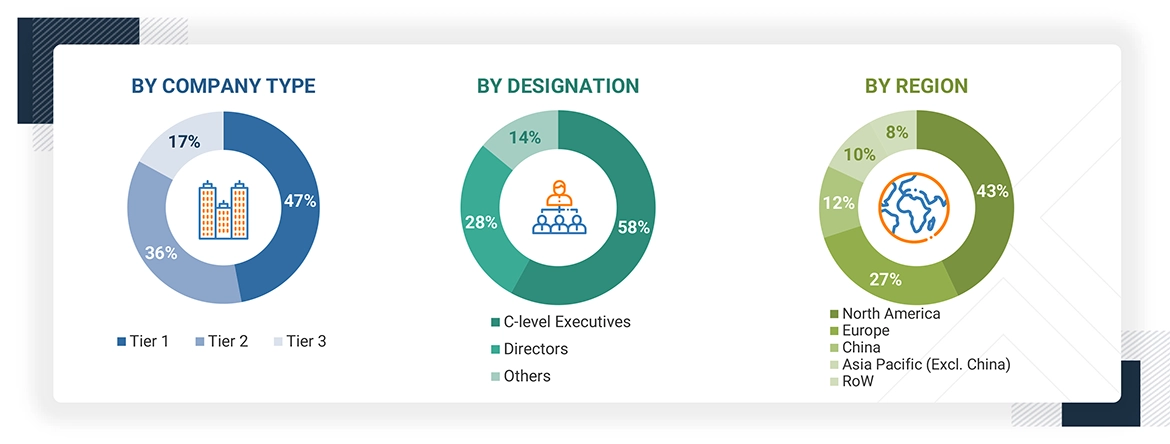
Note: RoW mainly comprises the Middle East & Africa, and Latin America.
Other designations include product managers, sales managers, and marketing managers.
Three tiers of companies have been defined based on their total revenue as of 2024; tier 3: revenue lesser than USD 500 million; tier 2: revenue between USD 500 million and 1 billion; and tier 1: revenue more than USD 1 billion. .
To know about the assumptions considered for the study, download the pdf brochure
Market Size Estimation
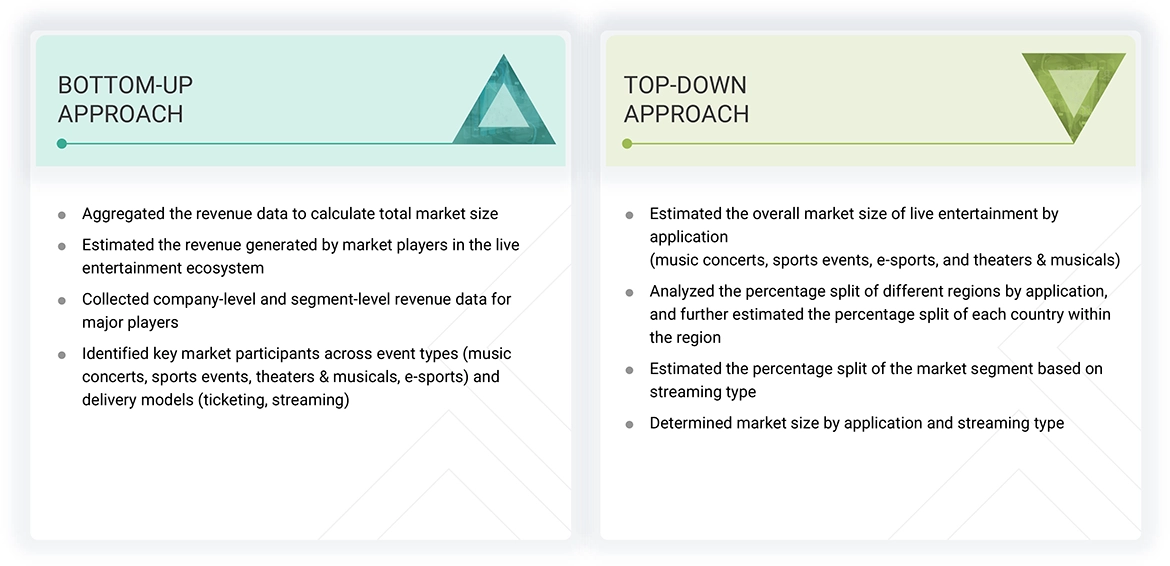
The bottom-up procedure has been employed to arrive at the overall size of the live entertainment market.
- Identified major global players delivering live entertainment services and assessed their market presence
- Analyzed revenues across different segments within the live entertainment market to identify growth drivers
- Estimated revenue contributions from key market players providing live entertainment services
- Obtained the global market size for live entertainment, offering a baseline for evaluating market potential
The top-down approach has been used to estimate and validate the total size of the live entertainment market.
- Estimated the total market size for live entertainment, outlining the overall scope and growth potential of the market
- Analyzed the regional market distribution, with further estimation of individual country shares within each region to identify localized trends and differences
- Estimated the market segmentation based on application (music concets, sports events, e-sports, and theaters & musicals, offering insights at both regional and national levels
- Calculated market size across various applications and streaming type
- Estimated the application-wise market distribution at the regional level, highlighting how different applications influence market dynamics across regions
Live Entertainment Market : Top-Down and Bottom-Up Approach
Data Triangulation
After arriving at the overall market size—using the market size estimation processes as explained above—the market has been split into several segments and subsegments. To complete the entire market engineering process and arrive at the exact statistics of each market segment and subsegment, data triangulation and market breakdown procedures have been employed, wherever applicable. The data has been triangulated by studying various factors and trends from the demand and supply sides in the live entertainment market.
Market Definition
The live entertainment market refers to the sector of the entertainment industry where audiences engage with content in real-time or near-real-time, typically within a shared space—either physical or virtual. This market includes a wide range of experiences such as live music concerts, sports events, theatre and musicals, movies, and e-sports, while excluding theme parks. Venues span from large-scale stadiums and arenas to medium and small-scale settings like cinemas, pubs, and karaoke rooms, as well as digital platforms such as the metaverse. Live entertainment is categorized into three main formats: real live, where performers and audiences are physically co-present; satellite live, where audiences share a physical space but view content via live broadcast without performers present; and virtual live, where audiences participate alone in a virtual environment. Content delivery can be real-time (online streaming) or non-real-time (recorded or pre-recorded), reflecting the evolving modes of audience engagement in the digital age.
Key Stakeholders
- Event organizers and promoters
- Artists, performers, and talent agencies
- Venue owners and operators
- Streaming platforms and digital media partners
- Ticketing service providers and distributors
- Sponsorship and advertising partners
- Technology solution providers (AR/VR, sound, lighting, event tech)
- Merchandise vendors and brand licensors
- Government and regulatory authorities (for permits, safety, crowd control)
- Fans and audience members (in-person and virtual)
Report Objectives
- To define, describe, and forecast the size of the live entertainment market by application and streaming type, in terms of value
- To provide information about technologies, value chain, and viewing experience associated with live entertainment
- To describe and forecast the market size for various segments concerning key regions, namely, North America, Europe, China, Asia Pacific (excl. China), and RoW, in terms of value
- To provide detailed information regarding the key factors such as drivers, restraints, opportunities, and challenges influencing the growth of the market
- To understand and analyze the impact of evolving technologies on the overall supply chain of the live entertainment market and upcoming trends in the ecosystem
- To provide macroeconomic outlooks with respect to the main geographies, namely, North America, Europe, China, Asia Pacific (excl. China), and RoW
- To provide a detailed overview of the live entertainment market industry trends and use cases.
- To strategically analyze micromarkets for individual growth trends, prospects, and contributions to the total market
- To provide ecosystem analysis, trends/disruptions impacting customer business, case study analysis, ecosystem analysis, and Gen AI/ AI impact related to the live entertainment market
- To analyze the opportunities in the market for stakeholders by identifying high-growth segments and detailing the competitive landscape for market players
- To analyze the competitive developments, such as acquisitions, service/solution launches, expansions, agreements, partnerships, and collaborations carried out by market players
Available customizations:
With the given market data, MarketsandMarkets offers customizations according to the company‘s specific needs. The following customization options are available for the report.
Company Information:
- Detailed analysis and profiling of additional market players (up to five)
Get the Full Live Entertainment Market Report
Full forecast, segment splits, and company analysis for all Live Entertainment Market.
- Italy Live Entertainment Market
- South Korea Live Entertainment Market
- India Live Entertainment Market
- Rest Of Europe Live Entertainment Market
- Rest Of Asia Pacific Live Entertainment Market
- US Live Entertainment Market
- Canada Live Entertainment Market
- Mexico Live Entertainment Market
- Germany Live Entertainment Market
- UK Live Entertainment Market
Need a Tailored Report?
Customize this report to your needs
Get 10% FREE Customization
Customize This Report
