
Indonesia Machine Control System Market (2025-2030)

The Indonesia Machine Control System Market was valued at $92.9 Million in 2025 and projected to reach to $125.7 Million by 2030, representing a compound annual growth rate of 6.2%. Indonesia's machine control system market is poised for sustained growth as the country accelerates its industrial automation initiatives and digital transformation agenda.


| Market Size in | USD 26.32 MN |
| Market Forecast in | |
| CAGR | |
| Forecast Period | |
| Units Considered | Value (USD MN) |
Indonesia Machine Control System Market Trends and Insights
- This 6.2% compound annual growth rate reflects Indonesia's increasing adoption of automation technologies across manufacturing, construction, and agricultural sectors.
- Indonesia's strategic position in Southeast Asia and growing industrial infrastructure investments are driving demand for advanced machine control solutions. The Indonesian market benefits from rising labor costs and the need for operational efficiency in key industries.
- Indonesia's expanding manufacturing base and infrastructure development projects are accelerating the integration of machine control systems.
- By 2030, Indonesia is expected to solidify its position as a significant market for machine control technologies in the Asia Pacific region, supported by government initiatives promoting industrial modernization and digital transformation..
Key Market Statistics
- CAGR (2025-2030) 6.2% CAGR
- Market Size, 2025 ~USD 92.9 Million
- Forecast, 2030 ~USD 125.7 Million
- Country Indonesia
Indonesia Machine Control System Market Overview
Market Valuation :
Indonesia's machine control system market is valued at USD 92.9 million in 2025, with projected growth to USD 125.7 million by 2030, representing a steady 6.2% CAGR driven by industrial modernization.
Manufacturing Sector Adoption :
Indonesia's growing manufacturing base is increasingly adopting automated machine control systems to enhance productivity and reduce operational costs, particularly in automotive, electronics, and textile industries.
Agricultural Mechanization :
The agricultural sector in Indonesia is embracing precision farming technologies and mechanized equipment with advanced control systems, supporting the nation's food security and export competitiveness.
Southeast Asian Hub Position :
As a key manufacturing and logistics hub in Southeast Asia, Indonesia's strategic location and growing industrial base position it as a critical market for machine control system expansion and regional technology deployment.
Indonesia Machine Control System Market Dynamics
- The 6.2% CAGR reflects increasing investments in manufacturing infrastructure, construction projects, and agricultural modernization across the archipelago.
- Government policies supporting Industry 4.0 adoption and foreign direct investment in automation technologies are expected to drive market expansion through 2030. Key growth drivers include rising labor costs prompting automation adoption, infrastructure development projects requiring advanced machinery, and the agricultural sector's shift toward mechanized farming.
- Regional supply chain integration and Indonesia's role as a manufacturing hub for multinational corporations will further accelerate demand for sophisticated machine control systems, creating significant opportunities for technology providers and system integrators..
Market Ecosystem
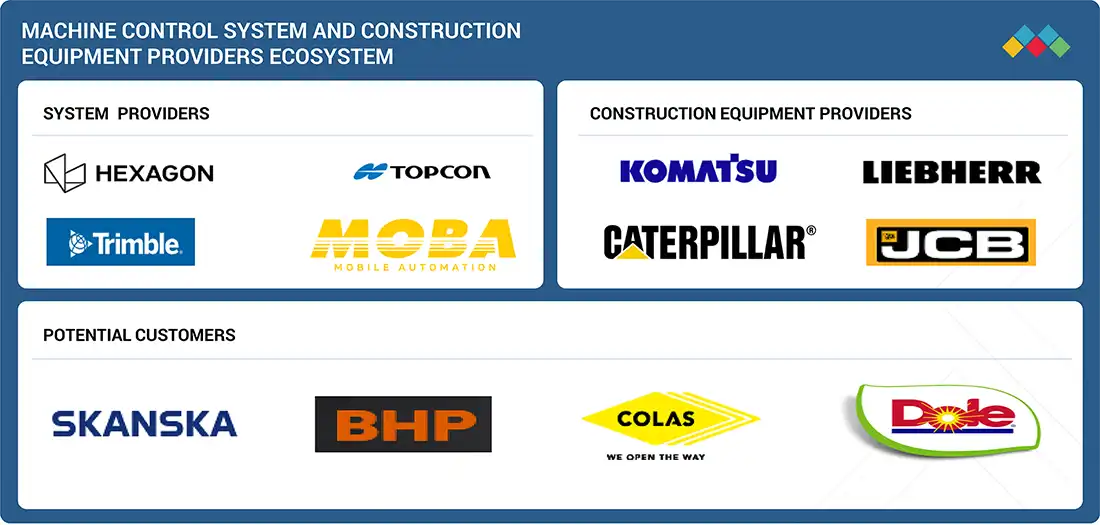
Machine Control System Market: COMMERCIAL USE CASES ACROSS INDUSTRIES
| COMPANY | USE CASE DESCRIPTION | BENEFITS |
|---|---|---|
 |
Advanced total stations and GNSS solutions for precision grading, excavation, and paving systems in large infrastructure projects | Enhanced accuracy in surveying and construction, reduced rework costs, accelerated project completion, improved asset utilization |
 |
Integrated GNSS and laser scanners in excavators and dozers for real-time guidance and autonomous operation | Improved construction productivity, minimized fuel consumption, increased operator efficiency, optimized earthmoving operations |
 |
3D machine control systems for pavers and graders leveraging GNSS and total stations | Seamless project execution, superior road quality, reduced material wastage, enhanced safety on construction sites |
 |
Sensor-based control systems for paving machines and asphalt compactors | Precise layer thickness control, consistent compaction quality, reduced material costs, extended pavement lifecycle |
 |
High-precision GNSS receivers and positioning solutions for loaders, scrapers, and graders | Reliable performance in challenging environments, cost-effective surveying, enhanced fleet productivity, and simplified integration with OEM platforms |
Logos and trademarks shown above are the property of their respective owners. Their use here is for informational and illustrative purposes only.
Related Ecosystem
Industrial Automation
- Sensors
- Image Sensors
- Manufacturing Execution System (MES)
- Actuators
- Flow Sensors
- ABB India Limited
- Siemens ag
- Emerson Electric Co.
- HONEYWELL INTERNATIONAL INC.
- SCHNEIDER ELECTRIC SE
Key Takeaways
- Indonesia's machine control system market is valued at USD 92.9 million in 2025 and is forecast to reach USD 125.7 million by 2030.
- Indonesia is experiencing a 6.2% CAGR, driven by automation adoption in manufacturing and construction sectors.
- Indonesia's growing industrial infrastructure and labor cost pressures are key catalysts for machine control system adoption.
- Indonesia is positioned as a critical growth market within the Asia Pacific region for machine control technologies through 2030.
Machine Control System Market Report Scope
| Report Metric | Details |
|---|---|
| Base Year | 2025 |
| Fastest Growing Segment | LASER SCANNERS (Type) |
| Forecast Period | 2025-2030 |
| Growth Rate | CAGR of 8.2% from 2025 to 2030 |
| Largest Segment | GNSS (Type) |
| Market Size Base Year (Billions) | ~USD 6.02 (2025) |
| Revenue Forecast (Billions) | ~USD 8.93 (2030) |
| Segments Covered | Type, Vertical, End-Use Equipment |
Indonesia Machine Control System Market Report Segmentation
3 segment dimensions are covered across the global market.
By Type
- Gnss
- Laser Scanners
- Sensors
- Total Stations
By Vertical
- Commercial
- Industrial
- Infrastructure
- Residential
By End-Use Equipment
- Dozers
- Excavators
- Graders
- Loaders
- Paving Systems
- Scrapers
INDONESIA: MACHINE CONTROL SYSTEM MARKET, BY VERTICAL, 2025–2030
| Segment | 2025 | 2026 | 2027 | 2028 | 2029 | 2030 | CAGR (%) |
|---|---|---|---|---|---|---|---|
| COMMERCIAL | 13.7 | 14.4 | 15.2 | 16.1 | 17.1 | 18.3 | 5.9 |
| INDUSTRIAL | 16.2 | 17.2 | 18.4 | 19.7 | 21.3 | 23 | 7.3 |
| INFRASTRUCTURE | 53.8 | 56.8 | 60.1 | 63.9 | 68.2 | 73.1 | 6.3 |
| RESIDENTIAL | 9.1 | 9.4 | 9.8 | 10.2 | 10.7 | 11.3 | 4.3 |
| TOTAL | 92.9 | 97.9 | 103.6 | 110 | 117.3 | 125.7 | 6.2 |
Target Audience
- Manufacturing Companies : Indonesian and multinational manufacturers need market insights to evaluate automation investment opportunities, benchmark against competitors, and identify technology partners for machine control system implementation.
- Technology Providers & Integrators : Machine control system vendors and system integrators require Indonesia-specific data to assess market potential, understand customer requirements, and develop localized solutions for manufacturing and agricultural applications.
- Investment & Private Equity Firms : Investors evaluating opportunities in Indonesia's industrial automation sector need comprehensive market analysis, growth projections, and competitive intelligence to identify promising portfolio companies and investment targets.
- Government & Policy Makers : Indonesian government agencies and policymakers need market data to inform Industry 4.0 initiatives, infrastructure development plans, and technology adoption policies that support economic growth and industrial competitiveness.
- Consultants & Business Strategists : Management consultants and business strategists advising clients on Indonesia market entry or expansion require detailed market segmentation, trend analysis, and forecasts to develop credible business cases and strategic recommendations.
Reasons to Buy this Report
- Localized Market Intelligence : Gain deep insights into Indonesia-specific market dynamics, including sector-wise adoption rates, regional demand patterns, and competitive landscape analysis tailored to the Indonesian industrial ecosystem.
- Growth Opportunity Identification : Identify high-potential segments within Indonesia's manufacturing, construction, and agricultural sectors where machine control system adoption is accelerating, enabling targeted market entry and expansion strategies.
- Investment Decision Support : Make informed investment and partnership decisions with comprehensive data on Indonesia's market size, CAGR projections, and growth catalysts through 2030, reducing business risk and maximizing ROI.
- Competitive Positioning : Understand Indonesia's competitive landscape, key players, technology trends, and customer preferences to develop effective go-to-market strategies and differentiate offerings in this emerging Southeast Asian market.
- Strategic Planning : Leverage Indonesia-focused forecasts and market analysis to align product development, supply chain strategies, and resource allocation with the country's specific growth trajectory and industrial priorities.
Frequently asked questions
What is the current size of Indonesia's machine control system market?
Indonesia's machine control system market is valued at USD 92.9 million in 2025.
What is the projected market size for Indonesia by 2030?
Indonesia's machine control system market is forecast to reach USD 125.7 million by 2030.
What is the growth rate of Indonesia's machine control system market?
Indonesia's machine control system market is growing at a compound annual growth rate (CAGR) of 6.2% from 2025 to 2030.
Which industries are driving demand for machine control systems in Indonesia?
Manufacturing, construction, and agricultural sectors are the primary drivers of machine control system demand in Indonesia.
What factors are contributing to growth in Indonesia's machine control system market?
Rising labor costs, industrial modernization initiatives, infrastructure development projects, and digital transformation efforts are key growth factors in Indonesia.
RESEARCH METHODOLOGY
The research study involved four major steps in estimating the machine control system market size. Exhaustive secondary research has been done to collect important information about the market and peer markets. The next step has been to validate these findings and assumptions and size them with the help of primary research with industry experts across the value chain. Both top-down and bottom-up approaches have been used to estimate the market size. After this, the market breakdown and data triangulation approaches have been adopted to estimate the market sizes of segments and subsegments.
Secondary Research
Various secondary sources have been referred to in the secondary research process to identify and collect the information required for this study. These sources include annual reports, press releases, investor presentations of companies, white papers, and articles from recognized authors. Secondary research has mainly been done to obtain key information about the market’s value chain, the pool of key market players, market segmentation according to industry trends, regional outlook, and developments from market and technology perspectives.
In the machine control system market report, the global market size has been estimated using the top-down and bottom-up approaches, along with several other dependent submarkets. The major players in the market have been identified using extensive secondary research, and their presence in the market has been determined using secondary and primary research. All the percentage splits and breakdowns have been determined using secondary sources and verified through primary sources.
Primary Research
In the primary research process, several primary sources from the supply and demand sides have been interviewed to obtain qualitative and quantitative information pertaining to this report. Several primary interviews have been conducted with market experts from the demand (agriculture and construction companies) and supply sides (machine control system manufacturers and distributors). This primary data has been collected through questionnaires, emails, and telephonic interviews. Approximately 25% of the primary interviews have been conducted with the demand-side respondents and 75% with the supply-side respondents. This primary data has been collected mainly through telephonic interviews, which accounted for 80% of the total primary interviews.
After successful interaction with industry experts, brief sessions have been conducted with highly experienced independent consultants to reinforce the findings of our primary research. This, along with the in-house subject-matter experts’ opinions, led us to the findings described in the report. The breakdown of primary respondents is as follows:
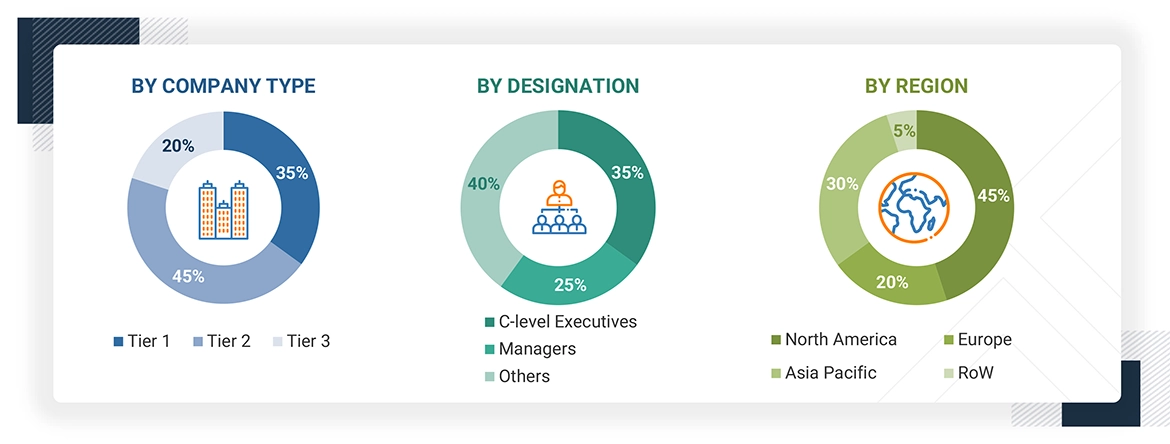
Note: Other designations include machine control system consultants and industry experts
The three tiers of the companies have been defined based on their total revenue as of 2024: tier 1 = >USD 10 billion, tier 2 = USD 1–10 billion, and tier 3 = USD 1 billion.
RoW comprises the Middle East, Africa, and South America.
To know about the assumptions considered for the study, download the pdf brochure
Market Size Estimation
In the complete market engineering process, top-down and bottom-up approaches and several data triangulation methods have been used to estimate and forecast the overall market segments and subsegments listed in this report. The key players in the market have been identified through secondary research, and their market shares in the respective regions have been determined through primary and secondary research. This entire procedure includes the study of the annual and financial reports of the top market players and extensive interviews for key insights (quantitative and qualitative) with industry experts (CEOs, VPs, directors, and marketing executives).
All percentage shares, splits, and breakdowns have been determined using secondary sources and verified through primary sources. All the parameters affecting the markets covered in this research study have been accounted for, viewed in detail, verified through primary research, and analyzed to obtain the final quantitative and qualitative data. This data has been consolidated and supplemented with detailed inputs and analysis from MarketsandMarkets and presented in this report.
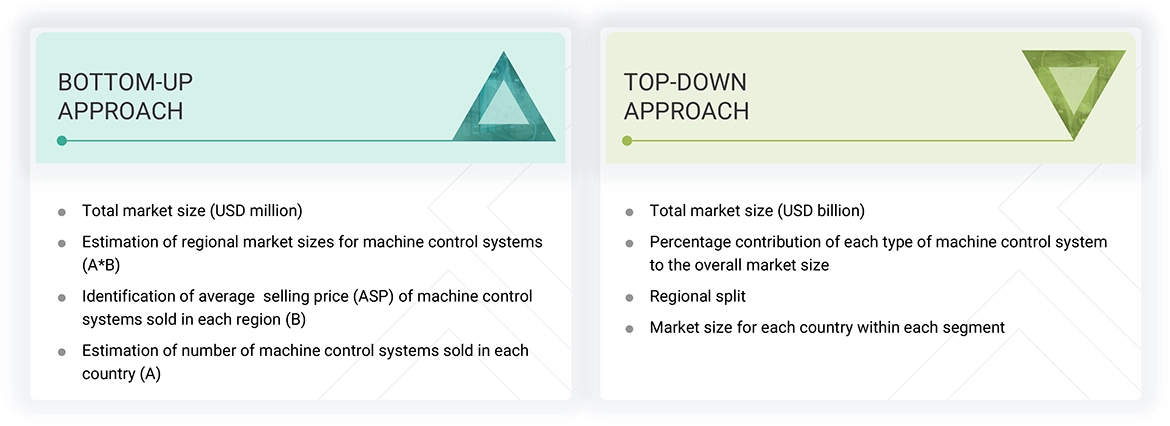
Bottom-Up Approach
- The bottom-up approach has been used to arrive at the overall size of the machine control system market.
- The machine control system market size, by volume, has been derived by identifying the country-wise usage of different machine control systems through the shipment volume of these systems.
- The shipment volume obtained has been further categorized according to the specific number of construction equipment used in the construction projects across industries.
- The number of machine control systems sold in each country has been added to derive the regional market size, in terms of volume.
- The market size, by value, has been derived by multiplying the average selling price of machine control systems by the number of units sold (volume).
- The country-level data has been added to obtain the total size, in terms of value, of the market in that region.
Top-Down Approach
- In the top-down approach, the overall market size has been used to estimate the size of the individual markets (mentioned in the market segmentation) through percentage splits from secondary and primary research.
- The most appropriate parent market size has been used to implement the top-down approach to calculate specific market segments.
- The companies have been mapped by type, equipment, and regional and vertical-wise offerings.
- Each company’s market share has been estimated to verify the respective revenue share in the machine control system market.
- The total market size obtained from company revenue analysis has been split between segments based on mapping data.
- With the data triangulation procedure and validation of the data through primaries, the overall parent market size and each individual market size have been determined and confirmed in this study.
Semiconductor Cleanroom Market: Top-Down and Bottom-Up Approach
Data Triangulation
After arriving at the overall market size from the estimation process explained above, the overall market has been split into several segments and subsegments. The data triangulation procedure has been employed wherever applicable to complete the overall market engineering process and arrive at the exact statistics for all segments and subsegments. The data has been triangulated by studying various factors and trends from both the demand and supply sides. Additionally, the market size has been validated using top-down and bottom-up approaches.
Market Definition
Machine control systems are deployed to position earthwork machinery precisely based on the design model. Machine control enables the integration of positioning tools into construction machinery. A machine control system not only guides operators in excavating, grading, dredging, or piling activities but also improves productivity by 30–50% compared to conventional digging operations. Machine control systems include global navigation satellite systems (GNSS), laser scanners, total stations, and sensors. These systems are highly user-friendly, fully upgradable, and flexible enough to meet various job site requirements across multiple verticals, such as residential, infrastructure, commercial, and industrial. The scope of this report is limited to the earthwork or construction work that takes place at the initial stage of the construction of a plant or factory of any industry.
Key Stakeholders
- Government and research organizations
- End users of information and enabling technology
- Providers of information and enabling technology
- Research organizations and consulting companies
- Technology investors
- Technology standard organizations, forums, alliances, and associations
- System integrators
- Analysts and strategic business planners
- Venture capitalists, private equity firms, and startup companies
Report Objectives
- To describe and forecast the machine control system market, by type, end-use equipment, and vertical, in terms of value
- To describe and forecast the market size across four main regions, namely, North America, Europe, Asia Pacific, and Rest of the World, in terms of value
- To provide detailed information regarding the major drivers, restraints, opportunities, and challenges influencing the growth of the market
- To understand and analyze the impact of evolving technologies on the machine control system value chain
- To provide a detailed overview of the value chain of the machine control system market
- To strategically analyze micromarkets1 with respect to individual growth trends, prospects, and contributions to the total market
- To strategically profile the key players and comprehensively analyze their market positions in terms of ranking and core competencies
- To analyze competitive developments, such as product launches, acquisitions, collaborations, agreements, and partnerships, in the machine control system market
- To provide ecosystem analysis, case study analysis, patent analysis, technology analysis, impact of AI/Gen AI, and 2025 US tariff on the machine control system market, key conferences and events, Porter’s five forces analysis, and regulations pertaining to the market under study
- To provide a macroeconomic outlook for all the regions in the region chapter
Available customizations:
With the given market data, MarketsandMarkets offers customizations according to the specific requirements of companies. The following customization options are available for the report:
- Detailed analysis and profiling of additional market players based on various blocks of the supply chain
Get the Full Machine Control System Market Report
Full forecast, segment splits, and company analysis for all Machine Control System Market.
- Kuwait Machine Control System Market
- Oman Machine Control System Market
- Qatar Machine Control System Market
- Rest Of Middle East Machine Control System Market
- Saudi Arabia Machine Control System Market
- UAE Machine Control System Market
- Rest Of Africa Machine Control System Market
- South Africa Machine Control System Market
- Argentina Machine Control System Market
- Brazil Machine Control System Market
- Rest Of South America Machine Control System Market
- US Machine Control System Market
- Canada Machine Control System Market
- Mexico Machine Control System Market
- Germany Machine Control System Market
- UK Machine Control System Market
- France Machine Control System Market
- Italy Machine Control System Market
- Spain Machine Control System Market
- Poland Machine Control System Market
- China Machine Control System Market
- Japan Machine Control System Market
- South Korea Machine Control System Market
- Australia Machine Control System Market
- India Machine Control System Market
- Malaysia Machine Control System Market
- Thailand Machine Control System Market
- Vietnam Machine Control System Market
- Nordics Machine Control System Market
- Rest Of Europe Machine Control System Market
- Rest Of The Asia Pacific Machine Control System Market
- Bahrain Machine Control System Market
Need a Tailored Report?
Customize this report to your needs
Get 10% FREE Customization
Customize This Report
